
Quick Answer
Before enabling payouts, record entity verification, ownership and control, the authorized representative’s identity and authority, applicable sanctions and risk screening, and the reviewer’s decision in one case file. Apply the checks required by your regulated role, jurisdiction and provider program. Unresolved ownership, authority or screening conflicts stay on hold; conditional approval does not enable payouts.
KYB for platform operators starts with one practical goal#
If your platform onboards businesses for payments, KYB has one job: help you decide, before money moves, whether the business is real, legitimate, and low enough risk to onboard without creating weeks of avoidable friction. Done well, Know Your Business helps you spot higher-risk business relationships early. Done poorly, it slows legitimate businesses until they give up and go elsewhere.
Step 1 Define the onboarding decision#
Start by being explicit about the decision KYB is meant to support. For payment platforms, this is not a vague compliance exercise. It is the approval gate that decides whether a business can be onboarded to accept or send payments. It needs to happen before you process a single transaction.
That matters because KYB is different from KYC. KYC checks an individual's identity, such as name, address, date of birth, and government ID. KYB answers a different question: is the business entity itself legitimate, and does its ownership or risk profile raise concerns?
In practice, you usually need both. If you verify only the person behind the account, you can still miss whether the company is genuine or whether the ownership picture makes the relationship riskier than it first appears.
A simple checkpoint works well here: before approval, you should be able to show what business you believe you are onboarding, who is behind it, and why the case moved forward.
Step 2 Scope the problem like an operator#
This guide is for compliance, legal, finance, and risk owners responsible for business onboarding decisions. Your process has to work across the business relationships you support, whether the business is a customer, vendor, supplier, contractor, or partner.
Treat that as a design constraint from the start. If you do not define scope and decision ownership up front, your team will improvise case by case. That is where inconsistent approvals start.
A common failure mode is asking every applicant for the same heavy document pack regardless of risk. That creates friction without improving decisions. Another is relying on a pass or fail result with no clear explanation of what was actually verified.
Your evidence pack does not need to be bloated, but it does need to be traceable. Keep the core materials tied to the case, including the entity details reviewed, any owner or UBO evidence collected, and the reviewer rationale in audit logs.
Step 3 Set a 30 day outcome#
A practical target is not to fix KYB forever. It is to define, within 30 days, what you verify, when a case must be escalated, and what your team must retain for reporting and review. That is enough to move from scattered checks to a repeatable approval standard.
This is an internal onboarding blueprint. Legal duties depend on your entity, regulated role, jurisdictions and bank or payment-provider program. For example, FinCEN’s CDD rule applies to covered financial institutions; its requirements are not automatically duties of every marketplace. Agree the control set and evidence needed for each product lane before enabling payments.
Set the minimum KYB controls you cannot skip#
Keep the minimum controls in one decision record: establish that the business exists, who owns or controls it, who is authorized to administer its account, what applicable screening found, and why the reviewer approved the case. Do not enable payouts while a required check remains unresolved.
| Control | Evidence in the file | Approval rule |
|---|---|---|
| Legal entity verification | Corporate registry check, or the best available equivalent in that market, with a traceable match between claimed entity details and the record the reviewer relied on | Block payout-enabling approval until complete; treat missing or fragmented data as unresolved risk |
| Ownership and control | Ownership and control structure review, UBO evidence, and director verification if it is part of the control set | Entity verification alone is not enough if beneficial ownership is still unclear |
| Sanctions, watchlists, and PEP screening | Screening results for every pending and approved case for associated entities, including OFAC screening when onboarding has U.S. exposure | Complete the screening required by the applicable legal regime and provider program; distinguish possible matches, confirmed prohibitions and PEP risk |
| Risk-based questionnaire | Responses that clarify business activity, ownership complexity, and red flags, stored with screening results, reviewer notes, and any override rationale | If the file cannot explain the approval on its own, the minimum controls are too loose |
| Authorized representative | Identity evidence and authority to act for the business, such as verified role, mandate or resolution appropriate to the entity | Do not permit payout administration until authority and required identity checks are resolved |
-
Verify the legal entity first. Block payout-enabling approval until legal entity verification is complete and a corporate registry check, or the best available equivalent in that market, has been reviewed. The standard is a traceable match between claimed entity details and the record the reviewer relied on, not a simple pass flag. Treat missing or fragmented data as unresolved risk, not a clean result.
-
Assess ownership and control in the same path. KYB covers identity, ownership, control structure, and business activity, so UBO review should not sit outside the main approval decision. Include director verification if you use it as part of your control set. If beneficial ownership is still unclear, entity verification alone is not enough to approve. Verify the account representative’s identity and authority to act for the entity, using the mandate, resolution or other evidence your program requires.
-
Screen parties under the applicable sanctions regimes and perform PEP/watchlist review where the program requires it. OFAC’s public search tools are screening aids, not a mandated universal tool or complete compliance program. A PEP finding calls for risk assessment; it is not itself a sanctions prohibition.
-
Record a risk-based questionnaire in case management. Ask only what clarifies business activity, ownership complexity, and red flags, then store responses with screening results, reviewer notes, and any override rationale. If the file cannot explain the approval on its own, your minimum controls are too loose.
Prepare your inputs and ownership before you enforce policy gates#
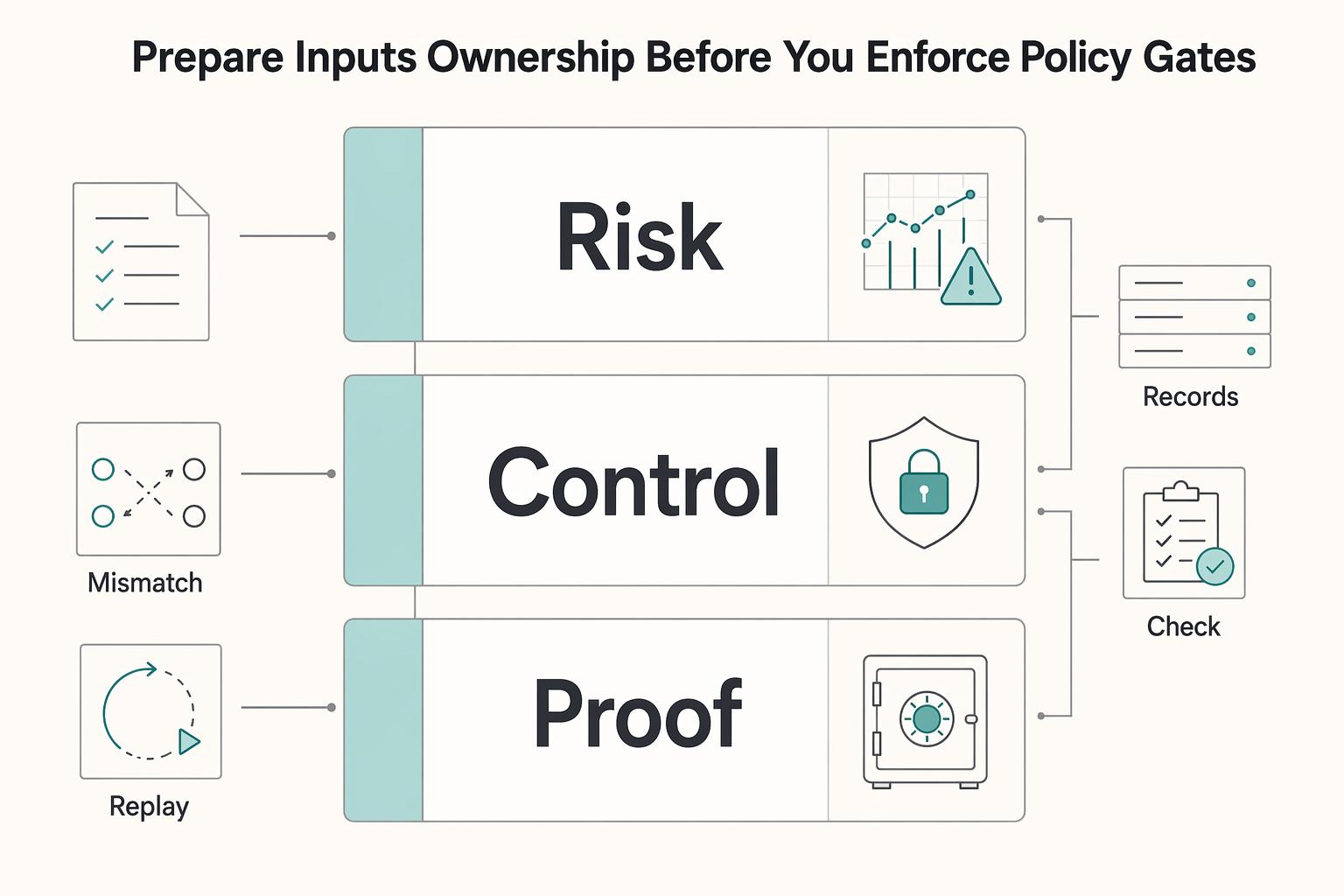
Before you enforce tighter policy gates, lock down four things: who owns each decision stage, what evidence you retain, where KYB sits relative to KYC and payouts, and which markets each program actually covers.
Step 1. Assign one owner for each stage of the decision path. When KYB controls fail, the issue is often operating design, not just tools. Set ownership explicitly: compliance owns risk decisions, legal owns edge-case interpretation, ops owns SLA and queue health, and engineering owns API and webhook reliability.
Use one practical test for stuck or disputed cases: you can name who decides, who advises, and who fixes the broken handoff. If legal becomes the default escalation point for missing data, integration failures, and policy gaps at the same time, accountability and queue performance both degrade.
Step 2. Define your evidence schema before the first approval goes live. Your case file should let a second reviewer reconstruct the decision without extra context. Store the registry record used, UBO artifacts, sanctions and PEP results, reviewer notes, and override rationale in audit logs.
Design the schema for layered ownership and control, including the natural persons identified under the applicable program’s ownership and control tests. Record the rule and version used. A vendor’s percentage setting is not a substitute for the legal or provider-specific test.
Step 3. Fix the order between Know Your Customer (KYC), KYB, and payout activation. You do not need one global sequence, but you do need one documented sequence per product lane. KYC is part of identity verification obligations and is commonly run with identification, due diligence, and continuous monitoring.
For platform operators, the control question is straightforward: can payouts activate before the business-approval gate is complete? If policy, product logic, and reviewer behavior do not match, the gate is not reliable.
Step 4. Publish market scope by program, not by assumption. List the markets in scope for each program, including United States, Middle East, India, and any additional markets you support. Then mark where registry access, ownership data, or screening depth differs by market or program.
Attach a short scope note to policy: supported, unsupported, and manual-review markets. That gives compliance and ops a consistent answer when a new jurisdiction appears.
Build the risk-tier matrix and escalation rules teams can actually use#
Turn ownership and evidence into a small decision matrix that tells reviewers exactly what to do next. If the route is unclear, decisions become inconsistent and hard to audit.
| Risk pattern | What you look for | Default outcome | Route |
|---|---|---|---|
| Low | Low-risk industry, simple ownership, limited cross-border exposure, clean screening, clean corporate registry check | Approve | Fast-track |
| Moderate | Some cross-border exposure, minor data gaps, ownership understood but not simple | Approve with conditions | Non-payout-enabling account setup and document follow-up until required checks are complete |
| High | Complex ownership, adverse screening hit that needs review, higher-risk industry, unclear operating footprint | Manual review | Enhanced due diligence |
| Prohibited or unresolved | Confirmed applicable prohibition, unresolved sanctions match, ownership gap or core identity conflict | Keep unresolved cases under review; apply the legally required disposition to confirmed prohibitions | Compliance/legal determines any block, rejection or reporting duty; ordinary policy overrides cannot waive a legal prohibition |
A second reviewer should be able to reconstruct the decision from the case file alone. Keep, at minimum, the registry record used, screening results, ownership evidence, and reviewer rationale.
Set non-negotiable escalation triggers before automation. Route the case out of fast-track when ownership mapping is unresolved, screening results are not clearly cleared, including PEP or sanctions ambiguity where applicable, or director verification data conflicts with core records. Do not leave these calls to first-line interpretation during onboarding.
Standardize the escalation evidence pack. Require the same packet every time:
- registry extract or equivalent corporate record
- UBO artifacts or ownership chart showing where mapping stops
- screening outputs and why a hit was not auto-cleared
- director verification result and the exact mismatch, if any
- reviewer summary with requested action: clear, request documents, hold, or reject
Define override authority, expiry, and revalidation. Use exceptions only when they are named, scoped, and time-bounded. Publish who can approve an override, when it expires, and what continuous monitoring or re-screening must happen before it can remain active. Overrides may address discretionary policy checks only; they cannot waive required checks or authorize prohibited transactions.
Execute onboarding in the right order to protect conversion#
Sequence KYB around entity confirmation, ownership and control, representative identity and authority, and applicable screening. Expand evidence requests when a specific gap or risk signal requires it.
Step 1. Start with legal entity verification and the registry record. Begin with the corporate registry record, or equivalent, and confirm the legal name, registration number, status, and jurisdiction against the application. If those fields do not align, pause before requesting ownership documents or extra questionnaire detail.
Your first checkpoint should be easy to reproduce: the exact registry extract used, matched identifiers, and a short reviewer note showing confirmed, conflicted, or unavailable.
Step 2. Verify ownership, control and the authorized representative. Once the entity is confirmed, establish beneficial ownership and any required director details. Verify the representative’s identity and authority to administer the account. Record the supporting mandate, resolution or equivalent evidence; a verified entity or owner does not by itself authorize the applicant.
Record where ownership mapping completes or stops, any director-data conflicts, and the representative’s verified authority. Resolve those gaps before the payout-enabling decision.
Step 3. Run sanctions and PEP screening on the confirmed profile. Screen against the owners and directors tied to the confirmed entity record, not a provisional profile. If a hit is not clearly cleared, route to manual review with the screening result and reviewer rationale attached.
Step 4. Expand the questionnaire only when risk signals justify it. Keep baseline questions short, then add fields only for cases with signals such as complex ownership, cross-border exposure, higher-risk activity, adverse screening context, or unresolved data gaps. Long, highly manual onboarding is associated with higher drop-off, and extra steps can slow sign-ups.
Use progressive evidence collection: ask for the next document only when the prior step leaves a real gap.
Step 5. Use narrow conditional approvals and record every handoff in one case record. If policy allows conditional approvals, keep them limited and non-payout-enabling until required evidence is resolved. At each status change, capture:
- status change and reason code
- evidence used at that stage
- missing items and due date or expiry
- named decision owner and reviewer note
This keeps control intact without applying maximum friction to every business.
Add continuous KYB reviews without re-onboarding everyone#
Continuous KYB works best when you refresh the risk signal that changed instead of restarting the full onboarding file. Continuous KYB for Platforms: How to Refresh Business Verification Without Re-Onboarding Everyone lays out the same operating pattern in trigger-by-trigger detail.
Step 1. Refresh the changed control and its dependencies. A post-approval alert should trigger the relevant checks, rather than automatic full re-onboarding. An ownership change may require verifying and screening newly identified owners, checking whether the representative’s authority remains valid, and revisiting the risk decision. Keep payouts on hold while required dependent checks remain unresolved. Record the prior and refreshed results, sources and decision.
Step 2. Define refresh triggers before alerts arrive. Map ownership updates, unusual payout patterns, country expansion and adverse information to the affected controls and dependent checks in policy. Escalate unresolved findings to the decision owner; release the hold only after required checks and the resulting risk decision are complete.
Step 3. Keep case states explicit so ops can act correctly. Monitoring only helps if case management shows exactly what happens next. Use clear states that tell operations whether to hold payouts, request documents, continue review, or clear the account after refresh. A second reviewer should be able to identify the trigger, current restriction, and release condition from the case alone.
Step 4. Make every refresh decision reproducible. For audit and regulator-facing review, keep a complete trail for each refresh decision. Log the trigger source, timestamp, prior and new case state, refreshed screening result, requested or received documents, and reviewer rationale linked to evidence. This keeps friction lower than full re-onboarding while preserving a defensible file.
Compare KYB providers with operator evidence not marketing claims#
Choose a KYB provider by observed behavior in your flow, not by feature-page claims. Compare Compliancely, Trulioo, Sumsub, and Signzy with one scorecard, and treat anything not demonstrated as unproven.
Step 1 Build an evidence scorecard before demos#
Focus on criteria that change approval and escalation outcomes: jurisdictional coverage, UBO discovery and ownership graphing, sanctions, PEP, and adverse media screening depth, and whether decisions persist in case management and audit logs.
| Criterion | Ask each vendor to prove | Accept as evidence |
|---|---|---|
| Jurisdictional coverage | Supported countries, registries, and business identifiers for your actual lanes | Live or sandbox checks on sample entities from target markets, including fallback behavior when a registry is unavailable |
| UBO and screening depth | Ownership resolution, adverse-match handling, and escalation options | A case showing ownership mapping, hit disposition, reviewer steps, and final decision state |
| Integration behavior | API quality, webhooks, SDKs, retries, and error handling | Logs or demo traces for timeout handling, webhook retry behavior, and how failed checks appear in your queue |
| Pricing model | Whether charging is per check, per seat, or tiered volume, and how predictable it is | Written pricing methodology and worked examples, not only a sales summary |
If compliance, ops, and engineering cannot all complete this scorecard from the same demo, the demo did not answer the operational risk questions.
Step 2 Test behavior inside your flow#
Run each vendor through a success case, a partial-match case, and a failure case. Check what happens when a registry lookup times out, a webhook is delayed, or an adverse match requires manual review.
Then verify persistence: each result should land in case management with timestamp, source, decision state, and enough detail for audit logs. A dashboard badge without a traceable case record pushes the work onto your team.
Step 3 Ask for country evidence and document unknowns#
Do not accept broad global coverage language for United States, Middle East, and India lanes. Ask for country-level proof in each launch market, document partial coverage clearly, and record the manual fallback you would need.
Keep unknowns explicit in the vendor memo. Leave false-positive rates, integration complexity, and pricing predictability marked as unknown unless you independently validate them.
Fix the common KYB breakdowns before they become audit findings#
The fastest way to reduce avoidable KYB risk is to fix four repeat failures first: approval without evidence, no monitoring after onboarding, unresolved ownership, and rollout beyond your actual policy coverage.
1. Replace pass/fail approvals with evidence-backed decisions#
A green status is not a decision rationale. Require audit logs that show what was checked, what matched, and why the reviewer approved, rejected, or escalated.
Set a minimum record for each manual touch: reviewer, timestamp, evidence references, and decision reason. For higher-risk cases, record the external source used to confirm entity existence or ownership details, so another reviewer can reconstruct the outcome without backchannel context.
2. Treat sanctions and PEP checks as ongoing controls#
If the business relationship continues, screening cannot be only an onboarding event. Build continuous monitoring into the control model and define how alerts are handled before you turn it on.
Keep the first version practical: document who reviews sanctions or PEP alerts, what pauses activity, and what evidence clears a case.
3. Do not clear high-risk cases with unresolved ownership#
Collecting ownership fields is not the same as resolving control. KYB decisions should identify who truly owns or controls the business, including layered structures, and store that conclusion in the case file.
For higher-risk lanes, block approval until beneficial ownership mapping is complete and validated against reliable external data, such as registries or other trusted data sources.
4. Launch by defined coverage, not launch pressure#
Roll out only where your process has explicit jurisdictional coverage and approved fallback handling for gaps. If coverage is partial, document the gap and operating fallback before go-live instead of relying on ad hoc exceptions.
The tradeoff is straightforward: faster onboarding can help conversion, but weak escalation around sanctions and PEP exposure creates larger downstream risk.
Your 30-day next step and copy-paste launch checklist#
Use the next 30 days to make your KYB process defensible and operable, not just documented. If you cannot name the minimum checks, escalation owner, and evidence record by market, pause scale.
- Week 1: confirm minimum controls by market.
Define the required checks for each market and program: entity verification, ownership and control, the representative’s identity and authority, and applicable sanctions and risk screening. Specify the evidence for each check and what remains on hold when registry, ownership or authority data is incomplete.
- Week 2: publish decision rules and ownership of exceptions.
Convert policy into a short risk-tier matrix with inputs, outcomes, and escalation triggers. Include unresolved ownership mapping, sanctions ambiguity, unclear PEP results, and mismatched registry or director data as manual-review triggers. Get compliance, legal, and ops sign-off on override authority, because unclear exception ownership becomes operationally expensive.
- Week 3: implement onboarding order, logging, and evidence standards.
Use the same sequence in the launch checklist: entity verification; ownership and control; representative identity and authority; applicable sanctions and PEP checks; then risk-triggered extra documents. Log the timestamp, reviewer, source and decision at each checkpoint. Check document validity early so expired identity evidence does not emerge only at final approval.
- Week 4: pilot with real cohorts and tune before rollout.
Test with live cases, not only happy paths, then review false positives, document loops, and ownership dead ends. Judge success by reconstructability: can a second reviewer explain the file from audit logs alone? If low-risk cases still collect full document packs up front, tighten your evidence triggers.
- Final check before broader scale.
Confirm country-level coverage, continuous-monitoring refresh triggers, and escalation paths for specialist legal review. If you operate in Latin America, do not treat it as one compliance jurisdiction; keep country limits explicit where registry access is fragmented. Tie refresh events like ownership changes, payout spikes, or adverse screening hits to a clear hold, review, or release action.
Frequently Asked Questions
What KYB checks are mandatory for platform operators before enabling payouts?
There is no universal statutory KYB checklist for every platform. Identify your legal obligations and provider-program requirements by product lane, then document entity, ownership/control, authorized-representative and screening checks. In this operating model, payouts remain disabled until the required checks and approval rationale are complete.
How can we verify business clients quickly without creating unnecessary onboarding drop-off?
Confirm the entity against a reliable registry or documented alternative, then request additional evidence for unresolved ownership, authority or risk. Progressive collection should reduce repeated requests while preserving required checks. Test whether an authorized applicant can complete the low-risk path without unnecessary document loops.
When should a KYB case move from automated approval to manual review?
Move it out of automation when beneficial ownership mapping is incomplete, risk findings are ambiguous, or registry data conflicts with submitted details. It should also move when the ownership threshold in your program is triggered but not well supported. Apply the ownership and control test defined for your jurisdiction and provider program; an unsupported percentage or a vendor default does not resolve the case.
What should be included in a KYB audit trail for internal audit or regulator requests?
Keep the file reconstructable: reviewer name, timestamp, decision, evidence references, source record used, and the reason for any approval, rejection, escalation, or override. If ownership findings shaped the outcome, store the resolved UBO conclusion, not just the raw shareholder data. A good check is whether a second reviewer can explain the case without asking the first reviewer for context.
How often should we refresh KYB checks under continuous monitoring?
Do not assume a single refresh cadence fits every program. Refresh on meaningful events such as ownership changes or other adverse risk signals. If you also use a calendar rule, set it internally by risk tier and document why that interval makes sense.
How do we handle countries where registry data is incomplete or inconsistent?
Treat weak registry coverage as a documented gap, not as an invisible pass. Cross-check additional reliable records, request company documents, and route the case to manual review if the entity, directors, or ownership chain still do not reconcile.
What should we ask KYB vendors to prove before signing a contract?
Ask for country-level proof for the exact markets you care about, not a global coverage claim. They should show how business verification and ownership findings feed approvals, document collection, and escalation paths, and what the decision record looks like when data is missing. Make them run one of your hardest cases live. If the file is not clear and defendable at the end of the demo, it will not improve once you go live.
Try a related tool
Researched and edited by the Gruv editorial team. Gruv builds cross-border billing, payouts, and finance-operations software for global businesses.
Sources
Includes 2 external sources outside the trusted-domain allowlist.
Educational content only. Not legal, tax, or financial advice.
Related Posts
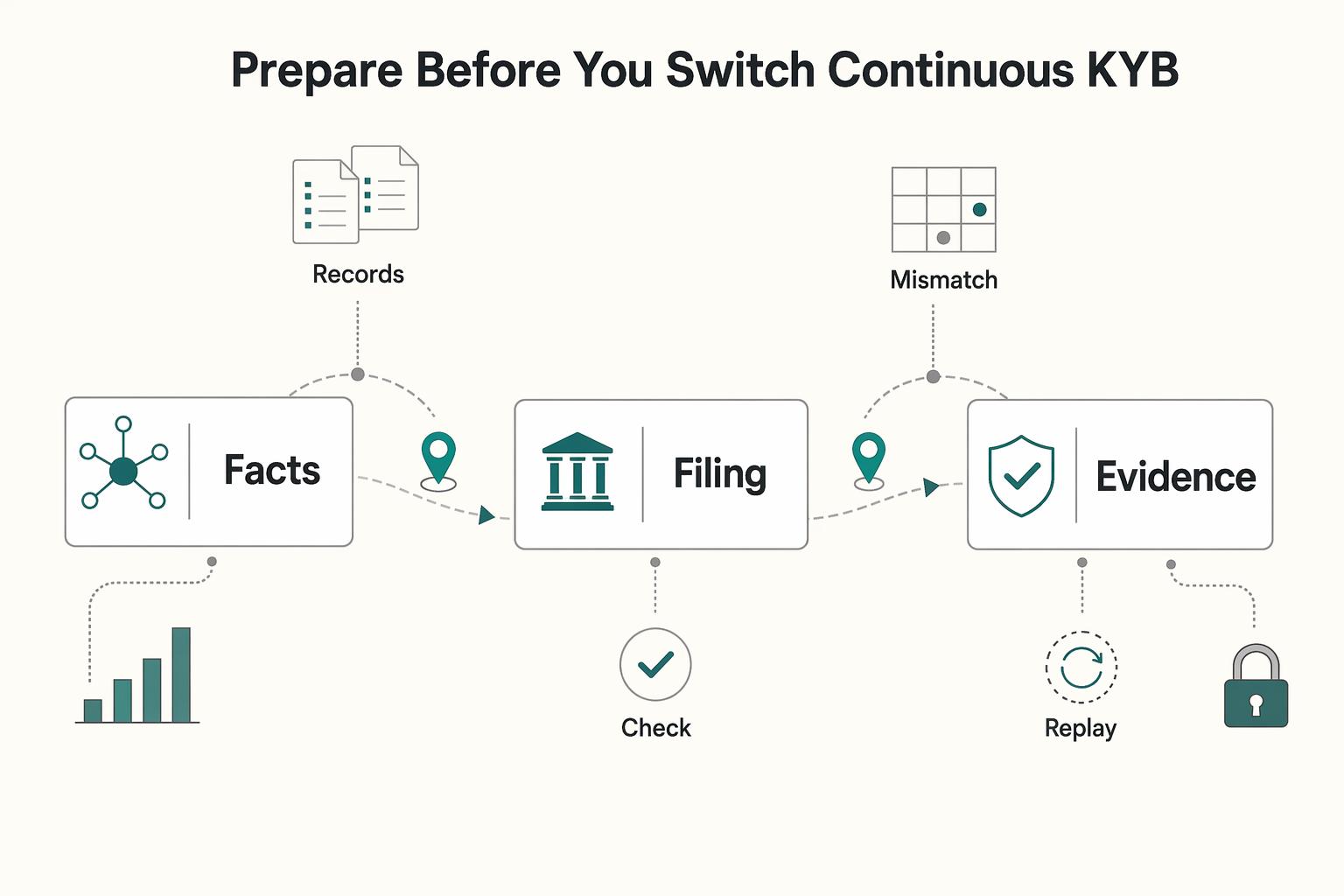
Continuous KYB for Platforms Without Full Re-Onboarding
Continuous KYB should reduce surprises without turning onboarding into a recurring document chase. For platforms, this is a shift in operating model, not a bigger onboarding form. KYB starts as a legitimacy check, but it now needs to continue through the full merchant lifecycle so you can catch material changes early without dragging every business back through full re-onboarding.
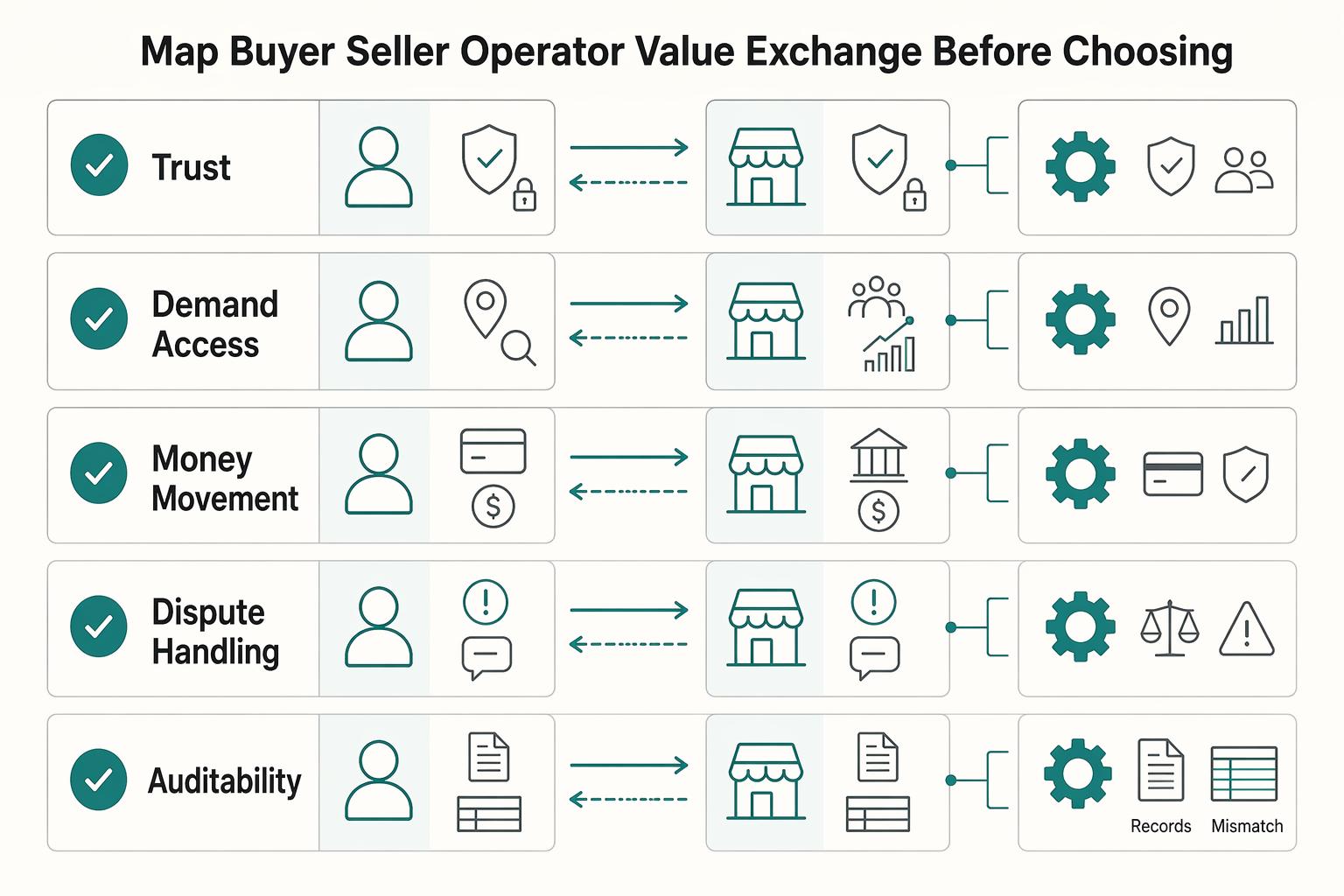
Marketplace Economy 101 for Buyers, Sellers, and Operators
A marketplace connects buyers with third-party sellers or providers. It is one kind of platform business, not an alternative to being a platform. The operating questions are who supplies the product or service, who contracts with the buyer, how the operator earns revenue and who handles a failed transaction.
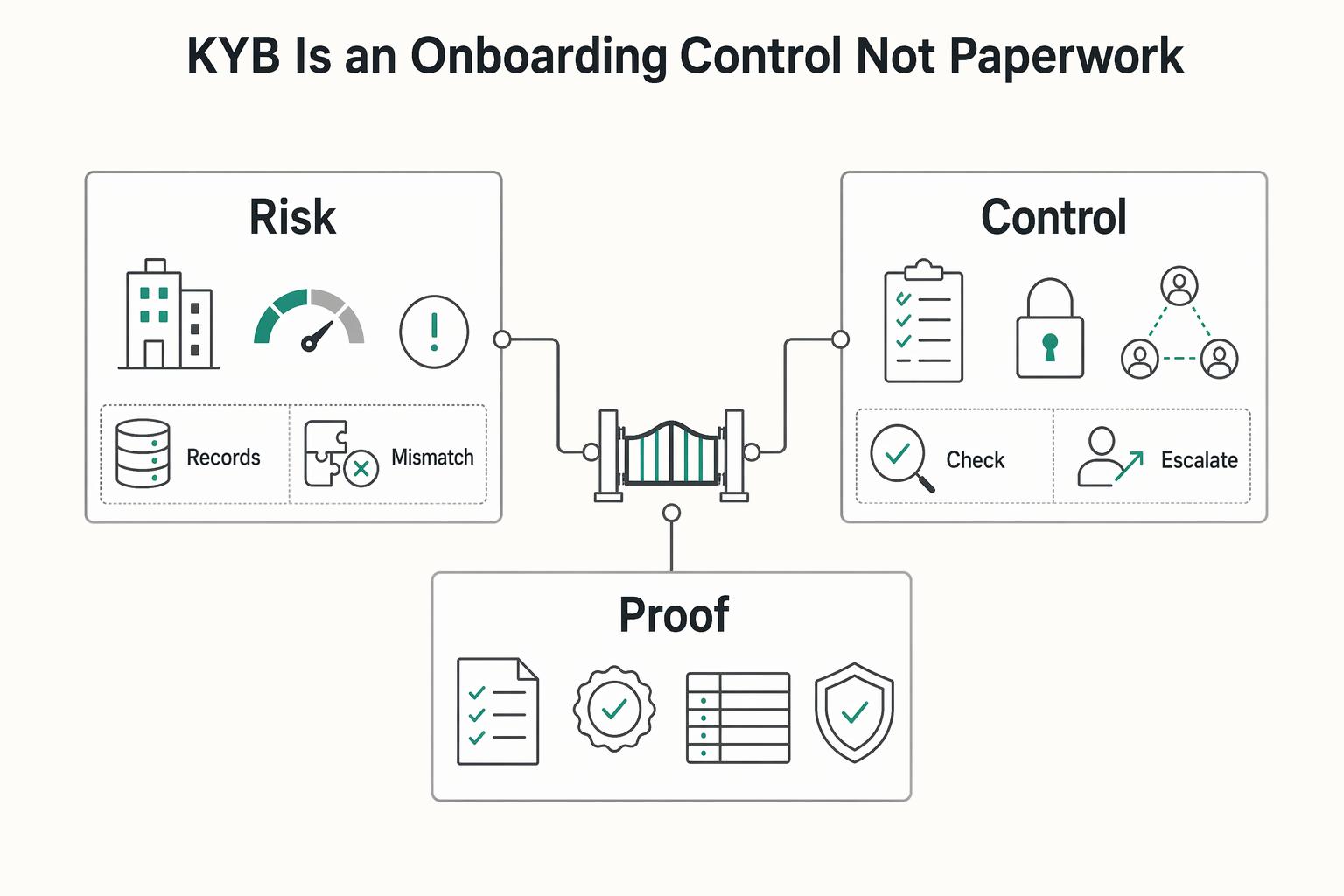
What Is KYB? Know Your Business Verification for Marketplace Onboarding
Marketplace onboarding usually breaks in one of two ways: the team treats Know Your Business (KYB) as a compliance label with no product consequences, or it rushes activation and discovers business-identity or risk issues when money is about to move. For platforms running embedded payments, KYB is better understood as an operating gate for business customers. It is a documented decision on whether the entity is understood well enough to enter a financial relationship.