
Quick Answer
A marketplace helps buyers and third-party sellers transact; a platform is the broader category. Choose your role and fees by the value provided and responsibilities assumed. Test completed matches, repeat use and contribution after support, incentives and payment costs, then expand only when the narrow pilot can fulfil orders and handle exceptions reliably.
How the Marketplace Economy Works#
A marketplace connects buyers with third-party sellers or providers. It is one kind of platform business, not an alternative to being a platform. The operating questions are who supplies the product or service, who contracts with the buyer, how the operator earns revenue and who handles a failed transaction.
A retailer usually buys inventory and sells on its own account. A marketplace usually helps independent sellers reach buyers, with services such as discovery, payment collection or dispute handling. Hybrid businesses can do both. A broader platform may instead provide tools, infrastructure or other interactions without matching a buyer to a seller for each transaction.
An inventory-light business still has costs: matching, seller support, buyer acquisition, fraud controls and refunds. These can grow faster than fee revenue. Test those costs against completed transactions rather than assuming that more signups create a sustainable marketplace.
Early traction can hide harder questions: how onboarding works, which checks or approvals sit between signup and first transaction, whether the core transaction flow is reliable enough for both sides, and how much the model changes as you expand. A model can look scalable because it avoids inventory, but that does not make it easy to run.
Choose the role you can operate reliably. Decide which responsibilities stay with the seller, which you undertake and which a payment or logistics partner performs. Contracts and actual delivery need to match that allocation.
First map the buyer, seller and operator roles. Compare pricing against the value each side receives, calculate contribution after transaction costs, and test a narrow market before funding wider acquisition.
A practical checkpoint is whether you can explain, in plain language, who is onboarded, who gets paid, what checks or documents sit between signup and first transaction, and which segments are explicitly in scope for phase one. If you cannot answer those questions yet, that is not a reason to quit. It is a reason to narrow the plan before you scale it.
The sections that follow are built to help you do exactly that: choose the model, pressure-test the economics, and sequence expansion in a way your operations can actually support.
Define the marketplace economy in operator terms#
Start with operations: if you match third-party buyers and sellers and provide the transaction rails, you are running a Marketplace business model. In this model, the operator is an intermediary that provides the infrastructure and tools for transactions, and revenue is typically fees or commissions.
The core difference from a Traditional retail model is inventory and sales control. Retail usually buys or owns stock and sells directly. A marketplace is typically inventory-light: sellers carry inventory costs, while the operator focuses on technology, user experience, and customer acquisition.
Use Platform business model as the broader label. A marketplace can be one type of platform, but not every platform is only a marketplace transaction layer.
P2P means participants transact with other peers, while B2B involves business buyers and sellers. Those labels do not decide inventory ownership, payment liability or pricing. Map who supplies, sets price, fulfils, invoices and resolves problems before choosing the operating structure.
If you want a deeper dive, read eCommerce Reseller Payouts: How Marketplace Platforms Pay Third-Party Sellers Compliantly.
Compare model structures and monetization levers#
Choose pricing based on the value you actually control in the transaction flow. If you mainly reduce search and transaction costs between buyers and sellers, transaction-linked pricing is usually easier to justify; if your value is access or tooling before any sale, listing or access pricing is often easier to defend.
| Monetization lever | When it fits | Why teams pick it | Common break point |
|---|---|---|---|
| Take rate | You meaningfully shape discovery, trust, checkout, and transaction completion | Revenue tracks completed transactions and value capture at the point of exchange | Fragile if supplier margins are tight or if buyers and sellers can move repeat deals off-platform |
| Listing fee | Sellers get clear value from presence, visibility, or access even before conversion | More predictable top-line than fully transaction-linked revenue | Churn risk if listing value is weak or conversion stays low |
| Hybrid pricing | You provide both ongoing access and transaction rails | Balances access revenue with performance-linked revenue | Can feel like double charging unless each fee maps to a distinct service |
As a planning rule, compare the proposed fee with seller margins and the incremental demand or service you provide. A high take rate can push repeat transactions off-platform. Listing charges can discourage supply before sellers see results; test the choice with your actual participants.
Why reference patterns differ#
Airbnb and Amazon's marketplace are established transaction-platform examples: they connect buyers and sellers and reduce search and transaction costs. That pattern often supports transaction-linked monetization.
Shopify’s core store software gives merchants tools to run their own shops; its pricing combines subscriptions with payment-related charges depending on the setup. DoorDash illustrates an additional fulfilment/logistics role. Compare those responsibilities with your plan rather than copying a fee or treating every platform as the same transaction intermediary.
A commission, subscription, listing fee, lead fee, freemium upgrade or featured placement can each fund a different service. Decide whether sellers pay for a completed sale, access, a qualified lead or additional visibility. Clearly distinguish paid placement from organic matching so the pricing does not undermine buyer trust.
What to verify before you pick a model#
Trace one successful order and one failed order end to end, then confirm:
| Check | What to confirm |
|---|---|
| Generated demand | Who generated demand |
| Trust and transaction risk | Who handled trust and transaction risk |
| Support and exception handling | Who absorbed support and exception handling work |
| Next deal off-platform | Whether the next deal can happen off-platform after first contact |
| Contribution margin | After incentives, not before them |
Failure checks that can erase headline margin#
Watch three failure modes that can wipe out headline margin:
- Disintermediation: repeat transactions bypass your rails after initial matching.
- Subsidy dependency: growth depends on continuing incentives rather than durable unit economics.
- Quality-control load: refunds, disputes, and support work consume more margin than headline pricing suggests.
Work through one order’s contribution#
Illustration, not a provider quote: a buyer pays $100 excluding tax, and the marketplace charges a 15% seller commission. The seller is owed $85 and platform fee revenue is $15 under the assumed agency arrangement. Budget $3.20 for processing, $0.70 for payout/routing costs, $0.20 allocated active-account cost, $2 support, $1 expected net platform refund/fraud cost and $5 buyer incentive. Contribution is $15 − $3.20 − $0.70 − $0.20 − $2 − $1 − $5 = $2.90 before acquisition and fixed overhead.
At the same cost assumptions, a 10% commission would produce $10 fee revenue against $12.10 costs, or −$2.10 contribution. Actual seller entitlements, fee rounding, refund recoveries, taxes and provider charges can change the figures. A temporary reserve against seller funds remains a liability where owed, not extra fee revenue. Test whether better matching or lower costs can improve the outcome before scaling incentives.
For a step-by-step walkthrough, see MoR vs. PayFac vs. Marketplace Model for Platform Teams.
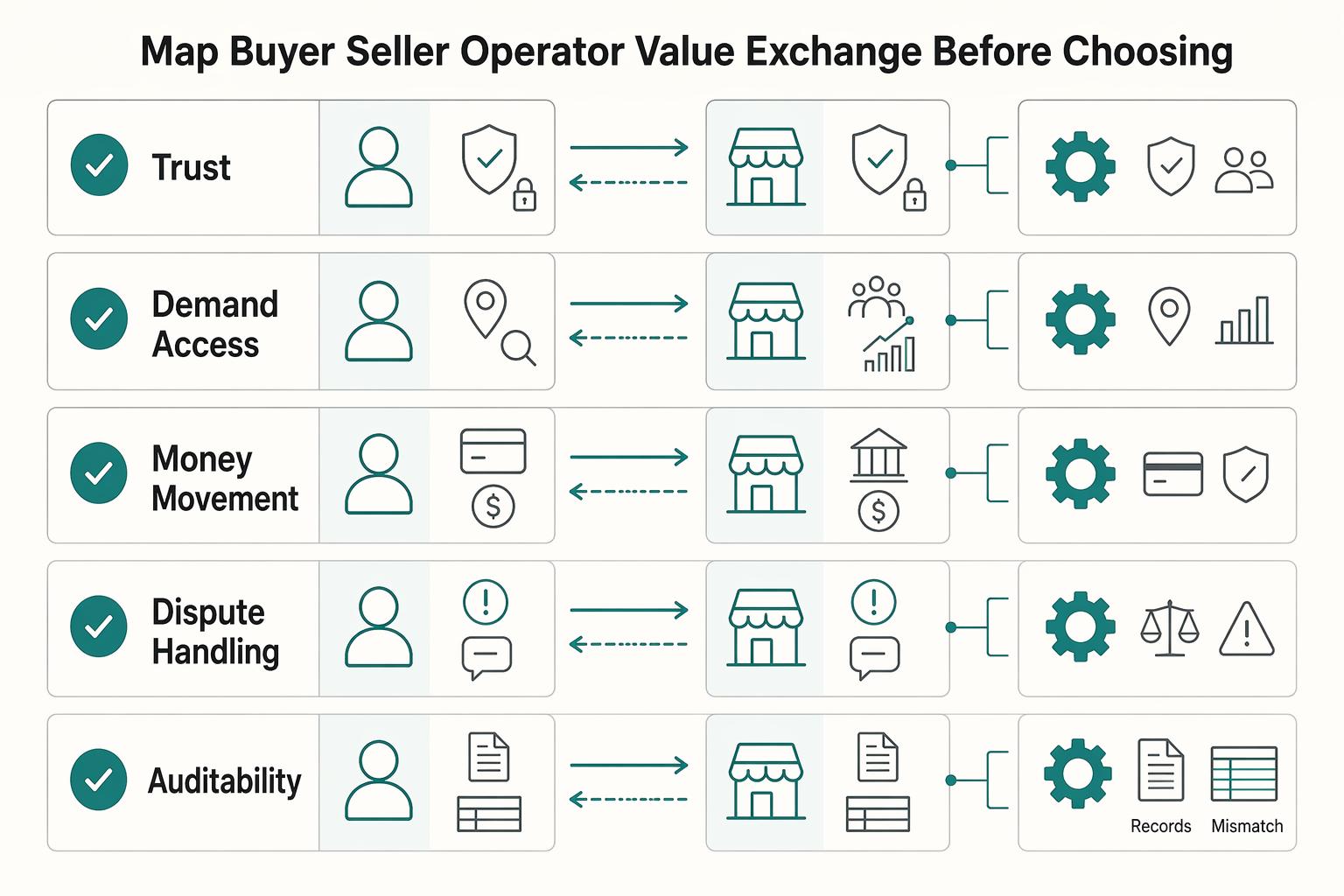
Map buyer seller operator value exchange before choosing a model#
Map buyer–seller exchange and the operator’s service to each side. The operator need not be a third independent demand side: its role is to make the interaction useful enough that buyers and sellers return. Record what each participant gives, receives and remains responsible for.
Define the exchange in testable value units, not slogans. The operator's core job is to make third-party transactions more valuable, so each row should show what buyers and sellers get and what the operator must run reliably.
| Value unit | Buyer receives | Seller receives | Operator responsibility |
|---|---|---|---|
| Trust | Confidence in who they are transacting with | Confidence the counterparty is legitimate | Set and run onboarding controls (including KYB/KYC decisions where relevant) |
| Demand access | Faster access to relevant supply | Access to relevant demand, including buyers they may not reach directly | Build and maintain matching and discovery quality |
| Money movement | Clear payment experience and status | Clear payout path and status | Operate payment acceptance, reconciliation, and payout batches |
| Dispute handling | A defined path when a transaction fails | A defined path to respond and resolve | Own exception handling and resolution workflow |
| Auditability | A usable record of what happened | A usable record for finance, support, and review | Maintain transaction and decision history |
Use one checkpoint before committing: for each row, can you clearly state why buyers stay, why sellers stay, and what only the operator provides? If one answer is vague, treat that as a model risk.
You may see different expectation patterns by market segment, for example consumer flows that emphasize speed versus business flows that emphasize records, but the test is the same: the operator value must be explicit and operational. Related: Choosing Creator Platform Monetization Models for Real-World Operations.
Decide if a market is launchable before go-to-market spend#
Before launch, establish the controls actually required by your market, product category and payment arrangement, plus a workable complaints and fraud response. A small lawful pilot can use documented manual processes. Automating every control or creating separate support, risk and operations departments is not a launch requirement.
The OECD’s 2022 marketplace report, based on survey participation from 28 countries and 15 marketplaces, discusses fraud, seller/product information, education and complaint-data gaps. Use it as consumer-protection context, then determine the rules for your own market; the survey does not establish a universal launch checklist.
| Launch check | What to verify before launch | Launch signal | Hold signal |
|---|---|---|---|
| Consumer-protection readiness | The country/category expectations you will follow and who owns them | Clear policy owner, documented process, user-facing handling path | Rules are still abstract or ownership is unclear |
| Seller-information readiness | What third-party seller and product information you require | Required fields and review steps are defined and usable | Information standards are incomplete or inconsistent |
| Complaint-data readiness | How complaints will be tagged, routed, and reviewed | Marketplace-specific complaint categories and escalation ownership are set | Complaint handling is ad hoc or defined "after launch" |
| Fraud/scam response readiness | How you will detect and respond to abuse early | Surveillance and seller/consumer education actions are in place | Controls are deferred until after growth |
| Evidence quality | Whether teams can review one end-to-end case without guesswork | Support, risk, and operations can trace and explain the case | Teams depend on tribal knowledge to explain outcomes |
Build the evidence pack before spending#
Compile the operational plan for the pilot: responsible people, required seller/product information, complaint categories, escalation route and abuse-response actions. A small team may combine roles; each task still needs a named owner and a usable record.
Use one checkpoint that is hard to fake#
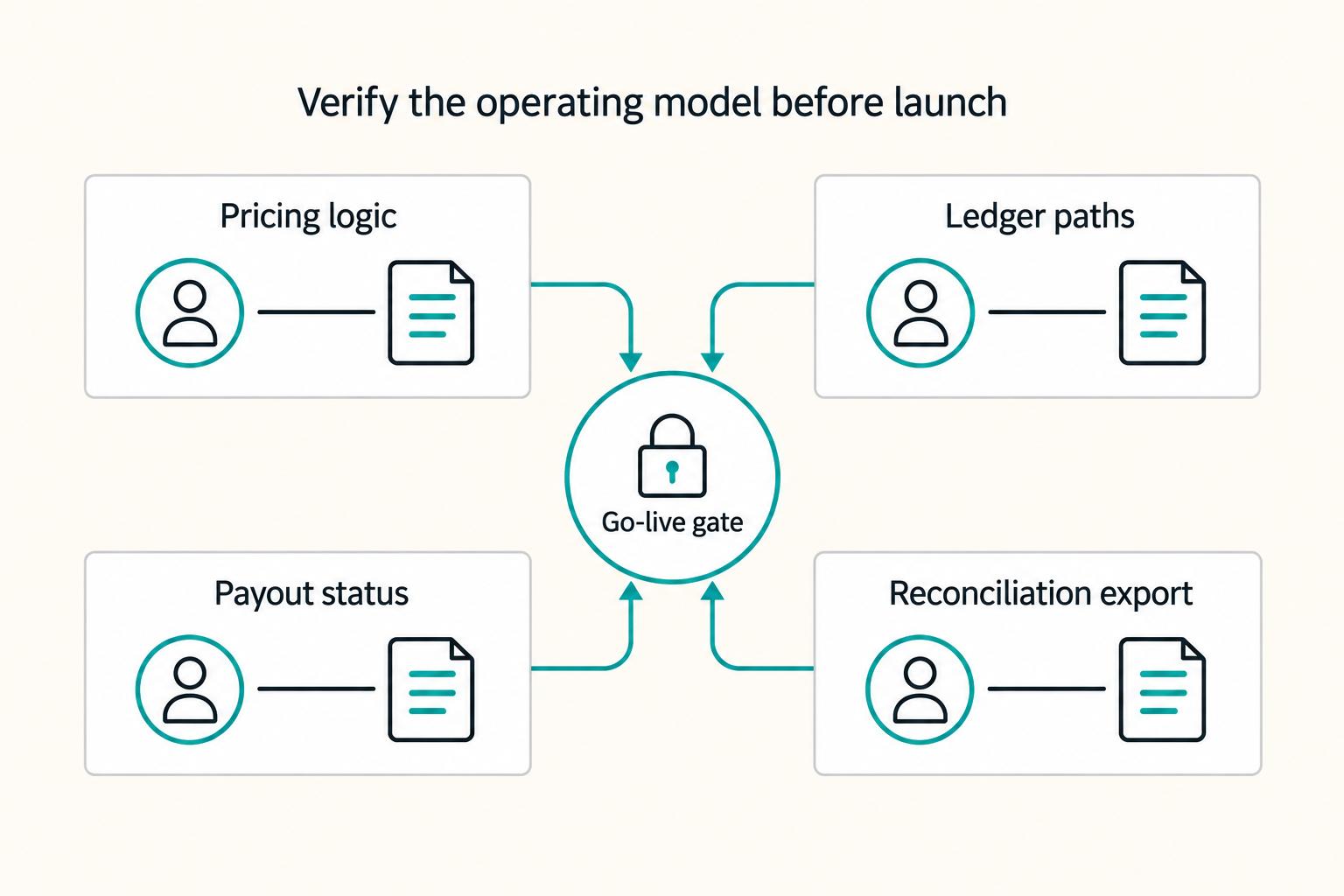
Walk through a realistic successful order and a failed one. Have the responsible people locate the payment, seller obligation and complaint outcome. Fix any gap that prevents lawful fulfilment or reliable handling; use manageable manual work to learn what needs automation.
OECD also called out the value of more specific consumer complaint data for marketplaces, so define those tags before launch rather than after the first spike.
Sequence cold start and liquidity by vertical and country#
Start with a category and geography where a small cohort can fulfil a specific demand. Seed whichever side is constrained: supply may need recruiting first, or committed buyers may help attract suppliers. Concentration matters more than a large untargeted catalog.
A market can be launchable and still be the wrong place to spread thin. In a platform model, value comes from making third-party transactions work, so supply, demand, and transaction trust need enough concentration to create liquidity density rather than headline activity.
Start with the narrowest supply that can fulfill real demand#
Choose a small seller/provider cohort and test whether it can fulfil real buyer requests. Manual matching is often useful in an early pilot; count its labour cost and learn which interventions are repeatable. Transactions requiring rescue are a signal to investigate, not proof that no liquidity exists.
The shape of demand changes how this plays out. Uber-style models depend on local density in a tight area, while B2B marketplaces often run through longer, fit-sensitive procurement paths where supplier quality and transaction reliability matter more than catalog breadth.
Validate quality before buying more demand#
Track these leading indicators by cohort:
| Indicator | Definition for a chosen cohort/window | How to interpret |
|---|---|---|
| First successful match rate | Fulfilled first requests / eligible first requests | Separate inability to match from later payment or fulfilment failure |
| Repeat transaction rate | First-time buyers who transact again / first-time buyers with enough follow-up time | Choose a repeat window appropriate to the category; incomplete follow-up distorts the rate |
| Dispute incidence | Disputed completed transactions / completed transactions, with reason codes | Track severity, reporting lag and resolution cost alongside the rate |
Read the measures together. Weak repeat use can reflect poor fit, a naturally infrequent purchase or a short observation window. More recorded disputes can reflect worse quality or easier reporting. Investigate the cohort and reason codes before treating either change as a verdict.
Use one hard checkpoint before expansion: review failed first matches, tag root causes, and keep the linked evidence trail: request, outcome, dispute artifact if any, and operator action. If repeat demand is weak, narrow category scope before expanding geography.
Design payments and payout operations that survive scale#
Trace the transaction from checkout or invoice through confirmed collection, ledger posting, seller entitlement, transfer and payout. These are different states: a payment accepted by the processor is not necessarily available cash or a completed seller payout.
Build the money trail first#
Your payment records should explain collection, the amount owed to each participant, payout eligibility and exceptions. Choose a provider arrangement that supports the legal role you are taking. An internal balance is an accounting record, not proof that you are licensed to hold or move customer funds.
| Failure mode | What it looks like | Operational response |
|---|---|---|
| Webhook timing drift | Product shows "paid" while finance still has an unposted balance | Check the provider object and reconcile the missing posting; do not invent a successful state. |
| Duplicate payout attempts | Retries fire after slow success responses and guardrails are weak | Look up the existing operation; reuse its stable request identifier where supported and avoid a second payout while outcome is unknown. |
| Unmatched deposits | Incoming transfers cannot be tied to the right payer | Investigate payer/reference details and route the unmatched amount to review. |
| Stale FX quote usage | Promised payout amounts do not match settlement assumptions | Check quote validity, actual rate, fees and the agreed payout currency before execution. |
For a pilot, demonstrate source document, provider status, ledger impact, seller amount owed, payout instruction and final result. Stripe’s webhook guidance notes that delivery can be duplicated or out of order. Deduplicate supported event identifiers, verify the current object when needed and reconcile unresolved transactions; receiving one event does not establish finality.
Choose intake and payout tooling with eyes open#
A virtual account can help identify bank-transfer receipts; it does not itself solve seller onboarding, payment licensing, dispute allocation or payouts. Stripe Connect offers account and charge arrangements with different responsibilities. Its charge documentation explains, for example, that destination-charge refunds and chargebacks reduce the platform balance. Decide who bears these costs before choosing the integration.
The following are current U.S. standard pricing examples from Stripe Payments and Connect pricing, not worldwide quotes or a universal fee bundle. Confirm country, currency, charge arrangement, selected capabilities and negotiated terms:
| Component | U.S. standard example and scope |
|---|---|
| Standard domestic card processing | 2.9% + 30¢ per successful transaction |
| International cards | +1.5% |
| Manually entered cards | +0.5% |
| Connect (platform-managed) monthly active account | $2 per monthly active account |
| Connect (platform-managed) payout fee | 0.25% + 25¢ per payout sent |
| Connect funds routing/platform management | 0.25% of payout volume under the “you handle pricing” table; check applicability |
| Managed Payments fee | 3.5% per successful Managed Payments transaction in addition to Payments fees; separate merchant-of-record product, not a default Connect fee |
Connect distinguishes Stripe-managed user pricing from platform-managed pricing. The platform-managed schedule includes the account, payout and funds-routing lines shown above; optional or cross-border services can add costs. The $2 account fee applies in months with payouts to a bank account or debit card. Model small payouts and refund scenarios as well as average orders: original processing, Connect and currency-conversion fees are not generally returned under standard pricing.
Build compliance and governance gates before volume#
Make payout eligibility and any restriction explicit. Record the affected amount, reason, authority, review owner and release conditions. Apply necessary legal/provider restrictions and proportionate contractual controls; do not freeze all of a seller’s unrelated earned funds merely because one order has a dispute.
Gate money out with explicit review states#
Apply the verification and screening required by the provider arrangement and applicable law at the relevant stages, including changes that affect payout eligibility. A marketplace is not automatically responsible for every regulated-provider AML duty. Document the responsibility split and what information the platform must supply.
A workable queue usually includes:
- visible states such as pending review, restricted, eligible for payout, or under investigation
- hold reasons tied to the account or transaction
- release criteria documented before funds are unlocked
Determine the legal scope for each market#
For a service with UK links, use Ofcom’s scope checker to assess Online Safety Act coverage and exemptions. User listings, messaging and reviews of third-party user content can matter; the marketplace label alone is not the test. Review the functions you provide and any applicable duties. The UK guide provides further context.
Keep tax operations narrow, factual, and evidence-based#
Separate seller information reporting from a seller’s personal tax relief. U.S. citizens and resident aliens abroad are generally taxed on worldwide income. The foreign earned income exclusion can apply to a qualifying individual with foreign earned income; the physical-presence route requires 330 full foreign days within a 12-month period, plus the other requirements.
The exclusion also requires a foreign tax home and a valid claim on a return reporting the income. The 2026 maximum is $132,900 per qualifying person, with adjustment for part-year qualification. It does not exempt marketplace company revenue or automatically apply to every overseas seller. Keep any individual FEIE planning outside the platform’s standard payout promise.
Identify any required seller tax certificates and platform information returns for the actual arrangement; assign collection, reporting and sensitive-data access responsibilities. A seller’s personal FBAR analysis is separate from platform 1099 reporting. Do not require every seller to prove FEIE or FBAR completion as a routine payout condition.
What to decide in the next 30 days#
Use the next month to lock three decisions in order: choose the model, prove one country is launchable, and run one controlled pilot before scaling. That sequence keeps you from funding demand before money movement and operator workflows are ready.
Pick the model and price it on purpose#
Write down the actual role: transaction matching, merchant software, inventory retail or a hybrid. In a marketplace, third-party sellers usually supply the goods or services while the operator provides agreed discovery and transaction support. Document exceptions rather than forcing the business into an exclusive marketplace-versus-platform choice.
Write a one-sentence monetization rationale your team can repeat: what value you create, for which side, and when that value is clear enough to charge for it. Also assume your first setup is a starting point, not a forever decision. Once scaled, platforms often reconfigure value to stay competitive, so the goal now is a clear starting logic, not perfect final design.
Finish one country launchability review#
Complete one launchability review for one country with evidence, not assumptions. The output should cover compliance scope, payout path readiness, and reconciliation visibility.
At minimum, verify:
- a dry onboarding flow for the seller or payee profile you plan to support
- the first payout path, including approval or hold points
- traceability from transaction record to payout status and finance reporting
If the compliant payout path is still uncertain, pause demand efforts in that market.
Pilot narrowly, then confirm fit before expanding#
Run one controlled pilot cohort and scale only if liquidity quality and operational reliability meet your predefined thresholds. Keep the pilot narrow enough to test real matching and repeat usage, not just signups.
Use a clear go or no-go rule before launch, then confirm country or program fit, payout coverage, and implementation constraints against your actual rollout plan. If you need to pressure-test model choice, use this archetypes guide. For coverage and implementation fit before expansion commitments, Talk to Gruv.
Frequently Asked Questions
What is the difference between a marketplace and a platform in one sentence?
In this context, a marketplace is a transaction-focused platform model where multiple buyers and sellers connect to transact, while "platform" is the broader label.
How does a marketplace create value differently for buyers, sellers, and operators?
Buyers get access, choice, and a simpler way to transact in one place. Sellers get demand plus infrastructure the operator may provide, such as payments, shipping, and customer service. The operator creates value by reducing transaction friction and trust gaps, then usually earns through fees or commissions while typically not owning the inventory itself.
When should an operator use a take rate, a listing fee, or a hybrid pricing model?
Use a take rate when the completed transaction is the service you can charge for; use listing or subscription pricing when access or tooling has value before a sale. Hybrid pricing can work if each charge has a clear purpose. Lead fees, freemium upgrades and featured placements are additional options. Test seller margins, conversion and retention rather than choosing from an unsupported market-share statistic.
What is the chicken-and-egg problem, and what is the practical first move?
Buyers wait for useful supply while sellers wait for demand. Start with a narrow use case, identify the constrained side and recruit enough participants to complete real transactions. Manual matching can help test the interaction before you automate or buy broad traffic.
What usually breaks marketplace economics after early growth?
Processing and payout costs, incentives, support, refunds, fraud losses and off-platform repeat deals can consume the take rate. Calculate contribution per completed transaction after those costs, then compare repeat use and acquisition cost. GMV and seller money owed are not automatically platform revenue.
What must be validated before launching a new country or vertical?
Validate that the marketplace can reliably run its core transaction loop in that market: buyers and third-party sellers can transact, operator infrastructure is in place, and the fee or commission model can support operations. If those fundamentals are still uncertain, delay launch.
Try a related tool
Researched and edited by the Gruv editorial team. Gruv builds cross-border billing, payouts, and finance-operations software for global businesses.
Sources
Includes 1 external source outside the trusted-domain allowlist.
- docs.stripe.com/connect/chargestrusted
- docs.stripe.com/webhookstrusted
- irs.gov/individuals/international-taxpayers/foreign-...trusted
- irs.gov/individuals/international-taxpayers/figuring...trusted
- oecd.org/content/dam/oecd/en/publications/reports/202...trusted
- stripe.com/pricingtrusted
- stripe.com/connect/pricingtrusted
- ofcom.org.uk/os-toolkit/regulation-checker/regulation-che...external
Educational content only. Not legal, tax, or financial advice.
Related Posts
Which of the 5 Marketplace Archetypes Fits Your Platform
If you need to choose a marketplace model without getting stuck in taxonomy debates, this guide is meant to help you get to a decision in one pass. It is written for founders, product leaders, finance ops, and engineering owners who need to choose a model that fits the business, then carry that choice into execution without avoidable surprises.

UK Online Safety Act Compliance for Marketplace and Platform Operators
Treat the UK Online Safety Act as operating work now, not a policy debate. The most practical way to reduce uncertainty is to run an auditable implementation plan: make an initial scope call, stand up baseline controls, assign owners, and keep records you can defend if Ofcom asks questions.

How Marketplace Platforms Pay Third-Party Sellers Compliantly
Generic marketplace payout advice usually skips the part that breaks in production. Paying many sellers is not just moving money out. It is deciding who gets paid, when they become eligible, what happens when a buyer disputes a payment, and how finance proves every release later. If you are working on **ecommerce reseller payouts marketplace platforms pay third-party sellers**, this guide is for the marketplace operator, not for solo freelancer banking tips.