
Quick Answer
KYB verifies a business’s identity, activity and relevant ownership or control for the relationship being offered. It can include specified person-level checks alongside entity verification. Requirements depend on the regulated party, customer, product and jurisdiction; retain evidence and reasons for approval, limits or review.
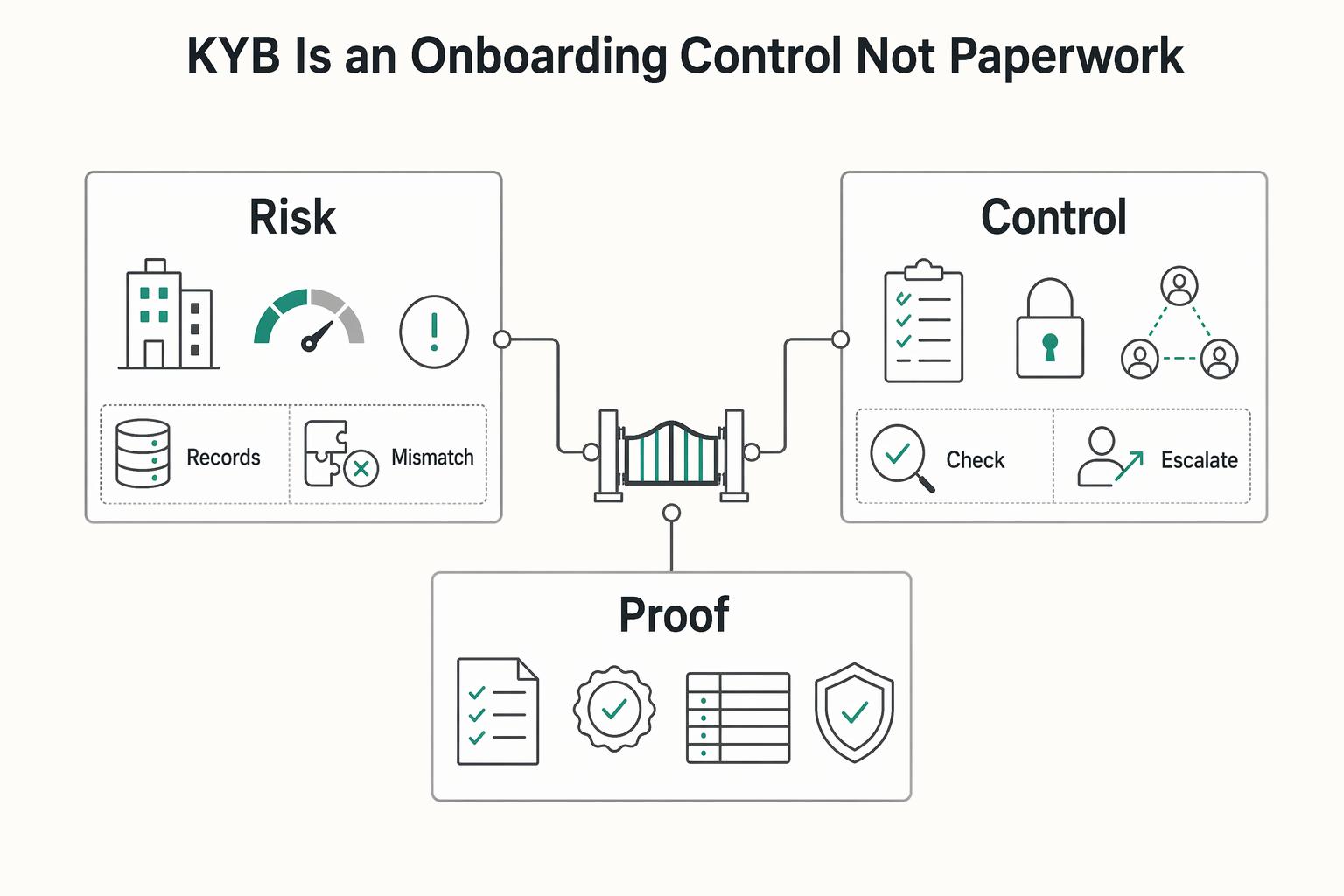
KYB is an onboarding control, not paperwork#
Marketplace onboarding usually breaks in one of two ways: the team treats Know Your Business (KYB) as a compliance label with no product consequences, or it rushes activation and discovers business-identity or risk issues when money is about to move. For platforms running embedded payments, KYB is better understood as an operating gate for business customers. It is a documented decision on whether the entity is understood well enough to enter a financial relationship.
At a basic level, KYB is the verification process financial institutions use to assess business counterparties. It sits alongside Know Your Customer (KYC), which verifies natural persons, within broader AML and CFT controls. That definition matters, but the practical question is not only the definition. It is where the business check sits in your onboarding path, what evidence supports approval, and who handles exceptions when the record is incomplete or contradictory.
That shift from definition to execution is where teams either gain control or create rework. A marketplace can make signup feel smooth, but if ownership and registration records are not captured in a way compliance can trust, the friction shows up later. The usual failure mode is not "we forgot a form." It is "we let the account look complete in product, but finance or compliance cannot explain why it was approved."
Define which customer and account types need business checks under the actual law, partner requirements and product design. Collect the required entity and related-person data once, then record how it supports the decision. Sole proprietors, excluded entities and different account types may follow different paths.
One early detail matters more than teams expect: evidence retention. A green status in the UI is not enough. If you cannot later show what registration data was checked, what screening result was returned, and why an analyst approved or held the account, you do not really have a reliable control. The same goes for escalation design. If ownership cannot be reconciled to credible records, do not improvise at go live. Decide in advance whether the account pauses, moves to manual review, or is limited to non-financial activity.
This guide takes that practical view. It moves from KYB basics into the decisions platform teams actually face in production: where KYB and KYC meet, what the minimum evidence pack should contain, how to tier risk, what varies by jurisdiction and program, and how to keep onboarding fast without weakening AML controls. Related reading: What Is FinCEN for Freelancers and FinTech Users.
What KYB means in marketplace onboarding#
In marketplace onboarding, Know Your Business (KYB) is the business-entity check within Customer Due Diligence (CDD) that confirms whether a company is legitimate, who owns or controls it, and whether the relationship risk is acceptable. It sits alongside Know Your Customer (KYC), but the scope is different: KYC verifies individuals, while KYB verifies the business those individuals represent.
A case is complete when the required entity, related-person and risk checks for that relationship are satisfied, or an applicable exclusion is documented. Directors, authorized representatives, equity owners and controlling persons are different roles; identify and verify the people the applicable rule or partner program requires.
This is where weak onboarding shows up: the account looks complete in product, but ownership and control are still unclear. If someone reopens the file later, they should be able to see what business details were verified, what ownership data was collected, and why the account moved forward.
KYB is designed to reduce concrete risk, including shell company misuse and hidden ownership that can create downstream AML and CTF exposure. When ownership cannot be reconciled to credible records, treat the case as unresolved and move it to review instead of guessing.
KYB and KYC decisions in one onboarding flow#
Run KYB for legal entities and Know Your Customer (KYC) for natural persons; inside Customer Due Diligence (CDD), they are complementary rather than interchangeable.
A business account can require both entity checks and verification of specified related people. Determine the ownership and control tests for the actual program rather than assuming every director or shareholder needs the same personal verification.
Map the decision before you build the form#
Define KYC and KYB branches by account type at design time, then tie each branch to activation rules. Do not leave that choice unresolved just to move faster once the funnel is live. At minimum, your map should answer:
| Decision point | What to define |
|---|---|
| Counterparty type | Whether the counterparty is a natural person or a legal entity |
| Related people for legal entities | Which related people also require person-level verification |
| Locked capabilities | Which product capabilities remain locked until each check is complete |
Your audit trail should also show why KYC ran, why KYB ran, and which person profiles were linked to the business record.
The common failure mode#
Two common mistakes are stopping at registration when ownership/control checks are required, and demanding the same documents from every director or customer without considering role, entity type or applicable exclusions.
If account type is unclear, treat it as a gating issue and resolve it before you enable sensitive features.
Keep a separate branch for MoR and direct models#
For MoR and direct-platform models, map the actual customer, regulated party and financial product before setting checks. The model label alone does not determine CDD duties or remove the partner institution’s requirements.
You might also find this useful: KYC KYB CIP Explained for Cross-Border Freelancers and Small Teams.
The minimum KYB evidence pack you need before activation#
Set an evidence file for the actual relationship before enabling financial capabilities. Resolve the ownership/control checks required for that customer, or document the applicable exclusion. Restrict new capabilities while required checks are unresolved; handling existing funds and earned pay needs its own lawful process.
A useful file records legal name, existence, business address, activity, authorized representatives, required ownership/control information and screening decisions. Tailor documents and person-level checks to the actual rule and program, with data access and retention controls.
Build the file for audit, not just approval#
A UI approval state alone is not enough. Your record should let a reviewer see what was checked, when it was checked, what matched, and what was reviewed or overridden.
Store decision artifacts, not just pass/fail outcomes. Keep the underlying business and ownership records you relied on, screening outputs with timestamps, and notes for manual review decisions. If the case file only says "passed KYB," your Customer Due Diligence (CDD) trail is still thin.
Set the gate by product stage#
Define evidence requirements by stage so standards do not drift:
| Evidence item | Required for account creation | Required before first payout | Required for higher limits |
|---|---|---|---|
| Legal name and registration status | Capture and verify | Must still be valid | Refresh if stale or changed |
| Business address | Capture | Verify mismatches or missing detail | Refresh on material change or risk signal |
| Related people and authority | Capture required roles and authority | Verify required persons for the selected relationship | Refresh on relevant change or risk signal |
| Applicable ownership/control test | Collect required data or document exclusion | Resolve required checks or approved applicable exclusion | Review relevant changes under risk-based procedures |
| Screening results | Record policy-check results | Results should be current and retained in the case file | Re-screen before raising exposure |
The ownership/control row matters when that test applies. Confirm the actual threshold, control-person rule and exclusions rather than requiring every business to produce an identical UBO file.
When required evidence is contradictory, route the case to review and restrict new financial capabilities as appropriate. Keep existing balances and payment obligations visible; incomplete onboarding is not by itself authority to seize or indefinitely withhold funds.
How to tier KYB risk and when to escalate#
After the minimum file is complete, move beyond a pass/fail mindset to explicit risk tiers tied to product permissions. A risk-based KYB model lets lower-risk businesses move faster while higher-risk cases get deeper review before money movement.
Build tiers from the file#
Use the signals your KYB checks already produce: ownership analysis, legitimacy checks, and screening against adverse media, watchlists, and PEP lists.
| Risk tier | What the file looks like | Illustrative treatment of new activity |
|---|---|---|
| Low | Ownership and control are clear, legitimacy checks are consistent, and screening shows no material concerns | Progress through onboarding with standard controls |
| Medium | Required evidence or risk signals need further assessment | Limit new activity under the program policy pending review; preserve lawful handling of existing balances and obligations |
| High | Material contradictions or screening results require compliance disposition; PEP status alone is not a sanctions prohibition | Restrict new financial activity pending compliance disposition; handle existing funds and obligations under applicable law |
Define escalation triggers before the queue fills up#
Set escalation rules in advance so product, ops, and compliance make the same decision from the same evidence. At minimum, define triggers for:
| Escalation trigger | Condition from the section |
|---|---|
| Watchlist or PEP results | Not auto-cleared by policy |
| Registration records | Conflicting or incomplete |
| Ownership structures | Required ownership/control information remains unresolved after applying the actual threshold, control-person test and exclusions |
| Adverse indicators | Remain unresolved after initial review |
Use these illustrative tiers to select review and restrictions on new activity under the actual program. Record the disposition and preserve a lawful, separately owned process for existing balances and payment obligations; a risk label alone does not authorize indefinite withholding.
What is mandatory vs what varies by country and program#
For a scoped US example, 31 CFR 1010.230 governs beneficial-owner checks for specified covered financial institutions and legal-entity accounts, with exclusions and exemptions. It is not a universal mandate on marketplaces. Read it with FinCEN’s current CDD FAQs and February 13, 2026 account-opening relief.
That is the rule for this section: when someone says a control is mandatory, require the exact rule, the jurisdiction, and the entity in your stack that is bound.
The one hard anchor and what stays unknown#
For a non-excluded legal entity under this US rule, identify each individual with 25% or more direct or indirect equity, if any, and one person with significant control responsibility. Verify the identity of those identified people under the covered institution’s risk-based procedures; the rule does not demand independent proof of every ownership assertion. No 25% owner does not eliminate the control prong.
Before launch, keep a short legal-basis memo per country and program with four fields:
| Memo field | What to record |
|---|---|
| Rule or directive | The rule or directive |
| Bound entity | The entity in your stack that is bound |
| Affected product capability | The affected product capability |
| Control basis | Whether the control is mandatory, partner-imposed, or internal policy |
If those fields are incomplete, do not present the control as legally required.
Europe is usually an interpretation problem#
In Europe, map the obligation to the actual national law, regulated activity and relationship. A directive name alone does not establish a platform’s document list, ownership threshold or retention schedule. Keep the applicable local rule and partner requirements in the country record.
| US CDD example | What applies | Operational implication |
|---|---|---|
| Covered party | Banks, brokers/dealers, mutual funds and futures commission merchants/introducing brokers covered by the rule | Do not assume every marketplace or MSB is covered by this specific rule |
| Ownership and control | Each individual with 25% or more equity, if any, and one significant control person; entity/account exclusions apply | Document each applicable prong or exclusion |
| 2026 account-opening relief | First account, information-reliability concerns and risk-based ongoing CDD | Repeated new accounts do not automatically require fresh collection under the relief |
| Record retention | Identification records: five years after closure; verification records: five years after creation | Apply the scoped rule alongside applicable privacy and other retention obligations |
If your evidence file has ownership and screening data but no clear legal basis for each control, expect rework at payout time. Keep country rules and product rules separate, and validate both before rollout. For country-by-country implementation planning, see KYC/KYB Requirement Mapper: What Each Country Demands for Platform Onboarding.
How to implement KYB without stalling growth#
Implement KYB as a decision workflow tied to activation gates, not as a document inbox. Keep straightforward cases moving with minimal manual review, and route higher-risk cases into a clear review path with traceable evidence.
This sequencing matters because manual or outdated handling becomes a bottleneck, and every extra day in onboarding increases drop-off risk and delays time-to-value. For embedded payments, that usually shows up as onboarding progress without usable money movement.
Start with policy, then lock the data model#
Start with policy before UI work. Define clear outcomes, for example approved, approved with limits, or pending review, what evidence supports each outcome, and what triggers escalation.
Then align your data model to that policy. Use a persistent business identity profile: one internal record that acts as a single source of truth for business identity, verification outputs, and review decisions. Without that, teams end up piecing together fragmented data across tools and creating avoidable operational drag.
Only then wire API and UI capture. Ask for a strict minimum evidence pack for the first decision, and collect additional data when risk, country, or product usage requires it.
Orchestrate checks so product controls follow the decision#
Capture data, verify required evidence, assess screening results and route exceptions to review. Then determine new capability access using both the KYB decision and separate provider/product eligibility. The table is an illustrative policy, not authority to freeze existing funds.
| Illustrative new capability | Required checks pending | KYB approved and provider/product eligible | Escalated case |
|---|---|---|---|
| Create invoices | Allow limited setup only if the actual program permits it | Allow within approved scope | Select restrictions under actual policy |
| Open/use a new Virtual Account | Await required approval and provider eligibility | Allow only the separately eligible capability | Restrict new use pending disposition; handle existing balances lawfully |
| Submit new payout batches | Await required checks and eligible route | Allow within authorized limits and available funding | Restrict new submissions as applicable; resolve existing payment obligations lawfully |
Launch narrow first: strict minimum evidence pack, conservative automation, and explicit manual-review routing. Expand automation after false-positive and review-volume baselines stabilize.
Build for retries, status history, and audit export#
Verify signed provider events and retain their case/version identifiers. Persist and deduplicate events before updating state; serialize decisions so an older approval cannot overwrite a newer rejection or hold. Keep business verification status, risk disposition and provider capability approval separate.
Before activation, finance and ops should be able to confirm traceable decision logs and exportable audit artifacts. The implementation is working when compliance status, product permissions, and finance release logic stay aligned.
Mistakes that cause KYB rework and compliance incidents#
Most KYB rework comes from one pattern: teams treat approval as final even while risk, ownership, and product scope keep changing.
Treat approval as a dated decision#
Treat each approval as time-bound, not permanent. A business record is a snapshot, so if you approve once and never revisit, controls can drift while the account still moves money.
Under FinCEN’s February 13, 2026 relief, covered institutions may limit beneficial-owner identification and verification to the customer’s first account, facts calling earlier information into question, and risk-based ongoing due diligence. This removes automatic repetition at every new account, not the underlying CDD duties.
A practical checkpoint is simple: every approved business should have both a status and a freshness state. If status is approved but ownership or registration evidence is stale, finance should see that before funds are released.
Documents are not the same as ownership resolution#
A document set alone does not resolve Ultimate Beneficial Owner (UBO) ambiguity. Teams often collect registration files and close the case, then hit rework at payout or downstream review when ownership and control must be explicit.
Define how required ownership/control information is collected, verified and reviewed. Escalate contradictions under the actual rule and risk policy; document exclusions. A near match or PEP result calls for assessment and is not the same as a confirmed sanctions prohibition.
Your evidence bundle should show:
- the ownership snapshot used for the decision
- unresolved gaps or assumptions
- who approved any exception
Do not automate away judgment#
Over-automation creates incidents when ambiguous cases pass or block without clear human escalation criteria. The issue is not automation itself; it is missing rules for when near matches or higher-risk flags must stop for review.
Apply the same discipline to legal scope. Do not promise product access in a new country or flow while AMLD interpretation or applicability of FinCEN CDD requirements is still under assessment. If you need a country-level starting point, use KYC/KYB Requirement Mapper: What Each Country Demands for Platform Onboarding.
Conclusion#
The clearest test is simple: if your team cannot explain, in plain English, why a business was approved, limited, or held, your process is not ready. Know Your Business (KYB) works best when it acts as an activation control tied to money movement, not as a glossary term sitting beside signup.
For marketplace teams, the practical win comes from combining business checks, individual checks, and product controls instead of treating them as separate tracks. KYB verifies the entity. KYC verifies the relevant people behind it. Customer Due Diligence (CDD) ties those checks to a decision you can defend later under AML expectations. That combination can help you move faster without giving full financial access to accounts you cannot actually explain.
A good operating standard is straightforward. Keep a defined evidence pack for approval, keep the artifacts that supported the decision, and define the exact cases that must go to manual review. The checkpoint that matters most is not whether the UI shows "verified." It is whether the case file shows the business details, ownership evidence, and review results that support the outcome. If the only record left behind is a pass flag, expect rework when payouts, audit questions, or partner reviews catch up with you.
Collect required evidence once and keep straightforward setup moving. Restrict new financial capabilities where required checks remain unresolved, while assigning review ownership and a lawful process for existing balances or payment obligations.
If you want a concrete next step, do this in order:
- Map your current onboarding flow from account creation to first payout and mark where KYB, KYC, and escalation decisions actually happen.
- For each gate, write down the evidence required, who can approve exceptions, and what is stored for audit.
- Before enabling new payout or account capabilities in a country or program, confirm the minimum KYC and KYB data required for that region and sponsoring bank.
That last step matters because requirements are not universal. The minimum data can vary by jurisdiction and bank partner, so do not treat one market's checklist as globally portable. If you need a place to start that review, use the KYC/KYB Requirement Mapper: What Each Country Demands for Platform Onboarding.
KYB is more than business verification. It is the decision point that should control access, capture evidence, and hold the line when the ownership or risk picture is still incomplete.
Frequently Asked Questions
What is KYB in simple terms?
Know Your Business means checking a business’s identity, activity and relevant ownership or control for the relationship you intend to provide. The required evidence depends on the customer, regulated party, product and jurisdiction.
How is KYB different from KYC for marketplace onboarding?
KYC focuses on an individual. KYB focuses on a business entity. In business onboarding, teams may use both, because a company account can still involve real people who own or control it.
Which documents and checks are usually required in KYB?
Start with legal name, existence, address and activity, then collect the related-person and ownership/control information required for the actual program. Verify representatives’ authority and record exclusions. A register extract alone does not prove every risk question, while not every director needs identical personal checks.
Why is UBO identification central to KYB decisions?
Registration does not always reveal the people with relevant equity or control. Apply the actual ownership threshold and control-person test; directors and owners are not interchangeable. For the scoped US CDD example, 25% equity ownership and one significant control person are separate prongs, with exclusions.
Is KYB legally required in every country and every program?
No. FinCEN’s US CDD rule covers specified financial institutions and account relationships, with exclusions and 2026 account-opening relief. Marketplaces may face different direct duties or partner requirements. Record which party is bound and which controls are law, contract or internal policy.
Can we allow partial onboarding before KYB is complete?
Allow setup steps only where the actual rules and partner program permit them. Publish the capabilities available in each review state; do not equate a saved business profile with approval to move money. Separately define lawful handling of existing funds.
When should a KYB case be escalated to manual review?
Escalate conflicting registration or authority records, required ownership information that cannot be resolved, and screening matches needing assessment. A PEP or name match is not automatically a confirmed sanctions hit. Record the disposition and have an owner resolve it.
Try a related tool
Researched and edited by the Gruv editorial team. Gruv builds cross-border billing, payouts, and finance-operations software for global businesses.
Sources
Includes 3 external sources outside the trusted-domain allowlist.
- ecfr.gov/current/title-31/subtitle-B/chapter-X/part-1...trusted
- fincen.gov/resources/statutes-regulations/federal-regis...trusted
- fincen.gov/resources/statutes-and-regulations/cdd-rule-...trusted
- complyadvantage.com/insights/kyb-vs-kyc-differenceexternal
- moodys.com/web/en/us/kyc/resources/insights/what-is-kyb...external
- taktile.com/articles/what-is-kyb-onboarding-how-to-balan...external
Educational content only. Not legal, tax, or financial advice.
Related Posts
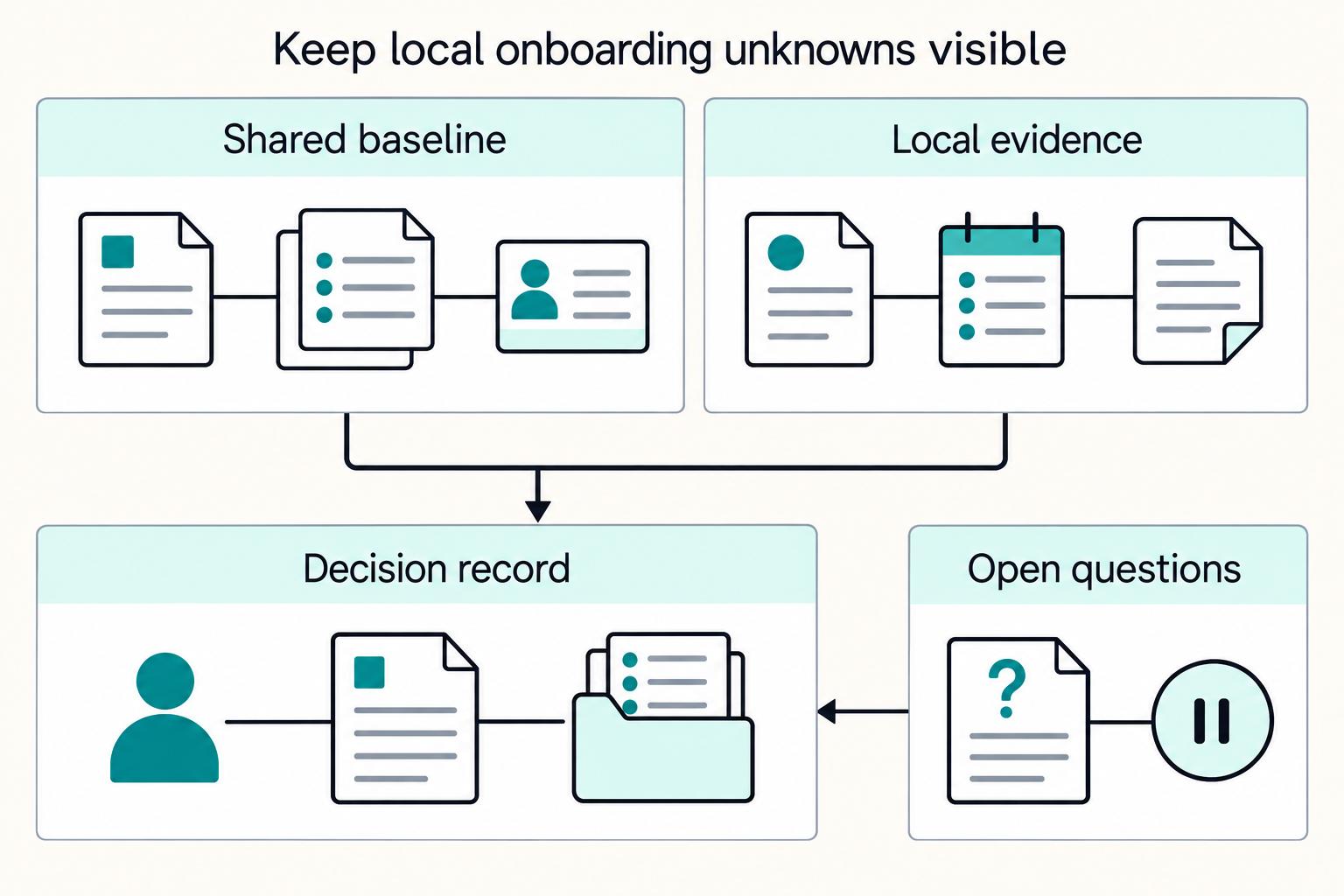
KYC KYB Requirements by Country for Platform Onboarding Decisions
A country label is only the start of a KYC/KYB decision. First identify the legal entity providing the service, its regulated activity, the customer type and the bank or payment program involved. Those facts determine which legal duties and contractual checks belong in the mapper.

Permanent Home Test in a Tax Treaty: Meaning, Evidence, and Tie-Breaker Rules
For the elite global professional, "permanent home" is not a term of comfort; it is a high-stakes legal definition that can trigger crippling double taxation. While other guides offer academic theory, this is a strategic playbook. We will transform your compliance anxiety into agency with a clear, three-step framework to audit your footprint, build your evidence, and early control your tax residency.

What is the 'Center of Vital Interests' in a Tax Treaty?
Start by making one defensible tax residency call based on facts, not on a preferred country outcome. Use the treaty tie-breaker in order, document why each step does or does not resolve residence, and stop at the first clear result.