
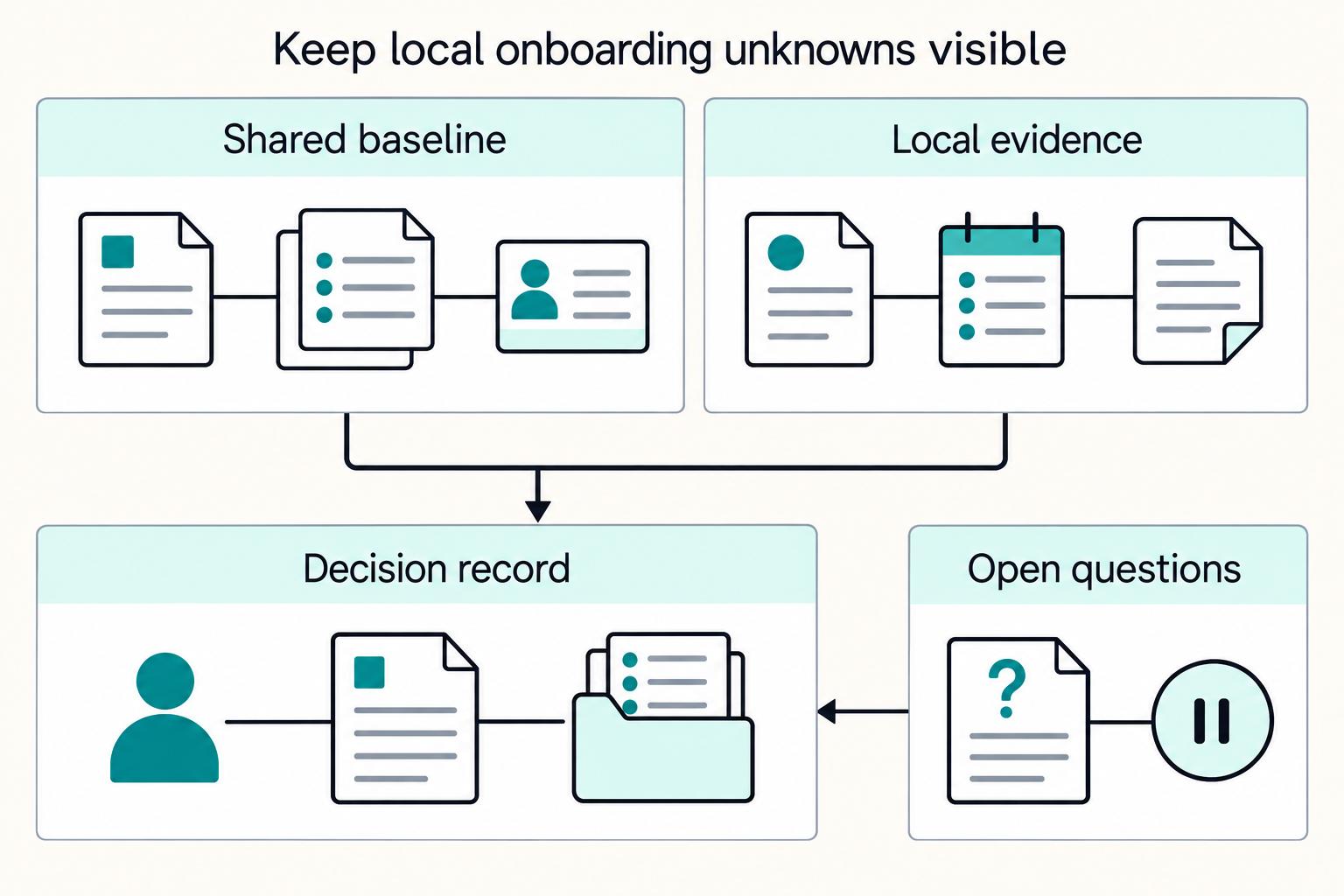
Quick Answer
Start with the service entity, regulated activity and customer type. Then map the legal and provider requirements for identity, business and ownership checks, risk review, reporting and permitted activity. Use separate U.S., Canadian, EU member-state and UK records with dated sources and policy owners. A draft profile is not permission to establish a regulated relationship, and an unresolved check does not always have the same reporting or payout consequence.
Use Country Requirements to Set Onboarding Rules#
A country label is only the start of a KYC/KYB decision. First identify the legal entity providing the service, its regulated activity, the customer type and the bank or payment program involved. Those facts determine which legal duties and contractual checks belong in the mapper.
Static checklists fail quietly#
KYC is commonly used for customer identity and due diligence; KYB emphasizes business identity, ownership and control. A bank’s Customer Identification Program, customer due diligence and suspicious activity reporting serve distinct purposes. Store their outcomes separately, and distinguish the platform’s work from decisions retained by its regulated provider.
| Branch | Scope to establish |
|---|---|
| United States | Covered bank or other regulated service, CIP/CDD and provider-program allocation |
| Canada | Reporting-entity sector and FINTRAC guidance for the activity |
| EU member state | Applicable national law, obliged-entity role and dated EU reforms |
| United Kingdom | Relevant supervisor, Money Laundering Regulations and sector guidance |
Give each applicable jurisdiction its own policy record, with the regulated role, legal basis, provider requirements, effective date and owner. One customer can involve several jurisdictions. An internal risk rule may be stricter than the applicable minimum, but label it as policy rather than law.
The mapper this article uses#
This guide uses one decision mapper across the United States, Canada, the European Union, and the United Kingdom. Before funds move, it helps finance, ops, and product teams decide:
- what to collect for the person, the business, and ownership
- what must be verified before a case moves forward
- what triggers escalation to higher scrutiny
- what must be logged before payout release
Approval gates and rejection paths should be explicit. "Account created" is not the same as "ready to pay out." A usable mapper gives each country clear status checkpoints such as ready to onboard, limited activity only, and ready to pay out. Each state should have a defined evidence bundle. If a requirement is unresolved, mark it as unknown or needs counsel instead of letting it become default production logic.
Operational failures are often quiet. A document gets uploaded but never reviewed, or risk data is split across tools and handled manually. That is why a document pack alone is not enough. Keep a single source of truth for each case and a visible payout status that tells downstream operations whether funds are blocked, limited, or clear to release. Where rules differ by regulator, program, or provider, confirm them with local counsel and your compliance owner before encoding them in product behavior.
For a practical baseline on customer checks, read What Is KYC? Know Your Customer Requirements for Payment Platforms.
Start with the terms your approval engine must distinguish#
Separate control types before you automate approvals. If KYC, KYB, CDD, EDD, CIP, and UBO checks all collapse into one generic "verified" state, you lose track of what was actually proven.
| Term | Definition |
|---|---|
| KYC | Customer identity verification and ongoing monitoring during the relationship |
| KYB | Business verification to establish entity legitimacy and risk |
| CDD | The baseline due diligence layer that includes KYC and KYB checks |
| EDD | Deeper review when baseline checks are not enough to clear risk |
| CIP | Collection of core identifying data to confirm identity |
| UBO checks | Review of ownership and control behind a business entity |
Keep CIP and UBO in separate decision-table slots because they answer different questions. CIP completion alone is not a finished business ownership review, and an ownership tree on file does not mean identity checks are complete.
Use separate statuses for identity, business verification, ownership, baseline due diligence and elevated-risk review. Record why a case is waiting and who must act next; set service targets from your provider’s commitments and observed queue performance.
If a requirement cannot be mapped to one control type, identity, ownership, risk escalation, or reporting, pause rollout and resolve control ownership first. Related reading: What Is KYB? Know Your Business Verification for Marketplace Onboarding.
Build one country mapper with a global baseline and local overlays#
Use one country mapper with a shared baseline and explicit local overlays. That way, unresolved local requirements create controlled holds instead of silent approvals.
Use rows for a jurisdiction and program, not just a country. Include the regulated service entity, customer type, legal basis, evidence methods, ownership rule, risk triggers, reporting owner, permitted activity and review date. Make internal requirements and provider conditions visible alongside legal duties.
| Field | Example entry | Decision use |
|---|---|---|
| Jurisdiction and program | U.S. bank program for a corporate customer | Identify which entity owns each legal duty |
| Evidence rule | Accepted entity record and required ownership information | Test the actual program checklist |
| Risk trigger | Unexplained ownership link | Assign risk review, without treating every defect as suspicion |
| Permitted activity | Draft only while verification is pending | Enforce relationship and payout limits separately |
| Reporting | Restricted review by designated owner | Keep legal reporting decisions separate from release approval |
| Policy version | Effective date, source and approver | Reassess affected cases when rules change |
Use internal checkpoint labels that are evidence-based and separate from regulator wording:
- Ready to onboard: person identity result, business verification result, beneficial ownership structure, and baseline CDD decision recorded.
- Ready for limited activity: baseline complete, ownership gaps resolved, and any escalation constraints documented.
- Ready to pay out: baseline complete, local overlay obligations resolved, and payout decision linked to case evidence.
Add applicability before thresholds. A reporting rule must name the covered entity, activity and trigger. Do not use a customer’s tax or foreign-account reporting as a routine KYC gate. Where another obligation genuinely affects the flow, track it separately with its owner and legal basis.
Keep reporting in a restricted workstream. A report being prepared, filed or acknowledged does not itself approve onboarding or payout. Due diligence, suspicious-reporting decisions and permission to move funds need separate records.
Map United States onboarding controls before payout enablement#
For a covered U.S. bank, the written CIP sets risk-based identity verification and procedures for cases where identity cannot be verified. A marketplace using that bank should map which data it collects under the program and which decisions remain with the bank.
| Decision | Record to retain |
|---|---|
| Draft profile | Collected evidence and open requirements |
| Relationship permitted | Applicable program decision and any documented limitation |
| Payout permitted | Current permission, evidence reference and release controls |
| Reporting assessment | Restricted rationale, designated owner and required filing status |
For covered financial institutions, FinCEN’s February 13, 2026 relief removes automatic beneficial-owner re-verification at every subsequent account opening. Initial account opening, doubts about existing information and risk-based ongoing requirements still matter. This is not a general exemption from due diligence.
Keep bank beneficial-ownership checks distinct from corporate ownership filings and FBAR. Those are separate regimes; FBAR filing status is not the U.S. customer-verification test. Record the applicable account-opening requirements and the provider’s decision rather than inserting a tax-report acknowledgement into the payout gate.
An unresolved identity or ownership issue should follow the provider’s documented procedure. Record whether the relationship may be opened, limited or must be refused, and who can authorize each state. A platform-created profile is not proof that the regulated relationship may start.
For a step-by-step walkthrough, see KYC KYB CIP Explained for Cross-Border Freelancers and Small Teams.
Map Canada controls without copying US assumptions#
For Canada, identify whether the service entity is a FINTRAC reporting entity and which sector guidance applies. Use the full legal reference: Proceeds of Crime (Money Laundering) and Terrorist Financing Act. Provider-program requirements can also apply to a platform that is not itself a reporting entity.
FINTRAC’s beneficial-ownership guidance requires relevant reporting entities to obtain ownership information when verifying an entity and take reasonable measures to confirm its accuracy. For corporations, the record includes directors and names and addresses of individuals owning or controlling at least 25%, directly or indirectly. Trusts and other structures have different rules.
From October 1, 2025, the guidance also requires database comparison for high-risk corporations incorporated under the Canada Business Corporations Act; material discrepancies must be reported within 30 days. Put the assessed risk, database result and any required report in the applicable Canadian program record.
Reporting thresholds are transaction- and sector-specific. For relevant entities, certain international electronic funds transfers of CAD 10,000 or more are reportable, with aggregation rules also relevant. Do not turn that into “all transactions over CAD 10,000” or a universal identity-verification threshold.
Keep the sector, requirement, evidence method, risk assessment and decision rationale with the case. A draft profile may collect evidence while review is open; any regulated relationship or activity must follow the applicable timing rules.
Handle European Union and United Kingdom divergence early#
Separate EU member-state rules and the UK branch. The EU supplies a legislative framework, but current onboarding duties must be mapped to the applicable national law and regulated role. Record future changes with their application dates rather than applying them early.
Encode the EU baseline you can support now#
For obliged entities, map customer identity, beneficial ownership, the purpose of the relationship and ongoing monitoring under the applicable national rules. Keep suspicion-reporting decisions in a restricted workflow. A software checklist should reflect the entity’s actual duties, not assume every platform is an obliged entity.
Compare directives conservatively#
Distinguish the current framework from scheduled reforms. Confirm the provision, national implementation and application date before changing production policy.
| Framework | Mapper treatment |
|---|---|
| Directive 2015/849 as amended, including Directive 2018/843 | Map the national rules currently applicable to the entity and activity |
| Regulation (EU) 2024/1624 and Directive (EU) 2024/1640 | Track the new package and its dated transition; do not treat adoption as immediate application of every onboarding rule |
Separate EU-level context from local enforcement decisions#
Identify the relevant national supervisor and financial intelligence unit for the regulated activity. Do not infer case approval authority from a general EU institutional overview. Store who owns interpretation and who can approve the operating rule.
Where financial-information access is delayed or incomplete, treat the case as unresolved. Log the gap, hold release, and require reviewer signoff before any status change.
Put the United Kingdom in its own branch#
For HMRC-supervised businesses, the UK guidance calls for customer and applicable beneficial-owner identification, verification, risk assessment, monitoring and retained records. CDD generally precedes the relationship or transaction; its limited timing exception does not allow routine delays because verification is difficult. Map the relevant supervisor and sector rather than importing an EU template.
Set decision rules for CDD EDD escalation and payout holds#
Separate evidence collection, permission to establish the relationship and payout permission. Incomplete files and higher-risk cases may need different review paths. Limited activity is allowed only when the governing rules and provider program permit it, not merely because the platform has blocked payout.
KYC controls sit inside a broader AML/CFT control set that includes CDD, EDD, monitoring, suspicious reporting, and recordkeeping. A single approved flag can hide unresolved risk and make payout decisions harder to defend.
Write the escalation logic as product rules#
Encode explicit if/then transitions so product, ops, and compliance all see the same state:
| Signal | First review | Activity decision |
|---|---|---|
| Payment name mismatch | Check account ownership and any authorized arrangement | Restrict the affected flow if policy requires; escalate unexplained risk |
| Location anomaly | Assess evidence; a VPN alone does not establish wrongdoing | Follow documented risk rules |
| Account takeover signal | Route to security/fraud response and compliance where relevant | Protect the affected account while investigating |
| Possible PEP match | Confirm identity, relevant role and applicable risk treatment | Apply required enhanced measures and authorized approval |
Store both the trigger and the response. EDD required alone is not enough. Keep the trigger source, reviewer, requested evidence, hold reason, and next decision point in the same record.
Make the hold visible and practical#
Show operations the action needed and the affected activity, with stage-based queue targets. Keep confidential investigations and SAR/STR information restricted; a useful customer-facing status does not need to reveal the reporting decision.
Match the review to the risk. A name mismatch may be explained by an authorized third-party arrangement; a possible PEP match needs identity and role confirmation before the applicable risk treatment. Store the evidence and authorized decision, and clear only the activity that decision permits.
Tie EDD outcomes to suspicious reporting#
Route potential suspicion to the designated reporting owner for the applicable legal test. Unresolved EDD is not automatically a SAR or STR, and filing one does not by itself authorize release or require every payout to remain blocked. Decide permitted activity separately under law, provider rules and any applicable consent requirement.
Assign ownership explicitly: MLRO, or equivalent, for suspicious-reporting decisions, and product or ops for hold enforcement. Avoid country-only escalation logic. Compliance interpretation can vary within the same country, so include regulator-level or program-level handoff fields where needed.
Keep the release gate simple. Do not release payout until the required due-diligence artifacts for that program are complete, verified, and attached to the decision record that shows why the case passed CDD or exited EDD.
For launch planning, see Payment Method Coverage by Country for Launch-Ready Global Platforms. If you are formalizing release gates, turn the if/then escalation rules into implementation tasks with Gruv Docs.
Define the KYB evidence pack for entity and UBO verification#
A business evidence pack should establish the applicant’s legal identity and status, who may act for it, and who owns or controls it under the applicable rule. A sole proprietor is not a corporation; tailor entity evidence to the actual structure.
Tie the pack to approval states#
Map each artifact to a specific KYB state. Do not move a case to ready to onboard or ready to pay out based on a single clean registry hit.
| Evidence component | What it should prove | Failure that should return to remediation |
|---|---|---|
| Entity registration proof | The applicant’s legal identity and status for its entity type | Registry extract or document does not match the legal entity being onboarded |
| Control-person records | Directors, authorized signatories, or equivalent transacting or instructing persons are identified | Signatory data is missing, stale, or tied to a parent or affiliate instead of the applicant entity |
| UBO/controller evidence | Real owners or controllers can be traced and reviewed | Ownership chain stops at an intermediate or offshore layer without a supporting structure chart |
| Company and owner screening results | Required subjects were screened under the applicable sanctions and risk policy | Screening covers only the company, not owners or controllers |
A registry hit is one input. Verify it belongs to the applicant and assess the ownership, authority and activity evidence required by the program.
Add local extensions only where they belong#
Companies House mandatory identity verification began on 18 November 2025, with a 12-month transition for existing directors and PSCs to meet their individual due dates. Check the current deadline and status for the person involved. Registry verification does not replace the separate checks a bank or obliged business must perform.
Apply the same pattern to ownership-reporting contexts where Beneficial Ownership Information (BOI) reporting is relevant. Add a separate extension only where your customer type, product, or jurisdiction makes it relevant. Do not treat BOI as universal across all markets.
Keep tax and banking documents in scope#
Treat tax documentation as context-specific, not universal KYB requirements. Apply the same scope discipline to bank Customer Identification Program (CIP) materials. In the FFIEC context, written CIP requirements are tied to covered banks. This keeps collection focused on business-verification decisions and prevents document sprawl.
Enforce evidence quality before review time gets wasted#
Set one non-negotiable gate: evidence must be current, readable, and attributable to the exact legal entity being onboarded. If any check fails, return the case to remediation before analyst review.
For a complex ownership chain, request the layers needed to reach the relevant natural persons and explain their control. Collect identity and address evidence according to the program’s accepted methods and exceptions. Avoid asking for every possible document when the actual gap is a missing link in ownership.
Plan failure handling before volume exposes gaps#
Set failure handling before queues scale. Assign each recurring defect to one next action and one review clock so avoidable evidence issues do not turn into downstream operational delays.
Use a practical split. Some failures are evidence-refresh problems, some need analyst judgment, and some must stay blocked until risk is resolved. That split matters because onboarding often runs parallel checks on the business entity and controlling individuals, so one unresolved break can delay the full case.
Map a failure taxonomy to one next action#
Use a short example taxonomy as a working policy across product, ops, and compliance:
| Failure pattern | Verify first | Default path | What to request |
|---|---|---|---|
| Identity mismatch | Whether the accepted evidence method supports the claimed identity | Manual review for conflicting attributes; re-submission for unreadable or incorrect files | Corrected data or accepted identity evidence; liveness only where required |
| Entity name mismatch | Whether the application legal name matches submitted business identity evidence | Re-submission first; manual review for explainable name differences | Business identity evidence and supporting name-link proof where needed |
| Incomplete UBO chain | Whether ownership or control is traceable to ultimate beneficial owners or controllers | Remediation first, then manual review for complex structures | Ownership and control evidence by layer |
| Unresolved EDD flags | Whether higher-risk indicators remain open after baseline checks | Hold for risk review; reject with a clear reason if risk cannot be cleared | Requested EDD evidence for relevant controllers or beneficiaries |
| Stale documentation | Whether records are current and attributable to the exact entity or person | Retry retrieval errors; otherwise re-submission | Fresh, current versions of outdated records |
Verify the exact defect before requesting more evidence. Give specific remediation instructions when permitted, but keep suspicious-reporting information and protected investigation details out of customer messages.
Treat EDD and UBO breaks differently from basic document defects#
Route document defects differently from risk defects. A stale or unreadable file is often a collection issue. Unresolved EDD and broken UBO tracing are risk-review issues.
Clock document retrieval, analyst review and escalated risk decisions separately. Use actual queue data and provider commitments to set expectations rather than promise a generic completion time.
Add SLA checkpoints that expose queue health#
Use stage-based checkpoints instead of one total-case timer:
- Intake check: evidence is readable, current, and tied to the exact entity or person.
- Baseline verification check: core KYC, KYB, sanctions, PEP, and ownership checks are complete for standard review.
- Escalation check: EDD and incomplete-UBO cases are separated and clocked independently.
Track queue age by stage. If delay clusters in intake, improve document collection and remediation prompts. If delay clusters in escalation, adjust risk-review capacity and escalation handling. For the full breakdown, read State of Platform Onboarding Benchmarks for KYB and First Payout.
Connect compliance decisions to ledger and payout operations#
Compliance decisions need to drive ledger and payout behavior from the same record chain, or you risk approving one state and paying out another. Treat every KYC, KYB, and due-diligence decision as an operational event, not just a note in a provider dashboard.
Keep onboarding status, payout status, and hold reason visible together. API integrations can monitor real-time counterparty data changes; when a compliance event indicates a status change, your payments stack should show which internal account or merchant record changed. It should also show whether payout was enabled or held, and why. If ops must check multiple tools to answer "why was this seller paid?" or "why is this seller still blocked?", control is weak.
Make decision states visible where money moves#
Persist an internal compliance state alongside the payout state, and link both to the ledger subject they control. You may not have one single required schema, but you do need consistent identifiers. The checkpoint is traceability: from a provider event or analyst decision to the exact ledger account, balance owner, or payout profile, and back again without guesswork.
Watch for status drift. One pattern is onboarding marked approved while payout stays blocked because a hold reason was not propagated. The opposite pattern is payout active while the latest compliance decision remains blocked. If either appears in testing, fix the state mapping instead of relying on manual notes.
Make retries replay safely#
Deduplicate provider events and analyst actions using stable identifiers, and apply state versions or current-provider-state checks so an older approval cannot overwrite a newer hold. Update the decision and its audit record together. At payout release, check the current permitted state; event deduplication alone does not prevent duplicate payment instructions.
Keep an audit trail that works for reconciliation#
Your audit trail should connect evidence, decisioning, and payout outcomes. Store the KYC or KYB evidence reference, decision timestamp, provider reference, hold or release reason, and the payout release event. An audit trail is the full logged history of activity and communications, not just a document folder.
Restrict personal evidence and suspicious-reporting material to authorized roles. Keep an exportable change history for compliance review while giving operations only the fields needed to enforce the permitted activity.
Add one monthly control check#
This is a practical control, not a universal legal mandate. Each month, sample approved and blocked cases and verify:
- evidence is readable, attributable to the correct person or entity, and consistent with the recorded decision
- decision logs include timestamps, provider references, and version history when decisions changed
- payout behavior matched decisions, including holds, releases, and blocked disbursement attempts
Treat mismatches as a compliance-to-ledger control failure, not a documentation cleanup task.
Turn the mapper into an operating control#
Use the mapper to record permitted activity and its basis. A draft profile, an established regulated relationship and a payout-enabled account are distinct states. Missing requirements must lead to the action the governing rule specifies, not automatically to “onboard now, block payout later”.
Use a shared field structure, then map every applicable legal and program difference: scope, evidence methods, ownership rules, timing, reporting, retention and permitted activity. Keep identity, business and ownership outcomes separate so one completed check does not hide another unresolved requirement.
If identity, entity or required ownership checks are unresolved, retain the draft status and follow the applicable refusal, restriction or remediation procedure. A payout hold is one possible control; it does not make an otherwise prohibited relationship permissible.
Use evidence consistency as a hard checkpoint. If person, entity, and ownership details do not tell one coherent story, escalate. Those gaps create financial, regulatory, and reputational risk.
Keep policy language current as requirements evolve. When country detail is unresolved, mark it as a controlled unknown and hold a stricter path until compliance and legal owners decide. Unknown should be an explicit mapper state, not an accidental approval route.
Related: The Compliance Cost of Going Global: What Platforms Spend on Tax KYC and Licensing Per Country. When your country mapper is stable, validate it against real payout states and hold logic with Gruv Payouts.
Frequently Asked Questions
What is the practical difference between KYC and KYB in country-based onboarding?
KYC focuses on the individual: confirming identity and assessing customer risk. KYB focuses on the business: confirming the entity and verifying ownership and control, including UBO checks. In country-based onboarding, friction can appear when person-level checks are treated as sufficient before business ownership verification is complete.
Which onboarding checks are universal, and which must be country-specific?
Identity, entity, ownership and risk review are common control categories. Their applicability, accepted methods, exemptions, timing and retention differ by regulated role and jurisdiction. Standardize the field structure, then map the actual legal and program rule.
How do United States, Canada, European Union, and United Kingdom requirements differ in day-to-day operations?
Start with regulated role and activity. U.S. bank CIP and CDD rules differ from Canadian FINTRAC sector requirements; EU duties depend on applicable national law, and the UK has its own regulations and supervision. Keep ownership thresholds, reporting triggers and permitted activity in distinct fields rather than infer them from a country label.
When should a platform escalate from CDD to EDD instead of collecting more basic documents?
Escalate from CDD to EDD when the risk profile increases, not only when a file is incomplete. Typical triggers can include higher-risk customers, suspicious behavior, or ownership structures that remain unclear after basic checks. When that happens, move to higher-scrutiny review and document the risk reason.
What documents and ownership proofs should be mandatory for business onboarding and UBO verification?
There is no single document checklist that applies unchanged across countries. A practical baseline is entity verification evidence, ownership or control information, and identity evidence for relevant control persons or UBOs. Prefer registry-sourced, time-stamped records where available, and flag cases for remediation when entity and ownership details do not align clearly.
Do IRS approved KYC rule lists apply to all platforms or only specific contexts such as QI arrangements?
Treat IRS KYC rule lists as context-specific, not universal onboarding requirements. They may apply in specific tax or withholding contexts, such as QI arrangements, rather than across all platform models. Before adopting them, confirm they match your product, jurisdiction, and operating context.
Try a related tool
Researched and edited by the Gruv editorial team. Gruv builds cross-border billing, payouts, and finance-operations software for global businesses.
Sources
Includes 4 external sources outside the trusted-domain allowlist.
- bsaaml.ffiec.gov/manual/AssessingComplianceWithBSARegulatoryR...trusted
- finance.ec.europa.eu/financial-crime/anti-money-laundering-and-co...trusted
- fincen.gov/news/news-releases/fincen-issues-exceptive-r...trusted
- fintrac-canafe.canada.ca/guidance-directives/client-clientele/bor-engexternal
- fintrac-canafe.canada.ca/guidance-directives/transaction-operation/ef...external
- gov.uk/hmrc-internal-manuals/anti-money-laundering-...external
- gov.uk/guidance/verify-your-identity-for-companies-...external
Educational content only. Not legal, tax, or financial advice.
Related Posts
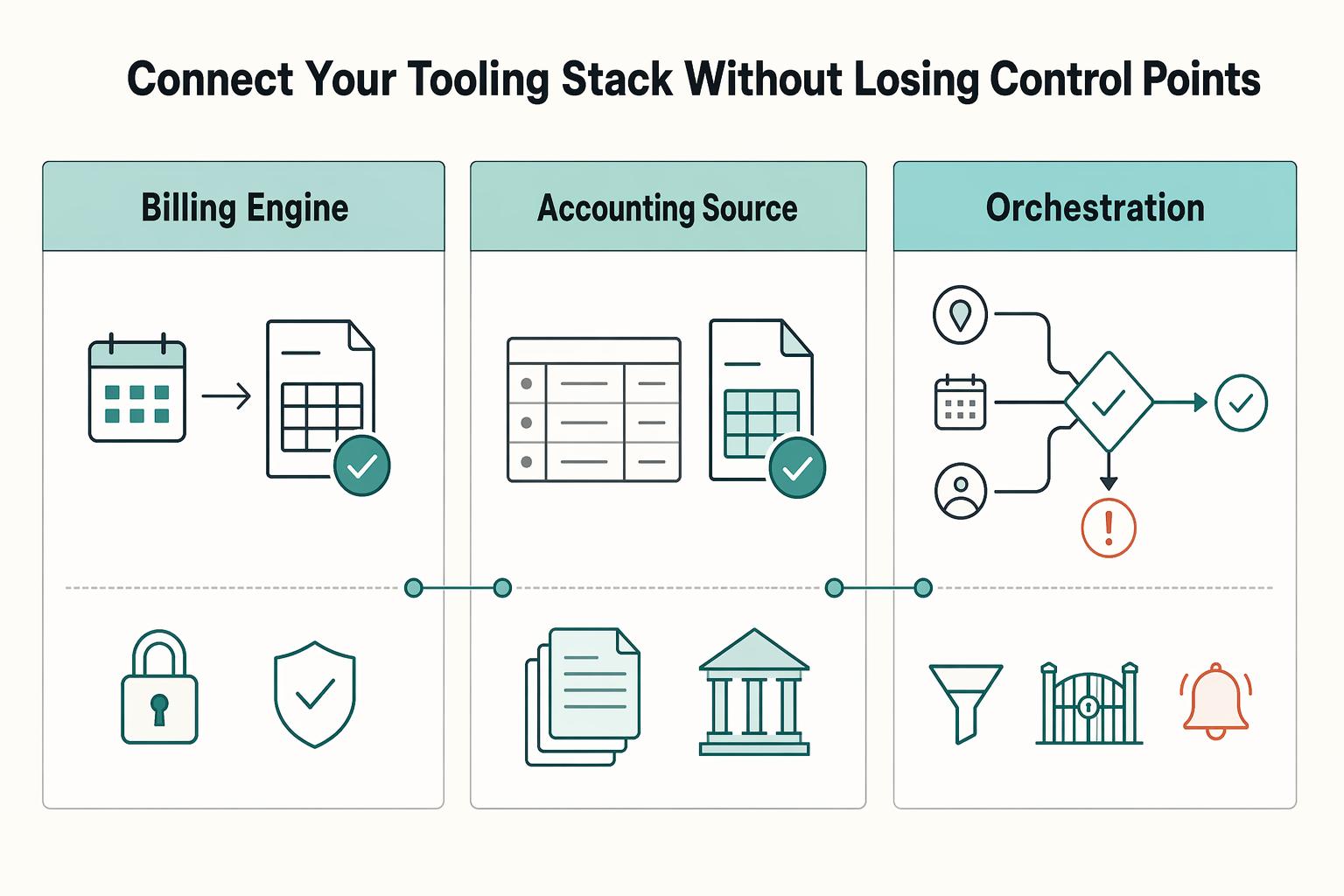
How to Automate Marketplace Late Fees by Country
A marketplace cannot choose a late-payment charge from the buyer’s country alone. It must identify the creditor, debtor, applicable law, contract terms and default date, then calculate the claim on the correct outstanding amount. A seller’s statutory interest is not automatically platform revenue, and an overdue invoice does not authorize an extra off-session card charge.

What Platforms Spend Per Country to Stay Compliant in Global Expansion
Per-country compliance cost planning starts with the operating model, and that choice needs to happen early. Use this guide if you are a compliance, legal, finance, or risk owner making country launch decisions before go-live. It helps you test assumptions before they turn into delays, rework, or avoidable spend.
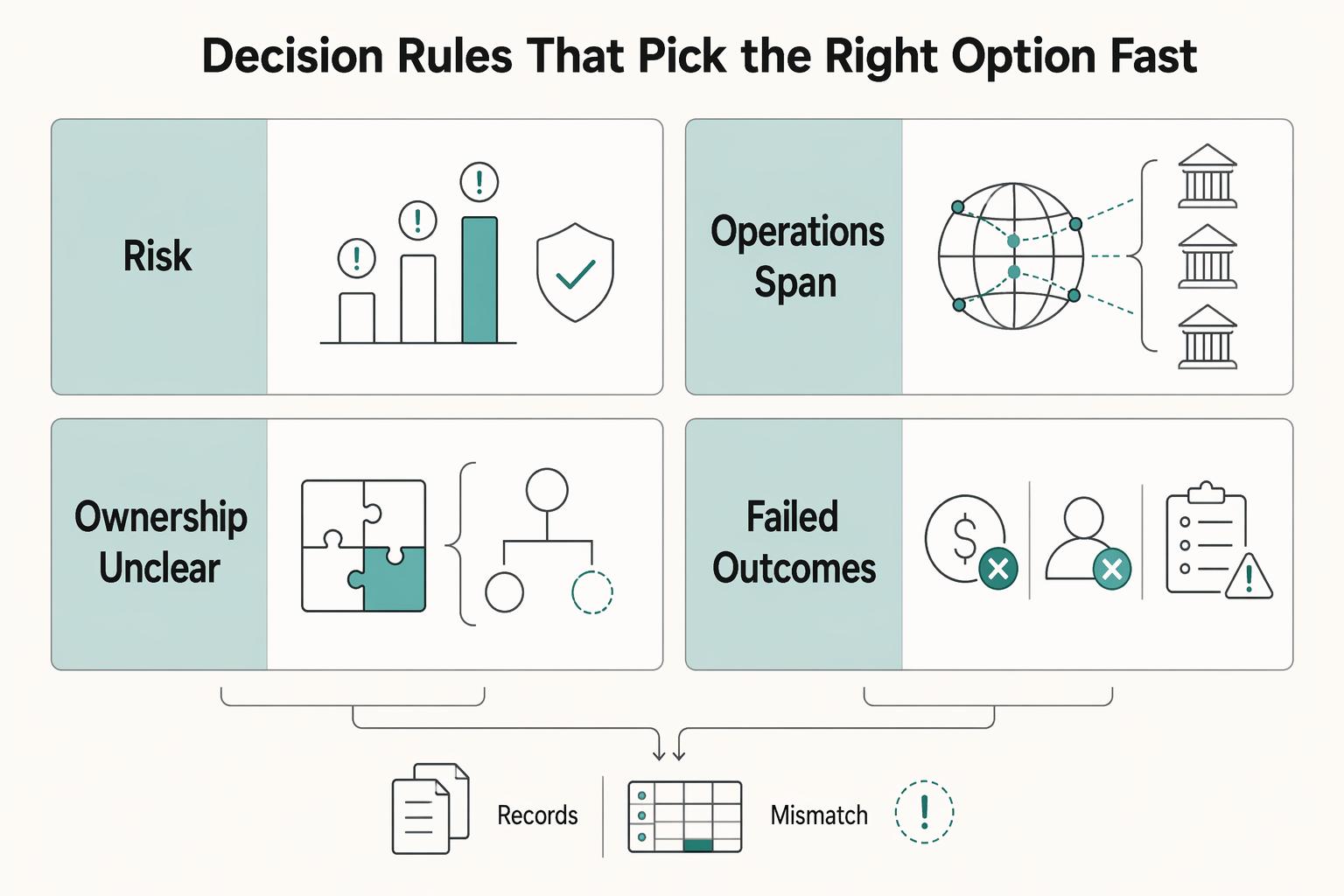
What Is KYC? Know Your Customer Requirements for Payment Platforms
For payment platforms, KYC scope is a product and operations decision, not just a paperwork step. The real question is where identity checks happen, how much manual review your team can absorb, and what you do when a person or business does not pass cleanly.