
Quick Answer
Identify the creditor and applicable law, establish default and use the approved annual rate on the correct unpaid principal. Keep interest and recovery compensation separate. Issue claims through a supported document path, prevent duplicate assessment and preserve principal collection when automatic fees are disabled.
Automate the creditor’s approved claim, not a global late-fee toggle#
A marketplace cannot choose a late-payment charge from the buyer’s country alone. It must identify the creditor, debtor, applicable law, contract terms and default date, then calculate the claim on the correct outstanding amount. A seller’s statutory interest is not automatically platform revenue, and an overdue invoice does not authorize an extra off-session card charge.
The six steps below show how to configure that decision, with UK and German examples and a hypothetical partial-payment calculation. They cover commercial invoice debts, not consumer credit or every country. Enable only the reviewed transaction scope. Keep lawful principal reminders running when automatic fee assessment is disabled; collecting principal does not depend on creating a fee.
Step 1: Identify the creditor and applicable transaction rules#
Start with the contracting supplier and customer, their legal entities, governing-law clause, relevant locations and the transaction’s commercial or consumer status. Cross-border mandatory rules and jurisdiction questions can override a convenient country tag. Record the legal determination for the actual arrangement rather than selecting a rule from billing address, currency or card issuer alone.
Determine whether the platform is the creditor, an authorized collection agent for the seller, or a purchaser/assignee of the receivable. Keep the underlying invoice and authority attached. A marketplace take rate on ordinary sales does not create a right to retain statutory interest or recovery compensation. Any platform share needs its own valid agreement and accounting treatment.
For illustration, assume Seller A remains creditor and the platform only administers collection. The platform keeps seller principal, seller interest and seller recovery compensation distinct from its own service fees. It cannot waive Seller A’s claim merely because support has an adjustment button. Define who may authorize a concession, how the customer is told and how any seller balance changes.
Resolve tax treatment, invoice-document requirements and accounting recognition for interest versus compensation versus any platform service before posting. A calculated entitlement, a recognized receivable and received cash are separate events. The examples below assume approved recognition; they do not supply a universal tax or revenue-recognition policy.
Step 2: Encode real country rules and default triggers#
UK government guidance describes statutory B2B interest as 8 percentage points plus the Bank of England base rate. It says statutory interest cannot be claimed where the contract has a different interest rate. Do not stack contractual and statutory interest as two charges for the same period. Public-authority rules also require separate treatment.
The 2002 rate order for England, Wales and Northern Ireland uses the official dealing rate on June 30 for interest starting in July–December, or December 31 for interest starting in January–June. Store the applicable reference date and debt’s interest-start determination. Do not substitute today’s Bank Rate each night. Confirm the governing instrument for the relevant UK jurisdiction, including Scotland, before enabling it.
The UK timing guidance says that absent an agreed date, payment becomes late 30 days after invoice receipt or delivery of goods/services, whichever is later. Record those events rather than using invoice issue date automatically. An internal grace period is a separate commercial collection choice; specify whether it delays demanding interest or changes what your approved policy claims.
UK recovery compensation is separate: £40 below £1,000, £70 from £1,000 to £9,999.99 and £100 from £10,000. The guidance permits the fixed charge once for each payment. Do not recreate it every reminder or monthly interest statement; have the reviewed policy identify the qualifying debt/payment and band basis.
In Germany, BGB §286 governs default. A demand after maturity is one route, with specified exceptions such as a calendar-defined payment time. The 30-day route depends on maturity and invoice receipt; for consumers it requires the prescribed warning. Also evaluate the rule’s responsibility exception. A system-generated due date alone does not prove every debt has entered default.
BGB §288 provides nine percentage points above the basic rate for remuneration claims in transactions with no consumer involved. Its €40 compensation requires a non-consumer debtor and is credited against qualifying legal-recovery damages. Consumer cases do not inherit that B2B combination. Keep additional damages, fixed compensation and interest as distinct claim types rather than duplicating recovery costs.
Bundesbank’s June 30, 2026 announcement sets the basic rate at 1.52% from July 1, 2026, making that B2B statutory rate 10.52% annually for the period. The basic rate changes on January 1 and July 1. Segment an ongoing German calculation at applicable rate changes; this differs from the UK interest-start reference mechanism above.
BGB §289 prohibits default interest on interest. Configure the approved principal base separately from accumulated interest and compensation. For other countries and US state-specific transactions, keep automatic fees off until the actual law, contract and transaction scope have a complete reviewed configuration. No global monthly percentage follows from these two examples.
Step 3: Store the calculation and approval fields explicitly#
| Rule field | Required decision |
|---|---|
| Scope and authority | Creditor/debtor, commercial status, applicable law and collection authority |
| Default trigger | Maturity, receipt/delivery, required demand/notice and exclusions |
| Rate | Annual percentage, statutory/contractual basis, reference date and effective periods |
| Calculation basis | Eligible unpaid principal, allocation rules, simple interest, day count and rounding |
| Compensation | Separate entitlement, band/amount, unique qualifying debt and recovery-cost offset |
| Collection policy | Grace, disputes, demand timing, waiver authority and customer notice |
| Posting | Creditor/entity, document type, ledger treatment, tax decision and reversal path |
| Version | Source, reviewer, effective date, enablement scope and blocked reason |
Approve the full row with the people accountable for legal interpretation and financial treatment. Version it and retain the sources used. A rule with unknown default timing, creditor ownership or calculation base remains disabled. Its unresolved field should state the missing decision; a percentage and country name alone are insufficient.
Define time zones, counted calendar days, start/end inclusivity and leap-year handling. Use full precision during calculation and a specified rounding point. The worked example uses a non-leap 2026 period and actual days divided by 365, with each segment’s start included and end excluded. Do not assume a vendor’s monthly percentage, 30-day convention or daily rounded amount reproduces an annual statutory calculation.
Configure payment allocation as well as payment amount. BGB §367 generally allocates an insufficient payment to costs, then interest, then principal; an alternative debtor allocation has its own acceptance consequences. Never subtract the full incoming payment from interest-bearing principal without checking the applicable allocation and actual record.
Step 4: Calculate a partial-payment claim without double counting#
Assume a reviewed German B2B €1,000 remuneration claim is already in default at the start of September 1, 2026. Assume no applicable exception, higher contractual rate or dispute, and that the creditor accepts an express €500 principal allocation at the start of September 11. These are hypothetical facts. The accepted allocation is why principal falls to €500; it is not the default allocation for every German payment.
| Period, end excluded | Principal | Annual rate | Days | Unrounded interest |
|---|---|---|---|---|
| September 1–11 | €1,000 | 10.52% | 10 | €2.88219178 |
| September 11–21 | €500 | 10.52% | 10 | €1.44109589 |
Interest is €1,000 × 0.1052 × 10/365 plus €500 × 0.1052 × 10/365 = €4.32328767, rounded once to €4.32. If the one qualifying €40 compensation claim is approved and has not already been assessed, the remaining demand at September 21 is €500 principal + €4.32 interest + €40 compensation = €544.32. This does not apply 10.52% to a full year or charge interest on the €40.
Store the two principal segments, accepted allocation, rate source, date interval and compensation identity with the calculation. If a late-arriving receipt shows that principal was paid earlier, recompute the affected segments and issue the difference as a correction. A rule version change explains the correction; it does not create another €40 claim.
For an approved UK claim, use its own applicable annual rate and fixed-compensation band, not the German 10.52% or €40. GOV.UK illustrates annual interest divided by 365. A flat recovery amount and daily interest can coexist when the actual law permits both, but neither is an automatically recurring monthly late fee.
Step 5: Issue the claim through a supported document path#
Stripe’s finalized-invoice documentation says fields related to the amount generally become immutable after finalization. An overdue finalized invoice therefore cannot universally receive a new late-fee line. For this proposed implementation, create a separate approved interest/compensation invoice or other legally appropriate document, linked to the original debt and creditor. UK guidance also directs sending a new invoice when claiming interest.
Create the additional document in draft, validate the amount, allocation, creditor and tax treatment, then finalize/send it through the supported billing path. Keep the original principal invoice intact. Use the real creditor’s billing arrangement: a platform’s own customer invoice does not automatically represent the seller’s legal claim. Any automatic debit also needs the applicable customer authorization and provider support.
Give each claim a durable business identity tied to the creditor, underlying debt, claim type and assessment interval. Protect the write atomically against duplicate or overlapping intervals, and keep cumulative assessed interest distinct from the new incremental amount. A job rerun or webhook duplicate must return the existing claim, not create another document.
Stripe’s idempotency documentation allows keys to be removed after at least 24 hours and treats reuse after pruning as a new request. Keep internal uniqueness and external references beyond the provider key’s lifetime. If creation times out, recover the original result before using a new key; otherwise two valid external invoices can exist for the same claim.
For Seller A’s €44.32 additional claim, an illustrative platform-agent subledger can record €44.32 receivable from the buyer and €44.32 payable to Seller A once approved recognition conditions are met. On collection, cash increases and that receivable clears; remitting to Seller A clears the payable. These entries describe an assumed agency arrangement, not platform fee revenue or a universal balance-sheet presentation. Avoid booking the same claim again when it syncs into accounting.
Stripe credit notes reduce an open or paid invoice without replacing the original. For a wrong unpaid interest charge of €4.32, a supported credit note on the additional document reduces that claim while preserving the €40 item and principal record, if those remain valid. Under the illustrative agency posting, reverse the matching €4.32 receivable/payable. Follow the provider’s pending-payment restrictions before issuing the correction.
If the charge was already collected, the correction also needs the appropriate refund or customer-credit treatment; a credit document alone is not proof cash returned. Link the original claim, correction, payment/refund and any seller remittance adjustment. Distinguish an error correction from a valid claim that the creditor voluntarily waives, and retain approver and reason for each.
Step 6: Keep principal collection and fee controls coordinated#
Continue lawful principal reminders while an automatic fee rule is unknown or disabled. Messages must separate principal, interest and compensation, show the period and basis, and avoid asserting unapproved charges. A disputed fee can have an item-level collection pause without inventing a pause on every undisputed obligation. Document whether accrual continues during review under the applicable rule and approved policy.
Stop demands for amounts actually paid, credited or waived. A pending bank payment needs review before escalation or another debit. A paid status produced by a full credit note does not mean cash was collected: distinguish payment, credit, waiver and write-off in collection reporting and reconciliation.
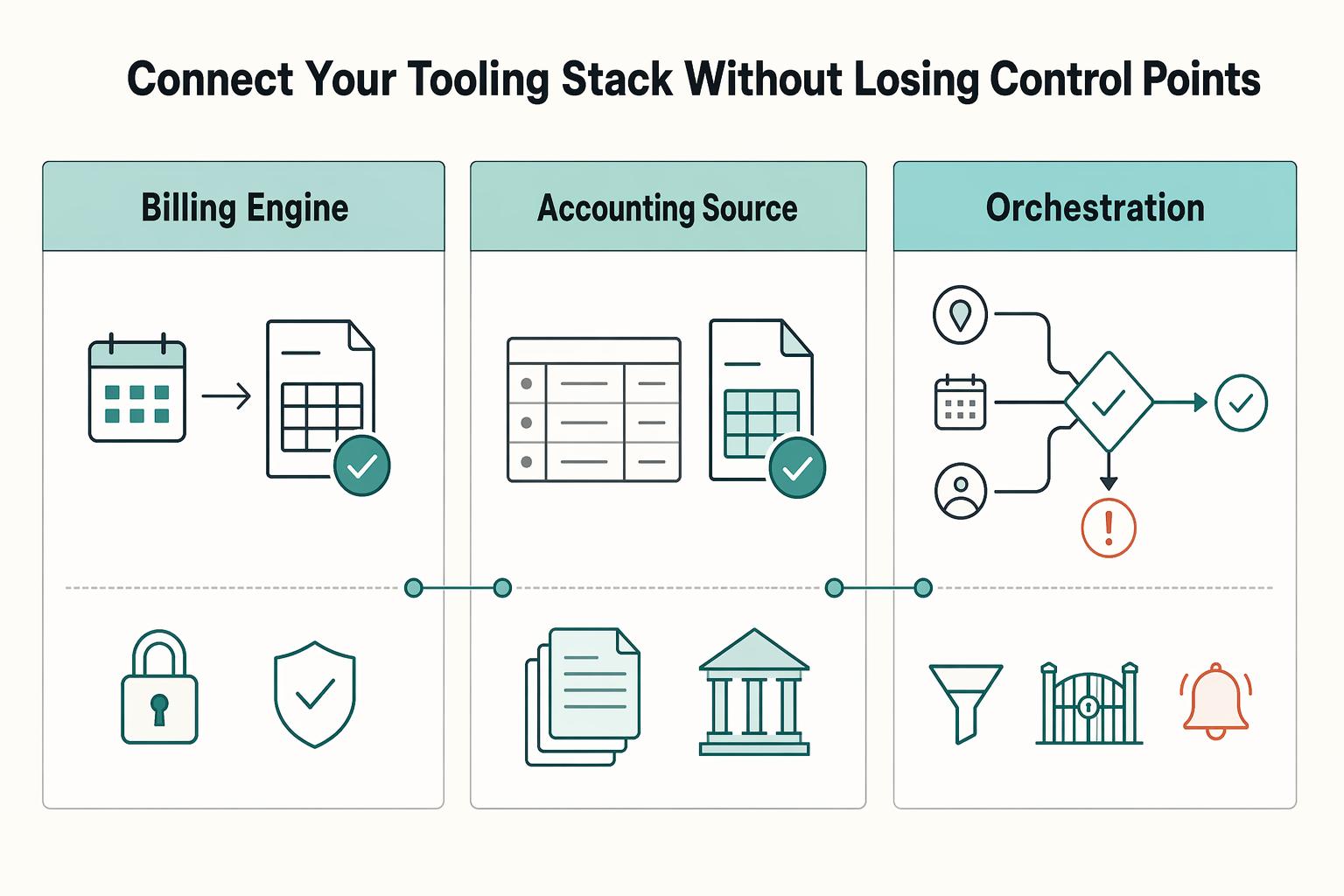
The diagram separates conceptual system roles; it does not certify vendor functionality. The approved rule decides entitlement and amount, billing creates the supported document, accounting records the treatment, and orchestration routes events through those controls. Give every layer the same creditor, claim and document identifiers. Record blocked attempts and sync failures so a successful automation run is not mistaken for a posted or collected claim.
Before enabling a scope, exercise default not established, consumer exclusions, rate changes, partial payments with differing allocation, duplicate assessment, overlapping intervals, expired provider keys, unknown creation results and a later correction. These are implementation acceptance scenarios for your systems, not evidence that this article’s hypothetical configuration has been deployed.
Finance reviews assessment accuracy, corrected/waived amounts, collection results and ageing by creditor and jurisdiction. Use current/not-yet-due, overdue 1–30, 31–60, 61–90 and over-90-day buckets so the first overdue month does not disappear. Judge principal collection separately from fee collection; an increase in assessed charges is not cash recovery or evidence that collection speed improved.
Frequently Asked Questions
Can buyer country select the fee rule by itself?
No. Establish the actual creditor, debtor, applicable law, contract and commercial/consumer status. Currency, billing address or card issuer alone cannot resolve the governing rule or platform entitlement.
Can a UK invoice carry both contractual and statutory interest?
UK guidance says statutory interest cannot be claimed if the contract has a different interest rate. Use the reviewed applicable basis; do not stack both for the same period. Fixed recovery compensation is a separate entitlement.
Does every German overdue invoice qualify for nine points plus €40?
No. Establish default and the required transaction scope. The nine-point rate applies to remuneration claims with no consumer involved; the compensation requires a non-consumer debtor. Consumer and other cases need their own treatment.
How does the worked partial payment affect interest?
The creditor accepts €500 specifically against principal after ten days on a €1,000 claim. Another ten days run on €500. At the illustrated 10.52% annual rate and 365-day basis, total interest rounds to €4.32. Different allocation or dates change the result.
Can a late fee be added to any finalized Stripe invoice?
No. Amount-related fields are generally immutable after finalization. Use a supported separate approved claim document when appropriate, linked to the original debt, and use supported credit/refund paths for corrections.
What happens when the legal configuration is incomplete?
Keep automatic fee creation disabled and record the missing decision. Continue lawful principal reminders. Enable only the reviewed scope once default, rate, calculation, ownership, document and correction paths are complete.
Researched and edited by the Gruv editorial team. Gruv builds cross-border billing, payouts, and finance-operations software for global businesses.
Sources
Includes 5 external sources outside the trusted-domain allowlist.
- docs.stripe.com/invoicing/integration/workflow-transitionstrusted
- docs.stripe.com/invoicing/dashboard/credit-notestrusted
- legislation.gov.uk/uksi/2002/1675/pdfs/uksi_20021675_en.pdftrusted
- bundesbank.de/en/press/press-releases/announcement-of-the-...external
- gesetze-im-internet.de/bgb/__286.htmlexternal
- gesetze-im-internet.de/bgb/__288.htmlexternal
- gov.uk/late-commercial-payments-interest-debt-recoveryexternal
- gov.uk/late-commercial-payments-interest-debt-recov...external
Educational content only. Not legal, tax, or financial advice.
Related Posts

The Freelance Payment Penalty: A Modeled Audit of Platform Fees, FX Spreads, and Payout Delays
The money rarely disappears through a single, easy-to-spot fee. The real loss is stacked. A marketplace takes its commission, a processor adds a charge for international cards, a bank or payment company converts the currency at a spread, a platform holds the funds before release, and a wire sheds a little to intermediaries on the way in. Each layer looks defensible on its own, but the worker feels the combined result as a smaller deposit and a later payday.

How to Respond to a Subpoena for Business Records
Move fast, but do not produce records on instinct. If you need to **respond to a subpoena for business records**, your immediate job is to control deadlines, preserve records, and make any later production defensible.

A US Expat's Guide to Investing in UCITS ETFs to Avoid PFIC Issues
The real problem is a two-system conflict. U.S. tax treatment can punish the wrong fund choice, while local product-access constraints can block the funds you want to buy in the first place. For **us expat ucits etfs**, the practical question is not "Which product is best?" It is "What can I access, report, and keep doing every year without guessing?" Use this four-part filter before any trade: