
Quick Answer
Platform operators may need Form 1042-S when a payment stream may be reportable under Chapter 3 or Chapter 4, not just because the payee is foreign. Start by classifying each payment stream, collecting tax documentation before payout, choosing the correct withholding lane, and keeping a stream-level evidence pack. If Form 1042-S is required, Form 1042 is also required, and unclear sourcing or documentation should be escalated before automation.
What Form 1042-S Means for Platform Operators#
If you own compliance, legal, finance, or risk for a platform paying foreign contractors, sellers, or creators, you may need to make Form 1042-S operational. That means clear decisions, reliable checks, and escalation points your team can apply and defend.
Before You Start#
Use this guide as an operating aid, not a substitute for IRS instructions. The IRS describes Form 1042-S as the information return a withholding agent uses to report certain income paid to addresses in foreign countries. It also reports income and amounts withheld as described in the Instructions for Form 1042-S. Build controls from the current filing-year instructions, not legacy internal docs.
Anchor your team on IRS scope#
Start with one baseline: this guide covers payment streams that may create Form 1042-S reporting and related withholding obligations, not every payment to a non-U.S. payee. The IRS states that payments subject to NRA withholding must be reported on Form 1042-S, and that a Form 1042 return is also required.
Before adding any product rule, require the rule owner to point to the current Instructions for Form 1042-S (2026) or Publication 515. If you are setting that rule, we recommend linking the exact IRS source in the decision record. If they cannot, treat the issue as unresolved and keep it out of automated payout logic.
Treat this as an operational control problem#
The work here is operational, not theoretical. Turn tax questions into owned tasks: what payment type is being made, what documentation exists, who decided the withholding treatment, and what filing output that decision drives.
Use Publication 515 as core context for withholding agents paying foreign persons. Use the form instructions to confirm what must be reported. If those sources do not clearly resolve a point, pause and escalate to specialist tax or legal review.
Set the boundary between certainty and escalation#
Act on what is clear now:
- Keep current Instructions for Form 1042-S as the primary filing reference.
- Keep Publication 515 as the withholding-agent context reference.
- Distinguish Chapter 3 from Chapter 4 obligations.
Do not let a foreign address, foreign payee, or foreign bank account stand in for actual analysis. If sourcing, income characterization, or withholding treatment is unclear, stop short of automation and log an escalation note with the open issue and the IRS document reviewed.
Decide if a payment stream is in scope before you build controls#
Scope decisions should start with the payment stream itself. If you start with a list of foreign payees, you can overbuild controls for some flows. You can also miss income-type differences that require separate Form 1042-S reporting for the same recipient.
Map the stream before the recipient#
Classify what your platform pays first: contractor fees, seller disbursements, creator revenue shares, and other recurring payout types. Treat these as operational buckets only, not IRS conclusions.
Because separate Form 1042-S reporting is required by income type for the same recipient, your scoping gate should begin with the stream itself. If your team cannot tie a stream to the ledger event, product flow, and contract language describing what the payment is for, stop before automating form or withholding logic.
Test each stream for U.S.-source FDAP and log uncertainty#
For scope decisions, test whether the stream may be U.S.-source FDAP. Chapter 3 covers U.S.-source FDAP paid to foreign persons, and Chapter 4 withholdable payments generally center on U.S.-source FDAP.
Use a simple status field per stream: yes, no, or unclear for U.S.-source/FDAP relevance, plus a short rationale. If sourcing is unclear, route it to review. Do not mark a stream out of scope only because no tax was withheld, since a payment may still be reportable on Form 1042-S even when withholding is reduced or eliminated.
Split clear non-scope from Chapter 3 and Chapter 4 candidates#
Use three lanes so owners apply the right control set:
| Lane | What belongs here |
|---|---|
| Clear non-scope | Streams that fit IRS non-reporting examples. |
| Potential Chapter 3 withholding | Streams that may involve U.S.-source FDAP paid to foreign persons. |
| Potential Chapter 4 withholding | Streams that may be Chapter 4 withholdable payments, generally U.S.-source FDAP. |
Keep the split explicit. IRS non-scope examples include certain deposit interest in the Chapter 3 context and excluded nonfinancial payments such as services in the Chapter 4 context. Keep a written scoping record tied to current Form 1042-S instructions, and mark unresolved streams as pending tax or legal confirmation instead of guessing.
For a step-by-step walkthrough, see Form 1042-S for Foreign Persons With U.S.-Source Income.
Gather the minimum evidence pack before the first payout#
If a stream is in scope or might be, do not go live until the evidence file, filing ownership, and pre-live review are documented. Skipping one of those three items at launch can create cleanup pain later.
Capture tax documentation at onboarding#
Collect tax documentation before first payout, not during filing season cleanup. Where the payee is a foreign entity and the facts require it, capture Form W-8BEN-E. Link it to the payout profile and stream identifier so teams can trace profile, payment line, and reporting treatment.
For each stream, record more than the document image: intake date, document type, reviewer, and the status conclusion used for withholding and reporting. Keep this explicit because Form 1042-S reporting can still apply even when withholding is reduced to zero under a treaty or Code exception.
Assign filing ownership before year-end#
Set clear ownership for Form 1042-S and Form 1042, even if both sit in the same function. We recommend naming the owner before the first live payout touches a potentially reportable stream. Chapter 3 reporting ties to both forms, and Chapter 4 withholdable payments can also feed Form 1042-S, so your evidence has to support recipient-level reporting and annual return totals.
If you file paper Form 1042-S, assign ownership for Form 1042-T as well. Define a completeness review ahead of the March 15 deadline to confirm live streams, potentially reportable streams, and matching evidence files. If filing timing slips, Form 8809 may provide an automatic 30-day extension when timely filed, but it does not fix missing documentation.
Build one evidence pack per payee stream#
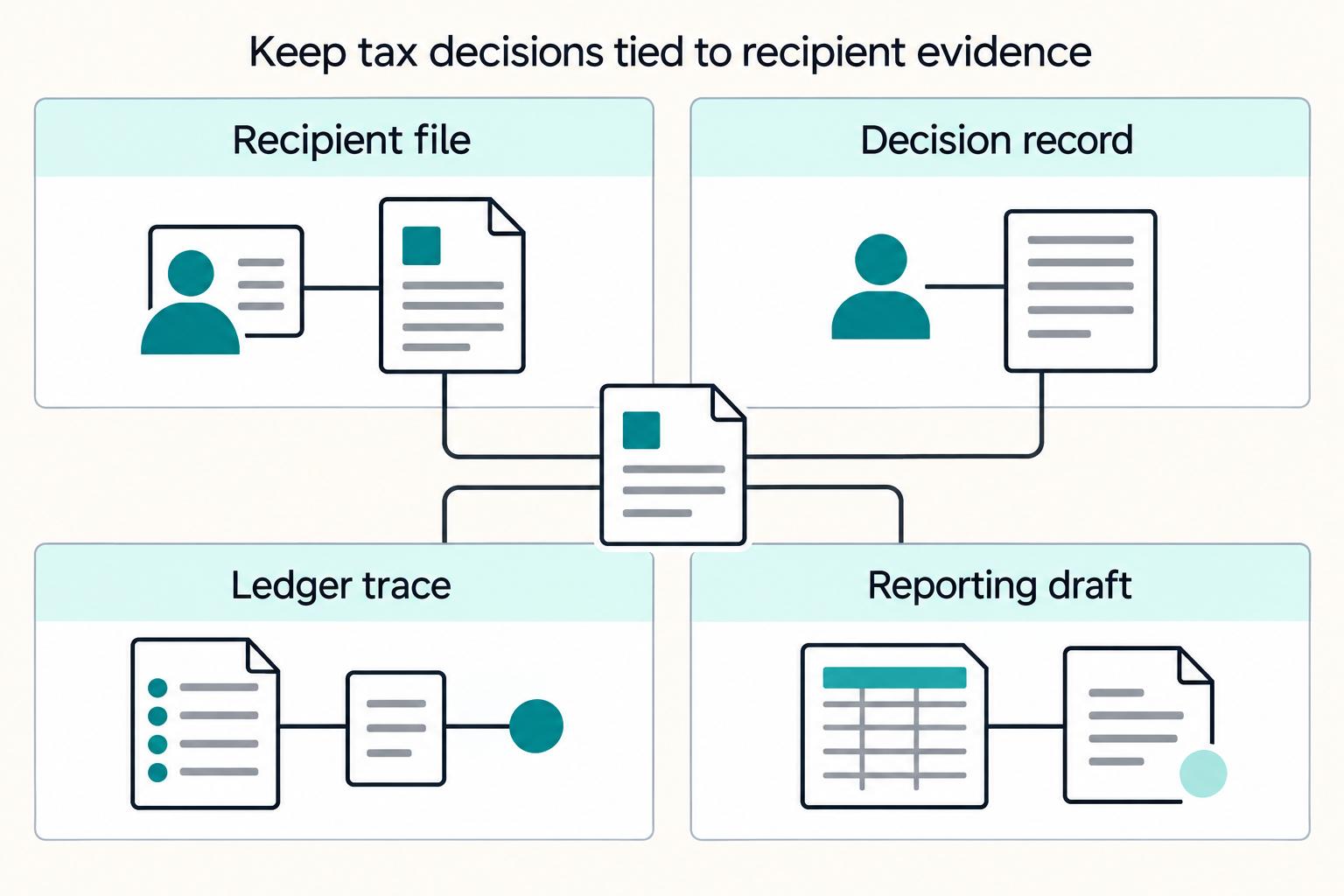
Keep the file stream-specific, not just payee-specific. The same recipient can have multiple payment types with different reporting outcomes. Minimum contents per stream:
- Payee tax status
- Payment type
- Withholding lane under review or selected
- Rationale for withholding or non-withholding
- Escalation notes tied to the IRS rules your team relied on
For zero-withheld outcomes, keep written reasoning in the file because reporting may still be required.
Require a documented pre-live sign-off#
Use an internal pre-live checkpoint before first payout. The label is internal, but the checkpoint should confirm:
| Checkpoint | What to confirm |
|---|---|
| Tax documentation | Tax documentation is on file |
| Stream characterization | Stream characterization and withholding rationale are documented |
| Filing ownership | Filing owners know whether the stream can feed Form 1042-S and Form 1042 |
If documentation is incomplete, hold release and escalate. IRS guidance treats unknown recipients as subject to withholding at the maximum applicable rate, and in a cited no-TIN NRA scenario, that is 30% federal income tax.
Classify each payment type before you touch withholding logic#
An early failure is treating the payee record as the decision point. Classify the payment first and the payee second, because the IRS requires a separate Form 1042-S for each type of income paid to the same recipient.
Build an internal decision table by payment type#
Use one stream-level table that ops, tax, and product all follow before production payout runs.
| Payment type | Question to resolve before withholding logic | What to document | Escalate when |
|---|---|---|---|
| Service fees | What is being paid for under contract or platform terms? | Contract or terms excerpt, payout description, reviewer conclusion, linked payee tax form | Service scope is vague, bundled, or inconsistent across systems |
| Creator payouts | Is this a service payment, revenue share, license-type payment, or another distinct stream? | Monetization terms, ledger label, revenue-share rule, reviewer notes | "Creator earnings" label masks multiple income types |
| Marketplace proceeds | Is this goods, services, access, or a mixed transaction? | Order or settlement details, fee split, stream ID tied to payout line | Settlement combines components without item-level split |
| Partnership-related distributions | Could this involve partnership treatment, including a publicly traded partnership branch? | Source agreement, ownership notes, escalation memo if needed | Facts suggest partnership treatment |
| ECI branch | Could this be effectively connected income? | Written reasoning, support docs, reviewer sign-off, pending tax/legal confirmation if unresolved | Facts point to ECI or support is incomplete |
Add mandatory ECI and publicly traded partnership branches#
Before go-live, require reviewers to answer two questions in writing:
- Could this payment involve effectively connected income?
- Could this payment involve a publicly traded partnership or nominee distribution?
If either answer is yes or unclear, pause automated classification and escalate for tax or legal review. This is an internal control choice, but a practical one because these branches may change withholding and Form 1042-S treatment.
Also keep payment characterization separate from recipient documentation. Tax forms support the file, but they do not by themselves classify the payment.
Freeze uncertain classifications before automated withholding runs#
Use a simple production rule: if payment characterization is uncertain, hold automated withholding decisions and escalate before payout runs. We recommend keeping that hold visible to tax, legal, and payout operations in the same workflow. That protects both withholding and reporting logic, including cases where amounts may still be reportable on Form 1042-S even when no tax is deducted.
For each hold, record:
- proposed payment type
- exact unresolved fact
- escalation owner
- blocked or not blocked status for payout
- target resolution date
Mark unsupported assumptions as pending confirmation#
When a decision is not explicit in the Instructions for Form 1042-S, label it pending tax/legal confirmation in the table, ticket, and evidence file.
Keep that label through year-end review so operating assumptions are not mistaken for approved tax positions. If a reduced-withholding outcome is involved, remember the 2026 instructions require a Chapter 3 exemption code when withheld tax is below 30%. Classify first, automate second. That sequence can reduce downstream Form 1042-S and Form 1042 cleanup risk.
Related: 1042-S Reporting for Platforms: Withholding on Payments to Non-US Contractors.
Choose the withholding lane and document why#
Once payment type is settled, choose the withholding lane before payout automation. Treat Chapter 3 and Chapter 4 as separate decisions; for withholdable payments, both statuses may need to be recorded for the same stream.
Decide which chapter question you are answering#
Start with the payment and the legal question.
- Chapter 3 (NRA withholding): U.S.-source FDAP paid to foreign persons (IRC 1441-1443, 1461-1464).
- Chapter 4 (FATCA): withholding under IRC 1471-1474; for this purpose, a withholdable payment is generally U.S.-source FDAP.
| Decision point | Chapter 3 | Chapter 4 |
|---|---|---|
| Core question | Is this U.S.-source FDAP paid to a foreign person? | Is this a withholdable payment, and what is the payee's Chapter 4 status? |
| Main analysis | NRA withholding and any documented reduced or exempt treatment | FATCA classification analysis |
| Documentation anchor | Documentation is required for reduced treatment | Entity documentation is required to establish Chapter 4 status |
| If documentation is missing | Do not apply reduced Chapter 3 withholding based on presumed status where documentation is required | Presumption rules may require treating the entity as a nonparticipating FFI |
| Form 1042-S link | Report Chapter 3 status and classification | Report Chapter 4 status when the reported payment is withholdable |
Route missing documentation to exception handling#
If documentation is missing or stale, do not silently default to reduced or no withholding. Route the stream to exception handling.
| Exception field | Detail |
|---|---|
| Stream ID and payee ID | stream ID and payee ID |
| Missing or stale document type | missing or stale document type, such as Form W-8BEN-E for entities |
| Blocked chapter question | Chapter 3, Chapter 4, or both |
| Payout status | blocked or released under approved exception |
| Escalation owner and target resolution date | escalation owner and target resolution date |
Use a simple production rule: if you cannot reliably associate the payment with valid documentation, apply presumption rules and block preferred treatment by default. For Chapter 3, you cannot use presumed status to reduce withholding when documentation is required. For Chapter 4 entity payments, presumption rules require treating the entity as a nonparticipating FFI.
Record each exception with:
- stream ID and payee ID
- missing or stale document type, such as Form W-8BEN-E for entities
- blocked chapter question: Chapter 3, Chapter 4, or both
- payout status: blocked or released under approved exception
- escalation owner and target resolution date
The Instructions for Form 1042-S include unknown-recipient coding paths, including recipient code 21 for Chapter 3 status and recipient code 29 for Chapter 4 status. Treat these as explicit exception outcomes, not hidden defaults.
Keep a per-stream rationale tied to Form 1042-S#
Store lane decisions at the payment-stream level, not only at payee level. Form 1042-S requires Chapter 3 status and classification and, when the payment is withholdable, Chapter 4 status.
At minimum, keep:
- payment type and source conclusion
- chosen withholding lane or lanes
- linked supporting documentation
- expected Form 1042-S field mapping
- internal control owner, by name or role
Add one testable review check: does current documentation still support the stored Chapter 3 status, and if the payment is withholdable, is Chapter 4 status also present? If not, return the stream to exception handling before the next payout run.
Keep reportability separate from withholding. A payment can still be reportable on Form 1042-S under Chapter 3 or Chapter 4 even when no tax was withheld.
Confirm rates and edge cases in current IRS instructions#
Use current IRS instructions for rates, codes, and thresholds. Do not infer edge cases from vendor summaries.
The 30% rate is a common reference point in both Chapter 3 and Chapter 4 contexts, not a universal result for every stream. If tax withheld is less than 30%, current instructions require a Chapter 3 exemption code on Form 1042-S.
Before go-live and before filing, run two checks:
- lane logic still matches current IRS instructions
- any reduced, exempt, or no-tax result is supported by valid documentation and the correct reporting code
Before you lock withholding rules into production, align decision branches to payout policy gates and audit-trail requirements in the Gruv docs.
Connect Form 1042-S to the rest of your filing obligations#
Once you know how a stream is treated, tie that decision to the full filing stack. Form 1042-S, Form 1042, and, if paper filing applies, Form 1042-T should be managed as one coordinated annual package.
Assign form ownership and reconcile as one package#
Set clear ownership and handoffs for each form, then reconcile them as one package before filing.
| Form | What it does | Key use rule | Operating owner example (not an IRS rule) |
|---|---|---|---|
| Form 1042-S | Information return reporting certain income paid to foreign addresses | Prepare based on your documented withholding and reporting decisions | Compliance or tax reporting |
| Form 1042 | Annual withholding tax return for U.S.-source income of foreign persons | Reconcile annual withholding and reporting totals before filing | Tax operations or tax |
| Form 1042-T | Transmittal for paper Forms 1042-S | Use only when submitting paper Forms 1042-S | Filing operations, if paper filing is used |
The IRS baseline is one due-date framework: Forms 1042, 1042-S, and 1042-T are due March 15 of the following calendar year. Before submission, confirm your 1042-S record counts and withholding totals align with Form 1042.
Choose your filing method early#
Choose your filing method early, because Form 1042-T is only for paper 1042-S transmittals. If filing 1042-S electronically, do not use Form 1042-T.
Document one filing-path decision up front, electronic or paper, and block conflicting prep work. For current planning, the Instructions for Form 1042-S state IRIS will be available beginning January 1, 2026.
Define extension and contingency handling#
Define extension and contingency handling before deadlines. Use Form 8809 to request an extension of time to file information returns including Form 1042-S. IRS guidance references an automatic 30-day extension through FIRE.
If electronic filing requirements cannot be met, Form 8508 is the waiver request path for the current tax year. Treat it as an exception path, and document the request and outcome.
Keep Section 5000C scoped correctly#
Keep Section 5000C scoped correctly. It applies to specified Federal procurement payments to foreign persons and imposes a 2 percent tax on that payment amount, and those cases can affect Form 1042-S and Form 1042 handling.
Do not apply section 5000C by default to ordinary platform payouts solely because the payee is foreign. Use it when the payment is in a federal procurement context.
Run an annual readiness check#
Run an annual readiness check against current IRS guidance before go-live and again before filing. IRS instructions direct filers to check for post-publication developments.
At minimum, confirm March 15 deadline handling and filing method. Also confirm whether Form 1042-T is actually needed, whether any Form 8809 or Form 8508 decision is documented, and whether any section 5000C cases exist.
If you want a deeper dive, read IRS Form 1042-S for Platforms: How to Report US-Source Income Paid to Foreign Contractors.
Build platform controls that survive audit and turnover#
Good controls make a filing position traceable long after the original operator is gone. Make payout release depend on tax traceability, not just onboarding completion.
Anchor traceability at onboarding#
Create a distinct tax record per payee profile, and link it to payout events and reporting records. At minimum, capture documentation status, withholding-lane decision, whether reduced withholding or treaty treatment was evaluated, reviewer, approval date, and the supporting artifact used for that decision.
Test this control by tracing one payee end to end: onboarding documents, internal withholding decision, ledger entries, and the draft Form 1042-S record. This matters because a separate Form 1042-S is required for each recipient whether or not tax was withheld. If you must file Form 1042-S, you must also file Form 1042.
Avoid collapsing different payout relationships into one generic foreign-vendor record. It may speed setup, but it can break recipient-level reporting and make corrections harder when withholding outcomes differ.
Block payout release with real exception queues#
Do not release payout batches when key tax decisions are unresolved. Put three queues in front of release:
| Queue | Trigger |
|---|---|
| Missing tax data | incomplete documentation or missing recipient TIN where reduced withholding or treaty treatment is being claimed |
| Unresolved classification | payment type or Chapter 3 versus Chapter 4 treatment is still open |
| Stale or conflicting documentation | the tax form no longer matches profile data, payment facts, or prior withholding history |
Apply strict routing rules for undocumented or incomplete cases. If the payee is treated as an unknown recipient, maximum applicable withholding applies. If a required TIN is missing and no exception applies, default withholding is 30%, and treaty benefits are not available until the TIN is provided.
Add a second checkpoint before finalizing reporting output. Validate for known IRS error patterns: invalid income codes, invalid tax rates, required boxes left blank, or recipient still marked as "Unknown."
Retain masked evidence with auditable approvals#
Store tax-sensitive artifacts with role-based access controls and clear approval ownership. Keep source forms, review notes, override reasons, approval timestamps, and change history for profile fields that affect withholding or reporting.
Set retention based on substantiating the return position, not convenience. IRS recordkeeping requires keeping records as long as needed to prove return amounts. The general 3 years assessment period is a baseline, not an automatic deletion rule for items tied to open positions or corrections.
For turnover resilience, maintain auditable event history for decisions and access-control changes. If you are in IRS Safeguards scope for federal tax information, your audit trail must also capture changes to logical access rights and permissions.
Set escalation triggers for legal and tax review#
Escalation should happen when facts could change the character of the payment, not only the withholding rate. That is the point where specialist review should take over.
Escalate fact patterns that can change the payment character#
Do not let operations teams guess through ECI or sourcing issues. The IRS treats income connected with a foreign person's U.S. trade or business as ECI. Form 1042-S reporting includes some ECI distributions, including publicly traded partnership or nominee distributions. For personal services, source is generally where services are performed, and split U.S. and non-U.S. services require an accurate allocation.
Attach a short fact memo to the stream: where services were performed, who performed them, whether U.S. activity is involved, and why the stream is or is not treated as ECI or U.S.-source. An avoidable mistake is relying on payee country while ignoring where the work occurred.
Route Form 8233 claims to specialist review#
Treat Form 8233 as a specialist process, not a generic treaty toggle. It is for nonresident alien individuals claiming exemption from withholding on compensation for personal services, and IRS instructions require treaty-term validation to complete it correctly. If a claim is made through an entity profile, or the income is not personal-services compensation, escalate.
Verify three points before reduced withholding: claimant is an individual, income type is personal services, and treaty and TIN conditions are satisfied. If support is missing, withhold at 30% where applicable until proper documentation is received.
Escalate documentation conflicts#
Rely on a properly completed Form W-8BEN-E only when it is consistent and reliable. Escalate when the form, payout profile, and prior withholding history conflict, because those conflicts can trigger presumption-rule handling and unknown-recipient exposure at the maximum applicable rate.
Document conflicting fields, prior withholding outcomes, and reviewer comments, then route the case for legal/tax determination before finalizing withholding treatment.
Handle edge cases without freezing operations#
Edge cases should be isolated, not allowed to jam the whole payout program. The practical goal is to contain the affected stream, keep unrelated payouts moving, and force reconciliation before filing is finalized.
Create a fallback path for late or corrected documentation#
Route late, corrected, or disputed payee documentation into a correction queue instead of stopping every stream. Keep the original treatment, updated documentation, received date, impacted payment IDs, and interim approver together in one record.
Your control test is simple: for any affected stream, you can show what treatment was applied, what changed, and whether a Form 1042-S amendment may be needed. Do not overwrite prior records, because losing that sequence makes later corrections hard to defend.
Do not assume exact IRS amendment-step procedures are covered in this guide. Keep correction handling conservative, and flag unresolved items for instruction-based review before final treatment.
Separate payment release from tax reporting exceptions#
Keep payment release and tax reporting exception handling on separate control paths so one exception does not block unrelated payouts. Use stream-level status flags so operations can distinguish between payable streams and streams still under reporting review.
A practical check is whether one unresolved case can stop unrelated batches. If it can, the controls are too tightly coupled for edge-case handling. This separation is an internal control design, not a confirmed IRS-prescribed method here.
Reconcile mismatched withholding records before annual filing finalization#
Before annual finalization, reconcile ledger withholding, payee-level withholding records, and draft Form 1042-S outputs. Run that review before final sign-off for Form 1042 and Form 1042-T, not after assembly.
For each mismatch, trace back to source records and log one disposition: resolved, corrected in draft reporting, or escalated and still open. Avoid unowned temporary fixes that do not tie back to a controlled record.
An IRS-mandated recovery sequence for these mismatches is not confirmed, so your internal sequence should stay documented and reviewable.
Maintain a known-unknowns log tied to IRS sources#
Keep a known-unknowns log for questions that remain unresolved and must be checked against the IRS sources already identified in your evidence set, including the Instructions for Form 1042 (2025). For each item, record the question, affected streams, interim treatment, owner, source to verify, and last review date.
Use this log as a control boundary: unresolved means unresolved until a tax owner verifies the live source and records the decision. If an item remains open close to filing, escalate it instead of carrying it silently into year-end workpapers.
Related reading: How to Write a Payments and Compliance Policy for Your Gig Platform.
Avoid the failure patterns that cause rework and penalties#
Most avoidable problems are structural. Teams group foreign payees too broadly, build policy from generic guidance instead of IRS instructions, or fail to keep the records needed to explain each Form 1042-S result.
Classify by stream, not by passport#
Do not treat reportable payments to non-U.S. payees as one reporting population. A separate Form 1042-S is required by recipient, and reporting treatment also depends on income type and tax rate, so classify at the payment-stream level before payout logic runs.
Your checkpoint is straightforward: for any stream, you can show the recipient, payment characterization, withholding treatment, and why that maps to one form record. A common failure pattern is collapsing mixed payment types or multiple beneficial owners into one record. That creates cleanup later, especially because boxes 13a through 13h can hold recipient information for only one beneficial owner per form. If multiple forms are issued for one payment, aggregate amounts reported across those forms cannot exceed the actual payment and withholding totals.
Anchor operating policy to IRS instructions#
If a production rule came from generic online guidance instead of IRS instructions, treat it as unverified until reviewed against IRS materials. Reporting can still apply even when no tax was withheld, so summary guidance is not enough for production controls.
Use IRS instructions as the trigger for policy change. One concrete control is filing method: at 250 or more Forms 1042-S, filing is required electronically through the FIRE System.
Retain the evidence that explains each filed result#
For every filed or draft Form 1042-S, keep an evidence pack tied to the output and approval history. At minimum, include:
- the source payee record and stream classification
- the withholding rationale and reviewer sign-off
- correction history, including prior treatment and changed inputs
Your test is whether another reviewer can reconstruct why a form was produced, corrected, or split without asking the original operator. If you cannot tie a form to its approval history, joint-owner reallocations and amended filings become much harder to defend.
We covered this in detail in How MoR Platforms Split Payments Between Platform and Contractor.
Conclusion and copy paste operating checklist#
The sequence is straightforward: decide scope by stream, support the decision with documentation, choose the withholding lane, connect it to the filing stack, and escalate anything you cannot support from current IRS materials. That sequence is an operating recommendation, not an IRS-mandated order, but it aligns with core Form 1042-S and Form 1042 filing obligations.
- Classify payment streams first.
Document what each stream is, whether it is in scope, and the facts behind that decision. Form 1042-S generally covers amounts paid to foreign persons that are subject to withholding, including cases where no tax is withheld because of a treaty or Code exception.
- Collect required documentation before final treatment.
For example, Form W-8 BEN-E documents foreign entity status for Chapters 3 and 4. If records conflict, pause final treatment and route the discrepancy for review.
- Record the chapter lane decision.
As an internal control, keep the rationale in one place, and use Publication 515 plus current Form 1042-S instructions when facts are unclear. Do not assume zero withholding means zero reporting.
- Map the filing stack as one connected obligation.
If Form 1042-S is required, Form 1042 is also required. Form 1042-T applies to paper Form 1042-S transmittals, with a separate Form 1042-T for each type of Form 1042-S.
- Define escalation rules for uncertainty.
Use Form 8809 when you need an extension for information returns such as Form 1042-S, including the automatic 30-day path described by IRS. Use Form 8508 for an electronic-filing waiver request, and note approval is limited to the current tax year.
- Payment streams classified with documented rationale
- Required tax documents captured and validated
- Chapter lane decision recorded for each in-scope stream
- Filing stack ownership set for Form 1042-S, Form 1042, Form 1042-T
- Exception handling and escalation path documented
- Known unknowns logged for IRS-instruction confirmation before final filing
If you want a second-pass review of your 1042-S control design and rollout assumptions, contact Gruv.
Frequently Asked Questions
What does Form 1042-S report for foreign contractor payments on a platform?
Form 1042-S reports certain income paid to addresses in foreign countries and related withholding items. For a platform, the key issue is whether the payment is reportable under IRS rules, not whether the payee is simply foreign. If a payment is subject to Chapter 3 withholding, Form 1042 reporting is also required.
Does a platform need Form 1042-S for every non-U.S. payee?
No. Not every non-U.S. payee is automatically reportable on Form 1042-S, and exceptions can apply when withholding is not required. Foreign status alone is not the trigger.
How is Form 1042-S different from Form 1042 and Form 1042-T?
Form 1042-S is the information return for reportable payments. Form 1042 is the annual withholding tax return for certain income of foreign persons, including payments reported on Form 1042-S under Chapter 3 or Chapter 4. Form 1042-T is the paper transmittal for Forms 1042-S and is not used for electronic filing.
When do Chapter 3 withholding and Chapter 4 withholding apply?
Chapter 3 applies to U.S.-source FDAP paid to foreign persons. Chapter 4 is FATCA withholding. If the payment facts and documentation do not clearly support the right regime, hold the final withholding decision for review.
Where does Form 8233 fit when a contractor claims treaty relief?
Form 8233 is for nonresident alien individuals claiming an exemption from withholding on compensation for personal services because of an income tax treaty. It is not a general treaty form for foreign entities. If a platform receives an out-of-scope Form 8233 submission, treat it as a review item rather than automatic relief.
What information is still required before a platform can make a final withholding decision?
You need enough documentation to support the withholding and reporting position before finalizing treatment. A practical control is whether a second reviewer can explain why the payment is or is not reportable on Form 1042-S and which records support that conclusion. Missing or conflicting records should block finalization until resolved.
When should a team use Form 8809 or Form 8508?
Use Form 8809 to request an initial or additional extension of time to file specified information returns, and file it by the due date of those returns. Do not use Form 8809 to extend Form 1042. Use Form 8508 to request a waiver from electronic filing for the current tax year, submit it at least 45 days before the due date, and plan to reapply because approval does not carry forward automatically.
Researched and edited by the Gruv editorial team. Gruv builds cross-border billing, payouts, and finance-operations software for global businesses.
Sources
Educational content only. Not legal, tax, or financial advice.
Related Posts

The Freelance Payment Penalty: A Modeled Audit of Platform Fees, FX Spreads, and Payout Delays
The money rarely disappears through a single, easy-to-spot fee. The real loss is stacked. A marketplace takes its commission, a processor adds a charge for international cards, a bank or payment company converts the currency at a spread, a platform holds the funds before release, and a wire sheds a little to intermediaries on the way in. Each layer looks defensible on its own, but the worker feels the combined result as a smaller deposit and a later payday.

How to Respond to a Subpoena for Business Records
Move fast, but do not produce records on instinct. If you need to **respond to a subpoena for business records**, your immediate job is to control deadlines, preserve records, and make any later production defensible.

A US Expat's Guide to Investing in UCITS ETFs to Avoid PFIC Issues
The real problem is a two-system conflict. U.S. tax treatment can punish the wrong fund choice, while local product-access constraints can block the funds you want to buy in the first place. For **us expat ucits etfs**, the practical question is not "Which product is best?" It is "What can I access, report, and keep doing every year without guessing?" Use this four-part filter before any trade: