
Quick Answer
Form 1042-S is an IRS information return prepared by the withholding agent that reports certain U.S.-source amounts paid to a foreign person, how the income was categorized, and any withholding. Use it to verify payer and payee details, gross income, income category, withholding rate, and withheld tax, then reconcile it to your books and decide whether any withholding may be recoverable through filing.
What Form 1042-S reports#
Form 1042-S is an information return from a withholding agent. It reports certain income paid to foreign persons, its classification and withholding. Receiving it does not by itself establish that the payer’s sourcing, rate or recipient details are correct, or that you must file a U.S. return.
Those details drive your next decisions: whether the income was reported correctly, whether withholding was applied correctly, and whether any overwithheld amount may need to be recovered later.
| What this form is | What it is not |
|---|---|
| An IRS information return prepared by the withholding agent (often the payer) | An audit notice or enforcement letter |
| A record of reportable U.S.-source amounts paid to a foreign person, plus any withholding | Your own tax return |
| A document you use to verify reporting before making filing decisions | The same as Form 1042, the payer's annual withholding tax return |
Two quick clarifiers: a 1042-S can be issued even when no tax was withheld, and receiving multiple 1042-S forms is not automatically an error. Separate reporting by recipient, income type, or withholding rate can require that.
Work through it in this order:
- Verify: confirm payer and payee details, income characterization, gross amounts, and withholding against your records.
- Reconcile: map what was reported to your books and filing workflow.
- Reclaim: decide whether the withholding shown is final tax or potentially recoverable through filing.
Escalate early to a qualified tax advisor if the form conflicts with your status, if you received conflicting payer documents, or if the recipient copy appears inconsistent with the IRS-filed version. Any mismatch can delay processing.
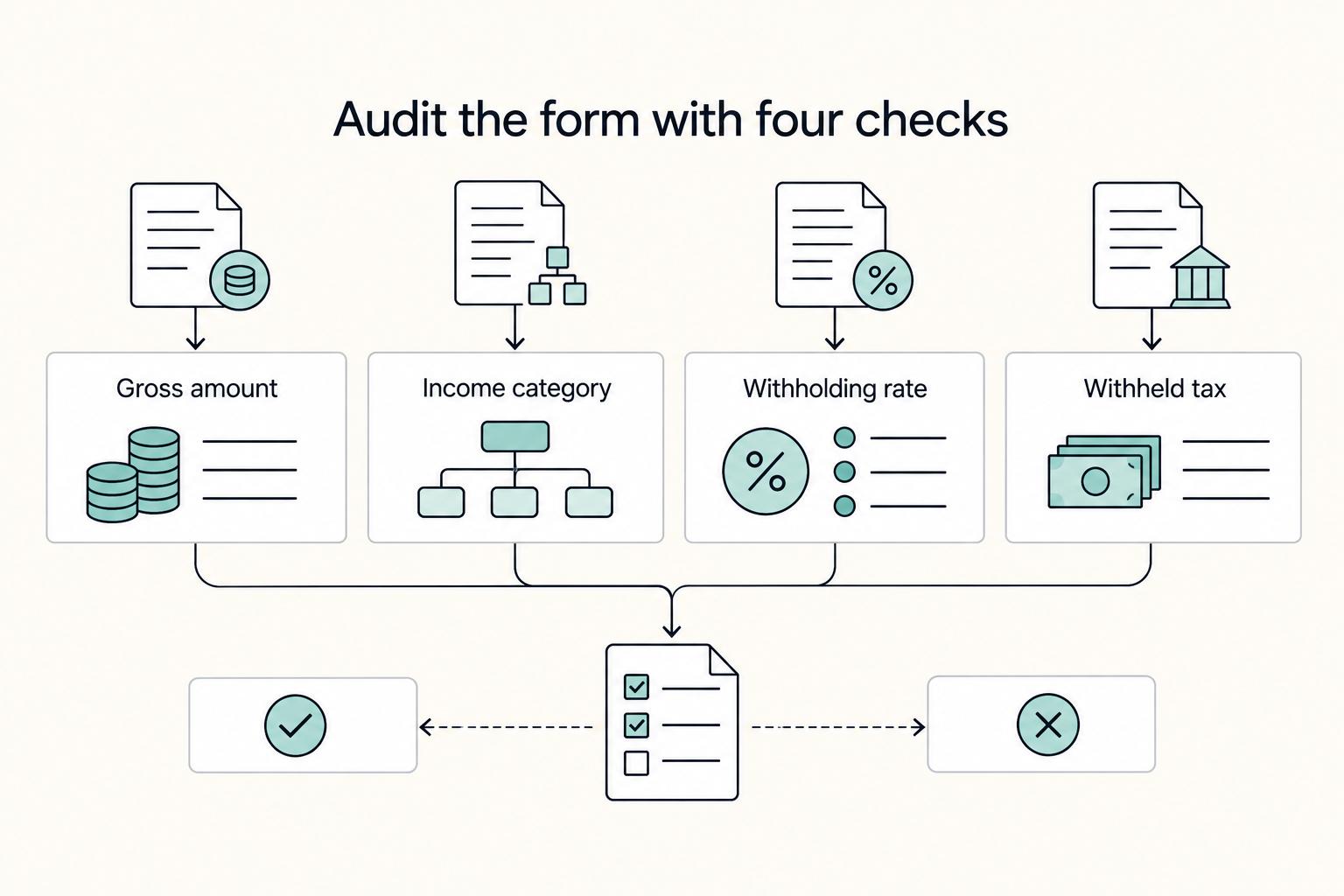
Step 1: Verify - Your 4-Point Checklist to Audit the Form#
Use the IRS instructions for the tax year printed on the form: a 2025 income form issued in 2026 uses the 2025 instructions. Pull the certificate you actually supplied, invoices and payment records, and record the form’s unique identifier and amendment number before requesting corrections.
| Check | What to verify | Records |
|---|---|---|
| Gross amount | Reported gross income matches what was paid in that tax year; compare against gross, not only net cash received | Invoice ledger, bank deposits, platform payouts, remittance notices |
| Income category | The category matches what you were actually paid for | Agreement or contract terms, current Form 1042-S instructions, IRS Publication 4152 |
| Withholding rate | The rate aligns with your W-8BEN position and the income type | W-8BEN, payer-applied documentation, intermediary details if relevant |
| Withheld tax | The math works against the gross amount and rate, allowing for normal rounding | Form 1042-S, contract, invoice ledger, payment proof, withholding emails |
1) Match the gross amount to your records#
Start by reconciling reported gross income to what was paid in that tax year. Build a simple ledger for each payer with invoice date and number, invoice currency, amount billed, amount paid, payment date, and any withholding. Then tie it to bank deposits, platform payouts, or remittance notices.
Compare against gross, not just net cash received. Withholding under sections 1441 and 1442 is generally applied to gross amounts, so net-only bookkeeping can make a correct form look wrong.
If you invoiced in a non-USD currency, document the conversion path before calling it a mismatch. Capture the original currency amount, the payer-converted USD amount if one was used, and the FX date and source in your books. If a mismatch remains, test for timing or intermediary-routing issues first. Then send the withholding agent an evidence pack with invoice lines, payment proof, FX support, and the specific disputed items.
2) Confirm the income category fits the real payment#
Check both the payment’s nature and its source. Service income generally follows where the services were performed; royalty sourcing generally follows where the rights were used. A U.S. customer alone does not make all payments U.S.-source. Foreign-source income generally is not reported on 1042-S, subject to limited cases such as withholding applied in error. Split mixed service-and-license payments using the actual contract and facts.
Use the income-code list in the instructions for the relevant year. For example, code 17 covers compensation for independent personal services; royalty codes distinguish industrial royalties from specified copyright and other categories. Ask the issuer for its code and sourcing basis rather than choosing a generic “royalty” label.
| Your situation | What the category should broadly reflect | What to verify before accepting | Code mapping note |
|---|---|---|---|
| Freelance services (consulting, design, development, advisory) | Compensation for services performed | Where services were performed and whether Form 1042-S reporting applies | Use current code mapping after verification |
| Mixed deal (services + usage rights) | Primary economic driver of each payment component | Contractual allocation and source of each service or rights-use component | Use current code mapping after verification |
| Royalty type payment (licensed content, software, IP, brand rights) | Payment for rights use | Rights granted, place of use and the specific royalty category | Use current code mapping after verification |
If classification is close but unclear, ask the issuer which contract terms and internal payment coding they used.
3) Tie the withholding rate to your W-8BEN claim#
Your rate check should map directly to the W-8BEN on file. That form establishes non-U.S. status for withholding purposes and can support a reduced or exempt treaty rate where applicable. If needed, review How to Fill Out Form W-8BEN for a Foreign Freelancer.
| Rate check | Next step |
|---|---|
| Aligns with your W-8BEN position and income type | Continue |
| Rate basis is unclear | Ask which documentation was applied and whether an intermediary affected treatment |
| Looks overwithheld | Ask whether your W-8BEN was received and applied to the correct income category |
Use this branch:
- If the rate aligns with your W-8BEN position and income type, continue.
- If the rate basis is unclear, ask which documentation was applied and whether an intermediary affected treatment.
- If the rate looks overwithheld, ask whether your W-8BEN was received and applied to the correct income category.
A 30% rate commonly applies to covered U.S.-source FDAP income unless an exemption or treaty reduction applies. Other withholding regimes have different rules. W-8BEN supports foreign status and eligible treaty claims; it is not an instruction that overrides the payer’s legal duties. For personal services performed in the United States, check whether Form 8233 or another certificate was required.
4) Validate withheld tax and prep Step 3#
Check boxes 3b and 4b for the applicable chapter’s tax rate, and boxes 7a, 8, 9 and 10 for withholding and adjustments. A simple gross-times-rate comparison may be insufficient when another agent withheld tax or overwithholding was repaid. Ask for the payment breakdown if the reported totals do not match your remittances.
Create a compact file now with the Form 1042-S, W-8BEN copy, contract, invoice ledger, payment proof, and withholding emails. You will use the same file for corrections and for any refund claim path later.
If this check is clean, move to Step 2 to reconcile it into your books, then use Step 3 to decide whether withholding was final or recoverable. Bring in a qualified cross-border tax advisor early if intermediary flows, disputed classification, treaty interpretation, or mixed documentation regimes are driving the result.
Before your next client payment cycle, prepare a clean documentation pack to reduce preventable withholding errors: Use the W-8 Form Generator.
Step 2: Reconcile - Integrating the 1042-S Into Your Business#
Once the form is accurate enough to trust, treat it as a bookkeeping input, not just a tax document. Reconcile what you submitted on Form W-8BEN with what the payer reported on Form 1042-S, then book it before return prep.
Run the control check first#
W-8BEN documents your foreign status and any supported treaty position; 1042-S records what the payer reported. Compare both with the underlying payment facts. The certificate alone does not establish sourcing or the final amount of tax due.
Record known transactions in your books while you investigate a discrepancy; do not leave earned revenue or received cash unrecorded because a tax form is disputed. Flag the difference in your reconciliation, identify the certificate on file at payment, and request the issuer’s explanation or amended reporting.
Store records so you can retrieve them fast#
Good retrieval turns a tax issue into a manageable task. Save the recipient copy, Copy B, in a secure, access-limited location. Use a consistent filename so you can find it without opening the file, for example: 2026_ClientName_Form-1042-S_CopyB_TaxYear2025.pdf.
Link that file to the same client record as your contract, invoices, payment proof, and W-8BEN copy. You want one retrieval path for return prep and, if needed, for attaching the 1042-S to Form 1040-NR.
| Document | System entry | Why it matters | Owner |
|---|---|---|---|
| Form W-8BEN copy | Client compliance file | Shows the status or treaty position you gave the payer | You |
| Form 1042-S Copy B | Tax year folder + linked client file | Recipient record of reported gross income and withholding | You |
| Invoice and payment ledger | Revenue and cash records | Lets you tie reported gross to actual billings and receipts | You or bookkeeper |
| Correction emails or payer notes | Client correspondence file | Preserves mismatch, correction history, and intermediary context | You |
Reconcile gross income and total withholding without duplicate revenue#
Box 2 is reported gross income and box 7a is the issuer’s federal withholding. Also review box 8 for tax withheld by other agents, box 9 for repayments and box 10 for the total withholding credit. The form is a reconciliation document: if invoices already recorded the revenue, do not book it a second time. Record cash and withholding against the existing receivable using the accounting treatment appropriate to your books.
Hypothetical example: you already recorded a $1,000 invoice. The payer withholds $300 and sends $700, with no fees or other adjustments. Clear the $1,000 receivable with $700 cash and a separately tracked $300 withholding balance; do not add another $1,000 of revenue when the form arrives. Whether the withholding balance is recoverable or becomes tax expense depends on the final tax treatment. Zero withholding still requires a gross-income reconciliation.
For a step-by-step walkthrough, see A Guide to Tax Withholding on US Fellowship and Grant Income for Foreigners.
Step 3: Reclaim - Recovering Your Withheld Tax#
If your Form 1042-S shows withholding and your actual U.S. liability should be lower, you may have a reclaim path, but only if you file correctly and on time.
First confirm the overwithholding signal, then assemble the documentation set, file the refund claim return, and track the result.
Decide if reclaim is realistic now#
Start with one question: does the withholding shown on Form 1042-S align with the W-8BEN that was actually on file on the payment date? If not, treat that mismatch as a reclaim signal.
Ask whether the payer can correct reporting or repay overwithholding under the applicable reimbursement or set-off procedure. The timing depends on the filing and furnishing dates and current rules; the 2026 instructions allow qualifying adjustments up to specified extended deadlines. If payer adjustment is unavailable, a recipient refund claim may be needed. Do not treat an old March 15, 2024 example as the deadline for a later tax year.
A nonresident alien individual generally uses Form 1040-NR when a return or refund claim is required. Use your SSN if eligible, or an ITIN if not eligible for an SSN. If you need a first ITIN, the W-7 instructions generally permit submitting the application with the required return and identity documents; you do not always have to obtain the number before submitting that package. Foreign entities use their applicable return rather than an individual 1040-NR.
Build the claim file before you file#
Build the file before you start the return. That is what keeps a refund claim from turning into a document chase later.
| Document | Role | Claim note |
|---|---|---|
| Form 1042-S copy or copies | Supports that withholding occurred | Attach the copies you received where instructions require support |
| W-8BEN you provided | Shows the status or treaty position you gave the payer | Compare it to what was on file on the payment date |
| Invoices and payment records | Support the income and payment history | Include them in the full claim set |
| Step 2 reconciliation | Links reported amounts to your books | Include it in the full claim set |
| Payer confirmations or correction emails | Preserve correction history and context | Include them in the full claim set |
| SSN/ITIN or W-7 application records | Supports taxpayer identification | Use the existing number or the permitted W-7-with-return process when appropriate |
Use one folder for the full claim set:
- Form 1042-S copy or copies
- the W-8BEN you provided
- invoices and payment records
- your Step 2 reconciliation
- payer confirmations or correction emails
- SSN/ITIN records or the required W-7 application documents
The 1042-S and 1040-NR linkage is the core mechanism. The return is your refund claim, and the 1042-S supports that withholding occurred. Where instructions require support, attach the 1042-S copies you received.
For direct deposit, use the banking fields on the Form 1040-NR for the actual return year and follow its account requirements. Keep the return acknowledgment and refund correspondence with the reconciliation; do not reuse line numbers from a different edition.
Reclaim now vs prevent next cycle#
| Path | Trigger | Common documents | Expected effort | Common failure points |
|---|---|---|---|---|
| Reclaim now | Withholding appears higher than your actual U.S. liability | 1042-S, applicable return, SSN/ITIN or W-7 package, certificate and payment records | High | Unsupported filing position, identification or supporting-document errors, missed refund limits |
| Prevent next cycle | You expect future U.S. payments | Current W-8BEN, onboarding record, payer confirmation it is applied | Moderate | Sending W-8BEN but not confirming the payer applied it before payment |
| Do both | You were overwithheld and will continue U.S. source work | Full reclaim file + prevention controls | High | Solving this year's claim but leaving next payment cycle unchanged |
The refund deadline is not three years from the date a 1042-S was issued. Under the IRS general rule, the claim deadline is generally the later of three years after filing the return or two years after paying the tax, with separate lookback limits on refundable payments and specific exceptions. Withholding has statutory deemed-payment timing. Calculate the deadline from the return and tax-payment facts, especially if no return was filed or the claim is late.
Prevention controls that actually reduce repeat errors#
Prevention work is most effective before payment, not only at year-end. Before the first payment, send the W-8BEN, store the signed copy, and get written confirmation from the payer that it is on file and applied. Recheck status before payment runs, and refresh documentation when your facts change.
Build this into your existing onboarding checklist. Then compare it against How to Fill Out Form W-8BEN for a Foreign Freelancer.
Talk to a tax professional when forms conflict, treaty treatment is unclear, or multi-country filing positions interact. Also escalate when the amount at stake is material for your business.
Use Form 1042-S as an Operating Record: Verify, Reconcile, Reclaim#
Use Form 1042-S as an operating record: verify it, reconcile it, and then use it in the right filing or correction workflow.
- Verify the actual tax-year edition, recipient identity, income code, source, rate and withholding adjustments. Request payer-issued amendments for genuine errors.
- Reconcile the form to existing invoices, receipts, fees and tax balances without recording revenue twice. Retain the original and amended copies and their identifiers.
- Separate correction, payer reimbursement and recipient refund claims. Prepare the appropriate return and identification package, and calculate refund timing from filing and payment facts.
Next actions: archive the documentation, reconcile it to your records, and prepare the filing inputs you or your preparer will use.
If you want this process to stay repeatable each year, build your own compliance workflow from practical calculators and templates: Explore Gruv tools.
Frequently Asked Questions
What is the difference between Form 1042-S and Form 1099?
Form 1042-S generally reports covered payments to foreign persons, while 1099-NEC and 1099-MISC generally belong to U.S.-person reporting workflows. The certificate is useful evidence, but reporting also depends on the income and source: services performed entirely outside the United States generally do not become reportable U.S.-source income merely because a U.S. client paid you. Ask the payer to review both classification and sourcing before deciding which correction is needed.
Do I need to file Form 1042-S with the IRS?
The withholding agent files the information return. You retain the recipient copies and attach or transmit Form 1042-S information with your own tax return when its instructions require it, especially to support a withholding credit. Those are different responsibilities. Payer filings generally follow the March 15 framework, with extensions and calendar adjustments where applicable.
How does Form 1042-S affect your U.S. tax return?
It works as evidence of reportable income and any withholding already remitted. If you are a nonresident individual who must file, the return form is generally 1040-NR, including when you are claiming overwithheld tax. The form can still matter even when no tax was actually withheld because reporting obligations can exist without actual withholding.
Under what conditions is withheld tax refundable?
Withheld tax may be refundable when too much tax was withheld for your situation, including when treaty treatment is properly supported by documentation. For individuals, the claim path is filing Form 1040-NR and claiming the overwithheld amount there. The outcome depends on your documentation and filing position. Escalate to a tax professional if treaty treatment is unclear, your withholding conflicts with your W-8BEN, or your filing facts are complex.
What should you do if the information on your Form 1042-S is incorrect?
Treat this as a correction workflow, not a form you should self-edit. IRS guidance is explicit that incorrect recipient name details require the withholding agent to issue an amended 1042-S, and material mismatches should be resolved through payer-issued corrections. Do not treat the issue as closed until you receive corrected documentation and your records reconcile.
My client sent me a Form 1099 instead of a 1042-S. What should I do?
Contact the payer in writing, provide the correct status documentation and explain the income source. Ask it to correct any 1099 issued in error and determine whether 1042-S reporting is actually required; a foreign-source service payment does not automatically need a replacement 1042-S. Keep the original and corrected forms together, and reconcile any return already filed using inconsistent reporting.
Try a related tool
Researched and edited by the Gruv editorial team. Gruv builds cross-border billing, payouts, and finance-operations software for global businesses.
Sources
Educational content only. Not legal, tax, or financial advice.
Related Posts

Digital Nomad Taxes in 2026 With a Defensible Filing Plan
With digital nomad taxes, the first move is not optimization. It is figuring out where you may be taxable, where filings may be required, and what proof supports that position.
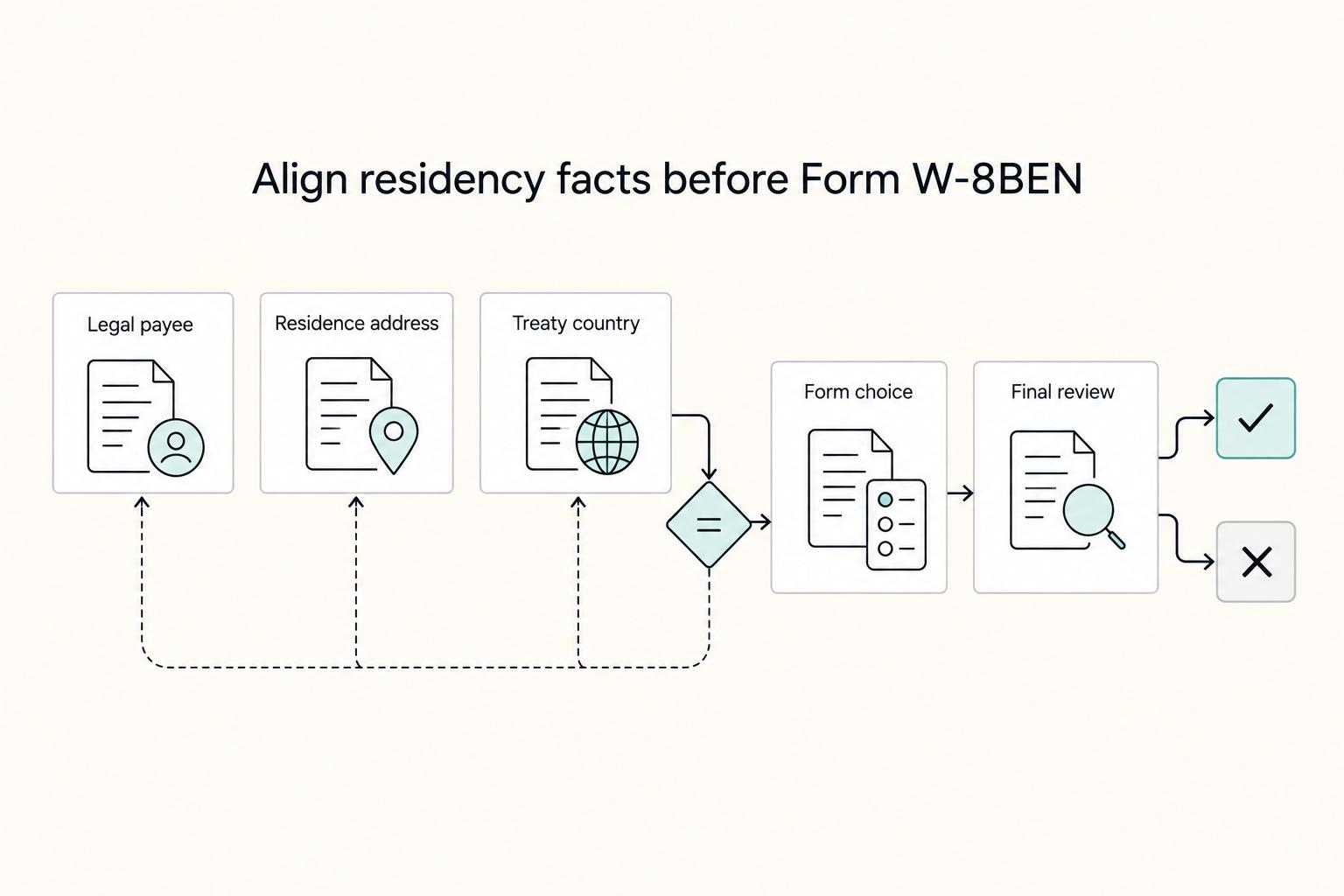
How to Fill Out Form W-8BEN for a Foreign Freelancer
Form W-8BEN lets a non-U.S. individual document foreign status to a payer and, where eligible, claim treaty benefits. For a freelancer, the first decisions are who owns the income, where the services were performed, and whether this is the right certificate. A U.S. client does not by itself make your work U.S.-source income.

The Freelance Payment Penalty: A Modeled Audit of Platform Fees, FX Spreads, and Payout Delays
The money rarely disappears through a single, easy-to-spot fee. The real loss is stacked. A marketplace takes its commission, a processor adds a charge for international cards, a bank or payment company converts the currency at a spread, a platform holds the funds before release, and a wire sheds a little to intermediaries on the way in. Each layer looks defensible on its own, but the worker feels the combined result as a smaller deposit and a later payday.