
Quick Answer
Yes. corporate veil llc protection is real, but only while you run the company as distinct from your personal activity. The strongest proof is clean account separation, consistent owner-transfer records, and signatures that show representative capacity on contracts. Risk rises when funds are mixed, documentation is rebuilt after the fact, or obligations are personally guaranteed. Treat liability protection as an operating discipline you maintain continuously, not a one-time filing result.
What the corporate veil protects, and when courts disregard it#
An LLC can protect your personal assets in most routine business-liability situations, and that protection is strongest when you treat the business as a real legal entity separate from yourself. In practice, that means claims and debts are often contained at the company level, not your personal accounts. That protection is not absolute. If you personally guarantee an obligation, or if you run the LLC in a way that erases the separation, your personal assets can still be exposed.
Courts generally start from the presumption that limited liability should be respected. Still, they can disregard it when the facts show the entity was not truly separate or that honoring it would sanction fraud or promote injustice. For an independent professional, that is the basic risk frame. Filing the LLC is only the starting point. Your day-to-day operations help determine how strong the shield really is. State law also matters, so outcomes can differ by jurisdiction.
Two common doctrines are useful here. The first is alter ego: the LLC has no meaningful identity apart from you, often shown through commingled funds, weak records, or undercapitalization. The second is misuse/fraud: the entity is used to evade liability or produce an unjust result. A useful self-check is simple: could you quickly produce clean bank records, contracts, invoices, and company records showing that the LLC operates as its own entity?
| More protected when you do this | More exposed when you do this |
|---|---|
| Keep business and personal funds separate | Pay personal bills from the business account or mix client income with personal cash |
| Maintain clear company records and contracts | Operate informally with weak records and no clean paper trail |
| Fund the business enough to operate realistically | Leave it undercapitalized while taking on obligations it cannot meet |
| Use the LLC as the contracting party when possible | Personally guarantee obligations without understanding the separate risk |
This guide breaks that principle into three practical layers: clean financial separation, records that prove authority, and funding that shows the business can stand on its own.
If you want a deeper dive, read Sole Proprietorship vs. LLC: The Definitive Guide for Global Freelancers.
Layer 1: The Financial Moat (Operationalizing Separation)#
Your first line of defense is a money trail you can explain. The goal is not a complicated setup. It is consistent records that keep business activity and personal activity distinguishable.
The legal material behind this section does not support one universal LLC rule for account setup, transfer routing, memo wording, or reimbursements. Use this as an operational clarity framework, then confirm legal and tax treatment with a qualified local adviser.
- Keep business and personal transactions distinguishable in your records.
- Use consistent labels so transfers are understandable later.
- Track tax planning moves so you can reconcile them month to month.
- Record owner payments in a way that stays consistent with your books and adviser guidance.
A money flow you can follow every month#
Keep the setup simple enough to run consistently. A simple structure you maintain is usually more useful than a complex one you do not.
If you pay yourself in more than one way, use clear labels and verify treatment with your accountant or local adviser before you standardize the process.
Allowed vs risky#
No single behavior automatically decides a veil outcome. The practical question is whether your records are easy to follow or hard to explain.
| Situation | Clearer recordkeeping approach | Blurrier recordkeeping approach |
|---|---|---|
| Mixed-use purchases | Separate and document business and personal portions | Posting the full amount without support for personal use |
| Personal bill pay | Keep personal and business spending clearly distinguishable | Running personal spending through business activity without clear documentation |
| Cash withdrawals | Keep documentation that explains purpose and timing | Frequent undocumented withdrawals |
| Transfer memos | Use consistent, descriptive notes | Using blank or inconsistent notes |
| Reimbursements | Tie repayment to documented business expenses | Using reimbursements without a clear record trail |
Reimbursements need a repeatable paper trail#
Reimbursements are easy to muddle when a business expense is paid personally. The fix is consistency. One workable process is:
| Step | What to capture |
|---|---|
| Document | Receipt, vendor, date, amount, and stated business purpose |
| Categorize | The expense in your books |
| Approve | A dated record |
| Repay | The documented amount |
| Archive | The related records together |
This is operations discipline, not a substitute for jurisdiction-specific legal or tax advice. For related context, see our guide to forming and running a Cayman Islands LLC.
Layer 2: The Paper Wall (Modernizing Corporate Formalities)#
If someone challenges your separation, your records should show that the LLC made the decision and that you signed as a company representative, not as an individual.
That is the job of the paper wall. Documentation is what turns separation into evidence, especially when a third party makes a claim. Gaps create openings: unsigned approvals, mismatched signer titles, or records that conflict across agreements, contracts, and bank files.
Keep the authority trail simple and aligned#
Start with one question: who has authority to bind the LLC? Your operating agreement, written approvals, bank authorizations, and signed agreements should answer it the same way.
Simple is usually stronger here. Extra layers help only if you can maintain them without conflict. You do not need a perfect structure. You need one that is coherent, documented, and reflected in how you actually operate.
Before you rely on informal approval, check your agreement's written-consent mechanics. Confirm whether it permits action by less than unanimous written consent and how that action has to be documented.
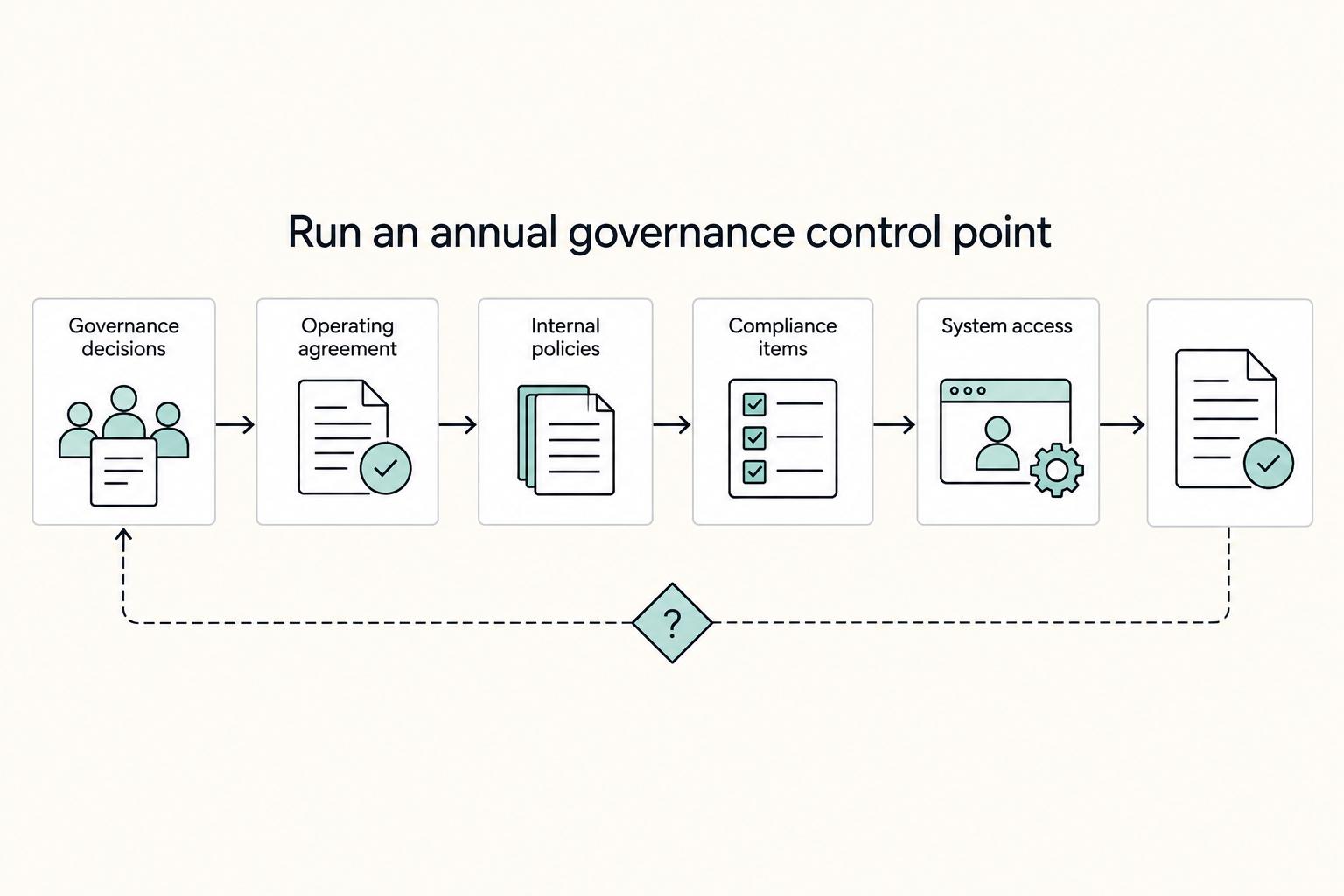
Run an annual review as a practical control point#
An annual member review memo or checklist is not universally required, but it does more than tidy your files. It shows that you actively maintain separation instead of assuming last year's setup still works. Include at least these checks:
| Check | What to confirm |
|---|---|
| Governance decisions | Were documented and stored |
| Operating agreement | Still matches current ownership, management, and signing authority |
| Internal policies | Still match practice, especially for signing authority, reimbursements, and approvals |
| Compliance items | Are logged, with state-specific filing items added only after you verify your jurisdiction |
| System access | To banking, accounting, contract, and filing systems is current, and stale access is removed |
Then test the file set against one real event from the year. You should be able to retrieve the approval record, signed document, and support file without rebuilding the story from memory.
Use resolutions for high-impact decisions#
Do not turn every routine action into a formal resolution. Use resolutions when a decision changes authority, obligations, ownership, or the company's risk profile. For each high-impact decision, consider a short log entry with:
- decision
- authority
- effective date
- supporting file
- signer capacity
These are not universal legal requirements. Their value is consistency. An outside reviewer can quickly see what was approved, under what authority, when it took effect, and who signed in what role.
Sign in representative capacity consistently#
Signature blocks are a small detail that carries a lot of weight. Your signature format should consistently show that the LLC is the party and that you are acting for it.
| Document type | Better representative signing example | Riskier version |
|---|---|---|
| Client or vendor contract | ABC LLC By: Jane Doe, Member | Jane Doe only |
| Vendor onboarding form | LLC legal name as the contracting party, signed by Jane Doe, authorized representative | Personal name as the party, with no company capacity |
| Banking document | Signed as Jane Doe, Member of ABC LLC | Signature appears personal, with no title or entity reference |
Consistency matters more than magic wording. If a form gives you a place for title or capacity, use it. If it pre-fills your personal name as the party when the LLC is the real party, correct it.
Make records retrievable, not just stored#
A paper trail you cannot retrieve quickly is weak evidence. The point is not just to save documents. It is to make them easy to find, review, and match to the underlying event. A workable protocol looks like this:
- one folder tree for formation, operating agreement, annual reviews, resolutions, contracts, banking, and filings
- consistent file naming, for example
2026-01-15_member-resolution_new-bank-account - limited edit rights, with view access only as needed
- a recurring review so signed finals are preserved and draft clutter is controlled
If you ever have to defend separation, the goal is to produce a record set that shows, clearly and quickly, that the LLC made the decision, the right person approved it, and you acted within that authority.
Related: A Guide to Corporate Governance for Solopreneur LLCs. Want cleaner documentation habits for client work and signatures? Use the freelance contract generator to standardize your paper trail.
Layer 3: The Capital Core (A Practical Guide to Capitalization)#
Your position is generally stronger when the LLC is funded like a real business and not rescued only after trouble appears. If the company cannot cover predictable obligations, that can weaken the separateness story. Undercapitalization is one factor courts may look at alongside commingling and record or formality failures, and standards vary by state.
Fund the business for its actual risk, not optics#
There is no magic reserve number. You need a credible funding plan that shows the LLC can pay ordinary costs and absorb expected risk.
Set a working-capital buffer based on what the business has to pay even in a slow month. Include recurring overhead, known tax obligations, contractual commitments, and near-term delivery costs. Then stress-test that buffer against one bad but plausible event, such as delayed client payment, refund pressure, software disruption, or an unexpected legal expense.
Use this check: if someone reviewed your bank activity and ledger, would they see a reasonable ability to pay business bills without an immediate owner bailout?
Treat insurance as part of your capital picture#
Insurance belongs in the capitalization picture, but it is not a substitute for cash and it does not guarantee limited liability protection. It can show that you planned for losses you could not reasonably self-fund. Run a coverage-fit check at setup and at each renewal:
- list your key risk categories
- map each risk to a policy, or document that you are intentionally self-funding it
- review coverage, exclusions, and policy conditions before relying on the policy
- confirm the named insured, activities, locations, and workforce or contractor setup still match operations
Pay close attention to exclusions and scope gaps. For example, employee injury exposure is generally handled through workers' compensation rather than general liability.
Capital contribution or owner loan#
Classify owner funding when the money moves, not later. Clean transfer records and consistent bookkeeping reduce both legal and tax friction.
| Treatment | Usually fits when | What to document |
|---|---|---|
| Capital contribution | You are funding startup or operating needs without scheduled repayment | transfer record, memo such as "initial capital contribution," supporting approval if required, equity or capital ledger entry |
| Owner loan | You expect repayment and want the advance treated as LLC debt | transfer record, loan memo or note, repayment terms, interest terms if any, liability ledger entry |
| Additional contribution after launch | The business needs more equity support after scope or cost changes | transfer record, short funding memo, approval record, updated capital ledger |
Confirm the accounting and tax treatment for your jurisdiction and entity classification before you finalize anything. Federal defaults differ by LLC structure, and in partnership-tax contexts, contributions and liability allocations can affect basis.
Build an evidence trail for every funding event#
A common failure point is when the transfer, memo, and books tell different stories. Your capitalization file should let a reviewer follow that story quickly.
| Record element | What it should show |
|---|---|
| Transfer record | From owner account to LLC account |
| Memo language | Stating contribution or loan |
| Supporting resolution or written approval | When your governing documents call for it |
| Ledger classification | As equity or liability |
| Archive location | For related bank proof and supporting transaction records, such as receipts, deposit slips, or canceled checks |
If your memo says "loan" but your books show equity, or the reverse, correct it immediately. The strongest file is consistent across the money movement, memo language, approvals, and ledger treatment. For a step-by-step walkthrough, see A Deep Dive into the Legal Protections Offered by a Nevada LLC.
Conclusion: Keep separation as an ongoing operating duty#
Your LLC shield is not automatic and not just a filing step. You protect it by consistently showing that the business is separate from you in money, records, and decisions. Courts are often cautious about veil piercing, but outcomes are still fact-specific, and they can pierce when they see serious injustice. If your LLC looks like an alter ego, your personal assets may be exposed.
The practical takeaway is straightforward. Separation is an ongoing operating duty, not a one-time setup step. Keep it simple and consistent. Do not treat business accounts like personal cash, and do not skip basic formalities just because you are the only owner.
Financial Moat: Keep business funds in business accounts, document owner-money moves when they happen, and fix any personal-spend mixing immediately.
Paper Wall: Use the LLC identity consistently on agreements and approvals. Keep timely records for major decisions, reimbursements, and other items a third party could review later.
Capital Core: Keep the business able to meet predictable obligations, document owner funding consistently, and reassess whether current insurance and available cash still match your risk.
Run this on a cadence. Perform regular separation checks, keep documentation hygiene current, and review coverage plus entity maintenance alongside any filing or reporting requirements that apply in your jurisdiction. If your records, account activity, and actual conduct do not match, treat that as a red flag and fix it now.
Action checklist: review your Financial Moat, Paper Wall, and Capital Core against your current accounts, signatures, records, funding, and coverage, then close the first verified gap today. You might also find this useful: How LLC Owners Separate Business and Personal Finances.
If you want your invoicing, payment flow, and payout records in one operational stack, review Gruv for freelancers to confirm fit and coverage.
Frequently Asked Questions
What formalities matter most if you run the LLC alone?
Focus on practices that show separation between you and the entity, especially clean financial separation and consistent records. Requirements and outcomes are jurisdiction-specific, so avoid assuming one universal checklist applies everywhere.
How do you reduce alter-ego risk in practice?
Keep personal and business funds separate, and maintain clear records for payments and reimbursements. Veil-piercing risk increases when a court sees the owner and entity being treated as one.
How much capitalization is enough?
There is no universal number you can rely on, and standards vary by jurisdiction. Instead of a fixed rule, keep funding and obligation records consistent so your file shows a clear separation story.
What is the right way to pay yourself?
Use a consistent, documented method to transfer money from the LLC account to your personal account. Avoid using LLC funds for personal spending, because mixing can weaken separation.
Can a one-owner LLC still face veil-piercing risk?
Yes. Veil piercing means a court can set aside limited liability and hold an owner liable for an entity obligation, and U.S. determinations are contextual. If dispute risk is rising, organize your key financial and business records now.
What if you use your personal car, laptop, or home for business?
Mixed-use can increase separation risk when documentation is weak. Keep contemporaneous logs, receipts, and reimbursement records that show date, amount, and business purpose.
Try a related tool
Researched and edited by the Gruv editorial team. Gruv builds cross-border billing, payouts, and finance-operations software for global businesses.
Sources
- delcode.delaware.gov/title6/title6.pdftrusted
- digitalrepository.unm.edu/cgi/viewcontent.cgitrusted
- doi.sc.gov/957/Understanding-Your-Insurance-Policytrusted
- irs.gov/businesses/small-businesses-self-employed/li...trusted
- irs.gov/taxtopics/tc305trusted
- law.cornell.edu/wex/piercing_the_corporate_veiltrusted
- law.cornell.edu/wex/piercing_the_veiltrusted
- mn.gov/commerce/insurance/industry/small-business/l...trusted
Educational content only. Not legal, tax, or financial advice.
Related Posts

Sole Proprietorship vs LLC for Global Freelancers in 2026
For most freelancers in 2026, the practical default is still simple: use the simplest structure you can run cleanly, then formalize when risk actually rises. If your work is still in validation mode and the downside is contained, a sole proprietorship is often the practical starting point. When contract exposure, delivery stakes, or dispute risk starts climbing, forming an LLC deserves earlier attention.

Corporate Governance for Solopreneur LLCs That Holds Up Under Review
Treat this as a decision map for running a single-member LLC as an ongoing business, not a one-time filing checklist.

The Freelance Payment Penalty: A Modeled Audit of Platform Fees, FX Spreads, and Payout Delays
The money rarely disappears through a single, easy-to-spot fee. The real loss is stacked. A marketplace takes its commission, a processor adds a charge for international cards, a bank or payment company converts the currency at a spread, a platform holds the funds before release, and a wire sheds a little to intermediaries on the way in. Each layer looks defensible on its own, but the worker feels the combined result as a smaller deposit and a later payday.