
Quick Answer
Customer churn is the share of your starting customer cohort lost during a defined period: lost starting customers divided by starting customers, multiplied by 100. Revenue churn measures recurring value lost from the same starting cohort. Keep new acquisitions outside those calculations, and state whether revenue churn is gross or net of expansion.
Why churn rate matters for subscription platforms#
Churn measures customer or recurring-revenue loss. It can weaken growth even when acquisition still exceeds losses, so read it alongside new business and expansion rather than assuming high churn always means the business is shrinking.
- Churn rate is a loss measure, not just a dashboard label.
At its core, churn rate measures how often customers stop doing business with you over a set period. In subscription and recurring-revenue models, that period is usually monthly or yearly, and the result is expressed as a percentage by multiplying the ratio by 100. Scope matters more than most teams expect. If you include new customers or newly won recurring revenue in the same period, you blur the signal before anyone can use it.
- The right churn metric depends on the decision.
Customer churn tracks how many customers you lost over time, regardless of what they paid. Revenue churn tracks the value of the recurring revenue you lost. Negative churn is different again: expansion revenue from existing customers exceeds churn and downgrade losses. These are not interchangeable metrics.
- A usable churn number has to hold up under verification.
The definition is only part of the work. You need a clear period, a clear metric choice, and clean boundaries around what is included. In practice, that means separating customer churn from revenue churn and excluding new customers or newly won recurring revenue from the period you are measuring.
Compare benchmarks only when customer type, period and metric definition match. This guide focuses on reproducible calculation and decisions instead of a universal target.
Who this churn guide is for and how to pick metrics first#
Pick your first churn metric based on who owns the decision and what kind of loss creates business risk.
- Founders and finance ops teams
Start with revenue churn if a small number of accounts drive a large share of recurring revenue. In that setup, losing a few customers can skew forecasts and revenue planning, so customer count alone is often too blunt.
- Product leaders and engineering owners
Start with customer churn when account-count volatility is the main risk. Keep the math literal: customers lost in a period divided by customers at the start of that period, then multiplied by 100.
- Teams looking for one universal benchmark
This guide is not for that use case. A "good" churn rate depends on your product and business model, so treat external comparisons as context, not the rule.
- Anyone building dashboards before metric controls are clear
Set controls before reporting: name the decision owner, define when to use customer churn vs revenue churn, and align on period cadence. You can track multiple churn types together, and combining customer and revenue views gives a better retention and profitability signal than either metric alone.
Which churn metric should you use for each decision#
Use the metric that matches the decision in front of you: if losing a few high-value accounts could change runway, prioritize revenue churn; if onboarding quality or broad account loss is the risk, prioritize customer churn (subscriber churn).
| Metric | Best for | Key pros | Key cons | Concrete platform use-case |
|---|---|---|---|---|
| Customer churn | Product and ops decisions about account-loss volume | Simple, fast signal; clear formula: (customers lost during period / customers at start of period) x 100 | Can hide value concentration across accounts | Measure losses from the starting paid cohort; track trial conversion separately |
| Revenue churn | Founder/finance decisions on forecast and risk | Shows direct recurring-revenue impact when a few accounts matter most | Can miss broad smaller-account attrition if used alone | A few large subscriber losses could materially change planning confidence |
| Negative churn | Expansion/retention analysis in a mature base | Can show whether retained-account expansion offsets losses | Not comparable unless your team documents one consistent house definition | You want to track whether expansion inside retained accounts is strong enough to offset losses |
Track both customer and revenue churn, but assign one as the primary trigger so action does not stall.
Owner and action cadence#
- Customer churn
Product or growth can own customer churn, with a weekly check and monthly trend review. Look for losses within the starting paid cohort. Track trial-to-paid conversion separately so failed trials do not inflate paid-customer churn.
- Revenue churn
Founder or finance ops should review this at monthly close. If it diverges from customer churn, treat that as concentration or mix risk and adjust retention priorities accordingly.
- Negative churn
A GM, growth, or revenue lead can own this, but only after the formula is locked. Review it monthly after the definition and inclusion rules are written and stable.
Scope rules before charting#
Define, in writing, whether trial, active, paused, and churned states are included or excluded in each metric. If those boundaries change, your trend can shift even when customer behavior does not.
Keep one dated metric definition and one period-level population logic for each trend. One non-negotiable rule: never plot churn rates built from different lifecycle definitions on the same trend line.
For a more detailed churn playbook, read How to Calculate and Manage Churn for a Subscription Business.
The 5 churn views every subscription platform should keep live#
Keep five views live, but anchor decisions in the two core views first: customer churn and revenue churn. Add the other views only after your internal definitions are written and stable.
- Customer churn rate
Use this as the clearest view of account loss volume. Keep the math literal: (customers lost during period / customers at start of period) x 100. It is easy to read and useful for early retention checks, but it can hide value concentration.
- Revenue churn
For a starting MRR of $20,000, suppose cancellations remove $1,000 and downgrades remove $500. Gross revenue churn is ($1,000 + $500) / $20,000 = 7.5%. If that same cohort expands by $2,000, net revenue churn is ($1,500 - $2,000) / $20,000 = -2.5%. This hypothetical cohort has negative net revenue churn despite losing recurring revenue to cancellations and downgrades. New-customer MRR stays outside both calculations.
- Negative churn
Negative net revenue churn means expansion in the starting cohort exceeds cancellation and downgrade losses. It can coexist with customer churn, so report the customer count and gross loss alongside it. Use a documented rule for reactivation and keep that treatment stable.
- Lifecycle churn by state
Use this as a diagnostic view, not the headline KPI. It helps you locate where losses begin in your own lifecycle model, but only if state definitions stay consistent over time.
- Segment churn view
Use this to prioritize action by segment so retention work is targeted, not broad. It is useful for focus, but small segment sizes can create noisy swings.
Keep these views live, but do not weight them equally. Get customer churn and revenue churn clean first, then layer in the diagnostic views.
Model churn by subscription lifecycle state before you act#
Model your lifecycle states before you run retention plays. Churn is measured over a specific period, and the result depends on consistent state boundaries. If those boundaries shift, both customer churn and revenue churn become harder to trust.
- Define your state rules in plain language
If you use states like trial, active, paused, and churned, document what moves an account into and out of each state. Keep one shared rule set so teams do not classify the same account differently.
- Lock transition timing before you calculate churn
Agree on which event timestamp controls period assignment for each transition, then run the churn calculation. This keeps period-to-period comparisons stable and reduces rework later.
- Decide how paused is handled, then keep it consistent
Be explicit about whether paused is counted as churn in your model. Stay consistent over time so trend changes reflect customer behavior, not definition changes.
- Set a verification path for churned records
Require each churned label to map back to the source event that triggered it. If you also report revenue churn, align that status logic with the financial records used for revenue reporting.
Use this state-level view to see where loss is happening before you act. Customer loss can skew forecasts, stall growth, and erode revenue, so clarity in the model matters as much as the final percentage.
Related: What Is a Subscription Lifecycle? How Platforms Manage Trial Active Paused and Churned States.
Trace churn to lifecycle and recurring-revenue records#
Treat unexplained losses as provisional until the calculation can be reproduced from the starting cohort and source records. A cancellation may reduce future MRR without creating an immediate journal entry.
- Document one path and use it consistently.
Document the path from source event to effective lifecycle transition and recurring-revenue change. Check billing records where relevant, and reconcile financial postings separately where refunds, credits or other accounting effects occur. MRR and recognized revenue are different measures.
- Handle retries before you trust period totals.
If your event sources retry, define how duplicate business events are detected and prevented from being applied twice. The goal is simple: replayed messages should not create extra churn-state changes or extra recurring-revenue movement for the same underlying event.
- Close with an evidence pack, not a dashboard snapshot.
Keep the starting cohort, lifecycle rules, effective dates and MRR movement records for the period. That evidence lets the team explain a spike without requiring a fictional ledger posting for every churn event.
- Set a clear period-assignment rule for boundary cases.
Decide which timestamp controls period assignment when event time, access-end timing, and posting timing do not align, and apply that rule consistently. Review boundary records before calling a month-end movement a true churn shift.
Vendor claims about faster reconciliation or churn improvement can be useful as hypotheses, but they are not proof for your own books.
Red flags and failure modes that distort churn#
Churn gets unreliable fast when your analysis scope changes or your evidence is thin. If the segment, signal, or explanation behind the metric is unclear, treat the trend as directional, not decision-ready.
- Population drift inside the trend
If your audience definition changes between periods, the churn line can look better or worse for the wrong reason. Keep segment definitions stable and explicit, because tracking churn by audience segment is what reveals where losses are actually happening.
- Satisfaction used as a retention proxy
Positive survey sentiment does not establish retention. Compare satisfaction results with actual renewals, cancellations and account feedback before choosing a retention action.
- Behavioral data without customer reasons
A churn chart shows outcomes, not causes. Churn analysis is about why customers leave, when it happens, and what patterns predict it, so pair quantitative signals with customer reasons such as exit surveys or interviews.
- Metrics reviewed without a shared evidence set
Teams stall when they debate the number instead of the drivers. Bring the segment view, churn signals, revenue-impact view, and customer feedback into one review so everyone is working from the same evidence.
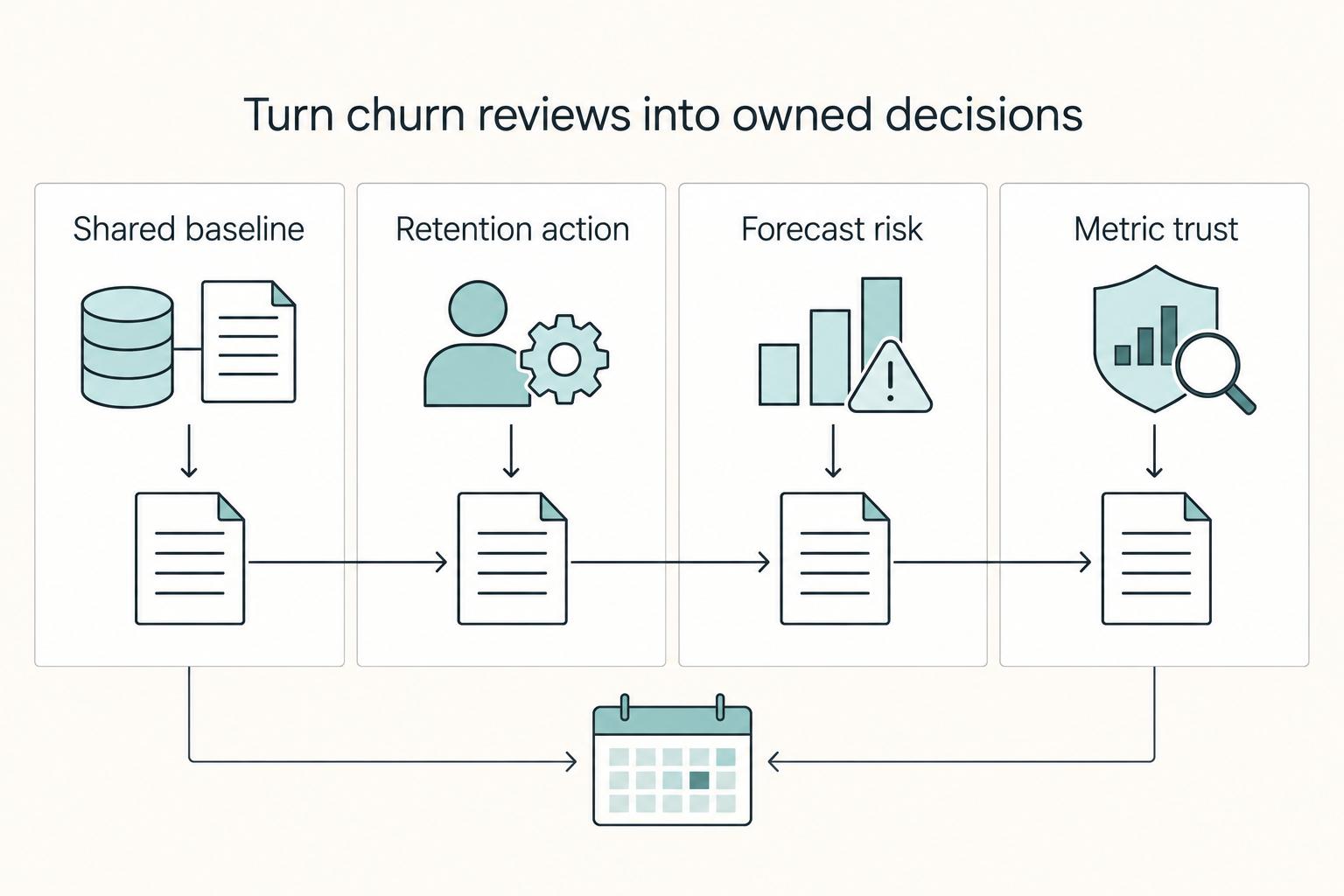
Turn churn into cross-functional decisions each month#
Each monthly churn review should end with one owner, one decision, and one next action. If churn stays a dashboard number, teams relitigate it instead of fixing retention.
Before the review, lock the same customer population, churn definition, and time period so month-to-month changes are comparable.
- Founder call on growth risk
If churn is rising, protect retention before pushing more growth spend. Losing even a few customers can skew forecasts, stall growth, and erode revenue.
- Product and customer success call on retention work
Use churn as a cross-functional operating signal, not a product-only metric. Set one retention priority both teams can execute in the next cycle, then review its effect in the next monthly close.
- Finance ops call on planning confidence
Treat elevated churn as a forecasting risk. High churn disrupts cash-flow forecasting and financial planning, so review planning assumptions when churn moves against target.
- Engineering and ops call on metric trust
Keep the churn calculation reproducible across teams. If definitions or reporting logic shift between periods, decisions slow down because the number is no longer trusted.
Conclusion#
Treat churn as an operating decision, not a glossary term. If ownership, definitions, and calculation rules stay vague, the number will create debate instead of helping you protect retention, revenue, and overall company health.
- Lock the meaning before you track the trend
Churn rate is a percentage, and it only works when the period is explicit. The core definition is straightforward: it measures the percentage of customers or subscribers who discontinue their relationship with the business over a specific period. The issue is not the math but consistency. If your team changes who counts as active, churned, paused, or excluded from one month to the next, you are not looking at movement in retention. You are looking at movement in definitions. A good checkpoint is simple: every trend line should state the reporting window and the population rule in plain English next to the metric.
- Keep one clean calculation anchor and make it traceable
For most teams, the basic calculation anchor is customers lost during the period divided by customers at the start of the period. That gives you a stable starting point. What matters next is consistency and traceability. If period boundaries or population rules shift, the metric becomes harder to trust. A common failure mode is period drift: a loss gets counted in the wrong reporting window, and suddenly a clean retention story looks like a spike. If you cannot explain how a churned customer was counted in the final total, do not overreact to the dashboard.
- Choose one primary metric, one owner, and one review cadence
You do not need five headline churn KPIs to act well. Pick one primary churn metric that matches your current risk, and define exactly who is counted and when. Then assign decision ownership. Someone should know what action follows a rise in the number, what triggers investigation, and what evidence gets reviewed. A regular review cadence is a practical choice, but the real point is regularity and explicit rules, not one universal cadence. That discipline matters because high churn directly hurts revenue and profitability, and retaining customers can be less costly than replacing lost customers.
That is the practical answer: churn is not just a definition, but a retention signal you can verify, own, and act on.
Frequently Asked Questions
What is churn rate?
It is the percentage of customers or subscribers who discontinue their relationship with a business over a specific period. The key detail is the period. A churn number is only clear when the reporting window is explicit, such as a month, quarter, or year.
How do you calculate churn rate correctly for a subscription platform?
For customer churn, divide customers lost from the starting cohort by customers in that cohort, then multiply by 100. If 24 of 800 starting customers leave, churn is 3%. A customer acquired and lost during the month belongs in a separate new-customer retention view. If one customer has multiple subscriptions, define whether the metric counts customers or subscriptions.
What is the difference between customer churn and revenue churn?
Customer churn counts customers lost from the starting cohort. Gross revenue churn counts cancellation and downgrade MRR lost from that cohort divided by its starting MRR. Net revenue churn subtracts expansion from those losses. Label gross and net explicitly; MRR is not the same as recognized accounting revenue.
What is negative churn, and when does it matter?
Negative net revenue churn occurs when expansion from the starting cohort exceeds its cancellation and downgrade losses. It does not mean the customer-loss rate is negative. Report gross losses and customer churn alongside it so expansion cannot hide attrition.
Should we track monthly churn rate, annual churn rate, or both?
Track monthly churn for operating decisions and annual churn for longer-term retention. State the cohort and period for each. Do not simply multiply monthly churn by 12: with a constant 3% monthly loss and no reactivation, compounded annual loss is 1 - 0.97^12, about 30.6%. Actual annual churn should come from the annual cohort records.
What is a good churn rate for SaaS or embedded payments platforms?
There is no universal "good" rate for SaaS or embedded payments. Treat benchmarks as context, not a one-size-fits-all target, and define scope clearly (for example, customer/subscriber churn vs. revenue/value churn). If you need external context, use a segmented benchmark source like Churn Rate Benchmarks by Industry: What Payment Platforms Should Expect and Target, not a single cross-industry average.
Try a related tool
Researched and edited by the Gruv editorial team. Gruv builds cross-border billing, payouts, and finance-operations software for global businesses.
Sources
Includes 6 external sources outside the trusted-domain allowlist.
- en.wikipedia.org/wiki/Churn_ratetrusted
- hbs.edu/ris/download.aspxtrusted
- amplitude.com/blog/churn-rate-formulaexternal
- chargebee.com/resources/glossaries/what-is-churn-rateexternal
- checkout.com/blog/what-is-churn-rateexternal
- churnzero.com/churnopedia/churn-rateexternal
- coursera.org/articles/what-is-churn-rateexternal
- fe.training/free-resources/venture-capital/what-is-churn...external
Educational content only. Not legal, tax, or financial advice.
Related Posts

Churn Benchmarks by Industry: Metrics, Cohorts and Targets
A payment platform can lose a merchant account, a paying software subscriber or recurring transaction revenue. Those are different outcomes. Before comparing churn by industry, define which relationship can churn and what event ends it. A merchant with no transactions this month is not necessarily a canceled subscriber; a failed renewal attempt is not necessarily a lost customer.
When Platforms Should Move to Payment Orchestration and Multi-Gateway Routing
Payment orchestration can become a practical priority when payment performance and finance operations start limiting growth, not just checkout delivery. A single PSP can be the right setup for a long time. But once approval paths, provider constraints, or reconciliation workload start affecting outcomes, you need a clearer strategy than adding providers ad hoc.
What Is a Subscription Lifecycle? How Platforms Manage Trial Active Paused and Churned States
A subscription lifecycle describes how a subscription moves through setup, trial, service, payment recovery and exit. Each state should tell finance, billing ops and product what changes in charges, access, edits and reconciliation. Business labels such as paused or churned need a mapping to the actual provider behavior.