

Quick Answer
Use a day rate when priorities or effort need flexibility, with a defined billable day, budget cap and checkpoints. Use a project fee for an agreed scope with cost estimates, acceptance criteria and change approvals. Test overrun scenarios and set invoice triggers separately from fee basis. Pricing does not determine worker classification.
Match the pricing model to the engagement you are selling#
You are not just choosing a pricing line item. You are deciding how cash flow behaves, how much control you keep over the work, and what the client expects to manage. In day rate versus project rate consulting, the pricing model is the business model.
A day rate sells access to your time. A project rate sells a defined, priced outcome. That sounds simple, but the operating difference is sharp. With time-based work, payment tracks the days used, so total spend moves with effort. With project pricing, total spend can be steadier if scope holds. The real question is not which model sounds more senior. It is which model matches the engagement you are actually selling.
| Decision point | Day rate | Project rate |
|---|---|---|
| What you sell | Time and expertise for a set period | A defined deliverable or outcome |
| What you control | Depends on contract terms; billing is tied to time used | Depends on contract terms; delivery method is usually tied to agreed scope |
| What the client controls | Can adjust priorities within the purchased time | Approves deliverables and scope changes based on the agreement |
| Payment predictability | Predictable per day worked, but total spend can move | More predictable total fee if scope holds |
| Scope clarity needed | Can work when scope is still evolving | Works best when scope and boundaries are clearly defined |
| Change frequency tolerance | Often more flexible when requests keep changing | Better when changes are limited or formally handled |
| Approval complexity | Depends on signoff flow and governance | Depends on signoff flow and governance |
| Main commercial risk | Earnings stay tied to available time; clients may set do-not-exceed expectations | Profitability depends on keeping scope aligned with price |
| Efficiency effect | Finishing faster can reduce revenue | Finishing efficiently can improve margin |
| Stronger fit | Discovery, troubleshooting, advisory access | Defined delivery work with measurable acceptance |
Where risk shifts#
Define what a billable day buys: hours or availability window, partial-day treatment, expenses, cancellation terms and billing cadence. A do-not-exceed cap limits authorized spend; it is not a promise to finish unlimited work for that amount. Track days and remaining budget, then seek written approval before exceeding the cap or agree which work will stop.
A fixed fee lets the client know the price of the agreed scope while you absorb effort overruns within it. If the same deliverable takes fewer days, the fee stays fixed; if it takes more, your effective daily return falls. That is a risk allocation, not proof that fixed fees are always more profitable. Estimate effort and dependencies before choosing the fee.
A simple decision test before you draft the proposal#
Before you choose a model, run three checks:
| Check | Question |
|---|---|
| Scope certainty | Can you name the deliverable in plain English and list what is out of scope? |
| Outcome measurability | Can both sides tell when the work is done and acceptable? |
| Dependency risk | Will progress depend on client approvals, access, or frequent internal changes? |
If scope certainty is low, consider starting with a day rate. That is often the cleaner choice for discovery, audits, triage, or senior advisory sessions where the value is in judgment as much as output. If the outcome is measurable and dependencies are manageable, a project fee can be stronger for defined delivery work.
One useful checkpoint is to ask the client to confirm, in writing, the deliverable, the approver, and the expected budget limit before you price. If they cannot do that yet, treat it as a signal that the engagement is still exploratory, not fixed-fee ready.
Neither model is universally better. Use time-based pricing when the work needs flexibility. Use project pricing when the result is clear enough to be priced, reviewed, and accepted. If you want the upside of a fixed fee, the next section is where the real work begins: scope risk, and the controls that keep project pricing viable.
Control scope risk before quoting#
If you use a project rate, scope control protects your margin. Flat fees can improve cost predictability for the client, but vague scope shifts cost risk to you. Time-and-materials is transparent on effort, yet it can drift into longer timelines and unexpected cost growth. Use one rule: the tighter the fee, the tighter the scope.
Use a pre-quote intake before you price#
Before you quote a fixed fee, get five points confirmed in writing. This is a practical intake, not a universal standard.
| Point | What to confirm |
|---|---|
| Business outcome | What business result does the client need, beyond the artifact? |
| Definition of done | What does complete and acceptable mean in one plain sentence? |
| Decision owner | Who gives final approval? |
| Client dependencies | What access, data, SMEs, or internal resources must the client provide? |
| Approval workflow | Who reviews, in what order, and how many rounds? |
This matters because scope, complexity, breadth, depth, delivery model, and team composition all affect fees. If your price assumes one consultant, three stakeholder interviews, and one final deck, write those assumptions down now.
Before sending the proposal, recap those five points by email and ask for confirmation. If the client cannot name the approver or define done, treat the work as not fixed-fee ready yet. Keep it on a day rate, or run a paid discovery phase first.
Build the SOW as a set of scope controls#
Use the agreed SOW to document the commercial boundaries, review process and change approvals. Clear wording helps both sides manage the fee; it does not guarantee that a dispute or legal question will disappear.
| Control point | Weak fixed-fee setup | Controlled fixed-fee setup |
|---|---|---|
| In-scope deliverables | Broad labels like "strategy support" | Specific outputs, format, quantity, and delivery date |
| Exclusions | Left unstated | Explicit list of what is not included |
| Acceptance criteria | "Client approval" | Plain acceptance test tied to the agreed result |
| Revision policy | Unlimited edits implied | Defined number of consolidated review rounds |
| Assumption log | Scattered across calls and email | One written list of client inputs, access, reviewers, and timing assumptions |
Keep the SOW operational. If the fee covers one workshop, say one workshop. If implementation, training, extra stakeholder sessions, or new analysis requests are excluded, list them. If approvals are due within a set number of business days, put that in the assumption log so delayed feedback does not quietly reset your schedule.
Before signature, compare the price, proposal and SOW. Resolve anything described but unpriced, or priced but undefined. Include currency, taxes, expenses and client dependencies so both sides know what the quoted fee covers.
Use a written change path and say it plainly to clients#
When scope changes, pause and run a written change order before more work starts.
| Step | Action |
|---|---|
| 1 | Record the request in writing. |
| 2 | Review impact on scope, effort, dependencies, and timeline. |
| 3 | Re-estimate fee and delivery dates. |
| 4 | Get written approval, then reset the timeline if needed. |
| If not approved | Continue only under the original scope. |
Client-facing script: "I've priced this as a fixed fee so your cost is clear up front. We'll confirm deliverables, acceptance criteria, and the approval path now so responsibilities are clear. If scope changes, I'll send the cost and timeline impact in writing before we proceed."
If you cannot get a written done state, a named decision owner, and a solid SOW, do not force a project rate. Use a day rate or paid discovery until the scope is stable.
You might also find this useful: How to Price a Clinical Trial Data Analysis Project.
Set payment timing separately from the fee model#
Once scope is locked, your payment structure becomes your main cash flow control. On high-value engagements, it decides how much delivery you fund upfront, how exposed you are to approval delays, and how quickly margin pressure shows up.
If a client asks for one invoice at the end, treat that as a risk decision. Fixed pricing can fit clearly defined scope, but end-loaded billing concentrates collection risk at final acceptance.
| Billing schedule | Typical structure | Cash flow impact | Dispute exposure | Admin overhead |
|---|---|---|---|---|
| Single final invoice | One invoice at completion | Highest upfront funding burden on you | Concentrated at one final approval point | Lowest |
| Milestone billing | Invoices tied to defined stages | Better alignment between progress and payment | Spread across multiple approvals instead of one event | Moderate |
| Advance plus progress invoices | Agreed advance credited against the fee, with later invoices at defined stages | Reduces initial funding burden once the advance is paid; later collections still depend on agreed terms | Clarify advance credits, cancellation and what each progress invoice requires | Moderate: track advance credits and the remaining balance |
Make each invoice trigger concrete#
For each invoice, state the contractual trigger, approver where needed, issue date and payment due date. Triggers may be a deposit, reserved time, delivery or agreed acceptance; not every invoice requires a completed deliverable. Define observable deliverable criteria and a review window. Avoid making payment depend on business results outside your control, such as later client sales or internal adoption.
Run hybrid pricing with explicit boundaries#
Use hybrid pricing when the project core is clear but change around the edges is likely. Keep fixed-fee scope limited to named deliverables, agreed review rounds, and documented client dependencies. Route extra workshops, added stakeholder groups, implementation support, or follow-on analysis to the pre-agreed day rate or retainer lane.
Define a written escalation path for scope changes: log the request, review impact, confirm revised fee or timing, then start the added work. For retainer coverage, define included request types, exclusions, and when work moves to separate billing. That keeps continuity and response priority clear without turning into open-ended access. Review utilization weekly and financial performance monthly so you catch drift before it becomes a cash flow problem.
If you want a deeper dive, read Value-Based Pricing for Strategic Consultants: A How-To Guide.
Check the working relationship separately from pricing#
A day rate does not establish employment, and a fixed project fee does not establish independent-contractor status. Classification depends on the actual relationship and applicable law. In U.S. federal tax guidance, the right to direct how work is performed matters even when that control is not exercised.
Check instructions, retained control over method, integration and the wider facts under the applicable classification rules. Escalate concerns about the actual working arrangement; rewriting invoices around outcomes cannot cure an employee relationship. Other jurisdictions and legal tests can differ from the U.S. federal tax example.
| Commercial record | Day-rate engagement | Project-fee engagement |
|---|---|---|
| Scope | Authorized work and priorities within the purchased time. | Named outputs, assumptions, exclusions and review rounds. |
| Approval | Days authorized, time record and budget checkpoint. | Deliverable review and change approval. |
| Change handling | Approve added days or revised priorities within the cap. | Approve fee and schedule impact before added scope. |
| Classification | Assess actual relationship under applicable law. | Same assessment; a fixed fee is not a safe harbor. |
Keep records accurate for either model: scope, authorized time or deliverables, invoices, approvals and changes. Assess legal status from the real facts rather than trying to make the paperwork look more independent.
For cross-border engagements, keep permanent-establishment exposure on your radar, but treat thresholds and day-count rules as jurisdiction-specific and verify locally.
Next step: align contract terms, invoicing structure, and engagement cadence so they tell one consistent story before kickoff. If your contract says "project" but your operating pattern looks open-ended, fix that mismatch before signature. We covered this in detail in How to Price a 'Productized' Consulting Service.
Your Pricing is Your Strategy#
Choose the model by scope certainty, dependency risk and the client's need for flexibility. The fee basis and payment schedule are separate choices: either model can use agreed advance, periodic or milestone invoicing.
| Model | What you price | What the workflow requires | What to watch |
|---|---|---|---|
| Day rate | Authorized days or capacity. | Define a day, cap, records and billing cadence. | No unauthorized overrun; preserve room for changing priorities. |
| Project fee | Agreed scope and deliverables. | Estimate effort/cost/risk; define acceptance and changes. | Effort overruns reduce your effective return. |
| Hybrid | Fixed core plus explicitly authorized variable work. | Keep core boundaries and extra-work rates clear. | Do not charge both lanes for the same work. |
For the hypothetical USD 8,000 project above, an agreed schedule could invoice USD 3,200 as an advance, USD 3,200 on draft delivery and USD 1,600 on final acceptance. Define the final review window and each due date separately, along with cancellation and advance-credit treatment. These percentages are illustration terms. Milestone invoicing distributes collection exposure but does not guarantee payment.
How to choose this week#
- Pick the model you can explain and operate cleanly in your proposal and invoicing process.
- If you use hourly, make the mechanics explicit: rate, time tracking, and billing cadence.
- If you test project-based or value-based pricing, review results after delivery and adjust your next quote based on what actually happened.
- Treat unsupported rules as assumptions until you validate them in your own engagements.
Move from one model to the other#
After paid discovery, quote the next defined phase as a new fixed-fee scope with its own assumptions and start approval. Compare actual days, project costs and unpaid changes with your estimate afterward. Re-estimate future work from that evidence; do not retrospectively change an agreed fixed fee because your original estimate was low.
Frequently Asked Questions
How do I calculate a project rate from a day rate?
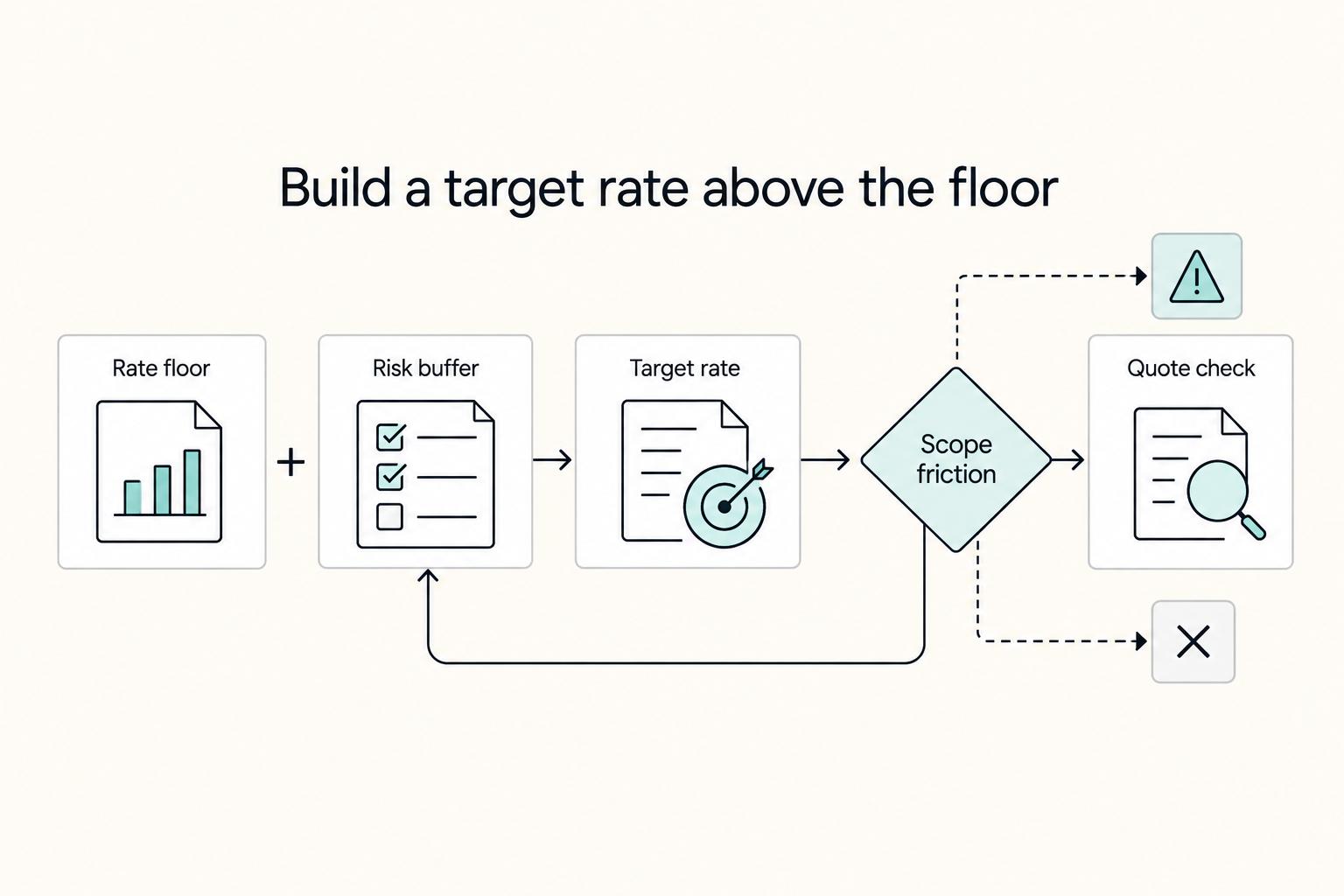
As a pricing estimate, multiply your sustainable day rate by expected delivery days, then add separately quoted costs and a reasoned allowance for remaining risk. For a hypothetical USD quote: 8 days x USD 800 = USD 6,400; add USD 600 project costs and USD 1,000 contingency for an USD 8,000 fixed fee, before applicable taxes. If delivery takes 10 days and costs stay USD 600, the fee after those costs yields USD 740 per day before other overhead and taxes. Compare that downside with your planning rate; the formula is a starting estimate, not a market price or profit guarantee.
What specific contract clauses prevent scope creep?
Define outputs, exclusions, client inputs, review rounds and observable acceptance criteria. State the review period and invoice trigger separately. Log a change request, assess fee and schedule impact and get written approval before added work. Keep working within the original scope if the change is not approved; a clause cannot prevent every request or dispute.
When should you use a day rate?
Use a day rate where priorities or effort remain uncertain, or the client wants bounded advisory capacity. Agree day length, partial-day treatment, authorized budget, billing cadence and checkpoints. Discovery and troubleshooting often fit. A long engagement can also use day rates when both sides want flexibility and control spend; length alone does not make project pricing mandatory.
How do you transition a client from a day rate to a project rate?
Run the first phase as paid discovery, then convert what you learned into a fixed-scope proposal. At the end of that phase, document the project scope, assumptions, deliverables, exclusions, and acceptance points, and price the next phase around that defined work instead of open calendar time. If the client pushes back on price, do not default straight to rate negotiation. First ask what they want removed from scope, because that keeps the discussion tied to scope and outcomes rather than hours. If you need help setting the base number before you make that shift, use How to Calculate Your Billable Rate as a Freelancer.
Try a related tool
Researched and edited by the Gruv editorial team. Gruv builds cross-border billing, payouts, and finance-operations software for global businesses.
Sources
Educational content only. Not legal, tax, or financial advice.
Related Posts
How to Calculate a Freelance Rate You Can Actually Get Paid On
A workable rate is not the neat number a calculator produces. It is the number that still works after you account for real billable capacity, non-client time, scope drift, and the gap between sending an invoice and receiving cleared cash. Start with hourly math even if you do not plan to bill hourly, then turn that number into a quote with clear `payment terms`.

Value-Based Pricing for Strategic Consultants Under Real Payment Risk
Value-based consulting fees reflect what solving a problem is worth to the buyer. The fee can still be fixed and paid in advance or by delivery milestones. Separate that pricing decision from a performance-linked bonus: a value-based fee does not automatically make payment conditional on the client achieving a future business result.

The Freelance Payment Penalty: A Modeled Audit of Platform Fees, FX Spreads, and Payout Delays
The money rarely disappears through a single, easy-to-spot fee. The real loss is stacked. A marketplace takes its commission, a processor adds a charge for international cards, a bank or payment company converts the currency at a spread, a platform holds the funds before release, and a wire sheds a little to intermediaries on the way in. Each layer looks defensible on its own, but the worker feels the combined result as a smaller deposit and a later payday.