
Quick Answer
Start with payout scenarios, then map each to a rail. ACH is typically the default for recurring U.S. runs because it is batch-based and often takes one to three business days, while SEPA fits euro transfers across participating countries. Use wire for urgent exceptions only after route checks, and treat SWIFT as messaging, not settlement. Mark payouts as final only after confirmed outcomes, not at initiation or early processing states.
Payment rails decide your payout speed, failure risk, and support load#
For platform operators, rail choice is an operating decision, not just a glossary term. It affects payout speed, exception handling, and how much cleanup your support and finance teams inherit.
Payment rails are the networks and systems that move money between bank accounts, domestically and internationally. In platform payout flows, the rail you choose shapes how predictable payouts feel and how messy reconciliation gets when something stalls.
This article stays focused on the practical decision: how to choose ACH, wire transfer, SEPA, and real-time options with fewer surprises. Different rails fit different regions and use cases, so there is no universal default.
A quick operating lens:
- ACH (Automated Clearing House): a US rail for batched electronic payments such as direct deposits and bill pay.
- SEPA (Single Euro Payments Area): for euro-denominated payments across participating European countries.
- SWIFT: a global interbank messaging network commonly used with international wire transfers, which matters because messaging and fund movement are not the same layer.
- CHIPS: a US-based real-time payment system mainly used for high-value interbank transactions.
Set architecture checkpoints early. Rails are an external infrastructure layer, while back-office reconciliation is a separate back-end concern. Keeping those layers distinct makes payout operations easier to trace and reconcile.
The scope here is deliberate. This is about platform payout operations, not consumer payment tips. Start with your real payout scenarios, then map them to the rail set that keeps routing clear and reconciliation manageable.
For a broader look at where payment infrastructure is heading, see Payment Infrastructure Trends 2026: How Marketplace Operators Should Prioritize Real-Time Rails, Stablecoins, BNPL, and Embedded Checkout.
Define payment rails and the terms teams confuse with them#
A payment rail is infrastructure used to clear and settle payments between participating institutions. Measure both interbank settlement and recipient availability: they are distinct checkpoints, and the end-to-end time also includes your provider’s processing.
App, bank and network names describe different layers. A cross-border path can involve correspondent accounts and several domestic systems rather than both end users sharing one network. Confirm the instruction path, required account details and evidence of settlement and recipient credit.
Labels are not enough to define a rail#
Names like PayPal, Venmo, and Zelle often get used as shorthand for a sending experience. That label alone is not precise enough for engineering or finance because it does not tell you the actual movement path, timing, or reconciliation evidence.
A common failure mode is promising "instant" in the UX before anyone has validated the underlying rail behavior and its exception handling.
SWIFT is not a shortcut for every part of the flow#
SWIFT carries financial messages between institutions; it does not itself hold or settle the funds. Depending on the corridor, banks use correspondent balances and domestic settlement systems. Confirm the relevant BIC and account identifiers in the provider’s requirements rather than treating a SWIFT message as proof of recipient credit.
Use two separate design-review questions: how the payment instruction is sent, and how funds are in the end credited to the recipient account.
Where card networks and blockchain fit#
Card networks and blockchain are also discussed at the rail level in some taxonomies. The practical point is to stay consistent. Do not confuse checkout or wallet UX with settlement behavior, timing, and the audit trail you need when a payment goes off-path.
The rail families that matter for platform payouts#
For most platform payouts, bank-transfer rails do the core movement work, and your choice should follow urgency, geography, and exception load. Do not promise payout timing until you have confirmed the exact rail, recipient support, and settlement evidence your team will rely on.
Bank transfer rails#
ACH supports U.S. credit (push) and debit (pull) entries through batch processing. Nacha describes credit settlement on the same, next or second banking day; provider submission delays and recipient availability can add to the customer’s end-to-end wait. Same Day ACH requires an eligible entry submitted within the applicable window.
| Rail | Fit/scope | Grounded detail |
|---|---|---|
| ACH | U.S. bank credits and debits | Batch processing with banking-day settlement windows and entry-specific return rules |
| Fedwire | U.S. dollar wire settlement | A bank-level settlement system; distinguish its completion from the recipient bank’s customer posting |
| CHIPS | High-value U.S. dollar payments | The Clearing House combines liquidity-efficient processing with final settlement; verify your bank’s actual route |
Track the ODFI, ACH operator and RDFI. Outbound ACH credits can return for invalid or closed recipient accounts; insufficient funds and unauthorized-debit disputes are different failure patterns, generally associated with debits. Settlement does not eliminate all later return or correction risk.
Fedwire and CHIPS are U.S. dollar settlement systems with distinct participation and processing arrangements. Ask which system and correspondent path your bank uses; a marketing label of “wire” does not identify every handoff or prove recipient-account credit.
Regional and real-time rails#
You will also encounter regional rails. Treat them as market-specific routing options, and confirm whether your provider setup and recipient account data support the local path.
FedNow and The Clearing House’s RTP network are separate U.S. instant-payment networks. The FedNow network limit increased to $10 million on November 12, 2025; participating institutions can set lower limits. RTP also supports transfers up to $10 million. Verify recipient reach, account eligibility and provider limits for the selected network.
Access and coverage still decide whether "instant" is real in your product. Many fintechs need a partner financial institution to access FedNow, so verify institution participation and limit settings before you expose the option in the UI.
Cards and blockchain in payout programs#
Card networks are also rails in scope, not only bank-transfer methods. For platform teams, separate collection-path choices from payout-path choices and make sure reconciliation can link both sides cleanly.
If your program evaluates blockchain or stablecoin rails, treat them as program-specific options rather than default replacements for bank rails.
Compare ACH, wire, SEPA, and real-time rails before you build#
Choose the rail that matches your operating promise, not the fastest headline. If payout timing is business-critical, prioritize real-time options such as Real-Time Payments (RTP) where support is confirmed. If predictable scheduled runs and batching matter more, start with Automated Clearing House (ACH); for euro transfers across participating countries, plan around Single Euro Payments Area (SEPA).
Compare messaging, clearing, interbank settlement and recipient availability separately. Finality is a property of the applicable system and rules; it does not mean every possible return, fraud investigation or correction disappears.
The operator comparison that matters#
| Rail | Settlement pattern | Reversibility profile | Geography fit | Operational overhead | Exception handling burden |
|---|---|---|---|---|---|
| ACH | Batch; eligible credits settle same, next or second banking day | Entry-specific returns and corrections can follow settlement | U.S. ACH path | Cutoff, batch and beneficiary controls | Separate rejection, return and missing-credit investigation |
| Wire: Fedwire or CHIPS route | Bank-level settlement within the system’s operating arrangements | Do not assume a sender can unilaterally reverse a completed wire | U.S. dollar settlement; cross-border legs may use correspondents | Bank cutoff, beneficiary and correspondent checks | Trace references and recipient posting; recall is not a guaranteed refund |
| SEPA Credit Transfer (SCT) | Standard euro credit-transfer scheme; distinguish it from SCT Inst | Scheme-specific recall, rejection and return handling | Euro payments within SEPA scheme scope | Provider cutoff, account and scheme-reach checks | Keep scheme outcomes and bank-credit evidence |
| SEPA Instant Credit Transfer (SCT Inst) | Instant euro credit-transfer scheme available around the clock | Completed transfers require applicable recovery procedures, not ordinary cancellation | Reachable accounts within SCT Inst scope | Scheme reach, limits and current rulebook checks | Investigate timeouts without issuing a duplicate |
| FedNow / RTP | Separate U.S. networks with instant settlement through participants, 24/7 | Final network settlement is not ordinary ACH-style revocability | Reachable U.S. recipient accounts on the selected network | Verify bank reach, funding and actual program limits | Treat return requests separately from original final settlement |
Where teams usually get this wrong#
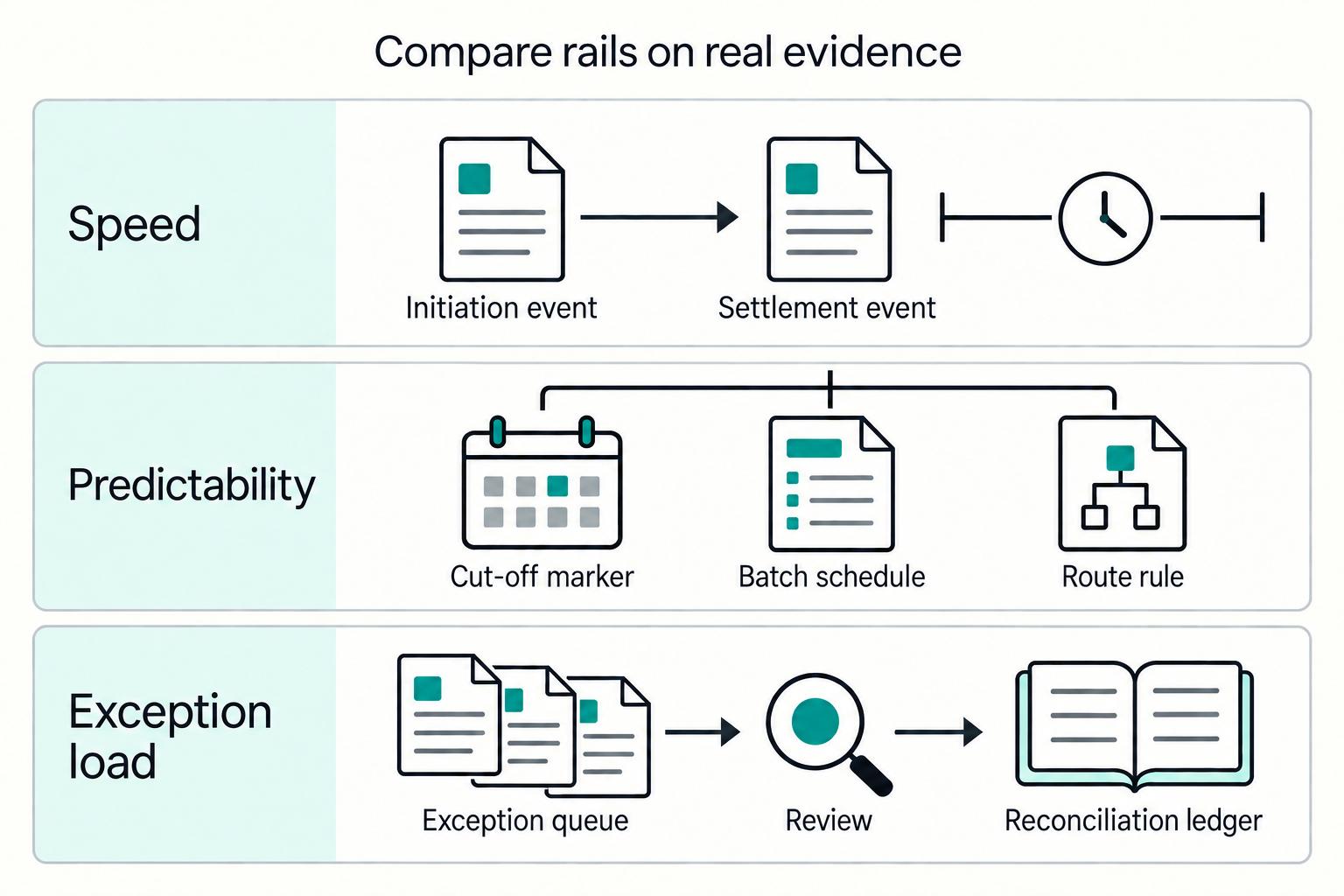
Teams usually get this wrong by optimizing for speed alone. The real decision is speed versus predictability versus exception load. ACH makes that tradeoff easy to see. It is strong for recurring, batch-oriented operations, but it is not continuous real-time processing, and settlement can lag posting. In the cited flow, the ODFI sends batched entries to an ACH operator, so your ledger and support logic need to track that handoff clearly.
With wire, avoid using the label as an operating promise. You still need the actual route and status model, especially when cross-border messaging may involve SWIFT, which is a messaging network.
Unknowns to force into diligence#
Before you sign off on build, force the unknowns into the open. You need clarity on cost structure, failure-rate benchmarks, and recipient coverage by provider, partner bank, and corridor.
Ask for:
- A rail-by-rail recipient support matrix for your target markets
- Sample status events for initiated, posted, and settled states
- ACH throughput constraints, including any daily transaction limits
- The actual wire path, including whether cross-border messaging depends on SWIFT
Do not launch a route whose essential operating details are unknown. For planned U.S. runs, evaluate ACH; for euro payouts, distinguish SCT from SCT Inst. Confirm support and evidence for either choice before promising delivery.
Choose rails by payout scenario, not by trend#
Set a default rail by payout scenario, then define exceptions up front. Rails coexist because they serve different purposes. The practical task is choosing the rail that fits each transaction while keeping the rule set understandable.
| Payout scenario | Usual first choice | Why it often fits | Verification before go-live |
|---|---|---|---|
| Recurring domestic contractor payouts | ACH | ACH is well-suited to large volumes of low-cost payments and repeatable payout runs. | Confirm recipient support, batch handling, and clear status checkpoints. |
| Recurring EUR payouts in your existing setup | Your established EUR rail setup | Fits planned EUR payout flows when you already run this setup operationally. | Confirm corridor and recipient coverage, plus confirmation events. |
| Urgent exception payout | Wire transfer | Useful when urgency outweighs routine batch efficiency. | Re-check beneficiary details, route handling, and final status ownership. |
| Instant-expectation domestic payout | FedNow or RTP where supported | These rails can enable real-time settlement between banks. | Confirm recipient eligibility, program support, and fallback behavior before promising speed. |
| Cross-border or mixed domestic/international payout book | Corridor-specific routing | Different destinations and currencies can require different rails. | Map destination-specific routing paths and confirmation events. |
Planned recurring payouts#
For planned runs, prioritize predictability over trend pressure. ACH is a strong default for high-volume, low-cost domestic flows, and an established EUR rail setup can be the practical choice for recurring EUR payouts.
Do not stop at initiation states. Keep your routing, ledger, and support flow aligned to clear checkpoints through settlement and confirmation on both sides.
Urgent payouts should stay exceptional#
Use wire as an exception tool, not a silent backup default. Require an explicit reason, a second beneficiary check, and a clear owner for final confirmation so urgent handling stays controlled. When teams normalize exception handling for routine misses, extra processing layers can add long-term operating cost at scale. Keep that tradeoff intentional.
Instant rails need eligibility gates#
If your product promise includes fast availability, define eligibility gates before you ship that promise. FedNow and RTP can support instant experiences, but reach and support should be verified in your actual program, not assumed.
Keep the gates operational: reachable recipient, successful compliance checks, and documented fallback behavior. If this choice is central, review FedNow vs. RTP before locking product language. Added processing layers can also raise long-term operating cost at scale, especially at very high transaction volumes.
Cross-border routing needs a corridor map and clear fail states#
For cross-border payouts, maintain a corridor map and treat it as launch-critical. Verify route behavior per destination instead of implying speed or coverage from rail labels alone.
Document unsupported corridors, blocked recipients, and routes without reliable confirmation states so failures are explicit. Rail operations include authentication, compliance checks, and settlement, so blocked cases should fail early and clearly.
Map the end-to-end flow from API call to settlement confirmation#
Map the flow so your team can distinguish request receipt, in-flight processing, and true settlement finality. Fast status updates can still sit on provisional or batch-backed settlement, so your product states should not imply irrevocable funds before that point.
Sequence the lifecycle before you ship statuses#
Start with the API capture step, then track each transition to ledger posting:
| Step | Stage | What happens |
|---|---|---|
| 1 | Initiation | Capture required payout data (amount, currency, identifiers, payment method details) and create the internal record. |
| 2 | Routing checks | Choose the rail and prepare the instruction path. |
| 3 | Submission | Send the instruction to the provider or rail for processing. |
| 4 | Clearing and settlement | Institutions process the movement. |
| 5 | Funds transfer confirmation | Receive outcome signals from the provider or rail. |
| 6 | Ledger posting | Record financial effects as they occur, including provisional or clearing entries, settlement, fees and subsequent returns; do not defer all accounting until final success. |
Submission is not settlement. Interbank finality, recipient-account availability and later scheme-specific returns are different facts; model each where it applies.
How ACH moves through the chain#
For Automated Clearing House (ACH) flows, define actors up front:
- ODFI: originating side institution.
- RDFI: receiving side institution.
- ACH operator: routes ACH batch instructions between institutions.
ACH is batch-based. Eligible credits can settle the same, next or second banking day, while a provider may add processing time. Returns can occur after initial settlement, so retain a return-handling path.
Protect the two highest-risk checkpoints#
Treat dependency handoffs as high-risk points:
- Instruction creation: failures here can block or distort every downstream step.
- Outcome handling: distinguish provisional, settled and returned financial events; do not label an early acceptance as final success.
You do not need a universal taxonomy, but you do need one that product and ops share.
Define status surfaces and assign owners#
Example internal status map (adapt labels to your stack):
| Status surface | Meaning in your stack | Typical transition owner |
|---|---|---|
| pending | Request received, not yet submitted | Application or API layer |
| processing | Submitted and being handled | Provider or rail-facing service |
| held | Paused for review or dependency | Ops workflow |
| credited | Confirmation is strong enough for recipient-visible success | Finance and ledger rules, informed by provider confirmations |
| returned | Failed or reversed after submission | Provider signal plus ops handling |
Separate rail-status updates from ledger-posting decisions. That ownership boundary keeps recipient-facing status aligned with how money actually settles.
Related reading: How Platforms Are Using AI to Automate Payment Operations: Use Cases and ROI.
Build compliance gates before you scale volume#
Put required compliance and screening checks at payout eligibility, not after a failure. If you route first and validate later, you create late failures, manual review, and more exception handling. Treat compliance as Step 2 in routing: remove disallowed rails first, then compare the remaining options on speed and cost.
Gate eligibility before submission#
Decide eligibility from one consistent routing envelope every time: corridor, currency, amount, urgency, beneficiary bank identifiers, payer entity, and payment purpose. This gives ops and engineering a clear basis for why a payout was allowed, held, or blocked.
Do not submit a payout until required compliance and screening checks have passed for that payout type and destination. In cross-border flows, screening has to happen in-flow. If corridor-specific requirements are missing, payouts can fail after submission or land in exception queues for manual clearing.
Treat corridor coverage as variable#
Coverage and compliance obligations vary by corridor and payment type, so do not treat rail availability as universal. Before making launch promises, confirm support for the route, beneficiary reachability, and the compliance process for that scenario.
Faster rails can improve turnaround, but speed does not remove cross-border timing, hours, or rules coordination. If support or controls are unclear, block the route until the gap is resolved.
Pull tax records into the payout decision#
Keep payout controls and finance evidence in the same record. When a payout is tied to an invoice, capture invoice number, invoice date, supplier identity, amounts, and tax before submission.
Preserve traceability by linking payment confirmation back to the related invoice number or ERP payment ID. Without that link, reconciliation and audit handling get harder when payouts are blocked or reviewed.
Define escalation and override rules before volume arrives#
Define who can release a review hold and what evidence is required. A policy exception cannot override a legal prohibition, sanctions block or required provider restriction.
For blocked payouts and overrides, log the reason, reviewer, documents checked, and final decision in an audit trail that still makes sense six months later.
Design for failures you will actually see in production#
Design payout handling on the assumption that rail behavior differs in status, timing, and failure modes. A successful API response, or even a webhook event, is not proof that funds have completed movement.
Treat status as rail-specific, not generic#
Model payout state by rail, not as one universal lifecycle. What looks like a delay on one rail may be normal processing on another, so non-success states should not collapse into one generic "failed" state.
Keep three checkpoints separate in your records:
- submission accepted
- rail status update received
- final outcome confirmed
Only the final confirmed outcome should drive "paid" customer messaging.
Prevent avoidable failures before submission#
Use pre-flight checks that match the route you are sending through. Depending on the rail and provider, checks may include:
- account and recipient detail validation where supported
- route, currency, or access eligibility checks where available
- operating-window or cutoff-aware routing where available
If speed is required, confirm the recipient is reachable on the real-time route before using it. If eligibility is unavailable or unclear, route to a fallback you can support operationally. For rails where confirmation can lag, present that status as expected rail behavior until you have evidence of a true exception.
Recover by failure class#
Route recovery by failure type, not by a single retry rule.
| Failure class | Typical handling | Verify before action |
|---|---|---|
| Return or rejection status | Hold, review, then correct details or retry if appropriate | Beneficiary details snapshot, prior attempts |
| Prolonged pending status | Keep pending with monitoring, then escalate by internal review policy | Provider reference, timestamps, status history |
| Route or eligibility mismatch | Do not retry on the same rail. Reroute if fallback is allowed. | Eligibility result, fallback availability, urgency |
Do not replace a payout merely because it is pending or timed out. Resolve the original provider outcome or confirmed cancellation first. Supported same-request retries must follow that provider’s key scope and retention; a different rail or provider is not covered by the original key.
Write customer messaging that matches rail reality#
Define approved support language for pending, processing, returned, and failed by rail. Avoid "funds are on the way" when completion is still uncertain.
Keep communication rules simple:
- do not promise exact arrival times unless your program can reliably support that promise
- for pending payouts, state what is known now, what will be checked next, and when the next update will be provided
For a step-by-step walkthrough, see Sequencing Your Payment Product Roadmap: What to Build First When Launching a New Platform.
Reconciliation evidence finance and audit will require#
Reconciliation should run as a finance-operations control with a defined evidence pack and a repeatable exception process, not as ad hoc cleanup.
| Item | Article detail |
|---|---|
| Provider reference numbers | Include provider reference numbers. |
| Account, amount, and reference details | Include sender and receiver account details, amount, currency, date, and reference numbers. |
| Matched invoice or transaction record | Include the invoice or transaction record the movement is matched to. |
| Messaging and settlement events | Build one internal trace chain per payment that links both messaging events and settlement events. |
| Event times by system | Document how each system records event times so finance knows how to interpret timing differences at each stage. |
Set one internal minimum evidence pack for every payment event so finance and audit can trace records across systems. The pack should cover the items above.
Build one internal trace chain per payment that links both messaging events and settlement events, so each movement is traceable even when records come from multiple sources.
Define a regular reconciliation cadence, an exception queue, and clear owners for unresolved breaks. Keep this as an internal operating policy, and review exceptions early to catch suspicious or unauthorized activity faster.
Record event timestamps and business-day calendars consistently. Provider processing, interbank settlement, recipient availability and later returns can create different reconciliation breaks; investigate the specific handoff rather than assuming a universal two-to-three-day lag.
Decide when multi-rail routing is worth the complexity#
Use multi-rail routing when one rail is creating recurring, measurable pain. Add complexity to solve a specific operating problem, not as a default resilience upgrade.
Use multi-rail routing only for recurring, measured problems such as missed delivery expectations, unsupported recipients or excessive exception work. If the existing ACH path meets your scheduled payout requirements and return controls work, adding another rail may not be worthwhile.
Trigger points that can justify a second rail:
- repeated SLA misses caused by the rail itself, not your own approval or compliance delays
- corridor expansion where one route cannot complete the full payout path
- support backlog tied to one rail's timing, eligibility, or exception profile
- urgent exception payouts where a wire transfer is acceptable at higher cost because reliability is the priority
Keep routing policy explicit: primary rail, fallback rail, and hard-stop rules for each scenario. This matters most for real-time endpoints because RTP and FedNow are not interchangeable. A payment sent on one may not be receivable on the other. If instant delivery is required and recipient eligibility on the chosen real-time network is not confirmed, use a hard stop or controlled downgrade, such as ACH, and reset the delivery promise accordingly.
Before adding another rail, confirm operational readiness. You should already monitor payouts through initiation, authorization, processing, and settlement, with rail-specific exception reconciliation. If that control layer is not ready, multi-rail routing can increase ambiguity for finance, support, and compliance rather than reducing risk.
Launch checklist for the next implementation cycle#
Keep this cycle narrow and explicit: define a small set of payout scenarios, lock default rails, and set hard stops before production traffic.
- Pick 2-3 priority payout scenarios and assign a default payout rail to each, plus fallback or stop conditions.
- Validate launch-readiness gates by scenario and market/program:
KYC,AML, licensing eligibility, business model clarity, transaction monitoring and reporting, and technology security and operational resilience. IncludeKYBrequirements where applicable. If core approval requirements are unclear, timelines can slip or approval can fail. - Implement control-layer basics in code and ops tooling: idempotency on payout creation, explicit webhook event handling, and clear status mapping so exceptions are interpretable.
- Keep API credentials in an appropriate secrets manager, restrict access and rotate them under the provider’s requirements.
- Run a controlled pilot with reconciliation sign-off, then expand in stages only after your pre-set risk and support criteria are met. If teams cannot explain a failed payout end to end, pause rollout and fix that gap first.
Document the default route, permitted fallback, duplicate guard, status mapping and finance evidence in one implementation specification.
The right rail choice is an operating decision, not a glossary definition#
If you came here asking what payment rails are, the practical answer is this: choose rails by payout scenario, operating risk, and execution readiness, not by headlines.
The core tradeoff is speed, cost, and revocability risk, plus the operational burden of exceptions. A wire can be the wrong fit for routine low-value payments, while ACH can be the wrong fit when immediate certainty matters because it is batch-based and can carry return risk.
Use scenario-based routing instead of forcing every payout through one rail. For real-time paths such as RTP, verify recipient-bank eligibility before routing and make fallback behavior, such as ACH, explicit before you promise speed.
Before rollout, keep a simple launch pack per corridor and payout program:
- Supported rails for that market and recipient type
- Pre-route eligibility checks
- Fallback behavior when the preferred path is unavailable
- Status signals operations and support can act on
Coverage, compliance handling, and exception behavior vary by market and program, so confirm those details in current provider documentation before production commitments.
For deeper implementation decisions, continue with:
- FedNow vs. RTP: What Real-Time Payment Rails Mean for Gig Platforms and Contractor Payouts
- SaaS Accounting Software Evaluation: What Payment Platforms Need Beyond Standard GL Features
- How to Pay Contractors in Latin America: Brazil Mexico Colombia Argentina Rails Compared
Before you commit to production, validate corridor coverage, recipient eligibility, and controls for the exact markets you plan to serve. If you want to validate corridor coverage and payout controls before production, talk to Gruv.
Frequently Asked Questions
What are payment rails in plain terms for platform teams?
Payment rails are the underlying infrastructure that connects banks and financial institutions to move funds. For platform teams, that matters because rails are used for both domestic and cross-border transfers and can affect how you run payout operations.
What is the practical difference between ACH, Wire transfer, SEPA, and real-time rails like FedNow and RTP?
ACH is a U.S. batch network. Fedwire and CHIPS serve U.S. dollar wire settlement. SEPA has separate standard and instant euro credit-transfer schemes. FedNow and RTP are distinct U.S. instant networks. Compare network behavior and your provider’s end-to-end delivery terms separately.
Are PayPal, Venmo, and Zelle payment rails or payment apps on top of rails?
PayPal and Venmo are named payment options in business pricing, not a full rail taxonomy. Confirm the underlying movement path for Zelle and other providers in your provider terms before building around it.
Does real-time always mean funds are instantly available and final?
Not as a universal rule. "Real-time" is not a blanket guarantee of instant availability and finality, so verify those terms in your provider documentation.
When should a platform use SWIFT instead of a local rail like FPS or Interac?
Use a bank path involving SWIFT messaging when it supports the required currency, destination and recipient that a local route cannot serve. SWIFT is messaging rather than settlement. Compare the full correspondent path, fees, delivery evidence and supported local alternatives before choosing.
How should we choose a fallback rail when the primary payout route fails?
Define supported primary and fallback routes in advance. Before replacing an already submitted payout, resolve its authoritative outcome or confirmed cancellation. Provider idempotency keys do not deduplicate across different providers; an unknown original belongs in investigation.
Which controls should be live before enabling cross-border payouts at scale?
Confirm the legal and provider program, recipient reachability, required identity and screening checks, funding and limits. Implement durable duplicate guards, provider-specific status handling, protected credentials and reconciliation of settlement, fees and returns before expanding volume.
Try a related tool
Researched and edited by the Gruv editorial team. Gruv builds cross-border billing, payouts, and finance-operations software for global businesses.
Sources
Includes 7 external sources outside the trusted-domain allowlist.
- docs.stripe.com/api/idempotent_requeststrusted
- europeanpaymentscouncil.eu/what-we-do/sepa-credit-transferexternal
- europeanpaymentscouncil.eu/what-we-do/epc-payment-schemes/sepa-instant-...external
- frbservices.org/financial-services/fedwire-funds-serviceexternal
- frbservices.org/news/communications/111225-fednow-transactio...external
- nacha.org/content/how-ach-payments-workexternal
- theclearinghouse.org/payment-systems/chipsexternal
- theclearinghouse.org/payment-systems/rtpexternal
Educational content only. Not legal, tax, or financial advice.
Related Posts

The Freelance Payment Penalty: A Modeled Audit of Platform Fees, FX Spreads, and Payout Delays
The money rarely disappears through a single, easy-to-spot fee. The real loss is stacked. A marketplace takes its commission, a processor adds a charge for international cards, a bank or payment company converts the currency at a spread, a platform holds the funds before release, and a wire sheds a little to intermediaries on the way in. Each layer looks defensible on its own, but the worker feels the combined result as a smaller deposit and a later payday.

How to Respond to a Subpoena for Business Records
Move fast, but do not produce records on instinct. If you need to **respond to a subpoena for business records**, your immediate job is to control deadlines, preserve records, and make any later production defensible.

A US Expat's Guide to Investing in UCITS ETFs to Avoid PFIC Issues
The real problem is a two-system conflict. U.S. tax treatment can punish the wrong fund choice, while local product-access constraints can block the funds you want to buy in the first place. For **us expat ucits etfs**, the practical question is not "Which product is best?" It is "What can I access, report, and keep doing every year without guessing?" Use this four-part filter before any trade: