
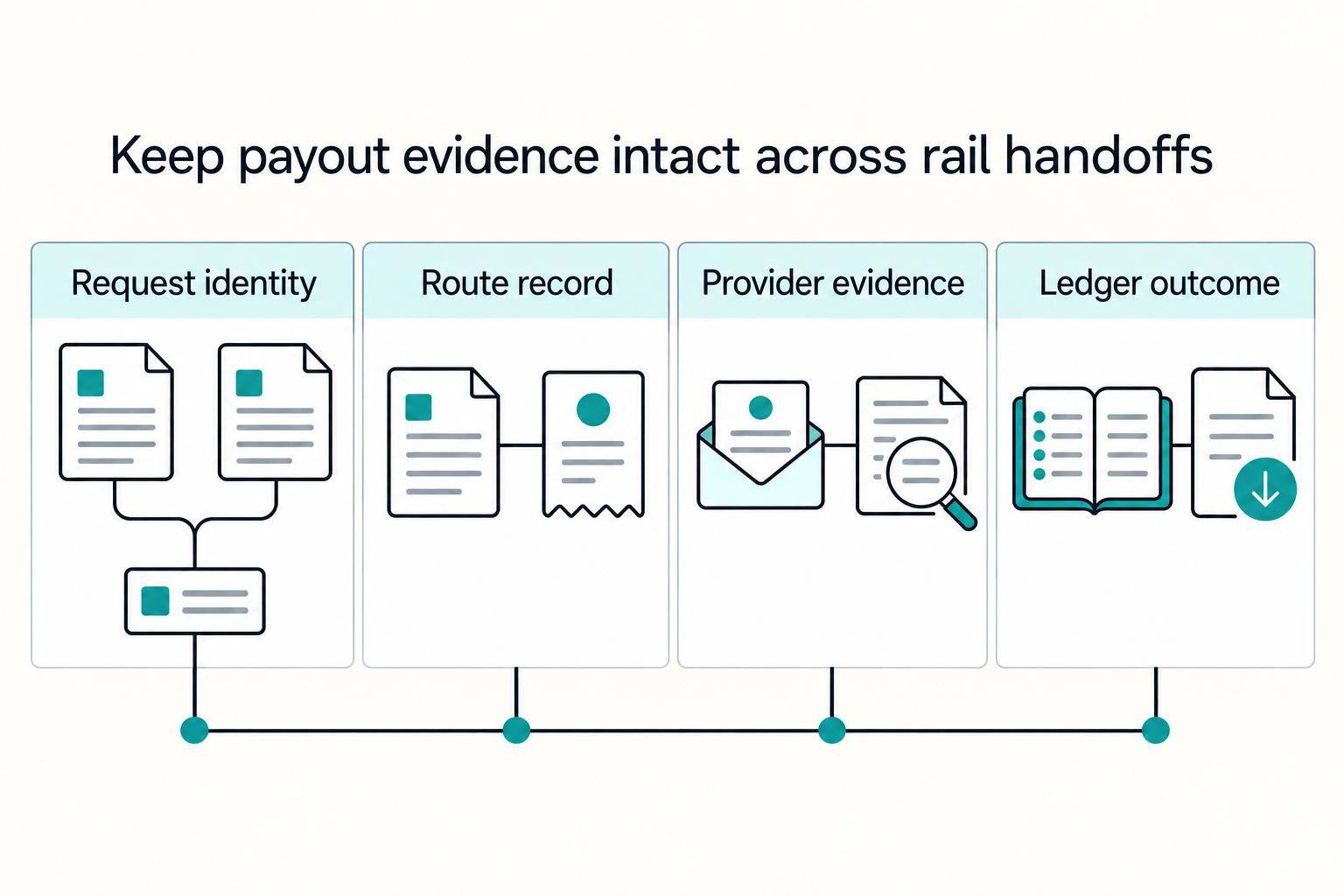
Quick Answer
Pay contractors in Latin America by choosing the rail family that creates the least manual cleanup from approval to ledger close. Start with local rails such as Pix in Brazil and SPEI in Mexico when timing matters and coverage exists, use stablecoin-funded paths only for specific corridor or contingency needs, and keep traditional bank rails where bank-native controls, audit expectations, or documentation requirements decide the route.
How Payout Rails Differ Across Brazil, Mexico, Colombia, and Argentina#
If you need reliable contractor payouts in Latin America, rail choice is an operations decision first and a pricing decision second. The common mistake is assuming every "fast" payout option behaves the same once FX handling, approval timing, provider dependencies, and month-end reconciliation are in scope.
Regional evidence shows instant payment systems are advancing, but not at a uniform pace. Regulatory, technological, and operational friction still affects rollout. In practice, Brazil, Mexico, Colombia, and Argentina are different operating environments, not one interchangeable rail market.
A practical starting point is to compare rail families before you compare providers.
| Rail family | Why teams choose it first | Where trouble usually appears | Confidence in public evidence |
|---|---|---|---|
| Traditional bank wires | Familiar process and broad international reach | More intermediary dependency, weaker cost visibility, and timing outside your direct control | Moderate on broad behavior; limited like-for-like corridor benchmarks |
| Local domestic or instant rails | Better fit for domestic payment habits and the push toward interoperable models | Country-specific routing, data, and reconciliation requirements can differ sharply | Strong on regional direction; weaker on operator-grade cross-country comparisons |
| Stablecoin-enabled paths | Attractive for teams seeking tighter digital settlement and FX workflow control | Compliance setup, provider dependency, and off-ramp reliability can outweigh headline transfer speed | Mixed; a meaningful share of current speed and cost claims is vendor-sourced |
The main comparison in this article is simple: which rail family helps you approve, send, match, and close payouts with the least manual cleanup each cycle. Before you invest engineering time, verify whether your provider controls the rail directly or depends on third-party banking partners and intermediaries. That dependency can raise support load and close-process risk. Also separate regional trend from corridor proof: interoperability is improving, but cross-country side-by-side performance evidence is still limited.
This comparison is for platform teams that need a practical decision path. You will leave with a decision matrix, country implementation checkpoints, and a 90-day execution sequence for finance, ops, and engineering.
At a glance comparison for LATAM contractor payout rails#
Use this table as a routing starting point, not a final market benchmark. the only concrete rail evidence is a Mexico SPEI flow from one provider, so treat Brazil, Colombia, and Argentina outcomes as provider-specific until you validate them in production.
| Criteria | Traditional bank rails | Local rails such as PIX, SPEI, PSE, CBU or CVU | Stablecoin-funded paths such as USDC or USDT |
|---|---|---|---|
| Settlement window | Can align with treasury batch habits, but payout timing is less controllable from your side once banking cutoffs and intermediaries are involved | Mexico SPEI is the only evidenced case here: one provider describes USD to MXN conversion and CLABE payout in minutes; no equivalent timing evidence here for PIX, PSE, CBU, or CVU | The same provider describes a USDC-funded MXN SPEI path in minutes, including weekends; outside that setup, timing depends on the off-ramp and local payout leg |
| Operating hours | Operationally familiar for teams that already run during banking hours | In the evidenced Mexico API model, processing is described as 24/7; operating behavior for Brazil, Colombia, and Argentina is not evidenced here | Off-hours execution is a core reason teams evaluate this path; 24/7 behavior is evidenced here only for the cited Mexico model |
| Cost visibility | Not established in this section with measurable benchmarks | Not established in this section with measurable benchmarks | Not established in this section with measurable benchmarks |
| FX control | Not established in this section with measurable benchmarks | Mexico SPEI example includes USD to MXN conversion in one API flow; no cross-country FX control comparison is evidenced here | Mexico SPEI example includes USDC funding and MXN conversion in one API flow; no cross-country FX control comparison is evidenced here |
| Prefunding pressure | Not established in this section with measurable benchmarks | Not established in this section with measurable benchmarks | Not established in this section with measurable benchmarks |
| Reconciliation quality via API and webhooks | Not established in this section with measurable benchmarks | In the evidenced Mexico model, the provider calls out unified ledgers, machine-readable receipts, clean webhooks, and idempotency | In the same evidenced Mexico model, those reconciliation controls are part of the API-led flow |
| Country applicability (Brazil, Mexico, Colombia, Argentina) | Do not assume one behavior across all four countries from this section alone | Mexico (SPEI) has concrete provider-stated detail; Brazil (PIX), Colombia (PSE), and Argentina (CBU/CVU) are not evidenced here at the same level | Concrete detail here is tied to a Mexico SPEI off-ramp example; do not generalize that performance across all four countries without corridor-level proof |
| Confidence level | Moderate on operational familiarity; low on quantified performance in this section | Higher for the existence of the Mexico SPEI flow; low for cross-country side-by-side performance claims | Mixed: concrete for the cited Mexico flow, but much of speed and execution detail is provider-stated rather than independent market-wide evidence |
What each rail is good at and where it breaks#
Once you narrow the rail family, the next question is how each one behaves under real operating pressure.
If payout timing is critical and local coverage is usable, start with local rails. Add USDC or USDT only when a specific corridor or contingency need justifies the extra funding, compliance, and reconciliation work. Keep traditional bank rails where banking policy, audit expectations, or documentation requirements still decide the route.
The practical decision point is the same in every model: what happens from payout approval to contractor receipt.
One payout journey, three different failure patterns#
The payout journey itself does not change much: approve, route, fund or convert, submit, process status events, then close your ledger when payment is actually complete. What changes by rail is intermediary count, status clarity, and where exceptions get stuck.
| Journey stage | Traditional bank rails | Local rails such as PIX or SPEI | USDC or USDT funded flows |
|---|---|---|---|
| Approval and release | Familiar for teams built around treasury and bank approval controls | Useful when local payout coverage exists and you want a more direct domestic path | Useful as an additional funding branch or backup when other corridors are fragile |
| Routing and intermediaries | Can include correspondent banks, SWIFT wires, and multiple intermediaries | Often used to reduce intermediary dependence, but implementation is uneven across countries | Adds a stablecoin funding leg, then an off-ramp and local payout leg |
| Status visibility | Can become opaque once payment leaves your direct control | Works best when provider events and receipts are clean and usable | Inherits local event-handling needs and adds one more handoff to reconcile |
| Common break point | Delays or fragility across intermediary chains | Fast movement can still create ops pain when internal status handling is weak | Teams often underestimate the compliance and operational overhead in the extra branch |
Instant payment systems are a modernization tool, but regional progress is uneven and still constrained by regulatory, technological, and operational barriers. That makes local rails a strong first choice in many cases, but not something to generalize across Brazil, Mexico, Colombia, and Argentina without corridor-level validation.
Faster rails still fail with weak event reconciliation#
Speed and operational reliability are different problems. A rail can move funds quickly and still break your operation if API events and webhooks do not reconcile into one final payout state.
Use a simple checkpoint: for one approved payout, confirm one submission, one provider reference, one final receipt status, and one closed ledger entry. Then test late, duplicate, and missing webhook cases. If your retry logic depends only on an internal pending state, you can create duplicate-payment risk or manual investigations even after contractor receipt.
Where traditional rails still win#
Traditional rails still make sense when bank-native controls and documentation are mandatory. They also matter when your compliance program is not ready for a stablecoin branch.
The stablecoin source here positions regulated USD stablecoins as a backup when legacy corridors fail, not a universal replacement. It also describes the Senate-passed GENIUS Act bill with licensing, 100% reserve backing, routine audits, and AML/BSA controls. Adding USDC or USDT changes compliance workload; it does not remove it.
The June 2025 FinCEN action involving three Mexican financial institutions shows how banking dependencies can create liquidity and payment stress. It does not, by itself, make stablecoins the default choice. The practical rule stays narrow: prioritize local rails first when timing matters and coverage exists, use stablecoin-funded paths as a targeted second branch, and keep traditional rails where banking requirements control the decision.
Brazil execution details teams usually miss#
Brazil goes wrong when teams treat Pix availability as proof the payout operation is ready. The priority is to make payouts compliant and auditable across contractor type, tax handling, including withholding, contract terms, NF-e, and LGPD-safe data handling.
Use Pix when your provider supports it, but keep field-level and rail-mechanics assumptions in a validation queue until provider docs and live evidence confirm them.
What is actually supported versus what you still need to prove#
| Area | What is established | What to verify before go-live |
|---|---|---|
| Local payout method | Pix is explicitly cited as a local method for Brazil contractor payments | Required fields, validation behavior, status outputs, and exception responses from your provider |
| Compliance layer | Brazil payments must handle tax complexity (including withholding), proper contract terms, and NF-e requirements | Which compliance artifacts must exist before release and how approvals enforce them |
| Data handling | Strong data protection is required under LGPD | What data is collected, who can access it, and how retention/export controls are applied |
| Contractor type | Strategy should account for Autônomos and Pessoa Jurídica | Distinct onboarding, payout, and documentation rules for each type |
| Payments + invoicing flow | Source recommends using Pix and integrating with Brazil's e-invoicing context | How payment records map to invoice and ledger evidence in your operations |
Where assumptions can hurt execution#
Do not assume concrete claims about SITRAF mechanics, Central Bank operating requirements, or specific Pix identifier and reconciliation rules are settled. Treat those as implementation questions to resolve directly with your provider, not as settled facts in your rollout design.
The checklist that prevents avoidable Brazil exceptions#
The point of this checklist is not speed. It is avoiding preventable payout exceptions that later turn into finance cleanup and compliance exposure.
- Validate contractor classification and required contract and invoice data before payout release.
- Enforce LGPD-safe handling as part of payout operations, not as a later compliance patch.
- Run pilot scenarios for status changes and exceptions before scaling volume.
- Define a manual investigation pack that links payout record, contractor type, contract evidence, and NF-e context.
The Mar 27, 2025 source direction is consistent: use local methods like Pix, but connect them to invoicing and compliance workflows so the payout operation is defensible, not just fast.
Mexico execution details for reliable SPEI payouts#
For high-volume Mexico payouts, strict CLABE and reference validation matters more than launch speed. In this flow, you fund in USD, convert to MXN, and send to CLABE via SPEI. If required payout data is incomplete, reject early instead of creating reconciliation debt for Finance later.
Reliable execution depends on whether each payout stays traceable across initiation, webhook updates, ledger entries, and receipts. End-to-end tracking only helps when the same identifiers and references survive every step.
The fields to treat as release blockers#
Focus on three control areas, even without a universal SPEI field schema: destination credential quality, reference discipline, and finance mapping.
| Control point | What to validate before release | Why it matters |
|---|---|---|
| CLABE capture | CLABE is present, validated by your provider rules, and tied to the intended contractor record | Routing errors start with destination data and are operationally expensive to investigate |
| Payment reference discipline | A consistent reference or memo strategy is required for every payout | Missing or inconsistent references slow support and month-end reconciliation |
| Finance mapping fields | Internal payout ID, contractor ID, FX context, ledger linkage, and receipt linkage are present | Finance needs machine-readable receipts and traceable records, not only bank status |
Also verify that those fields appear downstream, not only at submission. If references disappear in webhook payloads, exports, or receipts, reconciliation is still fragile.
What "near-instant and final" means for operations#
In the cited model, settlement is described as near-instant and final, with receipts fit for audits and financial reporting. Operationally, treat completed payouts as investigation cases, not easy reversals.
Keep support language conservative and route completed-payout disputes to an exception queue with provider reference, internal payout ID, webhook timeline, and receipt artifact.
Engineering controls should match that finality posture: use idempotency and clean webhook handling so fast execution does not create duplicate attempts or inconsistent status across systems.
Implementation checkpoint to enforce before go-live#
Reject payouts when required reference fields are missing. Do not pass incomplete records with a plan to repair them in finance later.
Use this release gate:
- Block submission when CLABE is missing or fails provider-side validation.
- Block submission when required reference or finance-mapping fields are empty.
- Mark payouts as fully settled in your ledger only after webhook status and receipt artifacts align.
This reduces the documented failure mode where manual instructions, cut-offs, and late confirmations create exceptions. SPEI speed only helps when payout records remain finance-trackable end to end.
Colombia and Argentina realities that change routing#
For Colombia and Argentina, treat routing as country-specific until your provider proves local behavior end to end. The safe default is simple: do not reuse Brazil or Mexico assumptions just because the API surface looks similar.
FLAR's 2025 IPS framing is the key constraint here: maturity across Latin America and the Caribbean is uneven, and regulatory, technological, and operational barriers still affect sustained implementation. Terms like real-time or 24/7 are directionally useful, but they are not proof that status meaning, finality, retries, and reconciliation will behave the same across corridors.
| Route area | What is grounded | What is not safe to assume | What to verify before launch |
|---|---|---|---|
| Colombia corridor | FLAR includes a dedicated Colombia IPS overview (4.3.3.1) and challenges/opportunities section (4.3.3.2) | That provider wording implies the same operational behavior you already see in other countries | Provider status map, webhook sequence, and receipt evidence for the exact corridor you plan to enable |
| Argentina corridor | Regional direction includes stronger interoperability over time | That interoperability labels automatically make destination credentials interchangeable in your flow | Current supported credential types, validation outcomes, and real error payloads for each route |
| Shared integration pattern | IPS can reduce costs and improve liquidity, but implementation gaps remain country by country | One retry policy, one success state, and one exception path for all LATAM routes | Country-aware status handling, with ambiguous cases held for ops review instead of blind retries |
Run both countries behind the same release gate: only auto-complete in your ledger when API response, webhook timeline, and receipt artifact align for the same internal payout ID. If that evidence does not line up, keep the route in controlled rollout and send exceptions to manual review.
Also keep launch decisions corridor-specific, not just country-specific. If a provider cannot show current documentation for supported direction, accepted destination credentials, status lifecycle, and settlement evidence, keep that route out of your default router.
The real cost stack behind contractor payouts#
The only defensible comparison is total delivered cost per completed payout, not the headline rail fee. Model cost as one stack: transaction fees, exchange-rate margin, speed-related effects, liquidity or prefunding, and the exception-handling work needed to close finance and support loops.
World Bank methodology aligns with that approach: total cost includes transaction fee, exchange rate and margin, and service speed. FSB transparency targets also point to full transaction-cost disclosure, including sending, receiving, and intermediary charges plus FX conversion charges. If you only have a front-end transfer fee, your all-in cost is still unknown.
Compare the stack, not the headline fee#
Read this as one standard scenario: treasury starts in one currency, payout lands in BRL, MXN, COP, or ARS, and completion must be auditable.
| Rail family | Rail fee layer | FX spread layer | Treasury float or prefunding layer | Ops overhead layer | Hidden cost trigger | Public-data confidence |
|---|---|---|---|---|---|---|
| Bank rails | Usually visible at send, but receiving or intermediary deductions may appear later | Can be material when conversion is embedded in the provider or bank stack | Can rise when balances, cutoffs, or settlement delay must be funded | Review load rises when final delivered amount or status timing is unclear | Intermediary deductions, stale quote before release, sent status without clear receipt evidence | Public pricing and corridor benchmarking are incomplete; fee pages alone are not enough |
| Local rails (PIX, SPEI, PSE, CBU/CVU) | Domestic leg can be structurally lighter; PIX is described as tending toward lower acceptance cost with fewer intermediaries | Still applies whenever payout requires conversion into local currency | Often shifts into local prefunding or intraday liquidity requirements | Low when IDs and events reconcile cleanly; high when reference data is missing | Failed payout after FX booking, incomplete webhook chain, manual recon across internal and local references | Good public timing signals; weak public corridor-level cost and success benchmarks |
| USDC/USDT paths | Network fee is only one component | Conversion cost can appear at buy, off-ramp, or contractor cash-out | Depends on how liquidity is sourced or held and off-ramp readiness | Evidence burden rises when finance needs chain proof plus off-ramp and receipt confirmation | Stale quote at conversion, off-ramp failure, manual chain-to-local reconciliation | Public all-in corridor data is thin; crypto remains a small share globally |
Where extra cost usually appears#
Extra cost usually shows up in layers, not as a single fee line.
Bank rails can add uncertainty in delivered amount and status timing, which creates support and reconciliation work even when a payout eventually succeeds. Local rails can improve domestic-leg timing signals, but FX and liquidity costs still exist if funding starts outside the local market. Stablecoin routes can reduce one conversion step in some flows, but if contractors need local fiat, conversion and off-ramp cost still appears elsewhere.
Grounded timing and availability signals are useful but narrow:
- SPEI documentation includes explicit participant fee layers, a fixed fee plus operations fee, and a 30-second participant-to-recipient-bank transfer leg rule.
- Transferencias 3.0 cites online accreditation up to 15 seconds.
- ACH Colombia shows an availability split: PSE in the 24/7 group, ACH transfers on business days.
Hidden triggers that break cost models#
Three triggers commonly push real cost above modeled cost:
- Stale FX quotes: quote time and release time drift.
- Failed payouts after conversion: reversal handling, contractor messaging, and retries add labor and cost.
- Incomplete webhook chains: manual reconciliation rises when internal payout IDs and local references do not align cleanly.
What public data still does not answer#
Public data still does not provide standardized corridor-level SLA benchmarks, corridor-level success rates, or quantified webhook-completeness rates across bank rails, local rails, and USDC or USDT routes for Brazil, Mexico, Colombia, and Argentina.
World Bank notes that data on cost and efficiency is limited, and FSB's 2025 update says quantitative data is still insufficient for a complete picture. Treat unknowns as explicit unknowns in your table, and validate each corridor with evidence packs for both one successful payout and one failed payout before you scale routing logic.
Failure modes and recovery rules before scale#
Do not increase payout volume until failure reason codes are stable and visible across Brazil, Mexico, Colombia, and Argentina. Before scale, treat these as blockers: missing beneficiary identifiers, duplicate payout attempts without idempotency, stale FX conversion requests, and delayed or duplicate webhook delivery.
Fast local rails do not remove these risks. They compress your response window. A payout can look "sent" while your ledger, provider response, and webhook stream disagree. Webhook systems can also deliver the same event more than once, and undelivered events may be retried for up to 3 days.
Failure handling by incident type#
| Failure mode | What to verify first | Default response | Escalate to manual ops when |
|---|---|---|---|
| Missing or invalid beneficiary identifier | Preflight destination data before release. In Mexico, CLABE is 18 digits. In Argentina, CBU and CVU are 22 digits. In Brazil, Pix key validity can fail when linked CPF/CNPJ status is not valid. | Hold for review before money movement or FX booking | The same source field keeps failing, country mapping is inconsistent, or finance already posted the payout as released |
| Duplicate payout attempt without idempotency | Check whether an idempotency key was sent and whether a provider reference already exists. Duplicate submits are a known risk when idempotency headers are omitted. | Auto-retry only if the same logical payout has no provider reference and no ledger release yet; otherwise hold | Two submissions race at the same time, or one attempt already returned a provider reference |
| Stale FX conversion request | Compare quote time to release time and confirm the payout was not queued past your internal freshness rule | Hold and re-quote | FX is already booked, contractor comms already went out, or retry would materially change delivered amount |
| Delayed or duplicate webhook delivery | Check processed event IDs, delivery-attempt history, HTTP outcomes, and pending retries | Auto-retry processing only if the event is new and payout state is still pending | Provider API state, webhook state, and ledger posting state diverge past the retry horizon |
Severity rules matter more than rail label. Use auto-retry for clearly transient transport issues, including connection problems that can delay SPEI processing. Hold when duplicate payout risk or conversion-basis drift is possible. Escalate when money movement may have happened but internal state is not reliable enough to release again, and log what was observed, what changed, and why a second release was blocked or approved.
The incident evidence pack you should require#
Use the same evidence pack for every incident so investigation does not depend on memory or screenshots.
- Provider reference: store the provider payment identifier. For SPEI, this can include the clave de rastreo (up to 30 alphanumeric characters), which supports status checks over the last 45 working days.
- Payout request payload hash: keep an internal integrity check so teams can confirm whether two requests were materially identical without exposing full payloads.
- Ledger posting state: capture whether the payout was authorized, posted, reversed internally, or never posted.
- Webhook timeline: record event IDs, receive times, prior HTTP outcomes, and pending retries to separate truly missing events from delayed delivery.
Do not rely only on provider idempotency retention windows. Stripe notes keys may be pruned after at least 24 hours, Adyen states a minimum of 7 days, and PayPal rejects duplicate sender_batch_id values used in the last 30 days. Your internal duplicate defense should outlive the shortest provider memory.
If you cannot answer, for each country, what failed, whether money moved, whether you can prove it, and whether retry is safe, you are not ready to scale.
Compliance and controls that keep payouts defensible#
Treat compliance as staged release discipline, not as a document pile. If you cannot prove who was approved, which checks ran before conversion, and how provider outcomes match your ledger and exports, the payout is not defensible.
| Flow stage | Control point | What must be true before you proceed | Evidence to keep |
|---|---|---|---|
| Pre-payout | KYC and AML gating | Customer due diligence is complete using reliable, independent source documents, data, or information, and the relationship remains in good standing under ongoing due diligence | Onboarding decision, verification timestamp, reviewer or service record, internal account ID |
| Pre-conversion | Policy and payment-transparency checks | The payout record contains required route and program data, and no unresolved compliance hold remains before FX is booked or local funds are committed | Policy result, selected route, required-data check, approval record, conversion request time |
| Post-approval, pre-release | Release rules | The payout still matches the approved beneficiary, amount, route, and internal state, with no duplicate or stale-request risk | Idempotency key, release authorization, payload hash, provider request timestamp |
| Post-release | Audit trail and exportability | You can trace from original request to provider response to ledger event to reporting export, without relying on screenshots or inboxes | Provider response, internal event log with what, when, where fields, ledger posting, export reference |
Stage your controls to the money movement#
Block early, not after funds are on the rail. FATF remains the global AML/CFT baseline (as amended October 2025), and FATF revised Recommendation 16 and its Interpretive Note on payment transparency on 18 June 2025.
For operators, that makes pre-conversion checks a release gate, not bookkeeping. Confirm parties, route data, and approval state before an FX quote becomes exposure.
This matters even more on fast rails. Pix is designed for transfers in a few seconds at any time, including non-business days; SPEI supports near real-time participant transfers 24 hours per day, every day of the year; Transferencias 3.0 states online crediting in up to 15 seconds. Faster rails reduce delay and shrink your error-correction window, so re-check compliance status at release when it can change between approval and send.
Where an EOR helps and where it does not#
An Employer of Record is relevant when you need a third party to serve as the formal legal employer and take responsibility for employment-related matters. It is not a substitute for rail-level payout controls.
If payouts still run through Pix, SPEI, PSE, or bank-based routes, you still need route-aware data validation, release controls, and traceable provider records. Use the EOR for employment administration, not as a reason to weaken payout controls.
What audit-ready actually means#
Audit-ready means end-to-end traceability, not just "we have logs." An audit trail should let you trace from the original transaction forward, with clear records of what happened, when, and where.
For contractor payouts, start from one payout request and follow a clean chain through approval, conversion decision, provider submission, provider response, ledger posting, and final finance export. A practical checkpoint is whether finance can reproduce that chain without asking engineering for raw production data.
Data minimisation still applies. Keep operational exports focused on internal IDs and event references, and restrict full identity or bank details to the smaller group that needs them for investigation.
Country setup is not one-size-fits-all. FATF explicitly notes countries cannot all take identical measures, and provider rail coverage and compliance scope vary. If a rail or country is enabled only under specific compliance conditions, encode that in release rules and fail closed when conditions are not met.
Integration architecture finance and engineering can both trust#
With those compliance gates in place, payout reliability comes down to execution order and strict controls: initiate the payout request, lock the idempotency key, route by rail, ingest verified webhooks, reconcile to the ledger, then publish final status. Publishing status before reconciliation, or treating retries as harmless, is how duplicate sends and finance cleanup begin.
The order of operations that holds up under retries#
Use one payout-creation API contract that returns an accepted state, not a final outcome.
- Create the internal payout record.
- Validate required route data for the selected rail.
- Lock a client-generated idempotency key before any provider call.
- Persist route decision and approval reference.
- Submit to provider.
- Ingest and verify webhook signatures before any state change.
- Reconcile provider outcome to ledger.
- Publish final status.
Idempotency is the control that makes retries safe without duplicating operations. Keep the idempotency key visible in the payout record for engineering and ops. Stripe's 255-character key limit is a practical ceiling, and key-retention policy should reflect webhook reality: even if keys may be removable after 24 hours, undelivered webhooks can be retried for up to three days.
The architecture artifacts that matter most#
| Artifact | What it must do | Verification detail | Common failure if weak |
|---|---|---|---|
| API contract | Create one payout record per business intent and return a non-final accepted state | Persist internal payout ID, idempotency key, route choice, approval reference | Client retries create duplicate submissions |
| Webhook signature verification | Prove the event came from the provider before any state change | Verify provider signature header against raw body and endpoint secret | Forged or replayed events mutate payout state |
| Retry policy | Make outbound calls and inbound event handling retry-safe | Retries reuse the same idempotency key; already processed events return success | Endless retries, duplicate sends, or duplicate ledger posts |
| Reconciliation job | Compare provider events and internal ledger state until they agree | Match internal payout ID, provider reference, amount, currency, timestamps | "Paid" in ops view but missing from ledger or export |
| Exception dashboard | Expose items needing manual action with evidence attached | Show current state, last provider event, retry count, missing evidence | Finance and support rely on screenshots and inboxes |
Webhooks should update state, but they should not be the only final-status authority. Providers document duplicate event delivery and automatic redelivery, so handlers should deduplicate processed events and still return success for already-handled events to stop further retries. Keep webhook validation, parsing, and routing as a thin boundary layer, then pass only verified events into payout logic.
Reconciliation is where finance gets its answer#
Publish "completed" only after reconciliation confirms that provider outcome and ledger entry agree for the same payout. Keep the evidence pack simple and complete: internal payout ID, idempotency key, provider reference, raw payload hash, webhook receipt timeline, ledger posting reference, and final export reference.
Any "awaiting webhook" state needs a timed escalation path. If redelivery continues, pending items should age into a visible exception queue for signature failures, mismatched amounts, or missing ledger posts.
Stablecoin branches need stricter conversion checkpoints#
For USDC, and for any USDT path your provider enables, treat quote handling as a release control. Stablecoin corridor quotes are time-bounded, and once expired, a new quote is required. Quote inspection should be used to re-check expiration and fees before execution.
Require approval, quote, and release to align in time. Persist quote ID, fees, rate, expiry timestamp, and the approval record. Immediately before execution, verify quote validity. If stale, reject release and require a fresh quote instead of silently substituting economics under prior approval.
A 90 day launch sequence for LATAM contractor payouts#
Launch Brazil and Mexico first, prove reconciliation under load, then add Colombia and Argentina. Expanding rail count before finance and engineering agree on evidence, ownership, and close criteria is what creates duplicate sends and month-end cleanup.
| Stage | Countries and rails | What to decide or build | Verification detail that matters | No-go red flag |
|---|---|---|---|---|
| Phase 1 design | Brazil PIX, Mexico SPEI | Prioritize first corridors, define success metrics, set go-live criteria | Finance and engineering both sign off on payout states, evidence pack, and exception ownership | "We'll clean it up in ops" while close or reconciliation rules are still undefined |
| Phase 2 build | PIX and SPEI integration | API, idempotency, webhook ingestion, validation rules, reconciliation tests | PIX recipient checks and SPEI CLABE validation run before release; webhook signatures are verified against raw body | Payouts can be submitted with incomplete rail data, or status changes happen before verified events |
| Phase 3 expand | Colombia PSE, Argentina CBU/CVU | Add route variants, then tune retries and exception handling from live telemetry | PSE statuses reflect authorization flow; CBU/CVU 22-digit validation is enforced | Teams treat Colombia and Argentina as copy-paste versions of Brazil and Mexico |
| Final checkpoint | All active rails | Scale only after controls pass repeatedly | Audit trail, failure recovery, and close-process reconciliation stay consistently complete | Volume rises while reason codes, retry outcomes, or ledger matching are still unstable |
Phase 1 design#
Brazil and Mexico are the right first pair because the rail behavior is clear and operationally useful. PIX is available 24/7 and is positioned for reconciliation, automation, and system integration. SPEI is operated by Banco de México, and recipient banks are expected to credit customers within 30 seconds after payment receipt. For a broader rollout lens, compare this corridor view with Cross-Border Payments Guide for Platform Operators.
Do not turn those rail timings into a blanket customer SLA. Instead, set launch metrics you can enforce: payouts released with valid rail data, payouts reconciled to ledger without manual touch, webhook verification pass rate, and age of unresolved exceptions at close. Go-live criteria should let finance block launch if "paid" is not backed by ledger evidence.
Phase 2 build#
Build PIX and SPEI as strict-data rails. For Mexico, reject payouts without a valid 18-digit CLABE and required finance reference fields. For Brazil, include recipient validation gates aligned with the 06/03/2025 PIX update on CPF/CNPJ name conformity for Pix keys. If you need the regional expansion view, pair these launch checks with Global Payouts in Emerging Markets.
Keep the integration controls strict: one payout record, one idempotency key, verified webhooks only, reconciliation before final status. Signature verification depends on the unmodified raw request body, so middleware that alters body content should be treated as a release blocker.
Test failure paths, not only happy paths:
- duplicate payout submission with the same idempotency key
- valid provider acceptance with delayed webhook delivery
- provider event received, but amount or recipient reference does not match the internal record
Phase 3 expand#
Add Colombia and Argentina only after Brazil and Mexico are stable. PSE is an authorization flow through the user's bank virtual banking channel, so your status model should not imply that authorization and final settlement always occur at the same moment. This country split is easier to govern when you map Local Bank Transfer Networks by Country alongside International EFT Payments for Cross-Border Platforms.
For Argentina, enforce shared validation for CBU/CVU because both are interoperable 22-digit identifiers. Treat timing as scenario-dependent: one BCRA page states up to 15 seconds for online crediting, and a separate clarification states up to 25 seconds when interoperability across schemes applies.
Final checkpoint before scale#
Increase volume only when controls are consistently complete on every active rail. Your audit trail should always include internal payout ID, idempotency key, provider reference, webhook receipt timeline, ledger posting reference, and final export reference. If close-process reconciliation still depends on screenshots, inbox searches, or hand-built spreadsheets, do not scale yet.
Decision checklist for choosing the right rail this quarter#
Choose the narrowest rail setup that solves this quarter's real payout problem: Pix or SPEI first for urgent domestic payouts, and USDC or USDT only when cross-border delays, weekend constraints, or corridor volatility are clearly hurting operations.
| Option | Choose it when | Verify before go-live | Red flag |
|---|---|---|---|
| Pix in Brazil | You need always-on domestic speed with strong local rail fit | Recipient data is validated, retries are protected with an idempotency key, and finance can reconcile payout status to ledger evidence | You add a second rail before Pix exception handling and duplicate-retry controls are stable |
| SPEI in Mexico | Mexico volume is meaningful and payout timing is operationally important | CLABE is present and valid at 18 digits, required reference fields are enforced, and support scripts reflect bank-forwarding timing expectations | Teams allow incomplete CLABE or reference data and defer reconciliation fixes |
| USDC or USDT path | Cross-border timing, weekend delays, or transparency gaps are significant enough to justify added controls | Compliance gating is active, corridor payout coverage is confirmed, and conversion checkpoints are auditable | You assume stablecoins are automatically faster or cheaper without testing the full payout path |
| One rail family only | Reconciliation maturity is still low | API events, webhook ingestion, retry behavior, and close-process evidence are consistently reliable on one rail family | Multi-rail routing starts while finance still relies on manual cleanup |
Pix is the clearest urgency-first rail in Brazil because it is available 24 hours every day, including non-business days. SPEI is the comparable domestic choice in Mexico when timing matters, with participant banks expected to send payment orders to recipient banks within 30 seconds after an order is made. That timing only helps when your input data is strict, especially the 18-digit CLABE.
Evaluate stablecoin paths, but do not prioritize them by default. Public guidance supports potential cross-border speed and cost benefits, while FATF also flags amplified illicit-finance risk as adoption grows and oversight requirements increase across jurisdictions. If you cannot prove compliance gating, payout coverage, and failure recovery, defer that branch this quarter.
One page go or no-go#
- Cost transparency: finance can explain fee path, FX touchpoints, and who absorbs conversion variance.
- Failure recovery readiness: retries use idempotency keys, duplicate sends are blocked, and delayed events do not create double-payment risk.
- Audit evidence completeness: each payout has an internal ID, provider reference, webhook receipt timeline, and ledger posting reference.
If any one of these is weak, ship fewer rails, not more.
Conclusion#
No single rail wins across Latin America contractor payouts. The reliable approach is a corridor-specific rail mix matched to your exception tolerance and the controls your team can run consistently.
The market is not uniform: Pix in Brazil supports transfers in seconds at any time, including non-business days; SPEI is Mexico's core near-instant interbank path; PSE is Colombia's standardized online payment service operated by ACH Colombia; and Argentina's Transferencias 3.0 supports transfers across bank and virtual accounts, available 24/7 with BCRA stating online crediting in up to 15 seconds. Those differences directly affect routing, payout-status messaging, and retry and support design.
Cost should be modeled as a full stack, not a headline fee. A route that looks cheap on transaction pricing can become expensive after FX spread, prefunding, treasury timing, exceptions, and reconciliation effort. World Bank benchmarking still reports a 6.49% global average remittance cost, which is a reminder to validate total economics corridor by corridor.
Use a narrow execution rule, then expand deliberately:
- Start with one high-confidence corridor where the domestic rail is clearly established.
- Prove live reconciliation from internal payout ID to provider reference to ledger entry.
- Block bad recipient data and prevent duplicate sends before release.
- Scale only when failed, delayed, and duplicate transfers can be explained without manual reconstruction.
Treat transparency controls as ongoing requirements. FATF's Recommendation 16 update on 18 June 2025 reinforces that cross-border payment controls remain an active operating requirement, not a one-time compliance task.
Frequently Asked Questions
What are the main rail options for paying contractors in Latin America?
The main choices are domestic account-to-account rails and stablecoin-enabled paths where provider support actually exists. The core domestic rails in this comparison are Pix in Brazil, SPEI in Mexico, PSE in Colombia, and Argentina transfer flows that interoperate across CBU and CVU accounts.
Which rails matter most in Brazil, Mexico, Colombia, and Argentina?
Brazil centers on Pix, which is available at any time, including non-business days. Mexico centers on SPEI, and routing depends on a valid 18-digit CLABE. Colombia uses PSE for online transaction flow and notifications, while Argentina uses Transferencias 3.0 across bank and PSP accounts with 22-digit CBU and CVU identifiers.
Are stablecoin payouts always better than bank rails for contractor payments?
No. Stablecoin paths can reduce reliance on intermediaries in some cross-border designs, but they are not automatically cheaper, faster, or easier to run. They add compliance gating, conversion timing, and destination payout coverage requirements.
Is the fastest rail usually the best operational choice?
No. Fast movement only helps when recipient data is valid, duplicate sends are prevented, and reconciliation is reliable. In SPEI, payments can queue when the sender lacks liquidity, and pending payments are canceled at end of day, so support and ledger workflows still need to handle those states cleanly.
What should finance and engineering validate before launch?
Finance should be able to show the fee path, FX touchpoints, who absorbs conversion variance, and an auditable trail from internal payout ID to provider reference to ledger posting. Engineering should reject malformed local identifiers, enforce idempotency before submission, and verify webhook authenticity and replay handling. In Mexico, a basic control is refusing payouts when CLABE is not exactly 18 digits.
What data is still missing from most public rail comparisons?
The biggest gap is operator-grade performance data. Public sources are useful for definitions, availability, and selected timing details, but they do not provide corridor-by-corridor contractor payout success rates, webhook delay distributions, or failure-rate benchmarks across Pix, SPEI, PSE, and Argentina transfer paths. Broad pricing datasets also have measurement limits and are not contractor-payout SLA datasets.
When does an Employer of Record model help, and when does it not solve rail-level problems?
An EOR helps when the main issue is employment administration and regulatory compliance. The EOR is the formal legal employer, while your business keeps managerial control. It does not replace rail-level controls like duplicate prevention, webhook replay handling, FX quote freshness, or reconciliation evidence.
Researched and edited by the Gruv editorial team. Gruv builds cross-border billing, payouts, and finance-operations software for global businesses.
Sources
- bis.org/cpmi/publ/d209.pdftrusted
- congress.gov/event/119th-congress/house-event/LC74518/texttrusted
- csrc.nist.gov/glossary/term/Security_Audit_Trailtrusted
- documents1.worldbank.org/curated/en/529921469672181559/pdf/69256-REVI...trusted
- federalreserve.gov/econres/notes/feds-notes/payment-stablecoins...trusted
- imf.org/-/media/Files/Publications/WP/2024/English/w...trusted
- oecd.org/content/dam/oecd/en/publications/reports/202...trusted
- ppp.worldbank.org/sites/default/files/2024-08/Handshake_Issue7...trusted
Educational content only. Not legal, tax, or financial advice.
Related Posts

The Freelance Payment Penalty: A Modeled Audit of Platform Fees, FX Spreads, and Payout Delays
The money rarely disappears through a single, easy-to-spot fee. The real loss is stacked. A marketplace takes its commission, a processor adds a charge for international cards, a bank or payment company converts the currency at a spread, a platform holds the funds before release, and a wire sheds a little to intermediaries on the way in. Each layer looks defensible on its own, but the worker feels the combined result as a smaller deposit and a later payday.

How to Respond to a Subpoena for Business Records
Move fast, but do not produce records on instinct. If you need to **respond to a subpoena for business records**, your immediate job is to control deadlines, preserve records, and make any later production defensible.

A US Expat's Guide to Investing in UCITS ETFs to Avoid PFIC Issues
The real problem is a two-system conflict. U.S. tax treatment can punish the wrong fund choice, while local product-access constraints can block the funds you want to buy in the first place. For **us expat ucits etfs**, the practical question is not "Which product is best?" It is "What can I access, report, and keep doing every year without guessing?" Use this four-part filter before any trade: