
Quick Answer
Choose local bank transfer networks by country based on launch readiness, not just whether a rail is live. For each market, pick one primary rail and one fallback only after your provider confirms outbound payout support, accepted beneficiary identifiers, institution coverage, current limits, and how rejects, returns, and statuses map into reconciliation and your ledger. Use ACH or SWIFT when domestic coverage is unclear or urgency is lower.
How to choose the right local payout rail by country#
Treat this as a decision map for operators, not a glossary of payment acronyms. The goal is to help you choose a payout rail you can actually launch, support, reconcile, and defend when market or provider conditions shift.
A payment system includes the instruments, procedures, and rules used to move funds between participants. For launch planning, a live domestic network is only one part of payout readiness.
Instant payments may move in real time, but launch decisions still depend on payout support, accepted beneficiary identifiers, institution coverage, and current limits. FedNow availability depends on whether the receiving institution is participating, and RTP reach data updates on a rolling basis, so this map is a time-bound planning view.
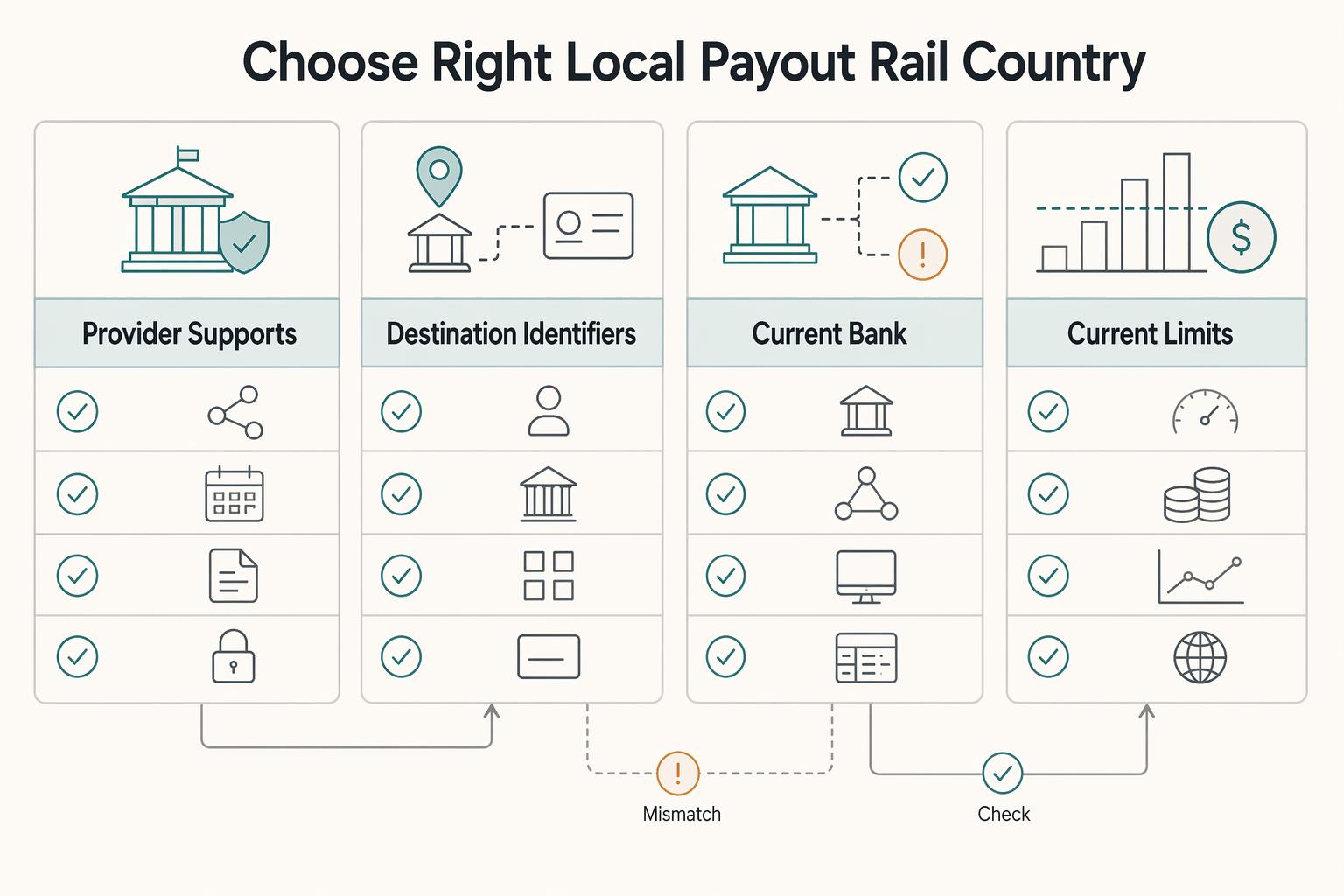
Before launch, verify more than "rail is live in country X." Confirm:
- your provider supports outbound payouts on that rail, not only lookup or other capabilities
- the destination identifiers currently accepted for that country and rail path
- the current bank and routing coverage list, since supported institutions can change
- the current limits and compliance constraints, since these evolve
Pick one primary rail per country and define one fallback before launch. Keep a checklist that product, finance ops, and engineering share as a single source of truth. Single-rail strategies are risky because coverage and requirements change. No single rail fits every use case, and fallback planning is a core outage control for time-sensitive payments.
What a local bank transfer network means in operator terms#
A local bank transfer network is domestic interbank infrastructure, not a payout product you can switch on. In practice, it is how financial institutions move money in-country on behalf of customers, such as RTP and FedNow in the United States or Pix in Brazil.
That distinction matters because "rail is live" is not the same as "your payouts are launch-ready." FedNow has been live since July 20, 2023, but reach still depends on whether the receiving institution has signed up. RTP is also live in the U.S., but access still depends on enabled institutions rather than every possible endpoint by default. Pix is Brazil's instant payment scheme, yet launch readiness for platform payouts still depends on provider-program support and verification.
Canada shows the same pattern. Interac e-Transfer runs through participating financial institutions, so it is not universal by default. Payments Canada's 2026 Q1 update said RTR had moved to user acceptance testing, so treat "RTR is available" as a verification item, not a launch assumption.
Teams get into trouble when they copy a real-time rail map and skip payout eligibility, return handling, and reconciliation behavior. FedNow receiver-side outcomes include accept, reject, and accept without posting (ACWP), so payout state design cannot stop at pending, paid, and failed. RTP includes return-of-funds flows, camt.056 and camt.029, so exception handling needs to be designed upfront.
Use this mental model for the rest of the article: country rail inventory, routing rules, compliance gates, and operations evidence.
If you keep one rule from this section, make it this: do not approve a rail for launch until current provider evidence confirms beneficiary reach, non-happy-path outcomes, and how statuses map into reconciliation and ledger views. For a deeper dive, read International Wire Transfer for Platforms: When to Use Wires vs. Local Rails for Cross-Border Payouts.
Country payout rail map for first-launch markets#
For first-launch markets, choose one primary domestic rail per country and define a fallback before you build routing logic. This is an operator map, not proof that every provider supports every rail.
The last-verified date is the source-set review date, 2026-04-01. Use it as a research freshness marker, not as production-support evidence.
| Country | Rail(s) to evaluate first | Common payout use cases | Settlement expectation | Known fallback option | Verification checkpoint | Last verified |
|---|---|---|---|---|---|---|
| United States | RTP, FedNow | Urgent domestic bank-account payouts where instant receipt matters more than batch efficiency | FedNow is designed for uninterrupted 24x7x365 processing. RTP positions itself as 24/7/365 instant infrastructure. | ACH can be a fallback for non-urgent or unsupported endpoints, but confirm corridor and provider support. ACH is batch and not currently settled on weekends and federal holidays. | Confirm which rail your provider actually supports for your program, then validate reject and return behavior and how each state maps to your ledger and reconciliation files. | 2026-04-01 |
| Canada | Interac e-Transfer Bulk, RTR | Commercial and high-volume disbursements through participating institutions | Interac business flows are quick with no cut-off times for submission. For RTR, do not assume production readiness from the rail name alone; Payments Canada reported movement to user acceptance testing in Q1 2026. | If evaluating RTR, keep Interac e-Transfer Bulk as the practical current path until provider evidence shows otherwise. | For Interac, confirm business bulk support and beneficiary data requirements. For RTR, require proof of live support plus handling for pacs.002 status reports and admi.002 reject messages, and map outcomes to ledger states. | 2026-04-01 |
| Brazil | Pix | Domestic payouts that benefit from always-on, seconds-based transfer timing | Pix supports transfers in a few seconds at any time, including non-business days. Brazil's SPI layer states settled transactions are final and irrevocable. | Confirm with your provider; do not assume a fallback. | Confirm Pix support, accepted beneficiary routing data, and how final and irrevocable settlement affects reversals, corrections, and ledger repair for misrouted or mis-keyed payouts. | 2026-04-01 |
| Mexico | SPEI | Domestic account payouts where near-instant movement is useful | SPEI is described as RTGS and allows payments in a matter of seconds. It is also reported that participant banks must forward and credit within 30 seconds. | Confirm with your provider; do not assume a fallback. | Verify provider support, beneficiary bank reach, reject handling, and how SPEI outcomes reconcile if your provider posts success before recipient-bank credit or rejection. | 2026-04-01 |
| Australia | New Payments Platform (NPP) | Domestic payouts needing near-real-time availability on a 24/7 basis | NPP provides near real-time recipient availability on a 24/7 basis. Source coverage also says NPP payments are settled finally and irrevocably. | Confirm with your provider; do not assume a fallback. | Confirm NPP support for your payout program, recipient reach, and how final settlement, rejects, and asynchronous exceptions appear in provider outputs and your ledger. | 2026-04-01 |
| Singapore | FAST, PayNow | SGD domestic payouts to bank accounts or to supported identifiers such as mobile number, NRIC/FIN, or UEN | FAST allows SGD transfers almost instantly and 24x7. PayNow runs through FAST almost instantly, but only between participating banks. | If PayNow recipient participation is missing, source coverage points to FAST or Interbank GIRO via other channels. | Confirm whether your provider supports FAST, PayNow, or both. If using PayNow, verify handling for non-participating recipient banks and how reroutes or fallbacks appear in status and reconciliation. | 2026-04-01 |
How to pick between two live rails#
When a country has two viable rails, choose the default by reliability and failure recovery, not speed claims alone. The real test is whether finance ops and engineering can explain every non-happy-path outcome in ledger terms.
In the U.S., RTP and FedNow can both be viable. Default to the rail where your provider can prove beneficiary reach for your payee mix, document reject and return behavior, and give you deterministic status mapping to your payout states.
Singapore is similar. PayNow is useful when identifier routing and participating-bank checks are reliable in your provider flow. If participation handling is unclear, use a FAST-first default and treat PayNow as conditional.
Where this map is intentionally incomplete#
The important gaps here are fallback certainty, exception semantics, and provider-level implementation detail, not instant-payment positioning. For Brazil, Mexico, and Australia, timing and settlement expectations are supported, but universal fallback claims, standard return-code models, and uniform webhook shapes are not.
Canada needs the strongest caution: RTR is a verification item, not a launch assumption. This points to ongoing rollout and user acceptance testing in Q1 2026, not a blanket production go-live claim.
Treat every row as a starting point, not a launch approval. No country is ready until you have provider confirmation of support, non-happy-path behavior, and tested ledger-state mapping end to end. For more on failure patterns, see Payout Failure Benchmark Report: Success Rates by Rail, Country, and Error Code.
APAC rollout details most map pages skip#
Do not launch Hong Kong, Indonesia, and the Philippines as one generic APAC bundle. Start with the market where your provider can already show reliable webhooks, reconciliation output, and clear payout-state mapping, then add the next market only after failure handling is stable.
| Market | Rail to evaluate | What the guidance supports | Operator checkpoint before launch |
|---|---|---|---|
| Hong Kong | Faster Payment System (FPS) | FPS is Hong Kong's instant retail payment infrastructure, introduced in 2018. It is positioned as a 24/7 retail payment service and supports real-time payments in HKD and RMB. | Confirm provider support for your payout program, required beneficiary data, and how success, reject, and duplicate-event outcomes appear in webhook payloads and reconciliation exports. |
| Indonesia | BI-FAST | Bank Indonesia describes BI-FAST as payment infrastructure it provides, with payments available in real time and 24/7. The source also states launch on 21/12. | Require evidence of live support, sample events for success and failure states, and idempotent handling when the same event is delivered more than once. |
| Philippines | InstaPay | BSP describes InstaPay as a real-time low-value EFT credit-push scheme launched on 23 April 2018, for transaction amounts up to P50,000. | Make the P50,000 limit an explicit routing rule. If a payout can exceed that amount, confirm provider behavior for blocks, rejects, or alternate routing before launch. |
Sequence by evidence, not geography#
Pick your first APAC market by implementation evidence, not by country priority on a sales plan. A rail can be real-time and 24/7 and still add ops work if event payloads are thin or reconciliation arrives late.
Before choosing the first market, ask for three artifacts: webhook samples, a reconciliation export, and a written status-to-ledger mapping. Launch where all three exist.
Webhooks help, but they are not enough#
Webhooks are useful for fast event handling at scale, but they should not be your only reconciliation source. The source-set guidance is explicit: webhook-only reconciliation is not recommended, events can be missed when endpoints are unavailable or misconfigured, and duplicate events can occur.
Add the second APAC market only after the first has stable handling for missed-event recovery, duplicate suppression, and reconciliation against a non-webhook source.
The tradeoff ops teams actually feel#
Rollout order should follow operational clarity, not transfer speed alone. If failure detail is weak, ops teams may spend more time on manual triage and exception research.
For FPS, BI-FAST, and InstaPay, prioritize the market where finance ops can explain each payout outcome with provider evidence, then optimize for speed.
This pairs well with our guide on How to Hedge FX Risk on a Global Payout Platform.
How to choose a primary and fallback rail by payout type#
Set primary and fallback rails by payout pattern first, then by country. In the same market, contractor payouts, creator payouts, and marketplace seller disbursements can need different defaults because urgency, predictability, and beneficiary coverage differ.
Domestic rails use in-country networks, so they can be faster and cheaper when both banks are in the same jurisdiction. Use that as your default only when provider support for your exact flow is documented. If domestic coverage is partial or unclear, keep SWIFT as a controlled fallback instead of making ad hoc decisions during live cycles.
Start with payout shape, not rail names#
| Payout pattern | Primary when support is verified | Fallback | Decision focus |
|---|---|---|---|
| Contractor payouts | ACH for scheduled U.S. cycles, Same Day ACH for same-business-day needs; PIX or SPEI for in-country instant payouts where coverage is strong | SWIFT for non-domestic or unsupported beneficiaries | Cutoffs, file schedules, reconciliation clarity |
| Creator payouts | RTP, FedNow, PIX, SPEI, or FAST/PayNow when fast access to earnings is part of the product | SWIFT, or ACH for domestic non-urgent exceptions | Speed, availability, fast failure handling |
| Marketplace seller disbursements | Mixed model: batch rail for routine settlement, real-time rail for urgent releases or exceptions | SWIFT for reach gaps | Country, urgency, bank coverage |
A practical rule: if local domestic coverage is strong and documented, default to the domestic rail. If coverage is uncertain, keep SWIFT in the routing tree with explicit expectations that delivery can be same day, next day, or several days.
Use different defaults for batch and urgent payouts#
Batch schedules usually belong on batch rails. ACH is a batched network with scheduled file delivery, and Same Day ACH adds same-business-day processing with three daily settlements, including use cases up to $1 million.
Urgent payouts should use real-time rails only where support is confirmed. FedNow is live for instant transfers at any time of day, RTP is available around the clock, and PayNow runs through FAST with 24/7, 365-day availability. The core tradeoff is similar across markets, but country and provider details still vary. Speed only helps if your team can interpret rejects and reconcile outcomes reliably.
Put routing policy in configuration, not in someone's inbox#
Routing policy should be explicit before launch. At minimum, route by country, payout type, urgency, beneficiary bank support, and fallback eligibility so outages or unsupported beneficiaries do not turn into unauditable mid-cycle decisions.
Before you promote any route from fallback to primary, require provider confirmation for that rail and payout program, beneficiary data requirements, sample success and reject events, and reconciliation output mapped to your ledger. If any artifact is missing, keep fallback as the default or launch in a limited cohort.
Define fallback as policy, not "retry everything." A beneficiary data validation failure usually needs data correction. A rail outage may justify rerouting. That distinction is what makes the routing map operational.
You might also find this useful: Reduce Payout Fees by Matching Disbursement Rail to Destination Country.
Use this section as a routing policy draft, then translate each country's primary and fallback logic into an implementation checklist in the Gruv docs.
When SWIFT or ACH is still the better option#
SWIFT or ACH is often the better choice when reach, corridor proof, or exception recovery matters more than raw speed. SWIFT is often the default when cross-border reach gaps exist.
| Option | What the section says | Operational note |
|---|---|---|
| SWIFT | Often the default when cross-border reach gaps exist | More than 11,500 institutions across more than 200 countries and territories are connected; require corridor confirmation before live volume |
| ACH | Usually the better domestic rail when predictability and cost control matter more than instant access | Efficient, low-cost batched service that settles four times each banking day and not on weekends or federal holidays |
| Same Day ACH | Same-business-day domestic timing option | Three daily settlements, including use cases up to $1 million |
| RTP | Real-time option with broad, not universal, reach | Reports 71% of U.S. DDAs; payments are final and irrevocable after submission, so exception handling is a return request, not a reversal |
| FedNow | Participation-based instant option | Reported more than 1,400 participating organizations |
Domestic clearing and settlement services are limited to domestic financial institutions, so a local instant rail does not automatically cover cross-border payouts. For many foreign-currency and cross-border bank transfers, correspondent banks and SWIFT messaging are still part of the flow. Use SWIFT when the beneficiary bank is outside proven domestic coverage or your provider cannot confirm that exact corridor and payout program. Before routing live volume, require corridor confirmation, required beneficiary fields, and sample payout status or reject events mapped to your ledger.
ACH is usually the better domestic rail when predictability and cost control matter more than instant access. FedACH is an efficient, low-cost batched service, and ACH is designed for scheduled, recurring payments between known counterparties on known due dates. ACH settles four times each banking day and does not settle on weekends or federal holidays, so route urgent cases elsewhere. For same-business-day domestic timing, Same Day ACH can still work up to the $1 million limit.
Do not force every payout onto RTP-like rails. Reach is broad, not universal: RTP reports 71% of U.S. DDAs, and FedNow reported more than 1,400 participating organizations. RTP payments are final and irrevocable after submission, so exception handling is a return request, not a reversal. If your reconciliation and case handling are not stronger than your speed requirement, ACH's scheduled, banking-day processing may be easier to operate.
Need the full breakdown? Read PIX vs. SEPA vs. ACH vs. SWIFT for Platform Payout Decisions by Market.
Compliance gates that must exist before you enable a rail#
Enable RTP, SPEI, or BI-FAST only after your compliance controls can operate at rail speed and are adapted to the jurisdiction and risk profile for that route. Rail speed does not replace onboarding, approval, or recordkeeping. It only reduces the time you have to stop a bad payout.
The minimum controls to have in place first#
In U.S. AML context, a Customer Identification Program must be part of the AML program, and identity checks must be risk-based. For legal-entity customers, written beneficial ownership identification and verification procedures also need to be in place. Before you enable a route, confirm these controls are live in production:
| Control | Requirement | Article detail |
|---|---|---|
| KYC/KYB checks | Aligned to your risk policy | Includes CIP-style identity verification and beneficial-owner verification where required |
| AML program controls | Live before enabling a route | Need named day-to-day compliance ownership, staff training, and independent testing |
| Approval gates | Keep them for higher-risk payees or segments | If policy requires manual review for a segment, keep that gate even on instant rails |
| Payout audit trail | Retain traceability data | Keep core payment-order and approval data needed for traceability |
| Funds-transfer recordkeeping | $3,000 or more can trigger requirements in U.S. bank recordkeeping context | Core payment-order information must be retained |
In U.S. bank recordkeeping context, funds-transfer requirements can trigger at $3,000 or more, and core payment-order information must be retained. Treat that as an operating standard. If a payout is challenged, you should be able to reconstruct key payment-order and approval events, what was submitted, and what the provider returned.
Do not let instant rails bypass manual review#
Manual-review rules should survive rail changes. If a payee segment needs analyst or escalation review today, keep that checkpoint when you switch to a faster rail.
Use a simple launch test on each route. Verify the hold is enforced before submission, the approver is captured in the audit trail, and the release event is linked to the final payout record.
Rail choice does not replace tax and reporting duties#
Rail selection does not determine whether FBAR or FATCA reporting applies. Those obligations sit next to payout routing, not inside it.
In U.S. context, FBAR can apply when aggregate foreign account value exceeds $10,000 during the calendar year (FinCEN Form 114). FATCA reporting for certain U.S. taxpayers can apply through Form 8938, and IRS guidance states this is in addition to FBAR, not a substitute.
PII handling needs its own gate#
PII controls need a separate pre-launch gate for each rail. Keep ops views masked, keep sensitive stored fields unreadable, and keep logs and event payloads limited to what is necessary.
In practice, that means no full sensitive identifiers in routine views, no sensitive values copied into debug logs, and no default retention of raw sensitive payloads.
For a step-by-step walkthrough, see Beneficiary Data Requirements by Rail for Platform Payouts.
The country evidence pack your team should maintain#
If the rail map is driving real launch decisions, the evidence pack is where those decisions get validated. Maintain one row per named rail, per country. If a row does not have a confirmed payout direction, return-code source, fallback rail, and a specific owner, treat that route as not launch-ready. Use this template so finance and engineering are working from the same operational record:
| Rail name | Country | Supported payout direction | Return codes source | Fallback rail | Last verification owner | Review cadence | Revalidation trigger |
|---|---|---|---|---|---|---|---|
<named rail> | <country> | <contract-confirmed direction> | <provider code table or internal mapping> | <approved fallback> | <named person> | <cadence> | <explicit trigger> |
Do not use generic labels like "real-time transfer." Track these as separate named entries in your map, as applicable to your provider contracts:
- RTP and FedNow (United States)
- Interac e-Transfer and RTR (Canada)
- Pix (Brazil)
- SPEI (Mexico)
- FAST and PayNow (Singapore)
- FPS (Hong Kong)
Link each row to a compact evidence bundle:
- provider references for country coverage and required beneficiary or bank details
- webhook event samples for status progression and status-change handling
- reconciliation export format, for example file format and columns finance uses
- exception SLA and escalation path, if defined in your provider agreement or operating procedure
Keep the pack fresh by rule, not memory:
- assign a review cadence to every row
- require revalidation when products, services, geographies, or provider setup change
For more on reconciliation controls, see Catching Payout Errors Early in High-Volume Platform Operations.
Integration order from API design to production cutover#
A practical build order is: lock internal payout states, map provider events, enforce idempotent retries and webhook deduplication, then connect ledger posting and reconciliation, and only then cut over.
Lock the state model before wiring provider events#
Define one internal payout lifecycle that works across rails and providers, then map every provider event to it. A practical baseline is pending, in_transit, paid, failed, and canceled.
Set ledger timing in the same design step. If finance and engineering use different checkpoints for when value is considered moved, reconciliation noise starts immediately. Document one accounting checkpoint per rail, plus the event names or report fields that prove each transition.
Use this readiness test before moving on: each external event and report line should map to one internal status without a manual exception bucket.
Make retries safe before you add scale#
Once status mapping is stable, make retries deterministic on both API and webhook paths:
- use idempotency keys on outbound POST payout requests so retries do not create duplicates
- deduplicate inbound webhooks by provider event ID before mutating payout state
- persist raw webhook payloads with receipt timestamps for incident review
- keep transitions monotonic so duplicates or late retries cannot reopen
paidpayouts or double-post ledger entries
If the team cannot describe exactly what happens when the same request or event arrives again 10 minutes later, pause launch.
Test rail behavior with real success and reject cases#
Do not stop at happy-path testing. Prove that PIX, SPEI, and your U.S. instant rail can collapse into the same internal handling, even when external behavior differs.
- use provider test mode or sandbox to run both success and reject flows
- for PIX and SPEI, use provider-specific fixtures that force
PAIDandFAILEDoutcomes - repeat equivalent scenarios for RTP or FedNow where your provider supports U.S. instant-payment testing
- confirm internal status handling stays consistent across instant rails and ACH's batch model
For Mexico operations, include a traceability check after testing so ops can verify payment status history when exceptions occur.
Connect reconciliation before cutover, not after#
Wire reconciliation only after statuses and retries are stable. Use payout and settlement reports that reconcile payout batches to underlying transactions, and webhook-driven report availability where supported. Before go-live, validate these gates for your providers and corridors:
- no unresolved mismatches between provider status, internal payout status, and ledger state
- deterministic retry behavior for both API requests and duplicate webhook deliveries
- verified fallback from the primary rail to an approved secondary route, such as ACH in the U.S. where it fits the corridor
After launch, review the first payout cycles jointly across product, finance ops, and engineering. Keep one shared incident note per exception with payout request ID, provider reference, webhook trail, ledger trace, reroute decision, and final resolution.
Failure patterns and outage response operators should expect#
Expect four recurring failure patterns: rail degradation, beneficiary data failure, a late return after an apparent success state, and reconciliation drift.
Operator rule: do not treat the first positive status as final. Asynchronous payout updates are normal, so webhook handling is required. A payout can reach a posted-equivalent state and still fail at the destination. Returned payouts are often caused by incorrect beneficiary details and are typically sent back within 2-3 business days, sometimes longer by country.
What usually breaks first#
| Pattern | What the article says | Operator response |
|---|---|---|
| Rail outage or degradation | Even 24/7 instant rails can have maintenance or service-impact windows | Use the preapproved fallback playbook for that corridor and alert finance ops as the incident process requires |
| Beneficiary validation failure | Incorrect destination information is a primary driver of returned payouts | Confirm the rail-specific beneficiary data was captured correctly and persisted in the payout record |
| Asynchronous return after initial success | Returned payouts are typically sent back within 2-3 business days, sometimes longer by country | Support later provider events that move a payout from posted into returned or failed without losing ledger traceability |
| Reconciliation drift | If webhook history, ledger posting, and payout reconciliation reports diverge, manual investigation load increases | Escalate with the payout request ID, provider reference or payout Trace ID, full webhook trail, and ledger entry trace |
Plan for service-impact windows even on 24/7 rails. Hong Kong's FPS is a 24/7 service, but bank notices still show periods where FPS-related transfer services are affected. If your primary route in Singapore or Hong Kong degrades, follow your preapproved fallback playbook for that corridor and alert finance ops as your incident process requires. In Singapore, some transfers can use alternatives such as FAST or GIRO when a PayNow path is not available.
Also plan for false positives. Incorrect destination information can pass basic field-presence checks at API submit time and still return later, so confirm the rail-specific beneficiary data was captured correctly and persisted in the payout record for audit and support. Keep transitions monotonic, but support later provider events that move a payout from posted into returned or failed without losing ledger traceability.
For each incident, require one evidence pack before escalation: payout request ID, provider reference or payout Trace ID, full webhook trail with receipt timestamps, and your internal ledger entry trace and reroute decision timestamp. If a payout is still missing after 10 business days, the provider payout reference is typically required for bank follow-up.
Turn your rail map into launch decisions#
Rail names alone do not de-risk payouts. Decision rules and verification do. Use one primary rail, one preapproved fallback, and clear checks for statuses, retries, and returns before you scale.
A posted payout is not the same as confirmed receipt, so treat exceptions as normal operations. Incorrect destination details cause most returned payouts, and your team should be able to trace the payout request, provider reference, webhook trail, and ledger state in one view.
Build the country evidence table first#
Your next step is to turn each country row into an evidence record that finance, product, and engineering can trust. The map only becomes operational when every row answers the same launch questions. At minimum, capture:
- country and named rail
- provider support for your exact operating profile, with last verified date and owner
- required account details by bank location
- internal status mapping, including states like pending, paid, failed, and canceled
- failure event behavior, including how a
payout.failed-type event is handled - fallback rail and reroute trigger
- one successful payout sample and one failed or returned sample, with references preserved
A high-value checkpoint is simple: confirm exact account details before enabling payouts for each country and bank combination. Provider payout availability varies by country, industry, and operating profile, so a rail on a public map is not launch approval.
Pick one primary and one fallback per market#
For a first launch, stay disciplined: one primary and one fallback per market is usually enough. In the U.S., you might set FedNow or RTP as the primary real-time route where your provider and operating profile support it, then keep a slower route as a controlled backup if support or recoverability is incomplete.
Choose your primary based on three things: current provider support, clean status mapping into your ledger, and recoverability when payouts fail. FedNow is designed for uninterrupted 24x7x365 processing, and RTP advertises 24/7/365 availability with transactions up to $10 million, but speed alone should not decide the default.
Apply the same rule in other markets. SPEI can be a strong local option when provider support and destination-field requirements are verified, but fallback design still matters more than the rail label. Also avoid hardcoding "instant" into customer promises. Interac e-Transfer can be almost instant but can take up to 30 minutes, and Canada RTR assumptions should be re-verified as rollout evidence progresses.
Launch in cohorts and document your assumptions#
After rail selection, launch in controlled cohorts instead of full volume. Start with one market or payee segment, verify idempotent retry behavior to avoid duplicate payouts, and confirm that success, failure, and return outcomes land correctly in internal states and reconciliation workflows.
Before implementation, have your provider confirm current country and rail support for your business model. Then document those assumptions in your payout ops process: primary rail, fallback rules, re-verification owner, and required evidence before finance signs off on wider rollout.
We covered this in detail in How to Build a Global Accounts Payable Strategy for a Multi-Country Platform.
Before you scale volume, validate corridor coverage, fallback behavior, and operational controls for your payout plan with the Gruv team via contact.
Frequently Asked Questions
What is a local bank transfer network for platform payouts?
A local bank transfer network is a domestic interbank rail used to move funds within one country. Examples in this article include RTP and FedNow in the U.S., Pix in Brazil, SPEI in Mexico, and FPS in Hong Kong. A live rail is not automatically launch-ready for your platform, so provider support still has to be confirmed.
Are real-time payment maps enough to plan global payout operations?
No. A real-time map is only a starting point because launch planning also needs payout eligibility, accepted beneficiary identifiers, message rules, return handling, and rail-to-ledger status mapping. Country behavior varies, so timing claims alone do not make a route operational.
How should we choose rails country by country without overengineering?
Use a simple baseline: assign one primary route and one fallback per country. Prefer a domestic rail when provider support, required fields, and return handling are documented. Use SWIFT or ACH when domestic coverage is unclear or the timing and reach tradeoff fits better.
When should we use SWIFT or ACH instead of local domestic rails?
Use SWIFT when corridor reach gaps exist, the beneficiary bank is outside proven domestic coverage, or foreign-currency transfer requirements exceed domestic rail scope. Use ACH for U.S. payouts when broad account reach, predictability, and cost control matter more than instant access. Route urgent cases elsewhere because ACH is batch-based and does not settle on weekends or federal holidays.
What data fields must be in a country payout rail map to make it operational?
An operational map needs more than rail names. Capture country, named rail, payout direction, provider support, payer and payee identification elements, message-level field definitions, status mapping, return behavior, fallback path, and last verification metadata. If payout records, provider references, and status updates cannot be traced together, the map is not production-ready.
How often should we re-verify rail coverage and payout behavior before scaling volume?
Re-verify on an event-driven basis, not just once at setup. Check again when scheme rules, message versions, provider integrations, products, services, geographies, or rollout status change. This is especially important for status-sensitive routes such as Canada RTR.
Try a related tool
Researched and edited by the Gruv editorial team. Gruv builds cross-border billing, payouts, and finance-operations software for global businesses.
Sources
- bsaefiling.fincen.govtrusted
- bsaefiling.fincen.gov/resources/FinCENFBARHelp.pdftrusted
- congress.gov/crs-product/R46843trusted
- ecfr.gov/current/title-31/subtitle-B/chapter-X/part-1...trusted
- ecfr.gov/current/title-31/subtitle-B/chapter-X/part-1...trusted
- federalreserve.gov/paymentsystems/fedach_about.htmtrusted
- federalreserve.gov/paymentsystems/fednow_about.htmtrusted
- irs.gov/businesses/corporations/summary-of-fatca-rep...trusted
Educational content only. Not legal, tax, or financial advice.
Related Posts

The Freelance Payment Penalty: A Modeled Audit of Platform Fees, FX Spreads, and Payout Delays
The money rarely disappears through a single, easy-to-spot fee. The real loss is stacked. A marketplace takes its commission, a processor adds a charge for international cards, a bank or payment company converts the currency at a spread, a platform holds the funds before release, and a wire sheds a little to intermediaries on the way in. Each layer looks defensible on its own, but the worker feels the combined result as a smaller deposit and a later payday.

How to Respond to a Subpoena for Business Records
Move fast, but do not produce records on instinct. If you need to **respond to a subpoena for business records**, your immediate job is to control deadlines, preserve records, and make any later production defensible.

A US Expat's Guide to Investing in UCITS ETFs to Avoid PFIC Issues
The real problem is a two-system conflict. U.S. tax treatment can punish the wrong fund choice, while local product-access constraints can block the funds you want to buy in the first place. For **us expat ucits etfs**, the practical question is not "Which product is best?" It is "What can I access, report, and keep doing every year without guessing?" Use this four-part filter before any trade: