
Quick Answer
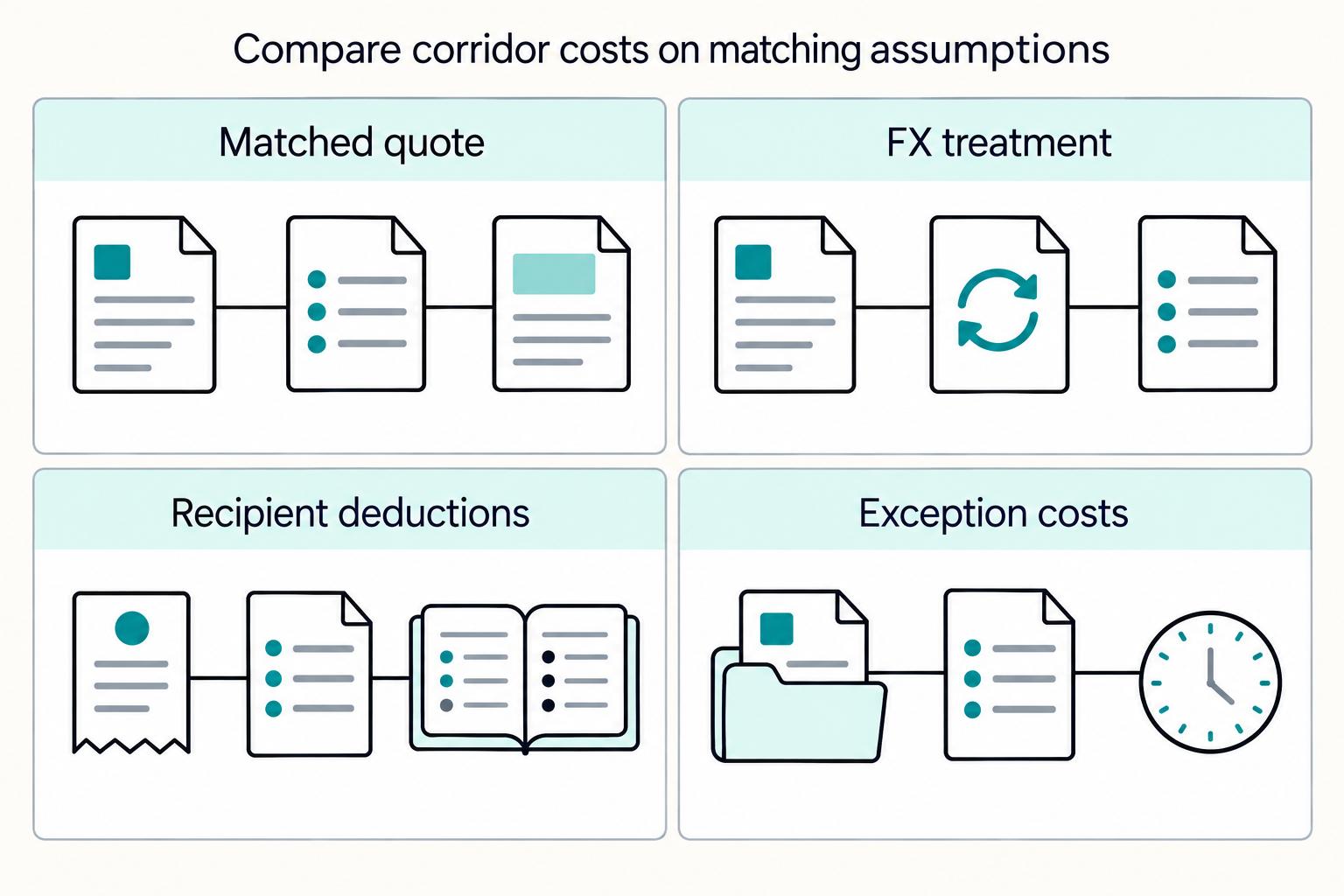
Pick rails per corridor and payout pattern, then require a fallback before go-live. Test SWIFT and correspondent-bank routes, non-bank operators, and stablecoin paths against one completion standard: recipient funds available with reference IDs, not just API acceptance. Build matched cost sheets at USD 200 and USD 500, including FX margin, intermediary deductions, and return effort. Run one live-like set with a clean payout, a held payout, and a returned payout, and expand only after those timelines reconcile end to end.
Start With the Corridor#
The hard part is not choosing one "best" rail. It is choosing the right rail for each corridor and payout type, where cost, speed, access, and transparency pull in different directions. For any route, the practical question is simple: for this country pair, payout size, and recipient experience, which path gives you acceptable delivery, controllable cost, and audit-ready evidence?
This guide gives you a decision-ready way to compare the three paths it focuses on: SWIFT with correspondent banking, money transfer operators (MTOs), and stablecoin rails. The point is not another generic "fast vs cheap" debate. It is to separate messaging from settlement, identify where cost is really created, and focus on what finance and ops will need to reconcile later.
That discipline matters. Since 2020, the FSB's cross-border program for the G20 has focused on the same four frictions: high costs, low speed, limited access, and insufficient transparency. There are 11 global targets, but recent KPI reporting still shows limited global progress and persistent differences across regions and corridors. You should expect uneven outcomes by route.
Scope boundaries matter up front:
- World Bank remittance data are corridor-specific and concern relatively small consumer transfers; they are context for a platform cost model, not a B2B payout tariff.
- Provider availability and capability are corridor- and program-dependent. A route that works for one payout flow may not hold up the same way in another.
- Rail-by-rail benchmarking is still incomplete, so universal claims about one rail always being faster or cheaper are not decision-ready.
Definitions matter too. SWIFT is a global financial messaging network, not a payment or settlement system. Correspondent banking is a bank-to-bank arrangement where one bank holds deposits for another and provides payment services, with the same account viewed as Nostro by one bank and Vostro by the other. In remittance tracking, money transfer operators include both traditional and fintech providers. Stablecoin use in payments is growing, but policy, integrity, and stability challenges remain.
Use one rule throughout this article: if a comparison does not show where a payment can pause, fail, or lose money, it is not ready for an operating decision. Before you compare fees, map the handoffs. Who initiates, who screens, where FX happens, who can hold funds, what IDs return, and what evidence you keep for returns or reviews.
By the end, you should have three outputs: a rail decision by corridor and payout scenario, a compliance ownership map for each checkpoint, and a launch checklist you can use before expanding coverage.
The rails and terms platform teams must get right first#
Get the terms wrong and you can misprice delivery time, cost, and exceptions. Start by separating who sends messages, who holds funds, and where conversion happens.
| Term | What it refers to | Key note |
|---|---|---|
| SWIFT | Global financial messaging network that carries instructions between financial institutions | Not a payment or settlement system |
| Correspondent banking system | Bank-to-bank routing where a correspondent bank provides local account and payment services for a foreign bank | One transaction may still move through multiple intermediary correspondent-bank steps |
| Non-bank money transfer operators | Provider category distinct from banks in the World Bank remittance methodology | Can include Wise, Remitly, and Western Union |
| Stablecoin sandwich | Operator shorthand for fiat in, conversion to a USD-linked stablecoin, transfer over a public blockchain, then conversion back to fiat through a centralized crypto exchange or similar off-ramp | Useful shorthand, not a formal industry standard |
Bank route terms#
The correspondent banking system is bank-to-bank routing: a correspondent bank provides local account and payment services for a foreign bank. The Nostro/Vostro relationship is the account view of that setup, where one bank holds another bank's funds on deposit.
SWIFT is the messaging layer in this flow, not the settlement layer. It carries instructions between financial institutions, but it does not hold funds. In practice, treat message and status updates as process signals, not proof of final recipient credit. Also remember that one transaction may still move through multiple intermediary correspondent-bank steps.
Non-bank routes#
Non-bank money transfer operators are a provider category distinct from banks in the World Bank remittance methodology, and FATF uses the broader money or value transfer services label for non-banking providers. In practice, this can include firms such as Wise, Remitly, and Western Union.
Some routes use local accounts and local payout methods, but that is not universal across every corridor or program. Before launch, confirm for each provider where funds are held, where FX is applied, and which reference IDs you get for payout, return, and investigation.
Stablecoin routes#
Teams often use stablecoin sandwich as operator shorthand for a sequence such as fiat in, conversion to a USD-linked stablecoin, transfer over a public blockchain, then conversion back to fiat through a centralized crypto exchange or similar off-ramp. It is useful shorthand, not a formal industry standard.
A key operational risk is treating a completed blockchain transfer as a completed payout. The on-chain leg and the recipient payout leg are separate checkpoints. If you cannot identify the handoff where funds become recipient-available, do not treat transfer status alone as a final completion or speed signal.
For ACH routing, see International ACH Transfers: Complete Guide for Platform Cross-Border Payouts.
Why cross-border payouts still feel slow and expensive#
Cross-border payouts feel slow or expensive because initiation is only the first step. Cost and delay usually show up in routing, conversion, compliance, and final credit. If your team cannot explain every handoff from initiation to recipient-available funds, treat any speed promise as corridor-specific risk, not a reliable baseline.
Where time and money disappear#
In the correspondent banking model, payments move through networks of banks that hold accounts with each other, so one transfer can pass through multiple institutions before final credit. That chain creates delay and opacity: multiple data formats, compliance-processing complexity, limited operating hours, legacy platforms, and long transaction paths.
Stablecoin-related routes often move the friction rather than remove it. The on-chain leg can look fast, but the flow still depends on fiat on- and off-ramps, and those conversion points can carry significant cost. A transfer can look complete on-chain while fiat payout is still pending.
Compliance checkpoints add timing and predictability risk. That matters even more in stablecoin-related flows, where some transfers can occur without a regulated intermediary, leaving control gaps if your process does not cover the full path through fiat payout.
Why corridor details change everything#
The same rail can perform very differently by country pair. Evidence shows meaningful variation across corridors and segments, and non-bank or foreign participants can face direct-access constraints that contribute to uneven routing outcomes.
World Bank corridor data cover 367 corridors across 48 sending and 105 receiving countries. The page currently highlights a 6.36% global average and links its September 2025 report. This small-transfer remittance benchmark is historical context, not a price or delivery guarantee for your platform program.
Policy pressure does not remove execution work#
The G20 roadmap has been in motion since 2020, and the FSB's 21 October 2024 progress report still frames the core problem as high cost, slow speed, insufficient access, and insufficient transparency. The direction is clear, but execution is still local.
For platform teams, that means corridor-level proof matters more than headline SLA language. If you cannot trace the path from payout initiation to final recipient credit, plan for higher delay, higher cost, and lower predictability than advertised.
Rail comparison for costs speed and operational burden#
Choose rails on total cost and exception ownership, not headline speed. A route can look fast at initiation and still slow down or get more expensive once compliance checks, conversion, intermediaries, or reviews kick in.
| Route (planning heuristic, not measured ranking) | Fee visibility | FX control | Settlement predictability | Reconciliation effort | Compliance overhead |
|---|---|---|---|---|---|
| SWIFT / Correspondent banking system | Low to medium. Transfer fees may be visible, but intermediary deductions and FX spread impact can be hard to predict upfront | Low to medium. Control depends on where conversion happens in the chain and bank pricing | Low to medium. One transfer may pass through several intermediary correspondent banks | High. More institutions in the chain means more references and exception tracing | High. Controls can be repeated across institutions in the payment chain |
| Non-bank money transfer operators | Medium to high. Pricing can be clearer on quoted routes, but corridor and provider limits still affect outcomes | Medium. Quotes can be clearer, but pricing still varies by route and provider | Medium. Outcomes vary by corridor, provider, and local payout access | Medium. Reconciliation requirements vary by corridor and provider | Medium. Controls vary by provider, and compliance responsibilities still apply |
| Stablecoin rails | Medium. On-chain fees are visible, but fiat conversion and off-ramp pricing may not be | Medium to high on-chain, then lower at fiat exit if exchange pricing moves away from par | Low to medium. On-chain transfer may confirm quickly, but fiat release depends on ramps and exchange operations | High. Reconciliation can require matching blockchain records, exchange records, and fiat payout records | High. Compliance work can span wallet movement, exchange activity, and fiat payout release |
Where cost actually appears#
Cost shows up in different places depending on the rail, which is exactly why corridor-level comparison matters.
In correspondent banking, SWIFT carries payment instructions while funds move through bank relationships in a payment chain. The more intermediaries involved, the slower and more expensive the outcome usually becomes. In practice, cost can appear in transfer fees, FX spread leakage, intermediary deductions before final credit, and exception-handling work when funds stall.
MTOs are a provider category that includes both traditional and fintech operators. That does not make cost universally lower. You still need corridor checks, because provider capabilities vary by geography and usage can depend on where sender and recipient operate.
Stablecoin routes shift cost points rather than remove them. The digital leg may be fast, but the path still depends on fiat on- and off-ramps, and off-ramp pricing can vary at conversion time. That can reduce friction on one leg while adding pricing and operational risk at fiat exit.
Use one operator rule: if a quote does not show gross send amount, conversion basis, known deductions, and return or retry costs, you do not yet have an all-in cost view.
Speed claims need an exception view#
Assess speed on two paths: normal flow and exception flow. Cross-border payments are still generally slower, more expensive, and more opaque than domestic flows, and compliance checks are part of that friction.
Variance usually appears in different places by rail:
- SWIFT/correspondent: intermediary chains and repeated checks can add delay
- MTO: corridor-specific constraints can interrupt processing
- stablecoin: on-chain confirmation timing can differ from exchange review, off-ramp processing, or fiat release timing
If a provider can only show "fastest case" timing and not review-case timing, treat that SLA as incomplete for operations planning.
What to verify before you commit#
World Bank remittance tracking covers 367 corridors across 48 sending countries and 105 receiving countries. Use that as a reminder that corridor evidence matters more than blended averages.
Before you approve any rail for live payouts, require three things:
- a payout trace from initiation to recipient credit, with reference IDs at each handoff
- a gross-to-net breakdown separating transfer fee, FX spread impact, intermediary deduction risk, and retry or return charges
- an exception report for that corridor showing what happens when checks hold release
Pick the rail your team can price, reconcile, and control under both normal and exception conditions.
Choosing the right rail by payout scenario#
Choose rails by payout scenario, then define fallback logic before go-live. For small, frequent payouts, prioritize fee transparency and reconciliation automation. For larger, less frequent payouts, prioritize compliance certainty, traceability, and a bank-route fallback.
Rail decisions hold up better when you map by recipient type, corridor, and payout value instead of relying on one blended benchmark.
Scenario matrix#
| Payout scenario | Typical payout pattern | Primary route to evaluate | Secondary rail | Where-enabled option | Operating reason to test it |
|---|---|---|---|---|---|
| Contractor payouts | Small to medium, recurring | International ACH transfers where a U.S.-linked ACH route is supported; otherwise non-bank operator routes | Bank route through the correspondent banking system using SWIFT messaging | Stablecoin rails only where fiat in/out controls are clear | Repeated payouts make fee visibility and reconciliation quality more important than headline speed. Traditional correspondent architecture is often a weak fit for small-value transfers. |
| Creator disbursements | Small, frequent, high volume | Non-bank operator routes | International ACH transfers where supported, or bank route where coverage is limited | Stablecoin rails for opted-in users where off-ramp and support are ready | High-volume programs need tight operational control; corridor performance can vary with provider flow conditions. |
| Marketplace seller payouts | Medium to large, less frequent, more investigations | Bank route via correspondent banking system and SWIFT messaging | Non-bank operator or local bank-linked alternative where corridor support is stronger | Stablecoin rails only for specific corridors with explicit compliance ownership | Larger payouts raise the cost of failed settlement, missing beneficiary data, and manual investigations. |
Ask the originating bank or provider whether the U.S. ACH entry is part of an international payment involving a financial agency outside U.S. territorial jurisdiction and therefore requires the IAT format. Foreign recipient citizenship alone is not the test; document the actual funding and payment path under the Nacha IAT definition.
Decision rules that hold up in operations#
For contractor and creator programs, optimize for operational control at scale: clear fee components, usable reference IDs, and payout states your ledger can consume from asynchronous events.
For marketplace seller payouts, prioritize traceability, investigation support and beneficiary corrections. A provider’s country footprint does not establish your exact corridor, business-program eligibility or payout method. Obtain written coverage for that flow.
Fallback logic you should define before go-live#
Before launch, decide how you will reroute, when you will hold, and who has authority to escalate. If you skip that work, fallback becomes improvisation.
- Primary rail
Set the default route by corridor and value band.
- Secondary rail
Keep a real fallback. If non-bank operator coverage is inconsistent for your program, retain a SWIFT-linked bank route or local bank-linked alternative. Before activating the fallback for an existing payout, resolve the first provider’s authoritative outcome or confirmed cancellation. Keys are not shared across providers; an uncertain original must not become a duplicate payment on the secondary rail.
- Hold and escalation conditions
Hold when required originator or beneficiary fields are missing. Escalate when settlement misses your review window, when sanctions or FX handling triggers reject or report paths, or when no usable trace reference is returned.
API acceptance is not settlement completion. Engineering should maintain one durable payout intent with provider attempts and separate financial events for settlement, fees, returns and adjustments. Deduplicate retries and webhook processing without collapsing those distinct ledger effects.
Owner teams by scenario#
One workable split is:
- Product: payout UX, timing promises, and delay messaging
- Finance: reconciliation standards, reference requirements, returns, and audit evidence
- Engineering: idempotent retries, webhook consumption, payout state transitions, and off-path alerting
Verification checkpoint: for one live-like corridor in each scenario, run a full payout trace from initiation to recipient credit, confirm handoff references, and test a hold case for missing beneficiary data. If ownership and user-visible status are unclear in that test, the rail design is incomplete.
Related reading: When Platforms Should Use Wires vs Local Rails for Cross-Border Payouts.
Build the cost model before you sign or integrate#
Build one all-in model per corridor and payout size before you sign, because a blended global rate can hide real exception and settlement-path costs.
Start with total remittance cost, not just the posted transfer fee: transfer fee, FX margin, and any recipient-side charges that affect what actually lands.
Ask for corridor sheets, not marketing averages#
Ask for pricing by corridor and fixed payout amount. World Bank remittance data provide historical context for small consumer transfers; use quotes for your actual business program rather than importing the global average into a contract model.
For a like-for-like comparison, hold transfer value constant. A practical baseline is local-currency equivalents of USD 200 and USD 500. If a provider quotes different value bands, have them restate on the same amounts before you compare.
Separate controllable and variable cost lines#
Break the model into two cost buckets so tradeoffs stay visible:
Controllable lines
- Provider fee card by corridor and payout method
- Operational labor for exceptions, returns, and reconciliation
- On-ramp and off-ramp fees in any stablecoin path
Variable or less controllable lines
- FX spread variability
- Recipient-side deductions
- Bank-route costs that can depend on downstream payment systems or correspondent accounts
- Conversion effects on stablecoin on/off-ramp legs
Do not cost SWIFT as if it were settlement itself. SWIFT is a messaging network; funds move through payment systems or correspondent accounts.
Hold every rail to one success definition#
Compare the SWIFT path, non-bank money transfer operators (MTOs), and any stablecoin sandwich (where offered) with identical assumptions: same corridor, amount, recipient type, data quality, cutoff window, and payout-success criteria.
Define success as the disclosed amount being made available to the recipient, not API acceptance. If a quote excludes failed payout handling, return fees, cancellation or refund workload, or investigation effort, reject the comparison.
For stablecoin routes, model the full chain: peg currency, on-ramp, blockchain leg, off-ramp, and fiat payout. If ownership of each conversion step is unclear, treat the price as incomplete.
Verification checkpoint before contract or build#
Before you sign a contract or start a build, ask for one evidence pack per corridor and rail option. It should include:
- all-in quote at matched payout values, including fee, FX treatment, and recipient-side deduction assumptions
- failed payout, return, and cancellation or refund handling costs
- reconciliation artifacts and manual-work estimates for exceptions
If failed-transfer handling is marked "out of scope," the comparison is incomplete. Where remittance-transfer rules apply, cancellation or refund handling can include timing obligations, including refunds within three business days of a valid cancellation request.
Once your corridor cost sheet is complete, map it to a payout flow with explicit policy gates, retries, and status visibility in Gruv Payouts.
Compliance ownership and evidence you need for audits#
Your compliance flow is not production-ready until each checkpoint is both owned and captured as a system event. If initiation, screening, release, hold, return, or manual review still runs through email or spreadsheets, treat launch readiness as failed.
FATF revised Recommendation 16 in June 2025 and stated in its June 2026 consultation that countries should be ready to implement the changes by end 2030. Map responsibilities now, while determining present obligations from applicable national law and the regulated roles in your payment chain.
Map checkpoints to owners and events#
Do not assign "compliance" to one team and stop. Assign each checkpoint to a function and to an exportable event. Use your own event naming convention; the labels below are examples.
| Compliance checkpoint | Typical owner | Example system event label to store | Audit evidence to keep |
|---|---|---|---|
| Initiation received | Product or payments platform | payout_initiated | Internal payout ID, provider reference ID or unique transaction reference, request timestamp |
| Screening decision | Compliance or provider screening service | screening_completed | Decision result, decision timestamp, ruleset or case ID |
| Payout release | Payments ops or automated rules engine | payout_released | Release approver or automated rule result, release timestamp |
| Hold placed | Compliance or risk team | payout_held | Hold reason code, case owner, hold timestamp |
| Return or rejection | Payments ops and finance | payout_returned or payout_failed | Provider return code, return timestamp, reversal or adjustment entry |
| Manual review | Compliance analyst | manual_review_opened and manual_review_closed | Reviewer identity, disposition, linked case notes |
A common break is between screening and release: teams can show an API response but cannot prove who approved release, when a hold changed, or which ledger entry reflects the final decision.
Define the minimum evidence pack#
Keep one complete, traceable record per payout: provider reference IDs, decision timestamps, user or entity verification status where required, ledger postings, and exported reconciliation records tied to the same internal payout ID. If account details are absent, a unique transaction reference helps, but it is not enough by itself.
Use a simple audit test: select one completed payout, one held payout, and one returned payout in the same corridor, then trace each from initiation to final ledger impact without Slack or email lookups. If you cannot reconstruct the timeline from stored records, your controls are weaker than they look.
Build a retention schedule by legal role and record category. U.S. funds-transfer recordkeeping rules can apply at $3,000 or more to covered financial institutions. Regulation E applies to covered consumer transfers rather than all B2B payouts; its general evidence-retention floor is two years, with additional requirements for remittance providers. FATF’s five-year standard is implemented through national law. Keep any longer sanctions, dispute or program-specific requirements in the same schedule.
Control depth changes by jurisdiction and rail#
Use the same control architecture across rails, then adjust depth by market and program. FATF's approach is risk-based and technology-neutral, so the ownership map should stay consistent even when implementation details differ.
Give these lanes extra scrutiny. Virtual-asset providers are expected to apply preventive controls comparable to financial institutions, while jurisdictional treatment is not uniform and can include prohibition. If a provider says stablecoin rails are enabled in a corridor, require precise jurisdiction scope, which entities perform CDD, and event-level records for on-ramp, blockchain movement, off-ramp, holds, and returns.
A practical next step is to standardize one evidence-pack template and require every provider to complete it. If a provider can move funds but cannot export decision timestamps, verification status, and reconciliation artifacts, you have speed without defensible auditability.
Related: How to Write a Payments and Compliance Policy for Your Gig Platform.
Integration sequence that reduces rework#
Start narrow: one corridor and one payout type. That lets you harden retry safety, status mapping, and reconciliation before corridor-specific exceptions multiply.
The most expensive rework usually happens at the edges, not in the rail itself. It shows up as duplicate creates after timeouts, provider states that do not match your product states, and payouts you cannot reconcile after a late failure or return.
Make create and retry safe before adding countries#
Use the provider’s supported idempotency mechanism for create requests and bind the attempt to your internal payout ID. Stripe, for example, can return the first saved result for the same key, including 500 errors. A repeated 500 is not permission to create a second payout: check the original outcome before replacing it.
Provider key retention is limited and provider-specific. Stripe can remove keys after at least 24 hours. Keep a durable duplicate guard tied to the authorized payout intent, amount, currency and beneficiary; reuse a key only for identical parameters within the supported contract. A changed request or another provider requires explicit resolution of the previous attempt.
Normalize statuses early, not after launch#
Define one internal lifecycle and map provider states into it end to end: requested, accepted, in-review, sent, failed, returned, reconciled. Treat this as your internal model, not a universal standard across providers.
Use webhooks for status sync where supported. Wise recommends transfer state change webhooks and documents rollback transitions, so your flow cannot assume status only moves forward. Wise also warns that sent does not necessarily mean funds have reached the recipient bank.
Store downstream bank and payment references when they become available. Make missing references an investigation state, and validate field availability and timing for your exact provider flow rather than assuming all rails expose SWIFT-level details.
Make quote expiry and redemption failures explicit#
Treat quote validity as a state separate from payout execution. Record quote ID, expiry, amount and conversion terms; obtain a fresh quote when it expires before acceptance. A quote accepted successfully can still be followed by an asynchronous payout failure.
| Failure state | Required handling |
|---|---|
| Quote expires before acceptance | Refresh it and reconfirm material price changes under your approval policy |
| Execution result unknown after timeout or5xx | Check authoritative status or use the supported same-request retry; avoid a duplicate conversion |
| Conversion succeeds but fiat payout fails | Record each leg separately and follow documented recovery or refund handling |
At minimum, handle three distinct failure paths:
- Stale quote before execution
- Execution accepted while downstream payout processing is still pending
- Post-request failure from entity processing
Move an uncertain execution to investigation and verify authoritative state before issuing a replacement. Keep immediate request errors, asynchronous conversion outcomes and downstream payout errors distinct in your state model.
Build observability from reconciliation backward#
Make reconciliation traceability a day-one scope item. Every payout should connect the API request to final ledger impact and export artifact.
Minimum chain to store:
- Internal payout ID
- Idempotency key
- Provider transfer ID
- Full status-change event history
- Final provider reference (when available)
- Ledger posting
- Reconciliation export row
Ledger-style transaction data is your accounting baseline. Stripe's balance transaction model and payout reconciliation APIs show the pattern: tie payout objects to related balance transactions for reconciliation. Before widening coverage, test one successful, one failed, and one returned payout in the same corridor and confirm each timeline can be reconstructed without email, Slack, or provider dashboard lookups.
Red flags that usually predict payout pain later#
If a provider sounds universal, cheap, and fully outsourced, treat that as a warning sign until they prove corridor coverage, true landed cost, compliance controls, and fiat-conversion steps.
- "One global rail for everything" without exclusions or fallback terms. Cross-border payments can require multiple intermediary steps in a correspondent banking payment chain, and that infrastructure is also described as shrinking and becoming more concentrated. Ask for explicit corridor exclusions, fallback terms, and failure ownership by country pair, payout type, and beneficiary bank.
- Low-fee claims that do not show full landed cost. Total cost can include transfer fee, exchange rate margin, and recipient-side charges. For correspondent-banking routes, ask for a corridor-level example that itemizes fee, spread methodology, and covered third-party fees where required.
- "Compliance is fully handled" language without concrete controls. Using a third party does not remove regulated-institution responsibility. Require explicit compliance checkpoints: hold triggers, release authority, timestamped evidence, and exportable audit artifacts. For ownership mapping, use a cross-border compliance checklist.
- Stablecoin speed claims that skip fiat conversion constraints. In the current stablecoin network, on- and off-ramps are typically handled by exchanges, trading platforms, and custodial wallets, and access can be inconsistent across corridors. If centralized crypto exchange path details, fiat redemption timing, or corridor ramp availability are missing, a critical part of end-to-end payout timing is still undefined.
A 90 day execution checklist for platform teams#
Use this initial 90-day window to prove one corridor end to end, with one reliable fallback and finance-grade evidence before you expand.
| Window | Focus | Key actions |
|---|---|---|
| Days 1 to 30 | Start with top one or two country corridors and baseline current performance | Capture initiation, provider acceptance, beneficiary credit, fail or return reason, and provider reference ID; use corridor-level benchmarks; finalize your rail comparison table for the options you are seriously evaluating |
| Days 31 to 60 | Implement one primary rail and one fallback rail, then lock compliance ownership | Assign clear owners for initiation, screening, release, holds, returns, and manual review; require exportable evidence at each control point; run controlled tests for both a clean path and an exception path |
| Days 61 to 90 | Expand to a second corridor only after the first is traceable and reconciled without manual firefighting | Enforce reconciliation SLAs; publish incident and exception procedures in plain language; use the retail speed targets as reference points for planning; pace rollout using your own corridor baselines |
Days 1 to 30#
Start with your top one or two country corridors and baseline current performance before changing rails. That gives you a before-and-after view when you test the new path.
- Capture the same core timestamps and IDs on every payout: initiation, provider acceptance, beneficiary credit, fail or return reason, and provider reference ID for tracing.
- Use corridor-level benchmarks to pressure-test cost and coverage assumptions. World Bank coverage spans 367 corridors across 48 sending and 105 receiving countries, so it is useful for directional checks.
- Finalize your rail comparison table for the options you are seriously evaluating, including exclusions and landed-cost examples by corridor. If a provider cannot provide that detail, do not advance.
Days 31 to 60#
Implement one primary rail and one fallback rail, then lock compliance ownership before broader rollout. That keeps escalation paths clear before volume grows.
- Use fallback as an operating design choice where it is commercially and legally supported, rather than treating the FSB wholesale-access target as a mandate for every retail payout.
- Assign clear owners for initiation, screening, release, holds, returns, and manual review.
- Require exportable evidence at each control point: decision timestamps, verification status, ledger postings, and reconciliation records.
- Run controlled tests for both a clean path and an exception path.
Days 61 to 90#
Expand to a second corridor only after the first is traceable and reconciled without manual firefighting. Otherwise, you just scale the same exception pain.
- Set reconciliation SLAs for your ledger and corridor. The FSB’s end-of-day reconciliation target applies to wholesale payments; it is not a universal retail payout requirement.
- Publish incident and exception procedures in plain language: fallback authority, hold approval, support communications, and finance escalation timing.
- Use the retail speed targets as reference points for planning, 75% within one hour and the remainder within one business day by end-2027, not as assumptions about current market performance.
- Pace rollout using your own corridor baselines, especially since global KPIs have shown only slight improvement since 2023.
For launch planning, see How to Launch a Legal Compliance Platform for Freelancers and Handle Their Payments.
Conclusion#
Choose rails by corridor and payout scenario, not by headline fees or "instant" claims. SWIFT and correspondent banking, non-bank operators, and stablecoin-based transfers can each be the right fit, but none is consistently cheapest or fastest across every country pair.
In production, cost, speed, and compliance are inseparable. Once you include compliance checks, retries, holds, returns, and reconciliation, the real tradeoffs show up in execution, not in marketing. That is the recurring cross-border pattern: high costs, low speed, limited access, and insufficient transparency.
Before approving a rail, compare the exact corridor, payout size and recipient type under consistent success, exception and finance-close assumptions. If you cannot trace initiation through credit or return, investigate the missing handoff. Determine required originator and beneficiary information from applicable law and provider rules; the June 2025 FATF revisions have an end 2030 implementation horizon.
- Build one corridor-level comparison table covering fees, FX treatment, exception paths, retry cost, and reconciliation effort across the rails you can actually use.
- Build one ownership map for initiation, screening, payout release, hold, return, and reconciliation.
- Launch one corridor first with a named primary rail, named fallback rail, and explicit audit evidence requirements.
G20 work targets better cross-border outcomes by end-2027, but your decision still lives at corridor level today. Start narrow, prove performance and auditability, then expand.
When you are ready to validate corridor coverage and launch constraints for your first production path, contact Gruv.
Frequently Asked Questions
What are the three main rails for cross-border payouts, and how are they different in practice?
The three main paths are correspondent-bank routes, non-bank money transfer operators (MTOs), and stablecoin-related conversion paths. In bank routes, SWIFT carries payment messages, while settlement runs through correspondent banking accounts such as nostro arrangements. MTO paths are provider-run and corridor-dependent, and stablecoin-related paths are better treated as an additional scenario than a universal default rail.
Why do cross-border payouts remain slow and expensive even when domestic payments are fast?
Because cross-border flows add currency-conversion and compliance steps that domestic flows often do not. They also depend on domestic rails for first- and last-mile execution, so a fast middle segment does not guarantee fast final credit. That is why cost, speed, access, and transparency remain recurring pain points despite ongoing policy work.
When do non-bank operators like Wise, Remitly, or Western Union usually outperform bank routes?
They may outperform bank routes when they directly support your exact corridor, transfer type, and business use case. Validate support at the corridor level: Wise publishes country-and-transfer-type support details, while Western Union and Remitly publish broad but different footprint claims. If exclusions or business eligibility are unclear, do not assume a non-bank path will outperform a bank route.
What is a stablecoin sandwich, and where does operational risk usually appear?
Here, "stablecoin sandwich" means fiat-in, stablecoin transfer, and fiat-out; it is not a standardized regulatory term. Risk often appears at conversion and control points, where extra dependencies and compliance checks can delay or stop payouts. Treat it as an additional operational chain, not a default rail for every corridor.
What should platform operators validate before choosing a rail for a new corridor?
Validate corridor coverage, supported transfer type, and transparency before you commit. Confirm the exact country pair, business-program eligibility, and fee/FX treatment for the provider and corridor. If that detail is not clear, operations and finance are more likely to resolve issues manually.
How should teams compare speed claims when compliance checks and exceptions are asynchronous?
Compare stage-level timelines, not one headline number. Track clean-path and exception-path outcomes separately, then measure where delays actually occur. A rail can look fast after release and still underperform if review or exception queues dominate end-to-end time.
Can one rail cover every corridor, or should we plan primary and fallback rails from day one?
Plan a primary route and a supported fallback for each corridor. Define eligibility, switch authority and failure ownership in advance. Before replacing an existing payout, establish that the first attempt failed or was cancelled; an unknown outcome must be investigated rather than rerouted blindly.
Try a related tool
Researched and edited by the Gruv editorial team. Gruv builds cross-border billing, payouts, and finance-operations software for global businesses.
Sources
- congress.gov/crs-product/R46843trusted
- consumerfinance.gov/rules-policy/regulations/1005/31trusted
- docs.stripe.com/api/idempotent_requeststrusted
- docs.wise.com/guides/product/send-money/tracking/transfer-...trusted
- ecfr.gov/current/title-31/subtitle-B/chapter-X/part-1...trusted
- ecfr.gov/current/title-31/subtitle-B/chapter-V/part-5...trusted
- federalreserve.gov/paymentsystems/over_pssystems.htmtrusted
- federalreserve.gov/econres/notes/feds-notes/payment-stablecoins...trusted
Educational content only. Not legal, tax, or financial advice.
Related Posts
International ACH Transfers for Platform Operators
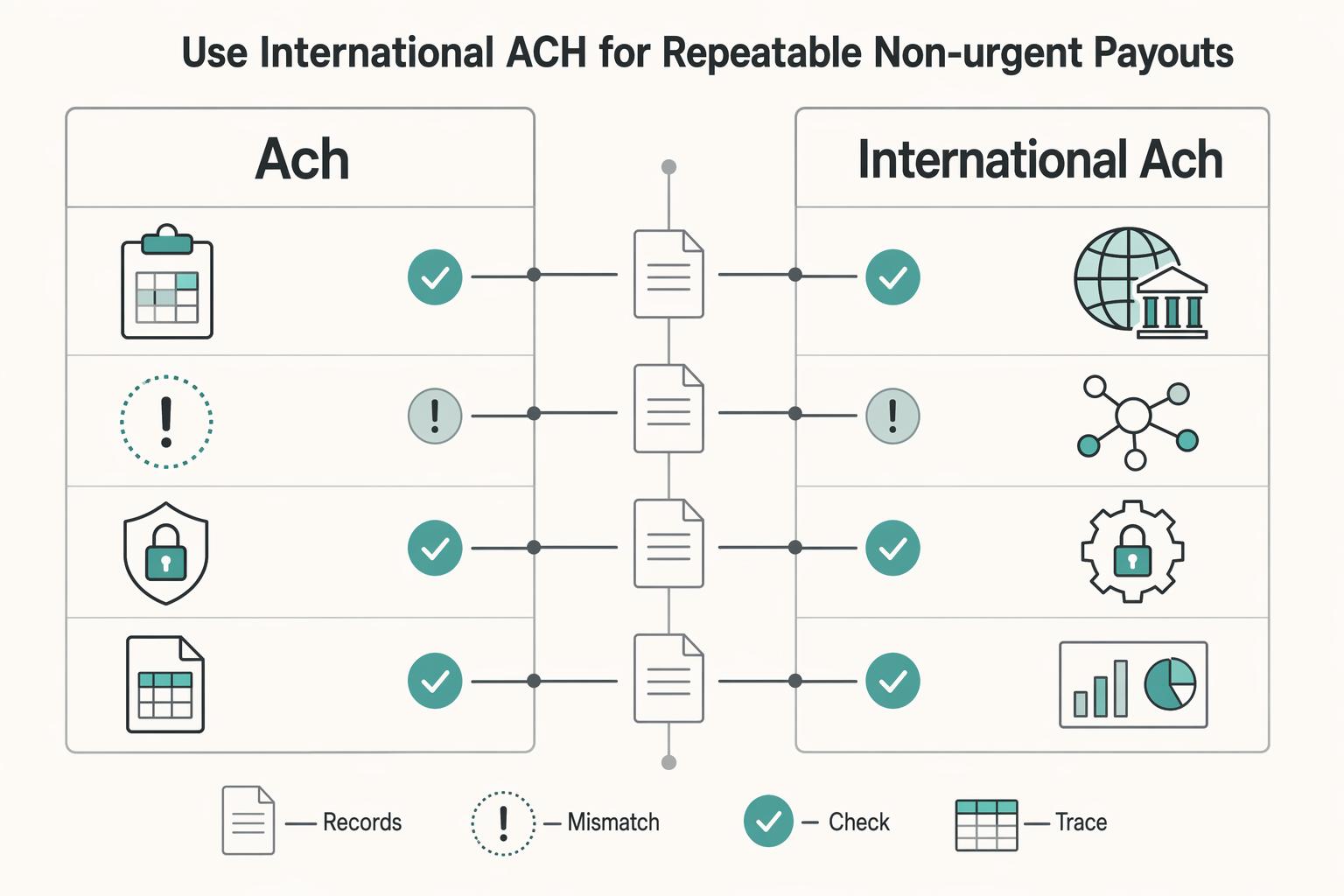
**International ACH can fit repeatable, non-urgent cross-border payouts when lower payout cost matters and you can still control approval, submission, recipient credit, and reconciliation.** For finance, ops, and product owners, this is less a payment-method debate than an ownership and control problem.

A Canadian Freelancer's Guide to Setting Up a US Stripe Account
Start with your Canadian Stripe account if your goal is to protect margin without adding U.S.-entity complexity. It is often the simpler path, and with the right payout setup you can receive USD without forcing immediate conversion.
Country-by-Country Launch Rules for Platform Payout Compliance
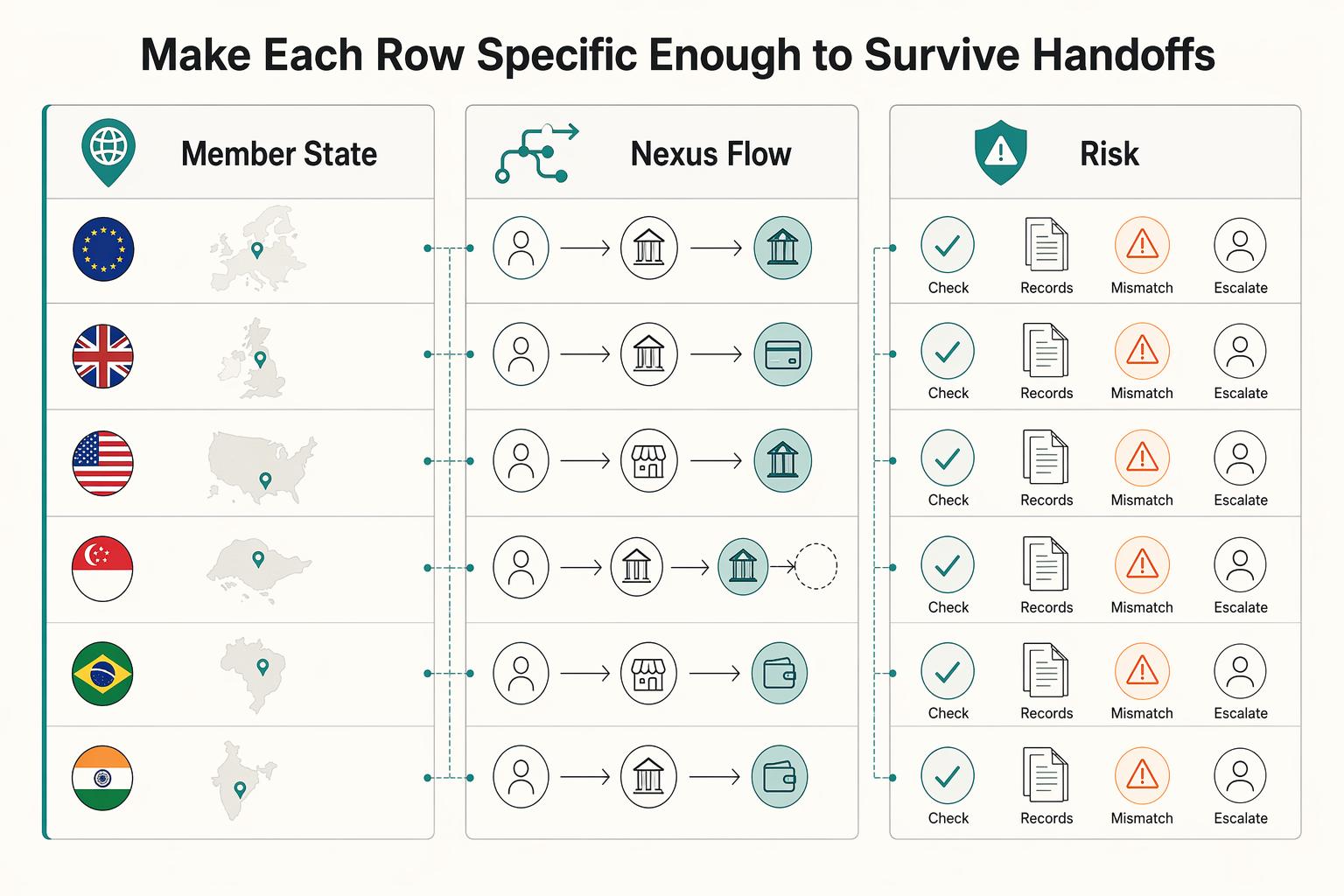
Treat each new payout country as a go or no-go decision. It may be blocked by law, blocked by operations, or cleared only with conditions. This guide helps compliance, legal, finance, and risk teams make that call early, assign ownership, and keep an evidence trail that holds up later.