
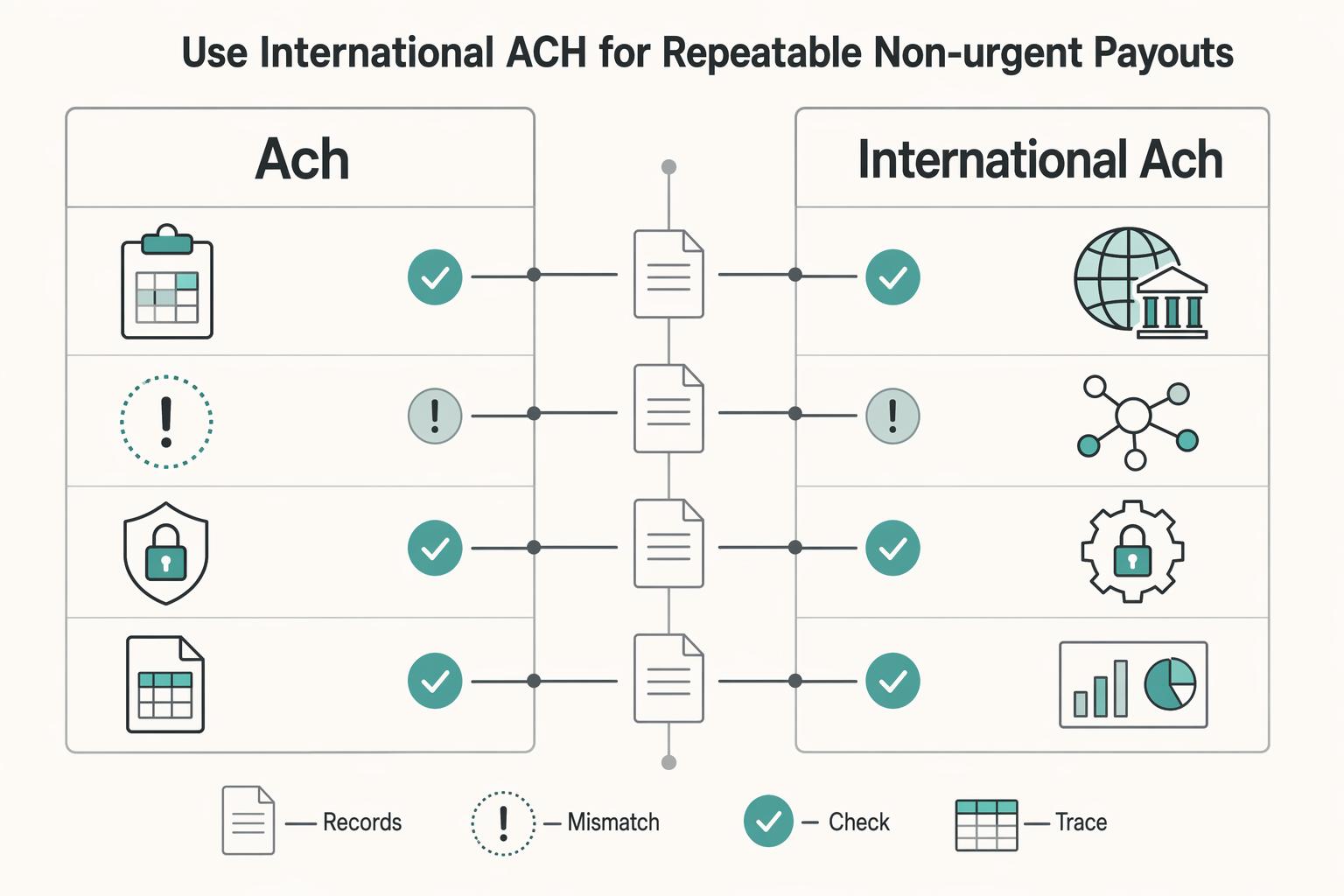
Quick Answer
International ACH is best for repeatable, non-urgent cross-border payouts where lower cost matters more than immediate delivery. It is corridor-specific, requires IAT classification for qualifying payments entering or exiting U.S. jurisdiction, and should be used only when your bank or provider can show clear status checkpoints, exception handling, and ledger-ready references.
Use international ACH for repeatable, non-urgent payouts#
International ACH can fit repeatable, non-urgent cross-border payouts when lower payout cost matters and you can still control approval, submission, recipient credit, and reconciliation. For finance, ops, and product owners, this is less a payment-method debate than an ownership and control problem.
| Term | Meaning | Scope |
|---|---|---|
| ACH | U.S. domestic, low-value electronic payment system | U.S. domestic |
| International ACH | Bank service that routes payments through ACH-like clearing systems outside the U.S. | Cross-border via ACH-like clearing systems |
| International ACH Transaction (IAT) | Nacha classification for a cross-border ACH entry involving a financial agency outside U.S. territorial jurisdiction | Qualifying cross-border ACH entries |
A useful starting point is to separate three terms that often get blurred together. Automated Clearing House, or ACH, refers to a U.S. domestic, low-value electronic payment system. "International ACH" is not the U.S. rail going global by itself. It is a bank service that routes payments through ACH-like clearing systems outside the U.S. When a cross-border ACH entry involves a financial agency outside U.S. territorial jurisdiction, Nacha classifies it as an International ACH Transaction, or IAT. If your team treats those as interchangeable, you can end up with gaps in who validates data, who submits, and who explains a delay.
That distinction matters because lower fees can be real in some setups, but so can the tradeoffs. In one bank framing, an international ACH payment may cost less than $5 per payment versus roughly $15 to $50 for a wire. Delivery can take two to four days instead of same day. That is a strong reason to consider it for repeatable cross-border payouts. It is not a reason to assume it fits every corridor or urgency level. If a recipient needs funds the same day, or your failure-recovery window is tight, the cheaper rail can become the more expensive incident.
The real decision is where control needs to live. Before you send a first production batch, verify at least these points. Confirm whether your bank or provider supports the relevant IAT path for the countries you care about. Confirm which status checkpoints you will receive between initiation and recipient credit. Confirm what evidence you can export to tie each payout back to your internal ledger. If you cannot map a submitted payment to a provider or bank reference and then to a booked cash movement, you do not yet have an auditable payout flow.
One operational risk is not just "payment failed." It is ambiguity in the middle: submitted but not credited, credited but not reconciled, or retried after a timeout with no clean proof of prior submission. That is why this guide stays focused on explicit checkpoints rather than generic payment definitions. You should leave with a practical way to choose the right operator mix, set approval and reconciliation controls in the right order, and run cross-border payouts without losing traceability when something goes off the happy path.
If you are still deciding whether ACH-like rails belong in your payout stack at all, keep one rule in mind. Assess your current payables process, your IT capacity, and the stakeholders who will own exceptions before you optimize for unit cost. The rail only helps when the operating model around it is clear. You might also find this useful: Why International Wire Transfers Arrive Short and How to Reduce Fee Leakage.
Separate the operator roles before you design anything#
If you cannot assign a clear owner to each handoff in a corridor, pause launch and fix ownership first. The first design task is role separation, not pricing or API selection.
| Layer | Role | Notes |
|---|---|---|
| Nacha | Governs the International ACH Transaction (IAT) rule set | Rule authority |
| Your bank | Access layer on the U.S. side | If it is the ODFI, it carries core warranties and responsibilities for the originator's compliance with Nacha Rules |
| Provider | Execution surface for payout tooling, funding methods, and status events | Examples given: Wise, Airwallex, Ramp; not the rule authority |
Start with three layers. Nacha (the National Automated Clearing House Association) governs the International ACH Transaction (IAT) rule set. Your bank is the access layer on the U.S. side; if it is the ODFI, it carries core warranties and responsibilities for the originator's compliance with Nacha Rules. Providers such as Wise, Airwallex, or Ramp are execution surfaces that expose payout tooling, funding methods, and status events, but they are not the rule authority.
Treat IAT as a responsibility map, not a product label. For each corridor, document:
- who validates beneficiary and payment fields before submission
- who classifies qualifying cross-border entries as IAT
- who submits into the bank path
- who reports intermediate and final statuses
- who owns returns, rejects, and manual investigations
Keep the path explicit. A provider may market "international ACH," but the flow can include local ACH funding, a bank submission leg, and a recipient-country clearing partner. Wise describes funding international transfers by local ACH and notes involvement of the recipient-country clearing house. Airwallex positions its payout network around local and SWIFT payouts rather than a single IAT model for every corridor.
Document the boundary in plain language: the ACH Network (the U.S. ACH network) is the nationwide batch network depository institutions use to exchange electronic credit and debit transfers, while the destination-country clearing house handles local clearing overseas. Before launch, require a corridor-specific ownership sheet and a sample status trail; if one transition still has no owner, hold that corridor. For a step-by-step walkthrough, see A Guide to SEPA Transfers for European Freelancers.
Map the payout sequence from request to booked cash movement#
Once owners are clear, freeze the sequence. Use this seven-step flow as your operating timeline so each state has an entry condition, evidence trail, and close condition:
| Step | Key control | Evidence or close point |
|---|---|---|
| Payout request | Create the payout instruction with the beneficiary, amount, corridor, and internal transaction ID | Instruction created |
| Policy gate pass | Hold the payout until approvals and required screening are complete | For cross-border flows, include sanctions screening in this gate |
| ACH initiation | Start submission only after approval | Instruction leaves your controlled queue and enters bank processing |
| IAT formatting | Use IAT classification and format for payments entering or exiting U.S. jurisdiction | Required party data populated |
| Destination clearing handoff | Track the destination-clearing stage separately | Provider processing states and downstream clearing progress can diverge |
| Recipient credit event | Do not treat provider "sent" as recipient credit | Funds are actually credited |
| Internal reconciliation close | Close only after your ledger entry, provider reference, and external outcome are matched | Matched status before close |
- Payout request
Create the payout instruction with the beneficiary, amount, corridor, and internal transaction ID.
- Policy gate pass
Hold the payout until approvals and required screening are complete. For cross-border flows, include sanctions screening in this gate.
- Automated Clearing House (ACH) initiation
Start submission only after approval. Treat this as the point where the instruction leaves your controlled queue and enters bank processing.
- International ACH Transaction (IAT) formatting
For payments entering or exiting U.S. jurisdiction, use IAT classification and format, with required party data populated.
- Destination clearing handoff
Track the destination-clearing stage separately, because provider processing states and downstream clearing progress can diverge.
- Recipient credit event
Do not treat provider "sent" as recipient credit. Provider timelines can show states like Incoming Payment Waiting, Processing, Funds Converted, and Outgoing Payment Sent before funds are actually credited.
- Internal reconciliation close
Close only after your ledger entry, provider reference, and external outcome are matched.
Order of operations is the control layer: approval before initiation, idempotency key before submit, ledger posting after provider reference capture, and close only after matched status. Build one timeline that includes both provider and bank-partner status surfaces so ops can tell whether a delay sits in ACH processing or destination clearing.
Before launch, run one corridor end to end and verify you can retrieve the approval record, idempotency key, provider reference, external status history, and closing ledger journal. This helps prevent early close errors, including bounce-backs that may appear in 2-3 business days or, in some cases, several weeks after a transfer is marked sent.
This pairs well with our guide on A Guide to Using Wise for Payroll for International Contractors.
Decide when international ACH is the right rail#
Use international ACH for repeatable, non-urgent corridors you have already proven. If payout urgency is high and your recovery window is short, route to wire or a local instant rail instead.
This choice is corridor-specific, not global. Cross-border flows can include multiple processing steps between initiation and booked funds, so one default rail policy often fails in production.
A practical routing rule#
Choose ACH when unit cost and repeatability matter more than immediate delivery. ACH is a batch network, and Federal Reserve Services positions it as an efficient, low-cost batched service. One bank's published international ACH window is one to four days, which is a practical reminder that beneficiary credit is not an instant event.
Choose wire when urgency and finality matter most. Fedwire is used for large-value, time-critical payments, and once processed on that rail the payment is immediate, final, and irrevocable. Corridor-specific delivery can still vary, but the urgency profile is stronger than batch ACH.
Choose local instant rails when your provider can actually reach them in that market. SEPA Instant targets funds made available in less than ten seconds, Pix supports transfers in a few seconds at any time, and UPI is an instant real-time system that operates round the clock. For fast recipient confirmation in Europe, Brazil, or India, these rails can be a better fit than forcing every case onto ACH.
| Rail | Cutoffs | Expected status latency bands | Return handling model | Reconciliation effort |
|---|---|---|---|---|
| International ACH | Bank cutoff dependent; batched | Often measured in business-day windows; one bank states 1 to 4 days | Bank or provider exception path after submission; verify corridor-specific return and repair handling | High, because you reconcile batch submission, destination clearing, and late exceptions |
| International wire | Bank cutoff dependent | Shortest option for urgent payouts; immediate finality once processed on the Fedwire leg | Bank-led reject or repair process; once processed, finality is stronger than ACH-style batch flows | Medium, with higher scrutiny per payment due to value and urgency |
| SEPA Instant | Provider and participant dependent | Less than 10 seconds where supported | Scheme and provider-specific reject handling; do not assume ACH-style returns | Medium, usually easier when the provider exposes clear success or failure events |
| Pix | Always on | Few seconds, including non-business days | Local scheme and provider-specific exception handling | Medium |
| UPI | Round the clock, including Sundays and bank holidays | Instant real-time | Local scheme and provider-specific exception handling | Medium |
Verify by corridor, not by brochure#
The biggest selection mistake is treating "supports international ACH" as sufficient proof. Corridor behavior depends on your bank or provider, payout currency rules, and the destination clearing partner. A published offering can still be narrow: one U.S. bank describes international ACH support for nine currencies across more than 40 countries, and notes that international ACH can only deliver in local currency.
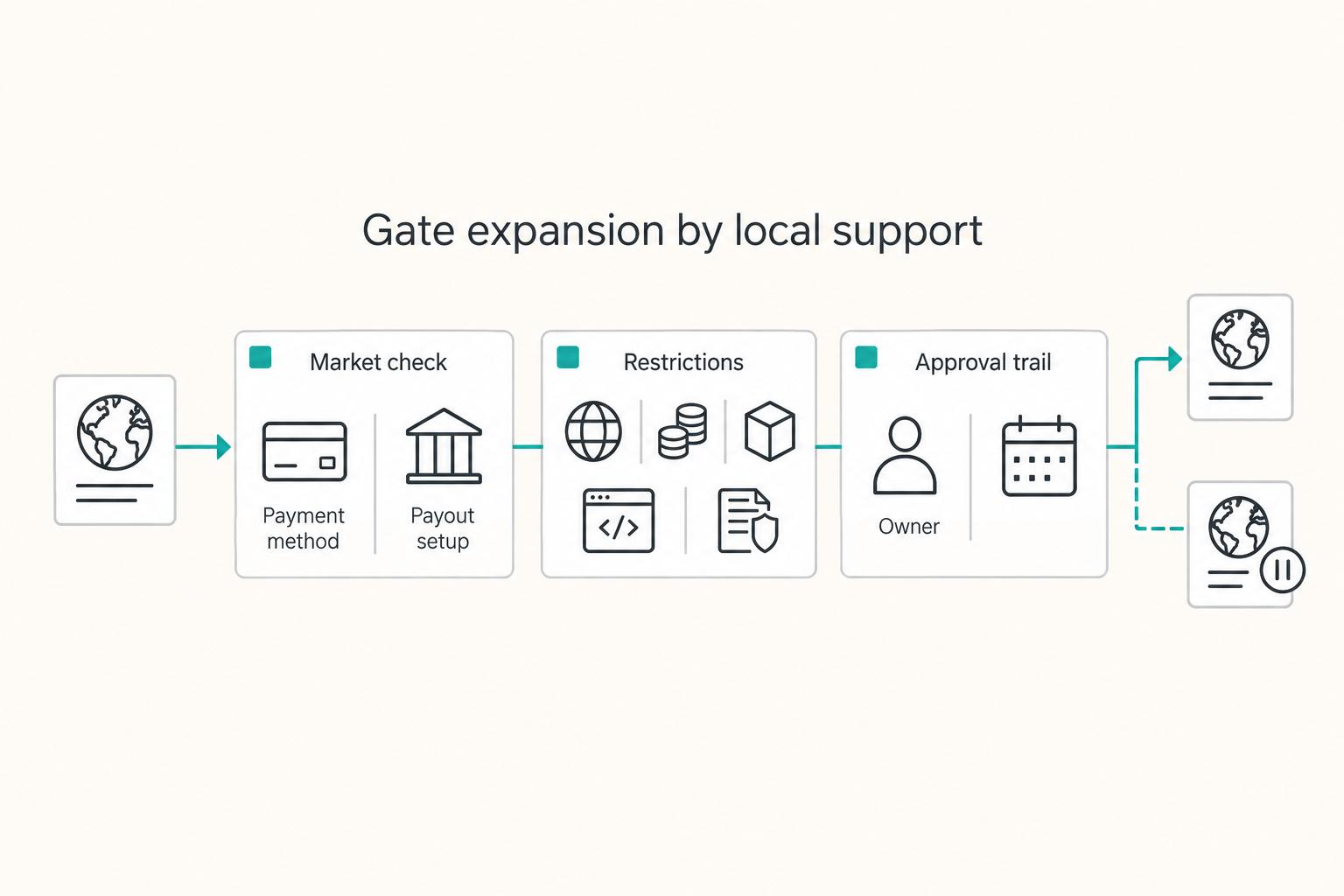
Before you default a corridor to ACH, require a small evidence pack and explicit sign-off. At minimum, verify the target country, supported local currency, bank cutoff, expected beneficiary-delivery window, sample status history from submit to credit, and the exact exception path when the payment fails after initiation.
Use a simple decision rule. If the payout is urgent, high value, or tied to a narrow remediation window, pick wire or the local instant rail your provider can actually reach. If the corridor is stable, local-currency delivery is acceptable, and your data shows consistent outcomes over time, ACH is usually the better cost profile. Related: International EFT Payments: How Platforms Can Send Electronic Funds Transfers Across Borders.
Score operator fit by corridor before signing volume commitments#
Score operators on corridor evidence, not brand familiarity. Use the same rubric for Wise, Airwallex, Ramp, and bank-direct options. Exclude any operator that cannot map its provider reference to your ledger transaction for scaled batches.
If a foreign financial agency is involved, the U.S. side must classify the entry as an International ACH Transaction (IAT) under Nacha. So your review should confirm a real IAT handling path where relevant, clear status transitions, and usable exception evidence when payouts fail or stall.
Score the corridor, not the logo#
Bank-direct fit should be scored per country. The Federal Reserve Services FedGlobal ACH origination manual (February 12, 2026) calls out country- and region-specific requirements for originating international ACH payments, so one corridor result should not be reused as a global pass.
Use four criteria across every shortlisted operator:
- Corridor support: confirm the exact country path and whether IAT handling is supported where relevant.
- Status granularity: require visible state transitions, not only start/end states. Wise documents rollback transitions, and Airwallex documents transfer status transitions for API version
2025-06-30or later. - Return reason quality: review failed-transfer payloads or reports from your target corridors to see whether remediation can be routed without constant support escalation.
- Evidence export quality: confirm exportable identifiers, timestamps, and failure details for reconciliation and audit review.
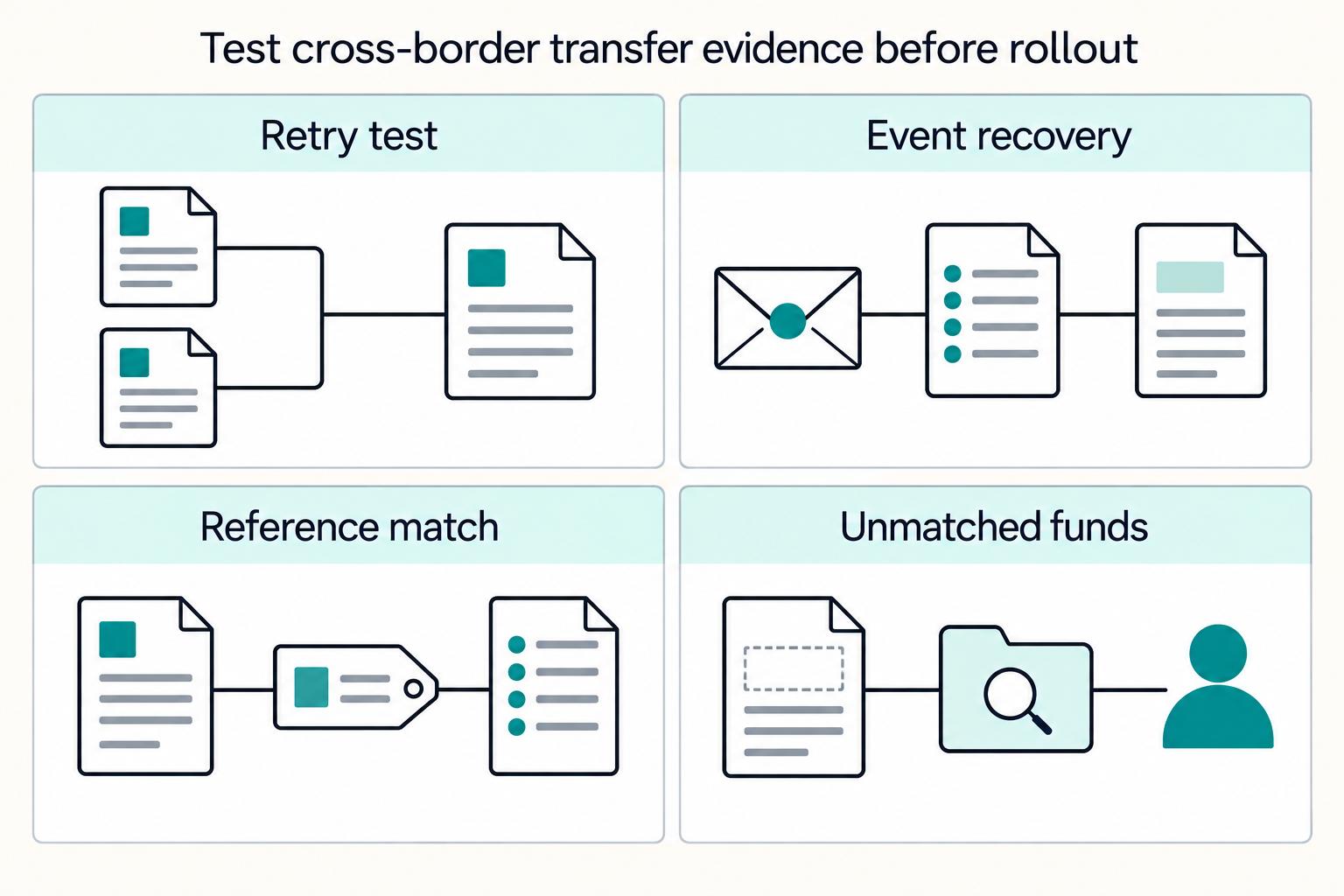
A practical test is one successful trace and one failed trace for each top corridor. Wise exposes a transfers#payout-failure webhook event for payout-stage failures. Airwallex supports simulated status transitions, including failed-transfer retry scenarios, so you can test exception handling before volume commitments.
Proof points to require before signature#
Require these three proof points in a live or testable environment before signature:
- IAT support path for corridors that touch the U.S. ACH Network, including where required data is validated and where exceptions appear.
- Retry semantics after timeout or failure, including duplicate prevention. Ramp's API docs require an idempotency key for accounting sync requests, which is the type of replay control to verify in payout-adjacent flows.
- Exception SLA definitions with named ownership and written handoff points.
Use one hard gate: if an operator cannot clearly describe what happens between acceptance and recipient credit, or cannot reliably tie provider IDs to your journal entries, do not commit scaled batch volume. Wise's partnerReference example shows reference continuity into settlement journals, and Ramp's bill object includes a client-side identifier that can support reconciliation design.
| Operator path | Onboarding docs P/F | Webhook or event coverage P/F | Payout batch controls P/F | Reconciliation artifacts P/F |
|---|---|---|---|---|
| Wise | Pass if corridor path and IAT handling are confirmed where relevant | Pass if transfer state changes and transfers#payout-failure are available | Pass if bulk settlement or submit flow preserves your internal reference | Pass if partnerReference matches settlement journal records |
| Airwallex | Pass if corridor support and applicable API version are confirmed | Pass if documented transfer statuses are available and testable | Pass if failed-transfer cancel/retry behavior is demonstrated | Pass if transfer IDs and status history are retrievable for ledger matching |
| Ramp | Pass if payable object and client-side identifier fit your flow | Pass if required resource webhooks are available | Pass if idempotency behavior is demonstrated on your submit path | Pass if client-side ID can anchor internal reconciliation |
| Bank-direct | Pass if country-specific origination requirements and required fields are documented | Pass if bank events or reports show where exceptions surface | Pass if duplicate prevention and batch-file controls are defined | Pass if bank reference, batch ID, and exception reports map back to journals |
If a corridor is not pass across all four columns, pause volume commitments for that corridor.
Design reconciliation controls around the ledger as source of truth#
Make your ledger the system of record for payout state, and treat wallet balances or provider dashboards as views. Close books from journal entries that carry both your internal payout ID and the external ACH or provider reference.
ACH is a batched interbank network, so status can appear on one surface before another. If you clear cash from a wallet screen alone, you can mark a payout complete before you have counterpart evidence. Use one rule: every posted payout journal must map to a matching external record, and every external event must map to a journal or an open exception.
Use canonical states you control#
Do not depend on each operator's labels. Define your own reconciliation states, then map provider statuses into them.
| Your canonical state | Minimum evidence to record or clear it | What to check before close |
|---|---|---|
| requested | Internal approved payout record with unique internal ID | No journal marked as cash out yet |
| submitted | Provider transfer ID or bank submission reference captured on the journal or linked record | Internal ID and external reference both present |
| pending external | External status feed or reconciliation report shows item still in flight | Item is excluded from settled cash, but still visible for follow-up |
| credited | Settled transaction appears in the provider or bank settlement artifact | Amount, currency, date, and reference match the journal |
| returned | Return event or exception notice tied to the original reference | Original payout is relieved and return entry is booked |
| reversed | Reversal journal linked to the original credited or returned item | Audit trail shows why the prior posting changed |
Wise gives a concrete example: include partnerReference with the same reference used in the settlement journal. That is the reference-level linkage you want across operators.
Separate pending from settled on purpose#
Use different reports for different jobs. Airwallex's transaction reconciliation report helps reconcile to internal records and can include pending items, while its balance activity report is a month-end artifact for settled wallet activity.
Month-end controls should force three checks before close:
- Unmatched external events: any provider or bank event with no internal counterpart stays on an exception list until resolved.
- Stale pending items: escalate items that remain pending too long. For ACH exceptions, a Payment Trace Request is the formal path, and no-response cases should escalate after 10 business days.
- Manual adjustments: require dual-control verification for write-offs, forced clears, or journal edits, and review the audit log before posting.
This is what keeps the ledger authoritative instead of drifting into spreadsheet-only close work. Need the full breakdown? Read ARR vs MRR for Your Platform's Fundraising Story.
Handle failures and retries without creating payout duplicates#
Preventing duplicate disbursements should be your first failure-control objective. For an international ACH transfer, treat any post-submit timeout or ambiguous response as "unknown until verified," not as permission to submit again.
Cross-border ACH can take 1-5 business days, and reliability can vary by receiving country and bank path. So a "not received yet" message is not enough to mark a payout as failed. Separate delayed destination posting from a true return, and route each case differently.
| Failure class | What it usually means | What to do next |
|---|---|---|
| Delayed destination posting | Payment is still moving through the destination banking system | Keep status in pending external, monitor provider and bank status surfaces, and do not resubmit |
| Returned payout | The ACH payment could not be completed | Capture the return reason code or description, reverse or relieve the original payout in your ledger, then decide whether to remediate and resend |
| Bank capability mismatch | Corridor or receiving bank cannot accept the rail used | Stop retries on that rail, confirm corridor support, and consider a SWIFT wire for future payouts when urgency justifies it |
| Malformed beneficiary data | Beneficiary details failed validation or downstream acceptance | Route to beneficiary remediation with the exact field issue and required correction evidence |
| Timeout after submit | The call may have succeeded even though your app did not get a clean response | Retry only with the same idempotency key after checking for an existing transfer ID or external record |
Make retries idempotent on purpose#
Use a stable idempotency key tied to your internal payout ID, not to each job attempt. Reusing that same key on replay helps prevent duplicate execution if the first submit actually succeeded. Changing the key on each retry increases duplicate-request risk.
Before any retry decision, store four items together: internal payout ID, idempotency key, full request hash, and the first provider response or timeout event. Also account for key retention windows: if a key is pruned after about 24 hours, query by your original reference before any late resubmission.
Route exceptions by owner and rail decision#
Route exceptions by class so ownership stays clear and response time stays controlled:
- Operational retry: transport-level issues (for example socket or timeout errors) where no completed submit is found.
- Beneficiary remediation: return reasons that point to recipient-data issues.
- Corridor switch: rail or bank-path constraints that require planning a
SWIFTfallback for future payouts. - Manual investigation: ambiguous records, including IAT screening or exception scenarios; Nacha materials note that potentially 20% of received IATs may require manual review for potential matches.
If one corridor shows repeated unresolved returns, pause auto-batching for that lane and move to controlled manual review until root cause is fixed. Nacha treats elevated return patterns as a risk signal, so this is a control step, not just an ops preference. Related reading: Choosing Creator Platform Monetization Models for Real-World Operations.
Set compliance and tax evidence before first production batch#
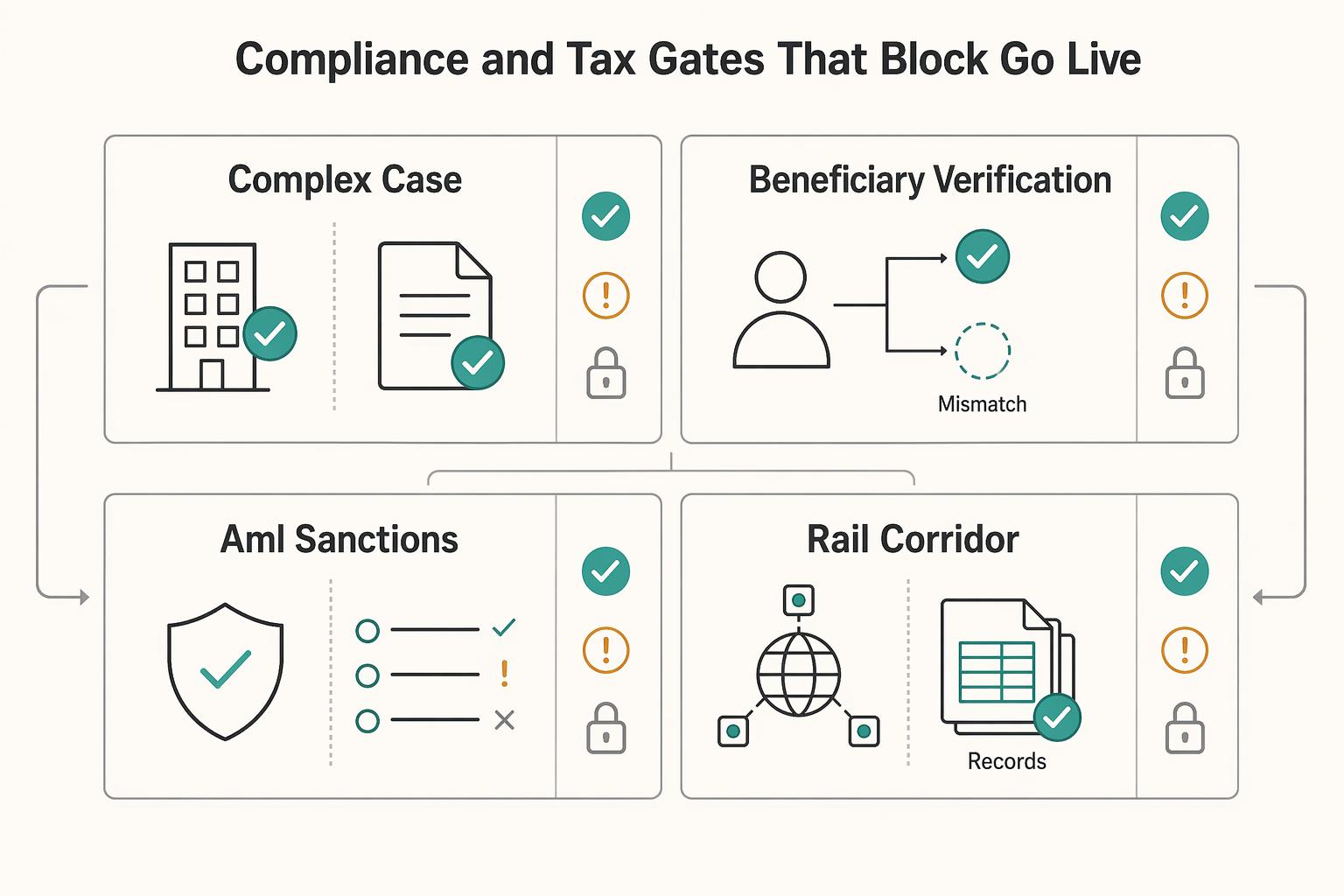
Before your first production batch, make evidence completeness a launch gate. If you cannot show why a payout passed identity, screening, and cross-border classification checks, do not send it.
For ACH payments involving a foreign financial agency, classify the payment as an International ACH Transaction (IAT). Your prelaunch records should show the IAT classification rule, the party data passed in the flow, and how that data supports screening operations.
Your onboarding evidence should also prove that CIP is risk-based, includes identity verification procedures, and is part of your AML program. For legal-entity customers, retain beneficial ownership identification and verification records in your due-diligence trail.
Minimum evidence pack#
| Touchpoint | What to retain | Why it matters |
|---|---|---|
| IAT classification and data handling | Rule used to classify IAT payments and records of required party data in the payment flow | IAT classification and party-level data support cross-border screening operations |
| CIP and onboarding controls | Identity verification procedures and outcomes within your AML process | CIP must be risk-based and part of the AML program |
| Legal-entity due diligence | Beneficial owner identification and verification records | CDD procedures require beneficial ownership controls for legal-entity customers |
| Tax reporting applicability | Per user/entity determination of whether FBAR, Form 8938, or Schedule SE may apply | These are separate obligations and should not be treated as interchangeable |
Keep tax evidence precise, not bundled. FBAR is FinCEN Form 114 (filed with FinCEN), and Form 8938 does not replace it. IRS guidance references an FBAR trigger above $10,000 aggregate foreign account value during the year and notes Form 8938 reportability generally starting at $50,000; Schedule SE is for calculating self-employment tax and applies only to relevant profiles.
At verification, run one production-like payout end to end and confirm that sensitive data handling is controlled: avoid logging sensitive data, redact where needed, and encrypt sensitive data at rest and in transit. Because international ACH requirements vary by country and region, log corridor-specific unknowns with an owner and block launch until confirmed. We covered this in detail in International Freelance Contract Clauses for Payment and Dispute Control.
Conclusion#
Treat international ACH as an operating-model decision first and a rail decision second. The teams that get value from it are not the ones that simply turn on "global ACH." They are the ones that define ownership, verify each corridor with evidence, and refuse to scale until reconciliation and retry controls are in place.
That matters because the rail is built for batched, low-cost processing, not perfectly uniform cross-border behavior. FedACH services describe ACH as efficient, low-cost batched payment processing, which is exactly why it can work well for repeat payouts. It is also why you should not expect wire-like certainty on timing or status quality unless your bank or provider can show it for the specific destination you care about.
The hardest checkpoint is often not pricing. It is whether the operator can prove corridor readiness in a form your finance and ops teams can actually use. For any payment transmitted to or received from a financial agency outside the territorial jurisdiction of the U.S., Nacha rules require IAT classification. In practice, that means your provider should be able to show not just "ACH support," but a real IAT path with the required cross-border fields. That includes party information, origin and destination country, currency codes, and, where relevant, FX-related data.
A good evidence pack is concrete. Ask for sample transaction artifacts or a production-like test that shows the provider reference, the payment status trail, and how exceptions are reported back to you. If your ledger cannot tie the request, submission event, external reference, and final disposition together, "status complete" is not enough. The same goes for corridor coverage claims. One bank may advertise nine currencies in more than 40 countries, another 24 currencies across 62 countries and territories, but those are operator-specific footprints, not market-wide guarantees.
The failure mode to design against is duplicate submissions and unclear final outcomes. If a submit times out, you need idempotent retry behavior so a replay does not create a second disbursement. Some operators explicitly support idempotent calls and return the original payment status and payment ID when the same payment is sent twice. If your provider cannot explain that behavior clearly, or cannot map original submission attempts to final outcomes, pause before moving that corridor into automated batching.
The final decision rule is simple. If operator responsibilities are explicit, corridor support is proven with evidence, and your controls can match status and references back to the ledger, this rail can be a reliable, lower-cost option for recurring cross-border payouts. If any one of those three pieces is weak, keep the volume small, route exceptions manually, or choose wire or local rails until the gap is closed.
Frequently Asked Questions
Who actually operates international ACH transfers for platform payouts?
No single party operates it alone. Nacha sets the rules, the U.S. ACH network is the batch network, and your bank or payout provider is usually the access point for submission. A destination-country clearing participant is also involved, so ownership of each handoff, status update, and exception should be explicit.
Is ACH domestic only, or can it be used for cross-border payouts?
ACH is a U.S. network, but it can support cross-border payouts when the payment leaves a U.S.-domiciled account and is routed into another country through local clearing participation. That is what people usually mean by international ACH or global ACH. Support is corridor-specific, so domestic ACH availability does not prove cross-border capability.
Why is international ACH often cheaper than wire transfers but sometimes slower?
It is often cheaper because ACH is a lower-fee, batch-based process. It can be slower because the payout may depend on multiple processing layers, including destination-country clearing. If the payment is time-critical or the recovery window is short, fee savings alone should not decide the rail.
Can every bank send international ACH, and how do we verify capability early?
No, availability is not universal. Verify capability early with written confirmation that the bank or provider can originate the specific corridor and handle the required IAT formatting. A production-like test or sample transaction artifacts should also show corridor support and how returns are reported.
What is the difference between an ACH transfer and an International ACH Transaction?
An ACH transfer is the broad payment type. An International ACH Transaction, or IAT, is the SEC code used to designate a qualifying cross-border ACH payment. If the transaction enters or exits the U.S., the IAT code and format matter.
When should a platform switch from international ACH to wire or local rails like SEPA, PIX, or UPI?
Switch when payout urgency, amount, or recovery risk outweighs unit-cost savings. Wire is usually the stronger choice for higher-value overseas payments, and local rails can be a better fit when you already have reliable in-country access. For a new corridor, compare ACH, wire, and local rails side by side instead of assuming ACH is the default.
Try a related tool
Researched and edited by the Gruv editorial team. Gruv builds cross-border billing, payouts, and finance-operations software for global businesses.
Sources
- cisa.gov/audiences/small-and-medium-businesses/secure...trusted
- ecfr.gov/current/title-31/subtitle-B/chapter-X/part-1...trusted
- federalreserve.gov/paymentsystems/fedach_about.htmtrusted
- federalreserve.gov/paymentsystems/fedfunds_about.htmtrusted
- irs.gov/businesses/small-businesses-self-employed/re...trusted
- irs.gov/businesses/comparison-of-form-8938-and-fbar-...trusted
- occ.gov/publications-and-resources/publications/comp...trusted
- publishedguides.ncua.gov/examiner/content/examinersguide/electronicpa...trusted
Educational content only. Not legal, tax, or financial advice.
Related Posts
What Is Negative Churn? How Platform Operators Achieve Revenue Expansion Without New Customers
Growth can flatten long before demand does. When customer losses and plan step-downs keep compounding across a growing subscription base, new sales have to work harder each month just to hold your ground. That is why revenue retention matters so much to founders, revenue leaders, product teams, and finance operators. It shapes medium- and long-term growth, not just this quarter's headline number.
How Platforms Choose International EFT Payments Across Borders
If you are choosing a provider for cross-border EFT, start with route evidence, not country-count slides. Cross-border payments are more complex than domestic ones: they are often slower, less transparent, and more expensive. Broad coverage on paper may not reflect performance in your real corridors or exception paths.
Payout Method Comparison Tool for Platform Operators Across ACH, SEPA, PIX, and UPI
Use this comparison as a decision aid, not a ranking. The point is to help you choose the right payout rail mix for marketplace payouts across ACH, Wire transfer, SEPA, SEPA Instant, PIX, UPI, and SWIFT based on operating fit, not headline speed alone. A strong choice usually balances speed, cost, geography, and payout experience.