

Quick Answer
Use a clause scorecard to accept, counter or pause each material term before signature. Agree scope, acceptance, invoice events, currency, IP/license, liability and closeout. Review governing law, forum and enforcement together. Payment-conditioned transfer or suspension must be agreed explicitly; a template or contractor label does not make the arrangement lawful.
Start Here Before You Send an International Freelance Contract#
Send a written contract before any work starts. In cross-border freelance work, this is one of the simplest ways to reduce misunderstandings and protect the terms that matter most.
This guide reviews the clauses that usually drive risk in practice: scope, payment, and what happens when a project goes off track. The point is not to turn every deal into a legal exercise. It is to keep momentum while giving you better defaults, clearer fallback language, and decision points for when to accept, counter, or pause.
Who this is for#
This is for self-employed freelancers and consultants selling services across borders. It is most useful when you already have a draft, a client contract, or a template and need to separate harmless boilerplate from terms that can create payment or delivery problems.
Templates can help you outline the job and payment terms, and an editable format like Microsoft Word can reduce signing friction. But convenience is not protection. A template is a starting point, not proof that the agreement is balanced or enforceable in the client's jurisdiction.
What to check before you send it#
| Check | What to confirm | Why it matters |
|---|---|---|
| Get core terms in writing early | Treat signature as part of kickoff, not optional admin | Without a written agreement, misunderstandings are common |
| Pressure-test scope and payment first | Scope and payment triggers | Vague scope and vague payment triggers are often where deals go off track |
| Mark clauses that need local legal validation | Governing Law, Jurisdiction, and dispute terms | Contract law varies by jurisdiction |
- Get core terms in writing early
Treat signature as part of kickoff, not optional admin. Without a written agreement, misunderstandings are common.
- Pressure-test scope and payment first
Illustrative scope calculation: a $5,000 fixed fee covering 40 hours yields $125 per hour before costs. If unpriced additions expand the work to 120 hours, the same fee yields about $41.67 per hour. This is an invented example, not a reported project; written scope boundaries and priced changes prevent that particular erosion.
- Mark clauses that need local legal validation
Governing Law, Jurisdiction, and dispute terms are not harmless boilerplate in cross-border deals. Contract law varies by jurisdiction, so validate these clauses with qualified local counsel when the stakes justify it.
What this guide will help you do#
The next sections are built for real negotiation and delivery decisions. Use this framework to sort terms into three buckets: what you must keep, what you can trade, and what should trigger a pause before signature.
The boundary that still matters#
Treat this as operational guidance, not jurisdiction-specific legal advice. Use it to tighten terms, ask better questions, and catch red flags early. Then validate Governing Law and Jurisdiction locally when project value or enforcement risk is meaningful.
Use the 10-Clause Scorecard to Pressure-Test Any Template#
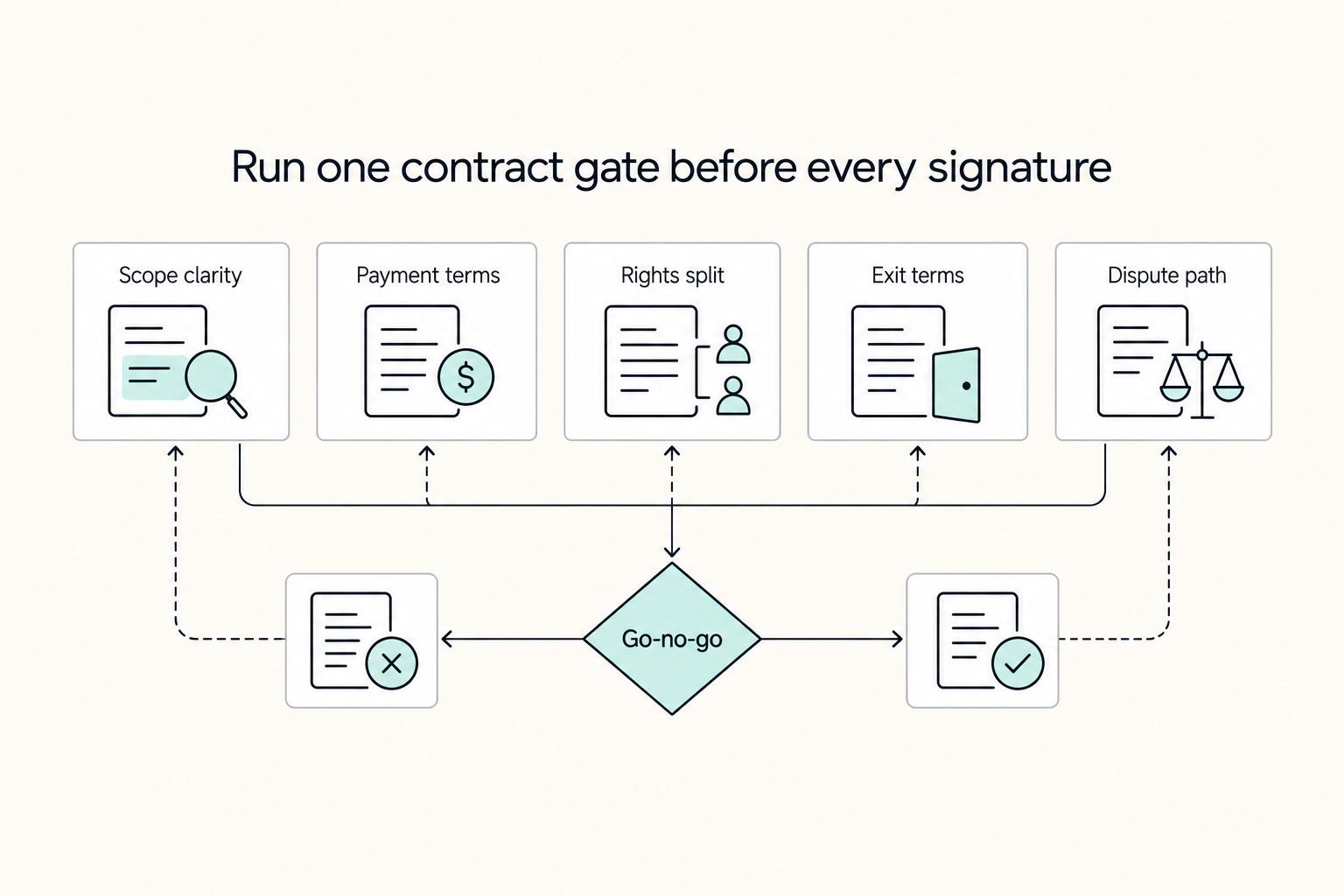
Score the draft clause by clause before you sign. This is a practical way to turn "looks standard" into a clear decision on each risk point: accept, counter, or pause work.
Start with any editable template in Microsoft Word or Google Docs, including a client form. Then replace generic language with terms that match the actual deal. Use this scorecard as a working checklist, not as a rule that exactly 10 clauses are legally required in every jurisdiction.
Build the scorecard first, then edit the contract#
Before you start redlining, build a simple scorecard with one row per clause and these fields:
- Must-have language
The minimum protection you need to do the work without ambiguity.
- Acceptable fallback
A compromise you can live with if the client pushes back.
- Walk-away red flag
Language that creates unacceptable collection, ownership, or dispute risk.
- Decision
Mark each row as accept, counter, or pause work.
| Clause | Must-have language | Acceptable fallback | Walk-away red flag | Decision |
|---|---|---|---|---|
| Scope of Work | Specific services, boundaries, and exclusions | Broad description plus written change approval | "Any related services as requested" | Accept / Counter / Pause work |
| Deliverables | Named outputs, format, due dates, revision limits | Deliverables described in proposal or statement of work | Deliverables left to future agreement | Accept / Counter / Pause work |
| Payment Terms | Exact amounts, due dates, invoice trigger | Net terms with milestone billing | Payment timing at client discretion | Accept / Counter / Pause work |
| Currency Clause | Invoice currency and payout currency stated | Single settlement currency if conversion is unavoidable | Silent on currency, or client can choose later | Accept / Counter / Pause work |
| Exchange Rate Clause | Named rate source and conversion date | Agreed commercial rate source if consistent | "Prevailing rate" with no source or date | Accept / Counter / Pause work |
| Intellectual Property Rights | Defined ownership/license model, assets and effective transfer trigger | Negotiated transfer or interim license with explicit timing | Ambiguous or unintended assignment of pre-existing/third-party assets | Accept / Counter / Pause work |
| Termination Clause | Clear rights for breach, non-payment, and convenience | Notice period plus payment for work done | One-sided termination with no pay protection | Accept / Counter / Pause work |
| Limitation of Liability | Liability cap and exclusion of indirect damages | Cap tied to fees paid under the contract | Unlimited liability for routine service work | Accept / Counter / Pause work |
| Indemnification | Narrow, role-based, mutual where possible | Proposed breach/misconduct trigger, with any separately accepted IP risk defined expressly | Broad one-way indemnity with no causal allocation, cap or claim procedure | Accept / Counter / Pause work |
| Governing Law, Jurisdiction, Dispute Resolution | One coherent venue and process | Negotiated forum with notice and cure steps | Inaccessible or unclear dispute path with impractical enforcement economics | Accept / Counter / Pause work |
Pay special attention to payment and currency mechanics#
Separate the amount owed from the payment route. State who pays transfer, conversion and intermediary charges and whether receipt of less than the agreed amount leaves a balance due. Wise pricing illustrates that route fees vary; its current quote is a cost input, not a fixed contractual exchange-rate rule.
For example, agree that the client owes USD 5,000, may fund in EUR, and bears conversion/transfer fees so the freelancer receives USD 5,000. That is different from agreeing to a EUR equivalent calculated on the invoice date, which fixes a EUR debt and leaves the freelancer exposed to later EUR/USD movement. Write the chosen model explicitly.
Define the rate direction, named source, timestamp and what happens if the source is unavailable. Avoid importing provider card/ATM fee tables into a services contract. If fees are deducted from the invoice amount, the fee allocation and any gross-up must say who bears the shortfall.
Pause when a clause needs outside verification#
Mark a material clause for review when you cannot identify its effect under the chosen law or its relationship to other clauses. A contractor-classification regulation is not evidence for governing-law or court-venue choices. Use legal sources that address the actual question and qualified local review where the risk warrants it.
If a key clause depends on legal text, mark that row pause work until you confirm it against the official edition or with qualified local counsel. One weak term may be negotiable. Several weak terms together can signal a risky deal.
Lock Scope and Acceptance so Work Cannot Drift#
Lock scope and acceptance early, or fixed-fee work can quietly turn into open-ended labor. Most problems start as small additions, not open conflict.
A five-page website can expand through extra pages, formats and integrations. In the example above, tripling hours from 40 to 120 cuts the gross hourly rate to one-third without increasing the fee. The value of the additional work is not extra revenue unless the client agrees to pay for it.
Define the work in deliverable terms#
Write the Scope of Work so a third party could tell what is included and what is not. Broad labels alone are too soft. In one place, name the Deliverables, delivery format, and revision boundaries. Before you sign, compare the contract against your proposal, statement of work, and pricing terms so no deliverable goes missing. Use this checklist:
- Name each deliverable clearly.
- State format and handoff method.
- State revision boundaries and confirm that new pages, features, or concepts are out of scope unless approved as a change.
Make acceptance observable, not emotional#
Acceptance should turn on facts, not mood. Tie Payment Conditions to objective events and set clear acceptance criteria plus a response window.
Your clause should answer three things:
- What counts as delivery.
- What counts as acceptance.
- What happens if the client does not respond during the review window.
This is process design, not a universal legal rule. The aim is to reduce payment delays caused by changing preferences after delivery.
Require written change approval before extra work starts#
Extra requests are normal. Unpriced extra work is the problem. State that changes to Scope of Work, Deliverables, timeline, or assumptions need written approval and updated Fees and Expenses before extra work starts.
Keep one approval path and use it consistently. If you approve changes in every channel, clients can start treating access as the process. Availability is not the same as approval.
Add the payment checkpoint#
State the invoice event and due-date calculation separately. An invoice might be issued on delivery and due fifteen calendar days later, while acceptance has its own defect-review process. If payment depends on acceptance, define its objective criteria, deadline, valid rejection procedure and what silence means, subject to applicable law.
Keep a proof trail: delivery message, handoff record, acceptance or review-window expiry, and written change approvals. That record is often as important as the clause itself.
Design Payment Terms that Reduce Non-Payment Risk#
Once acceptance is clear, payment needs to be just as clear. Vague payment language creates confusion, delays, and avoidable non-payment risk.
A written contract helps, but the payment clause still has to work in practice. Use a Milestone Payment Schedule tied to deliverable evidence, keep Payment Terms separate from Payment Conditions, and define what happens when payment is late.
1. Build the Milestone Payment Schedule around deliverable evidence.
Bill against observable outputs, not abstract phases. Milestone billing is stronger when each release event is tied to a named Deliverable or artifact, such as a completed draft or a single-feature prototype for testing.
An upfront deposit can reduce the amount of work funded from your own cash. Set its size from the first phase's cost, client credit risk and cancellation exposure; there is no universal 25–50% requirement. Define whether the amount is an advance credited to fees and how any unused amount is handled on termination.
- State the exact amount or percentage for each milestone.
- Define each release event in deliverable terms.
- State whether invoicing is triggered by delivery, acceptance, or another stated condition.
- Keep milestone labels consistent across contract, proposal, and invoice schedule.
- Keep proof of each trigger event: delivery record, handoff record, approval, or review-window expiry.
If payment is disputed, that proof trail can matter: contract, invoice, delivery record, acceptance or review-window record, and notices sent after non-payment.
2. Separate Payment Terms from Payment Conditions.
Make the due-date rule and any prerequisite identifiable, whether they are in separate clauses or one clearly structured payment section.
Payment Terms: amount due, due dates, and late-fee treatment. Payment Conditions: what must happen before payment is owed, usually delivery and acceptance under your agreed process.
This matters because mixed clauses can give clients room to argue that payment is not due because they are still "reviewing." Keep the sequence explicit:
- Condition is met: delivery and acceptance process is satisfied.
- Term applies: invoice becomes due under the Payment Terms.
Choose a realistic review window for the deliverable and client approval process. Two days might work for a small proof and be inadequate for a complex software handoff. Define how a reasoned rejection is delivered, what defects must be identified and how corrections are reviewed; do not treat silence as acceptance unless the agreed clause and applicable law permit it.
3. Pair the Late Fee Clause with a Stop-Work Clause.
Use both because they do different jobs. A late fee creates a financial consequence. A stop-work clause creates an operational consequence.
Do not assume immediate suspension is available in every jurisdiction. Draft stop-work to follow your contract's notice and cure process, and align it with the Termination Clause.
If a milestone invoice is overdue, follow the agreed notice and cure procedure before suspending new work. Keep security, confidentiality and other continuing obligations in force, and distinguish a disputed item from undisputed sums.
4. Write the escalation ladder into the clause set.
Make the path obvious before there is a problem. Use a simple sequence like:
- Reminder after the due date passes.
- Formal overdue notice under Payment Terms.
- Service pause under Stop-Work if the breach continues through the contract process.
- If your contract allows it, termination for breach if non-payment still continues.
Keep dated reminders, formal notices and any suspension decision with proof of delivery. If you continue work while resolving payment, document the agreed exception and its limit. Routine reminders are not a substitute for a notice sent in the form and channel the contract requires.
Example structure by project risk#
| Project profile | Example payment structure | What to verify before you start |
|---|---|---|
| Small, lower-risk project | Upfront deposit, then one final invoice on delivery or acceptance | Deposit received, final trigger clearly tied to Deliverables |
| Medium project with several handoffs | Upfront deposit plus milestone invoices tied to named outputs | Each milestone has an exact amount, artifact, and invoice trigger |
| Higher-risk project (new client, long timeline, changing requirements) | Higher upfront commitment and shorter billing intervals tied to concrete checkpoints | Stop-Work Clause, Late Fee Clause, and escalation path align with the milestone schedule |
If you keep one rule, keep this one: do not let payment depend on vague "progress." Tie each invoice to an event you can prove. Then make late payment change the project status, not just your accounting.
This pairs well with our guide on How to structure a 'payment on termination' clause in a freelance contract.
Control Currency Risk Before You Agree the Price#
Currency terms should answer what is owed, in which currency, whether conversion changes the debt and who bears fees. The following are drafting choices to agree, not universal legal requirements.
- Name both currencies in the Currency Clause.
If you include this, state the invoice currency and payout currency separately.
- Set the conversion rule in the Exchange Rate Clause.
For a converted debt, name the rate source, quote direction, observation time/date, rounding and an unavailable-source fallback. Distinguish that contractual reference rate from a payment provider's execution quote, spread and fees.
- Allocate Fees and Expenses so net pay is predictable.
Illustrative conversion: USD 5,000 divided by an agreed rate of USD 1.10 per EUR fixes EUR 4,545.45, rounded to cents. If that EUR debt is later converted at USD 1.05, it yields about USD 4,772.72 before fees, roughly USD 227.28 below the original dollar amount. Alternatively keep the debt in USD and agree a fee allocation that delivers the full dollar balance. Neither model eliminates all banking or exchange risk.
- Use a clear decision rule when terms stay vague.
Confirm the debt currency and rate method before signing. If a payment arrives short, reconcile the actual gross amount, conversion and fees against the agreement before requesting a balance; do not automatically invoice a second full payment.
Set IP Ownership Without Ambiguity#
If ownership is not explicit in the signed contract, payment alone and label-only drafting can leave the result unclear, especially across borders.
For U.S. copyright, 17 U.S.C. 204 generally requires a transfer, other than by operation of law, to be in writing and signed by the rights owner or authorized agent. Other jurisdictions and rights can have different formalities. Identify what the client needs—ownership or a license—and record the agreed grant and its timing.
1. Choose one ownership model and state it clearly.
In the Intellectual Property Rights clause, name the model you are using:
- Work for Hire only where it actually fits the jurisdiction and work type.
- Assignment of Rights for transferring ownership of defined project IP.
The U.S. Copyright Office's work-for-hire guide distinguishes employee work within employment from certain commissioned categories with the required written agreement. A freelancer label or payment alone does not make every commissioned work eligible. Use an assignment or license where appropriate, and review formalities under the relevant law.
2. Align transfer wording with scope and documents.
If you are assigning rights, match the IP language to defined deliverables so scope does not become ambiguous. Keep the wording consistent across the contract and any assignment document.
3. Define what is assigned, and what is not.
Be specific about what IP is being transferred. If relevant, distinguish project-specific deliverables from pre-existing materials you already owned or reuse.
List background libraries, reusable templates and third-party components separately, including the license the client needs to use them with the deliverable. A blanket assignment cannot give the client rights you do not own. If you propose payment-conditioned transfer, agree the interim review/use license and actual trigger explicitly before work begins.
4. State any exceptions before signing.
If either side needs carve-outs, put them in the contract itself, not side emails. Keep your records together: signed agreement, any IP assignment document, and deliverables scope. For a deeper comparison of ownership models, see Work for Hire vs. Assignment of Rights: A Freelancer's Guide to Owning Your IP.
Confirm Independent Contractor Status and Party Identity#
Verify actual contracting parties and the engagement's classification before work starts. Accurate names support invoicing and enforcement; calling someone an independent contractor does not determine their legal status.
State the relationship in plain language#
Include a short no-employment clause confirming the relationship is independent contractor, and that neither party is the other's employee, agent, or legal representative. Keep it explicit, but do not rely on wording alone.
Classification depends on the actual relationship and the applicable test. IRS guidance uses behavioral control, financial control and the relationship for U.S. federal tax; labor and other-country tests may differ. If working arrangements resemble employment, seek a lawful classification and operating model rather than assuming a revised clause cures it.
Verify the party block before signature#
Capture legal identities in the party block. A strong party block should include:
| Party detail | What to include |
|---|---|
| Client legal entity name | Client legal entity name |
| Registered office or registered address | Registered office or registered address |
| Registration or fiscal number | Registration or fiscal number where applicable |
| Freelancer identity details | Your full name or business name, plus Tax Identification Number and registered address where applicable |
| Client signer | Signer name, title and actual authority to bind the named client |
The goal is practical accuracy. Make sure the agreement names the real parties clearly and identifies the signer.
Match the contract to your invoice trail#
When you invoice, keep party details consistent with the agreement: legal name, address format, and tax or registration identifiers where used.
Retain the signed agreement, relevant onboarding documents and invoice records securely. Resolve legitimate differences, such as a disclosed parent paying for a subsidiary, by recording authority and payment responsibility. Do not put a personal tax identifier in a widely circulated contract when a secure tax form is the appropriate channel.
Define Termination Paths Before the Project Starts#
Define how the deal ends before something goes wrong. A termination clause tells both sides how the contract ends, and vague terms around scope or payment can make conflict worse.
Build the exit logic in the contract#
Keep termination terms in the signed agreement, not scattered across email or chat. The clause should be easy to find and easy to interpret if problems arise.
A practical check is whether both sides could read the language during a dispute and understand what happens next. If not, the clause is probably too vague even if it sounds clear.
Keep termination and stop-work language aligned#
Specify the breach, required notice, cure period and permitted suspension before termination. Keep this sequence consistent across payment and termination sections. Allow required urgent relief where appropriate; do not let an escalation sequence accidentally erase an immediate statutory remedy.
Aim for one readable sequence both parties can follow under pressure.
Define wind-down duties clearly#
Define payment for work completed, approved expenses, noncancelable commitments and any agreed cancellation fee. Reconcile advances against the final amount, including any refund due. State handover timing/formats, data return or deletion, continuing confidentiality, licenses, survival clauses and which milestones stop on termination.
Also keep a clean record trail, including the signed contract and project records. A written contract is most useful when both sides can refer back to it if issues arise.
For example, a USD 5,000 project has a USD 1,500 advance. On cancellation, the agreed closeout calculation is USD 2,000 of completed work plus USD 300 of authorized noncancelable costs. The remaining balance is USD 800: 2,300 minus 1,500. This invented example assumes the contract permits those charges; it is not an automatic cancellation entitlement.
Cap Downside with Limitation of Liability and Indemnification#
Do not leave downside exposure to chance. Set a clear liability ceiling for ordinary claims, and keep indemnification narrow so you are not taking open-ended risk you do not control.
1. Put a real ceiling on ordinary claims.
A liability cap can limit recoverable amounts for covered claims, subject to applicable law and the contract's exceptions. Define whether it is aggregate or per claim, which fee period supplies the number, and whether defense costs and indemnity fall inside it.
For freelance deals, start with a defined liability cap. Then read the whole draft again to confirm the cap still applies after other clauses and carve-outs are read together.
2. Keep indemnification tied to actual control.
Indemnification shifts liability from one party to the other, and it can create severe obligations if you treat it as boilerplate. Keep it tied to risks each side actually controls, and push for mutual language where possible.
Identify the trigger, losses, causation, mixed responsibility, defense control and settlement consent. A breach-only trigger may be a proposed fallback, while a defined IP indemnity can separately allocate a no-fault third-party risk. Client materials or changes should be excluded only to the extent they cause the claim, rather than erasing your own contribution.
3. Be deliberate about carve-outs.
Limitation clauses and indemnity can interact. Identify every uncapped or separately capped obligation, whether defense spend erodes the cap, and how related claims aggregate. Check actual insurance scope and exclusions; insured limits do not automatically equal contractual protection.
Limitation language is not foolproof on its own, and enforceability can vary by jurisdiction, so do not assume one clause protects you everywhere.
4. Flag the combination that matters most.
The clearest red flag is broad one-way indemnification plus no liability cap. Treat that as a high-risk structure, not routine template language.
- No liability cap: ask for one before smaller edits.
- Broad one-way indemnity: define the accepted risks, causal allocation and claim-handling process.
- Heavy carve-outs: confirm the remaining cap still protects the deal economics.
- Unclear legal effect in your jurisdiction: pause and get local review.
Choose Governing Law, Jurisdiction, and Dispute Resolution Deliberately#
Treat governing law, jurisdiction, and dispute resolution as one bundled decision, not separate boilerplate. Together, they determine which legal system interprets the contract, where disputes are heard, and how a dispute moves toward formal proceedings.
Clear drafting lowers dispute risk. Vague drafting does the opposite. Explicit terms reduce ambiguity, while poorly drafted language can create loopholes, unexpected liability, misunderstandings, and long litigation.
Compare the three realistic forum choices#
Start by comparing the real options you are likely to get, not the perfect option you may never win.
| Option | When it may be workable | Main tradeoff |
|---|---|---|
| Client court venue | The court can hear the dispute and a resulting judgment has a realistic route to debtor assets | Local counsel, language, travel and recognition may be expensive |
| Freelancer court venue | The court has jurisdiction and its judgment can be enforced where the client has assets | A favorable local judgment may still require foreign recognition |
| Arbitration | Award-enforcement framework and clause costs fit the likely dispute | Specify seat, rules/institution, language and arbitrator count; fees may overwhelm a small invoice |
Identify where the debtor's assets are and what recognition/enforcement would require. The New York Convention supports recognition of covered foreign arbitral awards, with conditions and refusal grounds; it does not make collection automatic. An arbitration seat is the legal location of arbitration, distinct from a remote or physical hearing venue.
- Set pre-dispute steps in writing. Define how disputes are raised and handled before formal proceedings. Avoid vague timing language.
- State triggers and consequences. Identify what activates or suspends the clause and what happens after breach.
- Read the bundle as one system. Confirm governing law, jurisdiction, and dispute-resolution terms do not conflict.
- Keep records that match the clause path. Written contracts help as evidence of agreed terms, and related records should follow what the contract requires.
If you want a deeper dive, read A deep dive into the 'choice of law' and 'jurisdiction' clauses for international freelance contracts.
Run Sanity Checks Before Signature and After Kickoff#
Before the signature goes on the page, do one final coherence check. After kickoff, keep your documentation routine tight. This helps you catch practical failures early: missing terms in the signed copy, inconsistent party details, and evidence gaps once payment or scope issues appear.
Before signing#
- Confirm every clause from your scorecard is in the exact draft being signed.
- Check party names are consistent with the names you will use on invoices and payment records.
- Read Governing Law, Jurisdiction, notice, and escalation language as one path so dispute-path references do not conflict.
- Confirm signatures are complete in the final executed version, not just in redlines or email approvals.
If any item fails, pause until the executed copy is complete and consistent.
After kickoff#
Set up one audit-ready folder immediately and update it at each milestone. Include the signed contract, statement of work, milestone approvals, delivery receipts, acceptance emails, invoices, and payment notices.
This does not make the contract enforceable by itself. It can help you show a clear timeline quickly if payment, scope, or ownership is disputed. If approval happens on a call, send a recap email and file it.
Failure-mode test#
Run three hypothetical failures against the actual draft: an overdue undisputed invoice, a requested scope expansion and a mid-project cancellation. You should be able to identify the next permitted action, its notice channel and the money or handover obligation without guessing.
| Scenario | What to define or confirm | Notes |
|---|---|---|
| Late payment | Define reminder timing, required formal notice and cure period, then the permitted suspension point | Before work expands |
| Scope expansion | Require written approval before extra work starts | Before work expands |
| Termination | Confirm handover, invoicing timing, and whether IP transfer waits for full payment | Before work expands |
| Missed communication | Agree response deadlines and notice channels appropriate to the work | A number of unanswered emails does not establish breach or replace required legal notice |
Keep your next-action references close: collecting overdue payments, Work for Hire vs. Assignment of Rights, and contract red flags.
For a step-by-step walkthrough, see How to Write an Arbitration Clause for a Freelance Contract. Before signature, turn your clause checklist into a reusable first draft with Gruv's freelance contract generator.
Final Takeaway for Faster Safer Deals#
For faster, safer cross-border deals, treat the contract as a sequence of risk decisions, not a polished template. The contract protects you when cash flow, stop-work, and dispute clauses are clear and reviewed the same way every time.
When clients push back, a practical order of operations is to protect payment first, then your right to stop work, then forum terms. It will not fit every deal, but it helps keep negotiation focused on the clauses that usually affect outcomes earliest.
What actually drives safety#
Focus on clause quality, not just where the draft came from. A polished template will not fix weak Payment Terms, a vague Termination Clause, or unclear Jurisdiction language. Bad setup can create real downside, including penalties or legal action, and international contractor arrangements need careful attention to misclassification risk.
Payment friction is the other major risk area. Traditional cross-border transfers can involve correspondent banking relationships, with delays, hidden costs, and client friction as a result. Currency conversion costs can also reduce what you actually receive, so unclear currency and fee terms leave avoidable risk in place.
Negotiate in an order that protects cash flow#
- Payment Terms first
Set due dates, milestone triggers, currency, and payment conditions before debating edge cases.
- Termination and Stop-Work next
Make sure suspension and termination follow agreed notice/cure steps and preserve continuing security, confidentiality and handover duties.
- Governing Law, Jurisdiction, and Dispute Resolution last
Review enforcement practicality before signature alongside payment and liability. A deposit can reduce exposure but does not cure an inaccessible or conflicting dispute clause.
Use a standard scorecard every time#
Use the scorecard to document a decision on each material clause, with the reason and agreed fallback. The purpose is a coherent agreement you can follow during delivery and a dispute.
Before signature, keep verification plain and exact: party details, forum terms, payment triggers, and signatures should all line up with how you invoice and deliver. After kickoff, keep one evidence trail: signed contract, acceptance records, invoices, payment notices, and handover proof.
If a client wants broad control, vague deliverables, delayed payment, and one-sided termination, treat that as a serious risk pattern. Counter hard, rebalance the terms, or pause the deal. If payment is missed, keep this overdue payments guide close.
After signature, use the agreed invoice events, currencies, fees and delivery records in your actual collection process.
Frequently Asked Questions
What clauses must an international freelance contract include at minimum?
A useful checklist covers parties and authority, scope/deliverables, acceptance and changes, fees/currency/payment, IP/license, classification, liability/indemnity, termination/closeout, notices and dispute terms. These are practical topics, not a universal list of legally required clauses. Use secure tax documentation where needed; a contractor label does not override the actual relationship.
Can an international freelance contract be enforced across countries in practice?
Sometimes, but do not assume enforcement will be simple just because both sides signed. Outcomes can depend on the contract terms, where each party is located, and whether the setup aligns with the freelancer's local labor regulations. Protect yourself early with documentation, including the signed contract and a clear handover, payment, and receipt trail.
How do I choose Governing Law and Jurisdiction if the client is overseas?
Choose Governing Law and Jurisdiction together based on a realistic path for notices, document handling, and escalation. Do not treat these as filler boilerplate. Also check the arrangement against the freelancer's local labor regulations, because location or residency mismatches can create exposure in some countries.
When should I use an Arbitration Clause instead of court based Dispute Resolution?
Compare likely claim value, court access, asset location and foreign judgment/award enforcement. Arbitration may help with covered foreign-award recognition but can be costly for a small invoice. Specify seat, rules/institution, language, arbitrator count and necessary court-relief exceptions; do not confuse remote hearings with the legal seat.
How should I write Currency Clause and Exchange Rate Clause terms to avoid payment disputes?
State the debt currency, permitted payment currency, rate source and timestamp if conversion changes the debt, and fee allocation. Specify quote direction and rounding. Distinguish the agreed reference rate from the provider's actual execution rate and fees, and state how a short payment is reconciled.
What is a minimum safe Milestone Payment Schedule for a new international client?
There is no universal legal percentage or single schedule that is always safe. A practical minimum is a milestone structure tied to clear deliverables and payment triggers, documented step by step. Keep each checkpoint auditable, such as completion evidence, handover documentation, payment, and receipt.
Watch
International Freelance Contract Clauses That Protect Payment
Try a related tool
Researched and edited by the Gruv editorial team. Gruv builds cross-border billing, payouts, and finance-operations software for global businesses.
Sources
Includes 1 external source outside the trusted-domain allowlist.
- copyright.gov/circs/circ30.pdftrusted
- irs.gov/businesses/small-businesses-self-employed/in...trusted
- law.cornell.edu/uscode/text/17/204trusted
- uncitral.un.org/en/texts/arbitration/conventions/foreign_arb...trusted
- uncitral.un.org/sites/uncitral.un.org/files/media-documents/...trusted
- wise.com/us/pricingtrusted
- americanbar.org/groups/intellectual_property_law/resources/l...external
Educational content only. Not legal, tax, or financial advice.
Related Posts

How Freelancers Collect Overdue Invoices When Clients Stop Paying
When a client misses an invoice deadline, first establish what is unpaid and why. Match the agreement, delivery record, invoice and received payments, then send a dated request for payment. Keep one owner and a next action date so reminders lead to a resolution rather than an indefinite chase.

Work for Hire vs Assignment of Rights for Freelancers
A freelance agreement is not just about price and scope. It decides who controls the rights in the work. If the ownership language is loose, rights can move earlier than you expect, cutting down your control once the work is delivered or used.
10 Freelance Contract Red Flags to Check Before Signing
Use this as a fast decision screen, not a legal theory exercise: sign the Freelance Contract, send a Contract Redline, or walk away.