
Quick Answer
Lead with ARR, then prove it with MRR evidence from a closed month. For arr vs mrr subscription metric fundraising, the strongest approach is to publish an ARR headline only after New MRR, Expansion MRR, Contraction MRR, and Churned MRR tie to reconciled ledger outputs and signed adjustment logs. If monthly movement is noisy or heavily adjusted, show the MRR bridge first and annualize only after assumptions are clearly disclosed.
ARR vs MRR is not a math debate, it is a credibility test#
For platform finance teams, the ARR versus MRR question in fundraising is less about which formula sounds cleaner and more about whether your numbers hold up when someone starts pulling at the thread. In many cases, you should lead with Annual Recurring Revenue (ARR), then support it with clean Monthly Recurring Revenue (MRR) movement that ties back to the books.
That matters because fundraising runs on projections, not just history. Growth helps, but teams are also judged on whether they can predict revenue consistently and explain the movement behind it. A large signed contract or a strong month can make a deck look impressive, but neither proves the business is durable on its own. The stronger signal is recurring revenue that is steady, understandable, and backed by data you do not have to reinterpret for each audience.
This is even more important if your team sits close to the operational plumbing, not just top-line reporting. If you own the ledger, reconciliation, settlements, or payout execution, you have seen how quickly a clean headline number gets messy underneath. A metric is only as reliable as the data behind it, and the sequence matters. If ARR goes out before the monthly movement is tied out, adjusted, and reviewed, you are asking people to trust the conclusion before they have seen the proof.
A practical checkpoint is simple. Before ARR is shared externally, make sure you can trace it back to the same closed-period data used for reconciliation. If someone asks why ARR moved, you should be able to point to the monthly drivers quickly, not rebuild the logic from exports and memory. A common failure mode is treating contract value or timing effects as if they were recurring revenue. That kind of mismatch can turn a strong fundraising narrative into a credibility problem.
The useful split is straightforward. ARR is the annualized recurring portion of contracted revenue earned over time, so it usually carries the valuation story better. MRR movement is the operating proof layer. It shows whether the underlying business is expanding, stalling, or hiding issues that annualization can smooth over. If your monthly view is unstable, unexplained, or hard to reconcile, a polished ARR headline will not hold up for long.
The rest of the article follows that logic: a quick ARR versus MRR comparison, practical rules for which metric should lead, the failure modes that distort recurring revenue, and a validation checklist to use before numbers leave finance. Up front, the recommendation is simple: headline ARR when you need the annual story, but only after your MRR movement is clean enough to survive scrutiny.
Related: SaaS Revenue Metrics Glossary: MRR ARR Churn NRR LTV CAC Explained for Platform Operators.
ARR vs MRR at a glance for fundraising and operations#
Use MRR for operating pulse and ARR for fundraising narrative. They are connected, but they are not interchangeable.
| Criteria | Annual Recurring Revenue (ARR) | Monthly Recurring Revenue (MRR) |
|---|---|---|
| Time horizon | Annualized view of recurring subscription or contract revenue | Monthly view of normalized recurring revenue |
| Formula basis | Often used as a run-rate view; ARR = MRR × 12 is directionally useful for mostly monthly subscriptions, but incomplete for mixed contract structures | Recurring revenue for the month, normalized to reflect recurring performance |
| Primary owner | No single canonical owner; typically coordinated across finance and operations for external reporting | No single canonical owner; typically coordinated across finance and operations for operating review |
| Reporting use | Investor reporting, fundraising conversations, valuation context | Short-cycle tracking of growth, churn, and expansion |
| Diligence risk | Definition drift or weak contract treatment can overstate annual scale | Unexplained monthly movement can hide underlying instability |
| Update cadence | Updated as recurring definitions and contract treatment are confirmed | Updated on a monthly operating rhythm |
| Best use | Valuation narrative in fundraising | Operating pulse |
| Common misuse | Annualizing revenue that is not truly recurring | Treating non-recurring or timing-driven monthly activity as recurring subscription revenue |
Formula note: ARR = MRR × 12 is a useful check, not a full method. Once contract structure matters, use contract treatment and recurring annual value logic, not multiplication alone.
ACV is useful here because it frames customer-level contract size. In contract-heavy books, ARR should reflect recurring annual contract value, not just cash movement in a given month.
Before you publish numbers, tie your MRR base to a closed period, then confirm ARR logic matches recurring definitions and contract terms. If ARR moves, you should be able to explain whether it came from recurring growth or from a definition change.
If you want a deeper dive, read Subscription Metrics That Matter: MRR ARR LTV and Churn Rate Explained.
What belongs in ARR and MRR and what must stay out#
Use one rule across every report: include only contract-backed subscription revenue in recurring metrics, and keep non-recurring activity out even when it appears on the same invoice.
Use contract terms and plan records as the source of truth, not dashboard defaults. ACV is the annual value of subscription revenue only, so implementation, services, and other one-off activity stay out of ACV and should not be rolled into ARR. MRR should represent recurring monthly subscription momentum, not raw cash timing.
| Item | ARR | MRR | Why |
|---|---|---|---|
| Recurring subscription line under active contract or plan | Include | Include | Recurring subscription base |
| Implementation or services fees | Exclude | Exclude | Not subscription revenue |
| One-off adjustments, credits, true-ups | Exclude | Exclude from core metric; explain separately | Not recurring momentum |
| Multi-year contract value beyond one year | Exclude from ACV-based ARR | Not applicable unless monthly recurring amount is defined | TCV is not ACV |
A practical checkpoint for investor reporting: for each included line, you should be able to point to the contract or plan term that makes it recurring. If inclusion depends on a dashboard filter rather than a definition you can repeat, your metric logic is too loose.
Do not treat contract length or billing cadence as interchangeable with recurring value. A 2-year contract has TCV that is 2x ACV, and billing terms do not change TCV. Keep ACV, ARR, and MRR definitions consistent across dashboards, updates, and board materials so your numbers stay disciplined and repeatable.
Where platform teams lose metric integrity in month-end close#
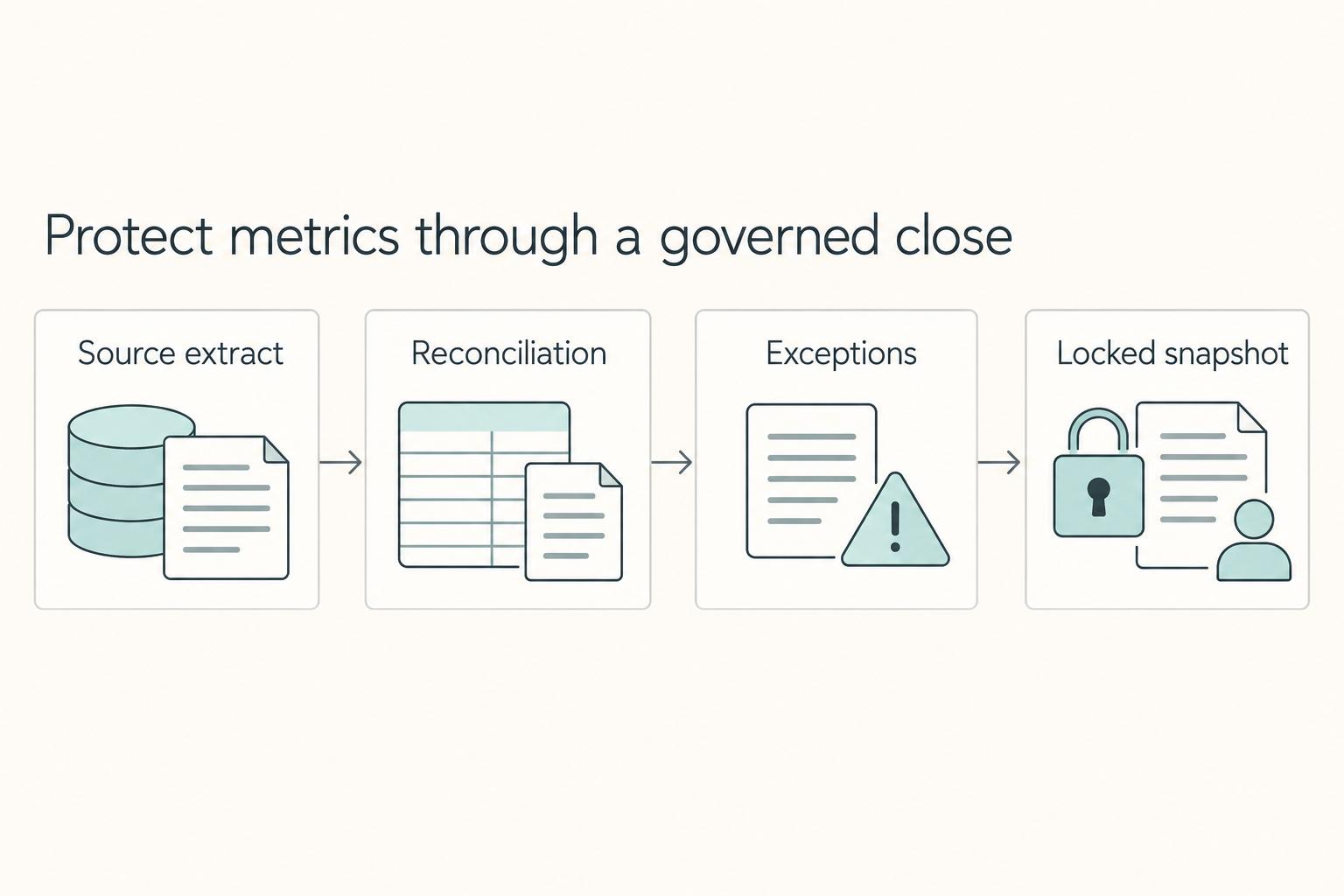
Metric integrity usually breaks during close when definitions are inconsistent and data governance is loose, not because the ARR/MRR formula is wrong. If Sales and Finance classify the same event differently, a 30-second clarification can turn into a week of reconciliation, and investors tend to read that inconsistency as exposure.
Use a fixed close workflow and apply the same definitions every cycle. A practical structure is source extract, tie-out and reconciliation, exception handling, then a locked reporting snapshot. The goal is consistency and traceability so your metrics stay reliable as reporting cadence increases.
Keep each close defensible with an evidence pack:
- Source extract for the reporting period.
- Adjustment log for any classification or metric-impacting changes.
- Named owner sign-off.
- Immutable snapshot used in board and fundraising materials.
This is the tradeoff: dashboard speed helps operations, but fundraising trust depends on governed, repeatable reporting. Your metrics are only as reliable as the data and controls behind them. For a step-by-step walkthrough, see The Best Tools for Managing Subscription Billing.
Which metric should lead your fundraising story in each growth scenario#
For the investor-facing headline, lead with ARR and use MRR to prove the monthly reality behind it. If the monthly base is volatile, ARR still gives long-horizon context, but it should be presented with a clear MRR component view so the story is not smoother than operations.
MRR tracks monthly subscription revenue, and ARR is the annualized version of that recurring revenue. The math is straightforward: 100 customers × $50 = $5,000/month, and $5,000 MRR × 12 = $60,000/year. The decision is less about formula choice and more about whether your monthly inputs are clean enough to defend.
| Growth scenario | Metric to headline | MRR components to emphasize | Why this framing helps | Main risk |
|---|---|---|---|---|
| Monthly SMB motion | ARR headline only with explicit MRR support | New MRR, Churned MRR, Contraction MRR, then Expansion MRR | Keeps monthly movement visible instead of hiding it inside annualization | ARR can overstate momentum when monthly movement is noisy |
| Annual enterprise motion | ARR can lead, with MRR as support | New MRR and Expansion MRR, while still showing Contraction MRR and Churned MRR | Fits a longer-horizon growth narrative while preserving operating detail | Large wins can mask retention pressure |
| Hybrid motion | ARR headline plus full MRR bridge | All four: New, Expansion, Contraction, Churned MRR | Shows stable recurring value and volatile monthly behavior together | Mixed signals can weaken diligence confidence if not separated clearly |
If Net MRR quality is weak, do not lean harder on a polished ARR headline. Fix retention and expansion classification first, then use ARR in valuation conversations. This matters directly when efficiency comes up: investors may ask for burn multiple, calculated as net burn divided by net new ARR, so weak net-new logic can weaken that discussion too.
How to turn monthly truth into an ARR narrative that survives due diligence#
Your ARR narrative should be the output of monthly proof, not a separate story. If you cannot show a clear bridge from MRR drivers to ARR run rate, with assumptions and adjustments visible, the headline will weaken in diligence.
Start with the closed month. Show movement in New MRR, Expansion MRR, Contraction MRR, and Churned MRR, then annualize only after you explain why that close is representative. If a large deal, unusual credit reversal, or pricing change shaped the month, disclose it up front. Investors expect logic, transparency, and a clear link between product, users, and revenue.
| Narrative layer | What to show | Verification checkpoint | Diligence risk if weak |
|---|---|---|---|
| Metric definition | What counts as recurring subscription revenue, what stays out, and whether ARR is straight annualization or contract-backed logic | Definition is consistent across the model and reporting snapshot | Reclassification questions and weaker trust in trend lines |
| MRR bridge | Opening recurring base, movement by new/expansion/contraction/churn, then closing MRR and annualized run rate | Rollforward ties to the same locked reporting month | ARR appears smoothed or inflated vs. monthly behavior |
| Normalization log | Each adjustment, why it was made, who approved it, and where support lives | Manual changes trace back to source files and approval | "The data doesn't exist in usable form" becomes the takeaway |
| Volatility explanation | Why recent months were stable or noisy, including plan changes, usage effects, or contract timing | Narrative matches actual movement patterns | Investors treat the run rate as less durable |
| Forward risk notes | Known risks that could affect the next recurring base and valuation framing | Risks are explicit, not buried in Q&A | Valuation framing gets discounted for uncertainty |
Build the normalization layer before anyone asks#
Keep this section specific and complete. For each adjustment, include what changed, why, who approved it, and where the evidence lives. If finance removed a one-off credit from the recurring view, state the reason and keep support easy to produce.
Use the same discipline with revenue-recognition language. You can describe contract-linked treatment of recurring lines, but avoid implying compliance you cannot support with contract evidence. Fixing reporting gaps during due diligence looks worse than resolving them before the process starts.
The minimum stack investors expect#
At growth stage, hard data takes precedence over vision. The core stack is metric definition, data lineage, volatility explanation, and forward risk notes tied to valuation.
Data lineage is often the weak point. Be ready to show where the number starts, where it is transformed, and where it is locked for reporting. If the path includes manual exports, spreadsheet reclassification, or executive adjustments, say so clearly and keep the evidence pack ready.
Do not hide what diligence will uncover#
Present ARR as the conclusion of monthly truth. If any of these exist, surface them early:
| Issue to surface | What changed or where it appears |
|---|---|
| Contraction pockets | By segment, plan, or customer type |
| Concentration risk | A few accounts drive recent expansion |
| Unusual credits or true-ups | Changed the closing recurring base |
| Policy changes | Changed what counts as subscription revenue |
If you cannot produce the MRR bridge, normalization log, and support in usable form, the annual story is not ready. You might also find this useful: Subscription Revenue Forecasting: How Platforms Model MRR Growth Churn and Expansion.
Red flags investors catch fast in ARR and MRR reporting#
Investors lose confidence quickly when your ARR story is not traceable to monthly proof. They are looking for evidence, and ARR models that do not add up erode trust fast.
- ARR growth without visible MRR drivers: If ARR rises, you should be able to show the closed-period bridge from opening MRR through New MRR, Expansion MRR, Contraction MRR, and Churned MRR to closing MRR, then annualize that closing base. If one large contract, pricing change, or unusual credit shaped the period, disclose it up front.
- Frequent recurring vs non-recurring reclassification with weak reconciliation: Occasional cleanup can happen, but repeated moves labeled only as "adjustment" or "billing correction" make the metric definition look unstable. Keep a compact log for each change: what moved, why, who approved it, and what support backs it.
- Version drift between reporting views: If board-pack figures cannot be reconciled to the same close snapshot and adjustment log, other metrics start to look negotiable. Freeze one monthly extract, reconcile to that version, and avoid deck-only edits without matching support updates.
Pre-meeting decision checklist for finance and ops owners#
If definitions are still moving or tie-outs are incomplete, do not lead with a polished ARR headline. Before the meeting, lock one chart of accounts, keep KPI definitions consistent across investor and board reporting, and make sure the discussion stays on strategy rather than sliding into a definitions debate.
Use this checklist:
- Confirm metric definitions are frozen across investor reporting and board reporting.
- Verify ARR, MRR, and Net MRR tie to reconciled ledger outputs and signed adjustment logs.
- Check that Churned MRR, Contraction MRR, and Expansion MRR drivers are explained in plain language.
- Disclose caveats clearly: stage-specific investor preference uncertainty, model assumptions, and unresolved diligence items.
- Choose your lead narrative based on data quality and volatility, not presentation preference.
Choosing the lead metric#
| Criteria | ARR headline | MRR-first defense |
|---|---|---|
| Best when | Growth is stable and the recurring base is cleanly defined | Monthly movement is volatile or recent changes need explanation |
| First exhibit | Current ARR view with a short bridge to monthly components | Monthly bridge first, then annualized view after drivers are clear |
| Main risk | Can look overstated if underlying movement is noisy or unresolved | Can feel tactical if you never connect back to the annual story |
| Decision rule | Use when definitions are frozen and close support is complete | Use when retention components or adjustment notes still need context |
Do not skip caveats. Clean KPI reporting and robust controls build trust; unsupported certainty does the opposite. If your monthly bridge is solid and volatility is low, lead with ARR and defend it with components. If not, lead with MRR evidence first. Metric quality can materially affect valuation outcomes, and examples like 4x ARR versus 12x ARR are a reminder that consistency and disclosure matter before the meeting.
This pairs well with our guide on How to Calculate and Manage Churn for a Subscription Business.
Build the fundraising story from reconciled operations, not presentation polish#
Your fundraising story is strongest when the valuation number is defensible and the supporting view is consistent with it. If you choose to headline ARR for valuation context, make sure the monthly support tells the same story instead of introducing a different one.
Valuation is not presentation polish. A defensible figure affects real capital-raise outcomes, so it has to come from reporting you can explain.
| Framing in the meeting | What it does well | Where follow-up pressure appears |
|---|---|---|
| ARR headline | Sets valuation context quickly | When support behind the number is unclear |
| Monthly recurring view | Explains revenue movement | When scale or valuation framing is missing |
| ARR plus aligned monthly support | Combines scale and defensibility | When deck and support materials are not aligned |
Before your next investor conversation, pressure-test consistency: does the headline metric match the same period and support materials you plan to discuss? That discipline usually does more for trust than another pass on slide polish.
Frequently Asked Questions
Is ARR just MRR multiplied by 12?
Not quite. That shortcut can be useful when your Monthly Recurring Revenue is clean, normalized, and truly recurring. Annual Recurring Revenue is an annualized view of recurring revenue scale, not a synonym for every monthly number times 12. It also helps to remember that ARR, MRR, ACV, and CARR are related metrics, but they are not interchangeable.
Should early-stage SaaS teams report MRR or ARR to investors first?
There is no universal rule. The safer approach is to use one clear definition set and apply it the same way everywhere you report it. The real test is whether the same definitions and formulas hold across investor reporting and board reporting.
What revenue should be excluded from ARR and MRR?
Exclude revenue that is not expected at regular intervals under a recurring model. For MRR specifically, one-time fees, implementation charges, and variable usage overages should stay out.
How do churn and expansion change the fundraising narrative?
They help show whether growth is durable or mostly an annualized presentation. MRR is useful here because it helps you forecast future revenue and measure the impact of churn, so monthly movement should be explained clearly behind the headline.
How often should finance teams refresh MRR component reporting before a raise?
Do not assume a fixed required cadence applies. A practical approach is to refresh it on the same cycle as the numbers you plan to show investors, while keeping definitions and formulas consistent across contexts.
What documents should be ready for ARR and MRR due diligence requests?
At minimum, have your metric definitions and formulas written down and applied consistently across contexts. Investors use these questions to evaluate whether your reporting is disciplined and repeatable.
Can a strong ARR story offset weak Net MRR trends?
You should not count on it. Investors often use metric-definition questions to test whether your reporting is disciplined and repeatable, so if monthly recurring trends are weak, address the drivers and risks directly instead of relying on an ARR headline.
Try a related tool
Researched and edited by the Gruv editorial team. Gruv builds cross-border billing, payouts, and finance-operations software for global businesses.
Sources
Includes 4 external sources outside the trusted-domain allowlist.
- cs.princeton.edu/courses/archive/spring18/cos226/assignments/...trusted
- sec.gov/Archives/edgar/data/1423774/0001423774240001...trusted
- sec.gov/Archives/edgar/data/1866390/0001193125212394...trusted
- averi.ai/how-to/5-saas-metrics-that-predict-fundraisi...external
- financeresolver.com/post/burn-multiple-the-1-metric-series-a-inv...external
- mercury.com/blog/acv-arr-carr-mrr-overviewexternal
- pilot.com/blog/mrr-vs-arr-how-to-measure-saas-subscrip...external
Educational content only. Not legal, tax, or financial advice.
Related Posts
Subscription Metrics MRR ARR and Churn for Better Pricing Decisions
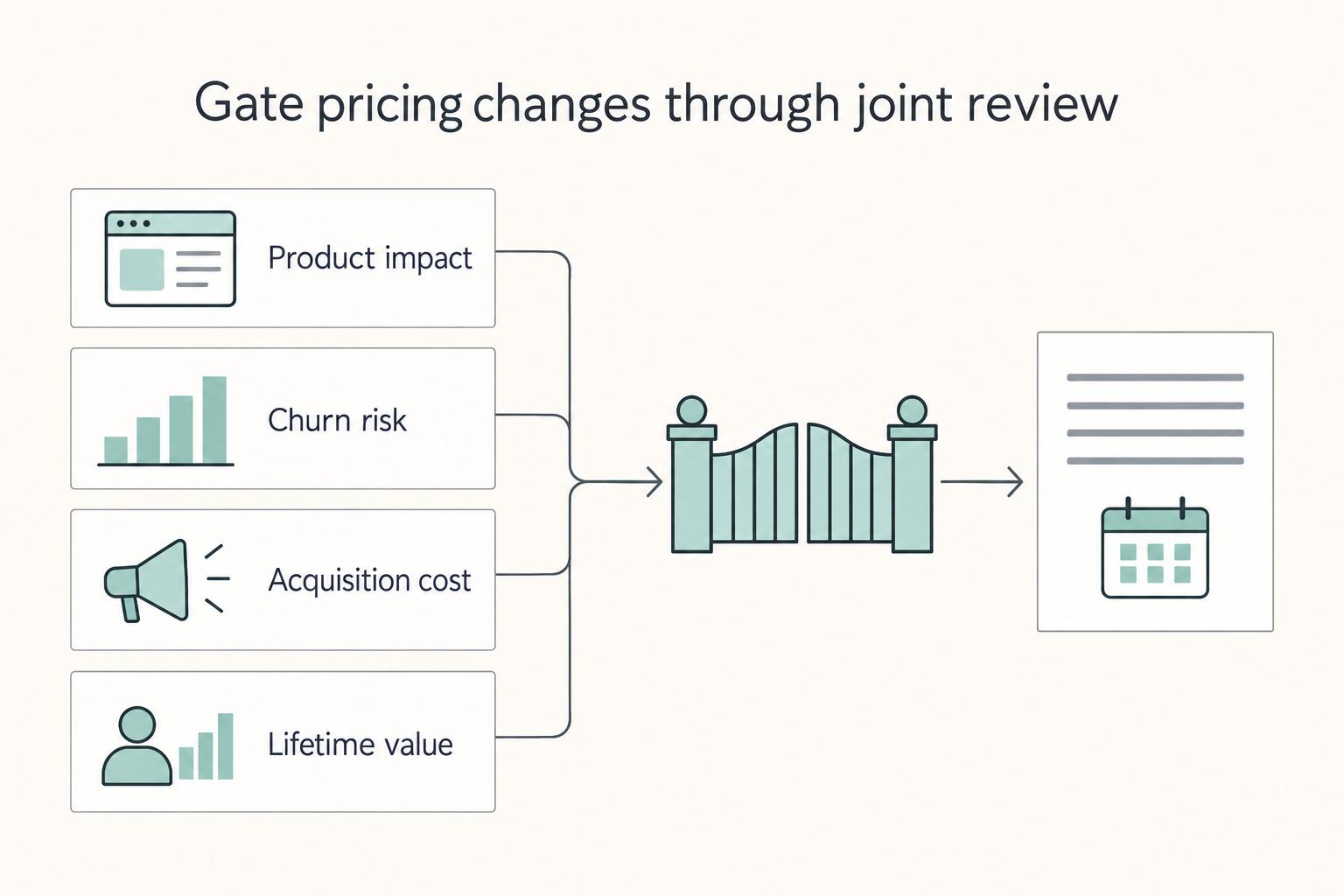
Recurring revenue is simple in principle: money your company receives on a regular basis. The trouble starts when clean definitions turn into messy decisions. Teams often track Monthly Recurring Revenue and Annual Recurring Revenue, but still make pricing, packaging, or customer-save calls without enough context.
SaaS Revenue Metrics Glossary for Platform Operators
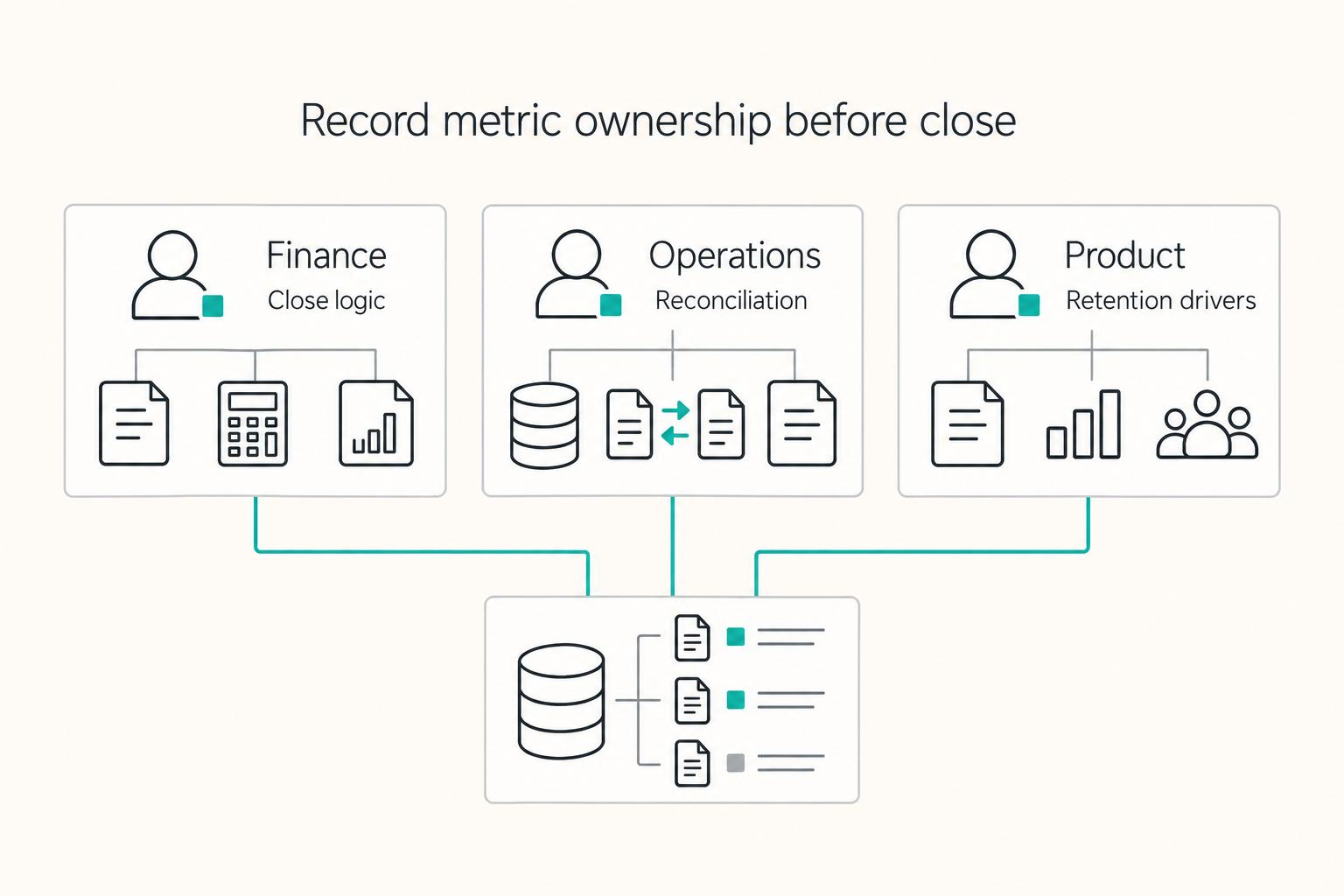
This glossary is for platform operators, not a generic SaaS KPI refresher. If your team owns the ledger, reconciliation, settlements, or payout execution, the real question is not what MRR or NRR means in theory. It is whether the number can be tied back to source records, period cutoffs, and settlement evidence before it reaches board reporting.
Subscription Revenue Forecasting for Platform Teams Modeling MRR Churn and Expansion
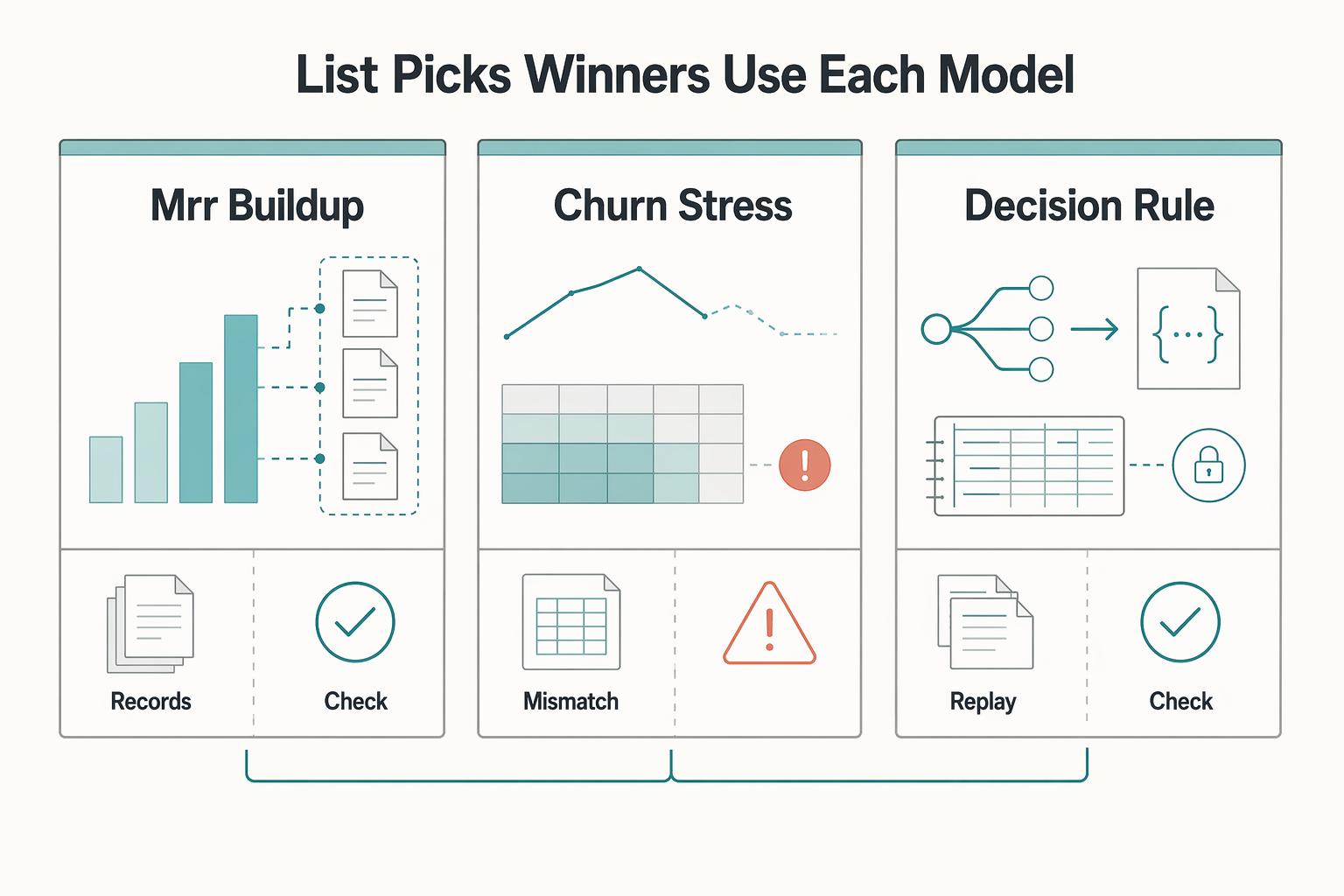
A usable forecast starts with shared definitions, not sharper formulas. If finance, ops, and product define MRR, Expansion MRR, or churn differently, the model can look precise and still fail the first serious review.