
Quick Answer
Start with one written definition for what enters Monthly Recurring Revenue (MRR) and Annual Recurring Revenue (ARR), then apply it every close. Exclude one-time fees, normalize annual contracts to monthly value, and treat ARR as MRR x 12 only after that base is clean. Next, review movement buckets like renewals, upgrades, downgrades, cancellations, and reactivations before changing pricing. Publish leadership numbers only after billing exports and Revenue Recognition (RevRec) outputs reconcile.
Using MRR, ARR, and churn to make pricing decisions#
Recurring revenue is simple in principle: money your company receives on a regular basis. The trouble starts when clean definitions turn into messy decisions. Teams often track Monthly Recurring Revenue and Annual Recurring Revenue, but still make pricing, packaging, or customer-save calls without enough context.
That is why this guide treats metrics as operating signals, not scoreboard ornaments. In SaaS, the core views are usually MRR and ARR, and each matters for a different reason. MRR shows the monthly pulse of the business. ARR puts that same engine into an annual frame. Used together, they give you a clearer read on short-term movement and longer-term impact.
The practical problem is rarely a missing dashboard. It is that the same headline number can hide different realities. A rise in the topline can come from multiple underlying changes, and without context it is easy to reward the wrong team, push the wrong plan, or mistake temporary lift for durable improvement.
This article is for founders, revenue leaders, product teams, and FP&A operators who need cleaner decisions, not more metric theater. You will get concrete guidance on what belongs in each metric and when MRR should lead instead of ARR. You will also see how to read movement instead of just totals, and how to connect those changes back to decision-making.
A few rules are worth stating up front. If a headline number cannot be tied back to a written inclusion policy, do not trust it for executive decisions. If monthly movement is unexplained, do not treat a flat or rising topline as proof that pricing worked. If MRR and ARR are pointing to different stories, pause before declaring a win. Those are not finance niceties. They are basic controls that keep product, revenue, and finance from solving different problems with different definitions.
If you want the short version, it is this: metrics like MRR and ARR only become useful when they are tied to a decision, checked against how your business actually bills, and read across short-term movement and long-term impact. The sections that follow turn that discipline into something you can use. For a broader metrics backdrop, read A Guide to Understanding Key Website Metrics (Bounce Rate.
Define the four metrics and what each one can decide#
Do not ask one metric to do every job. Use MRR for monthly operating decisions, use ARR for annual framing, and require written definitions before you rely on LTV or churn-rate comparisons.
| Metric | What it means in practice | Best used to decide | Red flag before you trust it |
|---|---|---|---|
| Monthly Recurring Revenue (MRR) | Monthly recurring revenue you can reliably expect. One common approach sums monthly-normalized subscription amounts currently being collected. | Near-term pricing and execution cadence | Normalize annual plans correctly ($1,200 annual contributes $100 monthly), and confirm whether your policy includes active and past_due subscriptions. |
| Annual Recurring Revenue (ARR) | Here, ARR is calculated as MRR × 12. | Annual planning horizon and longer-cycle visibility | If MRR policy is inconsistent, ARR multiplies that inconsistency by 12. Also define whether your team uses ARR narrowly (contract-length subscriptions) or broadly (recurring revenue). |
| Lifetime Value (LTV) | Confirm with the relevant authority. | Only use for spend decisions after your team documents a single formula and time window. | If teams use different LTV methods, comparisons are not reliable. |
| Churn Rate | This guide supports churn as an MRR movement driver (alongside new subscriptions, expansions, and contractions), but does not provide a churn-rate formula. | Loss diagnosis only after you define the exact churn metric in policy | Do not treat churn-rate outputs as comparable until denominator, scope, and window are explicitly defined. |
One operating rule is non-negotiable: MRR is not GAAP revenue. If billing, bookings, and MRR are blended, pricing and retention decisions will drift off a false baseline.
Set metric hygiene rules before you trust any dashboard#
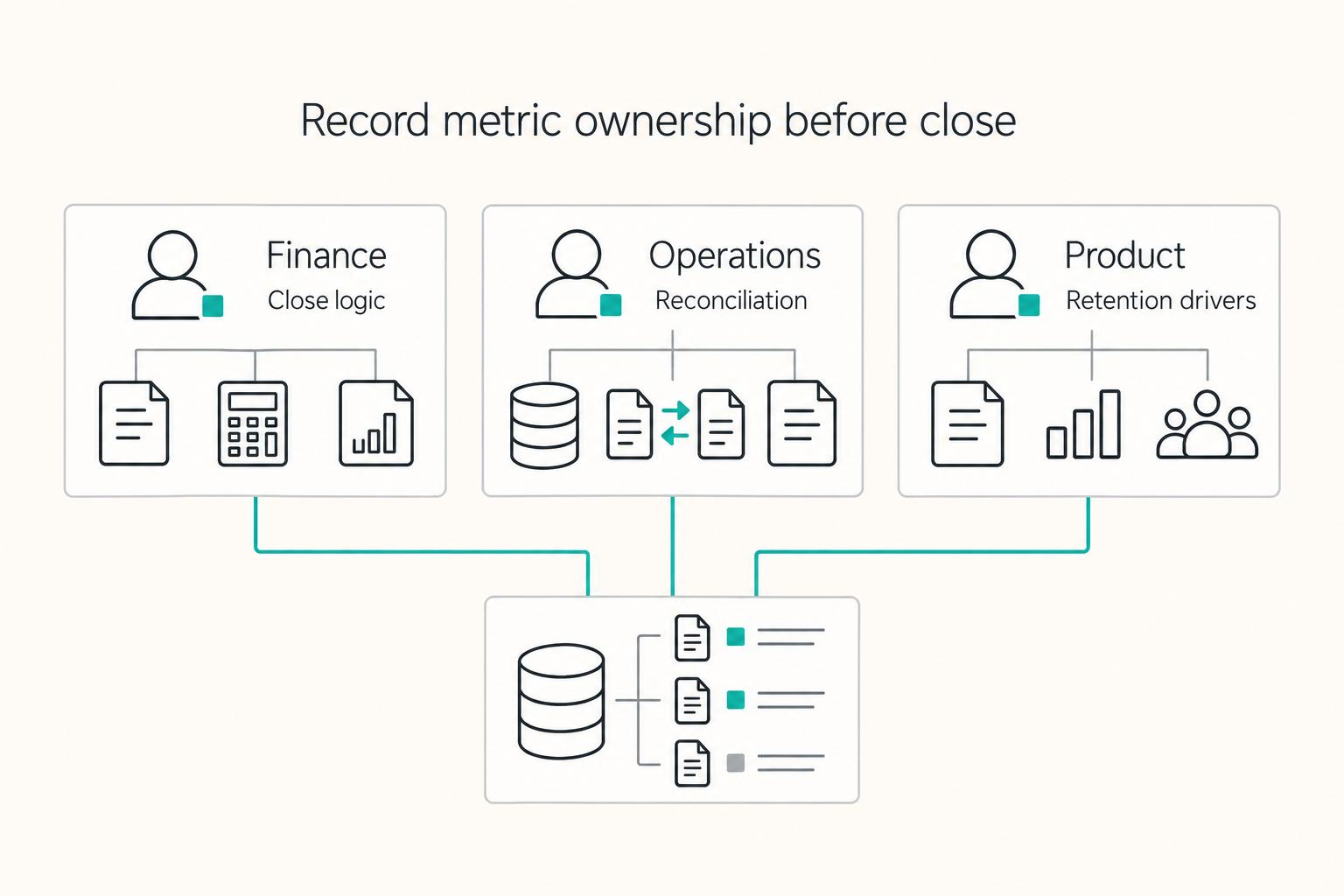
If your team cannot define the revenue base the same way, the dashboard is not ready for decisions. Write one policy for product, finance, and rev ops that defines what counts in MRR and ARR, and apply it consistently.
Start by separating Subscription Revenue from broader billing activity, then define which portion is treated as Recurring Revenue. The goal is not a universal formula. The goal is one internal standard everyone uses the same way each period.
Settle these points in the policy#
| Policy area | What to document | Red flag if left vague |
|---|---|---|
Subscription Revenue vs Recurring Revenue | What goes into MRR/ARR, and what stays out | Teams treat billings, recognized revenue, cash, and recurring revenue as interchangeable |
| One-time items | Explicitly exclude one-time fees and non-recurring add-ons unless your policy says otherwise | One-off activity gets read as recurring growth |
Discounts and Proration | How discounts and mid-cycle adjustments are reflected in reporting | Product, finance, and rev ops report different stories from the same period |
| Contract terms | How Monthly Subscriptions and Annual Subscriptions are mapped into one reporting logic | Annual contracts create timing spikes that distort trend reads |
Keep the operating rule simple: non-recurring items stay out unless your written policy explicitly includes them. For Discounts and Proration, consistency matters more than perfection on day one.
Add a pre-publish checkpoint#
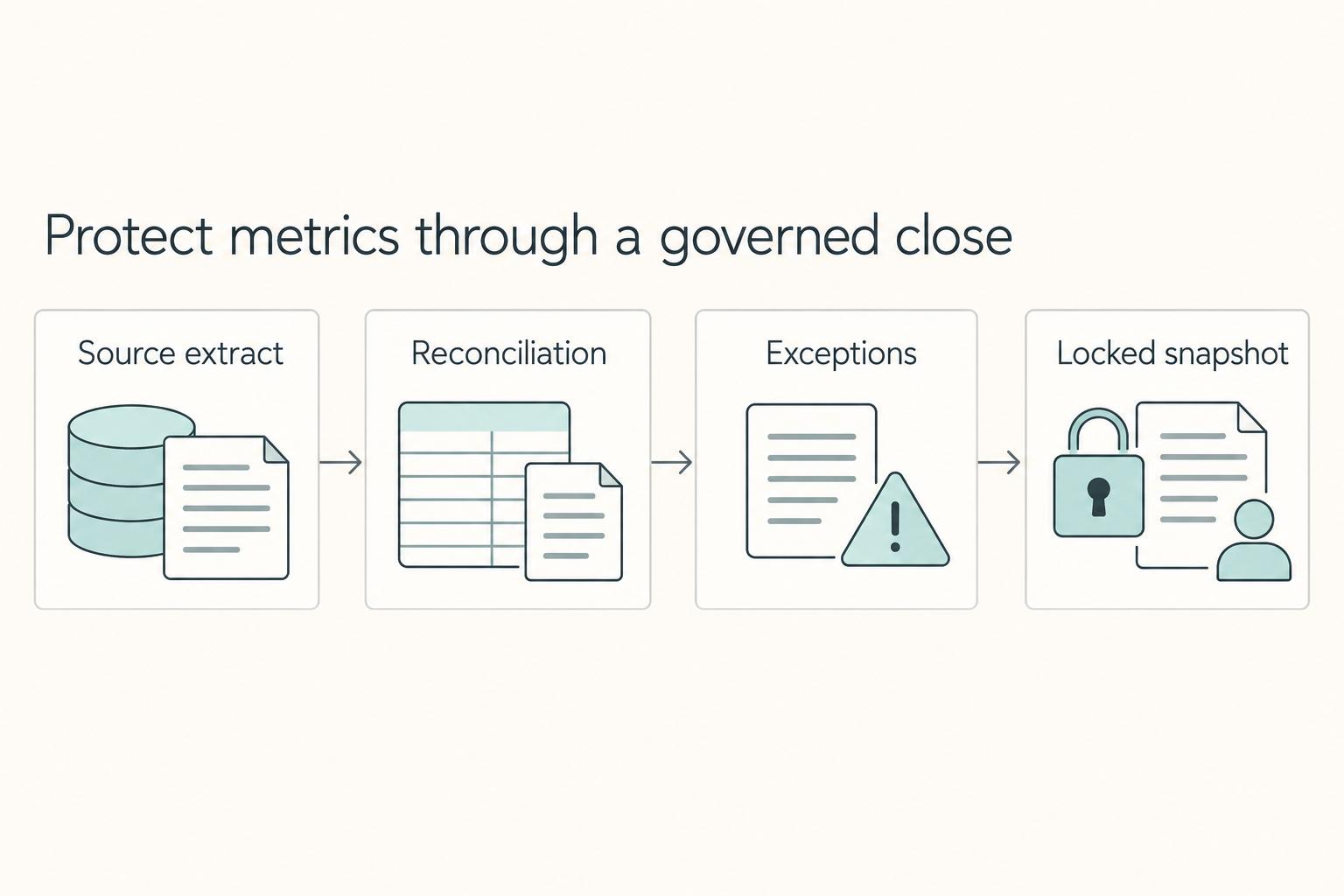
Before executive reporting goes out, reconcile the dashboard with billing exports and Revenue Recognition (RevRec) outputs. You are not forcing metric parity with recognized revenue; you are confirming that subscription populations, contract terms, and adjustments are explainable across both views.
If the variance is not clearly explainable, pause the story and resolve definitions first. More visibility without shared definitions and ownership usually slows decisions.
Read MRR movement like an operator not a vanity chart#
Once your definitions are fixed, treat MRR as a movement story, not a single topline number. Totals-only dashboards can hide tie-outs and early risk signals, which is how a stable month can still mask customer loss.
| Review view | What to check | Why it matters |
|---|---|---|
| Flat topline | If headline MRR is flat while downgrades or canceled subscriptions are rising, investigate retention before calling it a pricing win | Leakage through cancellations and failed payments can offset new or expansion revenue and make net performance look healthier than it is |
| Segment and plan tier | Do not rely on total ARPU alone; review movement by segment and plan tier | Shows whether stress is concentrated in specific packages, cohorts, or price points |
| Monthly movement bridge | Create one bridge from opening MRR to closing MRR with each movement category visible and no unexplained remainder | Every material change should be attributable before it becomes narrative |
Use a consistent internal movement split each month so every change is attributable, not guessed. Many teams track buckets such as new, reactivated subscriptions, customer renewals, upgrades, downgrades, and canceled subscriptions. The exact labels can vary, but the structure should stay stable across reviews.
Treat flat topline as a retention signal to test first#
If headline MRR is flat while downgrades or canceled subscriptions are rising, investigate retention before calling it a pricing win. In subscription models, leakage through cancellations and failed payments can offset new or expansion revenue and make net performance look healthier than it is.
Compare movement where risk is concentrated#
Do not rely on total ARPU alone. Review movement by segment and plan tier so you can see whether stress is concentrated in specific packages, cohorts, or price points. Keep segment and plan mappings consistent month to month, and tie bucket totals back to the same billing export used for close.
Build one monthly movement bridge for leadership#
Create one bridge artifact from opening MRR to closing MRR, with each movement category visible and no unexplained remainder. Keep the leadership view compact, then attach exceptions separately when needed. The operating standard is simple: every material change should be attributable before it becomes narrative.
Once movement is explainable, the next decision is which lens should lead: monthly or annual.
Decide when to steer by MRR and when ARR should lead#
Use Monthly Recurring Revenue (MRR) to run near-term execution, and use Annual Recurring Revenue (ARR) to frame annual planning. There is no universal switch point, so choose based on decision horizon: monthly adjustments versus yearly visibility.
MRR is the close-up lens for fast feedback on pricing, packaging, and customer behavior. This is usually the better lead metric when you ship changes frequently or need quick course correction.
ARR is the broader annual lens for long-range planning and investor conversations. If leadership plans in annual cycles or much of your base is on Annual Subscriptions, ARR should lead that discussion.
| Situation | Lead metric | What to check |
|---|---|---|
| Frequent pricing or packaging changes | MRR | Whether monthly movement reflects the expected impact quickly |
| Long-range planning and investor conversations | ARR | Whether the annual view is built from the same recurring base |
| Mix of Monthly Subscriptions and Annual Subscriptions | Both in parallel | Whether annual contracts are normalized to monthly value and one-time fees are excluded |
If ARR is annualized from MRR, keep the math and policy aligned: ARR = MRR x 12. When MRR and ARR tell different stories, reconcile inputs before building the narrative. Check contract-term mapping, confirm annual contracts were converted to monthly value, and verify one-time fees were excluded from both metrics.
A practical meeting rule: start execution reviews with MRR, then roll up to ARR for the longer-range view.
If you want a deeper dive, read SaaS Revenue Metrics Glossary: MRR ARR Churn NRR LTV CAC Explained for Platform Operators.
Connect MRR ARR churn to LTV and CAC before changing pricing#
Do not approve a pricing change on MRR or ARR movement alone. Check whether the change still improves unit economics after churn, cancellations, and downgrades, not just before them.
| Signal pattern | Likely read | Pricing or retention move |
|---|---|---|
| ARPU rises, Churn Rate stays stable, NRR holds or improves | Price capture may be working without clear customer damage | Expand carefully and keep monitoring core cohorts and plan-tier movement |
| ARPU rises, Churn Rate rises, NRR softens | Near-term lift may be hiding weaker fit or higher price sensitivity | Pause broad rollout and review canceled subscriptions and downgrades before expanding |
| ARPU is flat, Churn Rate falls, NRR improves | Revenue per account is unchanged, but retention quality may be improving | Strengthen packaging and value communication before another price move |
| ARPU rises in one segment while Contraction MRR also rises | Gains may be concentrated while other customers step down | Segment the change instead of applying one increase across the full base |
Use this as a decision aid, not a formula. A business can add customers and still shrink if churn outpaces acquisition, and pricing changes can follow the same pattern. If ARPU rises while Churned MRR and Contraction MRR rise too, treat it as a risk signal, not an automatic win.
Read the tradeoff in cohorts, not only in totals#
Start with the cohorts affected by the change: customers on new pricing, customers on legacy pricing, and customers with packaging changes. Compare ARPU, Churn Rate, and movement buckets for each group using the same recurring-revenue policy used in close. If top-line revenue rises but canceled subscriptions or downgrades rise in those cohorts, keep the decision open.
A practical review pack should include:
- cohort-level ARPU before and after the change
- Churned MRR and Contraction MRR for the same cohorts
- NRR direction by plan tier or segment
- projected LTV:CAC impact with written assumptions
Put an approval gate in front of major pricing changes#
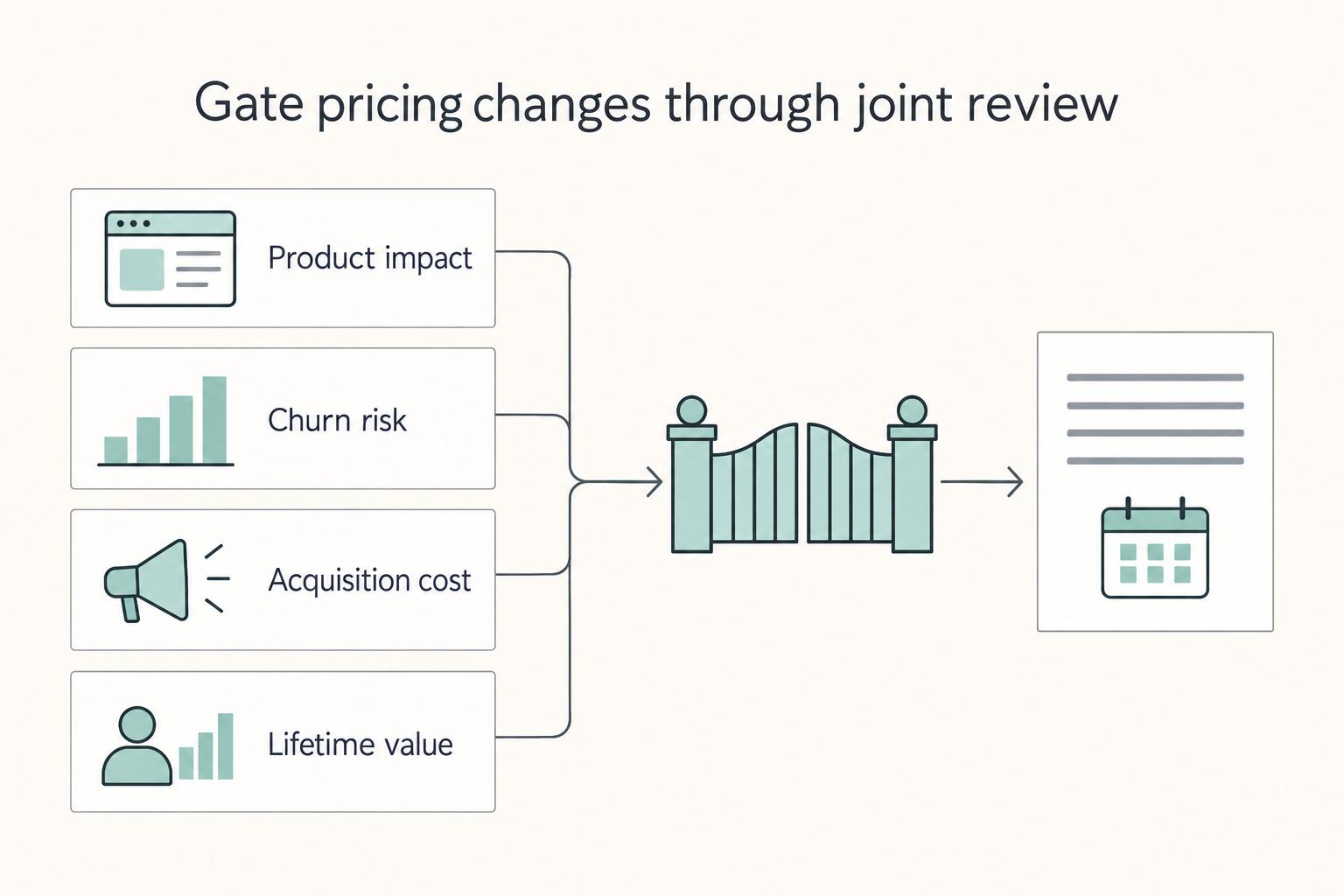
Require joint review by product, revenue, and FP&A before major pricing changes go live. The approval question is whether projected gains still hold after churn risk, acquisition efficiency, and lifetime value are considered together.
For a step-by-step walkthrough, see Choosing Between Subscription and Transaction Fees for Your Revenue Model.
Handle edge cases that quietly break recurring revenue reporting#
Make edge-case rules explicit at month close, or recurring-revenue volatility turns into reporting noise instead of a real business signal.
| Close-policy area | Rule or choice | Why consistency matters |
|---|---|---|
| Mid-cycle plan changes | Define whether the change lands in the current period by request date, invoice date, or effective date | Without that, changes can be mis-timed or double-counted |
| Cancellations | Use one cancellation timing rule: request date or effective end date | Apply the same rule in every period |
| Reactivated subscriptions | Keep reactivated subscriptions as a distinct movement category | Returning customers should not be treated as new in one month and reactivation in another |
| Proration, retroactive discounts, and reactivation logic | Do not assume your billing platform, BI model, and RevRec tool handle those cases the same way | Consistent handling keeps movement comparable across systems |
Start with effective dates on billing events. Stable customer counts can still hide meaningful revenue movement from plan changes, seat changes, expiring discounts, mid-period upgrades, and partial-period proration. Your close policy should define whether a mid-cycle plan change lands in the current period by request date, invoice date, or effective date; without that, changes can be mis-timed or double-counted.
Apply the same consistency to cancellations and returns. Use one cancellation timing rule (request date or effective end date) in every period, and keep reactivated subscriptions as a distinct movement category so returning customers are not treated as new in one month and reactivation in another.
Use a single close checkpoint:
- Tie each ARR or MRR movement to billing-detail changes at the invoice-line level.
- Reconcile the movement bridge with
Revenue Recognition (RevRec)outputs before publishing executive metrics. - Document where bookings and recognized revenue differ, because an ARR waterfall is not a GAAP revenue schedule.
A common failure mode is a manual spreadsheet that shows movement totals but loses lineage from customer-level changes to invoice-line changes. Do not assume your billing platform, BI model, and RevRec tool handle proration, retroactive Discounts, and reactivation logic the same way. Related: Subscription Revenue Forecasting: How Platforms Model MRR Growth Churn and Expansion.
Build a monthly FP&A review cadence teams actually use#
Use the monthly review as a decision gate. If inputs are not clean and definitions are not consistent, defer strategy calls until they are.
| Step | What happens | Order cue |
|---|---|---|
| Close billing inputs first | Finish the period inputs and log any exceptions | Start here |
| Validate metric hygiene | Confirm MRR, ARR, churn, and customer-movement categories still match your written rules | After inputs are closed |
| Publish the movement bridge | Show period movement across new business, renewals, Upgrades, Downgrades, cancellations, and reactivations | Before decision review |
| Run the FP&A decision review | Review pricing, retention actions, and spend only after the movement story is stable | Last step |
A practical cadence is:
- Close billing inputs first
Finish the period inputs and log any exceptions.
- Validate metric hygiene
Confirm MRR, ARR, churn, and customer-movement categories still match your written rules.
- Publish the movement bridge
Show period movement across new business, renewals, Upgrades, Downgrades, cancellations, and reactivations.
- Run the FP&A decision review
Review pricing, retention actions, and spend only after the movement story is stable.
Require one evidence pack every cycle#
Keep one pack per close that is short enough to read and strong enough to defend:
MRRandARRtrend with month-over-month movementChurn Rate,NRR, andLTV:CAC(if tracked in your operating model)- notes on renewals,
Upgrades, andDowngrades - variance commentary using one formula consistently, such as
Actual - Budget - materiality flags (for example, above $10,000 or 10%)
This keeps teams focused on meaningful variance instead of noise and makes decisions easier to trust.
Reforecast on a repeatable rhythm#
Forecasting reflects assumptions at a point in time. Reforecasting updates those assumptions with the latest forecast-versus-actual gaps, typically across the next 12-18 months. In volatile subscription models, that repeatable update cycle is what keeps plans decision-ready instead of stale.
Keep traceable artifacts for finance and ops#
Store an audit-ready trail for each cycle: the close inputs used, the published movement bridge, and any adjustment notes. Without traceability, teams can report KPIs but struggle to explain what changed and why, which weakens stakeholder trust.
Conclusion#
Do not pick a single hero metric. Manage subscription revenue by reading Monthly Recurring Revenue, Annual Recurring Revenue, CAC, CLTV, and churn as one connected decision set. Each answers a different part of the same question.
MRR is your near-term operating lens. Changes in MRR show which plans or packages are moving revenue month to month. ARR gives you the 12-month view for planning, resource allocation, and growth targets. CAC, CLTV, and churn are commonly reviewed alongside ARR to round out the business-health picture.
The practical takeaway is simple: definitions first, interpretation second, action third. If your metric policy is loose, downstream decisions get noisy. If movement is not decomposed into clear drivers, you can mistake a temporary lift for durable improvement.
You want one written metric policy that states what counts, what stays out, and how recurring revenue is defined consistently across teams. Then you want one monthly evidence pack that everyone sees before product, revenue, and finance debate strategy.
A useful evidence pack usually includes:
- MRR movement by plan or package, not just a total trend line
- ARR for the forward-looking planning view over the next 12 months
- churn trend plus CAC/CLTV review to inform major pricing or packaging decisions
- notes on unresolved definition or mapping gaps across reporting views
That last checkpoint is easy to skip when teams are moving fast. Do not approve a pricing narrative off a chart with unresolved reconciliation gaps. If one report says the base is improving but another tells a different story, stop and fix the definition or mapping issue before you call it growth.
If you implement only two things after reading this, make them these: one shared metric policy and one monthly evidence pack. That can be enough to get product, finance, and go-to-market teams working from the same economic truth instead of arguing from different versions of the same numbers. Related reading: Building Subscription Revenue on a Marketplace Without Billing Gaps. If you need help applying this to your own reporting setup, Talk to Gruv.
Frequently Asked Questions
What is the practical difference between `MRR` and `ARR` in day-to-day decisions?
Use MRR when you need fast operating feedback on recurring-revenue movement, including new or reactivated subscriptions. Use ARR when you need the 12-month view for planning and understanding longer-term impact. In practice, the two work best together because they show short-term movement and longer-term impact.
What should be excluded from `MRR` and `ARR` calculations?
Keep one-time or non-recurring fees out of both. A simple test helps: if the revenue is not predictable, stable, and likely to continue, it should not sit inside the recurring base. A common reporting mistake is letting non-recurring items inflate the trend.
Can a company with mostly `Annual Subscriptions` still manage weekly with `MRR`?
Yes, if you define a consistent monthly view of recurring subscription revenue and use it alongside ARR. That gives you a near-term operating signal while keeping the 12-month view in focus.
How do `Churn Rate` and `NRR` change how we interpret `ARR` growth?
Use caution here: specific churn or NRR methodology will depend on your own definitions. Treat ARR growth as directional, and pair it with a separate, clearly defined retention analysis before making strong conclusions.
When does a rising `ARPU` signal real progress versus hidden retention risk?
Treat ARPU as a directional signal and validate it against broader recurring-revenue movement before calling it durable progress.
How should we handle `Proration` and `Discounts` without distorting recurring revenue trends?
Keep your policy consistent and avoid letting non-recurring items distort MRR and ARR. Beyond excluding one-time or non-recurring fees, confirm detailed proration or discount accounting rules with your accountant or platform documentation. If you are still debating which view should lead in your operating meetings, ARR vs. MRR: Which Subscription Metric Matters More for Your Platform's Fundraising Story is a useful next read.
Try a related tool
Researched and edited by the Gruv editorial team. Gruv builds cross-border billing, payouts, and finance-operations software for global businesses.
Sources
Includes 4 external sources outside the trusted-domain allowlist.
- cs.princeton.edu/courses/archive/spring18/cos226/assignments/...trusted
- sec.gov/Archives/edgar/data/1353538/0001213900220253...trusted
- stripe.com/resources/more/how-to-use-monthly-recurring-...trusted
- support.stripe.com/questions/understanding-monthly-recurring-re...trusted
- durity.com/en-us/blog/revenue-dashboards-that-everyone-...external
- fincome.co/blog/how-to-master-reforecasting-in-saas-tim...external
- gatilab.com/saas-metrics-explained-mrr-arr-churn-ltv-and...external
- getmonetizely.com/articles/saas-pricing-metrics-101-arr-mrr-lt...external
Educational content only. Not legal, tax, or financial advice.
Related Posts
ARR vs MRR for Your Platform's Fundraising Story
For platform finance teams, the ARR versus MRR question in fundraising is less about which formula sounds cleaner and more about whether your numbers hold up when someone starts pulling at the thread. In many cases, you should lead with **Annual Recurring Revenue (ARR)**, then support it with clean **Monthly Recurring Revenue (MRR)** movement that ties back to the books.
SaaS Revenue Metrics Glossary for Platform Operators
This glossary is for platform operators, not a generic SaaS KPI refresher. If your team owns the ledger, reconciliation, settlements, or payout execution, the real question is not what MRR or NRR means in theory. It is whether the number can be tied back to source records, period cutoffs, and settlement evidence before it reaches board reporting.
Subscription Revenue Forecasting for Platform Teams Modeling MRR Churn and Expansion
A usable forecast starts with shared definitions, not sharper formulas. If finance, ops, and product define MRR, Expansion MRR, or churn differently, the model can look precise and still fail the first serious review.