
Quick Answer
To understand key website metrics, treat Bounce Rate, Time on Page, and Conversion Rate as a decision system, not isolated numbers. Build a simple funnel, pick one primary signal per stage, and run one small test at a time with clear ownership and review cadence. This gives you faster, lower-risk decisions than chasing more dashboards or broad rewrites.
You don't need "more marketing" - you need a decision system you can run in 30 minutes#
If your marketing decisions don't turn website metrics into a clear next action, you don't have a marketing strategy. You have noise. The goal here is not more concepts or another pile of tactics. It is a repeatable way to decide what to do next, quickly, even as a business-of-one or a tiny team.
Generic advice fails when operators need it most: at the moment of the next move. Analytics can show that something moved, but the dashboard will not tell you what to change, who owns the change, or when to check the result. That gap burns weeks.
The operator loop that makes metrics practical#
Treat every metric movement as a decision, not trivia. Keep a lightweight record of the decision you made and the one small change you are going to test so you stop debating metrics and start shipping.
Keep it tight:
- Make one small, reversible change at a time.
- Make ownership explicit.
- Set a specific moment to look again so "we'll revisit" does not turn into never.
Reality check (don't optimize in a vacuum)#
Your site does not exist in isolation. Before you "optimize" a page, make sure the end-to-end path actually works for the audience you're sending and the offer you're making. Otherwise you can spend a week polishing copy on top of a broken flow.
In practice, if you see strong traffic and weak conversions, your first instinct might be to rewrite the landing page. Before you touch copy, verify that the path to completion works as expected. Then change one thing, not ten.
Marketing, Sales, and Website Metrics: the non-negotiable definitions (without the fluff)#
Use working definitions so your metrics translate into decisions you can ship. Without them, you either fly blind or stare at numbers that do not change what you do next.
Ad metrics vs. ad measurement: stop collecting, start deciding#
Ad metrics are the signals that tell you whether campaigns are healthy, drifting, or broken. Ad measurement is what you do next: turning the numbers you collect into practical insights you can actually use to improve results.
| Concept | What it is | What it's for (operator view) |
|---|---|---|
| Ad metrics | The signs that show campaign health | Spot what's working, what's drifting, and what's broken |
| Ad measurement | Turning metric data into practical insights | Make changes that improve results, not just reporting |
Demand generation metrics: the compass through the sales cycle#
Use demand generation metrics to see whether your activities are moving prospects through the sales cycle toward becoming marketing qualified leads and, in the end, customers.
Operator move: pick a small set of metrics you will actually use to make decisions, then use them to diagnose where momentum is building or stalling and what you will change next.
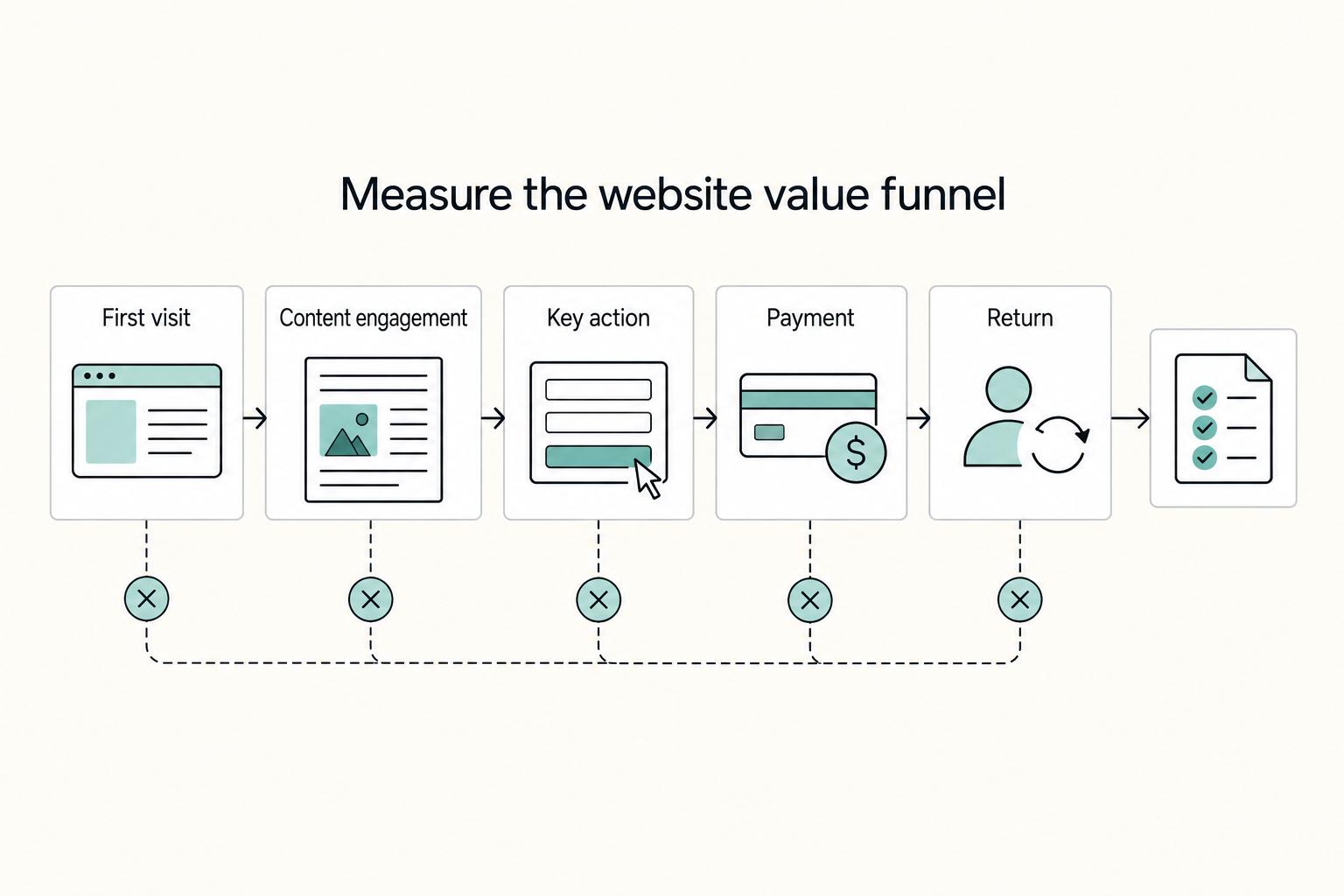
The mental model: build a value-funnel you can measure end-to-end (before you optimize anything)#
Build a measurable funnel first, then use key website and revenue signals to find where to intervene. Definitions are only useful if they connect to a real business outcome. Otherwise you will tweak headlines, buttons, and pages without a clear answer to "did this move us toward money?"
Start by writing your funnel stages in plain language, from first touch to repeat business. Keep it simple enough that a contractor can follow it. For each stage, choose one primary success signal you can reliably observe in your analytics and systems (or your payment stack), and treat everything else as supporting evidence. An operator-friendly template looks like this:
| Funnel stage (your words) | The question you need answered | Primary signal (example) | Where you check it |
|---|---|---|---|
| First visit | Did we attract the right intent? | Bounce Rate (directional) | Your analytics landing page views |
| Content engagement | Did they actually consume the page? | Time on Page (directional) | Your analytics page views (and any engagement tracking you have) |
| Key action | Did they take the next step? | Conversion Rate for the action | Your conversion/event tracking |
| Payment | Did intent turn into cash successfully? | Payment success rate | Checkout and payment provider logs |
| Return | Do good customers come back? | Repeat actions | Analytics plus product/CRM billing records |
Pick a "source of truth" you can audit#
A weekly dashboard gives you visibility. A one-page decision log gives you control. Use both.
| Decision log field | What to record |
|---|---|
| Date | When the change happened |
| Change shipped | One change only |
| Expected impact | Which signal should move |
| Observed impact | After the review window |
| Next decision | Keep, revert, iterate |
Keep the decision log brutally simple, and keep it consistent:
- Date
- Change shipped (one change only)
- Expected impact (which signal should move)
- Observed impact (after the review window)
- Next decision (keep, revert, iterate)
This keeps you audit-ready when you operate across time zones, tools, and contractors. You can point to what changed, when, and why.
Connect activity to money with an observable chain#
Treat every push as a traceable chain: channel → landing page → key action → payment outcome. If you cannot observe the chain end-to-end, you cannot optimize. You can only guess.
Instrumentation supports this. In your analytics, when enabled, track events you actually use in decisions, like scroll, click-to-email, book-call, and checkout-start. These add context to top-line page metrics so you can see what happened next.
Example: you run a partnership promo and see traffic spike. Instead of celebrating visits, you verify which landing page those visitors hit, whether they triggered your book-call event, and whether payments succeeded after the call. Now you can scale the partner that drives paid outcomes, not just clicks. If you need a concrete acquisition-to-action path, pair this with a waitlist flow: How to Build a Waitlist for Your SaaS Product Launch.
What should a basic marketing plan include (for a tiny, global team)?#
A basic marketing plan should clearly state who your customers are, how they will buy (or hire your services), and why. It should also show what you offer and which distribution channels you will use, so your team stays focused on the right work instead of chasing everything.
The five blocks to write (keep it tight, keep it usable)#
FedDev Ontario puts it plainly: "Your marketing plan is an essential part of your overall business." Treat it like an operating doc, not a slide deck.
- Target market (tight ICP): Write who the customer is, where they operate, what they are trying to accomplish, and how they buy (and why). FedDev Ontario explicitly calls out that a sound plan should "outline who your customers are, how they will buy your product or hire your services and why." If there are real-world constraints that affect who you can serve, note them so you do not market to people you cannot support.
- Competitive advantage (one clear sentence): Write one sentence that communicates the attributes of your product or service and why someone should choose you instead of the next credible option. Skip clever. Write a claim you can actually validate in the market.
- Offer (what you do, what you do not): Define what the customer gets in plain language and what you will not do, so the buying process is easier to understand. If you use a marketing mix framework like the "7 Ps," this is where your offer details fit.
- Channel plan + capacity: Pick 1 to 2 channels you can execute consistently. FedDev Ontario calls out establishing distribution channels, and Business Queensland notes that strategy and planning helps you focus your time and budget on the right marketing programs to reach goals. Consistency beats variety.
- Action plan (owners, resources, check-ins): Assign an owner to each action, note the resources you are willing to spend, and define how you will tell if it is working. FedDev Ontario also advises: "Revisit your marketing plan on a regular basis to keep it current."
| Plan component | What you write (one sentence) | "We'll know it worked if..." (example signal) |
|---|---|---|
| Target market | Who, where, job-to-be-done, how they buy, and why | More conversations, leads, or sales from the customers you actually want |
| Advantage | Why choose you (your key attributes) | Prospects repeat your positioning back to you, and objections drop |
| Offer | What they get and what you do not do | Fewer confused inquiries, faster decisions |
| Channels | Where you show up (distribution channels) | More responses or inbound from the chosen channels |
| Actions | Owner, resources, simple success check | Visible progress on the one outcome you picked |
In practice, you might sell a simple service globally, but practical constraints mean not every interested buyer can complete a purchase. Write that into the ICP and channel plan. Then stop investing effort in audiences that cannot realistically buy in the first place. If Product Hunt sits on your short list, use a plan, not vibes: A Guide to Launching on Product Hunt.
Which website metrics actually matter for your next decision?#
A small, consistent scoreboard is usually enough to drive your next decision. You do not need more metrics. You need a tight set that reliably points to what to check next, so you can make one clear, reversible change.
Optimizely puts the category in plain language: "Website metrics are data points that help you gauge the effectiveness of your website strategy." Treat them like a scorecard for decisions, not trivia. BenchmarkEmail adds the operator warning label: "Tracking more metrics doesn't equal better marketing." If you have limited time, extra metrics usually create extra opinions, not extra clarity.
The 3-metric scoreboard (and how to use it)#
Use these as decision prompts, not as universal truths. A common trio is Bounce Rate, Time on Page, and Conversion Rate.
| Metric | What it can signal | Caution in the article |
|---|---|---|
| Bounce Rate | "wrong visitor" or "page friction" | It can mislead when someone gets what they need from one page and leaves |
| Time on Page | attention and comprehension | It can inflate when someone leaves a tab open |
| Conversion Rate | whether they take the next step | It can drop even when the page and offer work if extra verification, tax forms, or payment confirmation steps are involved |
When one moves, or refuses to move, do not jump straight to conclusions. Pick one hypothesis, inspect what you can, then run one change you can undo.
Example: you rewrite a services page for a global audience. Bounce Rate drops, Time on Page rises, but Conversion Rate stays flat. Instead of rewriting again, shift your attention to the step you actually want people to take and what happens immediately before and after it.
Keep the metrics decision-grade (so you do not fool yourself)#
Vanity metrics pile up fast: "Open rates. Clicks. Impressions. Follower counts." Keep those in a separate tab. For website decisions, do this instead:
- Segment before you decide. Compare like with like, rather than relying on one blended site-wide average.
- Validate your definitions. Confirm what your setup counts as an interaction or conversion so you do not optimize against a measurement artifact.
- Tie the metric to the outcome. Track the downstream result you actually want, not just the on-site step that is easiest to measure.
Capture a snapshot, form one diagnosis, ship one reversible change, then review#
Capture a consistent snapshot, form one diagnosis, ship one reversible change, assign an owner, then review on a fixed rhythm. This is the practical version of the scoreboard. No "optimize everything" chaos.
Altior & Co defines the standard you're aiming for: "Marketing analytics is the system that connects every single thing your marketing team does to a real business outcome." Treat your website the same way. If you cannot connect a change to an outcome, you did not run analytics. You collected trivia.
Step 1: Build a decision log (your snapshot plus context)#
Pick a consistent review window, for example a recent period that matches your traffic volume, and focus on a small set of high-impact pages, typically your main landing and offer pages. Record a small set of key metrics you will actually act on, plus enough context to make the data usable later. A simple sheet with columns like this is enough:
| Field | What to write | Why it matters |
|---|---|---|
| Page + segment | URL, device type, and traffic source | Prevents blended averages from lying |
| Key metric(s) | The readings you will act on | Keeps you anchored to outcomes, not noise |
| Diagnosis (hypothesis) | One sentence: "I think X happens because Y" | Forces a testable claim |
| One change | The smallest edit you can revert | Protects learning speed |
| Owner + verification | Who ships, who confirms measurement | Removes ambiguity |
| Review date + decision | Keep / revert / iterate | Prevents endless tinkering |
Step 2 to 5: Diagnose, act, assign, review (without breaking measurement)#
Treat metric movement as a triage prompt, not truth. A spike, dip, or stall can reflect anything from the page itself to the way traffic is arriving to how clean your measurement is. Write the hypothesis anyway, then ship one change that specifically tests it: headline, CTA copy, pricing clarity block, proof, or a short FAQ.
Prospeo captures the operator mindset: outbound "gets easy once you stop treating it like 'messaging' and start treating it like a system." Your website works the same way. And the warning carries over in spirit too: teams lose weeks when the underlying system is unreliable.
Example: you see an engagement signal holding steady but conversions staying flat on a core service page. Instead of rewriting the whole page, you add a tighter CTA and a simple "what happens next" section, then you confirm your measurement is behaving as expected. One test. One owner. One review.
Running marketing across borders: constraints that change your metrics (and how to stay in control)#
Treat cross-border compliance, tax, and payout steps as funnel constraints and track them as separate stages. If you run the metric → diagnosis → action loop and still feel like marketing is not working, check for bottlenecks in post-click steps like verification, tax workflows, or payment settlement, where applicable. Stay in control by measuring intent separately from money movement.
Separate "intent conversion" from "payment success"#
When you sell across borders, your funnel can add steps after the click that your website metrics do not naturally capture, for example extra verification, tax forms, or payment confirmation steps. If you only track "Purchase" or "Paid invoice," your Conversion Rate can drop even when the page and offer work. Use a safe default split like this:
| Stage | What it means | What you track | What you do when it drops |
|---|---|---|---|
| Intent conversion | Buyer commits to try to pay | Checkout start, invoice created, "place order" click | Fix page clarity, CTA, pricing, form friction |
| Payment success | Payment completes successfully | Payment succeeded, funds received | Audit payment steps, requirements, support workflow |
| Exception rate | A subset fails or stalls | Failed, reversed, returned, timed out | Build a playbook for retries and manual resolution |
Example: a buyer reaches your checkout reliably, which means strong intent conversion, but payment success lags for a subset of buyers. You do not rewrite the landing page. You add a "What you'll need to complete payment" block, and you add an ops alert for stalled transactions.
Where rules vary (and how to confirm safely)#
Cross-border operations touch tax and identity rules that can change by jurisdiction and by provider policy. Do not learn compliance from a blog post. Create a verification checklist and confirm requirements with official sources or a qualified advisor for items like VAT, W-8, W-9, 1099, and FBAR (FinCEN Form 114).
| Item | How to handle it | Article detail |
|---|---|---|
| VAT | Confirm requirements with official sources or a qualified advisor | Rules can change by jurisdiction and by provider policy |
| W-8 | Confirm requirements with official sources or a qualified advisor | Rules can change by jurisdiction and by provider policy |
| W-9 | Confirm requirements with official sources or a qualified advisor | Rules can change by jurisdiction and by provider policy |
| 1099 | Confirm requirements with official sources or a qualified advisor | Rules can change by jurisdiction and by provider policy |
| FBAR (FinCEN Form 114) | Confirm requirements with official sources or a qualified advisor | Rules can change by jurisdiction and by provider policy |
| FEIE | Treat FEIE as a compliance workflow, not trivia | Physical presence test: at least 330 full days during any 12 consecutive months; max FEIE: $130,000 for 2025 and $132,900 for 2026 |
If you operate as a U.S. taxpayer abroad, also treat FEIE as a compliance workflow, not trivia. The IRS notes that the physical presence test is based only on how long you stay abroad and describes it as being physically present in a foreign country or countries for at least 330 full days during any 12 consecutive months. To claim the foreign earned income exclusion, you must still file a U.S. tax return reporting the income. The IRS lists the maximum FEIE as $130,000 for tax year 2025 and $132,900 for tax year 2026 (per qualifying person).
Operating model choices (evaluate against your funnel):
- Pick a model your team can actually run: document who owns tax, reporting, customer support, and exception handling.
- Treat payment and payout exceptions, including fails, returns, mismatches, and delays, as first-class funnel events so growth does not create ops chaos.
If you plan to localize offers or expand countries, read A Guide to Internationalizing and Localizing Your SaaS Product and add each new market as a tracked segment, not a guess.
Conclusion: your "do-this-next" checklist (and the safe default to keep you moving)#
Run marketing like ops: use a measurable funnel and a small set of key website metrics. Make one deliberate change at a time so you can learn without creating unnecessary risk. What matters now is execution you can audit. Specificity keeps you out of guess-and-hope mode. As coach Anne Taylor puts it: "Without specificity, leaders are left to guess what to change."
A simple weekly cadence (use as a starting template)#
Treat this as an operating pattern, not a doctrine: pick a clear funnel, choose a short list of metrics, and keep your changes small enough to evaluate. Weekly planning can reduce overwhelm and decision fatigue, and a simple accountability loop can improve follow-through. You do not need a bigger spreadsheet. You need a tighter loop. A lightweight decision-note format looks like this:
| Field | What you write (plain language) |
|---|---|
| Funnel stage | Land, Understand, Trust, Act, Pay, Retain |
| Page / step | The single page or step you touch this week |
| Hypothesis | "If we change X, we expect Y because Z" |
| Change shipped | What you actually changed |
| Where to look | The report view(s) you plan to check |
| Decision | Keep, revert, iterate (and what you'll do next) |
This week's checklist (copy/paste)#
- Sanity-check your analytics setup so your metrics stay comparable week to week.
- Pick one page or step. Write one hypothesis tied to the next action you care about.
- Make one small change you can undo if needed. Record what you changed in your notes.
- Review results with the same lens each time. Make a clean call: keep / revert / iterate.
- If you operate across borders, factor in that payment and compliance steps can add friction, and requirements can vary by market.
Example: you see strong interest, but commitments lag at a specific step. You do not redesign the site. You adjust the CTA block, log it, and re-check next week.
If you're launching soon, connect planning to execution with one focused asset like How to Build a Waitlist for Your SaaS Product Launch.
Frequently Asked Questions
What is marketing in plain terms (and what outcome should it drive)?
Marketing is the system that gets the right people to notice you, understand you, trust you, and take the next step. Done well, it can increase digital traffic, help generate sales, and grow your customer base, not just attention. WayPoint Marketing Communications puts it simply: “marketing supports their brand and drives sales.” If you cannot tie your work to a measurable next action, you are running vibes, not marketing.
What should a basic marketing plan include if I’m a solo operator or tiny team?
Keep it lean: define who you help (ICP), what you sell (offer), why you (positioning), where you show up (1 to 2 channels), and how you measure (key website metrics). Add one operating rule: every activity needs an owner, a weekly cadence, and a “we’ll know it worked if…” metric. You do not need a deck. You need a one-page plan you can execute without negotiation.
How is marketing different from sales, and where is the handoff on my website?
Marketing creates intent and trust. Sales converts that intent into a commitment (booked call, checkout started, invoice paid). On your website, the handoff lives at your primary CTA (book, buy, start trial, request quote). Treat everything before the CTA as marketing, and everything after it as sales execution plus operations.
How do I measure whether marketing is working on my website using Google Analytics?
In your web analytics (including Google Analytics), measure marketing by whether the people you attract complete the next meaningful action, not by raw traffic. Pick one primary conversion (for example: submit form, book call, checkout start) and review it alongside landing pages and traffic sources. Then segment. A sitewide average hides the truth.
What do Bounce Rate and Time on Page actually tell me (and when are they misleading)?
Bounce Rate can signal “wrong visitor” or “page friction,” but it can also mislead when someone gets what they need from one page and leaves. Time on Page can signal attention and comprehension, but it can inflate when someone leaves a tab open. Use both as diagnostic signals, then validate with downstream actions like CTA clicks or form starts.
What’s a practical way to prioritize marketing with limited budget and time?
Fix the biggest bottleneck closest to revenue first (usually your top landing page and your primary CTA flow). Run one weekly experiment (headline, offer clarity, proof, CTA) and keep a decision log so you know what caused what. If you need a focused way to capture demand fast, build a simple list and pipeline using How to Build a Waitlist for Your SaaS Product Launch.
Try a related tool
Researched and edited by the Gruv editorial team. Gruv builds cross-border billing, payouts, and finance-operations software for global businesses.
Sources
Educational content only. Not legal, tax, or financial advice.
Related Posts
How to Build a Waitlist for Your SaaS Product Launch
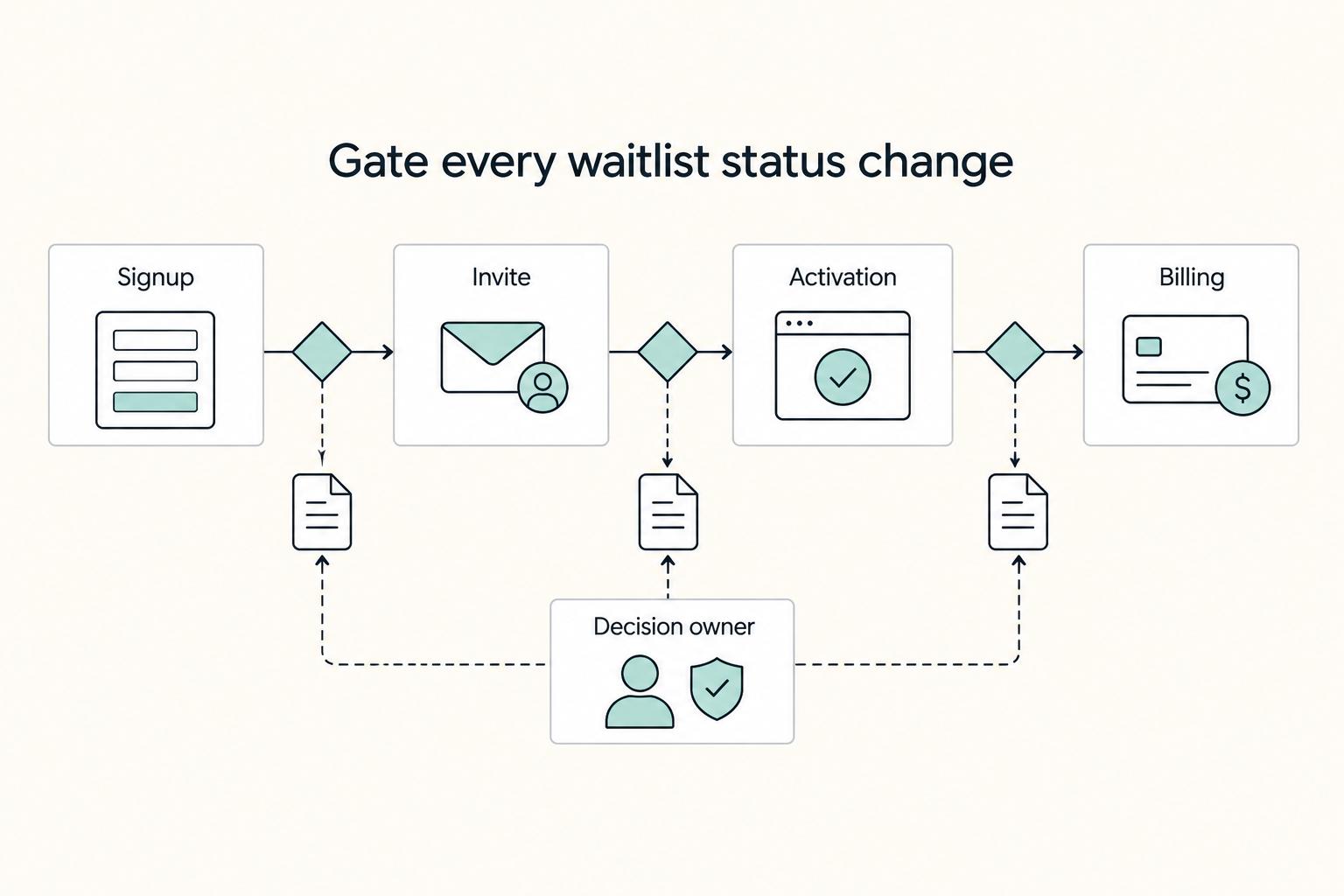
Your waitlist should lower launch risk, not create cleanup work the week you open access. Treat your waitlist as a control layer for readiness: who signs up, what intent they show, what promise they heard, and what has to be true before you invite the next group.

How to Launch on Product Hunt
You will get more from a Product Hunt launch if you treat it as a repeatable set of decisions, not a one-day bet on rank. Judge success by qualified demand, feedback quality, and what happens next: signups, demos, onboarding fixes, and product changes you can act on.

SaaS Internationalization for Teams That Need Launch Control
**You do not get orderly global growth by translating strings faster. You get it by treating saas internationalization as an operating discipline with named owners, launch gates, and documented stop conditions.** This tends to become true once you move past 1-2 languages or start shipping weekly updates across multiple markets. At that point, localization behaves more like infrastructure: invisible when it works and expensive when you ignore it.