
Quick Answer
Define the recipient obligation and funding owner first. Compare eligible routes on net receipt, arrival estimate, reviews and finance references. Choose additional providers only when their route benefit justifies managing separate balances and recoveries; resolve an unknown submitted payout before replacing it.
How platforms evaluate international EFT options#
If you are choosing a provider for cross-border EFT, start with route evidence, not country-count slides. Cross-border payments are more complex than domestic ones: they are often slower, less transparent, and more expensive. Broad coverage on paper may not reflect performance in your real corridors or exception paths.
Electronic fund transfer, or EFT, means money moved electronically between accounts. SWIFT carries financial messages; correspondent banks or other settlement arrangements move the money. Local rails may deliver the final domestic leg. A fast local leg does not make the whole cross-border route instant.
For euro payments, SEPA Instant Credit Transfer makes funds available within ten seconds on a successful supported transfer. That clock is different from the time your platform spends funding an account, converting currency or clearing a review. Compare the entire route from approved obligation to recipient availability before promising a payout date.
Product, engineering and finance have different reasons to care about the same route. Product needs a credible arrival estimate, engineering needs recoverable requests and events, and finance needs to explain the money at close. Use one shared route sheet so those decisions fit together.
Use this guide as both a buying document and a launch document. If a provider cannot show route-level evidence for your top corridors, explain cut-off behavior clearly, or trace a payout from request to final status, treat that as a red flag before contract signature.
Who this list is for and how to use it#
Use this list if you are choosing a programmable cross-border payout setup for repeat payouts, rather than a one-off transfer process.
- Best fit: recurring, multi-recipient payouts
This guide fits recurring, multi-recipient bank payouts with API submission, status updates and exception handling. Batch size is a product-specific limit; compare both batch and item-level responses so one rejected recipient does not obscure the others.
- Less useful: low-volume, manual operations
If finance sends occasional cross-border payments without product integration, customer-facing payout status, or deeper reconciliation controls, simpler bank-transfer tooling may be enough. The tradeoff can be lower operational control once tracking, returns, and internal reference mapping start to matter.
- Use order: payout job first, provider second
Define who owes the recipient, whose money funds the payout, which entity submits it, and where currency conversion occurs. Then map onboarding and screening duties to the actual regulated service and provider relationship. A platform paying its own contractors has a different funding model from a marketplace disbursing money owed by sellers.
- Cross-functional decision discipline
If product, engineering, and finance all approve the vendor, use one shared scorecard before signature so gaps show up early. Include integration evidence (API behavior, webhook events, retry handling), finance evidence (reconciliation outputs, return states), and compliance evidence (KYB/AML review paths and records). That can reduce split approvals where one team signs off and another later finds a launch blocker. Related: How to Pay US-Based Contractors from Australia.
What international EFT actually means in platform operations#
In platform operations, EFT means electronically initiated bank-account debits or credits, not a guaranteed speed or delivery outcome. It tells you how money moves, not how fast it will arrive.
- EFT describes the transfer method, not performance
"Electronic Funds Transfer" covers electronically initiated account-to-account movement. In cross-border workflows, that can involve rails such as SWIFT, SEPA, Faster Payments, RTP, BECS, or other local bank-transfer schemes, but the label alone does not tell you timing or receiving-account availability.
- Name the rail, because each rail behaves differently
SWIFT is a cross-border financial messaging network. SEPA supports cashless euro payments across EU countries and beyond. RTP is U.S. real-time infrastructure, Faster Payments is a UK near-instant system, and BECS supports bulk electronic debit and credit instructions in Australia.
- Treat "real-time" as corridor-specific and participant-specific
UK Faster Payments and SEPA Instant can shorten the domestic leg where the provider and recipient account support them. The provider may impose its own limits, reviews and funding conditions. Record those alongside the scheme name; recipient availability is the result your users care about.
- Use corridor evidence before you promise delivery windows
Cross-border payments still face known frictions around cost, speed, access, and transparency. For platform decisions, require route-level confirmation by corridor and receiving-bank access instead of broad "global" timing claims.
Once you are clear on what EFT does and does not guarantee, you can compare providers on the things that actually affect launch and operations. You might also find this useful: What is a Virtual IBAN and How Do Platforms Use It to Collect Payments Globally?.
Compare your options quickly before deep vendor calls#
Use one evidence-based scorecard before vendor calls, and make every provider fill in the same rows. If the sheet does not name your real corridors, controls, and close outputs, "global coverage" is still a marketing claim.
Score proof, not promises. Use this as a first-pass filter, then ask each vendor for route notes, API docs, sample webhooks, compliance workflow steps, and reconciliation exports.
| Route question | What to record | Why it changes the decision |
|---|---|---|
| Sender and recipient | Entity, country, currency, account type and supported payment purpose | A supported destination does not prove the payer or business model is eligible. |
| Funding | Source account owner, available balance, prefunding and settlement schedule | Merchant receipts and contractor funding are separate unless the chosen product explicitly connects them. |
| Execution | Cross-border leg, FX booking and final domestic rail | A domestic instant rail covers only its own leg. |
| Cost and delivery | Same send amount, net receipt, fee bearer, FX rate, cut-off and arrival estimate | Compare equivalent recipient outcomes, not just the advertised transfer fee. |
| Recovery | Unknown, rejected, held, credited and returned states; lookup references | A route change must not create a second payment while the first is unresolved. |
| Finance | Obligation ID, attempt ID, provider reference, fees and bank/report lines | Finance must account for actual movement, including later returns. |
- Corridor and rail fit
Start with the corridors your own recipients use. Treat U.S.-to-UK and UK-to-U.S. as separate rows: funding currencies, account eligibility and available rails can differ by direction. Do the same for Australia and India rather than assuming a bidirectional coverage badge describes both flows.
- Operational reliability
Compare recovery as closely as coverage. Ask which create operations accept idempotency keys, how long protection lasts, what parameters belong to the original request and how to look up an uncertain submission. A provider that can deliver a happy-path payout but cannot recover an unknown result creates a duplicate-payment risk.
- Compliance triggers and evidence
Record which regulated entity performs identity, business and sanctions checks, the events that trigger review, and who can release a lawful hold. Keep retention rules attached to the applicable obligation and record type. A vendor onboarding checklist is not proof that every platform has the same regulatory duties.
- FX handling and finance close
Separate an indicative rate from an executable quote. Record quote expiry, the amount and currency fixed by the quote, fees, and the execution reference that confirms conversion. At close, join the obligation and money movements using the actual product references rather than assuming a universal settlement export.
Once the scorecard is complete, the next question is structural: do you want one stack, a modular setup, or something in between?
Best international EFT platform models by use case#
Choose the model that puts complexity where your team can operate it well. Fewer vendors give you one control surface. Modular routing gives you more room to optimize corridor performance and fallback behavior.
| Payout architecture | Useful when | Ownership tradeoff |
|---|---|---|
| Single provider | One provider supports the required funding model and initial corridors | Fewer integrations and report formats, with concentration and outage exposure. |
| Modular providers | A second provider adds a needed route or a measurable cost/service benefit | Your team owns obligation-level duplicate prevention, funding allocation and multiple reconciliations. |
| Regional first | Recipients are concentrated in one region today | Check how later regions change beneficiary data, accounts and reporting. |
| Additional controls | The actual service requires enhanced reviews or approval separation | Controls apply across these architectures; they are not a separate rail or money-flow model. |
Single vendor stack with treasury plus payouts#
Use this when finance and ops need one control surface and one ledger view across key corridors, and you want unified controls with fewer handoffs.
- Best when: One provider covers the source-account model and the initial corridors.
- What to verify: One complete chain from obligation to transfer reference to bank/report entry, including FX, fees and returns.
- Main risk: Provider concentration; document the response to unavailability before an urgent batch is due.
Modular stack with specialist payout engine#
A modular setup is useful when a second provider adds an eligible corridor or a better recipient outcome. Route a new obligation before submission. After submission, keep the obligation with its original attempt until you know whether money moved.
- Tradeoff: More route choice comes with separate balances, provider contracts, status models and reconciliation files.
- Replacement rule: A timeout is unknown, not proof of failure. Poll by reference and inspect reports or obtain provider confirmation before a replacement attempt.
- Funding: A key sent to one provider cannot protect a create request at another provider. Your own obligation ledger must prevent overlapping active attempts.
Regional-first stack with global extension#
Use this when payouts are concentrated in one region now and you want local rail depth before global expansion, potentially with lower early complexity in onboarding, support, and reconciliation.
- Best when: Current volume is mostly UK and EU, with staged entry into additional corridors later.
- Operator upside: This can lower early complexity in onboarding, support, and reconciliation because you handle fewer cross-region edge cases first.
- Main risk: Potential expansion rework if future corridors force changes to ledger schemas, beneficiary objects, or webhook events.
- Checkpoint: Get a written extension path for future corridors before committing.
Compliance-first enterprise stack#
Where the service needs enhanced checks, select an architecture that supports them without losing operational visibility. Reviews need named owners, lawful release rules and a record of the decision.
- What to verify: Applicable identity and screening triggers, hold reasons, approval separation and retained evidence.
- Operating requirement: A held payout remains visible with an owner and next action; it must not be rerouted to bypass a restriction.
Keep merchant-of-record sales separate from payout architecture#
A merchant of record is the legal seller for covered customer transactions. Its sales-tax and checkout services may support your collection business, but they do not by themselves authorize or fund contractor disbursements. Single-provider and modular payout setups can coexist with a merchant-of-record sales arrangement.
- Collection: Identify the seller, customer charge, refunds, disputes and merchant settlement under the sales agreement.
- Payout: Identify the recipient obligation, funding owner, transfer service and any onboarding requirements for that recipient.
- Boundary: Document the approved link between those flows if one exists. Do not assume a MoR settlement can be split or sent to third parties under every contract.
For a step-by-step walkthrough, see When Platforms Should Use Wires vs Local Rails for Cross-Border Payouts.
Rail and corridor choices that decide cost and speed#
Decide rails by corridor, not by rail brand name. Map your highest-volume sender-country to receiver-country routes first, then assign a primary and fallback path for each.
1. Start with your top country corridors#
Rank corridors by your forecast obligations, currencies, recipient concentration and promised dates. Compare only routes that support the actual payer and purpose; a cheap consumer remittance quote may not be an eligible platform disbursement route.
For each route, name the funding account, FX step, cross-border movement and final domestic leg. SEPA Instant can serve a supported euro account-to-account leg, but it does not convert a dollar obligation or fund the originating balance.
2. Put speed on an urgency ladder#
Use different lanes for different urgency levels instead of forcing every payout onto the fastest route. This protects both cost and operational stability.
A practical ladder is urgent corrections or time-sensitive payouts on instant or near-real-time lanes, and routine scheduled payouts on often lower-cost non-urgent lanes. That aligns with cross-border payment objectives that balance speed, transparency, access, and cost. Set one control early: if too many payouts are marked urgent, you can lose cost advantage and add exception noise.
For scheduled obligations, work backward from the recipient deadline through funding, FX and submission cut-offs. If a preferred route is unavailable before submission, use an approved alternative. If a request has already been sent, resolve its outcome first.
3. Test local rails where recipient concentration is high#
If recipients are concentrated in one country, test local rails for the relevant in-country leg instead of defaulting all volume to one cross-border rail. India is a practical case.
For India, ask which eligible provider handles the cross-border receipt and which domestic service delivers to the recipient. NEFT or UPI appearing in a route description does not establish the whole international flow. Match payment purpose, beneficiary details and reports to the selected service. Related: How to Receive International Payments in India.
4. Demand route-level evidence, not global promises#
Require corridor-level proof before signing. Otherwise, you are accepting routing risk without visibility. Ask for this minimum evidence pack:
- delivery reliability by corridor and rail
- return or rejection rates by corridor
- cut-off times, including non-business-hour behavior
- timestamps from payout acceptance to rail submission to confirmation or return
- documented fallback path when the primary route is unavailable
An illustrative comparison makes this concrete. Suppose a funded platform owes a recipient £1,000. Route A charges the platform £5 separately and delivers £1,000; Route B deducts a £3 charge and delivers £997. B is cheaper for the platform but leaves the recipient obligation £3 short. If the agreement promises £1,000 net, compare a quote that actually delivers that amount. These are assumed figures, not provider prices.
Release controls and tax documentation serve different jobs#
Build payment eligibility around the permitted service, verified recipient, available funding and applicable restrictions. Tax documentation supports the correct withholding and reporting treatment. Missing paperwork does not create one universal rule that all contractor payments must stop.
| Decision | Operational treatment |
|---|---|
| Provider or legal restriction | Keep the attempt held or unsubmitted, record the reason and authorized review path; do not switch providers to bypass it. |
| U.S. reportable payment and missing or incorrect TIN | Determine whether backup withholding applies and calculate the payment and withholding entries separately. |
| Foreign recipient | Determine individual versus entity status, payment source and type, and the applicable documentation or withholding treatment. |
| Personal tax filings | FEIE and FBAR obligations are separate from the platform payout-release decision. |
For U.S. payments subject to backup withholding, IRS guidance specifies a 24% rate in applicable missing-TIN and other cases. For an assumed $1,000 reportable payment subject to that rule, $760 goes to the payee and $240 is withheld for remittance. Record both amounts against the $1,000 obligation. This is different from silently withholding the entire payment until a form arrives.
Form W-8BEN is for foreign individuals; foreign entities generally use a different form. Determine payment source and the relevant withholding regime before selecting documents. Collect and retain the applicable form or other permitted evidence, and apply any required withholding rather than treating every foreign contractor as having the same tax position.
Integration checks that prevent expensive rework#
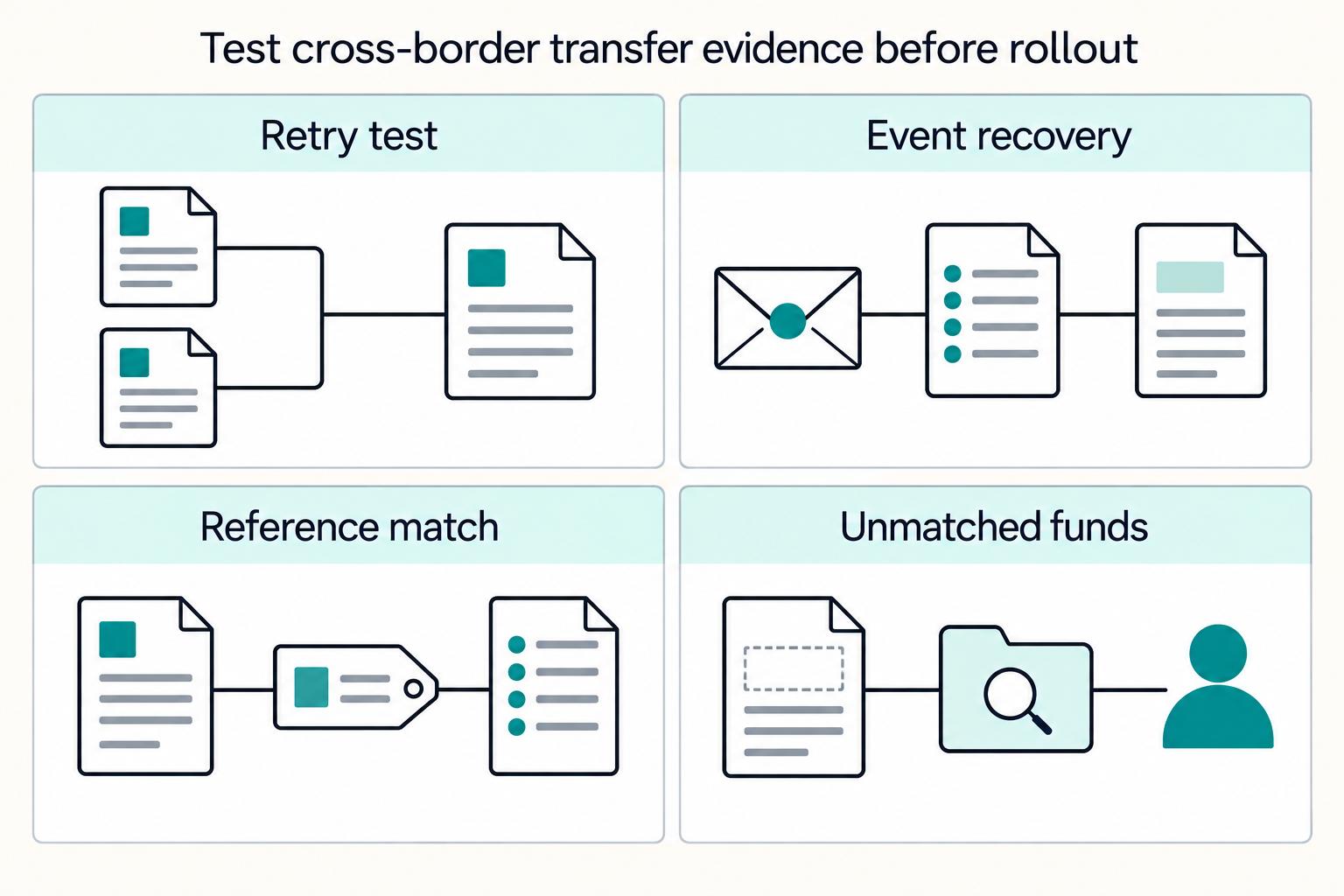
Run these checks before rollout on every money-moving flow. They help prevent duplicate transfers, missing payout states, and reconciliation breakdowns that are expensive to unwind later. Before you lock architecture, run your checklist against event, idempotency, and payout flow references in the developer docs.
- Idempotency on every money-moving API path
Create a durable obligation ID, then a separate attempt carrying provider, account, environment, operation, original parameters and idempotency key. Reuse that attempt only under the provider’s supported retry contract. Stripe, for example, retains an executed request result including a 500 error, and keys can be pruned after at least 24 hours. Expiry does not prove the payout failed. Resolve an unknown result before creating a new attempt or changing provider.
- Webhooks with sequencing logic, plus an API backfill path
Authenticate callbacks before saving them. Persist the event and recoverable work before acknowledging receipt; workers must be able to rediscover unfinished work after a crash. Apply a unique local effect marker with the ledger change so repeated or differently delivered events cannot post the same financial effect twice. Read current provider objects and reports to recover gaps. Event order is not a reliable instruction sequence.
- Ledger-first traceability using your reference and the provider reference
Store the obligation, attempt and provider movement references with currency, gross amount, fees and net receipt. A credited payout and a later return are distinct financial events. Record actual money movement even when an approval or matching control failed, while retaining the exception for investigation. Never erase a movement simply because it violated an internal rule.
- Incoming virtual-account receipts are a separate flow
A virtual account can help identify incoming deposits where the chosen product supports it. Match short payments, overpayments and unallocated balances to their own receipt records. An incoming deposit is not evidence that an outbound recipient has been paid, and there is no universal 75-day unmatched-funds rule across providers.
Failure modes to test before launch#
Before launch, force the failure paths and confirm they produce auditable outcomes in both provider status and your own records.
| Scenario | Test in sandbox or controlled mocks | Expected result |
|---|---|---|
| Expired quote before submission | Use an expired executable quote | No assumed conversion; obtain a new quote under the selected product contract. |
| Submission times out | Lose the create response after provider acceptance | The obligation remains tied to the unknown attempt; lookup/recovery precedes any replacement. |
| Crash after callback receipt | Stop processing after durable intake | Unfinished work is rediscovered and the financial effect posts once. |
| Later return | Deliver the return after a credited status | A distinct return entry updates money and the outstanding obligation without duplicating the original payout. |
| Compliance hold | Hold a submitted attempt | Named review path and accurate status; no automatic cross-provider bypass. |
Pilot plan for the first 90 days#
Use the first 90 days to establish eligible routes and prove the operating model. Mock uncertain legal or funding arrangements without moving money; a live pilot already needs the required permissions and controls.
-
Start narrow: Choose a small set of real sender-to-recipient routes and write down who owes, funds and executes each payment.
-
Set comparable measures: Track recipient availability against the promised date, total delivered cost, unknown-attempt age, returns and reconciliation effort. Keep held, rejected and returned outcomes separate.
-
Review patterns: Use the same route-level records across product, engineering and finance. Change future routing when there is a supported service or cost reason; resolve submitted obligations before changing their path.
-
Use exception load as the expansion gate. If exceptions stay high after operational tuning, pause new geographies and deepen reliability in the corridors already live. Persistent AML/CFT review friction is an operating risk because inconsistent implementation can increase cost, reduce speed, limit access, and reduce transparency. If you want a deeper dive, read How to Pay US-Based Freelancers from the UK.
Choose the option your team can actually operate#
Pick the provider your team can run reliably, not the one that ranks highest. If corridor evidence is thin, control ownership is vague, or finance cannot close from the outputs, pause and request a technical review before signing.
If you want a corridor-by-corridor fit check before signing, request a practical review of controls, routing, and rollout risks through Gruv contact.
Frequently Asked Questions
What is international EFT for a platform, and how is it different from a basic cross-border payment tool?
International EFT is an electronically initiated transfer that debits or credits an account. Compared with a basic international money transfer tool, cross-border payments for platforms generally have broader scope and purpose. In practice, platform teams often need to run payout lifecycle operations end to end, including eligibility checks, status handling, and reconciliation.
Which rails should we prioritize first between `SWIFT`, `SEPA`, `RTP`, `Faster Payments`, and `BECS`?
Choose rails for the supported domestic leg and currencies of your actual routes. SEPA covers euro account-to-account flows, Faster Payments serves UK payments, RTP serves eligible U.S. domestic payments and BECS handles Australian bulk account payments. SWIFT is messaging used in cross-border arrangements. None of those names alone guarantees end-to-end arrival or provider access.
How should we compare "global coverage" claims against corridor-level reliability?
Treat country count as a starting point, not a decision metric. Ask for corridor-level evidence on delivery timing, cut-off behavior, return handling, and status visibility from initiated to credited or returned. That matters because cross-border payments still face cost, speed, access, and transparency gaps, and some flows still rely on correspondent banking chains.
What is the minimum checklist to approve a cross-border EFT platform?
Do not assume a universal regulator-issued minimum checklist exists, so use a practical launch baseline. Confirm corridor and rail fit for your first markets, clear state tracking across initiated, accepted, credited, returned, and reconciled outcomes, explicit return and hold handling, and reconciliation outputs finance can close from. If those controls are unclear in real workflows, delay approval.
What usually breaks first at scale: onboarding, routing, reconciliation, or exception handling?
There is no supported universal "first failure" pattern across platforms. A practical place to test first is the handoffs between onboarding, routing, exceptions, and reconciliation. If internal ledger status, provider status, and customer-visible status drift during returns or missed events, reliability can degrade even when happy-path payouts look fine.
When should we choose a single vendor stack versus a modular multi-vendor approach?
A single stack can reduce operational complexity and keep one consistent operating model. Move to modular only when corridor-level routing or coverage gaps justify the added ownership burden. If your team is not ready to run cross-provider reconciliation and exception triage confidently, keep the stack simpler.
What compliance and tax controls should be non-negotiable before launch?
Identify the regulated entity and applicable screening, onboarding and funding requirements for the actual flow. For tax operations, determine payee type, payment source and the relevant withholding/reporting treatment. Missing U.S. TINs can require backup withholding in applicable cases; foreign individuals and entities do not use identical documentation. Personal FEIE or FBAR filings are separate from payout authorization.
Try a related tool
Researched and edited by the Gruv editorial team. Gruv builds cross-border billing, payouts, and finance-operations software for global businesses.
Sources
Includes 3 external sources outside the trusted-domain allowlist.
- docs.stripe.com/api/idempotent_requeststrusted
- docs.stripe.com/webhookstrusted
- ecb.europa.eu/paym/retail/instant_payments/html/index.en.htmltrusted
- irs.gov/businesses/small-businesses-self-employed/ba...trusted
- irs.gov/forms-pubs/about-form-w-8-bentrusted
- auspaynet.com.au/resources/direct-entryexternal
- paddle.com/help/start/intro-to-paddle/how-paddle-is-abl...external
- theclearinghouse.org/payment-systems/rtpexternal
Educational content only. Not legal, tax, or financial advice.
Related Posts

Receive International Payments in India: SWIFT, UPI, and NEFT
If you want to receive international payments in India without month-end confusion, map the rail in the right order. The cross-border leg, the India settlement leg, and the documentary proof are three separate things.

How to Pay US-Based Freelancers from the UK
Your ability to attract and keep strong US freelance talent depends less on budget than on how you operate. Strong freelancers often work like serious one-person businesses, and they start evaluating you from the first interaction. Compliance and payment handling are not back-office details. They are early proof that you will be easy to work with, careful with details, and worth prioritizing.

How to Pay US-Based Contractors from Australia
Engaging U.S. talent can be a smart growth move for an Australian business. But paying a cross-border contractor is not just an admin task. If you handle it reactively, you create compliance risk, unnecessary cost, and record gaps that are hard to repair later.