

Quick Answer
Start with a release gate: verify the contract party, invoice payee, and beneficiary details match, then request the right tax form for that payee. For US freelancers, that usually means Form W-9 rather than W-8BEN. Set currency terms before work starts, and if the invoice is in USD, approve and settle in USD instead of converting ad hoc from GBP. Save the transfer reference, remittance note, and payment confirmation in one file for reconciliation.
Your ability to attract and keep strong US freelance talent depends less on budget than on how you operate. Strong freelancers often work like serious one-person businesses, and they start evaluating you from the first interaction. Compliance and payment handling are not back-office details. They are early proof that you will be easy to work with, careful with details, and worth prioritizing.
This guide focuses on that standard in practice. It moves from onboarding and compliance to payment execution and long-term working habits. The aim is simple: build a reputation that makes good freelancers want to work with you again.
The Compliance Shield: Your First Professional Signal#
If you want to pay US freelancers from the UK without creating avoidable risk, run onboarding in a fixed order. Verify identity first, then confirm status and contract party, and collect the right tax and banking documents before the first payment.
Step 1 Verify identity details before requesting any form#
Start by confirming the legal name of the person or entity, their country details, and the exact party that will appear on the contract and invoice. That is the baseline for tax forms, payout setup, and your accounting trail.
Do not send a blanket W-8BEN request to a US freelancer. W-8BEN is for foreign persons when requested by a payer or withholding agent. If the payee is a US person and your setup requires taxpayer details, that usually points to Form W-9. In W-9 flows, make sure the legal name and TIN details align. A name and TIN mismatch creates backup withholding risk.
Step 2 Confirm status and who you are contracting with#
Status is not something to sort out after work starts. Confirm the engagement is genuinely contractor work before you process payment. Use HMRC's CEST check where relevant, because status errors can lead to unpaid tax and penalties.
Then lock the contract party: individual or company. That choice needs to match the contract name, invoice payee, and payment recipient details. Avoid signing with one party name and paying another without a documented reason.
Step 3 Request the right tax and banking documents for your payment rail#
The exact document set depends on who is paying, which rail you use, and the freelancer's tax status. Direct pay and platform pay can call for different forms, and platforms may require W-9 for US taxpayers and W-8 variants for non-US taxpayers.
Choose the payout method first, then collect the matching bank fields. Depending on the rail and bank, you may need details such as SWIFT, BIC, or IBAN. Keep written confirmation of the payment details used for the first payout.
Step 4 Lock payment and ownership clauses before work starts#
Before work starts, make these clauses explicit:
| Clause | What to set |
|---|---|
| Scope acceptance | Set scope acceptance and sign-off |
| Invoice requirements | Include a unique identification number |
| Payment terms | Set payment currency, payment timing, and who bears FX or conversion costs |
| IP transfer | Set the transfer trigger, with written and signed assignment language |
| Dispute path | State whether mediation is attempted first |
Two points are worth treating as non-negotiable. Under UK law, the author is the first owner of copyright unless another rule or agreement applies. Assignment is not effective unless it is in writing and signed by or on behalf of the assignor. For late B2B commercial payments in the UK, the statutory interest benchmark is 8% plus the Bank of England base rate.
Keep responsibility lines clear. Confirm who handles each tax and reporting obligation in your specific setup, and keep a compliance and accounting file. As a baseline, retain the signed contract, the status-check note and any CEST output, the payer-side tax form actually required, invoices, payment confirmations, and bank-detail confirmation. Any current reporting requirement relevant to your setup must be verified from official tax or accounting records before use.
Common mistakes to avoid#
These are usually simple errors, but they create friction fast:
- Requesting the wrong IRS form, such as asking a US freelancer for W-8BEN instead of checking whether W-9 is required
- Missing legal entity details, so the contract party, invoice name, and payee bank name do not match
- Leaving currency ownership unclear, then disputing totals when the invoice is in USD but payout is converted from GBP
If misclassification is part of the issue, read What to Do If You've Been Misclassified as an Independent Contractor.
The Frictionless Treasury: How Your Payments Reflect Your Professionalism#
Once onboarding is complete, the next signal is how you actually move money. Choose your payment rail based on predictability and landed payout, not habit, and make the payment process as clear as the contract.
Step 1 Compare landed payout before choosing a rail#
The real comparison is not the send amount. It is what the freelancer actually receives after visible fees, any FX conversion, estimated delivery timing, and the provider's current exception process. Run these five checks each time:
| Check | What to compare |
|---|---|
| Landed payout | Total landed payout in USD |
| FX display | Whether the FX rate is clearly shown or embedded |
| Transfer fees | Whether transfer fees are shown before send |
| Arrival timing | Whether you get an estimated arrival window before approval |
| Exceptions | What the provider currently says about holds, reversals, and support for exceptions |
Wise shows what a checkable quote can look like. Its pricing pages say it uses the live mid-market rate with an upfront fee. Its quote flow also shows a 20h rate guarantee plus an estimated arrival date such as "Should arrive by Wednesday." That lets you approve based on visible terms before sending.
Do not treat example quotes as universal. Wise also says fee varies by currency. Example figures like Total included fees (0.30%) 88.77 USD and Wire transfer fee 6.11 USD are route-specific examples.
Step 2 Pre-approve one primary rail and document why#
A default rail makes your team faster and more consistent. Pre-approve one option your team can run reliably, then document why it is the default so invoice approval does not turn into a fresh payment debate every time.
| Rail | Transparency | Predictability before send | Hold or reversal review | Reconciliation fit |
|---|---|---|---|---|
| Wise | Wise says it shows the live mid-market rate and an upfront fee; it also says pricing varies by currency. | Quote flow shows a temporary rate guarantee of 20h and an estimated arrival date. | Check Wise's current support and exception handling for your account type and route before relying on it. | Can be strong if you store the quote and transfer reference with the invoice. |
| PayPal | Confirm current fee behavior and FX treatment with the provider before use. | Verify what is shown before approval and what the recipient sees after receipt. | Confirm current hold, reversal, and dispute terms with the provider before use. | Verify export fields, reference detail, and mapping to your ledger. |
| Bank transfer | Confirm current sender fee, intermediary fee treatment, and FX handling with the bank before use. | Ask your bank what is known before release, including route-specific timing estimates. | Confirm current recall, return, and exception process with the bank before use. | Verify statement detail and reference data for invoice matching. |
If you use Wise as the default, treat the quote as a control point. Capture the rate, fee, currency pair, and arrival estimate before approval. If transfer volume is high, also check discount eligibility, since Wise says discounts start when you send over 25,000 USD (or equivalent) per month.
Wise also says same-currency transfers between Wise contacts are free. That matters only when both parties use Wise and you settle in the same currency.
Step 3 Quote in USD, approve in USD, settle in USD#
If the invoice is in USD, keep the full workflow in USD. Quote in USD, approve in USD, settle in USD, and confirm in writing who absorbs conversion costs.
A dispute can start when a USD invoice is internally approved as a rough GBP equivalent, then paid later at a different conversion outcome. Keep the rule simple: the invoice amount is owed in USD, and any conversion from your GBP balance is your internal funding step.
Before approval, verify that the amount, settlement currency, and rail match the contract and invoice. If you convert funds, keep the quote or confirmation showing the rate and fee used for that payout.
Step 4 Run a short treasury checklist on every payment#
You do not need a complex process here. You need one short checklist your team will actually use:
- Pre-approve the payment rail for the engagement
- Confirm beneficiary details against the contract party, invoice payee, and stored payout details
- Log payment reference IDs in your accounting record
- Send remittance confirmation with invoice number, amount, currency, send date, and reference
One common failure mode is a payment that was sent but cannot be matched quickly. Reference IDs and remittance confirmations can reduce delays, speed exception handling, and support a cleaner audit trail.
For a step-by-step walkthrough, see How to Pay US-Based Contractors from Australia.
Before you lock your payment rail, test a real invoice path with the Payment Fee Comparison so you can compare total cost and payout predictability.
The Professional Partnership: Building a System for Loyalty#
Reliable operations make payment relationships easier to maintain. Clear invoice handling, predictable timing, and early communication reduce avoidable friction.
Step 1 Set an invoice acceptance standard before approval#
HMRC guidance here does not prescribe a universal freelancer invoice format, so treat the checklist below as an internal standard, not a statutory template. Before you approve, check:
| Checkpoint | Before approval |
|---|---|
| Legal entity details | Check legal entity details for both sides, including the payee name you will actually pay |
| Scope reference | Check a scope reference that matches the contract, statement of work, or purchase order |
| Invoice identifiers | Check invoice number and invoice date |
| Amount and currency | Check amount due and currency |
| Payout details | Check payment rail or beneficiary details that match your stored payout record |
| Exception contact | Check for a remittance contact for exception handling |
Before release, the contract party, invoice payee, and beneficiary record should match in your internal records.
Step 2 Run a fixed approval-to-payment workflow#
"Pay on time" is not a plan unless you define how the invoice moves. The guidance here does not set a mandatory approval-to-payment cadence or handoff model, so you need to choose one internally. For each invoice, record:
- received date
- approval date
- scheduled payment date
- named owner for each handoff
If delay risk appears, contact the freelancer before the due date, share a revised payout date, and explain the blocker.
Step 3 Keep a complete payment file for each engagement#
A complete file makes your process easier to defend if something needs to be checked later. HMRC says you need to keep records, such as bank statements or receipts. When you start trading, you must keep records to work out profit or loss for your tax return.
Include:
- signed contract version
- approved invoice
- payment confirmation with transfer reference
- applicable tax or compliance documents for your engagement model
- bank statement, receipt, or transfer proof
For UK filing checkpoints, keep Self Assessment admin on schedule. HMRC says you must tell HMRC by 5 October if you need to complete a return, and late notification can trigger a penalty. First-time filers must register before using the online service. You need a UTR to file online, and tax is due by 31 January. If you already have a Self Assessment account, reactivate it before filing to avoid delays. Some cases, for example partnerships, cannot use the standard online filing service.
Step 4 Run the same internal recovery sequence every time#
The guidance here does not prescribe a required service-recovery workflow for delayed freelancer payments, but consistency still helps when a payment is delayed, fails, or lands unmatched. Run the same internal recovery sequence every time:
- acknowledge the issue quickly
- share revised payout timing
- confirm resolution with payment proof and transfer reference
- log root cause and prevention action
Close each incident only after payment is confirmed and the fix is recorded to prevent repeat friction.
If you want a deeper dive, read Separating Business and Personal Finances: An Important Step for LLCs.
Get the Paperwork Right, Then Remove Payment Uncertainty#
Across all three sections, the pattern is simple: get the paperwork right, make payout mechanics transparent, and remove uncertainty from invoice to remittance. Done consistently, this can lower errors, reduce disputes, and make strong freelancers more willing to work with you again.
| Area | Professional system | High-friction system |
|---|---|---|
| Compliance readiness | Correct tax form on file before payout, signed contract, matched payee details | Wrong or missing form, contract gaps, name and bank mismatches found at payment time |
| Payment transparency | Currency, due date, FX handling, and fees agreed up front | Freelancer discovers conversion loss or delays after invoicing |
| Freelancer experience | Predictable approval-to-remittance flow with payment proof | Status chasing, unclear deductions, repeated detail requests |
| Rehire likelihood | Often higher, because your process is consistent and low-friction | Often lower, because each invoice feels uncertain |
First, get the compliance file right before first payment approval. For a US person, use Form W-9, not Form W-8BEN. W-8BEN is for foreign individuals, and the form itself says US persons should not use it. Check that the legal name, taxpayer details, contract party, invoice name, and beneficiary details match. This helps reduce wrong-form and mismatch risk, including backup-withholding cases that can reach 24% in applicable scenarios, and signals that you run a controlled process.
Next, set payment mechanics in writing before work starts. Confirm contract currency, invoice currency, due date, approval path, and who absorbs conversion costs. When FX is involved, record whether pricing is at the mid-market exchange rate or includes provider spread. PayPal states its conversion rate includes a spread it retains. Reconcile the invoice total, FX quote, payout amount, and remittance confirmation each time. This helps prevent "why was I paid less?" disputes and shows respect for the freelancer's margin.
Then, run every payment from one engagement file. Keep the signed agreement, approved invoice, W-9 or other required tax form, beneficiary confirmation, transfer reference, and bank statement or receipt together. IRS guidance says keep the W-9 for 4 years. HMRC says keep relevant records for at least 5 years after the 31 January submission deadline, and failures can be penalized by up to £3,000 per failure. If payment may miss terms, notify the freelancer before the due date. UK rules allow statutory interest on late B2B debts at 8% plus the Bank of England base rate.
Use this on every new freelancer: correct form, clear contract terms, verified payee details, approved invoice, transparent FX handling, and saved payment proof. Consistency, speed, and documentation are your long-term trust advantage.
You might also find this useful: How to Fill Out Form W-8BEN for a Foreign Freelancer. If you want one operational flow for collecting funds, reconciling records, and sending compliant freelancer payouts, review Gruv Payouts.
Frequently Asked Questions
What should you check before the first payment goes out?
Before the first payment, make sure the signed agreement, approved invoice, and beneficiary details all point to the same payee. You should also confirm which tax or compliance documents apply in your case before funds move, because requirements can vary by business structure and filing route. If names do not align or bank details changed without verified confirmation, pause and resolve it before release.
Do you always need the same tax forms for a US freelancer?
No. You should not assume one universal form set. The required documents vary by your setup and the rules that apply, so verify the jurisdiction-specific tax form requirement with current guidance or your accountant before the first payment. Retain the records needed to support your return, such as bank statements or receipts, along with payment documentation and any tax documents confirmed for your case.
What records should you retain after payment?
Keep records that show who you paid, why you paid them, and how the money moved. HMRC guidance points to records such as bank statements or receipts, so store those with the contract version, invoice, and transfer reference in one engagement file. If you pay through a platform, keep the remittance or payout confirmation too.
Do you need to tell HMRC or file anything because you paid a US freelancer?
That depends on your entity type and whether you need to complete a return, so confirm that first. If you are a sole trader, you register through Self Assessment, and HMRC says you must tell them by 5 October if you need to complete a return for the previous tax year. The GOV.UK example date window is 6 April 2024 to 5 April 2025, with a 5 October 2025 notification point, so always check the current year’s guidance. For online filing, you need your UTR. First-time online filers must register first, and existing users may need to reactivate their account to avoid delays.
What should you confirm with an accountant for your specific business structure?
Confirm entity-specific tax handling before you standardize your process. HMRC says your business structure affects both tax treatment and legal responsibility, including sole trader personal liability for business debts and limited company liability capped at the value invested. Also confirm registration route details for your case, including sole trader triggers such as more than £1,000 in a tax year, NI number requirements, and whether you need commercial software or other forms for cases outside the standard online service.
What payment method should you choose?
Choose the method that gives you clear pricing, clear FX handling, reliable payout confirmation, and clean reconciliation back to each invoice. Compare bank wires, payment platforms, and specialist cross-border tools on transparency, conversion control, and the quality of downloadable payment proof. Current fee and processing details must be verified from provider records before use.
Should you pay in GBP or USD?
Set the contract currency, invoice currency, and settlement currency before work starts, then keep them aligned in operations. State in writing who absorbs conversion costs or exchange-rate movement so there is no default-assumption dispute later. Your invoice, remittance, and settlement receipt should all follow the same currency logic.
Try a related tool
Researched and edited by the Gruv editorial team. Gruv builds cross-border billing, payouts, and finance-operations software for global businesses.
Sources
Includes 2 external sources outside the trusted-domain allowlist.
- assets.publishing.service.gov.uk/government/uploads/system/uploads/attachment...trusted
- irs.gov/businesses/small-businesses-self-employed/fo...trusted
- irs.gov/individuals/international-taxpayers/forms-fo...trusted
- wise.com/us/pricing/send-moneytrusted
- gov.uk/late-commercial-payments-interest-debt-recov...external
- gov.uk/self-assessment-tax-returns/registeringexternal
Educational content only. Not legal, tax, or financial advice.
Related Posts

How LLC Owners Separate Business and Personal Finances
For an LLC, separating business and personal money is best treated as a weekly habit, not a one-time bank setup. It keeps records cleaner, cuts month-end cleanup, and creates clearer boundaries as the company grows.

What to Do If You've Been Misclassified as an Independent Contractor
Treat this as a protection problem first, not a label debate. If your work was treated as an independent contractor arrangement even though the relationship functioned differently, your first goal is to protect pay, rights, and records while you choose the least risky escalation path. You can do that without making accusations on day one, which often keeps communication open while you document what happened.
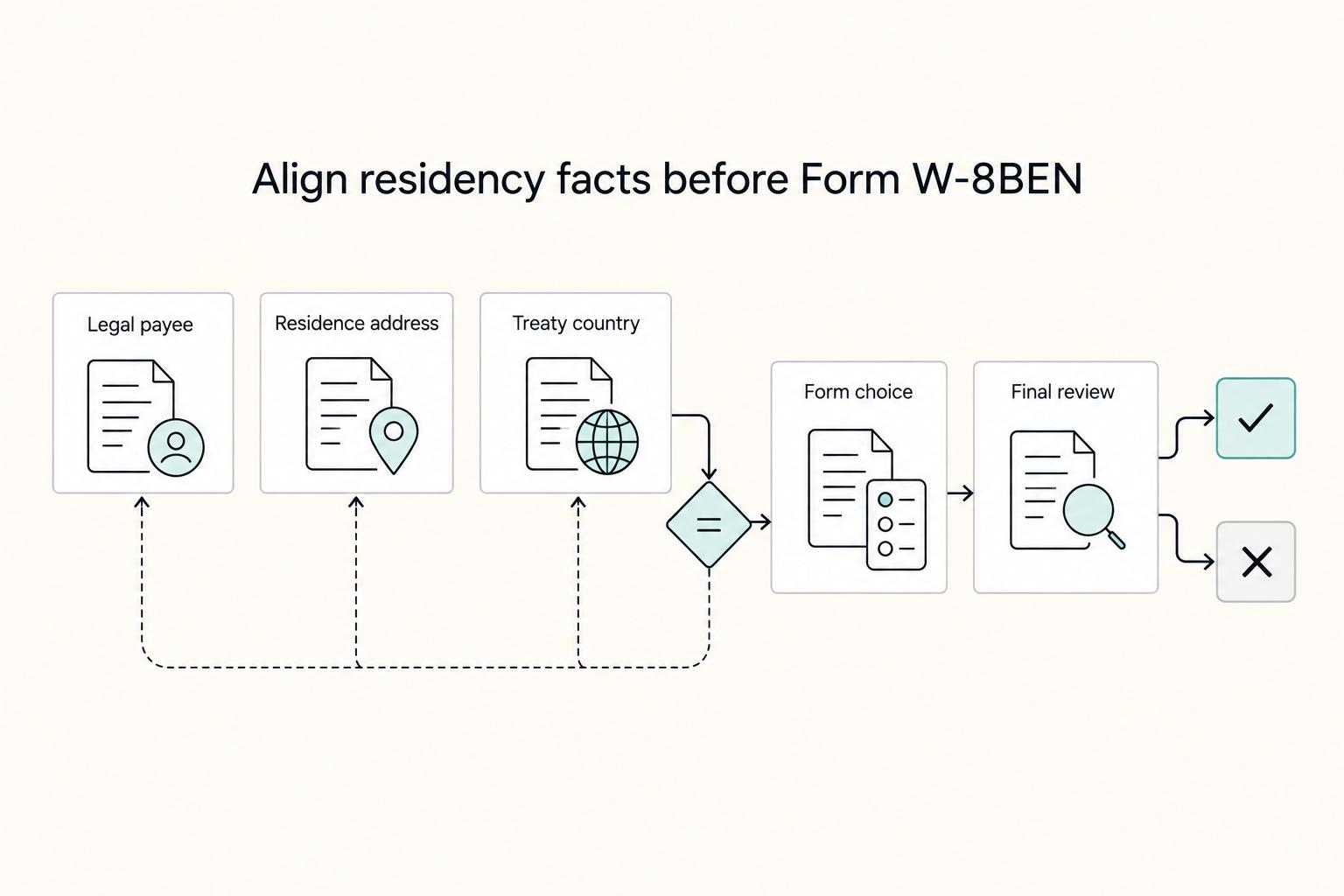
How to Fill Out Form W-8BEN for a Foreign Freelancer
For many global professionals, Form W-8BEN is the first real point of friction in a U.S. client relationship. It often gets treated like routine paperwork. That is the wrong frame. If you run a business of one, this form is an early operating decision that affects cash flow, onboarding speed, and how much confidence a client has in your setup.