

Quick Answer
Start with a control sequence, not ad hoc invoices, when you pay us contractors from australia. Collect a signed agreement, confirm worker status, and require the tax form that fits that status before vendor setup. Release funds only when invoice, beneficiary, and payer details align and you can explain fee and FX outcomes. After settlement, keep one complete file with payout proof and exception notes so classification or withholding issues can be resolved quickly.
Engaging U.S. talent can be a smart growth move for an Australian business. But paying a cross-border contractor is not just an admin task. If you handle it reactively, you create compliance risk, unnecessary cost, and record gaps that are hard to repair later.
The safest approach is to treat each engagement as a finance control sequence. The agreement, tax form, identity checks, payment route, and recordkeeping all matter, and they matter in order. This guide follows that order from onboarding through payment and close.
Part 1: The Pre-Engagement Foundation: Your First Line of Defense#
To pay U.S. contractors from Australia with fewer tax, fraud, and ownership problems, put three gates in place before any money moves: a signed agreement, the right tax form, and verified payout details. Give one person authority to move a contractor from pending to payable, and make everyone else a reviewer or escalation point.
Step 1. Assign one owner and apply stop-payment gates#
A single release owner is one of the simplest controls you can put in place. Failures happen when agreement terms, tax forms, and bank details are approved in different places and no one makes the final release decision.
Keep legal or ops as exception reviewers, but make finance or AP the control owner. Use the decision table below, then apply the same stop rule every time.
| Required artifact | What "valid" means | Who approves | Hold or escalate when |
|---|---|---|---|
| Signed contractor agreement | Signed by both parties; scope/results are clear; payment trigger is defined; dispute path is defined | Hiring manager + legal/ops reviewer | Missing signature, missing completion criteria, unclear ownership, or terms that read like employee supervision |
| IRS tax form | Signed Form W-9 for a stated U.S. person/resident alien, or signed Form W-8BEN for a stated foreign person when requested by the payer | Finance/AP owner | Form type conflicts with stated status, key identity fields are missing, or name and tax identity do not align |
| Payout instructions + identity check | Beneficiary name aligns with records; account details verified; any detail change confirmed through an independent channel | Finance/AP owner | Name mismatch, tax identity mismatch, late bank-detail change, or verification done only in the same email thread |
If any gate is incomplete or conflicting, do not release funds. Log the exception, escalate it, and keep the hold visible until someone resolves it.
Step 2. Approve the agreement like a control document#
The agreement is not just paperwork. It tells AP what can be paid, when it can be paid, and who owns the result.
| Check | What to confirm | When to hold |
|---|---|---|
| Contractor independence | Define outcomes, not day-to-day instructions | Drafting leans heavily on how work is done or supervision |
| IP ownership | If ownership transfers, require written, signed assignment language | Ownership transfer is assumed from vague wording |
| Payment trigger | Define exactly what counts as complete before AP can release funds | A third reviewer cannot quickly tell when it becomes payable |
| Dispute workflow | State how disputes are raised, who decides, and how undisputed amounts are handled | The dispute path is not clear |
A written contract is less risky than a verbal one, and both parties should sign it before setup is approved. Review it through four checks:
- Contractor independence: define outcomes, not day-to-day instructions. No single factor decides status, but drafting that leans heavily on how work is done or supervision is a risk signal.
- IP ownership: if ownership transfers, require written, signed assignment language. Do not assume ownership transfer from vague wording.
- Payment trigger: define exactly what counts as complete, whether that is an acceptance event, milestone, or completion condition, before AP can release funds.
- Dispute workflow: state how disputes are raised, who decides, and how undisputed amounts are handled.
Use this checkpoint: if a third reviewer cannot quickly tell what is being delivered, when it becomes payable, and who owns it after payment, hold setup.
Step 3. Triage the tax form before vendor setup#
Tax-form review should start with stated status, not with whatever form arrives first. That keeps the file anchored to the underlying facts.
- If the contractor states U.S. person or resident alien status, collect a signed W-9 with name and TIN alignment.
- If the contractor states foreign-person status, collect W-8BEN when requested by the payer or withholding agent.
Hold and escalate when the stated status and form conflict, for example a U.S.-person statement paired with W-8BEN, or a foreign-person statement paired with W-9. Treat that as a facts issue, not a clerical issue, and confirm the applicable [withholding and reporting rule for your case].
If required documentation is missing or invalid, withholding presumptions can apply, including potential 24% backup withholding or 30% foreign-person withholding depending on the facts. A W-8BEN is generally valid through the last day of the third succeeding calendar year unless circumstances change.
Step 4. Match identity and payout details before first release#
Before the first payment, run a three-way match across the agreement, tax form, and payout instructions. If the legal name does not line up across all three, you need documented support before money moves. This is also where fraud controls matter most, so use a clear exception process:
| Issue | Required check | Release rule |
|---|---|---|
| Name mismatch across the agreement, tax form, and payout instructions | Get documented support before money moves | Do not release funds until resolved |
| Payout-detail change | Verify through an independent channel using known contact details | Treat as high risk |
| Verification done only in the same email thread | Independent confirmation is still required | Stop payment until resolved |
| Confirmation of Payee mismatch | Keep the result in the evidence pack where available | Treat as a hold condition, not a soft alert |
- Treat payout-detail changes as high risk, even if the request looks routine.
- Verify change requests through an independent channel using known contact details.
- Do not rely on phone numbers or contacts provided inside the change request itself.
- If name, tax identity, or bank details mismatch, stop payment until resolved.
Your pre-release evidence pack should include the items below, and it should be complete before the first payout is approved:
- Signed agreement, signed tax form, approved vendor record
- Beneficiary verification record, including Confirmation of Payee result where available
- Secondary-channel verification notes for any payout-detail change
Confirmation of Payee is a useful warning control and began rolling out across Australian banks from July 2025, but it is not a fraud guarantee. If it shows a mismatch, treat that as a hold condition, not a soft alert.
Related: How Australian Agencies Can Pay US Contractors With Lower Risk.
Part 2: Choose the Payment Route by Control Strength and Evidence#
Once onboarding is complete, the payment method should follow control strength, not convenience. The right rail gives you clear payer-of-record evidence, visible fee and FX records, and a clean way to stop release when the file does not hold together.
Step 1. Choose the payment method by documentation quality, not habit#
Do not choose a payment method just because your team has used it before. Choose the one that gives you the shortest, clearest path from signed contract to remittance proof.
Before release, answer four questions in order: Who is the payer of record? What fee and FX detail will you retain? What reconciliation evidence will you have? What is your stop rule for incomplete documents? If any answer is missing, hold payment.
| Method | Payer-of-record clarity | Fee/FX visibility | Reconciliation evidence to retain | Escalate instead of releasing when |
|---|---|---|---|---|
| Payment platform | Acceptable when the paying entity in the platform matches the signed agreement and approved vendor record | Use only if the record shows charged amount, received amount, and FX detail (if conversion occurred) | Approved invoice, platform confirmation, beneficiary record, payer-entity record | Platform profile name, invoice name, or approved entity name does not match, or key transfer details are masked |
| Bank or wire | Strong only when sending entity, beneficiary name, and invoice party align exactly | Can be limited unless your bank record and invoice pack show deduction and settlement amounts | Approved invoice, bank confirmation, beneficiary verification notes, bank instructions | Beneficiary, invoice, or entity details conflict, or account/IBAN details are incomplete |
| EOR/intermediary | Use only when the intermediary contract clearly shows the paying entity and payment chain | Varies by provider; require records that show billed amount, fees (if any), and remitted amount | Intermediary agreement, approved bill/invoice, remittance proof, entity mapping | Intermediary cannot show who is legally paying, or your records cannot tie worker, invoice, and remitter |
Use the method that leaves the least ambiguity after the payment, not the one that only looks fastest on the front end.
Step 2. Treat bank or wire as an exception path, not your default#
Bank or wire can work, but it is less forgiving when setup is wrong. Use it when you have a clear control reason, not as a speed shortcut.
Incorrect details can block processing or trigger returns and recovery delays. For wire approvals, require sign-off from your finance or AP control owner and escalate mismatches before release. Keep a file that includes the approved invoice, independently verified beneficiary details, and the exact sending entity name. Make the bank-detail checks explicit:
- Westpac guidance requires payee account holder name plus account number or IBAN.
- ANZ terms state incorrect international payment details can preclude processing.
- CommBank notes invalid details may be auto-returned in 2-3 working days, and formal recovery can take several weeks.
If beneficiary, invoice, or entity details do not match, hold payment and return the case to vendor review. If timing is critical, use a previously verified rail after corrected documents are approved.
Step 3. Match invoice handling to the payer's GST registration path#
Invoice controls only work if they match the payer's GST path. For non-residents, the ABN-based standard GST path and the simplified GST path are separate operating tracks.
| Track | What to capture | Invoice handling | Operational note |
|---|---|---|---|
| ABN-based standard GST path | ABN | Run tax-invoice checks; apply the 28-day tax-invoice response rule when requested; for GST credits on purchases above A$82.50 (including GST), require a tax invoice | Can issue tax invoices and claim GST credits; BAS monthly or quarterly |
| Simplified GST path | ARN where issued; limited registration status | Do not force ABN tax-invoice fields | Not entitled to an ABN; cannot claim GST credits; quarterly GST return and payment handling |
| Both paths | Registration-path decision with invoice approval | Keep simplified GST as its own documentation path | AP does not need to re-decide treatment each cycle |
An ABN is an 11-digit identifier. Under standard GST registration, non-residents can issue tax invoices and claim GST credits, and they lodge and pay through BAS monthly or quarterly.
Under simplified GST registration, non-residents elect limited registration status, are not entitled to an ABN, and cannot claim GST credits for purchases. If there is no ABN, ATO contexts may issue an ARN. ATO simplified materials also indicate quarterly GST return and payment handling.
Use this checklist before first payment and whenever payer setup changes:
- ABN-based standard GST path: capture ABN, run tax-invoice checks, and apply the 28-day tax-invoice response rule when requested. For GST credits on purchases above A$82.50 (including GST), require a tax invoice.
- Simplified GST path: do not force ABN tax-invoice fields into this workflow. Capture ARN where issued, mark limited registration status, and note the filing cadence that applies.
- Both paths: store the registration-path decision with invoice approval so AP does not need to re-decide treatment each cycle.
Do not treat ARN as a simple ABN substitute for invoice controls. Keep simplified GST as its own documentation path.
Step 4. Pause the payment model when engagement signals change#
A contractor setup can become the wrong setup if the working pattern changes. When the engagement starts to look employee-like, stop automatic release and review status before the next run.
ATO guidance treats control over how work is done as a core classification factor tied to tax and super obligations. Pause and review when you see signals such as:
- You direct hours, methods, or daily task order instead of accepting agreed outcomes.
- The person shifts to recurring roster-style work or regular internal supervision.
- Payer setup changes make the worker look embedded in your regular workforce model.
- Billing shifts from milestone or deliverable triggers to ongoing labour under close control.
These signals are not a final determination, but they are enough to pause payment. Hold the invoice, route it to classification review, and do not keep paying through the old contractor path until the review is complete.
If you want a deeper dive, read How to Pay US-Based Freelancers from the UK.
Before you lock a rail, run your likely transfer paths through the payment fee comparison tool and document those assumptions in your approval checklist.
Part 3: Building Your System of Record After the Payment#
Once the payment is out, the job is not over. Your file should let someone else confirm who was paid, why they were paid that way, and how the settled amount was calculated without rebuilding the story from email threads.
Step 1. Build one complete contractor file#
One complete contractor file is the easiest way to keep the payment trail usable. Update it after every payout, not at year-end.
| Required artifact | Comes from | Who validates it | Hold the next payment when |
|---|---|---|---|
| Signed agreement and approved vendor record | Legal or procurement setup | Finance owner or approver | Contracting party name does not match invoice party or payout beneficiary |
| Current tax form and payee-status note | Contractor onboarding | Tax or finance reviewer | Payee status and form do not align |
| Approved invoice | Contractor | AP reviewer | Invoice amount, entity name, or scope does not match approval |
| Payout proof, including fee/FX detail if conversion occurred | Bank or payment platform | AP or controller | Net amount cannot be tied to gross invoice plus fees/FX adjustments |
| Exception correspondence | Email, ticket, or internal note | Case owner | Returned payment, bank-detail change, or withholding question is still unresolved |
Apply one status-to-form rule and escalate mismatches before the next cycle: for U.S. contractor reporting workflows, U.S. payee status uses Form W-9; foreign individual uses W-8BEN; foreign entity uses W-8BEN-E. For retention, keep W-9 records for 4 years and contractor or supplier records for 5 years. Also keep a file field for any jurisdiction-specific timing your policy requires.
Step 2. Reconcile before you close the period#
Close is easier if you run the same reconciliation steps every cycle, ideally before period close.
- Match the approved invoice to the payout record.
- Confirm beneficiary identity matches approved records.
- Tie fee or FX differences to an internal variance reason code.
- Move unresolved items into a tracked queue with an owner and next action.
Use consistent variance codes, for example bank fee, FX conversion, returned payment, or correction, so exceptions stay searchable and reviewable.
Step 3. Re-check classification when facts change#
Classification should not be a one-time onboarding decision. Re-check it whenever scope, cadence, or working arrangements change, because tax and super obligations depend on whether the worker is treated as an employee or independent contractor.
Use a recurring review across these factors: control over how work is done, delegation or substitution rights, basis of payment, and commercial risk. If those facts shift toward employee-like treatment, stop the next release and escalate classification review before paying through the prior contractor path.
For another cross-border example, see Best Way for a German Agency to Pay a US-Based Freelancer.
Conclusion: Operate Globally with Confidence#
The throughline is simple: do not pay from a file that does not make sense. If identity, tax treatment, or payment details conflict, pause first and resolve the conflict while the payment is still under your control.
Step 1. Confirm who you are paying before setup#
Start with the core checks before setup: legal name, TIN, worker status, and tax-form fit. If those checks do not point to the same person or entity, stop there.
- Proceed: the checks point to the same person or entity.
- Pause: name or TIN mismatch on a W-9, foreign-payee form in a U.S.-person file, missing or inaccurate TIN, or working patterns that now look employee-like.
Keep the form logic strict: a U.S. person uses W-9; a foreign payee generally uses a W-8 form. If the foreign-payee path is correct, use this W-8BEN guide.
Step 2. Release payment only when the route is fully checkable#
Release payment only when the route is fully checkable. If you cannot show how the money moves and how the amount settles, the file is not ready.
- Proceed: invoice, approval, payee record, and beneficiary details align; you can show total rail economics, including exchange rate plus fees; required provider checks are complete.
- Pause: unreliable or conflicting documents, incomplete beneficiary fields, invoice name not matching bank beneficiary, or no clear total-cost comparison.
Before release, confirm beneficiary basics: full name, address, bank name, account number, routing number or SWIFT/BIC, plus any country-specific fields your rail requires.
Step 3. Keep a system of record you can audit fast#
After payment, keep the record in a form that someone can audit quickly. At minimum, each record should show date, amount, and description.
| What to retain | Why it matters | Where filed |
|---|---|---|
| Payee setup (legal name, TIN, tax form) | Supports identity and tax-form fit | Vendor master and contractor file |
| Approved invoice and approval evidence | Confirms what was authorized | AP file linked to payout |
| Payment confirmation (fees, FX, beneficiary details) | Shows what was sent and to whom | Treasury/payment record on transaction |
| ABN or ARN path evidence, where relevant | Keeps GST handling on the right path | Tax/entity registration file |
| Reconciliation summary entry | Creates a single traceable transaction history | Ledger or close file |
Retain records for the period that applies to your entity and jurisdiction.
Next-step paths by scenario:
- Foreign-payee documentation: W-8BEN guide
- Worker status doubt: misclassification review guide
- Onboarding and control discipline: separate business and personal finances
For a step-by-step walkthrough, see The Best Way to Pay an Indian Development Agency from the US.
If you want this process to run with clearer status visibility and reconciliation-ready payout records, review Gruv Payouts and map it to your current control steps.
Frequently Asked Questions
What should you do about Form W-8BEN before the first payout?
This guide does not provide IRS onboarding rules for Form W-8BEN. Before first payout, confirm the required documentation through your tax process and hold release until the file is complete for the treatment your team plans to apply. If you need process context, use this W-8BEN guide.
Do you need to withhold tax if the form is missing?
Treat the case as pending review and route it to tax until the required treatment is confirmed.
Does the Australia U.S. tax treaty change what you need to do?
Potentially, but treaty-claim eligibility tests and evidence standards require case-by-case review. If treaty relief is raised, route the case for tax review and release only after the required support is confirmed.
Do you have to pay super or handle PAYG for a U.S. contractor?
Escalate super, PAYG, and worker-classification questions to tax or legal review before deciding payment treatment.
What is the safest payment route for a U.S. contractor?
Use your approved AP controls end to end, and pause release when key payment records conflict.
What needs to be on the contractor invoice?
Use your contract and AP policy as the control baseline, and return invoices that do not meet that baseline.
How long should you keep records for these payments?
Apply the retention rule that governs your entity and jurisdiction, and close any policy gaps with tax/legal.
What if the contractor legal name, tax form details, and bank beneficiary details do not match?
If those records do not align, treat the file as unresolved and escalate before release. Follow your internal AP and compliance controls for resolution.
Do GST registration or ABN issues matter when you pay overseas contractors?
Yes. For non-residents, the GST registration path changes what AP should expect in the file. Standard GST registration is the ABN-based path and is used when you need to issue tax invoices or claim GST credits; it includes BAS and GST obligations, and offshore electronic lodgment is restricted so an Australian registered tax agent may be needed. Simplified GST registration does not require an ABN, uses a 12-digit ARN, does not allow tax invoices or GST credits, and requires quarterly GST returns and payments. If registration is required, complete it within 21 days (for example, when GST turnover reaches the published $75,000 threshold); penalties may apply if required registration is missed.
Can someone use an ABN if they are really working as an employee?
An ABN alone does not settle worker-classification questions; if status is unclear, escalate for classification review. For GST routing, note that non-residents may be on a standard ABN-based path or a simplified path that uses an ARN instead. Use this guide for next steps.
Try a related tool
Researched and edited by the Gruv editorial team. Gruv builds cross-border billing, payouts, and finance-operations software for global businesses.
Sources
Educational content only. Not legal, tax, or financial advice.
Related Posts

How LLC Owners Separate Business and Personal Finances
For an LLC, separating business and personal money is best treated as a weekly habit, not a one-time bank setup. It keeps records cleaner, cuts month-end cleanup, and creates clearer boundaries as the company grows.

What to Do If You've Been Misclassified as an Independent Contractor
Treat this as a protection problem first, not a label debate. If your work was treated as an independent contractor arrangement even though the relationship functioned differently, your first goal is to protect pay, rights, and records while you choose the least risky escalation path. You can do that without making accusations on day one, which often keeps communication open while you document what happened.
How to Fill Out Form W-8BEN for a Foreign Freelancer
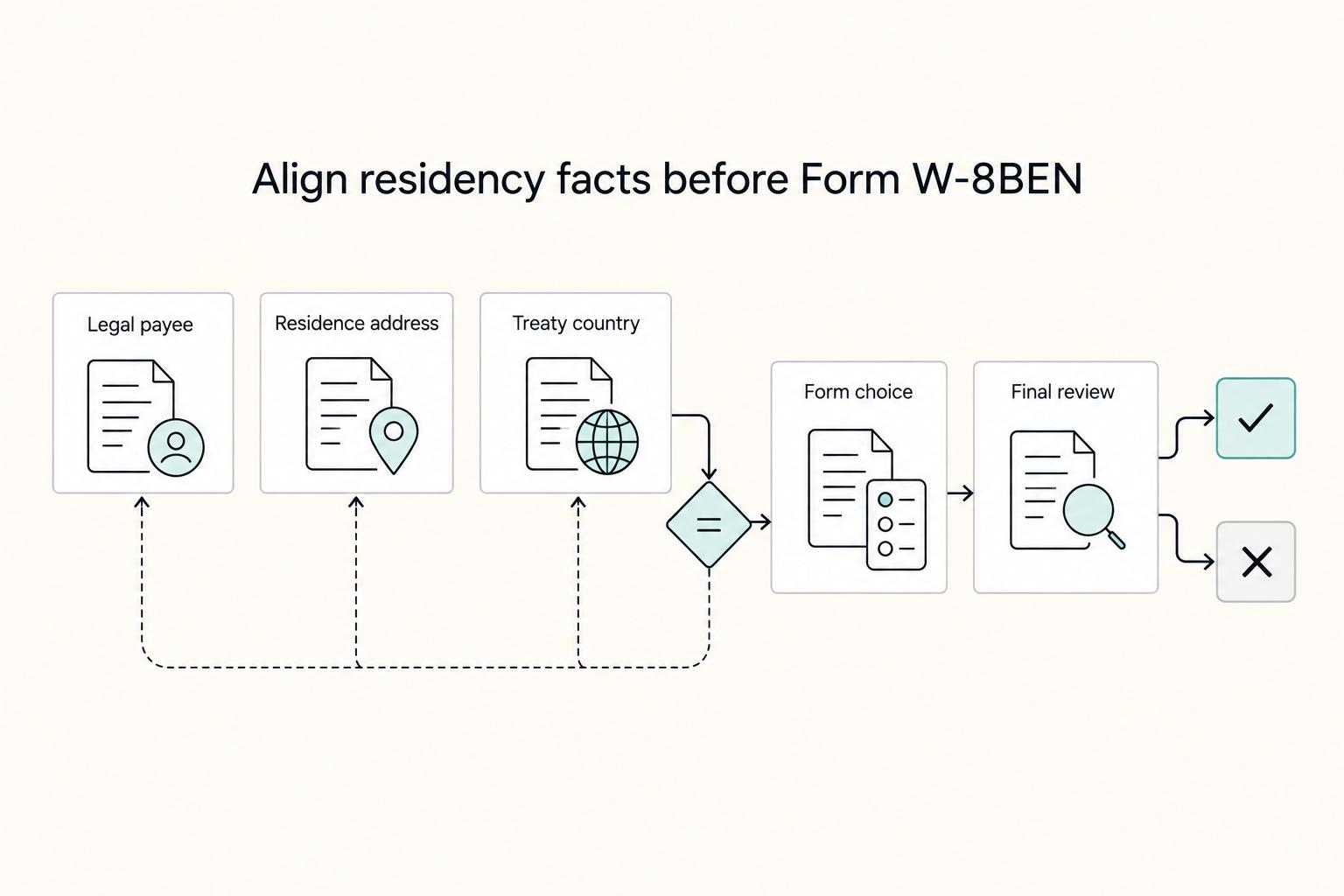
For many global professionals, Form W-8BEN is the first real point of friction in a U.S. client relationship. It often gets treated like routine paperwork. That is the wrong frame. If you run a business of one, this form is an early operating decision that affects cash flow, onboarding speed, and how much confidence a client has in your setup.