
Quick Answer
Most creator platforms should buy first, then move to a hybrid stack if multi-country coverage, provider flexibility, or payout control becomes necessary. The right choice depends on three jobs: how money comes in, how creators get paid, and how your team handles onboarding, payout status, exceptions, and reconciliation. Before any launch, verify each country corridor by payout method, currency, beneficiary checks, and reporting outputs.
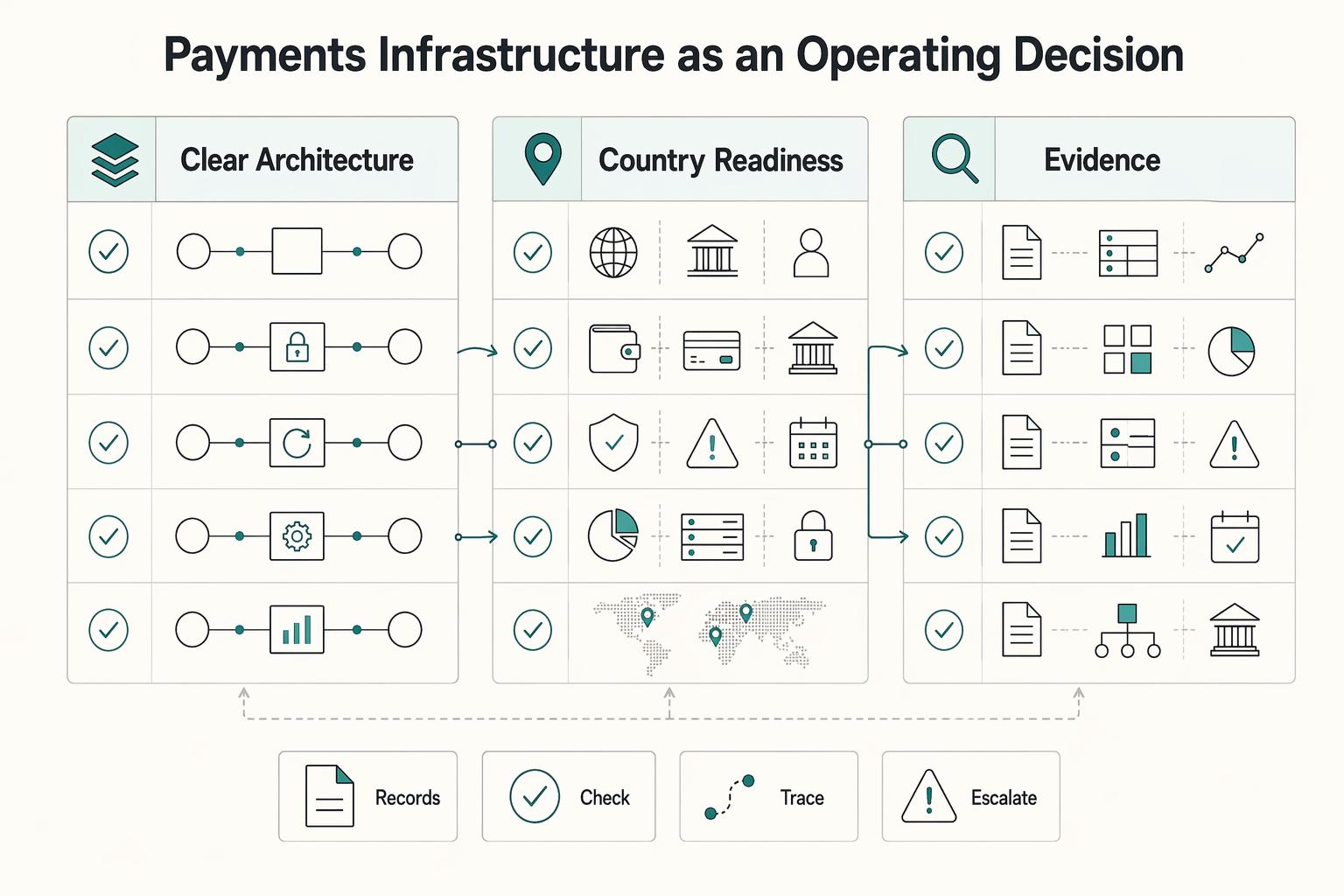
Payments Infrastructure as an Operating Decision#
Treat this as an operating decision, not a branding exercise. This guide helps founders and ops teams choose build, buy, or hybrid for creator payment infrastructure. The goal is to avoid committing roadmap, compliance effort, and go-to-market spend in the wrong markets.
The useful lens is not which provider looks global. It is what you must run every day across three jobs some vendors label Pay In, Pay Out, and Pay Ops. That means how money comes in, how creators get paid, and how your team handles onboarding, payout status, returns, exceptions, and reconciliation when something breaks.
The hard part is usually not the API demo. It is the operating surface behind it. If you build a custom onboarding flow, you still own the legal and regulatory duties attached to that flow. A build decision is not just an engineering decision. It can also shift compliance ownership onto your team.
This guide stays narrow on purpose. It is for operators expanding across countries, rails, and currencies where support is uneven. Brazil's Pix was created by Banco Central do Brasil and launched in November 2020. India's UPI was developed by NPCI, with its pilot launch on 11th April 2016. Some providers market one integration for local rails like Pix and UPI, but support is still corridor-specific by country, payout method, and currency.
Use this checkpoint as you read: verify coverage corridor by corridor before you trust the word "global." Confirm the pay-in method, payout method, settlement currency, and reporting outputs for each launch market. This matters even more if you promise creator receipts in non-local currencies while using local methods, because local methods often support only one specific currency. A provider can support over 135 presentment currencies in one context and still have narrow local-method rules in another.
That is the frame for the rest of the guide. We separate acceptance, disbursement, and the operations layer. We also treat orchestration for what it is: a centralized way to manage multiple providers, not a substitute for country-by-country payout and compliance validation.
By the end, you should have:
- A clear architecture decision for your stage: build, buy, or hybrid.
- A country-readiness checklist to apply before entering each market.
- A phased rollout sequence so new rails like Pix or UPI are added only after onboarding controls, payout visibility, and reconciliation evidence are stable.
At a Glance Comparison for Build Buy and Hybrid#
Start with buy when speed is the priority and scope is relatively narrow. Plan for a hybrid path when you expect multi-provider control, PSP flexibility, or tighter control over payout logic and reporting.
| Evaluation area | In-house build | Single-provider buy | Hybrid modular stack |
|---|---|---|---|
| Control | Highest control over onboarding, routing, payout states, and reporting | Lower control, shaped by one provider model | High on routing and provider choice, with some provider-owned edges |
| Launch speed | Usually slowest | Usually fastest | Often in between |
| Engineering lift | Highest, ongoing | Lowest upfront | Medium to high, especially on normalization |
| Compliance burden | Heavy on your team | Lower day to day, but not zero | Split across vendors, with more coordination overhead |
| Payout reliability | Depends on what you build and monitor | Can be strong, but tied to one provider's controls and coverage | Can improve with well-implemented multi-provider routing |
| Finance-ops workload | High unless you build strong reporting and exception tooling | Lower at first | Medium, often lower later if routing/reconciliation/reporting are automated |
| Exception handling cost | You own exception ownership and triage design | Simpler at first, limited by provider tooling | Can improve if exception states are normalized across providers |
| Failed payout investigations | Investigation workflow is yours to build | Easier to start, but tied to provider references/support process | More moving parts across providers |
| Reconciliation artifacts | Full flexibility, full responsibility | Usually available, but export depth varies | Strong if you standardize fields and keep source references |
| Provider migration effort | More provider independence is possible, but expensive and time-consuming to build | Highest lock-in risk when models/states are provider-specific | Lower lock-in risk if designed well, with higher upfront design effort |
What the three models mean in practice#
The tradeoff is straightforward. Build gives you more control, but it usually costs more and takes longer. Buy improves launch speed and lowers near-term effort, but it can limit customization and increase lock-in risk. Hybrid makes sense when you need one control layer to manage multiple PSP relationships, not just process payments.
Representative provider patterns (not rankings)#
These patterns reflect different operating choices, not a universal hierarchy.
- Payabli: single-stack pattern focused on Pay In, Pay Out, and Pay Ops with quick API-led deployment.
- Nium: payout-focused pattern emphasizing account validation to reduce failed payments and manual checks; reported scale metrics should be treated as diligence inputs, not launch approval.
- Corefy: orchestration pattern focused on a unified interface across multiple providers or acquirers, useful when routing flexibility and PSP-change resilience matter.
Costs teams often miss first#
Integration is the visible cost, but ongoing operations usually decide total effort once volume grows or exceptions pile up.
- Exception handling: timing differences, errors, and fraud can create reconciliation exceptions that require clear ownership and triage.
- Failed payout investigations: failed payouts can drive manual checks and follow-up work; account validation controls are one way providers try to reduce that burden.
- Reconciliation artifacts: finance needs matching transaction records, not just dashboard summaries.
- Migration effort: closed end-to-end stacks can create dead ends or unexpected cost spirals, so it helps to plan migration paths early.
If you need one rule of thumb, use this: buy first for speed, but design your internal model for a likely hybrid future.
What Counts as Payments Infrastructure for Creator Platforms#
For creator platforms, a practical baseline stack has three layers: Pay Out to move funds, Pay Ops to run operations, and Pay In only if you collect customer payments directly. Add orchestration only when you actually need routing control across multiple PSP relationships.
| Layer | What it does | Minimum for a creator platform | Buy-too-early risk |
|---|---|---|---|
| Pay In | Accepts customer payments | Needed only if your platform charges fans, brands, or buyers directly | You pay for gateway features before payout operations are stable |
| Pay Out | Sends funds to creators or partners | Usually essential early | Teams underestimate beneficiary checks and payout failure handling |
| Pay Ops | Gives status visibility, exceptions, and reporting | Essential early, once payouts begin | If this is weak, finance and support end up working from screenshots and ticket threads |
| Orchestration | Sits above processing to control routing, retries, provider priority, and failover | Needed later, when you have multiple providers or market-specific routing rules | Extra complexity without enough volume or provider diversity to justify it |
The important distinction is simple: payout infrastructure moves money, while orchestration controls provider choice and routing. Teams can over-buy orchestration when the real gap is operational basics such as onboarding, beneficiary validation, payout status visibility, and auditable reporting.
Use two practical checkpoints before you expand scope. First, confirm the stack can collect onboarding documents, apply validation or verification, and verify beneficiary details before payouts are sent. Nium, for example, positions beneficiary-account validation as a control against inaccurate or fraudulent payouts. Second, confirm payout states are explicit and trackable: pending, paid, failed, or canceled.
For reporting, require two artifacts early: a payout reconciliation report that ties bank payouts to payment batches, and a transaction-level settlement report for per-transaction cost review. Without both, reconciliation and close are more manual and error-prone.
Two terms also need clean boundaries. PayFac means a platform aggregates processing on behalf of users, which can affect onboarding and compliance scope. RDC means Remote Deposit Capture for checks captured remotely by a financial institution. It is a check-deposit capability, not a standard creator-platform payout rail. Related: Best Platforms for Creator Brand Deals by Model and Fit.
Country Launch Readiness Checklist Before You Enter a New Market#
Treat country readiness as a launch gate. Do not enter a market until the rail or bank method, payout-currency promise, beneficiary verification path, and finance evidence are all verified for that specific country or network.
| Market | Local rail to verify | Supported payout method to confirm | Settlement currency promise to confirm | Beneficiary verification path | Red flag from current public coverage |
|---|---|---|---|---|---|
| Brazil | Pix exists in Brazil and was launched by Banco Central do Brasil in November 2020 | Confirm whether your provider supports payouts through Pix, local bank payout, or only another bank route for your corridor | Local currency if you promise local-currency receipts; otherwise confirm fallback settlement currency and FX handling | Verification of Payee or equivalent name-match check; confirm whether mismatches reject by default and whether override is allowed | Public pages do not provide a rail-by-rail matrix, so do not infer Pix payout support from broad "global payouts" language |
| India | UPI is an NPCI instant real-time inter-bank payment system | Confirm whether your use case supports UPI payouts, bank payout only, or no local rail access | Local currency if you promise local-currency receipts; otherwise confirm fallback settlement currency and FX handling | Verification of Payee or equivalent; confirm whether enablement is self-serve or support-enabled | Lumanu's 180+ country claim is not proof your India corridor is available now for your payout flow |
| Euro area market | No specific local rail is established in the current pack, so verify the country-level bank payout network directly | Confirm bank payout method, required data fields, and return codes per country | Confirm the settlement currency path and any fallback conversion path for the specific country | Verification of Payee or equivalent name-account check, with written mismatch behavior | Netfield Media S.L. is clear on Merchant of Record positioning, but its public page does not expose country-level method detail |
| South Korea | No local rail detail is established in the current pack | Confirm domestic bank payout support and beneficiary account format requirements | Local currency if promised; otherwise confirm conversion and settlement path | Verification of Payee or equivalent; require the validation rule in writing before launch | Current SERP coverage does not show market-level method availability or beneficiary-validation detail |
If any cell still says "confirm," do not treat the market as launch-ready. That is especially important in Brazil and India, where rail existence, Pix or UPI, is not the same as confirmed corridor support for your payout flow.
What your team can change and what the contract fixes#
Before you sign off, separate team-configurable controls from provider-gated controls. Your payout status mapping, internal escalation rules, and finance review cadence are configurable. Beneficiary verification access may be provider-gated: Nium's Verification of Payee guidance says access can require support enablement, and mismatch override shifts liability to your organization.
Ask for the country or regional guide before approval. Payout behavior, beneficiary requirements, processing timelines, and return scenarios vary by country and network. Broad reach claims can still hide corridor gaps or delayed availability. Before first payout, require this minimum evidence pack:
- A provider-native payout status taxonomy, including handling for states such as processing, posted, failed, returned, or canceled, plus failure or return reason data you will actually receive.
- A written return-handling path with ownership for investigation and customer communication; Stripe notes returned payouts are typically seen within 2-3 business days, with country-dependent variation.
- A payout reconciliation report sample and export format so finance can download CSV data and reconcile each payout to its underlying transaction batch.
Run one operational test before go-live: a beneficiary-name mismatch case in UAT or an equivalent provider test flow. If mismatches reject by default, the control is behaving as expected. If override is possible, document approval authority and liability ownership before launch.
For a step-by-step walkthrough, see Merchant of Record for Platforms and the Ownership Decisions That Matter.
Before signing provider contracts, map your checklist requirements to real payout statuses, policy gates, and reconciliation outputs in the Gruv docs.
Build vs Buy Decision Rules by Product Stage#
Once your country checklist is green, choose architecture by stage. If you are still proving one corridor and one creator segment, buying first is often the practical move. Move to hybrid when multi-corridor or multi-partner complexity is real. If exceptions are slowing growth, harden Pay Ops before you add rails.
Build versus buy is a tradeoff, not a universal formula. Off-the-shelf options can improve speed and reduce initial lift, but they can also limit customization and increase provider dependency. Use the stage signals below as guidance, not fixed thresholds.
| Product stage | Trigger signals | Recommended architecture | No-go risk |
|---|---|---|---|
| Pilot | One corridor, one payout flow, one creator segment | Buy from a single provider with strong APIs and clear payout reporting | Building your own payout layer before you have stable exception data |
| Expansion | Multiple corridors, partner models, or region-specific routing needs | Hybrid stack with selective orchestration and modular provider control | Adding orchestration before you have normalized statuses, webhooks, and reconciliation fields |
| Exception-heavy scale | Failed payouts, returned payouts, compliance reviews, or beneficiary mismatches are slowing launch and support | Prioritize Pay Ops controls before adding new rails or providers | Treating new rails as the fix when the real issue is weak ops ownership and auditability |
Start with buy when your scope is still narrow#
If you are still validating demand, a single-provider approach is usually the practical path. Tipalti and Nium publicly position one-API payout models, and Stripe Connect supports connected-account event handling in platform setups.
Focus on control, not positioning. If you use Stripe Connect, set up the Connect webhook endpoint early so account and payout events are observable in your system. Use idempotency keys on POST requests so retries do not create duplicate payout actions.
Tipalti's "One Simple API" and Nium's "one API integration" positioning can speed early execution, and Nium publicly references domestic rails such as PIX and UPI. Treat those claims as starting points, not launch proof. Verify corridor support for your entity, payout type, and beneficiary-validation path.
Move to hybrid when provider abstraction starts paying for itself#
Hybrid becomes reasonable when you are adding corridors, partner models, or explicit provider concentration controls. This is the Corefy-style pattern: multi-provider connectivity with orchestration as middleware across methods, gateways, and institutions.
Do not add orchestration as a future-proofing reflex. Add it when you already know what must be normalized across providers: payout states, return reasons, beneficiary data requirements, and reconciliation outputs.
Fix Pay Ops before you chase more rails#
If payout failures, returns, or compliance exceptions are the blocker, the bottleneck is Pay Ops maturity. More rails will not fix weak approvals, unclear ownership, or missing auditability.
Use concrete controls: pre-payment screening and segregation of duties. Tipalti highlights both, including 20+ role-based permissions. Whether you use Tipalti or not, apply the same operating rule: separate who can initiate, approve, and report payout actions, and document mismatch-override authority and liability ownership. Related reading: Best Merch Platforms for Creators Who Want Control and Compliance.
When to Stay on One Provider and When to Add Orchestration#
Stay on one provider until concentration risk or regional coverage limits become real operating problems. Add orchestration to solve a live problem, not as future-proofing.
Single-provider setups are usually simpler because you manage one integration, one payout status model, one webhook contract, and one reconciliation export. Nium reflects that pattern with one API integration to access rails such as PIX and UPI, including local-currency payout in 40+ markets. That model fits best when your routes are still narrow and speed matters more than routing control.
| Decision area | One provider | Orchestration layer |
|---|---|---|
| Integration effort | One API and one event model | Multiple providers plus a control layer to maintain |
| Routing control | Limited to the provider's supported methods, regions, and capabilities | Direct control over routing rules, retries, provider priority, and failover |
| Concentration risk | Higher dependency on one PSP | Lower lock-in and more redundancy |
| Ops surface area | Simpler for engineering and finance | More dashboards, mappings, exceptions, and ownership decisions |
| Merchant experience | Provider-defined | May include vendor-specific options, such as Corefy's white-label merchant portal |
Use orchestration when the pain is concrete: a required market is unsupported, regional constraints keep creating exceptions, or redundancy is now a real operating requirement. The practical constraint still holds: no single provider covers everything globally, but that does not mean you should add providers early.
Before you migrate, confirm three prerequisites in your internal model:
- Normalized payout states across providers, for example mapping terminal outcomes like
PAID,REJECTED, andRETURNinto one internal lifecycle. - Consistent webhook handling, including redelivery and idempotency behavior.
- Comparable reconciliation fields across providers, for example Stripe payout reconciliation schema fields and provider-specific fields such as Nium
External IDand remittance status.
The tradeoff is straightforward: more control increases operational surface area. Engineering owns more routing and event mapping, while finance still handles settlement and dispute work in processor dashboards. If exception ownership is unclear, stay on one provider longer.
Compliance and Risk Controls That Usually Get Missed#
The biggest miss after provider selection is assuming your provider stack also owns your policy stack. Before any new market launch, verify four layers in your own operating model: KYC/KYB gates, AML and sanctions controls, payout policy rules, and PayFac obligations where your acquiring structure creates them.
The controls that matter before money moves#
Treat verification and AML ownership as launch blockers, not cleanup tasks. Adyen and Stripe Connect both state verification must be completed before accounts can process payments or receive payouts. For legal-entity onboarding in the U.S., beneficial ownership procedures under 31 CFR 1010.230 require written procedures to identify and verify beneficial owners. Under 31 CFR 1020.210, AML programs must include internal controls and designated day-to-day ownership. OFAC controls are risk-based against your products, customers, transactions, and geographies.
| Control area | What to verify before launch | What breaks if you skip it |
|---|---|---|
| KYC/KYB gates | Trigger points for individuals and legal entities, including beneficial-owner procedures where relevant | Payment or payout delays, account restrictions, and manual remediation spikes |
| AML and sanctions controls | Screening timing, escalation path, and named reviewers by market/customer profile | Alert backlogs and inconsistent review of higher-risk payouts |
| Payout policy rules | Clear hold/release rules, review steps, and exception handling paths | Inconsistent decisions and ad hoc operations |
| PayFac obligations (where applicable) | Whether your model creates PayFac or sponsored-merchant responsibilities and who owns them | You assume PSP coverage for controls your acquiring setup still owns |
A common failure pattern is product enabling a market before compliance approves policy gates and payments ops is staffed for review.
The audit trail you should insist on#
There is no single universal legal field set, but there is a practical minimum evidence pack you should require on every exception. For each payment or review event, retain: API request ID, provider reference, internal ledger movement, reviewer action, and an exportable exception record with hold or rejection reason.
That map is feasible with common provider artifacts. Stripe exposes Request-Id and logs API requests. Adyen provides pspReference plus downloadable settlement reporting, including CSV. Some exception-reporting outputs, including J.P. Morgan's Exception Details report, include explicit rejection reasons. Your operator checkpoint is simple: take one failed payout and confirm your team can trace it end to end quickly without engineering intervention.
Make policy ownership explicit before market launch#
No market should go live until policy ownership is explicit across product, compliance, and payments ops. Product should own trigger design and UX behavior, compliance should own policy standards and approvals, and payments ops should own execution queues, exceptions, and export review.
Treat governance, effective controls, and real operational ownership across BSA, AML, and OFAC as operating requirements, not documentation exercises.
FX and Treasury Choices That Change Unit Economics#
Your FX operating model affects payout predictability and trust. If creator trust depends on predictable local-currency receipts, use firm quotes with explicit expiry handling instead of ad hoc conversion, especially when promising specific local-currency payouts rather than balances held in USD or EUR.
Treasury usually comes down to two choices: convert on receipt or hold source currency and convert later. This maps to the documented hold-versus-convert model, including storing in USD or EUR and converting later. The benefit is timing control and possible bulk conversion. The tradeoff is FX exposure and the need for clearer creator communication when final local amounts can change.
| Choice | What you gain | What you must verify |
|---|---|---|
| Hold then convert | Timing control, bulk conversion options | Corridor support for the actual payout currency, creator messaging on FX timing, and whether availability is account-specific |
| Convert on receipt | Simpler downstream payout predictability | Locked-rate support, quote duration by API version, and expired-quote failure behavior |
| Firm quote before payout | Better confidence in exact local-currency outcomes | Quote expiry handling, invalidation rules, and retry UX for stale quotes |
For rate transparency, validate provider claims against a benchmark and your own payout records. WMR FX Benchmarks are positioned as a published, transparent methodology aligned with IOSCO principles, including a 4pm UK closing reference. Nium states Reuters-linked rate visibility with 5-minute updates and provides an FX comparison tool for markup checks using current and historical inputs. For one settled payout, record the quote timestamp, reference rate used for review, provider spread or markup, and final credited local amount.
Stale quote handling is a key failure path. Stripe documents that expired FX quotes attached to payment or transfer APIs return HTTP 400, and Stripe documentation also references distinct invalidation thresholds for payments and transfers. Treat this as a product requirement: fail safely, show that the quote expired, and provide a recoverable requote-and-retry path. If you cannot do this reliably, do not promise exact local-currency receipts.
Failure Modes That Break Creator Trust and How to Prevent Them#
Creator trust usually breaks in exception handling, not just in headline outages. Common failures include beneficiary mismatches, delayed returns, missing async events, and silent status drift. Choose infrastructure that lets you prevent avoidable failures before send, track lifecycle changes after send, and prove the final outcome with reconciliation evidence. A useful rule is simple: never treat "beneficiary verified" or "payout submitted" as final.
| Failure mode | What creators see | Control that matters most | Evidence you should keep |
|---|---|---|---|
| Beneficiary mismatch | Payout can be rejected (especially on EUR VoP name mismatch) | Pre-payout verification with Nium Verify; for EUR local payouts, VoP name-match handling | Verification result, beneficiary details used, provider reference |
| Delayed return | Payout looked sent, then funds reverse later | Explicit internal states for held, returned, and credited; return-handling queue | Return event timestamp, original payout ID, ledger reversal or adjustment proof |
| Async webhook gap | Conflicting answers from support and finance | Server-side webhook handling, replay support, and missed-event reconciliation | Webhook delivery logs, processed event IDs, reconciliation query output |
| Silent status drift | Your dashboard disagrees with provider records | Scheduled reconciliation against provider event history and settlement reports | Daily settlement report, internal status snapshot, exception log |
Beneficiary errors are preventable, not eliminated#
Incorrect destination information is a common return driver, so pre-send controls matter. Use Nium Verify before adding a beneficiary or creating a payout, and treat that check as required input quality control.
For EUR local payouts, Verification of Payee (VoP) adds a stricter name-match control: from October 9, 2025, Nium documents default rejection when names do not match. Even then, verification is not a guarantee of settlement. Verified beneficiaries can still see returns for reasons such as compliance reject, bank reject, or account closure.
Async gaps create avoidable trust failures#
Payout lifecycle events are asynchronous, so one client-side success signal is not reliable status proof. Use server-side webhooks as the primary source of truth, and design for delivery failure and replay.
Stripe retries undelivered webhook events for up to three days and supports querying missed events for reconciliation. Pair that with idempotent retry rules so recovery attempts do not create duplicate payout operations.
Normalize provider outcomes into clear internal states#
Map provider-specific labels into explicit internal states such as held, returned, and credited. These states should drive product and ops behavior, not just sit in logs.
This matters most in delayed-return scenarios. Stripe notes returns are typically visible within 2-3 business days, with country-dependent variation, and PayPal documents that unclaimed payouts can return after 30 days. If your product only shows "sent," those reversals become trust incidents.
Incident checklist to define before launch#
Before launch, use a lightweight, fixed artifact for payout exceptions:
- Owner with overall incident authority, plus a named customer-communications owner
- Customer message template with current status, whether funds are held or returned, required action, and next update timing
- Retry rule for when to retry idempotently, when to wait, and when to escalate to manual review
- Reconciliation proof with internal payout ID, provider reference, webhook event IDs, ledger entries, and settlement report evidence
- Closeout SLA definition owned by your team
The build-versus-buy decision is straightforward here: only trust a payout layer that gives you all three together, pre-send verification, durable async event handling, and auditable reconciliation.
A 90 Day Rollout Sequence from Pilot to Multi Market#
If you run a 90-day planning window, use it as a gated operating cadence, not a guaranteed go-live timeline for every market. A practical sequence is to prove one payout corridor end to end, stabilize reconciliation and status reliability, then add one new rail set when controls are consistently working.
| Phase | Primary scope | What you need to prove | Stop signal |
|---|---|---|---|
| Phase 1 pilot | One corridor, constrained Pay Out only | Exact corridor coverage, exception taxonomy, reconciliation export finance can use | You cannot explain a failed or returned payout from request to ledger impact |
| Phase 2 stabilize | Add Pay In and Pay Ops instrumentation | Ledger-to-wallet consistency, durable status handling, webhook recovery, payout reporting | Internal balances or status surfaces diverge from provider records |
| Phase 3 expand | Add one new rail set such as PIX or UPI | Stable failure classification, policy-gate handling, market-specific signoff | Local rail is available, but operating controls are still unreliable |
Phase 1 pilot#
Start narrow: one corridor and constrained Pay Out scope. Define exception ownership and visible states before first live sends, for example mismatch, hold, reject, return, webhook gap, and status drift.
Lock reconciliation early. Your export should let finance match payout batches to underlying transactions so settlement is auditable, not reconstructed after incidents. If your provider supports automatic payouts, use that transaction-to-payout association to keep reconciliation cleaner.
Treat coverage as exact scope, not headline reach: country, currency, beneficiary type, and payout method. Include compliance signoff at this gate, since accounts generally must satisfy KYC requirements before accepting payments and sending payouts.
Phase 2 stabilize#
Add Pay In and Pay Ops after pilot payouts reconcile cleanly. This stage can expose gaps between inbound wallet funding, ledger postings, and payout lifecycle handling.
Make status surfaces operational. Use provider payout states, for example pending, paid, failed, and canceled, and map them to clear internal states so support, product, and finance stay aligned.
Test webhook recovery deliberately. If events can be redelivered for up to three days, your replay and duplicate-protection logic should be proven in practice. If missed-event recovery is fragile, delay expansion.
Phase 3 expand#
Add one new rail set, not several at once. PIX in Brazil and UPI in India are instant payment systems, but they still introduce market-specific operating and policy detail.
Keep the expansion model phased: prove the rail first, then broaden rollout after controls are stable. Cross-border scaling depends on harmonized rule, settlement, and clearing layers, so unclear policy gates in one corridor can become larger problems in the next. If failure patterns are not consistently classifiable and recoverable, delay the new rail.
What each gate should include#
- Coverage confirmation for the exact country, currency, beneficiary type, and rail in scope
- Compliance signoff for payout eligibility and KYC requirements in scope
- Rollback criteria with trigger, owner, and in-flight payout handling
- Reconciliation proof with payout IDs, provider references, ledger postings, and settlement sample
- Recovery test output showing replay, duplicate protection, and status correction
Treat multi-market rollout as an evidence milestone, not just a product milestone. For deeper execution detail, pair this sequence with local rail operating considerations in Africa. You can also use lessons from scaling payout volume.
Conclusion#
Choose architecture by market and stage, not by brand familiarity or broad "global" claims. The deciding question is whether your exact corridor, beneficiary type, currency, and rail will work when real creators need to be paid.
Payment orchestration can centralize multiple providers in one platform, but technology alone does not determine whether expansion stays integrated. As the BIS notes, integration versus fragmentation depends primarily on policy decisions, so onboarding rules, exception handling, and finance ownership need to be designed as carefully as the technical stack.
Use a stage-based path. If you are proving one corridor for one creator segment, keep scope tight and buy for speed. If you are adding countries or provider relationships, a hybrid approach can fit better once payout states, webhook handling, and reconciliation fields are consistent and trusted. If failures and unresolved exceptions are already slowing execution, fix Pay Ops before adding rails.
Before you spend on GTM, complete country readiness as a launch gate. Verify contract-level support for the exact country, currency, beneficiary type, and payout method you need, including local rails such as Pix or UPI where relevant. Pix supports transfers in seconds at any time, including non-business days, and UPI is instant real-time inter-bank infrastructure, but rail availability alone is not launch readiness.
Your readiness pack should include:
- A clear payout-state taxonomy and exception path.
- Named owners for return handling and customer messaging.
- Finance-approved reconciliation outputs that tie transaction history to payout reference and final status.
Readiness guides are structure, not approval. FedNow guidance is framed as preparation topics to review, and RTP operating rules continue to change, with a current effective date of 01-01-2026 and an upcoming effective date of 09-30-2026. Use these as a model for checkpoints, ownership, and rollback criteria, not as proof that non-U.S. rollout requirements are satisfied.
If you want modular expansion instead of an all-at-once rebuild, Gruv is a practical option to evaluate. Gruv's positioning is modular by design: start with selected components and expand in sequence, which can align with adding collection flows, payouts, and operational controls as needs mature. Final takeaway: finish the country-readiness checklist, choose the stage-appropriate architecture, and set rollout checkpoints before committing growth spend.
When your decision is down to build now vs hybrid later, use Gruv Payouts to pressure-test rollout sequencing and operational control by market.
Frequently Asked Questions
What is payments infrastructure for creator platforms, and what is the minimum scope before launch?
Payments infrastructure for creator platforms is the stack that onboards creators, validates contact, tax, and payment details, moves funds, exposes payout status, and supports payout reconciliation. Before launch, the minimum scope is operational control: validated payee data, clear payout states, and exports that show which transactions are included in each payout.
What is the difference between payout infrastructure and payment orchestration for creator businesses?
Payout infrastructure is the layer that sends funds and records payout outcomes. Orchestration is a centralized layer that manages multiple providers through one interface and adds routing control. If your corridors are still limited, strong payout operations usually matter more at the start.
When should a platform build in-house instead of buying from providers like `Payabli`, `Nium`, or `Tipalti`?
Build in-house when provider constraints are already blocking required product control or market execution, and your team can absorb the higher cost and longer implementation time. Buy when speed and near-term cost efficiency matter more. If onboarding, status handling, or reconciliation ownership are still weak, fix those first before taking on a custom build.
What are the minimum capabilities required before entering a second country or currency?
You need confirmed coverage for the exact country, currency, beneficiary type, and payout method in scope, not just headline global claims. You also need repeatable onboarding, consistent status visibility, and explicit reconciliation ownership for payouts. If finance cannot trace payouts cleanly to transaction history, expansion is not ready.
How do local rails like `PIX` and `UPI` change payout reliability and operations?
They change the operating tempo because both rails support instant transfers and continuous availability. Pix supports transfers in seconds at any time, including non-business days, and UPI runs round the clock, including Sundays and bank holidays. Faster movement can improve creator experience, but reliability still depends on integration quality and operational controls.
What vendor unknowns should founders confirm before signing, even when pages claim global coverage?
Treat global coverage pages as starting points and verify contract-level availability for the countries, currencies, beneficiary types, and rails you actually need. Confirm the onboarding model, local licensing position where relevant, and the sponsor-bank or registration model. Those details can change who you can onboard and how payouts operate in market.
How can a team reduce payout failures without overbuilding a complex orchestration layer?
Start with input quality and operational visibility before adding routing complexity. Validate payee details during onboarding, expose clear payout status, and assign explicit ownership for reconciliation against transaction history. If failures are mostly data and exception-handling issues, improve onboarding, status mapping, and reconciliation controls first.
Researched and edited by the Gruv editorial team. Gruv builds cross-border billing, payouts, and finance-operations software for global businesses.
Sources
- bcb.gov.br/en/financialstability/pix_entrusted
- bis.org/about/bisih/topics/fmis/nexus.htmtrusted
- bis.org/cpmi/publ/brief4.htmtrusted
- bsaaml.ffiec.gov/manual/OfficeOfForeignAssetsControl/01trusted
- ecfr.gov/current/title-31/subtitle-B/chapter-X/part-1...trusted
- ecfr.gov/current/title-31/subtitle-B/chapter-X/part-1...trusted
- elibrary.imf.org/view/journals/002/2023/289/article-A004-en.xmltrusted
- elibrary.imf.org/downloadpdf/view/journals/002/2023/289/artic...trusted
Educational content only. Not legal, tax, or financial advice.
Related Posts

The Freelance Payment Penalty: A Modeled Audit of Platform Fees, FX Spreads, and Payout Delays
The money rarely disappears through a single, easy-to-spot fee. The real loss is stacked. A marketplace takes its commission, a processor adds a charge for international cards, a bank or payment company converts the currency at a spread, a platform holds the funds before release, and a wire sheds a little to intermediaries on the way in. Each layer looks defensible on its own, but the worker feels the combined result as a smaller deposit and a later payday.

How to Respond to a Subpoena for Business Records
Move fast, but do not produce records on instinct. If you need to **respond to a subpoena for business records**, your immediate job is to control deadlines, preserve records, and make any later production defensible.
A US Expat's Guide to Investing in UCITS ETFs to Avoid PFIC Issues
The real problem is a two-system conflict. U.S. tax treatment can punish the wrong fund choice, while local product-access constraints can block the funds you want to buy in the first place. For **us expat ucits etfs**, the practical question is not "Which product is best?" It is "What can I access, report, and keep doing every year without guessing?" Use this four-part filter before any trade: