
Quick Answer
Start by locking controls before adding corridors: enforce recipient states (new, verified, payable, restricted), require idempotent retries, and keep one internal status map from queued to paid, failed, or canceled. Keep single-provider routing while failure handling is still immature, then move to multi-provider only when coverage or resilience gaps are proven and fallback authority is named. Use 30-60-90 checkpoints to validate duplicate prevention, delayed-webhook recovery, and finance tie-out between payout request, provider reference, and ledger posting.
What changes when monthly payouts grow from 100 to 10,000#
Scaling a global payout platform is rarely just a vendor problem. More often, it is an infrastructure and operating-discipline problem, because cross-border payments still carry persistent issues around cost, speed, access, and transparency. If growth is framed as "one more provider" or "higher API throughput," breakpoints can show up in finance, support, compliance, and reconciliation.
That matches how official bodies describe the market. The G20 launched its cross-border payments Roadmap in 2020 to make payments faster, cheaper, more transparent, and more inclusive, with most quantitative targets set for end-2027. The Financial Stability Board has also said those efforts have not yet produced tangible global end-user improvements. You should not assume broader market progress will remove your day-to-day payout friction.
Payout scale is multi-layered, not a single-tool fix. The BIS frames cross-border improvement around three connected themes: payment system interoperability and extension, legal and supervisory frameworks, and cross-border data exchange and message standards. In practice, hardening payout infrastructure can span product, engineering, finance, and ops. Routing can affect reconciliation, data fields can affect compliance review, and support statuses can affect how fast exceptions close.
Use this as your first decision gate. If your plan depends on one tool change, pressure-test your operating controls first. For any payout, can you answer:
- Who approved it?
- What exact status is it in?
- Which record will finance reconcile against?
If those answers are not consistently clear, more volume will expose the gap faster than a new provider will solve it.
This guide is for payout cases where that gap gets expensive quickly: international contractor payments, marketplace disbursements, and B2C payout solutions such as seller, creator, customer, or influencer payments. These use cases can face different compliance requirements across jurisdictions. The goal is not to force one model. It is to give you a stage-by-stage path from manual handling to durable payout automation without losing traceability or operational control.
Message quality is part of scale, not just payout speed. On 18 June 2025, FATF updated Recommendation 16 to strengthen payment transparency and explicitly linked better payment-message information to safer payments and fewer fraud and error issues. In the peer-to-peer cross-border context, FATF cites standardized information requirements above USD/EUR 1,000. That is not a universal threshold for every payout type, but it is a practical warning that weak sender and recipient data quickly becomes an operational risk.
Cost pressure also remains material. The World Bank remittance benchmark covers 367 corridors, from 48 sending countries to 105 receiving countries. It highlights a global average sending cost of 6.49 percent, still above the long-standing 3 percent policy ambition. For operators, that reinforces a simple point: corridor choice, fallback design, and data quality can directly affect customer outcomes and margins.
The working assumption for the rest of this article is simple. Scaling from early payout volume to sustained higher volume is less about adding capacity and more about getting the operating model right. The sections that follow focus on the decision gates, tradeoffs, and recovery steps that matter when payout execution, recipient management, status tracking, and compliance all have to hold up together.
For a deeper dive, read How to Scale a Gig Platform From 100 to 10000 Contractors: The Payments Infrastructure Checklist.
What actually breaks first as payout volume grows#
As payout volume grows, pressure usually shows up in the work around execution, not only in API throughput. Recipient data readiness, status interpretation, and exception follow-up can become limiting factors as volume increases.
Watch the queues around the payout, not just the payout API. If payout operations still depend on manual cleanup, document chasing, or one-off approvals, operations load can rise quickly. That gets worse as you add corridors, because each new country can bring different data formats, banking relationships, and compliance obligations.
Use a simple check before submission: can you confirm the recipient is payable with complete, corridor-ready data? If data-format issues keep surfacing, treat that as an upstream controls gap rather than only a payout execution problem.
Make one status timeline the only truth. As volume rises, status ambiguity becomes costly. Keep one internal mapping for lifecycle states such as processing, posted, failed, returned, and canceled.
Also keep one distinction explicit: posted is not the same as recipient received funds. If support closes at posted while finance is still monitoring returns, you can create avoidable rework. Set one standard timeline and require finance, ops, and support to use the same event names and the same provider reference for each payout.
Formalize exception handling before you add corridors. Manual exception handling is labor-intensive and document-heavy. When phone, email, and ad hoc document exchange are still carrying investigations, expansion can multiply case pressure.
At minimum, define who owns each exception class, what evidence is required, and when retry is allowed. Retry policy matters because without idempotent requests, repeat submissions can create duplicate payouts instead of safe recovery.
We covered this in detail in Building a Virtual Assistant Platform Around Payments Compliance and Payout Design.
What to prepare before you scale#
Before you add corridors or push more volume, lock down three controls: a minimum evidence pack, one standard payout timeline, and separate readiness checks for contractor versus consumer payouts.
Start with a minimum evidence pack that makes every payout a clear go or no-go decision before submission.
Include:
- Payout request schema: recipient identifier, corridor, amount, currency, and provider or internal reference for later reconciliation.
- Go or no-go criteria: include a verification gate, since payout capability can depend on verified user status before funds are released.
- Ownership map: product for required data, engineering for validation and idempotent submission, finance for posting and close impact, and risk or compliance for verification outcomes and release rules.
This is also where tool sprawl starts to hurt. With too many partners, teams can end up juggling many external portals and separate credentials. If blocked payouts sit in queues without a clear owner, your map is incomplete. Review recent failed or returned payouts and confirm your schema and go or no-go rules would have blocked them earlier.
Define one standard event timeline for payout execution and status tracking, and require every team to use it. Use a stable internal lifecycle that can absorb provider label differences. A practical four-stage model is quote, recipient, transfer, funding. Then map provider statuses into your internal taxonomy rather than copying provider wording directly, for example provider states such as pending, paid, failed, and canceled.
Design for asynchronous reality. Webhook events can arrive out of order, so stale updates must not overwrite newer states. Your timeline is only useful if finance can connect each payout record to the related bank deposit or settlement batch during close. For any payout, confirm you can show an internal payout record, provider reference, latest status, last status timestamp, and reconciliation linkage.
Do not use one shared readiness checklist for every payout type. International contractor payments and US B2C or remittance payouts fail in different ways, so keep separate checks.
- International contractor payments: Collect tax-status documentation before payment, for example W-8BEN for applicable nonresident cases, because missing forms can trigger 30% withholding. Align reporting logic so nonresident compensation is reported on Form 1042-S, and handle applicable contractor reporting thresholds such as 1099-NEC ($600, changing to $2,000 for payments made after December 31, 2025).
- US B2C/remittance payouts: Build consumer-protection operations into status handling, including cancellation handling within 30 minutes where Regulation E remittance rules apply, and workflows that can support error-notice windows up to 60 days.
Red flag: if both lanes rely on one generic verified flag, split them now. A missing contractor tax form and a missed consumer cancellation are not the same operational problem.
Related reading: How to Embed Payments Into Your Gig Platform Without Rebuilding Your Stack.
Choose the architecture path before adding volume#
Choose your routing architecture before volume forces reactive changes. If your corridor mix is narrow and failure handling is still maturing, start with single-provider routing. Move to multi-provider routing when you need broader corridor coverage, higher reliability, or both, and you are ready for the added engineering and operational burden.
You already defined your evidence pack and status timeline. Now choose the architecture those controls can survive under pressure.
Treat build versus buy as a three-layer decision, not a single yes-or-no call. The first layer is orchestration: a centralized layer for managing gateways, processors, acquirers, and related providers through one platform. This is where routing rules, provider abstraction, and cross-processor visibility usually sit.
The second layer is provider connectivity: PSP integration that often includes recipient setup, payout execution, status ingestion, error handling, and provider-reference storage.
The third layer is compliance controls. Orchestration or PSP tooling can support parts of the flow, but downstream processor fees and transaction-loss liability can still remain under your processor terms. Define ownership explicitly for onboarding rules, holds, release decisions, support handling, and reporting.
A practical rule is to decide ownership line by line. Avoid broad assumptions like "the provider handles compliance" unless you can name the exact control, trigger, and exception owner. For each layer, name one owner, one fallback action, and one record such as routing rules, API mappings, or a compliance decision log. If any layer is missing, the architecture decision is incomplete.
Default to single-provider routing when simplicity and execution discipline matter more than optionality. A single-provider model can simplify early setup because one provider can bundle key payment functions. In practice, that usually means a narrower operating surface for integration, support, and reconciliation.
This usually fits best when corridor mix is concentrated, payout methods are limited, and exception handling is still manual. At that stage, adding a second provider early can increase complexity before it improves resilience. Do not assume one provider covers every corridor or payout type. Run a gap check on recipient onboarding, payout execution, status updates, and reconciliation or reporting coverage before volume grows.
Use multi-provider routing only when the reason is explicit: coverage, reliability, or both. Larger businesses often add providers for redundancy, reach, and performance, with global coverage and reliability as common triggers. The tradeoff is more complexity and heavier resource demands across engineering and operations.
Multi-provider routing is justified when a single provider cannot cover required corridors, concentration risk is too high, or rule-based routing by transaction attributes is needed. Orchestration can support rule-based processor selection and cross-processor retries, but fallback rules still need explicit controls.
Failover is not resilience by default. Before you enable reroute, confirm your payout IDs, recipient identifier strategy, compliance state, and provider reference model can operate across providers.
| Decision checkpoint | Single-provider routing | Multi-provider routing |
|---|---|---|
| Integration depth | One provider integration and generally simpler status mapping | Multiple provider integrations, or orchestration plus provider-specific mappings |
| Fallback behavior | Retry, hold, or manual review inside one provider relationship | Rule-based reroute or retry possible, but requires explicit rules and controls |
| Compliance ownership | Easier to assign, but obligations and exceptions still sit with you | Harder to keep consistent; holds, releases, and support ownership must be explicit |
| Reconciliation impact | Typically simpler with one provider reference/report model | More matching logic across provider report variants |
Expected outcome: a one-page architecture decision record naming your routing model, why you chose it, fallback authority, and reconciliation impact. If you cannot explain those four items clearly, stay single-provider for now.
This pairs well with our guide on How to Build a Global Accounts Payable Strategy for a Multi-Country Platform.
Standardize recipient and payout operations#
Standardize recipient readiness before you optimize payout speed. Make recipient states, approval lanes, and data-quality handoffs explicit before any payout execution begins.
| Recipient state | Definition |
|---|---|
| New | Recipient record exists, required fields are incomplete |
| Verified | Required identity and payout details are collected and checked |
| Payable | Verification is complete and the provider account is actually payout-enabled |
| Restricted | Payouts are blocked due to missing or stale details, failed verification, or a manual or provider pause |
The most useful control here is a clear internal recipient-state model tied to actual payout readiness. Define internal recipient states and map each one to provider-visible payout readiness. Use your own labels, but enforce clear entry and exit rules for each state.
Treat the verified to payable gate as a hard control. In API-led onboarding, your platform owns onboarding flow, communication, and verification-data collection, and connected accounts cannot send payouts until KYC requirements are fulfilled. A complete-looking profile is not the same as a payable recipient.
Per corridor, define required fields, document checklist, and the provider signal that proves payability. Provider signals can include capability states such as active, inactive, pending and payout pause flags such as payouts_enabled=false. Mark recipients payable only when internal checks and live provider state both pass.
Batch payouts and real-time payouts should not share the same approval lane. They need different controls and different expectations.
Batch payouts fit scheduled review and cutoff-based processing. Same Day ACH uses batch windows, with deadlines at 10:30 a.m. ET, 2:45 p.m. ET, 4:45 p.m. ET and settlement at 1:00 p.m. ET, 5:00 p.m. ET, 6:00 p.m. ET. Some providers also route batches into explicit approval states such as IN_APPROVAL before execution.
Real-time rails need tighter, faster controls because settlement is immediate and final. FedNow is 24x7x365 with final, irrevocable settlement, and RTP documentation also describes real-time final interbank settlement. Keep urgent payouts out of the bulk queue so teams do not bypass controls just to meet speed targets.
When approval workflows change, do not assume retroactive behavior. Transfers already awaiting approval can continue under the workflow active at submission time.
Blocked payouts should never sit in limbo waiting for someone to notice. Create a formal handoff for recipient data-quality failures.
Use payment pre-validation before cross-border initiation to verify recipient data accuracy, validity, and completeness. If pre-validation fails, operations should classify the issue, engineering should own systematic product or integration defects, and support should send a clear recipient-facing message. Avoid leaving cases in a generic pending status.
Expected outcome: each blocked recipient has an owner, a reason code, and a next action. For engineering-owned failures, require practical records such as the failing payload, provider error, and affected corridor.
If recipient-state quality keeps failing in support traffic, consider pausing new corridor launches. If tickets repeatedly point to missing recipient details, pause expansion until state validation is fixed. Bad recipient data can compound across corridors. The fix is tighter state transitions, earlier pre-validation, and stricter payable gating against both internal and provider checks.
You might also find this useful: Local Bank Transfer Networks by Country: A Platform Operator's Global Payout Rail Map.
Put compliance gates where they prevent rework#
Put KYC, AML, and sanctions decisions at queue entry, especially for batch payouts, so questionable items can be stopped before they enter approval and execution.
| Example outcome | Release path |
|---|---|
| compliance_blocked | Cannot release |
| compliance_held_for_review | Can release after review |
| compliance_clear | Ready for submission |
Gate batch admission on compliance, not just recipient profile status. For U.S. money services businesses, AML programs include customer-identification controls, and compliance procedures should be integrated with automated processing systems. That means screening decisions should sit in the same operational flow as queueing, not in a separate tracker someone reviews later.
Keep this gate hard and simple. No batch assignment unless recipient data is current, the required screening decision exists, and the payout corridor is allowed for that recipient and use case. A useful checkpoint is whether every queued payout has a machine-readable compliance decision and timestamp.
Treat stale compliance decisions as a release blocker. If a payout is edited and re-queued, require a fresh decision before it proceeds.
Make compliance outcomes explicit payout states so teams can act consistently. Do not leave review-required or non-releasable payouts in a generic pending bucket. Use internal labels, but keep outcomes operationally distinct, such as compliance_blocked, compliance_held_for_review, and compliance_clear, before provider execution states like paid, failed, or canceled.
The key distinction is practical: cannot release, can release after review, and ready for submission are different operational states and need different owners.
Each payout should show owner, reason code, last decision time, and next action type, whether recipient-facing, analyst-facing, or automatic release. If release can happen through a manual status edit without a new screening event, controls are too loose.
Use separate escalation paths for international contractor payments, because document mismatches, sanctions events, and corridor restrictions can require different handling. For U.S. sanctions scope, keep blocked and rejected events distinct. A transaction may be rejected without being blocked, and rejected-transaction reporting includes sanctions-target details. Blocked-property reports have a 10-business-day filing window from the date property is blocked. Escalation should follow that distinction rather than collapsing both into one generic sanctions queue.
Attach a compact evidence pack to each escalated payout:
- payout payload and provider reference
- screening result or alert that triggered the hold
- recipient identity or document mismatch details
- corridor, legal entity, and whether the event is blocked, rejected, or under review
Describe coverage at corridor level, not as a blanket claim. FATF's framework is risk-based and adapted to local legal and financial conditions, and cross-border AML/CFT requirements vary across jurisdictions and supervisory frameworks. So avoid broad labels like "covered" without context.
State which corridor is enabled, under which entity or program, and which controls apply before queue entry and before release. If you cannot answer that per corridor, scale there more cautiously.
Build execution reliability into every payout call#
Execution reliability comes from two controls: idempotent payout execution on every path, and a finite internal status model that can handle asynchronous provider events without leaving payouts stuck in pending.
Enforce idempotency exactly where payouts are created or submitted, including timeout retries, operator retries, and delayed-webhook scenarios. An idempotent request lets you repeat the same call without creating a second payout. Bind each idempotency key to the original payload, and reject reused keys with changed parameters. That replay safety matters because provider behavior differs. Some APIs reject parameter mismatches, and a reused key can return the original result again, including a 500.
For batch payouts, use native duplicate guards when available. With PayPal, reusing a sender_batch_id from the last 30 days is rejected, and 5xx retries are designed to be safe with the same sender_batch_id. After a timeout, retry with the same identifier, not a new one.
Before release, verify each payout attempt can be reconstructed from one record. That record should include the original payload, idempotency key or batch identifier, first response body, provider reference, and webhook event IDs with receive timestamps.
Treat payout status tracking as an internal mapping layer, not a raw mirror of provider labels. Provider flows are asynchronous and taxonomies differ. Adyen sends transfer status-change webhooks like balancePlatform.transfer.updated, while PayPal batch payouts can first appear as PENDING after an initial scan. Provider acceptance is not final payment.
Keep internal states semantically distinct, for example: queued, submitted, awaiting_provider_update, paid, failed_retryable, failed_final, returned_or_reversed, canceled, and manual_review. The names can vary, but the meanings should not.
Do not expose provider ambiguity directly to users. If a payout remains pending for an extended period, including provider cases that can last up to 10 days, age it into an owned exception path with a defined next action.
Use different retry and communication rules for batch rails and real-time rails. In ACH flows, batch rails are cutoff-driven. Same Day ACH depends on transmission deadlines of 10:30 a.m. ET, 2:45 p.m. ET, 4:45 p.m. ET, and 2:15 a.m. ET in the FedACH FAQ context. If submission times out near cutoff, retry with the same batch identifier, confirm provider receipt, and communicate scheduled or processing rather than paid.
Real-time rails require stricter pre-send checks because post-send recovery is limited. On RTP, submitted payments cannot be revoked or recalled, and settlement is final. If a real-time payout times out after submission, do not send again with a new key before checking the original request record and provider state.
Run failure drills before each production release so reliability is proven on non-happy paths. Use these checks each release:
- Duplicate prevention test: send the same payout-create request twice with the same idempotency key; confirm one internal payout and one provider submission path.
- Replay safety test: resend the same key with one changed field, for example amount or destination; for APIs that enforce payload matching on reused keys, confirm rejection and alerting.
- Delayed webhook recovery test: simulate successful submission with no webhook, then replay the webhook later; confirm a single state transition and no duplicate side effects.
| Failure mode | Detection signal | User impact | First recovery action |
|---|---|---|---|
| Timeout after payout submission | Client timeout, no immediate confirmation, execution attempt already logged | Risk of duplicate send if retried with a new key | Retry only with the same idempotency key or sender_batch_id, then check provider state before any new submission |
| Webhook delayed or redelivered | No callback in expected window, then late or repeated event arrives | Payout appears stuck or status changes more than once | Store event IDs, process each event once, and apply replayed events to the existing payout record |
| Batch accepted but not final | Provider shows initial PENDING after syntax scan | Customer assumes funds were sent before final outcome | Show submitted or awaiting_provider_update, not paid, and route aged items to an owner |
| Real-time payout submitted on final rail | Provider or rail confirms send on RTP | No recall option after send | Block any retry path that creates a second payment and move to trace or support handling |
For a step-by-step walkthrough, see How to Hedge FX Risk on a Global Payout Platform.
Close the books faster with a reconciliation system#
To close faster, make every payout traceable from request to provider event to ledger entry, and work exceptions daily instead of waiting for month-end cleanup.
Start with one canonical record per payout. Include:
- Internal payout ID
- Recipient
- Amount and currency
- Corridor
- Created timestamp
- Provider reference
- Ledger posting reference
If you use batch APIs, also store the provider batch identifier, for example PayPal payout_batch_id, so finance and ops can track status, failures, and investigations from one handle.
Design reconciliation around money movement, not just status labels. For each payout event, link three records: the payout request, the provider-side funds movement, and the accounting entry. In practice, that means tying your payout to provider references plus the underlying funds movement primitive, such as a balance transaction. The goal is simple: for any ledger payout, you can show what was requested, what the provider reports, and what settled.
If your setup uses automatic payouts that preserve transaction-to-payout association, keep that linkage intact. If you run manual payout flows, do not assume the provider can map included transactions for you. In documented cases, that mapping is not provided, so you need internal attribution logic. Sample paid, failed, and reversed payouts, and confirm each is traceable end to end.
Create daily exception queues with clear ownership. At higher volume, relying only on month-end cleanup can increase close risk. Work exceptions each business day, and treat stricter jurisdictional rules as in scope where they apply, for example FCA CASS daily internal client money reconciliation requirements.
At minimum, split queues into:
- Unmatched payouts
- Reversed payouts
- Failed payouts
- Unsettled items at report end
Keep the classes separate because recovery actions differ. For reversals, verify strict field consistency against the original transaction where required, for example Company ID, SEC Code, and Amount in the cited ACH reversal context.
Shape exports for finance close, not only ops monitoring. Exports should let finance match payouts received in the bank account to the transaction batches they settle. Include relevant metadata so investigation and close do not depend on manual spreadsheet joins.
Also break out failed payouts and unsettled transactions as separate sections. If provider reconciliation data uses a daily window starting at 12:00 am, align your internal cutoff or document the variance.
Set and enforce a backlog decision rule. Define an explicit threshold for unresolved reconciliation exceptions, and decide in advance what action to take when that threshold is exceeded, such as pausing new payout corridors. There is no universal number here, so set it based on close capacity, risk tolerance, and corridor complexity.
Also keep reconciliation evidence for the retention period required by your jurisdiction or program, for example five years in the cited FCA CASS recordkeeping context.
Expand into new payout corridors with explicit gates#
Treat each new corridor as an operational launch, not a config toggle. Cross-border payouts involve regulatory checks across multiple jurisdictions, and provider coverage varies by country and feature level, so each corridor needs explicit release blockers, owners, and evidence.
| Launch gate | What to confirm |
|---|---|
| Compliance readiness | Run a risk-based review across products, customers, transactions, and geographies |
| Recipient management | Confirm required information by account location, business type, and requested capabilities, and document expected identity documents per country |
| Support handling | Have clear procedures for receipt confirmation, cancellation, and "payment not received" |
| Reconciliation coverage | Finance can reconcile each payout to the transaction batch it settles |
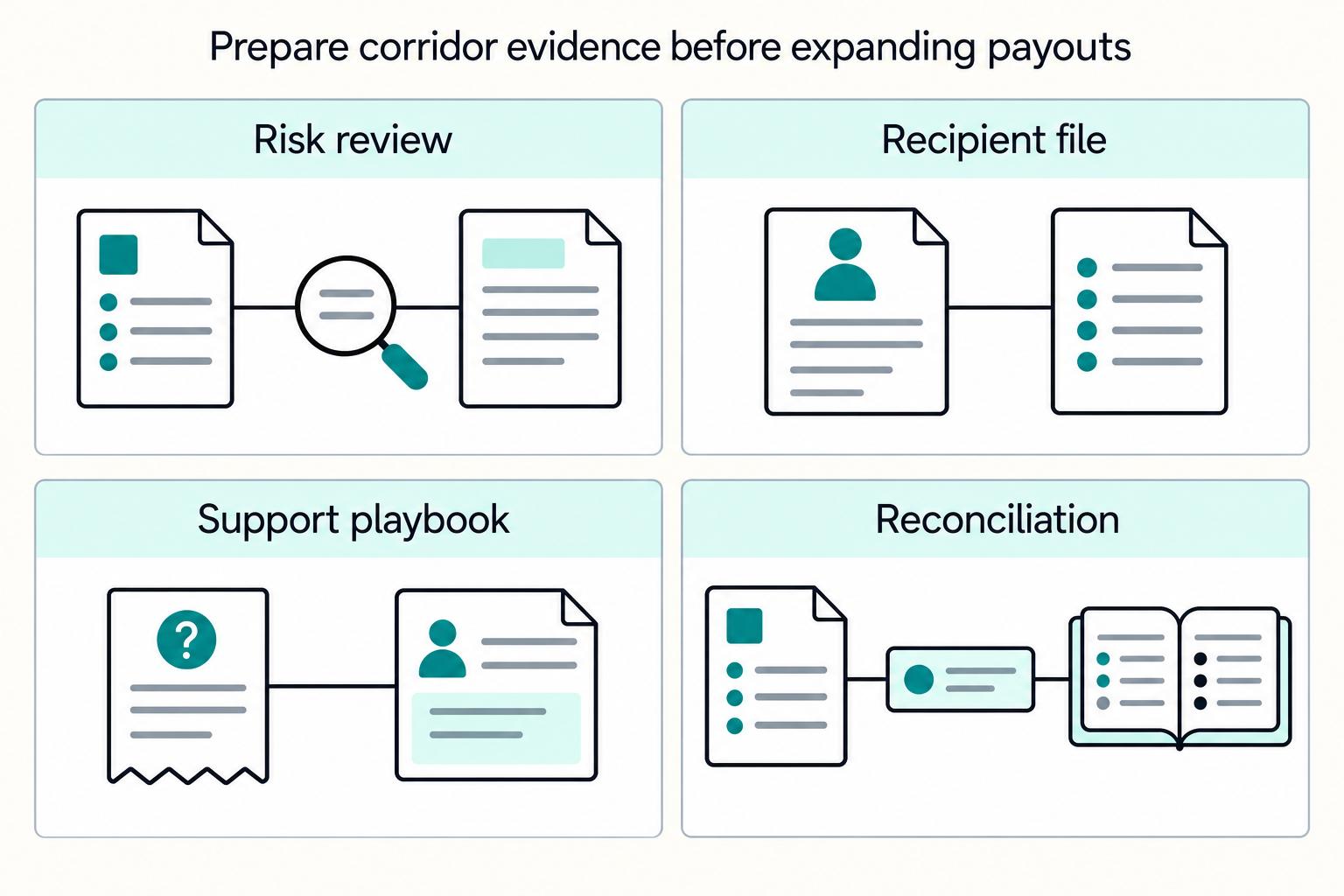
Set go or no-go criteria before engineering starts. Use four gates: compliance readiness, recipient management, support handling, and reconciliation coverage. If any gate is unclear, delay launch even if the provider lists that country as supported, including broad claims like support in over 156 countries.
For compliance, run a risk-based review across products, customers, transactions, and geographies. For recipient onboarding, confirm required information by account location, business type, and requested capabilities, then document expected identity documents per country. Create one corridor evidence pack with required recipient fields, document requirements, sanctions-screening path, and escalation owner.
Require support playbooks and payout-state coverage before go-live. Before launch, support should have clear procedures for three common cases: receipt confirmation, cancellation, and "payment not received." If support needs engineering to answer those cases, the corridor is not ready.
Also confirm your payout tracking reflects the real operational states for that corridor, especially when compliance checks happen before funds move. Avoid generic status handling that hides verification or sanctions-review blockers.
Prove reconciliation coverage for the exact payout type you will offer. The minimum bar is that finance can reconcile each payout to the transaction batch it settles. If the corridor includes instant payouts, assign explicit ownership for reconciling those against transaction history.
Run a small end-to-end test set across successful payouts, failed payouts, and investigation cases. For each case, verify finance traceability, support explainability, and ops recovery steps.
Choose rollout sequence by operational similarity and demand. Use operational similarity to inform sequencing, then prioritize strategic demand. This is a practical sequencing rule, not a universal best practice.
Consider one-corridor-at-a-time when recipient requirements, support handling, or reconciliation logic are new. Consider parallel launches when corridors share recipient data requirements, support procedures, payout-state behavior, and settlement treatment. If country feature availability or verification paths differ, split the launch into phases.
Common scaling mistakes and how to recover fast#
The scaling failures that hurt most are usually control failures, not throughput limits. Finance cannot close cleanly, routing ownership is unclear, automation hides exceptions, and batch and real-time rails get treated as interchangeable.
Fix reconciliation before you chase speed. If finance is still cleaning up unmatched items at close, faster payouts are not a win yet. Make close-readiness a release gate before the next scale push.
For each payout type, run a daily checkpoint that ties the payout request, provider reference, and ledger posting to one timeline. For real-time rails, use advices, acknowledgements, and debit or credit notifications that support real-time reconcilement instead of relying on a later export. A practical check is whether finance can explain one successful payout, one failed payout, and one unmatched payout without engineering log review.
This gets stricter on instant rails. FedNow is built for 24x7x365, reporting can be generated seven days a week, and the cycle day is generally 7 p.m. to 7 p.m. ET. If your accounting cycle still assumes business-day-only settlement, weekend backlog is likely.
Assign routing authority before adding another provider. Multi-provider routing is most likely to improve resilience when authority is explicit. Without clear ownership, teams can see provider sprawl, inconsistent support responses, and disputed incident decisions.
Document routing governance by function: product owns the customer promise, engineering owns rules and observability, finance owns settlement and reconciliation impact, and risk or compliance owns route restrictions. Accountability stays with your institution even when providers execute parts of the flow.
Your verification check is operational clarity, not technical failover alone. Who can authorize a route change during an incident? Who can disable fallback? Who approves making a temporary route permanent? If those answers are not settled in advance, adding providers can raise risk instead of improving resilience.
Slow automation until exception handling is real. Automation without a mature exception playbook can delay visible failure rather than preventing it. Recovery starts by codifying top incident classes and first-response steps.
Use a short playbook with the lifecycle detect, respond, recover. At minimum, define handling for duplicate-risk alerts, delayed provider acknowledgements, compliance holds, recipient data mismatches, and payment-not-received investigations. For each class, name the detection signal, first owner, customer-facing status, and escalation trigger.
Also prevent pending forever states after a timeout or webhook delay. Your playbook should state when to pause retries, when to investigate, and when to communicate externally, then feed lessons learned back into detection and recovery rules.
Split batch and real-time payouts operationally. Do not treat batch and real-time payouts as one interchangeable operational model. Shared infrastructure can work, but SLA, controls, and customer communication should be separated by payout type.
ACH is batch and store-and-forward, and ACH payments are not currently settled on weekends and federal holidays. FedNow runs continuously, including weekends and holidays. RTP settlement is final and irrevocable, and sending institutions generally cannot recall a submitted payment, so pre-send controls matter more than in reversible flows.
Recovery is to split templates and decision rules by rail. For batch payouts, center cutoff and settlement-day expectations. For real-time payouts, center pre-send validation, immediate exception review, and 24x7 escalation for high-risk cases.
Related: Airline Delay Compensation Payments: How Aviation Platforms Disburse Refunds at Scale.
30-60-90 day execution checklist#
By day 90, you should have evidence that status logic, retry safety, reconciliation, and incident handling work under production conditions. If that evidence is missing, hold expansion.
Lock the control surface in the first 30 days. Start by defining one payout status taxonomy and enforcing it across teams. Include clear terminal states such as paid, failed, and canceled, and separate long-pending cases from failure assumptions because some payout traces can remain pending for up to 10 days after arrival_date.
Enforce idempotency on payout creation and retry paths. Your pass or fail check is simple: reusing the same request key must not create a second payout, including after timeouts or webhook delays.
For recipient management, document the verification and document checks required before payout. At least one major platform model requires recipient verification before funds can be paid out. Close this phase by writing baseline go or no-go criteria for corridor launches.
Productionize the back office by day 60. By day 60, reconciliation should be provable at transaction level, not just visible in summary dashboards. Tie payout request, provider reference, and ledger posting to one traceable record, and keep a settlement details report, or equivalent transaction-level artifact, available to finance.
Formalize the exception-handling playbook so ownership is explicit: who identifies, coordinates, recovers, and tracks each incident class. If teams still need chat escalation to find an owner during an exception, this phase is not complete.
Rehearse resilience by day 90. By day 90, run corridor launch drills with the same operators who handle real incidents. For single-provider routing, test response decisions and customer communication. Where multi-provider routing is in scope, test failover authority, reconciliation impact, and rollback conditions before release sign-off.
Use this checklist artifact.
| Team | Owner | Checkpoint date | Release blocker | Sign-off criteria |
|---|---|---|---|---|
| Product | Named PM | Day 30 | Go/no-go criteria incomplete | Status model and launch gates approved |
| Engineering | Named tech lead | Day 30 and 90 | Idempotency or resilience drill test fails | Duplicate prevention and resilience drill tests pass |
| Finance | Controller or finance ops lead | Day 60 | Reconciliation workflow not provable | Transaction-level tie-out works |
| Risk or Ops | Compliance or ops manager | Day 60 and 90 | Recipient management or playbook gaps | Verification rules and exception handling playbook approved |
Turn this checklist into a testable rollout plan with explicit webhook, idempotency, and status checkpoints using the Gruv docs.
Conclusion#
Treat scale as a controls problem first. Prioritize recipient readiness, execution safety, and launch discipline instead of throughput alone.
If the same issues keep showing up throughout this article, that is the signal. Remove ambiguity before money moves, not after support, finance, and engineering are already trying to reconcile conflicting states.
Standardize recipient management before adding volume or new corridors when possible. If a recipient is not fully onboarded and verified, they should not be payable. In at least one major platform model, onboarding and KYC completion are explicit prerequisites for payout.
Set one shared recipient-state model that ops, risk, support, and engineering all interpret the same way. Repeated tickets about missing bank details, name mismatches, or incomplete onboarding are launch blockers, not cleanup work. Avoid urgent bypasses of recipient checks, because they can create preventable returns and manual rework.
Harden payout execution and status logic as a parallel control track. Retries should be safe, and every status change should be explainable from one standard timeline.
Use idempotency keys to prevent duplicate side effects during retries, and make retention behavior explicit in your operating documentation. One common API pattern allows pruning only after keys are at least 24 hours old. Map internal statuses cleanly to provider webhook events that report transfer progress and status changes. Before each release, prove in test or staging that duplicate prevention works, replayed events do not create new payouts, and delayed webhooks resolve to the correct final state.
Expand payout corridors only when your controls are ready. Use go or no-go criteria that require evidence, not optimism.
The G20 cross-border program emphasizes speed, transparency, access, and cost, which is a useful check against treating throughput as the only target. Corridor expansion adds legal, regulatory, and cross-border data and message-standard complexity, so treat each launch as an operational release. Your sign-off pack should include recipient data and KYC prerequisites, payout schema and event mapping, exception ownership, and reconciliation plus payment-order record retention expectations. In the US, banks must retain core payment-order records for funds transfers of $3,000 or more, so traceability cannot end at a provider dashboard status.
Use this as a control-first operating pattern, not a universal rollout sequence. Do not force a fixed 30-60-90 cadence. Assign owners, run the checklist against real gaps, and block launches that fail your defined go or no-go criteria.
Need the full breakdown? Read How Platforms Use Virtual Accounts to Reconcile Incoming Payments Per Client.
When you are ready to put these controls in place in production, map your target flow against Gruv Payouts to confirm coverage, gating, and batch handling needs.
Frequently Asked Questions
What breaks first when scaling a global payout platform from low to high monthly volume?
As monthly volume rises, pressure usually shows up in operations around recipients, approvals, and exceptions, not just in sending a payout API call. Tracking reliability also gets harder when payout status is difficult to reconcile across systems. As you add countries, currencies, and regulatory variation, that operational burden becomes harder to control.
When should teams move from manual handling to payout automation?
There is no universal monthly-volume threshold. Move when manual handling starts delaying payouts or finance cannot cleanly tie payout requests to settlement. Prioritize automation that covers batch processing, API-triggered payouts, and automated reconciliation.
What should be standardized before opening new payout corridors?
Standardize recipient data requirements and pre-funds compliance checks first. Validate recipient details up front, including name, address, and bank credentials, to prevent avoidable payout failures. Before funds move, run identity, sanctions, and required regulatory checks.
Which controls best prevent duplicate or failed payout execution?
Idempotent retries are a core duplicate-prevention control. If a request times out, resend it with the same idempotency key so it is treated as the same request instead of creating a second payout. Pair that with clear retry and exception playbooks.
How do you decide between single-provider routing and multi-provider routing?
Start by comparing coverage needs against operational burden. A global payouts platform model can reduce the technical and regulatory burden of building direct country-by-country connectivity yourself. Add multi-provider routing only when the added failover and reconciliation complexity is justified.
When are batch payouts better than real-time payouts?
Batch payouts fit high scheduled volumes where controlled processing and reconciliation matter. Real-time rails support immediate recipient access and always-on operation, but availability varies by corridor, and settlement can be final on some rails. In the US, Same Day ACH remains windowed, unlike always-on real-time rails such as FedNow.
What unknowns should be verified before a corridor launch goes live?
Verify corridor-specific recipient data requirements, compliance requirements, and payout tracking behavior before launch. Sanctions controls should be risk-based and scoped to your products, customers, transaction types, and geographic exposure. Before go-live, confirm reconciliation and exception-handling workflows if initial payouts stall.
Try a related tool
Where Gruv fits
Plan and approve payout batches
See how payee status, approval rules, route review, and exception handling sit in one payout workflow.
See reconciliation and mismatch review
Compare ledger entries, provider payment records, and statement rows to see what matches and what finance needs to review.
Researched and edited by the Gruv editorial team. Gruv builds cross-border billing, payouts, and finance-operations software for global businesses.
Sources
- bsaaml.ffiec.gov/manual/OfficeOfForeignAssetsControl/01trusted
- cisa.gov/news-events/news/cisa-releases-incident-and-...trusted
- cisa.gov/resources-tools/resources/federal-government...trusted
- consumerfinance.gov/rules-policy/regulations/1005/34trusted
- consumerfinance.gov/rules-policy/regulations/1005trusted
- csrc.nist.gov/projects/incident-responsetrusted
- ecb.europa.eu/press/intro/news/html/ecb.mipnews231017.en.htmltrusted
- ecfr.gov/current/title-12/chapter-X/part-1005/subpart...trusted
Educational content only. Not legal, tax, or financial advice.
Related Posts

The Freelance Payment Penalty: A Modeled Audit of Platform Fees, FX Spreads, and Payout Delays
The money rarely disappears through a single, easy-to-spot fee. The real loss is stacked. A marketplace takes its commission, a processor adds a charge for international cards, a bank or payment company converts the currency at a spread, a platform holds the funds before release, and a wire sheds a little to intermediaries on the way in. Each layer looks defensible on its own, but the worker feels the combined result as a smaller deposit and a later payday.

How to Respond to a Subpoena for Business Records
Move fast, but do not produce records on instinct. If you need to **respond to a subpoena for business records**, your immediate job is to control deadlines, preserve records, and make any later production defensible.
A US Expat's Guide to Investing in UCITS ETFs to Avoid PFIC Issues
The real problem is a two-system conflict. U.S. tax treatment can punish the wrong fund choice, while local product-access constraints can block the funds you want to buy in the first place. For **us expat ucits etfs**, the practical question is not "Which product is best?" It is "What can I access, report, and keep doing every year without guessing?" Use this four-part filter before any trade: