
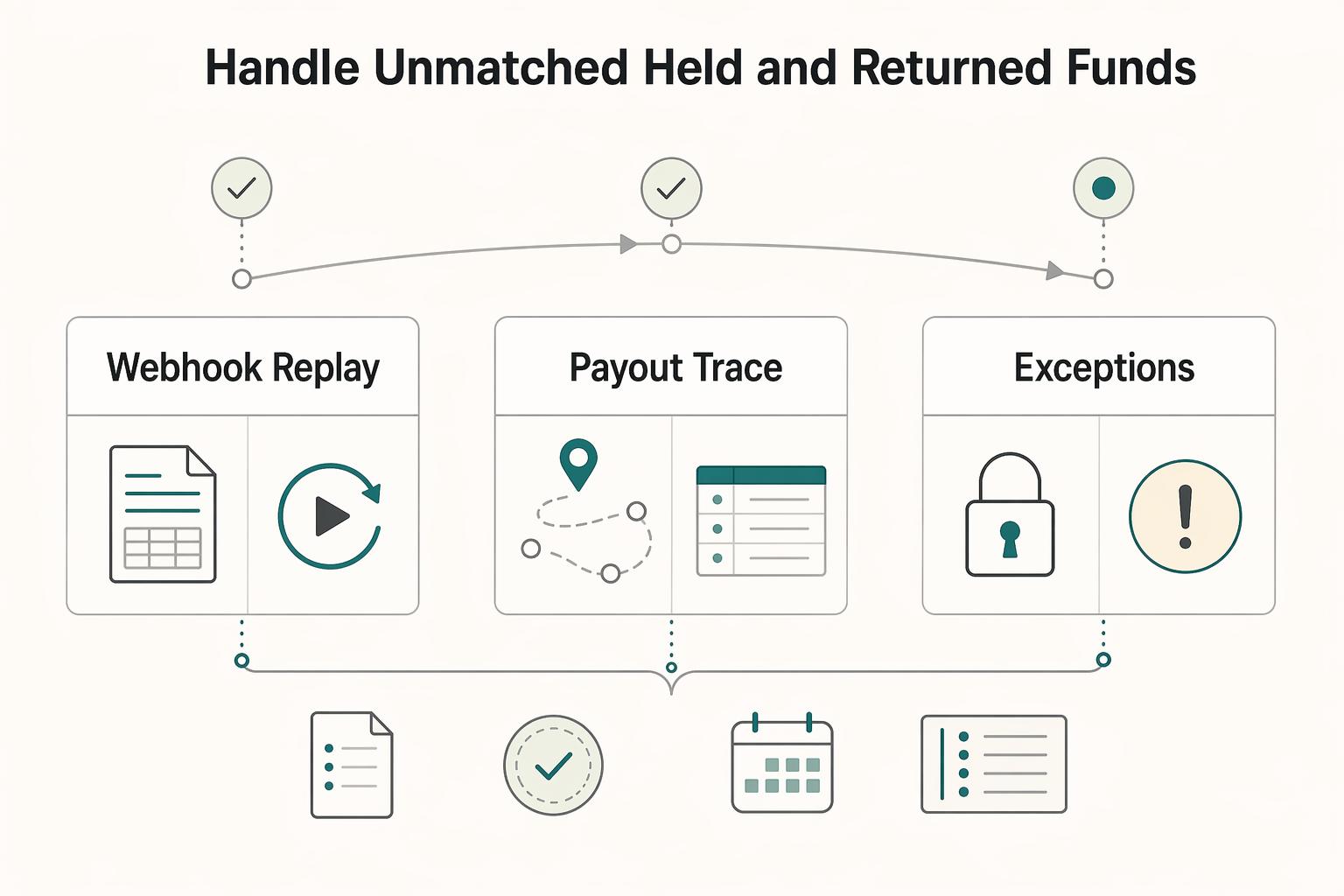
Quick Answer
Assign receive destinations at the client, invoice or request level according to payer behavior and provider support. Keep provider/account scope, movement identity, amount, currency, direction and historical assignment in the incoming-payment contract. Persist authenticated notifications durably and acknowledge before business processing. Deduplicate deliveries separately from financial effects, use recoverable posting/completion states, and prevent duplicate receipts across lifecycle events. Book confirmed unmatched cash to suspense, keep invoice application separate, and authorize payouts from authoritative available funds. Reconcile booked bank movements and balances to the ledger at a common cutoff, then check client allocations and exceptions.
Design payment attribution before integrating virtual accounts#
Virtual accounts can remove a lot of manual matching, but only if you design reconciliation into the product instead of treating it as cleanup after integration.
Assign a client a unique receive destination, then map receipts at that destination to the client. Invoice allocation is a second decision: one transfer may pay several invoices, arrive short, or leave an unapplied balance. A virtual account improves the first match; it does not make every invoice-settlement decision unambiguous.
For platforms, that promise usually depends on four surfaces working together:
- APIs with idempotency for retry-safe intake and attribution
- Webhooks for real-time event delivery
- Reconciliation logic that matches transfers to virtual account and invoice where supported
- Exception handling for unmatched or held funds
Treat webhook delivery as a notification channel. A payment can generate several lifecycle events and each event can be delivered repeatedly. Prevent duplicate delivery and duplicate financial posting separately.
Each confirmed inbound movement should link to its provider transaction, receive destination, accounting result and attribution decision. A missing client mapping prevents client release, but must not make confirmed bank cash disappear from the books.
Assume market and program variation from the start. Feature availability differs by region, and SEPA scope is jurisdictional. The ECB describes SEPA as covering 41 European countries, while the EPC maintains the formal scheme-country list. Validate rails, coverage, and timing assumptions for each rollout.
A product name does not establish the account structure. Modern Treasury’s virtual-account documentation describes different bank capabilities, including whether the bank maintains balances. Confirm the linked physical account, legal owner, client-ledger responsibility and access to booked transactions for your program before defining payout eligibility.
Use this guide as a working model. Keep allocation deterministic, keep event processing retry-safe, and maintain a hard path for exceptions.
What to Prepare Before You Build#
Do the design work first. Before you integrate, lock the flow, control boundary, accounting source of truth, and evidence pack.
1. Define the collection flow and expected load. Decide whether the destination receives invoice settlements, wallet funding or intercompany collections. Identify who legally owns the funds and whether your platform acts as principal or custodian. This guide focuses on incoming payments; outbound payment support must be assessed separately.
For each flow, define three fields up front: inbound rail, credited account, and internal entity for attribution. Also define your normal volume shape, not just monthly totals, because high-volume ACH or wire intake can behave differently from invoice-settlement flows when exceptions occur.
2. Confirm the integration boundary. Decide early whether reconciliation depends on direct provider APIs or a BaaS/intermediary model. That boundary changes operational control and risk, and in some bank-fintech setups third parties can run key records and payment operations.
Before you design rules, confirm what data you actually receive. If the intermediary exposes only normalized data, do not design around raw webhook events, statement files, or provider references you may never get.
3. Define the accounting authority. Use an authoritative transaction ledger for client balances, with a documented reconciliation to the finance GL. They may be separate systems with different detail. Derive product views from the transaction ledger and account for timing differences in the GL feed instead of letting both systems independently create client credits.
Before enabling spendability, establish confirmed receipt and the relevant ledger posting, then pass the release policy. One payment can have several accounting transitions; the control is one posting per intended financial effect, not one journal per webhook.
4. Assemble a shared evidence pack. Build a shared pre-launch evidence pack for product, ops, and finance: sample webhook JSON payloads, representative payment or statement files, and reconciliation outputs.
Include booked bank transactions and opening/closing balances, for example from camt.053 where available. Compare them with provider events and ledger entries. Add duplicate, out-of-order, missing-event and crash-recovery cases so the team can prove that transport failure does not change the financial result.
Use the provider’s bank-account and incoming-payment documentation to confirm which fields are available on your actual rail. A sandbox payload alone does not establish production statement coverage.
Choose the Right Allocation Model Per Client#
Pick identifier granularity based on failure tolerance. For multi-invoice payers, a client-level virtual destination is often a practical starting point; move to per-invoice identifiers when exact invoice attribution is mandatory.
1. Compare allocation models. Per-client, per-invoice and per-request identifiers solve different matching problems. Availability depends on the provider. Stripe’s bank-transfer invoice guidance describes stable customer funding instructions across invoices; an invoice on that system does not imply a distinct bank-account number for every invoice.
| Model | Best fit | What usually drives attribution | Operational overhead | Main failure risk | Lifecycle controls to define |
|---|---|---|---|---|---|
| Per client | Recurring payers with many open invoices | Persistent client-specific destination plus payment reference | One persistent identifier per client | Client is identified, but invoice attribution fails when the reference is missing or mistyped | Reassignment and exception rules for unmatched references |
| Per invoice | Invoice settlement where exact invoice matching matters most | Invoice-specific destination or invoice-specific identifier | Identifier issuance and tracking at invoice cadence | Payments may arrive after an invoice identifier is disabled | Disablement policy and post-close handling for late funds |
| Per transaction | One-off collections or high-control payment requests | Unique identifier per expected payment event | Identifier issuance per payment event | Lifecycle drift if identifiers are not retired and monitored | Explicit create/disable ownership and non-reuse controls |
2. Choose based on payer behavior. A repeat payer settling several invoices benefits from stable client instructions. Store the client destination separately from the invoice allocations so finance can change an application decision without inventing another bank receipt.
A client destination identifies the client even when the invoice reference is missing. Keep the receipt unapplied to invoices until an approved allocation rule or investigation resolves it. A strict-reference policy is one option; other documented rules can use amounts, dates and open invoices. Do not present your platform’s policy as a universal provider requirement.
For example, Stripe can reconcile by reference, exact amount or combinations of invoices. If your business requires customer-approved allocation, assess manual reconciliation rather than assuming the provider’s automatic choice expresses the payer’s intent. For a provider supporting per-invoice destinations, test what happens to partial, excess and late payments before adopting that model.
3. Match the model to the rail and region. Your rail and region should constrain the model choice. In SEPA contexts, IBAN-based addressing aligns with standardized payment-account rails for euro transfers and direct debits.
For a pooled vIBAN program, identify the linked physical account and the ledger assigning funds to clients. Do not generalize its legal account structure to every product marketed as a virtual account. Confirm supported inbound rails, currencies, account holder and provider reconciliation data separately; SEPA membership does not prove that your specific program supports every SEPA scheme.
In Australia, local account numbers or receive aliases may be used instead of IBANs. Treat each alias as part of the provider-specific destination mapping; do not infer per-invoice issuance, finality or payer identity merely from an alias being present.
4. Define retirement and misroute rules. Establish whether identifiers can be disabled, what happens to later transfers, and whether a retired identifier can ever be reassigned. Prefer non-reuse for client identifiers unless the provider and your historical mapping can safely distinguish old payments.
Keep an identifier registry with provider and account scope, currency, assigned entity, effective start/end dates, and status. Resolve a late receipt against the historical assignment applicable to that payment, not just the identifier’s current owner. Preserve closed assignments for investigation.
Before go-live, test these cases:
- Active client-level identifier with missing or incorrect invoice reference
- Payment sent to a disabled invoice-level identifier
- Misrouted payment sent to the wrong client destination
Target controlled failure, not perfect automation. You want a clear attribution state and a defined hold path when confidence drops.
Before you lock the allocation model, map your assumptions against Gruv’s Virtual Accounts flow so account assignment, status handling, and reconciliation ownership are defined upfront.
Define the Reconciliation Data Contract#
Define the inbound reconciliation contract before go-live so every incoming event maps deterministically in your internal model or lands in an explicit exception state. If an event cannot map through a documented path (including null handling), hold attribution instead of guessing.
1. Standardize your canonical inbound fields. Do not let provider payload shapes become your internal model. Create one canonical incoming-payment record across APIs and webhooks, then map provider-specific fields into it.
For many platform designs, that canonical record can include:
- amount in documented minor units, currency and direction
- provider/program/account scope and financial movement identifier
- virtual account or equivalent destination, with historical client mapping
- payer and invoice references when available, plus explicit null handling
- booking/effective date, provider status, delivery identifiers and source version
Include provider and account scope, delivery ID where present, financial movement ID, event type, observed status, effective/booked date and receipt timestamp. Store an API/schema version. A timestamp is useful evidence but is not universally sufficient to order events or identify duplicates.
For each provider, test real webhook or API samples and document each canonical field as mapped, transformed, or explicitly allowed to be null. Mark customer-entered free text as lower-confidence input.
2. Define mapping and accounting outcomes separately. Every notification should have a processing result, but not every notification creates a journal. Confirmed cash with unknown client attribution posts to the approved suspense treatment; a pre-notification with no confirmed movement remains a pending record.
Modern Treasury’s incoming-payment object includes amount, currency, direction, internal account and transaction links. A nullable virtual-account field does not authorize mapping every payment on a pooled account to one client. A nested-account fallback is safe only when the referenced account has a unique, documented client assignment.
Use the fallback only within the correct provider, account, currency and historical assignment. Otherwise create an unmatched case. Retain confirmed receipt in suspense while attribution is investigated; do not silently choose a default client.
3. Define spendability policy by attribution confidence. When identifier quality is weak, you can separate cash receipt from spendability as a platform policy choice. Where the receive address is unique, matching can rely on that address. Where transfer or static-memo flows depend on sender-entered reference text, missing reference data is a known reconciliation risk.
One practical policy is to record receipt in your books, but delay wallet spendability until attribution confidence meets your threshold. Route incomplete records to a fallback queue with provider reference, raw payload, receive identifier, and arrival time.
4. Split customer-facing identifiers from internal trace IDs. Expose only what payers can reliably use, usually the receive destination and, when required, a short invoice or payment reference. Keep internal trace fields internal, including provider event IDs, internal_account_id, and idempotency metadata.
Keep payer instructions stable and internal identifiers private. Webhook authenticity and durable receipt belong to intake; client attribution and posting belong to the worker. Return the provider’s required acknowledgement only after the message is durably retained, before lengthy business processing.
Keep this data contract versioned as an operational document, not only in code comments, so product, engineering, finance, and ops review the same mapping and exception rules when payloads change.
Build the Ledger and Event Sequence#
Use the transaction ledger as the authority for client funds, with finance-approved double-entry rules. Product balance tables are projections. Posted financial entries must remain auditable; corrections use linked adjusting or reversing entries rather than editing history.
1. Record notification delivery and financial identity separately. Verify the provider’s authenticity mechanism and retain the message durably. The worker records the delivery outcome and derives the underlying financial operation from provider/account scope, movement ID and intended transition. API request idempotency keys are a separate control for outbound commands.
Stripe’s API idempotency rules allow keys up to 255 characters and pruning after at least 24 hours. That request cache is not your financial history. Retain durable movement-level posting identifiers for your reconciliation and recovery horizon, including manual replays.
For an inbound movement, answer both questions: which notifications described it, and which financial effects have already been committed? A later status notification must not create a second receipt credit.
2. Commit posting and processing completion safely. Within a local transaction, enforce uniqueness of the financial operation, write balanced entries, record completion and enqueue the projection update through an outbox. Do not mark a message processed in one transaction and then post in another: a crash between them can lose the payment.
If the ledger is an external service, use a stable operation key, retain the intent and journal reference, and recover an ambiguous timeout by querying or safely retrying that same operation. Mark processing complete after confirming the ledger result. Modern Treasury’s ledger guarantees describe atomic entries and unique external identifiers; those guarantees do not make an unrelated local database update atomic.
Link the financial operation to provider evidence, journal entries and any invoice allocations. Missing client attribution uses suspense for confirmed cash, while missing movement confirmation uses a pending state. Reclassifying suspense to a client is another balanced operation, not another receipt.
3. Use auditable internal statuses with transition evidence. Use a clear internal status model that finance, ops, and engineering interpret the same way. Labels can vary by platform, but each state transition should carry evidence for why it happened.
Use separate status dimensions for bank movement, attribution and release: for example, booked/unbooked, matched/unmatched and held/releasable. Record allowed transitions and evidence. A delayed “pending” event must not overwrite a confirmed return or restore availability; use provider sequence/version rules or retrieve authoritative current status when ordering is ambiguous.
4. Decide whether wallet balances can lag, then monitor that lag explicitly. Assume asynchronous behavior in event-driven intake, and design for eventual consistency from the start. If your product can tolerate delay, keep wallet projection asynchronous and track journal-to-wallet lag as its own operational metric.
An asynchronous projection can serve display balances, but it should not independently authorize payouts from stale positive data. Check available funds and create payout reservations atomically against the authoritative ledger or an equivalent locked authority. Retry a failed projection update independently from the already committed receipt.
A worked example makes the financial transitions explicit. Assume USD customer funds are held in a pooled bank account and recorded as liabilities to clients. Finance may require a different chart for a merchant receiving its own receivables; the following entries illustrate the custodial model only.
A bank books $1,000 at client A’s destination. Post debit bank cash $1,000 / credit client-A funds liability $1,000 once. If the client cannot be identified, credit unapplied-receipts suspense instead; once resolved, debit suspense / credit client-A liability. No second debit to bank cash is created. If $400 pays invoice A1 and $500 pays A2, record allocation links totalling $900 and leave $100 unapplied. In this example invoice allocation tracks application of client funds, not new platform revenue or another cash receipt.
Suppose a confirmed $200 return occurs before any payout and with enough client funds remaining. Post debit client-A liability $200 / credit bank cash $200, link the original receipt, and reduce release capacity. If funds were already paid out, use the finance-approved receivable/loss treatment rather than silently discarding the return or hiding a negative position. Post provider fees and FX conversions separately with their own evidence and currency-balanced entries. For the allocation schedule, consume the $100 unapplied amount and reverse $100 of A2’s $500 application, reopening that invoice balance. A1 remains applied at $400 and A2 at $400, leaving $800 applied and $0 unapplied. Record the allocation correction and its link to the return; do not leave $900 applied against $800 of remaining funds.
At a daily cutoff, reconcile opening bank cash plus booked credits minus booked debits to closing bank cash, then bridge that amount to ledger cash. In this simple zero-opening example, $1,000 received minus $200 returned gives $800 cash and $800 client liability. Client liabilities plus suspense should tie to corresponding held cash, with fees, FX, funds in transit and other approved differences listed explicitly. Compare client-level movements too: matching the pooled total alone can hide a credit assigned to the wrong client.
Related reading: How to Reconcile Bank Statements in Xero.
Harden Webhooks and Idempotent Retries#
Once posting order is fixed, transport is where reconciliation can break. Treat webhooks and retrying APIs as unreliable delivery channels, not proof that money moved exactly once. Design for duplicate delivery, replay, and manual resend so a provider event does not produce duplicate financial outcomes.
1. Verify, retain durably and acknowledge. Follow the webhook type’s authentication scheme; do not assume every provider signs the same fields or uses the raw request body. An unauthenticated message must not enter trusted financial processing.
Adyen’s handling guidance describes verification, durable storage, a successful acknowledgement and then business processing. It expects acknowledgement within 10 seconds. If durable storage fails, return the appropriate failure response so delivery can retry; acknowledging an in-memory message risks losing it.
At minimum, persist provider event ID, received timestamp, signature-check result, payload hash, and processing status. That record is your replay evidence when multiple deliveries appear but only the intended journal effect is valid.
2. Separate delivery deduplication from financial idempotency. Preserve each delivery for traceability, then enforce the intended financial effect once. Stripe’s webhook guidance distinguishes duplicate event IDs from separate events describing the same object and event type. It also warns that event order is not guaranteed. Define provider-specific keys rather than assuming every webhook has a globally unique event ID.
Use a recoverable received/processing/completed/failed state machine. A lease can prevent concurrent workers but must expire after worker failure. Enforce the financial-operation uniqueness at commit, so two workers racing or retrying after a timeout cannot credit twice. Do not use a temporary cache entry as the sole proof that a payment was posted.
3. Split transient failures from data-quality failures. Use separate retry paths for transient failures and data-quality failures. Timeouts, temporary 5xx responses, and brief dependency outages should retry automatically. Malformed payloads, missing required identifiers, or format mismatches should stop retrying after your defined attempts and move to a dead-letter queue or topic with a clear reason.
Assign an owner to the dead-letter queue and retain the failed payload, reason and original operation key. Re-drive a repaired message with that key, not a new financial identity. A missing client reference needs investigation; repeating the same lookup forever does not improve its data.
4. Check the intended financial outcome. A notification-only transition may require no journal. A confirmed credit, return or correction should link to its expected posting and attribution state. Detect completed messages with missing journals, journals without a processed-operation record, and projection updates that have not caught up.
Attach an evidence pack to each checkpoint: provider reference, webhook event ID, dedupe decision, and current exception state, plus journal or attribution record IDs where applicable. If your team cannot quickly answer whether an event was rejected, replayed, dead-lettered, or posted from the record set, support and close cycles will degrade fast.
Handle Unmatched, Held, and Returned Funds#
When attribution confidence is low, hold the funds, route the event to a named exception queue, and require manual resolution rather than auto-crediting on similarity alone.
1. Route each exception into a specific queue. Use a small internal exception taxonomy so ops can triage immediately, for example: unmatched payer, missing reference, compliance hold, return or reversal, and duplicate event suspicion. Keep “unidentified” and “unapplied” receipts in this flow too.
If bank cash is confirmed but the business partner is unknown, book the receipt in suspense and open an investigation. If the client is known but the invoice is not, retain the client’s unapplied amount separately. Neither case justifies inventing an invoice match to clear queue volume.
2. Investigate with a consistent evidence pack. Before changing money state in the GL, use the same minimum evidence set each time, such as: provider reference, receiving account or virtual account identifier, webhook delivery history, and accounting trail.
Before a manual correction, look up existing committed operations and provider status. Preserve the correction’s operation key so a later transport retry reaches the same financial outcome. Operators need not wait for every possible redelivery to finish when the operation is already safely idempotent.
3. Hold low-confidence funds instead of guessing. If identifiers do not clearly tie to the right client or invoice, keep funds held or unapplied until manual confirmation. Do not release funds based only on close payer name, amount, and date alignment.
Keep received, attributed and releasable amounts distinct. Apply the specific program’s review or legal restriction, including any reporting requirement, rather than borrowing a generic 72-hour hold or ten-business-day deadline from another product or jurisdiction. Record the hold reason, owner and release evidence.
4. Apply returns without racing payout reservations. A confirmed return must reduce the authoritative release capacity and create its linked accounting effect. Coordinate that transition with payout reservations. If a payout is already irreversible, escalate the resulting shortfall and account for it; changing a wallet display cannot recall the funds.
Persist the provider’s linkage to the original movement and distinguish a return request from a confirmed return. Link any partial return by amount and currency. Use the relevant bank-transfer event model; card cancellation/refund events are not a substitute for incoming-transfer confirmation.
Add Compliance Gates and Audit Artifacts#
Treat receipt, credit, and payout eligibility as separate money states, and attach each state change to a named compliance gate instead of a generic “approved” flag.
1. Map policy gates to money states. Define the operational states up front: received, credited, held, withdrawable, and payout submitted. A payment into a Virtual Account can be real and reconciled before the account is cleared for withdrawals or payouts, so keep that separation explicit in product logic.
Use a hard rule: credited does not mean withdrawable. For payout-enabled accounts, verification requirements vary by jurisdiction, business type, and requested capabilities. In US legal-entity contexts, identity procedures (CIP) and beneficial ownership verification should sit before unrestricted money-out rights.
Test a client with positive ledger funds and a release restriction. New payout reservations should fail under that restriction even if the displayed balance has not refreshed. Define separately what can happen to an already submitted payout; cancellation capability and timing depend on its rail and provider.
2. Capture audit artifacts at each checkpoint. Store audit evidence at decision time, not during a later audit scramble. Each state change should link provider event, internal decision, and accounting impact.
At minimum, keep:
- decision log: actor, timestamp, reason code, prior state, new state, provider reference, linked journal ID
- approval record for any manual release or override
- webhook delivery metadata (Delivered, Pending, or Failed status, prior HTTP status codes, and future retry timing), plus restricted access to original payloads if retained
- reconciliation export finance can reproduce from the same dataset
Retain delivery history as evidence, but investigate the underlying movement as well. A delivered webhook is not proof that your worker posted it, and a completed journal is not proof that bank cash and client allocation reconcile. Each layer needs an independently visible outcome.
Define retention and retrieval requirements with the program owner for each record class and jurisdiction. Keep the posting chain and evidence retrievable for that period, with access controls and a deletion policy for unnecessary sensitive data. A single borrowed five-year baseline does not establish compliance for every platform.
3. Document market and program variance before launch. Publish one matrix before rollout that shows what changes by geography and program configuration. Cover supported rails, onboarding requirements, payout eligibility, and limited-release features in your provider setup.
For vIBAN programs, distinguish the contractual account structure, issuer and underlying bank, supported schemes, legal ownership and client-ledger responsibility. For local receive aliases, record the mapping and provider limitations. Neither naming convention proves that funds are safeguarded, insured or available for withdrawal.
4. Minimize PII in operator tools and event flows. Design for minimum necessary data exposure. Operators usually need enough detail to investigate, not full bank data or raw identity documents in every queue.
Use masked operator views, appropriate encryption, restricted access and audited retrieval of sensitive payloads. Keep derived events limited to the fields needed by each consumer. Security choices should reflect applicable data-protection duties and risks, rather than treating one regulation as a universal encryption specification.
Virtual Accounts can automate reconciliation without exposing your real bank account details to customers, but that benefit is reduced if sensitive payment data is copied across ops tools, exports, and alerts.
Track Operational Success Beyond Vendor Claims#
Measure success with your own operating data, not provider claims. The three metrics that hold up are straight-through attribution rate, exception queue age, and close-cycle delay.
1. Define three metrics with stable denominators. Straight-through attribution is the share of distinct confirmed incoming movements attributed correctly without manual intervention. Count movements rather than deliveries. Track invoice application and release approval separately so a correctly matched but legitimately held receipt does not become a matching failure.
Track exception queue age as a risk signal, especially the age of the oldest unresolved item. This follows the same operating pattern as oldest-message age alerts. Rising oldest age can signal stranded work that queue volume alone may miss.
Own close-cycle delay with finance as calendar days from initial monthly trial balance to completed monthly statements. Compare before and after on that timeline instead of claiming generic efficiency gains.
2. Validate automation with your own records. Compare the same traffic scope and measurement period before and after rollout. A vendor percentage is not evidence of your platform’s close improvement; include late exceptions and returns in the follow-up.
Run a before-and-after comparison on live traffic. For each payment, verify whether attribution completed without manual action, whether exceptions appeared later, and whether journal, client balance, and provider reference still aligned at close.
3. Tie reconciliation to downstream outcomes. Measure manual interventions, invoice application accuracy and payout delays caused specifically by attribution or ledger errors. Keep legitimate settlement or compliance delays separate, so improving matching does not appear to eliminate every reason funds are unavailable.
A useful dashboard shows confirmed receipts, unmatched cash, unapplied client amounts, held funds, committed payout reservations and the age of each exception. Finance should be able to explain the bridge from bank cash to client balances at the reporting cutoff.
For an adjacent accounting workflow, see bank-statement reconciliation in Xero. The platform still needs its own per-client ledger and custody model.
Common Build Mistakes and Fast Recovery Paths#
Many reconciliation failures can be traced to four predictable build mistakes. If attribution stalls or exceptions age, fix them in this order: account model, replay safety, identifiers, then edge-status handling.
1. Re-anchor funds on the Settlement Account and Ledger. Treat virtual accounts as attribution rails unless your provider explicitly defines them as balance-holding accounts. In many bank-led models, virtual accounts are sub-ledger identifiers linked to a physical account (Master Account), and transactions post to that linked physical account.
Recovery: trace one bank movement through its provider transaction, confirmed cash posting, client or suspense allocation and release state. Compare the whole pool and each client. A wallet projection can help display the result, but it must not be the sole evidence used to rebuild bank accounting.
2. Repair crash recovery before trusting automation. Keep durable intake, recoverable processing and unique financial-operation keys. Test a crash before posting, after ledger success but before local completion, and before the projection update.
Expected recovery is specific: the first case posts once on retry, the second retrieves the already committed journal, and the third rebuilds the projection without reposting cash. Test concurrent workers as well as sequential redeliveries. Provider request-cache expiry should not erase your movement history.
3. Replace free-text matching with deterministic identifiers. Do not use free-text references as your primary attribution key. Use a unique virtual-account identifier, or another deterministic internal key, for auto-attribution, and treat payer-entered text as supporting context only.
Use deterministic destinations for client attribution where the provider exposes them. Invoice application can follow a documented allocation rule, but ambiguous cross-client matching needs investigation. Missing attribution blocks client release while confirmed cash remains in suspense.
4. Separate pending, booked and returned funds. Define handling for notifications before booking, confirmed receipts, partial returns, failed return requests and missing notifications. Do not convert every provider status into a new cash credit.
Run a tabletop with actual bank-transfer payloads and booked transactions. Include a late pending event after a return, a duplicate notification with a different delivery ID, and an event missing from webhooks but present on the statement. Require the same trace for each: financial movement, committed posting, attribution, release impact and reconciliation evidence.
Launch checklist: prove attribution, posting and reconciliation#
For a confirmed receipt, finance should be able to trace the bank movement, committed journal, client or suspense assignment and release state. For a notification with no financial effect, the processing record should explain why no journal was required.
1. Choose and document the allocation model before launch. Pick per client, per invoice, or per transaction, write down the tradeoff, and name the failure mode you are accepting.
Your proof point is operational. For any inbound payment, an operator can identify the expected virtual account identifier, its internal mapping, and the fallback when the payer uses the wrong identifier. If that logic lives only in code or tribal knowledge, document it before shipping.
2. Finalize the reconciliation data contract across APIs and webhooks. Require at least virtual account identifier, provider reference, amount, currency, date, and your internal attribution reference. Keep description as supporting evidence, not a primary key.
Keep the contract versioned and test null values. Verify authenticity using the webhook type’s documented scheme; do not assume all HMAC methods sign an unmodified raw body. Preserve both delivery identifiers and the underlying movement identity.
3. Prove crash recovery and duplicate protection. Durably retain authenticated input, acknowledge according to the provider contract, then process with a unique financial operation and recoverable completion record. Commit ledger posting safely before projecting balances; authorize payouts from the authoritative release capacity.
Include duplicate and out-of-order delivery, manual recovery, an ambiguous external-ledger timeout, concurrent workers, and a booked statement movement whose webhook never arrived. Recovery must recreate missing work without changing already committed financial effects.
4. Launch exception queues and compliance gates before first funds arrive. Separate unmatched payments, held funds, returns or reversals, and suspected duplicates. If attribution confidence is low, hold funds for manual resolution instead of auto-crediting fuzzy matches.
Map booked cash, attribution, holds and reservations separately. Document compliance ownership and the applicable program rules. For SEPA transfers, map the provider’s reject, return and recall statuses to actual financial effects; a recall request is not itself a confirmed bank debit.
5. Validate audit outputs with finance, then baseline launch metrics in the first close cycle. Finance should be able to export or query a reconciliation artifact tying available provider request logs, webhook history, physical account posting, journal entry, and current client balance without engineering rebuilds.
At the first close, compare bank and ledger cash at the same cutoff and explain differences by movement. Reconcile client balances and suspense separately. Baseline attribution rate, exception age and manual interventions, then track which reconciliation defects actually delay payouts.
- Allocation model chosen and documented (per client, invoice, or transaction) with tradeoffs
- Reconciliation data contract finalized across APIs and Webhooks
- Idempotent retry and replay controls tested end-to-end
- Exception queues live for unmatched, held, and returned funds
- Compliance gates mapped to money states and payout eligibility
- Audit exports validated with finance before go-live
- Success metrics baselined for first close cycle after launch
If you need to assess account assignment, ledger responsibilities and provider coverage for a proposed flow, contact Gruv with the currencies, rails, jurisdictions and custody model. Those details define the implementation scope.
Frequently Asked Questions
How do Virtual Accounts actually reconcile incoming payments on a platform?
In a pooled virtual-account model, the unique destination helps identify the client while cash is booked in a linked physical account. The platform then records that movement once, attributes it to the client or suspense, and applies funds to invoices under its allocation policy. Reconciliation compares bank/provider movements, ledger entries and client-level records; receiving a webhook alone does not complete it.
What is the practical difference between a Virtual Account and a dedicated bank account?
A dedicated bank account has its own legal account structure and statements. A pooled virtual-account identifier can route payments into a linked physical account while a bank or platform ledger tracks client balances. Providers use the term differently, so confirm the actual account holder, custody arrangement and available statements rather than inferring legal ownership from the product name.
Should we assign Virtual Accounts per client, per invoice, or per transaction?
Use client-level identifiers for repeat payers when invoice application can be handled separately. Invoice-level or request-level identifiers can improve attribution when the provider supports them, but require retirement, late-payment and non-reuse controls. Stable customer funding instructions printed on an invoice do not necessarily create a distinct account for that invoice.
Which data fields are required for reliable auto-matching?
Include provider/account scope, movement identifier, amount, currency, direction, destination and booking status/date. Add historical client assignment and invoice references where needed. Define nullable fields and safe fallbacks. A pooled internal-account ID alone cannot identify one client when it represents many clients.
What should happen operationally when attribution fails?
Retain the confirmed bank movement in the ledger using suspense when the client is unknown, or a client’s unapplied amount when only the invoice is unknown. Open an owned investigation and block unsupported release. Deduplicate deliveries and enforce each intended financial effect once, including manual corrections and later provider redeliveries.
How do Virtual Accounts affect cash visibility and month-end close speed?
They can make attribution easier, but faster close depends on accurate movement-level posting, explicit exceptions and a reconciled bank-to-ledger bridge. Compare opening and closing balances and booked movements at a common cutoff, then verify client allocations. A matching pooled total can still conceal a payment assigned to the wrong client.
Try a related tool
Where Gruv fits
Researched and edited by the Gruv editorial team. Gruv builds cross-border billing, payouts, and finance-operations software for global businesses.
Sources
Includes 3 external sources outside the trusted-domain allowlist.
- docs.stripe.com/invoicing/bank-transfertrusted
- docs.stripe.com/api/idempotent_requeststrusted
- ecb.europa.eu/paym/retail/sepa/html/index.en.htmltrusted
- docs.adyen.com/development-resources/webhooks/handle-webhoo...external
- docs.moderntreasury.com/platform/reference/incoming-payment-detail-o...external
- docs.moderntreasury.com/ledgers/docs/ledgers-guaranteesexternal
Educational content only. Not legal, tax, or financial advice.
Related Posts

The Freelance Payment Penalty: A Modeled Audit of Platform Fees, FX Spreads, and Payout Delays
The money rarely disappears through a single, easy-to-spot fee. The real loss is stacked. A marketplace takes its commission, a processor adds a charge for international cards, a bank or payment company converts the currency at a spread, a platform holds the funds before release, and a wire sheds a little to intermediaries on the way in. Each layer looks defensible on its own, but the worker feels the combined result as a smaller deposit and a later payday.

How to Respond to a Subpoena for Business Records
Move fast, but do not produce records on instinct. If you need to **respond to a subpoena for business records**, your immediate job is to control deadlines, preserve records, and make any later production defensible.

A US Expat's Guide to Investing in UCITS ETFs to Avoid PFIC Issues
The real problem is a two-system conflict. U.S. tax treatment can punish the wrong fund choice, while local product-access constraints can block the funds you want to buy in the first place. For **us expat ucits etfs**, the practical question is not "Which product is best?" It is "What can I access, report, and keep doing every year without guessing?" Use this four-part filter before any trade: