
Quick Answer
Single-use virtual cards are best for supplier invoice payments in AP when card acceptance is confirmed and you need tight controls over supplier, amount, and expiry. They are a weaker fit for contractor payouts or any flow that depends on bank or debit cash-out. Use them alongside ACH, checks, or bank rails, with strong enrollment, reconciliation, and webhook handling.
Why Platforms Use Single-Use Virtual Cards#
Single-use virtual cards are often positioned as a fit for controlled vendor payments, but not for every contractor payout. This guide helps product, Payments Ops, and AP teams decide whether virtual cards fit their operating model, or whether cards belong alongside ACH, checks, or other payout rails.
A single-use AP virtual card is a credential constrained to an approved payment context, usually with amount and validity controls. Program definitions vary: one authorization is not always equivalent to one invoice payment when partial captures, reversals or retries are supported. Test the actual issuer lifecycle and supplier acceptance before assuming reuse is impossible.
The boundary is straightforward. In practice, contractor disbursement and vendor invoice settlement are often treated as different jobs. Many virtual card offerings are built around AP workflows, including ERP-initiated payment instructions, vendor enrollment, and transaction tracking. Providers also present virtual cards as one rail in a broader AP mix, not a universal replacement for every payout.
What you should expect from this guide#
This guide should leave you with three things:
- Scope boundaries: where cards are a strong fit, and where acceptance or reconciliation risk rises.
- Decision checkpoints: where instructions originate, who owns vendor enrollment, what finance needs for reconciliation, and how controls are enforced.
- Implementation workload: the operational burden around controls, exceptions, acceptance, and finance-system alignment.
What this guide is not#
This is not a top-tools list or a rebate-first comparison. We use examples from Corpay, WEX, Extend, Bottomline/Paymode, and Stripe Issuing to clarify tradeoffs in scope, ownership, and operating burden.
If you want a starting rule, prioritize single-use cards when control and AP traceability matter most. Be cautious when payout success depends on recipient acceptance or route-specific validation.
For related context, see our guide on How AI Platforms Should Use Credit-Based Billing Models.
Step 1 Decide when single-use cards are the right rail#
Single-use AP cards fit approved supplier obligations when the program supports the required amount, active-window and reuse restrictions. Verify deactivation, partial authorization/capture and reversal semantics before treating a credential as exhausted after one attempt.
In AP, single-use cards are built for payment-level controls: supplier and amount specificity, expiry behavior, and programmable card controls. Corporate card programs are usually positioned around travel and entertainment spend, while AP virtual cards are positioned around supplier payments and transaction-level tracking. In practice, each virtual card number can also function as a unique payment identifier for reconciliation.
Use cards first when all three are true:
- the payee is a supplier invoice recipient, not a contractor who needs bank- or debit-based cash-out options
- you need supplier-level controls such as amount limits, expiry windows, or merchant or category constraints
- supplier acceptance is confirmed before the payment due date
Do not skip that acceptance check. Validate acceptance at the supplier level, and treat vendor enrollment as an operating requirement, not just a feature toggle.
Set a hard routing rule early. If payout success depends on bank-account details or recipient preference for bank or debit cash-out, do not force card-only. Route those flows to a bank/debit payout rail or another non-card route.
Keep contractor disbursement and supplier-card UX separate. Under U.S. information-return rules, qualifying payment-card transactions are reported through the payment settlement entity’s Form 1099-K process rather than duplicated by the business payer on Form 1099-NEC/MISC. Confirm the actual payment classification and responsibilities; this does not make the recipient’s income tax-free.
For a closer look at card-level limits and merchant restrictions, see Spend Controls for Contractor Cards with Limits and Merchant Restrictions.
Step 2 Gather prerequisites before vendor calls#
Do the prep before vendor calls. Otherwise, you risk choosing on demo quality instead of operational fit. Build a small evidence pack that shows how a payment is created, approved, exported, and posted today.
Build the minimum evidence pack#
Start with artifacts your AP and engineering teams already have. At minimum, gather:
- your current ERP export format and any target payment file standard already in scope, for example ISO 20022 vendor payment files
- AP approval states that gate payment release, using your ERP's exact labels, for example Approved and Pending Approval
- your existing exception categories
- monthly payment volumes by supplier segment, for example contractors and vendors
- supplier profile and invoice-selection readiness for card-based AP flows
Keep that contractor and vendor split clean. Virtual card AP programs rely on supplier profile setup and invoice selection, and can be automated for high-volume processing, so mixed counts make enrollment effort harder to estimate.
Write control rules in plain language#
Define your policy first, then test provider fit. For single-use cards, the core control is use constrained to a specific supplier, amount, and time window. Document, in plain language:
- what each card is allowed to pay for
- hard amount caps
- expiration policy
- who can override, and under what reason
Include approval gating and amount locking as explicit requirements, not optional features.
List compliance gates before release#
Map onboarding, beneficial-owner and AML duties to the actual issuer, regulated partner, platform role and jurisdiction. Bank customer-due-diligence rules are not universal supplier-payment obligations for every platform. Record which party supplies evidence, makes decisions and maintains legally required records.
Name, at minimum, the following:
- Onboarding and beneficial-owner evidence required for the actual issuer/partner/platform role
- AML ownership and exception handling
- audit trail requirements
- PII handling and access restrictions
If you cannot identify where supplier or payment data appears and who is allowed to access it, stop and close that gap first.
Set integration non-negotiables early#
Ask about reliability behavior, not just endpoint lists. Webhooks are HTTP event delivery. The hard part is handling duplicate, delayed, or initially undelivered events.
Set these as non-negotiable:
- idempotent API requests for card issuance/creation so retries do not create duplicates, with behavior defined for the provider's documented retry window
- duplicate-safe webhook processing with redelivery handling
- end-to-end traceability from issuance request to ledger posting using provider request identifiers, logs, and internal metadata
If a provider cannot show that investigation trail clearly, pause selection.
For more on issuance failure modes, see Virtual Cards for Contractors and the Real Cost of Getting Issuance Wrong.
Step 3 Map build vs partner scope before debating features#
Decide ownership first. If your team cannot own card-lifecycle exceptions and reconciliation correctness from issuance request through ledger posting, partner first and keep orchestration in-house.
Creating a single-use card number is only one part. The real work is supplier setup, approval enforcement, settlement visibility, remittance detail, dispute follow-up, and audit trail quality.
Step 3.1 Split the scope into real components#
Treat the solution as six components, not one feature bucket:
- Card issuance API
This is the card creation and lifecycle surface. WEX developer materials expose issuance building blocks, and Stripe Issuing provides infrastructure you can operate through APIs and webhooks. If you own this layer, verify idempotency behavior for create requests and map provider card identifiers to your internal payment IDs.
- Controls engine
This is where you enforce supplier, amount, and time restrictions. Stripe supports real-time authorization decisions by webhook, and those decisions can require a response within 2 seconds before timeout behavior applies. If you own controls, your service reliability becomes part of payment approval.
- Supplier onboarding and Vendor Enrollment
Corpay says it enrolls vendors, delivers secure single-use virtual cards, and tracks every transaction. Bottomline says Paymode takes the work of onboarding out of your hands. If your team does not already run supplier outreach, acceptance handling, and profile maintenance, this is a strong partner-first signal.
- Settlement tracking
Issued does not mean paid. You need state tracking from issuance through authorization and final posting.
- Reconciliation exports
Visa positions ERP and AP integration as core scope, and Bottomline highlights remittance detail for virtual card and ACH reconciliation. Ask for sample exports early and test them against your ERP status labels.
- Dispute handling
Disputes require documented intake, evidence, deadlines and accounting adjustments. Confirm the issuing program’s dispute eligibility and resolution windows; acquiring-side dispute documentation or a generic 30–90-day estimate is not proof of the timeline for your card program.
Step 3.2 Compare models by ownership burden#
Use ownership as the comparison axis, not branding.
| Scope area | Build closer to issuer or infrastructure | Partner-led AP model |
|---|---|---|
| Card issuance | You own API integration, retries, and lifecycle correctness | Provider handles more downstream card-delivery operations |
| Controls | You own approval logic and, in some setups, real-time auth decisions | Provider may provide controls plus operational handling |
| Vendor Enrollment | You run supplier data collection, outreach, and enrollment maintenance | Corpay and Bottomline/Paymode position onboarding or enrollment as partner scope |
| Reconciliation | You design exports, state mapping, and exception closure | Provider may return remittance or tracking artifacts; you still own internal posting logic |
| Compliance and liability | You must assign actual program onboarding, requirements collection and loss responsibilities; verify the issuer/partner contract | More obligations can sit with the partner, but boundaries still need explicit contract and ops ownership |
| Failure blast radius | Retry, auth, or posting defects can affect every flow you own | Provider absorbs more operational fault domain, but orchestration errors still affect your users |
An issuing-infrastructure integration and a partner-led AP service allocate different responsibilities. Verify connected-account or other entity requirements for the actual program, then assign card creation, supplier delivery, authorization, settlement and dispute operations. A partner’s ERP-driven workflow still requires tested approvals and internal reconciliation.
Step 3.3 Apply the decision rule#
Build more in-house only if you can reliably own all of these:
- connected-account or legal-entity setup where required
- authorization and lifecycle event handling without duplicate side effects
- supplier enrollment and status tracking
- settlement-to-ledger reconciliation with audit evidence
- dispute intake, evidence submission, and long-tail follow-up
If any area is weak, partner first. Keep orchestration, approval logic, internal payment IDs, and ERP mappings in your control while shifting heavy operations to a partner.
Identify the issuer, sponsor or licensed partner required by the specific program before designing a direct network integration. Record market, product and API eligibility in the contract and sandbox setup rather than assuming every issuing API has the same sponsorship arrangement.
Step 3.4 Verify before deciding#
Do not accept full-service or API-first claims at face value. Ask each provider to walk one exception end to end: payment requested, supplier not fully enrolled, card issued or blocked, settlement state updated, remittance exported, and ledger corrected.
Decision checkpoint: your AP lead should be able to trace one payment cleanly without opening a support ticket. Split ownership without traceability is the failure mode to avoid.
For a step-by-step walkthrough, see How to Build a Spend Control Policy for Virtual Cards on Your Platform.
Step 4 Design issuance controls that survive real operations#
Design issuance controls so every card is explainable before it is created: why it exists, where it can be used, and who can change its lifecycle. If any part is unclear, tighten policy first, because failures usually show up in exceptions, not in happy-path issuance.
Step 4.1 Lock each card to a narrow payment intent#
For AP, tie the credential to the approved obligation, supplier acceptance, amount and active window. Some supplier-payment programs deactivate credentials after processing, but verify how yours handles partial capture, reversal and repeat authorization. Require documented behavior rather than translating single-use into an unsupported universal one-authorization flag.
Require these fields on each issuance request:
- documented reuse/authorization/capture behavior that meets the single-use AP policy
- payment reason tied to your AP policy
- exact amount lock
- expiry date or narrow expiry window
- intended supplier or merchant constraint, where supported
- source supplier-invoice approval reference, linked to the approved obligation
Stripe Issuing documents spending controls for merchant category, country, merchant ID, card presence and spending limits at card/cardholder levels. Test the selected program’s actual restrictions and approval path. A category restriction or short expiry does not identify a unique supplier; if the required supplier lock is unavailable, assess whether the remaining controls meet policy before issuing.
Step 4.2 Separate who creates, approves, voids, and reissues#
Do not let one person control the whole lifecycle. Creation, approval, void, and reissue should be separated. The point is separation of duties, especially around consecutive accounting tasks.
Use a simple role split:
- AP operations creates draft issuance requests
- a different approval role tied to invoice authority approves
- AP or payments ops handles voids, not the original requester
- reissues require highest scrutiny and explicit review
For reissue, retain the original card/payment reference, reason and new approval version. Resolve outstanding authorization and capture exposure before issuing a replacement: cancellation does not prove an already authorized charge cannot complete. If supplier, amount or invoice changes, obtain a new approval and preserve the original evidence.
Step 4.3 Add retry and override guardrails before launch#
Prevent duplicate cards at both the API and workflow levels before go-live. Duplicates can come from retries after timeouts or from double-submits.
Use supported idempotency keys per intended issuance action and version, alongside a durable internal uniqueness record. Stripe returns the first saved result, including 500 errors, and can prune keys after at least 24 hours; validation or concurrency failures before execution may not save a result. Resolve unknown outcomes before sending a fresh create request. Retain business evidence for your recovery/retention policy, beyond the provider key window.
For Stripe Issuing real-time authorization, respond within the documented two-second window. Timeout or webhook error can invoke configured fallback or Autopilot behavior that approves or declines; approval alone does not prove your service evaluated controls. Test fallback settings and inspect request_history reasons before relying on the authorization path.
Step 4.4 Verify every card with audit evidence#
Every issued card should be traceable without reconstructing the story from engineering logs. At minimum, your audit trail should capture Date/Time, Updated By, Action, and Description. It should also include provider card ID, internal payment ID, approval ID, status changes, any void reason, and the operator who reissued or overrode controls.
Run a simple verification test on a live payment. Prove the chain from approval artifact to issuance request, control values, delivery event, authorization outcome, and final ledger posting. If any link is missing, the setup is not production-ready.
A major failure mode is spend that finance cannot map to an approved obligation. Your controls should make that explanation immediately visible in the record.
For a deeper breakdown, read How MoR Platforms Split Payments Between Platform and Contractor.
Step 5 Wire the payment lifecycle from ERP trigger to ledger truth#
Once issuance is controlled, the next risk is state confusion after the card leaves your platform. Treat the ledger, not the provider dashboard or wallet balance, as the accounting record you trust. Make every upstream event prove its way into that record.
Step 5.1 Sequence one payment path end to end#
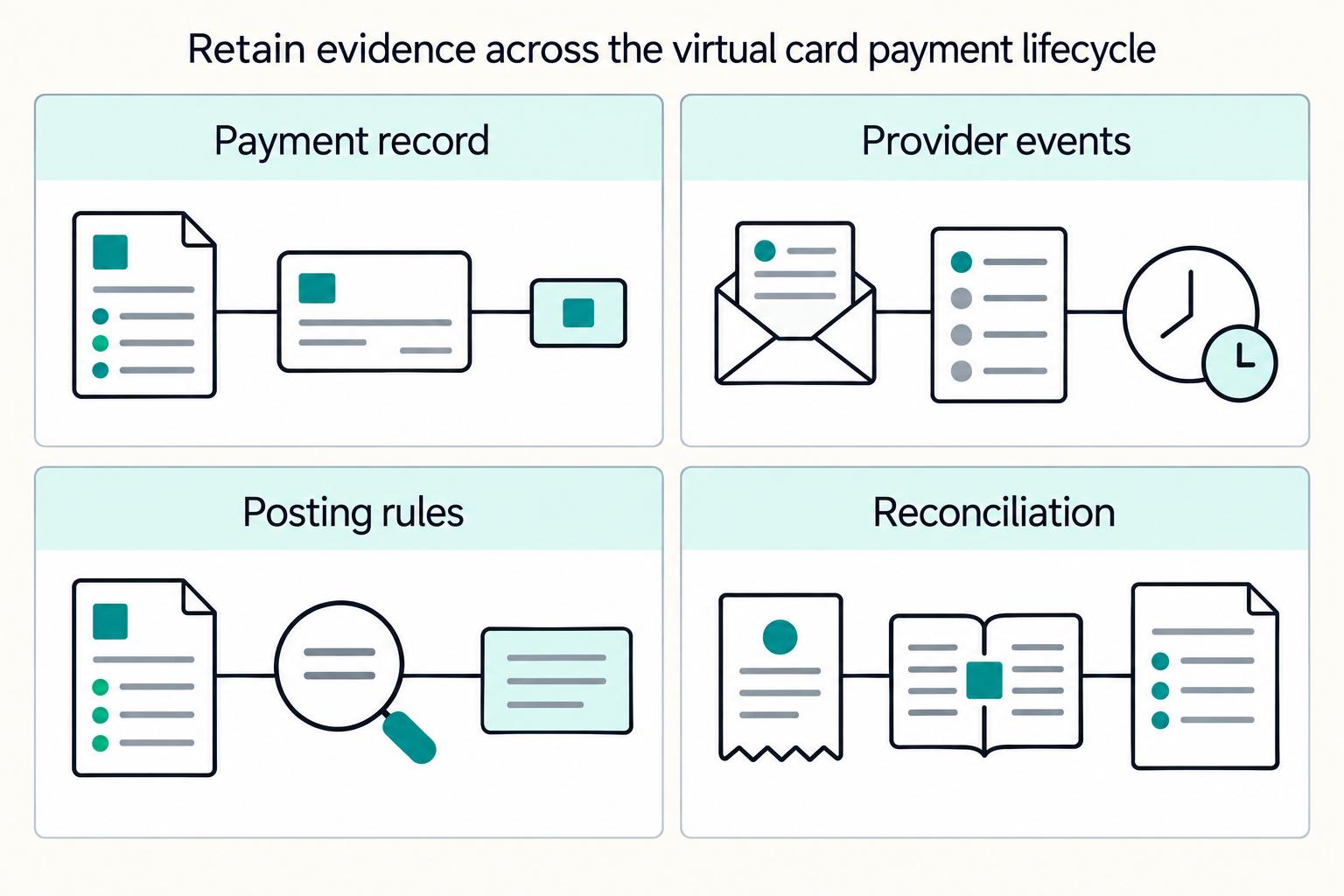
Use one internal payment object from ERP trigger through reconciliation export, and keep the same internal payment ID across the whole flow.
- ERP marks a payable approved and emits a payment trigger.
- Your payments service creates the internal payment record and issues the card.
- The supplier attempts the charge over card-network rails.
- Provider events arrive asynchronously at your webhook endpoint.
- Your ledger posts only after posting rules are satisfied.
- Reconciliation export joins provider and internal references for finance review.
This sequence matters because card flows are not atomic. Authorization and capture can be separate, so your status model needs room for "authorized but not yet final" instead of posting too early.
If your ERP can accept acknowledgment feedback, write back issuance acceptance or failure. Then write back the later payment outcome so AP does not need to check a provider console for basic progress.
Step 5.2 Carry identifiers that survive investigation#
Keep provider-assigned and internal-assigned references together on every payment record so investigations do not depend on log archaeology.
| Lifecycle point | Provider reference | Internal payment ID | Lifecycle status | Posting status | Retry count | Investigation owner |
|---|---|---|---|---|---|---|
| Issued | card or payment object ID | PAY-2026-00418 | issued | not posted | 0 | AP ops |
| Auth received | network or provider transaction reference | PAY-2026-00418 | authorized | pending review | 1 | payments ops |
| Capture confirmed | same transaction family reference | PAY-2026-00418 | captured | posted | 1 | finance systems |
| Exception | request ID plus event ID | PAY-2026-00418 | drift detected | blocked | 3 | payments ops |
Also persist provider event ID and API request reference where available. That gives you a direct trace from initiating call to lifecycle update.
Step 5.3 Post to the ledger only with replay-safe rules#
Replay-safe posting is required because webhook delivery is asynchronous and retries are normal.
Use two protections:
- make provider
POSTcalls retry-safe with idempotency keys where supported, using one key per intended create action - make webhook ingestion process-once for ledger effects, even if delivery attempts repeat
Stripe retries undelivered webhook events for up to three days, and Stripe idempotency keys can be up to 255 characters and may be pruned once they are at least 24 hours old. A practical pattern is one issuance key tied to internal payment ID plus version, plus event-ID deduplication on inbound processing.
Keep wallet state operational. If a wallet shows paid but the ledger has not posted a captured or otherwise accepted final state under your policy, show it as provisional.
Step 5.4 Handle the failure modes that create drift#
Assume state drift will happen. Design for updates, not one-shot certainty.
- Auth success, delayed capture: approval can happen before final settlement state.
- Webhook retry after partial processing: a status update might land while posting did not, creating duplicate-post risk on resend.
- Provider model mismatch: lifecycle objects and status semantics differ across providers.
Map provider statuses into internal states with an explicit needs review branch when equivalence is unclear.
Run one live trace test: ERP approval to issuance API call, then card-network charge attempt, webhook event ID, ledger entry, and reconciliation export row. If any step requires manual dashboard searching, the setup is not ready to scale.
Step 6 Handle contractor payments differently from vendor invoice payments#
Route by confirmed recipient acceptance and eligibility. For a recipient needing bank payment, select a supported transfer method such as ACH, local bank transfer or wire. A virtual account or virtual IBAN is an account/routing identifier used by a provider’s supported transfer flow, not a replacement payment rail by itself.
Step 6.1 Confirm card acceptance before issuing a payment card#
A single-use card works for vendor invoices only when the payee can process it. In a common AP pattern, vendors move to virtual card after confirmed acceptance, and new vendors start on check by default. Use that model: acceptance-gated, not card-first.
Treat acceptance as a required field on the recipient record, not an inbox note. Before issuing a 16-digit Visa or Mastercard credential, store who confirmed acceptance, when it was confirmed, and which route was confirmed. If you use an enrollment partner such as Corpay, store the enrollment outcome or vendor status change in the same record.
A practical checkpoint: can an AP analyst open the payment and see acceptance_confirmed = true, the confirmation source, and the due date? If not, the process still depends on memory.
Step 6.2 Route uncertain recipients to bank rails early#
If acceptance is unknown, route to bank rails early instead of sending a speculative card. Contractor payouts can work as withdrawal choices, not invoice settlement. Examples include U.S. bank deposit, local bank transfer, and wire, with method availability varying by geography, plus scheduled and instant withdrawals in some cases.
If card acceptance is unconfirmed by your internal cutoff, review a supported bank-transfer route and recipient details. Before switching, resolve any outstanding card authorization/capture exposure so the fallback does not pay twice. Virtual account/IBAN identifiers can support account routing and reconciliation where the selected provider supports them; they do not establish transfer eligibility or timing.
Validate setup and activation lead times with the selected provider before offering a fallback deadline. A payout method saved in the UI is not proof that it is active and ready for the intended transfer.
Step 6.3 Separate contractor payout experience from supplier settlement controls#
Supplier invoice settlement and contractor payout should not share the same UX model. Supplier invoice flows can be acceptance-gated and route to virtual card or fallback rails such as ePayments or check. Contractor payout flows can require method choice, geography-based availability, and scheduled or instant withdrawal options.
Reflect that in product states. A supplier view should prioritize approved, issued, captured, settled, and exception. A contractor view should prioritize available balance, selected withdrawal method, pending, available to withdraw, withdrawn, and failed.
Step 6.4 Capture route specific evidence for audit#
Keep rail choice and settlement proof on every payment record. Persist acceptance evidence, routing reason, and the final settlement artifact for each route.
| Route | Acceptance or eligibility evidence | Routing reason to store | Final settlement artifact |
|---|---|---|---|
| Single use virtual card | Vendor confirmed card acceptance, or partner enrollment result such as Corpay | Vendor can process card; AP chose card route | Provider capture reference and remittance, plus settlement evidence under the program; capture alone is not bank settlement |
| Supported bank transfer using account identifiers | Verified recipient bank destination and supported underlying transfer route | Card acceptance unknown, or contractor payout needs bank rail | Transfer confirmation, credited account record, or bank statement line |
| Paymode Premium ACH or other AP fallback rail | Recipient enabled for Premium ACH or equivalent network bank payment | Card not confirmed before cutoff, or AP selected non-card settlement | Documented completed transfer/settlement record plus remittance; tracking UI alone is not finality |
Audit test: for any paid item, can finance answer why this rail was chosen and what proves final settlement without dashboard screenshots? If not, your routing evidence is incomplete.
For more detail, read Contractor Advance Payments: How Platforms Can Offer Pay-Before-Delivery Without Taking Credit Risk.
Step 7 Evaluate provider claims without getting trapped by marketing#
Put rebate upside behind operability unless a provider can show, in detail, how failures are detected, retried, and reconciled. The hidden cost usually appears after launch, when an auth succeeds, a capture is delayed, or an event never reaches your ledger.
This matters even more after Step 6 because virtual cards are only one route. Bottomline says virtual cards are just one of multiple AP payment types, so any card-only or rebate-first pitch is incomplete until the non-happy paths are clear.
Step 7.1 Rank proof above rebate messaging#
Rebate messaging is easy to market and hard to validate without pricing exhibits, so do not let it drive selection. Compare it against what operations will feel immediately: failure handling quality, implementation load, and reconciliation clarity.
Corpay, for example, markets ERP-driven execution, vendor enrollment, single-use virtual card delivery, and transaction tracking. The decision test is not homepage completeness. It is whether your team can trace one payment from approval to final settlement, then recover it cleanly when part of that chain breaks.
Use a simple checkpoint: ask for one failed-payment walkthrough from issue to recovery using real artifacts, not slides. If they cannot show payloads, retry behavior, and the settlement reference you would store, rebate talk is premature.
Step 7.2 Pressure-test each provider with scenario questions#
Use scenario questions that force product claims into operational detail.
- Corpay: You enroll vendors, deliver single-use cards, and track transactions. Show the enrollment status change, transaction status change, and what my team receives when a vendor still cannot process the card.
- Issuing API provider: Which events cover issuance, authorization, capture, reversal and settlement, and which availability, market and currency commitments are in the program contract?
- API-first provider: Which endpoints support idempotency, how are event signatures verified, and what happens if intake succeeds but downstream posting fails?
- Bottomline / Paymode: You market Straight Through Processing to reduce manual virtual-card exceptions. Which exceptions stay manual, what data arrives for those cases, and how does STP change reconciliation records?
Treat vague answers like "customer success handles that" as a warning. If recovery depends on tickets instead of documented product behavior, you are buying manual work.
Step 7.3 Ask for concrete technical evidence#
Do not accept "API available" or "easy integration." Ask for a compact evidence pack:
| Proof to request | Why it matters | What to verify |
|---|---|---|
| Sandbox access and sample payloads | Shows whether testing is realistic | Can you simulate issue, auth, decline, delayed capture, and void states? |
| Webhook documentation | Shows event depth and naming quality | Are retries documented? Are signatures required and documented? |
| Idempotency semantics | Prevents duplicate issuance or postings on retry | Is behavior defined per endpoint, or only stated generally? |
| Exception recovery examples | Reveals real ops burden | Request one broken-event flow and one manual-recovery flow with timestamps and references |
Use Stripe documentation as a specificity benchmark, not a universal provider rule: live webhook automatic retries can last up to three days, Dashboard resend supports 15 days and CLI resend 30 days. Separate retry, resend and API retrieval windows, then maintain your own durable processed-event and business-effect records.
Validate provider scale and coverage claims with a dated source and the program you will buy. Procurement should prioritize supplier acceptance, actual market eligibility, tested exports and written recovery/support commitments over aggregate network counts.
Practical recommendation: shortlist the provider whose failure artifacts both engineering and finance can read without translation. If approvers cannot quickly tell whether something is paid or still pending, the marketing story will not hold up at month-end close.
Related reading: Best Business Credit Cards for Airline Miles for Global Freelancers.
Step 8 Build the decision checklist procurement and engineering can both sign#
Build one shared scorecard now, and treat unclear retry behavior or weak reconciliation artifacts as a hard stop, even if pricing looks good.
Step 8.1 Set shared scoring categories#
Use one checklist for AP, Payments Ops, engineering, and procurement. Tie each row to an owner, proof artifact, and pass-or-fail rule.
Score in four buckets:
- Controls: Where card issuing is in scope, can you issue single-use cards with required limits, and trace who created, approved, voided, or reissued each card?
- Integration depth: Are create or update calls retry-safe, are webhook delivery rules documented, and can events map cleanly to internal states?
- Ops burden: What remains manual after launch, especially enrollment exceptions, delayed settlement, and failed acceptance?
- Compliance readiness: Has procurement explicitly identified and assessed supplier risk, instead of relying on generic vendor questionnaires?
Score only from evidence: documentation, sandbox payloads, reconciliation exports, contract exhibits, or written support policies. If evidence is missing, mark the cell as unknown.
Step 8.2 Force unknowns into the open#
Keep unknowns visible in the main scorecard: pricing mechanics, program or market coverage, onboarding timeline, contractor support depth, and support SLAs.
Confirm each provider’s documented webhook success response, retry policy, signature verification and market eligibility. Those are checklist items to test before signature; another provider’s HTTP code or retry schedule is not a substitute for the selected integration contract.
| Provider | Confirmed from docs | Unknowns to close before signature |
|---|---|---|
| ConnectPay | Verify the selected vendor’s actual onboarding, account and issuing API documentation | Confirm exact vendor identity if any party also references ConnexPay. Then close webhook behavior, idempotency semantics, reconciliation artifacts, onboarding timeline, and support commitments. |
| Stripe Issuing | Stripe documents idempotency keys for create or update requests. Stripe retries failed webhooks in live mode for up to three days and warns teams to avoid duplicate event processing. | Confirm event coverage, settlement or export fields finance will store, pricing mechanics, market or program coverage, and named support commitments. |
| Wise Platform | Verify actual issuing/virtual-card eligibility and webhook behavior for the chosen market and program | Confirm card availability in target countries, contractor support depth, reconciliation outputs, onboarding path, and support SLAs. |
| Bottomline Paymode | Paymode presents AP payment support including virtual card and ACH, plus receipt or reconciliation automation claims. | Confirm manual exception share, documented retry or event behavior, contractor fit, pricing mechanics, and support commitments. |
Step 8.3 Define red-line rules before pricing finals#
Set non-negotiable fail conditions before commercial negotiation closes:
- Retry safety is unclear: no clear idempotent create or update behavior, or no defined behavior for repeated requests.
- Reconciliation evidence is weak: no stable settlement reference, status trail, and export artifact across issue to final settlement.
- Webhook handling is under-specified: no clear success condition, retry behavior, or duplicate-handling guidance.
Sign-off test: engineering replays the same create request in sandbox and proves safe outcomes; AP reconciles one delayed or retried event using only provider exports and your internal ledger. If either test fails, do not sign yet.
Related: What is a Virtual IBAN and How Do Platforms Use It to Collect Payments Globally?.
Before final vendor scoring, align your checklist to concrete integration evidence such as webhooks, retries, and reconciliation using Gruv's implementation references in the docs.
Step 9 Plan launch in phases with hard verification gates#
Do not launch to everyone at once. Run this as a canary rollout with a prewritten rollback path, and expand only when phase evidence supports a go decision.
Start with a narrow eligible supplier cohort and define triggers for stopping new issuance. Prepare a non-card route, but use it only after the original payment outcome and authorization/capture exposure are resolved. Rollback of product exposure is distinct from canceling or reversing a funds movement.
Use phase gates that operations can actually verify#
Use a small-to-larger progression, for example 25%, then 50%, then 100%, but gate expansion on proof between phases, not on a schedule.
Advance only when all are true:
- settlement behavior is clear from card issue through final payout or charge outcome
- reconciliation closes using provider exports plus your internal ledger
- exception handling works for delayed events and duplicate delivery cases
- finance signs off on the export format it will use for month-end work
Keep early cohorts small until production event behavior and reconciliation are stable. Stripe live-mode automatic retries can continue for up to three days; manual resend windows differ. Prove replay-safe handling and investigation evidence before widening traffic.
Require go or no-go checks each round#
At each phase, run three checks in order:
- Policy gate behavior: card amount, expiry, approval path, and retry safety are correct.
- Audit-log completeness: you can reconstruct who created, approved, voided, or reissued each payment from a chronological record.
- Finance artifact readiness: exports or payout reconciliation reports let accounting match settlement batches with minimal manual reconstruction.
Keep eligible bank-transfer routes ready for recipients who cannot accept cards. Virtual account or IBAN identifiers may support those routes, but do not move funds themselves. Choose among supported card, ACH, local transfer, wire or check programs by recipient eligibility, timing and recovery.
Step 10 Avoid the failure patterns that break trust after go-live#
Trust can break when teams apply a generic Commercial Cards playbook to different payout flows. Keep separate routing rules for vendor invoices and contractor disbursements, including who is card-eligible, who needs a bank rail, and who stays in manual review until eligibility is clear.
Before issuing any card, confirm that you can show the routing reason, approved amount, expiry window, and acceptance evidence for that recipient class. If a contractor flow still depends on destination-account health, do not force it through supplier-invoice logic.
Treat provider events as inputs, not final truth#
For Stripe or any webhook-led provider, assume production events can be duplicated, delayed, partial, or out of order. Use your internal ledger to determine whether a payment is pending, posted, reversed, or under investigation.
Protect issue and void actions with idempotent requests, and make event handling replay-safe. Stripe supports idempotency keys and notes that keys can be pruned after at least 24 hours, so your retry window and audit trail must account for that boundary.
Plan for Vendor Enrollment exceptions before they happen#
Vendor Enrollment is a go-live dependency, not a cleanup task. Virtual-card AP flows depend on supplier acceptance and setup, and programs may require vendors to already exist in payor records and be able to accept card payments.
Create a named exception queue for missing vendor setup, no card acceptance, and fee or integration objections. Assign an owner, response target, and fallback rail for each case before volume expansion.
Rank operability above rebate talk#
Rebate upside can matter, but it should not set launch priorities. Put reliability, traceability, and controllability first.
If finance cannot reconcile provider references to your ledger, or operations cannot explain why a card was reissued, rebate potential will not protect trust.
Conclusion#
Use single-use cards as a controlled AP rail, not your default payout rail. They work best when you need one supplier, one amount, one active window, and clear traceability through reconciliation. They are weaker when payout success depends on bank-account or debit-card disbursement requirements, or on unverified country coverage.
Step 1 Review scope before you review vendors#
Start with a build-versus-partner scope review before pricing. Assign ownership for issuance API, approval linkage, vendor enrollment, settlement tracking, webhook handling, reconciliation exports, and dispute or exception handling. If your team cannot own card-lifecycle exceptions and reconciliation correctness end to end, partner first and keep routing and ledger logic in-house.
Judge providers on operating fit, not homepage language. Corpay positions itself around vendor enrollment and transaction tracking, which matters if you do not want to run supplier-acceptance outreach. Bottomline frames virtual cards as one rail in a broader mix with ACH and checks, which is often the more realistic vendor-payment design.
Use one readiness check: can you name the owner for each failure state before launch? If ownership is unclear for duplicate issue attempts, supplier rejection, or mismatched reconciliation records, do not procure yet.
Step 2 Score the decision across product, ops, finance, and compliance#
After scope is clear, run one cross-functional scorecard before shortlisting. Product should score routing fit and recipient experience. Engineering should score idempotency support, duplicate-event handling, sandbox quality, and event recovery behavior. Finance and AP should score export completeness, audit traceability, and close effort. Compliance should score PCI DSS impact and any KYC or verification obligations your platform still owns.
Treat two red flags as hard stops:
- If a provider cannot explain idempotent request behavior, assume retries can create duplicate operations.
- If consumers are not replay-safe, duplicate delivery can create financial errors. Confirm each provider’s retry windows and maintain durable internal recovery records.
Keep coverage as a separate decision line. Stripe Issuing is geography-constrained, and its global issuing model relies on local issuing in a limited set of countries, not unlimited global coverage. If you serve multiple payout corridors, validate exact program coverage before legal review.
Step 3 Use this launch checklist before you go live#
Copy, paste, and assign owners:
- Define routing rules for vendor invoices versus contractor payouts, including bank-rail fallback when card acceptance is uncertain.
- Lock issuance controls: single use, fixed amount, expiry window, and approval linkage.
- Validate retry behavior with idempotency keys, and prove webhook consumers handle duplicate deliveries safely.
- Confirm reconciliation artifacts: provider reference, internal payment ID, lifecycle status, posting status, and investigation owner.
- Verify market or program coverage limits, including issuing geography and recipient acceptance assumptions.
- Approve phased rollout gates with rollback criteria, sandbox test evidence, and finance sign-off on exports.
The standard is not whether a demo looks good. It is whether you can route the right payments to cards, recover failures safely, and explain every issued credential in an audit. If yes, single-use cards are a strong control tool. If not, add fallback rails before you scale.
For a supported bank-transfer fallback, verify the underlying route and destination; Virtual Accounts can help with account identifiers and reconciliation where that program supports them. Resolve outstanding card exposure before switching.
Frequently Asked Questions
What is a single-use virtual card, and when should a platform use it for contractor or vendor payments?
A single-use AP virtual card is a credential constrained to an approved supplier/payment context under the issuing program’s amount, expiry and reuse rules. Use it when the supplier accepts cards and the actual authorization/capture lifecycle meets policy. Select a supported bank transfer when the recipient needs bank payment.
How are single-use virtual cards different from corporate cards and checks in AP operations?
A single-use AP program constrains a credential to an approved payment context, while broader corporate-card programs support recurring spend and checks follow a different delivery/clearing process. Verify the actual reuse, deactivation, amount and partial-capture rules; not every program equates single-use with one authorization or an exact entered amount. Supplier acceptance and reconciliation remain necessary.
Which controls are mandatory before issuing virtual cards at scale?
For a single-use AP policy, require approved amount, supplier acceptance, active-window and reuse controls, plus audit linkage. Test whether the issuer supports the exact restrictions and how partial captures or reversals behave. Restrict spending at the issuer’s supported authorization checkpoints; do not assume all controls run before the merchant sends authorization.
What should product teams ask providers to validate API depth, webhook quality, and reconciliation fit?
Confirm supported write-endpoint idempotency, signature checks and missed-event recovery. Stripe live-mode automatic retries can last up to three days, but other providers differ. Test duplicate and out-of-order events, and verify exports link provider references to the internal payment and financial-effect records.
When do rebate claims help, and when do they distract from operational risk?
Rebate claims help after acceptance, reconciliation quality, and exception handling are proven in your flow. They distract when they are used to wave away unresolved reliability or enrollment gaps. If a provider cites strong rebate gains, treat that as a cohort claim to validate, not as an outcome you can assume.
What are the biggest unknowns to confirm before signing with a provider?
The biggest unknowns are supplier acceptance, enrollment ownership, and failure recovery. Some suppliers reject virtual cards, and some payment flows need ACH fallback, so confirm who owns vendor enrollment and exception handling before launch. Also verify practical constraints like expiry rules and amount-entry requirements where processing succeeds only when the entered amount matches the issued amount.
When should a platform route payments to Virtual Accounts or Virtual IBAN instead of card rails?
Use a supported bank-transfer route when the recipient needs account-to-account payment or cannot accept cards. Virtual accounts and virtual IBANs can identify or segregate destinations for a provider’s collection/reconciliation flow; they are not standalone payment rails. Confirm the recipient, underlying transfer route, availability and outcome evidence, and resolve the original card attempt before fallback.
Researched and edited by the Gruv editorial team. Gruv builds cross-border billing, payouts, and finance-operations software for global businesses.
Sources
- controller.admin.ri.gov/central-accounts-payable/virtual-payment-pro...trusted
- csrc.nist.gov/pubs/sp/800/122/finaltrusted
- csrc.nist.gov/pubs/sp/800/161/r1/upd1/finaltrusted
- docs.stripe.com/api/idempotent_requeststrusted
- docs.stripe.com/webhooks/process-undelivered-eventstrusted
- irs.gov/instructions/i1099mectrusted
- irs.gov/pub/irs-pdf/p1099.pdftrusted
- ojp.gov/ovc_fmrc_guide_sheet_internal_control_separa...trusted
Educational content only. Not legal, tax, or financial advice.
Related Posts

The Freelance Payment Penalty: A Modeled Audit of Platform Fees, FX Spreads, and Payout Delays
The money rarely disappears through a single, easy-to-spot fee. The real loss is stacked. A marketplace takes its commission, a processor adds a charge for international cards, a bank or payment company converts the currency at a spread, a platform holds the funds before release, and a wire sheds a little to intermediaries on the way in. Each layer looks defensible on its own, but the worker feels the combined result as a smaller deposit and a later payday.

How to Respond to a Subpoena for Business Records
Move fast, but do not produce records on instinct. If you need to **respond to a subpoena for business records**, your immediate job is to control deadlines, preserve records, and make any later production defensible.

A US Expat's Guide to Investing in UCITS ETFs to Avoid PFIC Issues
The real problem is a two-system conflict. U.S. tax treatment can punish the wrong fund choice, while local product-access constraints can block the funds you want to buy in the first place. For **us expat ucits etfs**, the practical question is not "Which product is best?" It is "What can I access, report, and keep doing every year without guessing?" Use this four-part filter before any trade: