
Quick Answer
Start with corridor selection and control ownership before you build product flows. In virtual assistant platform payments compliance, the first go/no-go decision should require clear KYC, KYB, and AML gates, a defined payout route, and auditable records connected to webhook events and journal entries. If critical controls remain unclear, pause development, focus on one proving route such as United States to Philippines, and resolve tax-document triggers like W-9, W-8BEN, and VAT checks first.
Start with Corridor Choice and Ownership Before Feature Design#
Start with country choice and money movement, not screens or matching logic. For virtual assistant platform payments compliance, many costly mistakes happen before launch. Teams treat corridor support as automatic, assume a provider absorbs all regulated work, or reuse one onboarding flow across markets.
Test country viability before you write product requirements#
Cross-border payouts are program-limited, not global by default, and compliance expectations are not uniform across countries. AML standards use a risk-based approach, but each jurisdiction applies those standards through its own legal and operational setup. That makes your first corridor a product decision, not just a sales target.
Start with one or two corridors and force specificity early. Define who pays, who gets paid, where funds originate, and whether payout must land in local currency. Then verify current coverage at the program level, not just from a headline country list, because supported regions can still have feature gaps.
Checkpoint: for each corridor, confirm sender country, recipient country, payout method, and known regional feature limits from a current provider-country availability page. If any item is unclear, treat that market as unscoped.
Assign compliance ownership at each money step#
Decide who owns compliance at each money step. In U.S. regulation, "money transmission services" includes accepting currency, funds, or other value that substitutes for currency from one person and transmitting it to another location or person. Your payout model changes where that responsibility sits.
Some programs shift parts of the legal and compliance load to the provider. Others leave more with the platform. Even when obligations shift, you still need explicit ownership for policy gates, user communication, exception handling, and evidence collection. If the answer is only "the provider handles it," but the exact program scope is unclear, treat that as a risk.
Your first ownership map should name owners for key controls, including KYC, KYB, AML review, holds, and payout release decisions. Keep it as an internal decision record for product scope, support training, and later audit questions.
Choose the payout model that survives review and operations#
Choose countries and payout design first. Then build only what still holds after compliance ownership and operator effort are clear.
The tradeoff is structural. Models that speed country expansion can come with tighter program constraints or less flexibility in edge cases. Models that give you more direct control usually keep more legal and operational burden with your team. The right choice fits your first corridor, review capacity, and tolerance for manual exceptions.
Before you commit engineering time, assemble a small evidence pack for each launch candidate. Include current coverage confirmation, named owners for KYC, KYB, and AML decisions, the proposed payout path, and the exact review point for blocked or delayed payouts. If you cannot assemble that quickly, pause build work. Coverage and compliance boundaries still vary by program and country.
You might find this useful: Where to Hire a Virtual Assistant Without Creating Compliance Risk.
What to prepare before you choose a launch country#
Before you compare markets, define the operating facts for your first launch. If these inputs stay vague, onboarding, review, and document collection can end up mismatched to the real money flow. That usually leads to expensive rework.
Lock your first corridors and user mix#
Lock your first two corridors and user mix before market scoring. Write each corridor as a full scenario, not a label. For example, define United States clients paying assistants in the Philippines, with either one-to-one invoice payments or marketplace splits. That choice affects who is involved, where review happens, and which documents you need.
Checkpoint: for each corridor, state sender country, recipient country, payer type (individual or business), and whether funds move as direct payment or split flow. If you cannot state that clearly, pause launch-country selection.
Define day-one controls as explicit gates#
Define minimum day-one controls as explicit gates. At minimum, map KYC, KYB, and AML gates for onboarding and payout release. AML and CDD are risk-based, and FATF standards are adapted by country, so one onboarding flow may not be enough across markets.
If business customers are in scope, include a KYB path that can support beneficial-owner checks when your provider or regulatory setup requires them. Treating all payers as individuals can stall business onboarding when ownership details are required.
Choose your system of record and evidence surfaces#
Pick your system of record and evidence surfaces early. Decide source-of-truth ownership, required event logs, and who can approve exceptions such as document overrides or payout holds. Treat log handling as a full lifecycle: generation, storage, access, and disposal.
Verification point: exception decisions should be captured in auditable systems, not just chat threads or inboxes. If approvals are informal, incident response and audits slow down.
Set tax and document scope for launch and later phases#
Set tax and document scope for launch versus later phases. For U.S. contractor flows, Form W-9 is an early onboarding document used to collect the correct TIN for information reporting. Form W-8BEN is trigger-based: collect it when requested by the payer or withholding agent, not as a universal signup document for every non-U.S. payee.
If EU business flows are in scope, decide whether VAT validation is part of launch and use VIES for cross-border EU VAT-number checks. If tax-document rules are still unclear, narrow corridor scope before you expand.
For a step-by-step walkthrough, see How to Delegate Work to a Virtual Assistant.
Score each target market before writing product requirements#
Score each market before you write product tickets, so roadmap decisions rest on operability evidence, not demand signals alone. A single scorecard makes weak assumptions visible early.
Use one scorecard across countries#
Use one scorecard with identical fields across countries. A single scoring method, whether 1 to 5 or low, medium, high, keeps comparisons consistent and makes gaps easier to spot.
| Field | What to score | Verification point | Common failure mode |
|---|---|---|---|
| Onboarding friction | KYC/KYB depth, including whether business customers trigger beneficial-owner checks in your model or provider setup | Confirm document set, retry path, and exception owner | Treating all payers as individuals, then stalling business onboarding on ownership details |
| AML risk profile | Whether the jurisdiction raises screening, enhanced due diligence, or hold complexity under your provider or policy | Get the AML hold and release process in writing, including release evidence | Assuming a common corridor means low AML effort |
| Payout rail signal | Corridor fields such as receiving method, transfer speed, disbursing network coverage, fee, and FX margin | Compare provider routes against public corridor data | Using low cost as a proxy for reliability |
| Tax-document complexity | Whether flows require W-9, W-8BEN when requested, or VAT validation for relevant EU business flows | Define who collects each document and what blocks payout if missing | Collecting every form at signup whether needed or not |
| Operator cost | Expected manual review load, support burden, and exception volume | Estimate by corridor and user type, then validate in pilot logs | Approving a market before sizing review and exception work |
For U.S.-regulated banking contexts, treat written CIP as a formal requirement. If U.S. business customers are in scope, include whether beneficial-owner identification and verification is required in your covered setup, because that materially changes KYB effort.
Add operator cost before you compare demand#
Add operator-cost columns before you compare demand. Demand can make a corridor look attractive, but operator cost is what tells you whether it is workable.
Include manual review load, support burden, and expected exception volume for the United States-Philippines corridor. If you do not yet have internal volume data, use directional labels plus evidence notes. Public corridor data is useful only as a benchmark. RPW for United States->Philippines includes transfer speed, receiving method, disbursing network coverage, fee, FX margin, and total cost. It also shows a Total Average Third Quarter 2025 value of 4.52 (data collected Aug 04, 2025-Aug 21, 2025). That helps with route economics, not payout reliability or support effort.
Stop if critical controls are still unclear#
Apply a hard internal stop if two or more critical controls are unclear. If you cannot clearly state the AML hold process and tax-document path, do not commit roadmap resources.
This is an internal decision rule, not a legal threshold. If those controls are unclear, rework risk is high because release logic, exception ownership, and payout-blocking document rules are still undefined.
Label each market with one evidence-backed decision#
Label each market launch now, pilot later, or defer, and require one sentence of evidence for the label. That forces a real decision instead of a vague preference.
| Label | Example in article | When to use |
|---|---|---|
| launch now | United States | payer-side KYC/KYB is defined, W-9 collection is clear for U.S. taxpayers, and W-8BEN handling is defined for cases where the payer or withholding agent requests it |
| pilot later | Philippines | this is your first payee market and payout exception handling is still untested; FATF noted on 21 February 2025 that the Philippines was no longer under increased monitoring, but that does not by itself validate your AML hold or release process |
| defer | control paths still unclear | AML hold and release plus tax-document routing are still unclear, or enhanced due diligence is likely and you have not planned the added review effort |
If EU business flows are in scope, score VAT validation separately and only where relevant. Use VIES for cross-border EU VAT checks rather than applying it to non-EU corridors.
Define who owns compliance at each money step#
Ownership needs to be explicit before launch. If you cannot name one internal owner, one provider dependency, and one audit record for a money step, treat that control as unresolved.
Map the full flow from onboarding to payout confirmation#
Map onboarding through payout confirmation as discrete steps, then assign ownership per step. Use one row per step. For example: signup, KYC/KYB data collection, provider verification result, account approval, payment acceptance, AML review or hold, payout initiation, payout status, and final confirmation.
For each row, assign a platform owner, provider role, customer obligation, and escalation owner. Product should own product gates and UI rules. Ops should own follow-up and remediation flow. Compliance should own policy decisions and hold or release criteria. Legal should stay focused on legal interpretation and contract language.
If the only answer to "who can unblock this payout?" is "the provider," ownership is still incomplete. Third parties may execute checks and movement, but in regulated contexts that does not remove your internal responsibility to make and document decisions.
Separate platform policy, provider execution, and customer duties#
Separate platform policy gates from provider execution and customer duties. Do not use blanket language like "the provider handles KYC," because responsibility changes by integration model.
In Stripe Financial Accounts onboarding, a platform may collect required KYC/KYB information and pass it to Stripe, and Stripe then performs checks. In Stripe-hosted onboarding, the account holder is responsible for submitting required KYC information. Adyen also requires verification before payments and payouts while placing onboarding communication and remediation responsibility on the platform. Write each gate in three parts:
- Platform policy gate: what must be true before funds move, for example, verification complete or hold cleared
- Provider execution: what the PSP, bank, or provider verifies, screens, or executes
- Customer obligation: what the payer or payee must submit or confirm
If you operate in a U.S. banking context, track CIP separately from generic KYC language. CIP is a written, risk-based identity verification program for banks and should have its own owner and evidence path.
Make each gate reproducible from events and records#
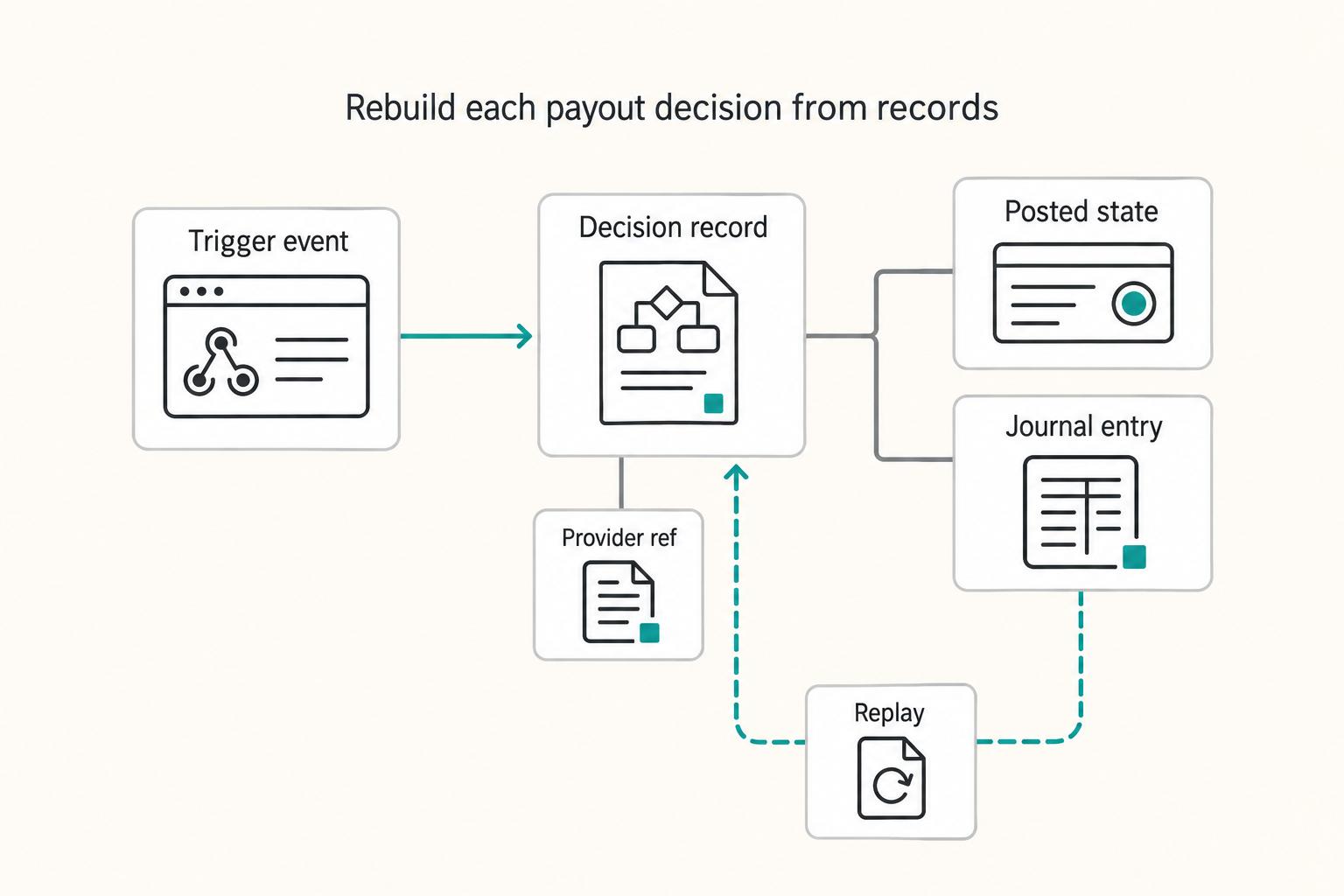
Make every gate reproducible with both event evidence and internal records. Each control should have the triggering event, your internal decision record, and the posted transaction or status record.
Use webhooks as the event-trigger surface, not as final truth. Webhook delivery is asynchronous and can arrive out of order, so payout decisions should rely on your internal records plus posted transaction state, including provider reference, timestamp, and decision outcome. For money movement, include the related journal entry so debits and credits are traceable.
Operationally, acknowledge webhooks quickly and process heavy logic asynchronously. For example, Dwolla expects a 200-level response within 10 seconds and can auto-pause a webhook subscription after 400 consecutive failures when 24 hours have passed since the last success.
This pairs well with our guide on How Freelancers Choose a Compliance-First Fintech Platform.
Choose your money movement model and its tradeoffs#
Pick the model that makes compliance gates easiest to prove and exceptions easiest to close, not the one with the most features.
Compare models by accountability before build effort#
Compare models by accountability first, then build effort. Start with who is merchant of record, which account can create payments, who owns disputes and refunds, and what evidence you can produce when something fails.
| Model | Launch speed | Control depth | Margin impact lens | Operational complexity | Best fit |
|---|---|---|---|---|---|
| Merchant of Record (MoR) | Can be faster with provider-managed acceptance | Lower direct control over acceptance components, with stronger built-in gates in some managed offerings | Economics depend on bundled tax, fraud, and dispute handling, not just processor fees | Lower payments build, but internal exception handling still required | Faster country expansion where bundled compliance coverage matters |
| Direct collections plus Virtual Accounts | Can be slower due to mapping, reconciliation, and release logic | Highest control over mapping, holds, and payout rules | Cost depends on internal ops, review queues, and reconciliation load | High | Flows that need clean mapping from each client payment to payable balance |
| Hybrid with payout batches | Middle ground | Medium to high release control, lower control on downstream payout execution details | Cost depends on batch funding mechanics and per-transfer exception handling | Medium to high | High-volume disbursements where shared funding workflows help |
Evaluate merchant-of-record design at the charge level#
Evaluate MoR at charge-structure level, not label level. In Stripe Connect, MoR can vary by charge type, and MoR determines which Stripe account is authorized to create payments for a payment method. For indirect charges without on_behalf_of, Stripe states the platform is MoR. In marketplace patterns where the platform is MoR, the platform manages disputes and refunds, and Stripe notes the platform can still be responsible for losses even when connected accounts are MoR in some flows.
Before launch, document four fields in your design record: charge type, payment-creating account, dispute or refund owner, and loss-coverage owner. If any field is unclear, the model is still unresolved.
A managed MoR path can reduce expansion friction in broad coverage scenarios. Stripe Managed Payments states it handles indirect tax in more than 80 countries, fraud protection, and disputes. Stripe also notes platform support is not included there and is available with Connect, so architecture fit needs to be checked early.
Use direct collection when reconciliation clarity matters most#
Choose direct collection with virtual accounts when reconciliation clarity is the priority. Virtual account numbers can give each payer destination a distinct identity and support automated reconciliation without exposing real account details.
This model raises your operational burden. The inbound account, customer or client entity, expected invoice or balance, and payout-authorizing journal entry all need to stay reliably linked. If that mapping breaks, funds can arrive without safe release criteria.
Unmatched funds also need timed handling from day one. Stripe documents handling requirements when unreconciled customer-balance transfers remain more than 75 days. Keep inbound virtual-account logic separate from payout destination design: Stripe warns non-standard or virtual payout accounts may have higher payout failure rates.
Use payout batches for funding efficiency, not settlement truth#
Use payout batches for funding efficiency, not payout-finality signals. A hybrid model can bundle many transfers under one funding workflow, but batch-level status is not enough for settlement truth.
Wise allows batch groups of up to 1000 transfers under one reference, and also states COMPLETED at batch level does not mean all payouts succeeded. Your control should require both records: batch funding status and per-transfer completion status.
If scheduled payouts are also in use, reconciliation gets noisier because automatic payouts can include funds from multiple transactions. Stripe also notes initial live payouts can be scheduled 7-14 days after the first successful live payment, so expectation-setting should be part of launch readiness.
Use compliance support without outsourcing accountability#
Use Compliance-as-a-Service for execution support, not accountability transfer. External providers can help with compliance operations, tax handling, and dispute workflows. They do not remove your oversight duty.
The FCA is explicit that regulatory obligations cannot be outsourced and responsibility for oversight remains with the firm. Reliance on third parties can also reduce direct operational control and introduce new risks. Your internal records should still show exception decisions, hold-release rationale, triggering provider events, and final transaction and payout outcomes.
Use this judgment rule: if faster country expansion and tighter policy control are the goal, prioritize models with stronger built-in compliance gates even if integration takes longer. If exact inbound-to-outbound traceability is the goal, direct or hybrid designs can fit, but only if you are ready to own the evidence trail end to end.
If you want a deeper dive, read The Best Way to Pay Filipino Virtual Assistants from the US.
Design payout controls that prevent duplicate or non-compliant transfers#
Do not release a payout unless the request is unique, compliance gates are clear, and provider events reconcile back to your internal record. Retries, missing verification, and delayed provider events are normal operating conditions, so your controls should assume them.
Make payout creation idempotent at the first POST boundary#
Make payout creation idempotent at the first POST boundary. Send an idempotency key on every payout-creation request, and reuse the same key only for true retries of the same request. Stripe notes POST requests accept idempotency keys, keys can be up to 255 characters, and a repeated key returns the same result, including 500 errors.
Treat any payload change as a new request, not a retry. If amount, destination, or reference changes, do not reuse the prior key, because the provider compares parameters and errors when they differ. Also account for retention: if keys are pruned after at least 24 hours, keep your own longer-lived payout request record for duplicate detection beyond that window.
Use state transitions to block non-compliant release#
Use state transitions to block non-compliant release before funds move. Define payout states, for example draft, blocked, ready, submitted, pending, paid, failed, canceled, and require preflight checks before moving to release states.
Verification completeness is the core gate. When requirements.currently_due is not empty, capabilities can be restricted, and payouts can be disabled if required information is not provided by deadline. Apply the same stop rule to destination risk: if an external bank account is errored, scheduled payouts are stopped until details are updated. Before submit, re-check payee identity state, payout capability state, and payout destination status.
If you apply AML-related holds, make those holds auditable. Store the hold reason, who placed it, and who can release it, and require remediation evidence for verification or account-information gaps.
Treat webhooks as system inputs, not optional notifications#
Treat Webhooks as system inputs for payout truth, not optional notifications. Request-time API responses alone may not establish final payout state. Accept webhook events with 2xx, store them durably, and process from storage.
Build for redelivery and deduplication. Do not assume exactly-once delivery, and Stripe can resend undelivered events for up to three days. Ignore already processed events, still return success, and ensure each provider state change is linked to your internal journal through the provider event ID, payout ID, and money-movement reference. If you cannot trace pending to paid or failed across both webhook records and journal entries, reconciliation is incomplete.
Set batch approval and rollback rules before bulk payouts#
Set batch approval and rollback rules before using bulk payouts. Batching reduces operator effort but increases blast radius, so define approval requirements in advance. Some providers can route API-created batch transfers through approval workflows, but that is a configurable workflow, not a universal legal requirement.
Separate pre-release stop controls from post-release recovery controls. For Stripe, cancellation is available only while status is pending, so paid payouts should not rely on API cancel as a fallback. For grouped disbursements, Wise allows up to 1000 transfers per batch group, but your controls should still track transfer-level outcomes and exceptions, not just batch-level completion state.
Related reading: How Independent Professionals Build a PCI-Compliant Workflow for Card Payments.
Build reconciliation and audit evidence from day one#
Reconciliation should be a day-one control, not a post-launch finance cleanup task. Make your core journal the source of truth immediately, and require every material money event to map to an immutable entry before you trust balances, payout status, or exceptions.
Post every material money event to an immutable journal#
Post every material money event to the journal, and correct with new entries, not edits. A journal entry is a complete, balanced debit-and-credit record for a single financial event. Corrections should use reversing or compensating entries instead of rewriting history. That append-only pattern preserves reconstructable audit history.
Use a strict two-way check: start from a provider reference and find the journal entry, or start from the journal entry and find the provider reference. If either lookup fails for a payout, charge, incoming transfer, fee, reversal, or return, reconciliation is already degraded.
Store a transaction evidence pack, not just balance impact#
Store a transaction evidence pack, not just a posted balance impact. At minimum, keep request metadata, provider reference, internal approval context, and the webhook event payload that confirmed the provider event. Because webhook endpoints receive structured JSON payloads, store the raw event, event ID, received timestamp, and the internal object updated.
Use metadata as a pointer, not as your archive. Stripe metadata limits still apply, 50 total key-value pairs, 40-character keys, 500-character values, so keep full approval context and documents in your own evidence store and link to them.
Reconcile incoming funds through virtual accounts with exceptions#
Reconcile incoming funds through Virtual Accounts, with explicit exception handling. Virtual accounts support separate tracking under one physical account and can improve payer identification during incoming-payment clearing. Match incoming funds with multiple fields, such as virtual account identifier, amount, and expected invoice or funding instruction, not a single signal.
Auto-reconciliation can match incoming payments to invoice amounts, but you still need clear handling for overpayments and underpayments, plus a policy for unmatched deposits and returned funds. When amounts do not align, route to an exception state instead of silently applying funds. For returns, post a new journal entry linked to the original receipt and store the provider return reference. If this is a core flow, How Platforms Use Virtual Accounts to Reconcile Incoming Payments Per Client is directly relevant.
Define audit exports before launch#
Define audit exports before launch, because retrofitting them is costly and incomplete. Finance and compliance reviews usually need one coherent record set. Include, for example, internal transaction ID, journal entry ID, provider reference, amount, currency, timestamps, approval actor, webhook event ID, virtual account ID if used, and exception or return reason.
If your operations include transactions subject to U.S. sanctions rules in 31 CFR chapter V, recordkeeping requirements are specific: maintain full and accurate records and keep them available for examination for at least 10 years after the transaction date. That requirement is scoped, not universal for all global payments, so apply it where relevant and design retention and export access accordingly.
Need the full breakdown? Read How Independent Contractors Should Use Deel for International Payments, Records, and Compliance.
Set tax and documentation boundaries by market#
Set market-specific tax boundaries in product logic before payout volume grows. Define document triggers, reporting ownership, and support limits in writing, then enforce them through payout states.
| Item | When it applies | Key note |
|---|---|---|
| Form W-9 | when a payee provides a TIN to a requester that may file an information return | collect the form that matches payee tax status before payout enters a path that may create reporting or withholding exposure |
| Form W-8 BEN | when the payee is a foreign beneficial owner and the payer or withholding agent requests it | the goal is not to collect every form from every user |
| Form 1099-NEC | qualifying nonemployee service payments of $600 or more during the year | assign one filing owner per reporting path |
| Form 1099-MISC | rents, royalties, prizes and awards, and other fixed determinable income | define boundaries before year-end form production |
| Form 1099-K | when the payment settlement entity reports under section 6050W | these amounts are not reported on 1099-NEC or 1099-MISC |
| VIES | for cross-border EU VAT-number checks in markets that require it | treat VAT as validated only after a successful check with a stored result and timestamp |
Collect the form that matches payee tax status#
Collect the form that matches payee tax status before payout enters a path that may create reporting or withholding exposure. Use Form W-9 when a payee provides a TIN to a requester that may file an information return. Use Form W-8 BEN when the payee is a foreign beneficial owner and the payer or withholding agent requests it.
The goal is not to collect every form from every user. It is to collect the right form before releasing funds in a path that creates reporting or withholding exposure. If a required form is missing or incomplete against the status on file, place the payout in tax-review hold as a product control. That hold is a design choice, but it addresses a real risk: when a correct TIN is required and not provided, backup withholding can apply at 24%.
At approval time, verify that an accepted document type is on file, that the record matches onboarding identity and tax status, and that the document is linked to the payout request ID.
Classify payment types and assign one filing owner#
Classify payment types early and assign one filing owner per reporting path. For U.S. information returns, Form 1099-NEC covers qualifying nonemployee service payments of $600 or more during the year. Form 1099-MISC is used for rents, royalties, prizes and awards, and other fixed determinable income.
Define boundaries before year-end form production. Some payments are reported on 1099-K by the payment settlement entity under section 6050W and are not reported on 1099-NEC or 1099-MISC, so unclear routing can increase correction risk.
Set correction and reissue ownership for already filed forms in contracts and ops docs. The IRS provides a correction path, but ownership can differ by operating model. Require evidence for each correction: original form record, reason code, corrected totals, filing date, and customer notice. If you expect 10 or more information returns, plan to e-file.
Keep FBAR and FEIE support informational#
Keep FBAR and FEIE support informational, not advisory. You can provide records and threshold context, but do not determine user eligibility. For FBAR (FinCEN Form 114), the IRS summary states reporting applies when aggregate foreign financial accounts exceed $10,000 at any time in the calendar year, with a due date of April 15 and an automatic extension to October 15. For FEIE, the IRS states a claimant must have foreign earned income and a foreign tax home, and one test includes 330 full days in 12 consecutive months abroad.
Product copy should therefore focus on available records, totals, and deadlines, not statements that a user "qualifies" for FBAR filing or FEIE treatment.
Validate VAT only after a successful VIES check#
Treat VAT as validated only after a successful VIES check in markets that require it. In the EU context, VIES is a European Commission search engine, and results are operationally binary: valid or invalid.
Define the state change explicitly. Mark VAT as validated only when your system stores the country code, submitted VAT number, VIES result, and timestamp from the check. If invalid, route to manual review or non-VAT handling per market policy. Avoid treating a typed VAT number as validated when no VIES lookup has succeeded.
Plan your first corridor launch with explicit go or no-go gates#
Do not treat first-corridor launch as a single event. A practical pattern is a controlled beta, then monitored expansion only when the evidence is clean, with a separate approval checkpoint before scale.
Split launch phases and keep pass conditions separate#
Split launch phases and keep pass conditions separate. Your beta should prove you can onboard, verify, pay out, and reconcile without creating exception volume that overwhelms operations. Provider launch guidance supports testing account creation, identity verification, and payouts before live rollout.
Keep risk, support, and payout-quality gates distinct. A corridor can show acceptable payout completion and still fail readiness if KYB queues back up or support cannot handle cancellations and refunds reliably.
For each phase gate, define the evidence pack in advance: onboarding outcomes, exception logs, payout status history, and reconciliation results in your records.
Set hard go criteria before the first live payout#
Set hard go criteria before the first live payout. For KYC and KYB, require stable completion and a defined edge-case path, including beneficial-owner identification for legal-entity customers at account opening.
For AML, require predictable operations. If your model falls into money services business scope, AML controls are required and must match your risk profile. Operationally, that means clear ownership, decision criteria, evidence requirements, and bounded handling for reviews.
Use reconciliation as a separate gate. Before expansion, each beta payout should tie to an internal record, provider reference, final status, and any approval or hold record. If status changes are not explainable end to end, pause.
Use one proving corridor before earning the next#
Use United States to Philippines as a proving corridor, then earn the next one. BSP reported the United States as the top source of cash remittances to the Philippines in 2025, with attribution caveats. Treat this as directional context rather than universal proof.
Apply a scenario rule: if U.S.-to-Philippines performance stays within the exception thresholds you set through beta and monitored expansion, proceed to the next corridor. If not, stop expansion and fix controls.
If your U.S. flow may be treated as remittance transfer activity, test cancellation and refund handling before you expand: sender cancellation requests are time-bound at 30 minutes, and refunds on valid cancellations are time-bound at three business days. Because delay logic can include fraud-screening and investigation steps, AML exception handling needs to be operationally predictable.
Define rollback triggers and stop authority before launch day#
Define rollback triggers and stop authority before launch day. Do not wait for incident conditions to decide who can halt payout batches. If your provider supports team approval or cancellation of payouts, assign primary and backup stop authority in writing.
| Rollback trigger | What to look for |
|---|---|
| Unreconciled journal gaps | gaps that remain unresolved |
| AML review queues | queues without clear ownership or timely handling |
| Payout status mismatch | status transitions that do not match provider events or reports |
| Failed recovery patterns | increasing failed cancellations, refunds, or account mismatches |
Use observable rollback triggers and make sure someone is clearly helped to act. The core risk is ownership failure: everyone sees the issue, but no one executes the stop decision.
We covered this in detail in How to Onboard a Virtual Assistant With Safer Access Controls.
Before you lock your beta gate, review the API and webhook surfaces your team will actually need for payouts, holds, and reconciliation in the Gruv docs.
Common failure modes and how to recover fast#
Once you move past beta, recovery speed matters as much as prevention. The working rule is simple: do not let retries, missing callbacks, compliance uncertainty, or stale tax forms turn into silent payout release.
Stop duplicate payouts at the request edge#
Stop duplicate payouts at the request edge. A common duplicate pattern is retrying after a timeout even though the first call was already processed. Enforce Idempotency keys on payout-creation requests, persist the first provider response for that key, and reuse the same key on safe retries. PayPal warns that omitting PayPal-Request-Id can duplicate a request, while Adyen states the first response can be returned without duplication when the same key is reused.
Use a simple checkpoint: one payout intent should map to one business identifier, one provider reference, and one payout state progression. Keep key retention aligned to provider behavior. Adyen states idempotency keys are valid for a minimum of 7 days after first submission.
Treat missing webhooks as unresolved#
Treat missing Webhooks as unresolved, not successful. If callbacks are delayed or your endpoint is unavailable, treat the payout as pending confirmation and wait for confirmation before finalizing it in your books. Stripe retries undelivered events for up to 3 days, and event listing only returns events from the last 30 days, so retry monitoring needs to be routine.
Prevent replay damage during recovery. Detect already processed events, ignore them, and still return success so retries stop.
Contain compliance gaps before remediation drifts#
When compliance gaps appear, contain exposure first and remediate in parallel. If post-launch review finds an AML control gap, follow your internal hold policy for affected payouts, preserve case evidence, and narrow active exposure while remediation is underway. Provider payout blocks can be compliance-driven, and U.S. AML rules treat ongoing money-laundering situations as immediate-escalation events for covered institutions.
Use a clear release owner. If approval authority after review is unclear, keep the hold in place until ownership is explicit.
Block missing or stale tax documents before drift scales#
Block missing or stale tax documents before drift scales. W-8 and W-9 issues can surface as incomplete collection, expired forms, or taxpayer-information mismatches. Run a remediation queue keyed to document status and expiry. For W-8BEN, validity generally runs through the last day of the third succeeding calendar year after signature.
If your provider pauses payouts when tax status is incomplete, apply the same gate in your payout flow and route users to targeted remediation. In some provider flows, payouts can unpause within two business days after valid submission when no other requirements are missing. Keep the tax-risk consequence visible: backup withholding can apply at 24 percent when required taxpayer information is missing or incorrect.
Related: Music Royalty Tax Compliance: How Platforms Handle 1099-MISC vs. 1099-NEC for Artist Payments.
Conclusion#
Start with the corridor decision, not the feature backlog. If you cannot clearly assign ownership for the KYC/KYB/AML controls that apply in your first two corridors, plus payout approval and exception evidence, defer the build.
Decide corridor readiness before feature design#
Classify each corridor as launch now, pilot later, or defer. Use a scorecard anchored in risk-based onboarding controls, review burden, tax-document handling, and escalation ownership. Provider coverage alone is not ownership or an evidence trail.
Lock the payout evidence chain before release#
Define one control path: one payout intent, one provider reference, one durable internal outcome. Use Idempotency keys to prevent duplicate execution on retries, and use Webhooks to capture asynchronous outcomes and reconcile them back to transaction state and exceptions.
Set tax and document boundaries in writing#
Be explicit about what each document does and where it blocks flow. Form W-9 provides a correct TIN for information reporting, and Form W-8BEN establishes foreign status for foreign individuals. For 1099-NEC, validate by tax year rather than hardcoding a threshold. Also separate 1099-MISC from card or third-party network transactions that belong on 1099-K, and use VIES only when EU VAT validation is in scope.
Use this launch checklist in review#
[]Country scorecard completed for first two corridors (KYC/KYB/AMLas applicable, tax docs, ops load)[]Money flow mapped with explicit owners, approval points, and exception routing[]Payout state machine implemented withIdempotency keysand webhook handling for asynchronous outcomes[]Reconciliation and audit exports validated against journal records[]Tax document boundaries set (W-8BEN,W-9,1099-NEC/1099-MISC,VAT validation)[]Go or no-go gates agreed for beta, expansion, and rollback
If every line is clear and testable, proceed. If not, tighten scope before adding more engineering.
If your launch checklist is complete and you want to confirm market coverage and ownership boundaries for your first corridor, contact Gruv.
Frequently Asked Questions
What compliance is required for a virtual assistant payment platform before first payout?
This guide does not set a single universal legal checklist. A conservative pre-launch baseline is a documented money flow with clear owners for onboarding, review, payout release, and exception handling. Define how KYC, KYB, AML, and tax-document collection apply to your model where relevant. If you cannot show what blocks a payout, who can approve an override, and what evidence is recorded in your source-of-truth system, treat launch readiness as incomplete.
Who owns `KYC`, `KYB`, and `AML` obligations in a marketplace-style payout flow?
Ownership depends on your provider model and contract, so treat it as a shared-control design question, not an assumption. A provider may run parts of verification and monitoring, while your platform may still handle data capture, product gating, exception routing, and decision records. If your plan says “the PSP handles compliance” but cannot name edge-case owners and records, the model is incomplete.
How do you design cross-border payouts without creating audit risk?
Design from evidence first, then rails. Keep a traceable record set that links payout request data, payer and payee details, approval decisions, provider references, Webhooks, and the final internal journal state. If your only source of truth is a provider dashboard, reconciliation and review can become fragile as volume or disputes increase.
When should a platform use `Merchant of Record (MoR)` instead of direct payout orchestration?
Neither model is universally required or universally better. Consider Merchant of Record (MoR) when your main goal is reducing how much merchant-side payment coordination you run directly, and you accept the related control and commercial tradeoffs. Consider direct orchestration when payout logic, beneficiary controls, and internal visibility are higher priorities and you can operate that complexity. In either model, confirm early that you will receive the event and transaction evidence needed for reconciliation, disputes, and internal review.
What should founders check before launching payouts in a new country?
A conservative launch-readiness check is: onboarding friction, review burden, payout reliability, document requirements, and recovery paths. For each item, confirm required user data, hold triggers, document blockers, manual-review ownership, and how delays or returns update your internal records. If multiple answers are still vague, delay launch until ownership and controls are explicit.
How do `Idempotency keys`, `Webhooks`, and the `Ledger` work together to prevent payout errors?
Treat them as one control chain, not separate features. Idempotency keys can reduce duplicate creation risk, Webhooks can confirm provider-side outcomes, and the Ledger stores durable internal state. Together they reduce payout-error and reconciliation risk, but they do not guarantee error-free payouts. The target is one payout intent mapped to one business identifier, one provider reference, and one state progression.
Try a related tool
Researched and edited by the Gruv editorial team. Gruv builds cross-border billing, payouts, and finance-operations software for global businesses.
Sources
Educational content only. Not legal, tax, or financial advice.
Related Posts

The Best Way to Pay Filipino Virtual Assistants from the US
There is no single best way to **pay Filipino virtual assistants**. The right choice keeps payments on time, secure, and easy to verify, not just cheap on paper.
Music Royalty Tax Compliance: How Platforms Handle 1099-MISC vs. 1099-NEC for Artist Payments
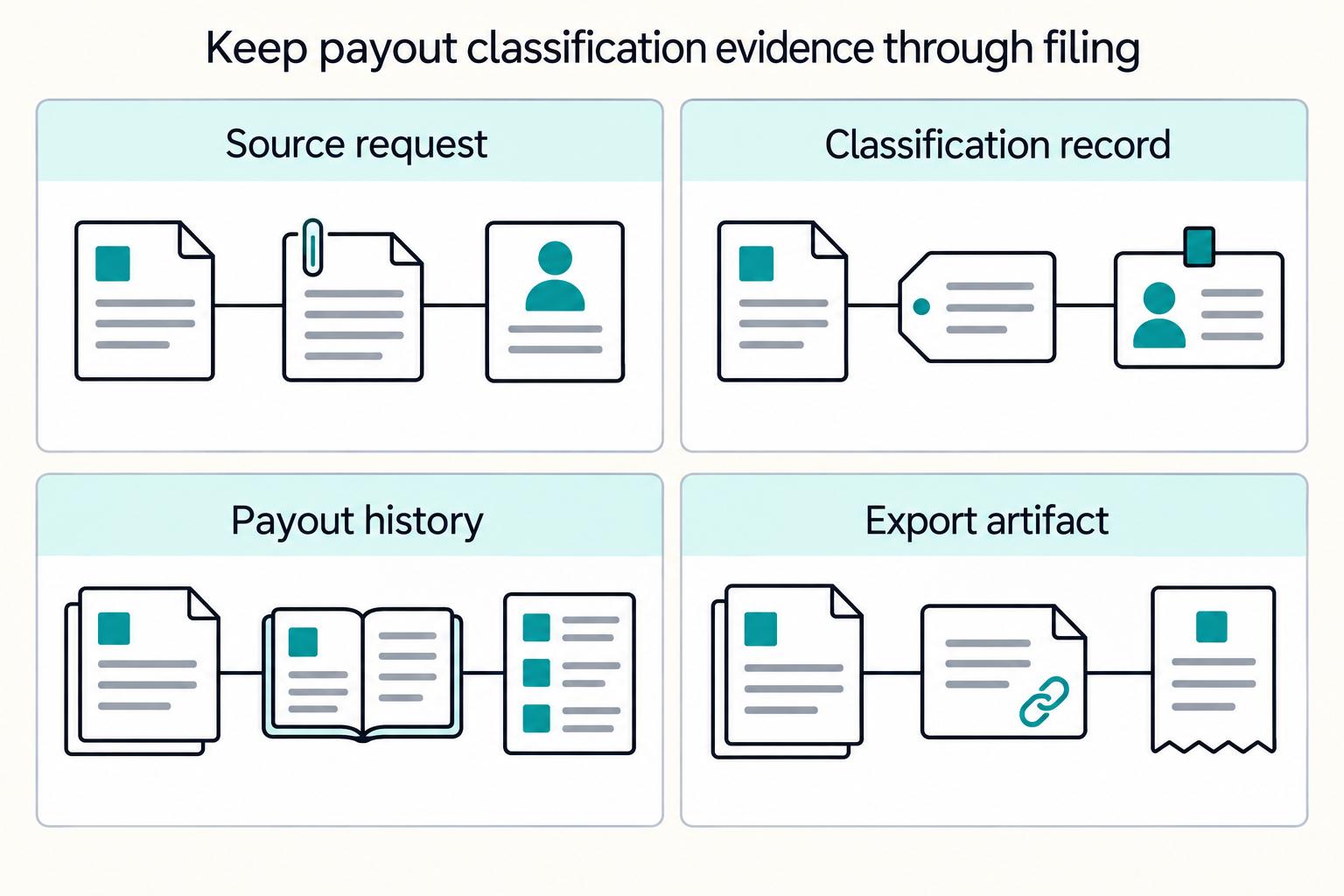
This is an operating-model decision, not a year-end form choice. A team can ship quickly and still end up with misclassified payouts, correction cycles, and filing risk if the classification logic is weak. If you run creator payouts, you need the classification rule before your first batch, not after your first correction cycle.
How Platforms Use Virtual Accounts to Reconcile Incoming Payments Per Client
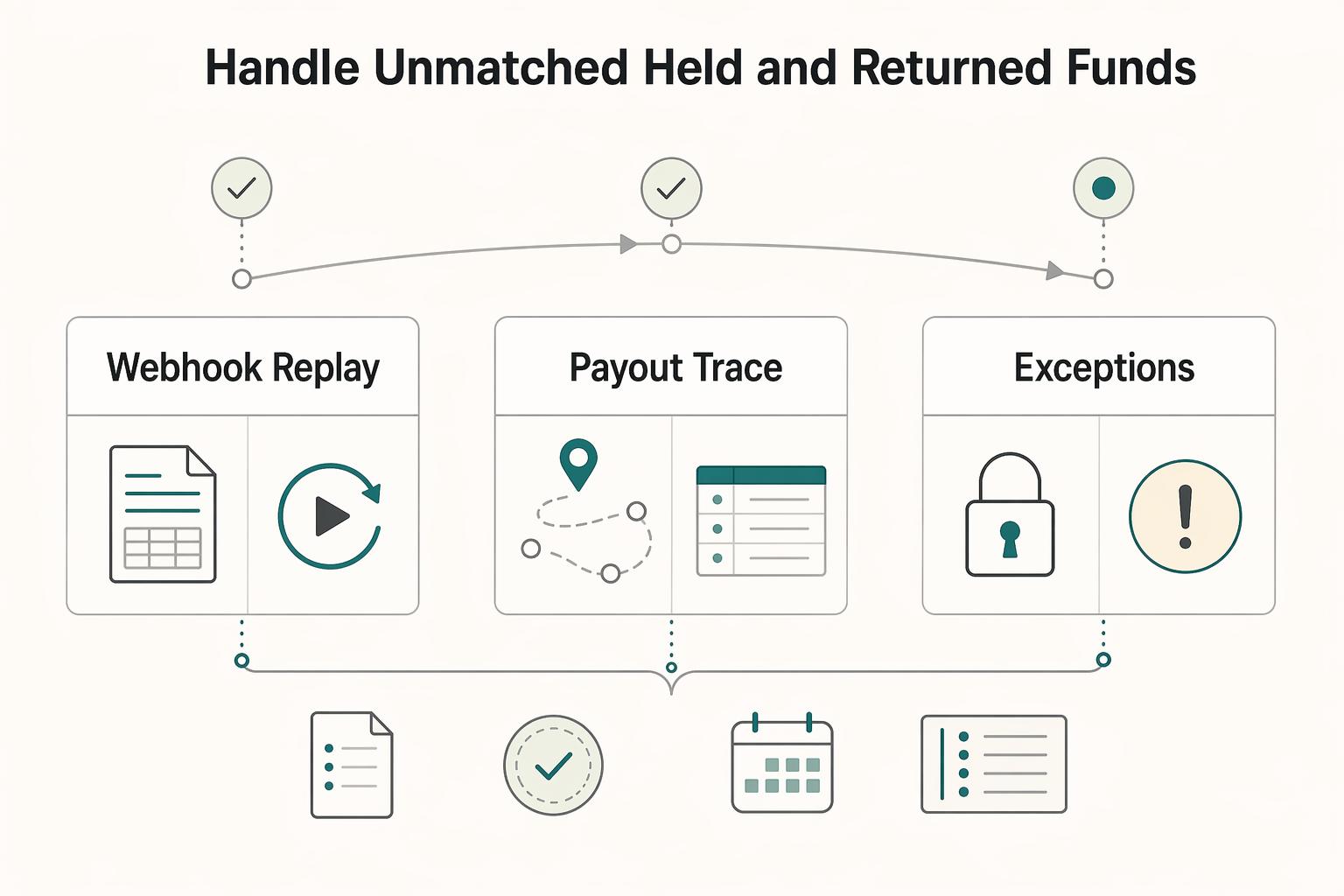
Virtual accounts can remove a lot of manual matching, but only if you design reconciliation into the product instead of treating it as cleanup after integration.