
Quick Answer
Yes - build your pci compliant workflow so clients enter payment details only in a PCI DSS-validated partner flow, not in your website fields, inbox, CRM, or notes. Use hosted pages or payment links for online payments and a hosted virtual terminal for controlled phone entry. Then verify which SAQ applies to your exact setup, and keep annual proof of provider validation plus documented allowed channels.
You're Reading the Wrong PCI Compliance Guides. Here's the Right Framework.#
For independent professionals, PCI DSS is mostly a scoping problem. Build a PCI-compliant workflow that keeps you out of direct card-data handling unless there is no practical alternative.
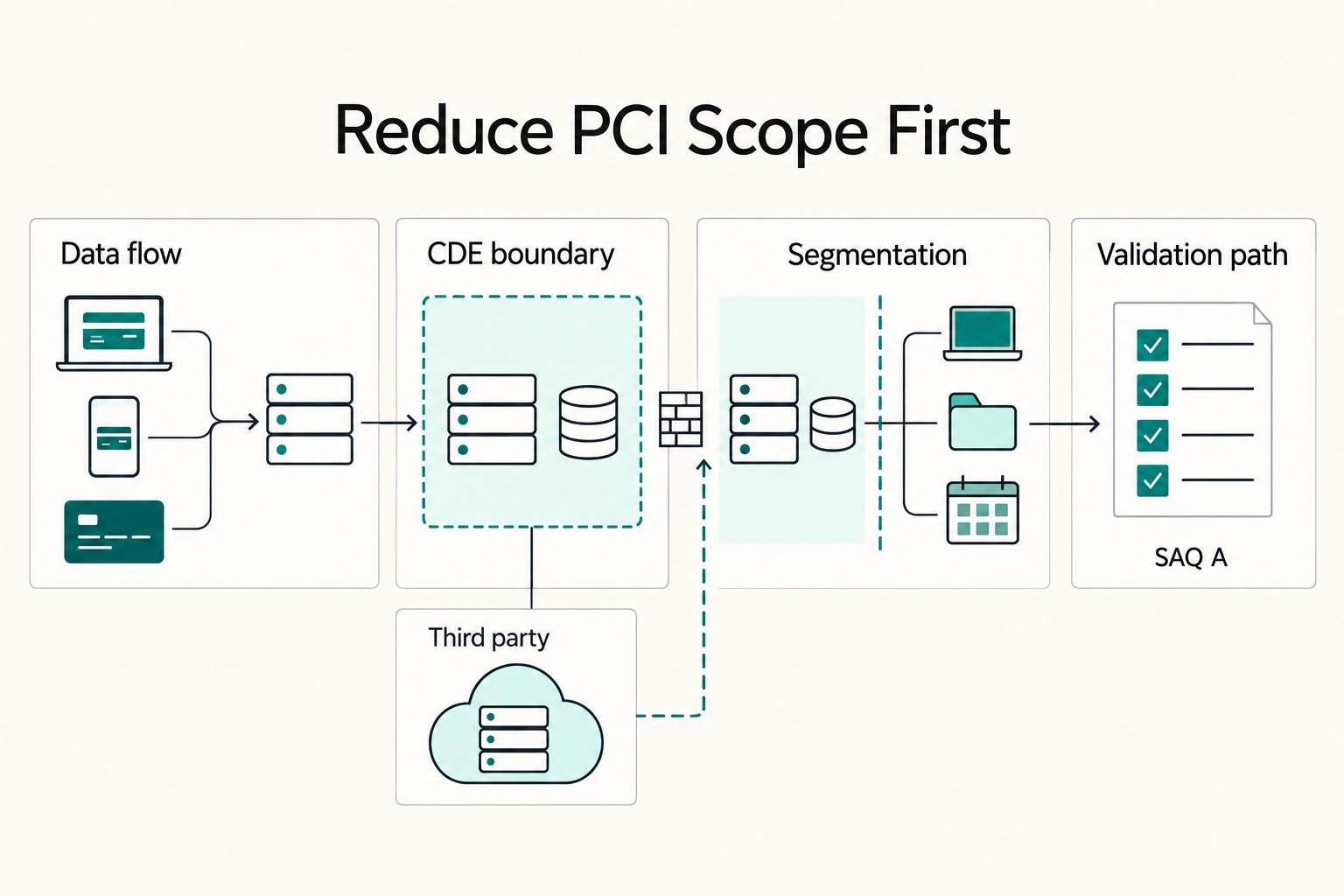
PCI DSS still applies if you accept or process payment cards, and scope is the first decision. The Cardholder Data Environment (CDE) includes the people, processes, and technology that store, process, or transmit payment account data. Something is in scope when it is part of that environment or connected to it without adequate segmentation. It is out of scope when it is not part of the CDE and is adequately separated.
Use one checkpoint before you choose tools: can account data be stored, processed, or transmitted electronically on your systems or premises? If yes, your scope grows. If connected systems are not properly segmented, they can be treated as in scope too.
| Area | Enterprise PCI playbook | Independent professional workflow |
|---|---|---|
| Primary objective | Secure and operate an internal CDE | Keep your business out of direct card-data handling where possible |
| Typical setup | Merchant systems are part of the CDE and must be secured | Use validated third parties for account-data functions where possible |
| Main responsibility | Define, segment, and secure in-scope systems | Choose and enforce a setup that keeps your systems out of scope where eligible |
| Validation path | Set by your compliance-enforcing entity based on scope | May qualify for SAQ A when account-data functions are fully outsourced to validated third parties and you do not electronically store, process, or transmit account data on your systems or premises |
In practice, the job is simple: choose the right partner setup, lock in daily handling rules, and confirm the validation path required by your compliance-enforcing entity, such as your acquirer or payment facilitator.
You might also find this useful: What is 'PCI DSS' compliance and do I need it?.
Start With the Architecture That Keeps Card Data Off Your Systems#
Your first decision is architectural. Build a PCI-aware workflow where you do not accept, store, or transmit raw card data on your systems or premises. That can materially reduce direct PCI exposure.
If account data never touches your laptop, inbox, CRM, notes app, or web server, many PCI DSS requirements may not apply directly to your environment. But outsourcing is not opting out. Your provider runs the card-data infrastructure; you still own vendor selection, implementation choices, and day-to-day process discipline.
| Area | In-scope handling on your side | Outsourced handling with provider-hosted tools |
|---|---|---|
| Systems touched | Your website, devices, email, storage, or internal tools may touch account data | Customer enters payment details on provider infrastructure, not yours |
| Team burden | You secure, document, restrict, and monitor every step that could affect account data | You still validate your setup, but direct card-data infrastructure stays with the provider |
| Failure exposure | A copied email, saved screenshot, browser form post, or misconfigured integration can pull you into scope quickly | Main failures are process mistakes, like collecting cards in the wrong channel or using the wrong integration pattern |
Trace one real payment flow end to end. Where does the card number first appear, and can anyone on your side see, copy, store, or forward it? If the answer includes your site, support inbox, recorded calls, or employee devices, redesign before you scale.
Use payment methods that keep card data with the provider#
Use only payment methods that keep account data on the provider side, and set one operating rule for each method.
| Payment method | Use this when | Common misuse to avoid |
|---|---|---|
| Hosted payment page | You send payment links, invoices, or redirects so card entry happens on a provider-hosted page | Embedding or customizing payment fields in ways that let your site affect payment security without rechecking SAQ impact |
| Client-side tokenization | You need recurring billing or saved payment methods but want sensitive card data kept off your server | Treating any tokenization setup as safe when token creation or handling still moves sensitive data through your server |
| Secure virtual terminal | Manual, one-at-a-time keyboard entry into a third-party hosted virtual terminal | Using it as a general ecommerce flow, or letting staff write card numbers down before entry |
Watch for channel drift. One "just email me your card" exception can break the controls that kept your environment out of direct handling.
Let architecture determine your SAQ path#
Treat SAQ type as the result of your architecture and operating discipline, not a label you claim up front.
| Architecture pattern | SAQ note | What to verify |
|---|---|---|
| Account-data functions are fully outsourced to PCI DSS validated and compliant third parties | SAQ A is for merchants whose account-data functions are fully outsourced to PCI DSS validated and compliant third parties | You cannot electronically store, process, or transmit account data on your systems or premises |
| Redirect-based checkout | Check SAQ A versus SAQ A-EP carefully | Redirect-based checkout is treated differently from embedded payment-form patterns in current PCI SSC SAQ A script guidance |
| Embedded third-party payment form | SAQ A-EP may apply even when card data is outsourced if your site can affect payment-transaction security | Confirm the current eligibility condition before selecting SAQ type |
Under PCI DSS v4.0.1, SAQ A is for merchants whose account-data functions are fully outsourced to PCI DSS validated and compliant third parties. You also cannot electronically store, process, or transmit account data on your systems or premises. That takes both a clean design and clean operations after launch.
For ecommerce, check SAQ A versus SAQ A-EP carefully. Redirect-based checkout is treated differently from embedded payment-form patterns in current PCI SSC SAQ A script guidance. If your site includes an embedded third-party payment form, confirm the current eligibility condition before you select SAQ type. If your site can affect payment-transaction security, SAQ A-EP may apply even when card data is outsourced.
Before any self-assessment, collect evidence: provider PCI documentation, payment-path screenshots, allowed and disallowed staff channels, and confirmation that your systems or premises do not electronically store account data. Then confirm final eligibility with your compliance-enforcing entity, for example your acquirer or payment facilitator, since validation requirements are set there.
Beyond the Brand Name: Your 4-Point Checklist for Choosing a Compliance Partner#
Once you decide to keep raw card data off your side, partner selection becomes a control of its own. Evaluate providers on proof, product fit, and incident behavior, not brand recognition.
| Checkpoint | Strong answer | Risk signal |
|---|---|---|
| PCI validation | Shares a current AOC, confirms 12-month revalidation, and appears on a card-brand registry | Says "we're compliant" without dated evidence, or shows expired or missing validation |
| SAQ fit | Maps your exact flow to SAQ A vs SAQ A-EP (or another SAQ) by product type | Treats all hosted or embedded options as automatically SAQ A |
| Fraud and disputes | Demonstrates configurable rules, confirms 3DS capability, and defines dispute deadline ownership | Relies on generic "AI fraud" claims and cannot show who runs dispute responses |
| Incident readiness | Defines first responder, escalation path, continuity expectations, and support-tier limits | Gives a generic support promise with no escalation or outage or breach workflow |
Confirm current PCI validation#
Ask directly: "Are you currently PCI DSS validated as a service provider, and can you send your current Attestation of Compliance?" Request dated proof, not a sales claim.
Then verify independently in card-brand registries as a due-diligence step. Registry presence is a validation signal, not a blanket security guarantee. If status is unclear, expired, missing, or otherwise not current, pause and request updated validation documents before moving forward.
Match product design to your SAQ outcome#
Ask: "Which of your products keep my setup aligned with SAQ A, and which move me into SAQ A-EP or another SAQ?" Make them answer for your exact implementation.
For hosted pages or full redirects, confirm card entry occurs on provider infrastructure. For embedded forms or pages, require explicit confirmation of protections against script attacks. "It's just an iframe" is not enough. For tokenization, confirm where tokens are created, whether raw card data ever touches your server, and what implementation responsibility remains on your side. For virtual terminals, confirm internet-based, keyboard entry, one transaction at a time.
If they cannot clearly map your flow to the right SAQ path, escalate to your acquirer or payment brand before you finalize the architecture.
Verify fraud controls and dispute handling#
Ask: "What fraud controls can I configure, what authentication options do you support, and who owns dispute response?" You need specific operational answers.
| Operational area | What to confirm | Grounded note |
|---|---|---|
| Configurable rules | Verify configurable rules, not only defaults | You need specific operational answers |
| 3DS capability | Confirm 3DS capability | Ask what authentication options they support |
| Dispute walkthrough | Ask for a dispute walkthrough from alert to submission | You need specific operational answers |
| Evidence ownership | Clarify who gathers evidence | Dispute action is often required within 7 to 21 days depending on the card network |
| Submission and deadline ownership | Clarify who submits it and who tracks deadlines | If ownership is vague, treat that as a risk signal and document the gap before signing |
Use the answers to pin down ownership. Dispute action is often required within 7 to 21 days depending on the card network. If ownership is vague, treat that as a risk signal and document the gap before signing.
Test support like incident readiness#
Ask: "If payments fail, fraud spikes, or a card-data incident is suspected, who responds first, how do we escalate, and what continuity should I expect?" Get names, channels, and sequence.
Confirm whether alerting and escalation features are included in your plan or tied to support tier. If the contract mentions response commitments, record the exact term once it is confirmed.
Also confirm how forensic investigation is handled if a breach response is required, including whether PCI SSC-listed PFIs are used when needed. If incident ownership is unclear, assume continuity risk and resolve it before launch.
Set the Everyday Handling Rules and Keep Them Enforced#
The workflow is only as strong as your everyday handling rules. Keep one principle across every payment touchpoint: PCI can still apply any time card data is processed or transmitted, even if you do not store card numbers. A conservative default is to keep card entry and reuse inside your third-party service-provider flow, and treat other paths as exceptions that need documented approval.
Use one rule table for every payment touchpoint#
The table below is a conservative operating pattern, not a complete channel-by-channel PCI rulebook.
| Context | Do this | Never do this | Why this matters / If this breaks |
|---|---|---|---|
| Invoicing | Send clients to your provider's hosted payment flow and keep card entry there. | Do not treat ad hoc channels as automatically acceptable without documented approval for your validation path. | PCI can still apply when card data is processed or transmitted, even if you do not store it. If details arrive anyway, stop, move the client to the approved flow, and escalate under your incident process. |
| Phone orders | Follow your provider's approved call-payment method so entry happens in that controlled flow. | Do not rely on "we'll process it later" handling outside your approved flow. | Delays and workarounds increase exposure. If details are captured outside the approved path, stop and escalate through your internal process, then redirect payment to the approved flow. |
| Recurring billing | Use your provider's recurring-billing method and document what your provider handles vs. what your team still owns. | Do not assume the processor or billing system handles everything automatically. | Assuming the billing tool "handles everything" is a known failure point. If responsibilities are unclear, pause and confirm ownership before continuing. |
Being strict here is practical risk control, not overkill.
Treat tokenization as a provider-managed reference#
If you use tokenization for recurring payments, keep it inside your provider's documented flow and do not guess at implementation details. Treat token creation, storage, reuse, and revocation as unknown until your provider documents them for your setup.
Add verification points that survive real work#
Controls fail when they live only in policy. Put your verification steps on the operating calendar so they happen in practice.
For SAQ A e-commerce merchants, vulnerability scans are expected at least once every three months by an Approved Scanning Vendor (ASV). Also tie payment-page review to PCI DSS v4.0 requirements 6.4.3 and 11.6.1 for eSkimming protections. Small page changes can quietly increase exposure if no one rechecks the controls.
Enforce the process in normal operations#
Put this workflow into a one-page SOP and require anyone who touches billing to follow it exactly. Review it on a fixed cadence aligned to your validation path, and record the verification checkpoint once it is confirmed.
Define exception handling before you need it: who stops a non-compliant transaction, who escalates, and how the client is redirected into the approved payment flow. That is how you keep one rushed request from breaking an otherwise compliant workflow.
If you want less payment risk inside your own stack, review Merchant of Record for freelancers and compare it against your PCI workflow checklist.
Treat Compliance as an Operating Boundary You Design, Document, and Review#
Compliance gets much easier once you treat it as an operating boundary, not a paperwork exercise. Define clear card-data handling boundaries and make sure your team follows them every time. That gives you clearer accountability, can lower exposure when something goes wrong, and creates more consistent trust signals for clients.
Design the system before paperwork#
Treat compliance as a designed system, not a last-minute form. If card details can still reach inboxes, chat, CRM notes, or internal messages, fix that path first. Process breakdown is where controls often fail.
| Reactive fixes | Designed controls |
|---|---|
| You respond after someone accepts card data through the wrong channel | You define approved payment channels and block or redirect everything else |
| You target a minimum paperwork pass | You run a documented process your team can follow consistently |
| You allow ad hoc tools and exceptions | You keep one approved payment flow as the default path |
Quick check: trace one payment from request to receipt and confirm no card details appear in systems you control.
Document the exact rules you run#
Document the exact rules you run. PCI DSS 4.0.1 has been the active standard since early 2025. The direction is continuous monitoring rather than annual box-ticking, so documented process plus consistent execution is the real control.
Keep it short and explicit. List approved channels, banned intake channels, who can send payment requests, who can access provider tools, and what to do when a client sends card data through an unapproved channel.
Review the workflow continuously#
Review these items on a recurring schedule:
- Verify approved payment channels still route clients into your approved payment flow, not into channels you manage directly.
- Confirm team and client intake boundaries so billing staff consistently refuse or redirect unapproved card-data intake.
- Review payment page integrity monitoring and automated log reviews, and record the review date so you are not relying on stale status.
Your compliance strategy works best as a system you maintain, not a one-time checkbox.
Frequently Asked Questions
Do you still need to be PCI compliant if you use a Level 1 provider?
Yes. Outsourcing does not remove your responsibility to make sure your provider is compliant for the services offered and to monitor that status at least annually. In practice, verify current attestation or validation status, verify your payment flow still keeps card data off your systems, and verify that only approved intake channels are used. If you use a website redirect, validate the applicable controls on the webserver hosting that redirect.
What happens if you are not compliant and there is a breach?
Expect a sequence of consequences: financial exposure, immediate containment and notification work, and an investigation that can require approved forensic support. The exact penalties depend on your payment partners and the facts of the incident. You should also plan for broader business impact.
Can you accept card payments without a website?
Yes, if card entry stays inside your provider’s hosted tools. Payment links can support this model because they send clients to a provider-hosted payment page rather than collecting card data in your own systems. For phone payments, use only your provider’s hosted virtual terminal and have staff enter details directly there during the call. If card data appears in inboxes, chat, or internal messages, stop and redirect the payment to an approved channel.
Try a related tool
Researched and edited by the Gruv editorial team. Gruv builds cross-border billing, payouts, and finance-operations software for global businesses.
Sources
Includes 5 external sources outside the trusted-domain allowlist.
- misq.umn.edu/misq/article/46/4/2289/468/Digital-Strategic...trusted
- blog.pcisecuritystandards.org/important-updates-announced-for-merchants-va...external
- blog.pcisecuritystandards.org/just-published-pci-dss-v4-0-1external
- listings.pcisecuritystandards.org/pci_security/completing_self_assessmentexternal
- pcisecuritystandards.org/faq/articles/Frequently_Asked_Question/What-...external
- pcisecuritystandards.org/faq/articles/Frequently_Asked_Question/Does-...external
Educational content only. Not legal, tax, or financial advice.
Related Posts
Taxes in Germany for Freelancers and Expats
Low-stress compliance in Germany comes from decision order, not tax tricks. Use this sequence: confirm core facts, apply conservative temporary assumptions, verify the few points that can break invoices or filings, and keep one evidence file that explains each decision.

Germany Freelance Visa Application Path for Freiberufler and Gewerbe
Choose your track before you collect documents. That first decision determines what your file needs to prove and which label should appear everywhere: `Freiberufler` for liberal-profession services, or `Selbständiger/Gewerbetreibender` for business and trade activity.
What Is PCI DSS Compliance and Do You Need It?
If you accept or process payment cards, treat PCI DSS as a current business requirement, then narrow your scope on purpose. The goal is to keep cardholder data from spreading into tools and workflows you never meant to involve, so the work stays manageable instead of turning into surprise cleanup later.