
Quick Answer
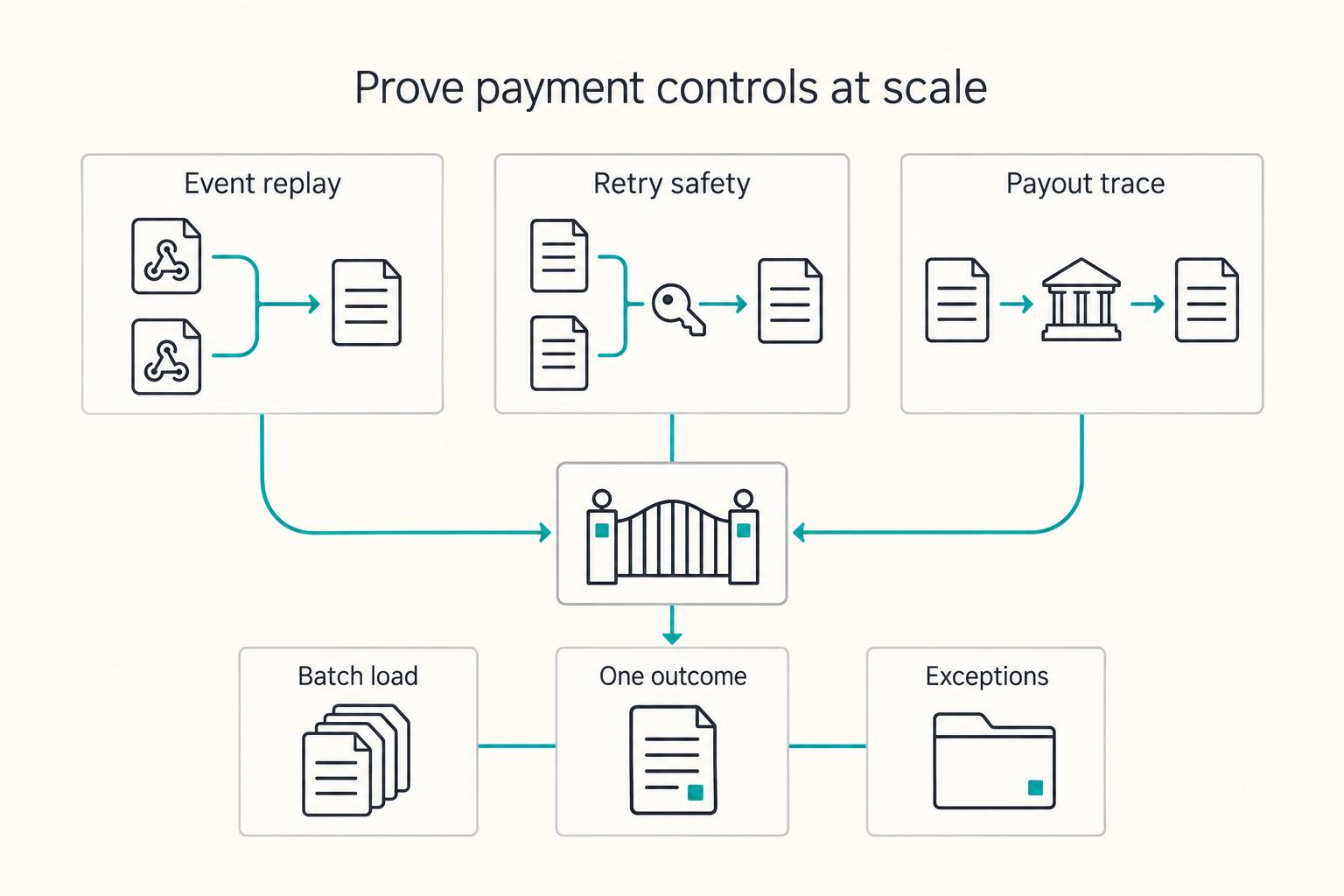
To scale a gig platform from 100 to 10,000 contractors, treat payments infrastructure as a launch gate, not a back-office task. Scale only when onboarding, compliance checks, payout execution, reconciliation, and reporting can handle more volume without manual repair. Use market-specific stop or go criteria, confirm end-to-end payout traceability, and pause expansion when queues, returns, or ledger breaks worsen.
What Changes Between 100 and 10000 Contractors#
If you want to scale a gig platform from hundreds to thousands of contractors, treat payments operations as a launch gate alongside demand, not as a back-office task. Demand can look strong while payout execution, compliance checks, and reconciliation risk build in the background, then surface when you add a country, contractor cohort, or reporting obligation.
Gig work is short-term by design and does not guarantee steady work, so payout reliability matters to platform trust. In an independent contractor model, the expansion question is not just whether more people will sign up. It is whether your team can verify, approve, pay, trace, and report payments as volume rises and jurisdictions multiply.
Start with the operating assumption#
Assume multi-market growth adds friction even when demand is clear. International standard-setters still describe cross-border payments through the same four problems: high costs, low speed, limited access, and insufficient transparency. A market can be commercially attractive and still be the wrong next launch if your payout, compliance, and reconciliation controls are fragile.
Define readiness around payment failure#
Define readiness partly by your ability to absorb payment failure, not only by your ability to generate signups. Top-of-funnel growth alone will not tell you whether onboarding can absorb identity-review spikes. It will not tell you whether bank returns are visible fast enough to stop repeat errors, or whether finance can match provider records to internal payout states.
Start with one practical test: can you trace a contractor payout from onboarding approval to settlement, then back to the ledger and reporting record without manual reconstruction? If not, adding volume increases risk.
This becomes more exposed in cross-border flows. International bodies have warned that inconsistent implementation of payment messaging standards can undercut cross-border payment benefits, so growth can reveal data and process gaps that stayed hidden at lower volume.
Time expansion with operating signals#
Use operational signals to time expansion alongside growth metrics, rather than relying on vanity metrics alone. Track the indicators that are hard to fake: compliance-review queues, unresolved payout exceptions, return visibility, and reconciliation breaks. If those worsen while signups rise, treat that as a warning.
Before opening a new market or contractor segment, confirm record coverage across the payout path: identity evidence, tax profile, payout method details, approval or denial history, and transaction history for audit and support review. Missing records may not block early payouts, but they create persistent support, finance, and compliance problems as volume grows.
Keep reporting obligations in the sequence#
Do not expand faster than you can meet your reporting and jurisdictional obligations.
The constraint is not only moving money. U.S. businesses paying independent contractors may have to file Form 1099-NEC. In the EU, DAC7 places reporting obligations on platform operators, entered into force on 1 January 2023, and the first exchange for calendar year 2023 took place at the end of February 2024. OECD platform reporting rules were also developed in response to rapid digital-economy growth.
The EU reporting obligation lands on the platform rather than on the people it pays, which makes it a product and data question as much as a tax one. DAC7 and DPI reporting for platforms covers what has to be collected, when it is due, and which fields become mandatory only in certain conditions. Running an export through the DAC7 seller data checker shows how far the current record is from that.
The failure mode is straightforward: launching where you can acquire contractors before you can reliably pay and report on them. The rest of this guide shows how to sequence expansion in the opposite order.
For onboarding controls at higher volume, see KYC at Scale: How to Verify 10000 Contractors Without Killing Conversion.
Define your readiness target before you chase growth#
Treat contractor acquisition and payout-system stability as separate lanes, and only scale when both are healthy. Signups show demand, but they do not prove an independent contractor can clear onboarding checks, pass review, get paid, and reconcile in your records without manual repair.
Track growth and payout stability separately#
Track two lanes per contractor segment: supply growth and payout stability. Keep segments operationally real, such as domestic ACH, cross-border bank transfer, or cohorts that require more manual review.
Use a path check, not just a top-line dashboard check. Sample one contractor per segment and confirm identity record, KYC/CIP outcome, AML status, payout trace, and matched ledger journal. If that path breaks, treat the segment as not ready for added volume.
Set market-specific stop and go criteria#
Set explicit stop or go criteria around payout-blocking gates, and set them by market and provider setup rather than as one global threshold. Countries do not use identical legal and operational frameworks. Your readiness criteria should be market-specific, owned, and reviewed on a fixed cadence.
At minimum, define stop or go checks for:
- KYC/CIP completion for payout-eligible users, including hard stops where required identifying data is missing under your bank or provider controls.
- AML review capacity, including queue aging and manual-case load.
- Payout exception backlog and unresolved ledger journal breaks.
For U.S. bank-partnered flows, include SAR throughput in capacity planning. Filing may be required within 30 calendar days after initial detection, and reporting cannot be delayed beyond 60 calendar days when no suspect is initially identified.
Pause when control signals degrade#
Pause expansion when control signals degrade, even if signups are rising. Rising compliance-gated payout queues, growing unmatched ledger journals, and worsening exception patterns are stop signals.
If a segment runs on ACH, monitor return behavior closely. The 3.0% administrative and 15.0% overall return-rate levels are inquiry or evaluation triggers, and 0.5% unauthorized returns can indicate problematic origination practices. The rule is simple: if payout integrity falls while acquisition rises, pause expansion and fix the payment path first.
For year-end reporting at scale, see How Gig Platforms Report 1099s for Thousands of Contractors at Year-End.
Gather prerequisites before choosing markets#
Once you have stop or go thresholds, choose markets from a shared evidence pack, not memory or sales pressure. If one document cannot show how funds move, settle, convert, and fail in a target market, you are still working from assumptions.
Build one shared review pack#
Use one pack that product, finance, operations, and compliance review together. Include confirmed facts, open questions, and an owner for each unknown so teams do not treat a market as "supported" before payout paths, tax documents, and reconciliation are actually defined.
Build the evidence pack from the money path#
Start with the money path, not the demand story. For each target market, document payout rail options you plan to use, expected settlement behavior, FX path when currencies differ, and known failure patterns.
Be explicit about corridor assumptions. Cross-border conditions vary by corridor, not just by country label, and the World Bank tracker spans 367 corridors across 48 sending countries and 105 receiving countries. That is a good reminder that broad market assumptions often miss the operational details that matter.
For each market, check:
- Who performs currency conversion
- When payout is treated as settled
- Which provider reference returns for traceability
- Which exception classes are most likely for failed or returned payouts
The red flags are simple: "bank transfer" with no operational path or settlement behavior, and FX left as a later finance task. If conversion ownership is unclear, support and reconciliation friction can appear early.
Confirm legal and tax scope before launch design#
Lock compliance and reporting scope before launch design so onboarding and payout eligibility can enforce it from day one. Review KYC, KYB, AML, VAT, and tax-document handling together.
| Item | Use or scope | Timing or note |
|---|---|---|
| Form W-9 | U.S. information return workflows | Used to provide the correct taxpayer identification number |
| Form W-8BEN | Foreign beneficial owners in U.S. withholding and reporting contexts | Submitted when requested by the payer or withholding agent |
| DAC7 | EU expansion | Places reporting obligations on platform operators and explicitly covers personal services; entered into force on 1 January 2023; first exchange for calendar year 2023 occurred at the end of February 2024 |
Some obligations are specific:
- In the U.S., Form W-9 is used to provide the correct taxpayer identification number for information return workflows.
- For foreign beneficial owners in U.S. withholding and reporting contexts, Form W-8BEN is submitted when requested by the payer or withholding agent.
- For EU expansion, DAC7 places reporting obligations on platform operators, explicitly covers personal services, entered into force on 1 January 2023, and the first exchange for calendar year 2023 occurred at the end of February 2024.
Checkpoint: your onboarding data model and evidence retention should already match these obligations. If the plan is still to collect W-8 or W-9 data later, do not turn on automated payout volume.
Map product controls to operating reality#
Before market launch, confirm product controls can handle normal payment behavior at scale. Define webhook handling for asynchronous events, idempotency key policy for retry safety, batch support for higher volume, and ledger traceability from request through settlement.
Design for real event behavior:
- Webhook delivery can retry for up to 3 days in live mode.
- Duplicate events should be ignored after prior processing and still acknowledged.
- Idempotency policy should prevent retry-created duplicates.
- If you rely on batch submission, validate bulk submission and retry behavior before launch.
- Reconciliation logic must match payout mode; with instant payouts, transaction-to-payout matching is owned by the platform.
Run one practical test before you call a market ready. Execute a payout, force a retry, process the webhook twice, and confirm you can trace the outcome through your ledger-style transaction record or ledger journal without manual stitching. If that fails, readiness is not there yet. A published Coinbase scaling account described the same failure pattern: synchronous processing creates tight coupling, and when a dependency slows, queues back up.
If you are choosing external providers, How to Find Vendors for Your Platform and Vet Third-Party Providers at Scale covers the vetting process.
Compare markets with a payments-first scorecard#
Use one scorecard across all target markets so you can prioritize markets where payout behavior, reporting, and exception handling are predictable enough to prove controls first. As an operator rule, sequence higher-variance markets after those controls are stable.
Normalize the fields before ranking#
Score each country on the same fields, every time, in one table.
| Market | Contractor payout preference input | Virtual Accounts | FX complexity | Compliance overhead | Failure-containment notes |
|---|---|---|---|---|---|
| United States | Use your own payment mix plus external usage data; do not assume one national preference | Verify by provider, currency, and use case | Score lower only for domestic USD flows; rescore if currencies change | W-9 collection for TIN; Form 1099-NEC may apply; reporting operations must be owned | Confirm return visibility and manual path for unreconciled transfers |
| EU market | Validate with country-level evidence, not regional assumptions | Verify by provider, currency, and use case | Review IMF AREAER and corridor setup when currencies differ | DAC7 can apply to platform operators connected to EU tax presence and activity | Test webhook handling, ledger traceability, and exception ownership before launch |
| United Kingdom | Validate locally | Verify by provider, currency, and use case | Review when funding or payout is non-GBP | UK digital platform reporting rules started on 1 January 2024 | Define manual reconciliation ownership for unmatched bank transfers |
Use evidence, not narrative notes. World Bank Global Findex can support cross-country inputs, but it does not replace your own onboarding and payout behavior data. A row is incomplete unless each field has a source, owner, and last-verified date. Mark assumptions as assumptions.
Add jurisdiction-specific regulatory friction#
Score operational reporting work explicitly, not just legal market access.
- United States: score W-9 collection and 1099 operations directly. Form W-9 is used to provide the correct TIN for information returns, and if you pay independent contractors, you may have to file Form 1099-NEC. Keep IRS source dates in-row because threshold language can change by year.
- EU: score DAC7 as a dedicated friction field. DAC7 entered into force on 1 January 2023, and the first exchange for calendar year 2023 occurred at the end of February 2024.
- United Kingdom: score digital platform reporting as a dated operational obligation. Rules started on 1 January 2024; the example filing deadline for 2025 reporting is 31 January 2026 at 11:59pm.
- AML intensity: increase friction when a jurisdiction is FATF grey-listed or high-risk; for high-risk countries, FATF calls for enhanced due diligence.
Score failure containment, not just launch viability#
Treat exception handling as a core ranking signal. A market that looks smooth on the happy path but is weak on exceptions can create operational risk quickly.
Score these explicitly:
- Return visibility: can operations see provider reference, failure class, and next action without manual reconstruction?
- Unmatched deposits: if transfers are not auto-reconciled, they can remain in customer balance until manually reconciled; assign owner, queue, and documented handling.
- Webhook latency risk: use provider-specific evidence only. For example, Adyen marks webhooks as failing if acknowledgment is not received within 10 seconds.
Validation checkpoint per market: run a payment, force a retry path, confirm your retry/idempotency design prevents duplicate outcomes, and verify operations can locate unmatched or returned items without manual stitching across tools.
Sequence low-variance markets first#
Prioritize lower-variance markets first, then move to higher-friction markets after controls are proven. This is an operator rule, not an empirical law.
If demand is similar across markets, pick the one with fewer payout unknowns, clearer tax-document operations, and faster exception containment. If Virtual Accounts may improve reconciliation, record that potential, but only mark availability after provider, currency, and use-case verification. Keep unknowns visible and attach the validation tests required to clear them.
Choose architecture that matches your stage#
Choose the simplest payment architecture your current exception volume can survive, then add complexity only when your own data shows a real bottleneck. For teams scaling contractor volume, that usually means starting with one primary provider, then adding resilience, reconciliation controls, and throughput tooling as failure patterns emerge.
Start centralized, then add a second provider for a reason#
Early on, single-provider simplicity often wins. Mastercard notes a monoline, single-acquirer approach can work well for businesses operating in smaller regions, which fits an initial launch setup: fewer integrations, one webhook model, and fewer reconciliation branches.
As you expand into more countries and payment contexts, the decision shifts from launch readiness to resilience and operational control. Mastercard describes multi-acquirer connectivity as helpful as merchants grow into new countries. Treat that as a design trigger, not an automatic switch.
Use a second provider only after the first is fully observable:
- Store provider reference IDs.
- Map webhook events to internal payout states.
- Prove returns, retries, and reversals reconcile cleanly.
Checkpoint: run a full payout lifecycle and confirm ops can trace request, acknowledgment, settlement, and return from one contractor record without stitching across multiple tools.
Use Merchant of Record and Virtual Accounts for specific problems#
Use Merchant of Record when you need payment responsibility centralized in the entity processing customer payments. Stripe defines the MoR as the legally responsible payment entity and notes responsibilities include KYC or AML and tax collection and remittance obligations tied to that role. This is a legal and operating-model choice, not a default expansion requirement.
Use Virtual Accounts when reconciliation is the bottleneck. J.P. Morgan defines virtual accounts as sub-ledger accounts linked to a physical bank account, and notes they do not hold funds directly. Add them when inbound transfer identification and unmatched-deposit handling are creating manual queues.
Operator test: if you add Virtual Accounts, confirm credited, held, and returned funds can be traced from the virtual account identifier to the physical account movement and then to the internal ledger journal.
Make payout batches a throughput choice#
Adopt batching when per-item processing overhead starts consuming your payout window. Uber's documented case found datastore round trips, not compute, were the bottleneck. Batching helped move from about 3-4 updates per second on some hot accounts to over 30 updates per second per user account. Uber also reported certain large daily bulk adjustments had been taking 21 to 24 hours before the batching approach.
Use that as directional evidence, not a universal cutoff by contractor count. If payout windows are stretching, retries are clustering, or adjustments are piling up, design and test batching before releases become fragile.
Before enabling batches, validate up front:
- Reject or isolate invalid routing or missing payout data before money movement.
- Define partial-failure handling.
- Assign clear ownership for replaying failed items only.
Scope every idempotency key by action type#
Scope idempotency keys to the economic action so retries stay safe. Stripe's idempotency model is explicit: retries with the same key should not create duplicate objects or duplicate updates.
| Action | Key scope |
|---|---|
| Payout creation | One key per intended payout instruction |
| Payout cancellation or reversal | Separate key space from creation |
| Batch submission | One batch key plus stable per-item identifiers |
| Payout method or profile updates | Separate from payout execution keys |
Verification test: force a timeout after provider acceptance, retry with the same key, and confirm no duplicate payout is created. Then intentionally change one business field and confirm a new key is required.
Centralized rails usually speed launch. As volume and country coverage rise, local-market optimization is worth the added architecture only when your failed-payout, return, and reconciliation data shows the default path is no longer enough.
For a step-by-step walkthrough, see Earned Wage Access Architecture: How to Build EWA Into Your Gig Platform.
Build onboarding gates that protect conversion and control#
Use phased, risk-based onboarding gates so you protect control without forcing every contractor through the same heavy path on day one.
Capture identity first, then gate payout access#
Keep payout enablement behind completed checks. One practical sequence is identity capture, KYC or KYB review, AML screening, then payout enablement, so you collect core data once and avoid enabling money movement while checks are still open.
In U.S. bank account-opening contexts, the strongest anchor is the Customer Identification Program under 31 CFR 1020.220. CIP must sit inside the AML compliance program, requires risk-based identity verification procedures, and requires record-making and record-maintenance for onboarding information. If your bank or payout partner uses that model, collect core identifying fields before the account is considered open, then prevent payout activation until required screening is complete.
If sanctions screening such as OFAC is not complete before account opening, FFIEC says controls should prevent transactions, other than initial deposits, until screening is done. In platform terms, "profile created" is not the same as "payouts enabled." Confirm ops can see identity fields submitted, verification result, screening status, and the exact flag that moved the account into or out of payout eligibility.
Split low-risk contractors from higher-risk applicants#
Route by risk tier early instead of forcing everyone through one flow. FATF's risk-based approach supports stronger measures where risk is higher and simplified measures where risk is lower, and the EBA applies the same risk-sensitive principle to remote onboarding.
Your first pass can separate:
- individual contractors with straightforward identity data
- legal entities that trigger KYB and beneficial-ownership review
- higher-risk cases that need enhanced review before payout access
For legal-entity customers, 31 CFR 1010.230 is the baseline: covered financial institutions must identify and verify beneficial owners, with scope-specific and institution-specific differences. Do not assume one institution's 2026 relief applies everywhere. One failure mode is reusing a consumer flow for business applicants, then finding beneficial-owner evidence gaps after payouts are queued.
Retain approval, denial, and override evidence#
Design evidence retention so you can reconstruct every onboarding decision later. CIP includes record-making and record-maintenance obligations, and ongoing due diligence under 31 CFR 1020.210 includes suspicious-transaction monitoring and risk-based customer-data updates.
For each decision, retain the case record, underlying documents or vendor results, and the reviewer or ruleset that made the decision. Keep a durable link to the ledger journal entry that reflects payout enablement or restriction. That ledger link is an operating control, not a stated legal requirement, but it keeps finance, compliance, and support aligned on the same account history.
Checkpoint: sample ten approvals, three denials, and manual overrides from the latest launch market. If the evidence chain still depends on engineering log pulls, your retention design is too weak.
Pause acquisition when pass rates move the wrong way#
If KYC pass rates drop after launch, treat that as a market-readiness signal and consider pausing paid acquisition until the root cause is clear. Diagnose whether the issue is document mismatch, form design, unsupported identity types, sanctions false positives, or routing into manual review.
This pause is an operating recommendation, not a regulator-mandated threshold. It can help prevent unresolved-case backlogs, protect contractor trust, and avoid pushing onboarding debt into payout operations.
Handle tax and classification risk before payout scale#
Treat classification and tax setup as hard payout gates before volume grows. If either stays unresolved, you create reporting risk and payout-path risk at the same time.
Review classification before automating payout volume#
In the U.S., classification risk is an operating risk, not a legal footnote. Under the FLSA, misclassification is treating a worker who is legally an employee as an independent contractor, and the Department of Labor notes misclassified employees may miss minimum wage and overtime protections.
Set one explicit checkpoint before enabling batch payouts: does this cohort clearly fit your contractor model, or does it need legal review first? IRS guidance for digital platforms is direct that worker classification and information reporting or withholding obligations must align.
Verification point: for each U.S. cohort, ops should be able to pull the classification basis, reviewer, approval date, and any exception notes from the account record. Keep this checkpoint current as rules evolve: the DOL final rule took effect March 11, 2024, and a new NPRM was announced February 26, 2026.
Collect the right tax form before payout eligibility#
Decide early whether the payee must submit Form W-9 or Form W-8BEN. W-9 provides a correct TIN to payers or brokers filing IRS information returns, while W-8BEN is provided by a foreign person to a withholding agent or payer in U.S. withholding and reporting contexts.
Collect and store the required form during onboarding, then block automated payout expansion when tax profiles are incomplete or contradictory. That is an internal control choice, and it can reduce cleanup queues that become hard to close at scale.
Assign one owner for 1099-NEC operations#
Assign one owner for 1099-NEC operations and related exceptions. Form 1099-NEC is used to report nonemployee compensation, and IRS reporting is condition-based, including whether payments reach the applicable threshold amount during the year.
Keep exception handling with the same owner, because reporting failures often start as onboarding data gaps. You should be able to answer for any U.S. contractor whether a W-9 is on file, whether the account is in 1099 review scope, and what unresolved issue is blocking clean reporting.
Route relevant accounts into DAC7 and FATCA-linked checks#
For EU platform operations, treat DAC7 data collection as part of account readiness. DAC7 places reporting obligations on platform operators, entered into force on January 1, 2023, and the first information exchange for calendar year 2023 took place at the end of February 2024.
For U.S.-linked cross-border handling, keep FATCA scope precise. FATCA is a reporting and withholding framework for certain foreign financial institutions and some other foreign entities, so do not assume it applies identically to every gig platform model.
Internal decision rule: no automated high-volume payout batches for accounts with unresolved tax-profile or classification flags. If a profile is not clean enough for reporting and review, it is not clean enough for scaled disbursement.
For cross-border expansion, see How to Scale Global Payout Infrastructure: Lessons from Growing 100 to 10000 Payments Per Month.
Make payout execution resilient under load#
Payout execution is more resilient under load when every batch follows a clear state model, retries only the right failures, and leaves a complete trace from request to final status.
Define one payout state model#
Use one canonical internal state model and map every provider update into it. A practical set is pending, in_transit, paid, failed, and canceled. Keep raw provider statuses for reference, but do not let each provider define your internal truth.
Process webhook-driven state changes with both your internal payout ID and the provider object reference, since provider events reference the provider-side object that changed. Make those updates idempotent so if an event is delivered again, you do not create duplicate side effects, and acknowledge accepted webhook events with a 2xx status code.
Verification point: for any payout, ops can retrieve the internal payout ID, provider reference, current state, previous state, and the event timestamp for the last transition.
Separate retryable failures from fix-first failures#
Retry only failures that are likely to succeed after a delay. Transient connectivity or service faults fit automatic retries. Failures that are unlikely to succeed when repeated should stop retrying and move to review.
If a provider supports idempotent requests, reuse the same idempotency key for the same payout-creation attempt to avoid duplicate side effects. On Stripe, idempotency keys can be up to 255 characters, and keys may be removed after at least 24 hours, so very old retries should not assume protection still exists.
Operating rule: if the next attempt needs no human change, retry it. If it needs corrected data or approval, stop and route it for review.
Run pre-flight checks before batch submission#
Run pre-flight validation before submission so provider processing is not your first error check. Validate required input fields before sending the batch.
Provider batch flows can help surface missing details and input errors before processing starts, but treat that as a second line of defense. In one Adyen Customer Area batch modification flow, the file cap is 6000 records, so batch sizing should be intentional. Each batch should produce a pre-flight result that makes blocked and error rows visible before submission.
Write every transition to the ledger journal#
Write each meaningful payout transition to the ledger journal, not only the final outcome. Include timestamp, amount, currency, internal payout ID, provider reference, and resulting internal state for each transition.
This makes request-to-settlement history reconstructable without manual stitching. With an immutable ledger design, prior states remain reconstructable and audit trails stay available at account and transaction level.
Red flag: if one payout investigation still requires pulling disconnected records from multiple places, your controls are not ready for higher volume.
Treat reconciliation as a launch blocker, not a finance afterthought#
If reconciliation still depends on manual investigation, treat expansion as higher risk until payout exceptions are consistently explainable and auditable.
Reconcile across all three records of truth#
Use three views together: provider records, internal payout states, and ledger journal postings. A payout marked paid, failed, or canceled internally should match provider processing, and each material status change should have a posted accounting movement or a documented reason it does not.
This matters because one provider payout can include multiple underlying transactions. Stripe notes that automatic payouts can include funds from multiple transactions and provides payout-reconciliation tooling to identify which transactions are in a payout. For manual payouts, Stripe also notes it cannot identify included transactions for you, which raises operational risk if your internal mapping is weak.
Verification point: for any sampled payout, retrieve the provider payout or settlement reference, internal payout state history, and exact ledger postings without manual stitching.
Run a daily exception review#
Run exception review daily. FCA CASS 7.16 requires internal client money reconciliation each business day in scope contexts, and CASS recordkeeping requires records that show and explain transactions and commitments. Even where that rule does not directly apply, daily review is a practical operating floor.
Track exceptions that block clean reconciliation:
- unmatched deposits or payout receipts
- held funds awaiting allocation or review
- returned payouts or reversals
- internal states that do not match provider status
- ledger gaps where funds moved but no posting exists
Treat ownership and resolution timing as internal operating policy so the queue does not grow unchecked.
Trace Virtual Accounts from event to ledger movement#
For Virtual Accounts, verify the full path from event to ledger posting, not just that funds arrived. Stripe uses virtual bank account numbers to automate bank-transfer reconciliation, but you still need internal traceability for your credited, held, or returned outcomes.
Webhook tracking should align with posted entries. Adyen recommends webhook-based tracking for recurring reconciliation, and its transfer and transaction webhooks provide status-change visibility and booked debit events. Also test exception paths: Stripe notes bank-transfer flows can include overpayments or underpayments, and unreconciled customer-balance funds held beyond 75 days are automatically attempted for return.
Verification point: sample one credited case, one held case, and one returned case (where those states exist in your flow), and confirm the webhook event, internal record, and ledger movement all tell the same story.
Before adding another market, map your payout states, webhook handling, and reconciliation workflow into one implementation runbook in the Gruv docs.
Set expansion pause and rollback triggers in advance#
Do not wait for a live payout incident to decide whether to pause expansion. Define and approve stop rules now, with trigger-to-action mapping as explicit as your launch criteria.
Define hard pause triggers#
Use three trigger families: compliance capacity, payout execution quality, and unresolved investigations. For compliance, set an internal stop point based on backlog growth and oldest-case age so expansion pauses automatically for the affected market or contractor cohort.
| Signal | Level or timeline | Context |
|---|---|---|
| SAR filing baseline | 30 calendar days after initial detection | Anchor AML escalation to real filing timelines |
| SAR outer limit | 60 calendar days | Applies when no suspect is identified |
| Unauthorized debit returns | 0.5% | Track in ACH-heavy flows |
| Administrative returns | 3.0% | Track in ACH-heavy flows |
| Overall returns | 15.0% | Track in ACH-heavy flows |
Anchor AML escalation to real filing timelines: the SAR clock starts at initial detection, with 30 calendar days as the baseline and 60 calendar days as the outer limit when no suspect is identified. For ACH-heavy flows, track Nacha warning levels in your trigger set: 0.5% unauthorized debit returns, 3.0% administrative returns, and 15.0% overall returns. Your daily dashboard should show oldest-case age, queue growth, return-rate trends, and repeated payout-batch failures.
Pre-approve rollback actions#
Pre-approve rollback actions before launch so incidents do not become policy debates. Typical options are pausing payments or payouts on affected accounts, restricting new payout creation, and using traffic isolation or traffic shifting only where fallback-provider contracts and compliance setup allow it.
If you use Stripe Connect, pausing payouts blocks both automatic and manual payout creation, and payouts can be canceled if payouts are not unpaused within 10 days of creation. Keep an incident decision log with timestamp, owner, trigger hit, affected accounts, and provider references.
Prepare contractor communication before you need it#
Assume payout disruption becomes a trust event immediately. Keep approved templates ready that state what is delayed, what is still working, whether contractor action is required, and when the next update will be sent.
This matters because in some payout configurations, you are responsible for notifying affected accounts when payments or payouts are paused. Run a drill: ops, compliance, and support should be able to send an accurate notice without rewriting it during the incident.
Related reading: How to Use AI to Personalize Subscriber Experiences at Scale on Your Platform.
Common mistakes that create payout and compliance debt#
One reliable way to create payout and compliance debt is to expand contractor demand before your compliance, event-handling, and tax controls can support the volume.
Match expansion to compliance throughput#
Expansion should track compliance capacity, not signup momentum. Customer Identification Program requirements make identity collection a prerequisite to account opening. CDD requires beneficial-owner identification for legal-entity customers at new account opening. AML programs require named day-to-day compliance ownership, so reviewer and investigator bandwidth is a real operating limit.
Verification point: compare weekly approved volume against open KYC, KYB, and AML cases by queue, owner, and oldest-case age. If legal-entity onboarding is in scope and beneficial-owner collection is not live, hold launch.
A common miss is staffing approvals without staffing investigations. For covered banks, after suspicious activity is detected, the SAR timeline is 30 calendar days, with up to 60 calendar days allowed when no suspect is initially identified.
Make webhooks part of the production path#
At payout-batch scale, webhooks should be part of the primary operating path, not an optional add-on. Providers position webhooks for asynchronous events and high volumes of business-critical updates, so manual status checks should be a fallback, not the main control.
Verification point: each payout status change should map to a webhook event or provider reference, and retries should use idempotency keys so the same operation is not applied twice. If teams are manually refreshing dashboards to confirm settlement, scaling risk is already present.
Separate wallet display from ledger truth#
Keep clear source-of-truth boundaries for payout state and reconciliation records; this can make incident triage more reliable as volume grows. You do not need perfect architecture on day one, but you do need traceable record ownership.
Check one failed payout end to end. You should be able to trace contractor-facing balance impact and payout state to underlying records with matching references.
Front-load tax and classification controls#
Tax and worker-classification controls belong before launch, not after. In the United States, the Department of Labor final rule on employee-versus-independent-contractor classification is effective March 11, 2024, and misclassification remains an active labor-risk area.
Tax workflows also need early enforcement. Missing TIN data can require immediate backup withholding at 24 percent, and late or incorrect information returns can trigger penalties, including a general rule of $250 per return. If a profile is missing required tax documentation or has an unresolved classification flag, exclude it from automated payout batches.
Related: Gig Worker Tax Compliance at Scale: How Platforms Handle 1099s W-8s and DAC7 for 50000+ Contractors.
Conclusion and copy-paste expansion checklist#
Use this as a go/no-go gate before each new market or contractor-cohort launch. If any line is not passed with evidence, treat that lane as not ready.
- Define control ownership before opening supply
[] KYC, KYB, and AML gates are defined with owners, SLAs, and override rules where applicable. Name owners, blocking statuses, and the override path in writing. If AML obligations apply to your structure, explicitly designate who coordinates day-to-day AML compliance and where approval records are stored.
- Put tax-document handling inside onboarding
[] W-8 or W-9, 1099, and jurisdictional tax-document handling are integrated into onboarding. For U.S. independent contractors, IRS guidance says the first step is collecting Form W-9, and W-9s should be retained for four years. For foreign beneficial owners, include Form W-8BEN in the payer or withholding flow when applicable. Keep clear 1099-NEC ownership, especially with the IRS e-file threshold lowered to 10 aggregated information returns effective January 1, 2024. If you are in an EU reporting perimeter, DAC7 has applied since 1 January 2023 and expects platform operators to collect and verify seller information.
- Prove payout reliability under retries and duplicate events
[] Payout state model, webhooks, idempotency key policy, and payout batches (if used) are tested under retry scenarios. Your pass condition is one payout and one correct final state even when requests and webhook events are retried. Idempotency keys are the control for safe retries without duplicate operations. If you use Adyen, acknowledge webhooks before business logic, respond within 10 seconds, and account for retry queue behavior that can continue for up to 30 days.
- Prove reconciliation from provider record to finance export
[] Reconciliation is passing across provider records, internal states, and finance exports. Test real samples across credits, returns, holds, and reversals. Each case should trace cleanly across provider references, internal payout states, and finance-facing records.
- Define stop and rollback rules before incidents
[] Pause and rollback triggers are documented, approved, and tested. Document what triggers a pause, who approves it, and what rollback means operationally, for example stopping new onboarding, new payouts, or both. Validate the path with a scenario test such as repeated payout-batch failures or unresolved AML holds.
- Log unknowns before committing scale spend
[] Unknown assumptions for this market are logged with validation steps before scale spend. Keep a short, explicit list of unresolved assumptions, each with an owner and validation step. If an assumption is still unvalidated, constrain launch volume and delay paid scale.
If your expansion checklist is passing but rollout risk is still unclear by country or rail, review your scenario with the team through Gruv contact.
Frequently Asked Questions
What usually breaks first when a gig platform grows from 100 to 10,000 contractors?
Payment operations often break before demand does. Manual approval queues, spreadsheet tracking, and payout-state chasing tend to fail as volume rises. If settlements are still being confirmed through polling or spreadsheets, that is a near-term scaling risk.
What payments infrastructure must be in place before entering a new country?
You need confirmed payout coverage for the target country before launch. Put webhook-driven status updates, idempotency keys, and traceability from payout request to settlement and ledger records in place. Tax and reporting ownership should also be explicit, including W-9 and 1099 flows in the U.S. where applicable and DAC7 scope for relevant EU platform operations.
How can we reduce payout failures without slowing contractor onboarding?
Use progressive gating so onboarding can move while payout enablement waits for routing details, tax data, and compliance checks. Review rejected payouts by reason code on a fixed cadence and prioritize the top failure modes. Tightening bank-detail capture and validation can be a strong first fix because bank-account data mismatch is a known rejection reason.
What is the operational difference between contractor growth and platform readiness?
Contractor growth is a supply metric. Platform readiness is an execution metric. It means your compliance operations, payout processing, and reconciliation can absorb more volume without unresolved exceptions. If signups rise while exception backlogs and unmatched ledger items also rise, growth is outpacing readiness.
When should we pause expansion even if contractor acquisition looks strong?
Pause when payout and compliance controls stop keeping up with volume. Warning signs include growing compliance backlogs, repeated payout-batch failures, unresolved compliance holds, or inability to trace a failed payout end to end. If you may be operating as a U.S. money-services business, expansion should wait until a written, maintained AML program is in place.
Do we need multi-rail payouts early, or can we start with one provider?
You can start with one provider if it covers launch markets and supports webhook events, idempotent retries, and reconciliation-ready payout status data. Add rails when country coverage gaps appear, when you run multiple payment processors, or when you need to decouple payments from payouts and support funds segregation. Add complexity for concrete risk and coverage needs, not for optics.
Try a related tool
Researched and edited by the Gruv editorial team. Gruv builds cross-border billing, payouts, and finance-operations software for global businesses.
Sources
- bsaaml.ffiec.gov/manual/OfficeOfForeignAssetsControl/01trusted
- dol.gov/agencies/whd/flsa/misclassificationtrusted
- dol.gov/agencies/whd/flsa/misclassification/rulemakingtrusted
- ecfr.gov/current/title-26/chapter-I/subchapter-F/part...trusted
- ecfr.gov/current/title-31/subtitle-B/chapter-X/part-1...trusted
- irs.gov/businesses/corporations/foreign-account-tax-...trusted
- irs.gov/businesses/gig-economy-tax-centertrusted
- ncua.gov/newsroom/press-release/2026/fincen-issues-ex...trusted
Educational content only. Not legal, tax, or financial advice.
Related Posts

The Freelance Payment Penalty: A Modeled Audit of Platform Fees, FX Spreads, and Payout Delays
The money rarely disappears through a single, easy-to-spot fee. The real loss is stacked. A marketplace takes its commission, a processor adds a charge for international cards, a bank or payment company converts the currency at a spread, a platform holds the funds before release, and a wire sheds a little to intermediaries on the way in. Each layer looks defensible on its own, but the worker feels the combined result as a smaller deposit and a later payday.

How to Respond to a Subpoena for Business Records
Move fast, but do not produce records on instinct. If you need to **respond to a subpoena for business records**, your immediate job is to control deadlines, preserve records, and make any later production defensible.

A US Expat's Guide to Investing in UCITS ETFs to Avoid PFIC Issues
The real problem is a two-system conflict. U.S. tax treatment can punish the wrong fund choice, while local product-access constraints can block the funds you want to buy in the first place. For **us expat ucits etfs**, the practical question is not "Which product is best?" It is "What can I access, report, and keep doing every year without guessing?" Use this four-part filter before any trade: