
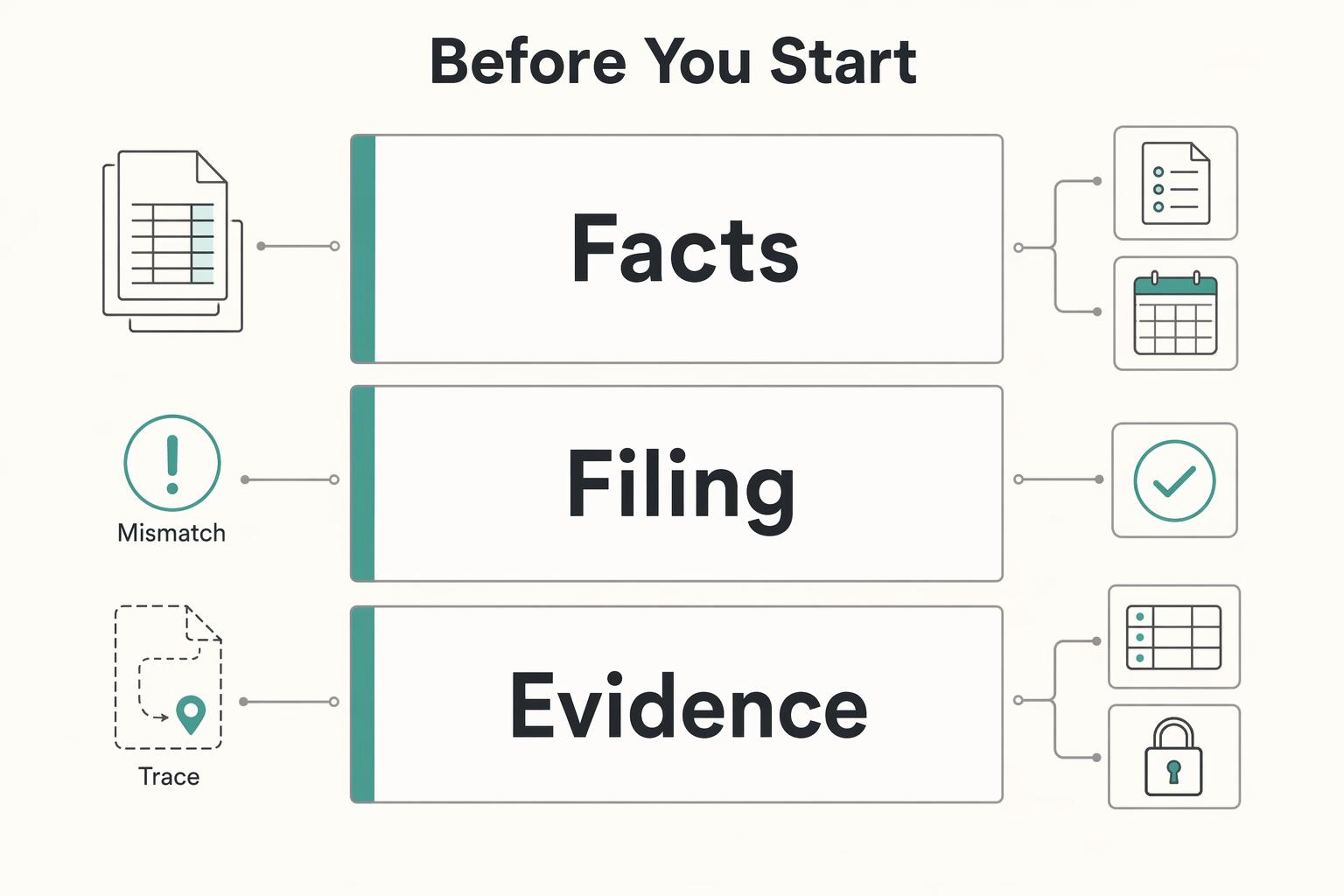
Quick Answer
Start by treating gig platform 1099 bulk reporting as a control process, not a year-end file upload. Set ownership, lock form-decision logic, validate Form W-9 and Form W-8 status, and run a dry run from a frozen snapshot before transmission. Reconcile draft outputs to ledger totals, stop conflicting worker-classification records, and escalate mixed or cross-border facts to legal or tax review. File only after approvals and evidence are complete.
Treat Gig Platform 1099 Bulk Reporting as an Operations Control Problem#
Treat gig platform 1099 bulk reporting as an operations control problem before you treat it as a filing task. If ownership, worker classification, and supporting records are loose before year-end, the final transmission only scales bad decisions faster.
Before you start#
This guide is for the teams that usually converge on year-end reporting at the same time: compliance, legal, finance, risk, and the engineering partners who generate extracts and filing files. The goal is not to review every payout by hand. It is to put clear rules and evidence around the few decisions that actually change whether a payee belongs in a specific information-return workflow or wage-reporting workflow.
At scale, that distinction matters. Reporting gets harder quickly once a platform handles hundreds or thousands of workers, sellers, or creators. Worker classification is still the foundational risk because the downside of getting it wrong can be severe. Market guidance also points to an electronic filing requirement once you reach 10 or more information returns, but you should confirm the current Internal Revenue Service filing instructions for your filing year rather than relying on older thresholds.
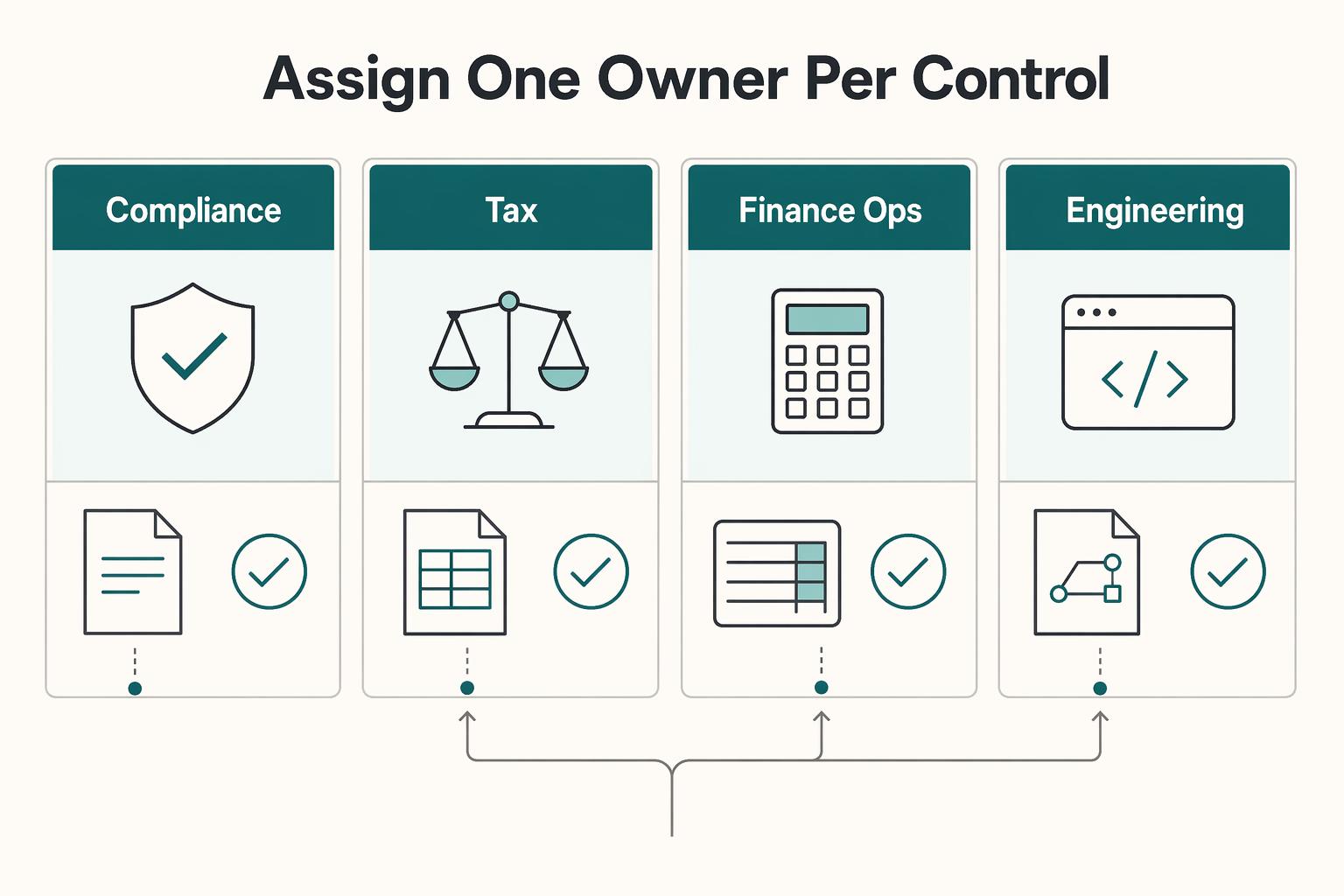
Step 1. Assign owners before you tune tools. Name people for rule interpretation, payee data quality, ledger reconciliation, and final sign-off. Software can generate files, but it will not resolve a mixed case where facts conflict. A quick test is whether every unresolved reporting issue has an owner, a due date, and an escalation path to tax or legal. If not, you do not have a filing process yet.
Step 2. Lock down the records that support the form decision. For most platforms, the minimum evidence starts with payment tracking and tax documentation. You need to know who was paid, why they were paid, through which payout rail, and what tax form record supports the payee. Before filing, you should be able to trace each included record back to tax documentation status, underlying payout totals, and the rule that placed the payee into a given form population. A common failure mode is letting incomplete or contradictory profile data drift downstream until January, when corrections get slower and more expensive.
Step 3. Escalate ambiguity instead of automating through it. If the facts do not clearly support 1099 treatment, stop and escalate. That matters most for unresolved worker classification, cross-border payees, and mixed payment models. The sections below focus on the controls you can lock now, the checks to run before filing, and the point where internal policy notes stop being enough and qualified tax counsel needs to make the call.
Set scope and ownership before year-end filing#
Set the reporting boundary now, not in January. Most year-end pain comes from unclear scope and ownership, not file formatting.
- Define in-scope populations by payout model and role.
Map who is in scope based on how money moves and what the payee does on the platform: contractor services, seller settlements, creator or royalty-style payments, and payroll populations that may belong on Form W-2 rather than information returns like Form 1099-NEC or Form 1099-MISC.
Treat classification ambiguity as a review trigger, not an auto-include rule. If one person appears across multiple products or as both employee and service provider, hold that record for decision review. Keep one population sheet with cohort, paying entity, payout rail, contract type, candidate form, and required tax documentation.
Keep threshold language precise: payer guidance commonly states filing the correct 1099 when qualifying service payments reach $600 or more, subject to exceptions. Do not apply that threshold universally across every form or payee type.
- Assign named owners, not team aliases.
As the January 31 cutoff approaches, generic ownership labels break down. Vendor guidance for the 2026 filing season also points to a 10-return electronic filing mandate, so unresolved decisions can become production risk quickly.
Assign a person to each lane: compliance, tax interpretation, finance reconciliation, engineering extract/transmission prep, state filing, and final release approval. Every open form-decision issue should show an owner, due date, and approver.
- Use one decision log as the source of truth.
Track unresolved form questions in a single log tied to the filing obligation. At minimum, capture payee ID, product, payout type, proposed form, open question, owner, escalation path, and final disposition.
Make legal escalation explicit for mixed worker models, unclear facts, or any W-2 versus 1099 split you cannot support from the record. If you cannot produce a clear note on why a payee was included, excluded, or moved between form populations, expect corrections later.
Map payout flows to the correct information return type#
Map payout flow to return logic in a controlled decision table before you run extracts. If the map lives only in code or tribal memory, conflicting logic will slip into filing.
- Build a controlled decision table before extract logic.
Keep the table outside engineering code, with tax or compliance ownership and legal review where facts are unclear. For each row, capture payout rail, contract type, paying entity, who controls funds first, who sends payout, candidate form family, review trigger, source memo, approver, and effective date.
Avoid generic labels like "platform payout" as the deciding rule. One platform can run settlement and direct-contractor flows at the same time, so hidden defaults create misroutes. If your internal logic references Publication 2104 (Rev. 12-2022), record that exact revision in the table.
- Add a conflict gate so one payee cannot flow through two form paths silently.
Stop records for review when the same payee ID or TIN maps to conflicting candidate forms, or when the same person appears in both a Form W-2 population and a 1099-candidate population.
Run this gate before file creation. Use a cross-product dedupe keyed to tax year, payee ID, TIN (if available), paying entity, and candidate return type, then route multi-hit records to review with underlying payment records attached.
- Document where your model breaks, especially in mixed MoR setups.
When Merchant of Record (MoR) and direct-contractor payouts both exist, document who contracts with the end customer, who settles funds, which entity books ledger movement, and whether the same payee can receive money through both paths.
"Recommended fund flows" can help operationally. Wingspan's gig-economy documentation says to "explore the recommended fund flows," which is useful implementation guidance but not a legal determination by itself. Your mixed-model packet should include the funds-flow diagram, agreement excerpt, sample ledger trail, and a decision note that either assigns a form path or marks review required.
- Require legal and tax checkpoints for edge cases, and block engineering defaults.
Engineering should implement approved rules, not resolve disputed classification between Form 1099-K, Form 1099-NEC, and Form 1099-MISC. Mark edge cases as "review required" when contract labels conflict with payout flow, MoR and direct payouts coexist for a payee, paying entity changed mid-year, or the documentation packet is incomplete.
The checkpoint must end in a clear outcome: approved path, excluded from filing, or hold for more facts. Tools can automate mechanics; Wingspan, for example, describes tax management for 1099 filing and TIN verification, but automation does not replace the approval decision.
For a step-by-step walkthrough, see Indian Gig Economy in 2026: Treat Platform Income as Variable Until Settlements Prove Stability.
Build contractor tax profile intake and validation gates#
Once the form map is set, use intake gates to catch foreign-asset reporting issues early and route them correctly instead of forcing them through standard 1099 operations.
| Check | Article fact | Handling |
|---|---|---|
| Foreign-asset flags | Escalate profiles that raise FATCA or other cross-border reporting questions into specialist tracks | Route to specialist review before export |
| Form 8938 threshold | In general reportability starts above $50,000, though thresholds can be higher in some cases | Use a Form 8938 check, not a blanket threshold rule |
| Annual return context | Form 8938 is attached to the taxpayer's annual tax return | If a U.S. taxpayer is not required to file an income tax return, Form 8938 is not required regardless of asset value |
| Penalty exposure | $10,000 penalty, with potential increases up to $50,000 for continued failure after notification, plus a 40 percent substantial understatement penalty in some cases | Treat penalty exposure as a separate escalation signal |
| FBAR | Can be a separate filing obligation | Do not collapse these decisions into ordinary contractor-profile processing |
- Route foreign-asset flags to specialist review before export.
Keep the main queue focused on year-end 1099 execution. Escalate profiles that raise FATCA or other cross-border reporting questions into specialist tracks. That keeps complex determinations out of routine intake handling.
- Use a Form 8938 check, not a blanket threshold rule.
The IRS says Form 8938 is used to report specified foreign financial assets, and in general reportability starts above $50,000, though thresholds can be higher in some cases. Your intake logic should therefore follow the instructions for exceptions rather than applying one universal cutoff.
- Validate filing context before marking a profile as required.
Form 8938 is attached to the taxpayer's annual tax return. If a U.S. taxpayer is not required to file an income tax return, Form 8938 is not required regardless of asset value.
- Treat penalty exposure and related filings as separate escalation signals.
IRS guidance references a $10,000 penalty, with potential increases up to $50,000 for continued failure after notification, plus a 40 percent substantial understatement penalty in some cases. Also, FBAR can be a separate filing obligation, so do not collapse these decisions into ordinary contractor-profile processing.
Run a bulk reporting dry run and exception queue#
Run a production-like dry run before filing: it should surface missing records, route exceptions to clear owners, and make reruns predictable before transmission is enabled.
Before you start#
Use one frozen source snapshot for the test population, not live tables that can change during review. Reuse existing bulk payout controls, including high-volume processing, payment status tracking, webhook notifications, and audit trails, so this review path is traceable the same way disbursement operations are.
- Generate draft outputs and bucket failures by error type.
Run the pre-filing job in draft mode and block transmission. Do not accept one undifferentiated failure list. Split exceptions into owner-ready buckets, such as missing required tax documentation, name/TIN mismatch, worker-classification conflict, unresolved state filing flags, and duplicate payee identity.
Every rejected record should include an owner, reason code, and next action. If a queue only says "record failed export," the exception process is not practical.
- Reconcile ledger totals against form-population totals before record-level review.
Start with the payout ledger, then compare its population and aggregate value to the draft reporting population. First, find omissions; then review malformed records.
Check both count and value, and keep evidence with the snapshot ID (or hash), ledger extract timestamp, draft output timestamp, and reconciliation notes.
- Prioritize high-risk exceptions instead of oldest-first.
Work missing documentation, classification conflicts, and unresolved state filing flags first. Keep lower-risk formatting cleanup separate from items that need compliance or legal escalation.
If classification is unresolved, pause automated form assignment and escalate. If a state flag is unknown, do not treat federal draft readiness as complete readiness.
- Apply idempotent retry rules when regenerating files.
Use a stable batch identifier for each rerun and a clear control rule for whether records are replaced, appended, or suppressed. Keep that rule in system controls, not analyst memory.
Test at least one controlled rerun from the same snapshot. Unchanged records should keep stable identities, and only corrected records should change. This prevents duplicate drafts in downstream filing tools after regeneration.
Execute filing week with approvals, evidence, and state routing#
Filing week should run as a controlled release, not a live debate. If owners, approvals, or submission records are unclear, pause and resolve that before transmission.
| Control | Required record | Note |
|---|---|---|
| Filing calendar | Compliance review; finance reconciliation sign-off; final release authority | Set one filing calendar per batch |
| Federal transmission | Separate outputs and statuses | One "submitted" status should not imply everything is complete |
| State routing | Separate outputs and statuses | Keep unresolved state items visible instead of hidden behind federal readiness |
| Evidence pack | Source extract hash or immutable snapshot ID; approver names; submission timestamp; submission confirmation; correction ticket links | Validate before marking completion |
| Rejected file incident | Rejection notice; affected batch ID; root cause; retry decision; resubmission confirmation | Use a same-day incident path |
- Lock the filing calendar and release authority.
Set one filing calendar per batch with explicit gates: compliance review, finance reconciliation sign-off, and final release authority. Keep those approvals in a tracked record tied to the batch, frozen source snapshot, target submission date, and named approvers. The IRM's emphasis on Roles and Responsibilities and Program Controls is a useful model for this discipline.
- Separate federal transmission from state routing and adjacent obligations.
Use separate outputs and statuses for federal transmission and state routing so one "submitted" status does not imply everything is complete. If you also manage EFTPS or other payment/reporting steps outside the transmission itself, document that boundary in the release checklist. This keeps unresolved state items visible instead of hidden behind federal readiness.
- Capture a complete evidence pack for each batch.
Store one standard evidence pack before closing any batch: source extract hash or immutable snapshot ID, approver names, submission timestamp, submission confirmation, and correction ticket links. Validate the pack before marking completion so the batch can be reconstructed later. If the record cannot be reconstructed, treat the batch as incomplete.
- Use a same-day incident path for rejected files.
Define rejection ownership, incident logging, required evidence, and retry approvals in advance. The IRM section Reporting System Problems to Headquarters supports the operating pattern: route problems through a named path with a clear current owner and status. Require a rejection notice, affected batch ID, root cause, retry decision, and resubmission confirmation before closing the incident.
Handle edge cases for cross-border and mixed worker models#
Once filing week is controlled, the next risk is false certainty. For cross-border payees and mixed worker populations, keep one rule: when facts are incomplete, pause automation and escalate to documented review.
Review cross-border fact patterns before applying U.S. information return logic#
Treat cross-border signals as an exception path, not a default 1099 decision. If your workflow uses Form W-8 review, route the case there before finalizing U.S. information return handling, and require a clear reviewer decision before the payee returns to a standard queue.
Keep the checkpoint operational: record the trigger signal, current form status, payout type, and final reviewer outcome. Do not let one legacy onboarding field override newer conflicting facts.
Explain forms, but stop short of personal tax advice#
Provide form education, not personal filing advice. You can explain what a form is and where your reporting boundary ends, but individual filing determinations should go to the worker's adviser.
Use only verified facts when you explain cross-border topics. FBAR is FinCEN's "Report Foreign Bank and Financial Accounts." FEIE applies only to qualifying individuals with foreign earned income, and excluded foreign earned income still must be reported on a U.S. return. If asked about the physical presence test, keep it factual: 330 full days in a 12-month period, those days do not need to be consecutive, and the test applies to both U.S. citizens and U.S. residents.
Pause automated form assignment when worker classification is unresolved#
When worker classification is unresolved, stop automatic form assignment. Mark the record as pending and escalate before the next extract is generated.
For each escalation, capture the contract type, service description, payout rail, market, and product context. Mixed labels across products should stay blocked until a single reviewed decision is recorded.
Flag virtual currency and other non-cash compensation for review#
Flag virtual currency and other non-cash compensation as review triggers, not hardcoded assumptions. Route these cases to legal or tax review and require sign-off before filing treatment is finalized.
Make sure the note lives on the payee or payout record and flows into your exception queue and evidence pack.
Fix common failures without creating new compliance risk#
When a failure appears, isolate it and correct only the affected records through your approved control path.
| Failure | Required response | Key detail |
|---|---|---|
| Missing Form W-9 data | Freeze records and requeue only corrected entities | Return records to eligibility only after the required data is complete and validated |
| 1099-NEC / 1099-MISC misassignment | Use a formal correction workflow | Document the failed rule, impacted payees, root cause, and control update |
| Ledger and filing extract do not match | Stop and reconcile before filing | Work from a controlled snapshot so the extract is reproducible and deltas can be explained |
| Quick-fix scripts bypass approvals | Require post-incident sign-off | Record what changed and update the documented control path before the next run |
Freeze payees with missing Form W-9 data before requeueing corrected entities#
Freeze records with missing Form W-9 data, then requeue only corrected entities. If missing W-9 data is discovered late, hold those payees, run targeted outreach, and return records to eligibility only after the required data is complete and validated. Do not reopen the full population, or you risk pulling already-cleared records back into exception handling.
Use a formal correction path when Form 1099-NEC and Form 1099-MISC were assigned incorrectly#
Use a formal correction workflow when Form 1099-NEC and Form 1099-MISC are misassigned. Treat this as a control failure, not a simple form swap: document the failed rule, impacted payees, root cause, and control update. A dedicated 1099 corrections path may exist in filing tooling, but approval and incident documentation still need to follow your internal process.
Use the payout ledger as the source record when totals do not match#
If the payout ledger and filing extract do not match, stop and reconcile before filing. Work from a controlled snapshot so the extract is reproducible and deltas can be explained. If you cannot reproduce the population and totals, the batch is not ready.
Block quick-fix scripts that bypass approvals, then require post-incident sign-off#
Do not allow "quick fix" scripts to bypass approvals. If an off-path change happens, require post-incident sign-off, record what changed, and update the documented control path before the next run. This aligns with a roles-and-controls operating model and helps avoid repeat failures, especially at larger filing volumes.
A third-party bulk-filing guide warns that intentional disregard can trigger penalties up to $630 per form and states electronic filing applies at 10 or more information returns. Treat shortcuts as escalation events, not normal operations.
Related: Gig Worker Tax Compliance at Scale: How Platforms Handle 1099s W-8s and DAC7 for 50000+ Contractors.
Final year-end checklist you can copy into your ops doc#
For gig platform 1099 bulk reporting, use this checklist to lock decisions before filing week. If ownership, form logic, or exception handling is still moving, pause the batch.
- Confirm owners and approval authority first.
Assign named owners across compliance, legal, finance, and engineering, and define escalation and final sign-off for each lane. For every open issue, you should be able to name who decides, who reviews, and who approves. IRS IRM 21.3.7 distinguishes Roles and Responsibilities from Program Controls, which is a useful control pattern for your runbook.
- Freeze and publish the form-decision table.
Lock the current logic for Form 1099-K, Form 1099-NEC, and Form 1099-MISC with an effective date so every team uses one version. Treat old spreadsheets and product-level assumptions as out of policy once frozen. If one payee appears in multiple payout rails and the table does not resolve it, route that record to review before batch freeze.
- Validate tax-profile readiness before export.
Separate Form W-9 and Form W-8 populations and assign exception queues to specific owners. Track each exception with an action-driving status, not a descriptive label only. Do not allow incomplete or conflicting tax profiles to move forward just because payout data looks clean.
- Run reconciliation from ledger-controlled data.
Compare ledger-derived totals to filing extracts and clear highest-risk exceptions first. If the extract does not tie back, regenerate from a controlled snapshot instead of hand-editing rows. Manual patches at this stage often create avoidable correction work later.
- File and capture evidence in the same motion.
Record the batch version, approvers, submission confirmation, and references for any same-day changes at filing time. For reruns or rejects, apply controlled change handling so you can explain what changed, who approved it, and what the change affected.
- Close with a control-focused post-mortem.
Document failures, late escalations, and one-off fixes that should become standing controls next cycle. The test is whether your checklist, decision table, or exception routing changes based on what you learned. If the output is only "watch more closely," the control gap is still open.
Related reading: Choosing Creator Platform Monetization Models for Real-World Operations.
If you want a quick next step for gig platform 1099 bulk reporting, try the W-2 vs 1099 calculator.
Frequently Asked Questions
What must a gig platform report at year-end if some payees never received an information return draft?
A missing draft does not decide whether an information return is required. The filing question turns on the payer, the payment type, and threshold rules such as service payments of $600 or more, subject to exceptions. Treat a missing draft as a delivery or population-control failure, then verify the payee against your ledger and tax profile instead of assuming the record is out of scope.
Is income still reportable when a contractor’s earnings were paid outside the platform’s primary payout flow?
Do not assume those payments are automatically excluded; confirm who the payer was and whether the payment belongs in your documented return logic. If that answer is unclear, pause automated form assignment and route for review.
How should operators decide between Form 1099-K, Form 1099-NEC, and Form 1099-MISC in mixed payout models?
Use a decision table tied to the actual payout rail and contract type, not a platform-wide default. The supported form family here is Form 1099-K, Form 1099-NEC, and Form 1099-MISC, and mixed models need a clear "review required" branch when one payee appears in more than one rail. The practical test is simple: can you explain, payee by payee, why only one form family applied for that payment stream?
What is the minimum evidence pack needed to defend a bulk filing decision during an audit?
Do not assume there is a formal IRS minimum evidence pack. A practical internal pack can include the records needed to reproduce the filing population and explain the form choice, plus submission confirmation and any later Form 1099 Corrections record. If you cannot regenerate the batch and tie changes back to documented review, the file is weak.
When should a platform escalate to specialist counsel instead of relying on internal policy notes?
Use your approved internal governance rules, and escalate when payer identity, payment classification, or form assignment cannot be resolved confidently within that framework.
How should teams handle state filing differences without duplicating every federal control?
Keep your filing population and reconciliation controls consistent, and avoid creating parallel logic paths unless a documented requirement requires it.
Try a related tool
Researched and edited by the Gruv editorial team. Gruv builds cross-border billing, payouts, and finance-operations software for global businesses.
Sources
- dol.gov/sites/dolgov/files/WHD/flsa/IC_NPRM_092220.pdftrusted
- federalregister.gov/documents/2020/09/25/2020-21018/independent-...trusted
- fincen.gov/report-foreign-bank-and-financial-accountstrusted
- irs.gov/businesses/corporations/fatca-information-fo...trusted
- irs.gov/individuals/international-taxpayers/foreign-...trusted
- lawfilesext.leg.wa.gov/law/wsr/2008/09/08-09PROP.pdftrusted
- medfordoregon.gov/files/assets/public/v/2/planning/documents/n...trusted
- regulations.gov/document/WHD-2026-0001-0001trusted
Educational content only. Not legal, tax, or financial advice.
Related Posts
1099-K Reporting Threshold After the IRS Delay: Control Updates for Platform Operators
This is a controls update, not a news recap. If your Form 1099-K program was built around transition-era assumptions, recheck it against the current IRS baseline before you change workflow or code.

Gig Worker Tax Compliance at Scale: How Platforms Handle 1099s W-8s and DAC7 for 50000+ Contractors
At scale, the hard part is not the acronyms. It is deciding sequence, ownership, and evidence when Form 1099-K, Form 1099-NEC, Form W-8BEN/W-8BEN-E, and DAC7 do not line up cleanly. If you run a high-volume marketplace, put controls in the right order and define clear stop points where legal or tax takes over.
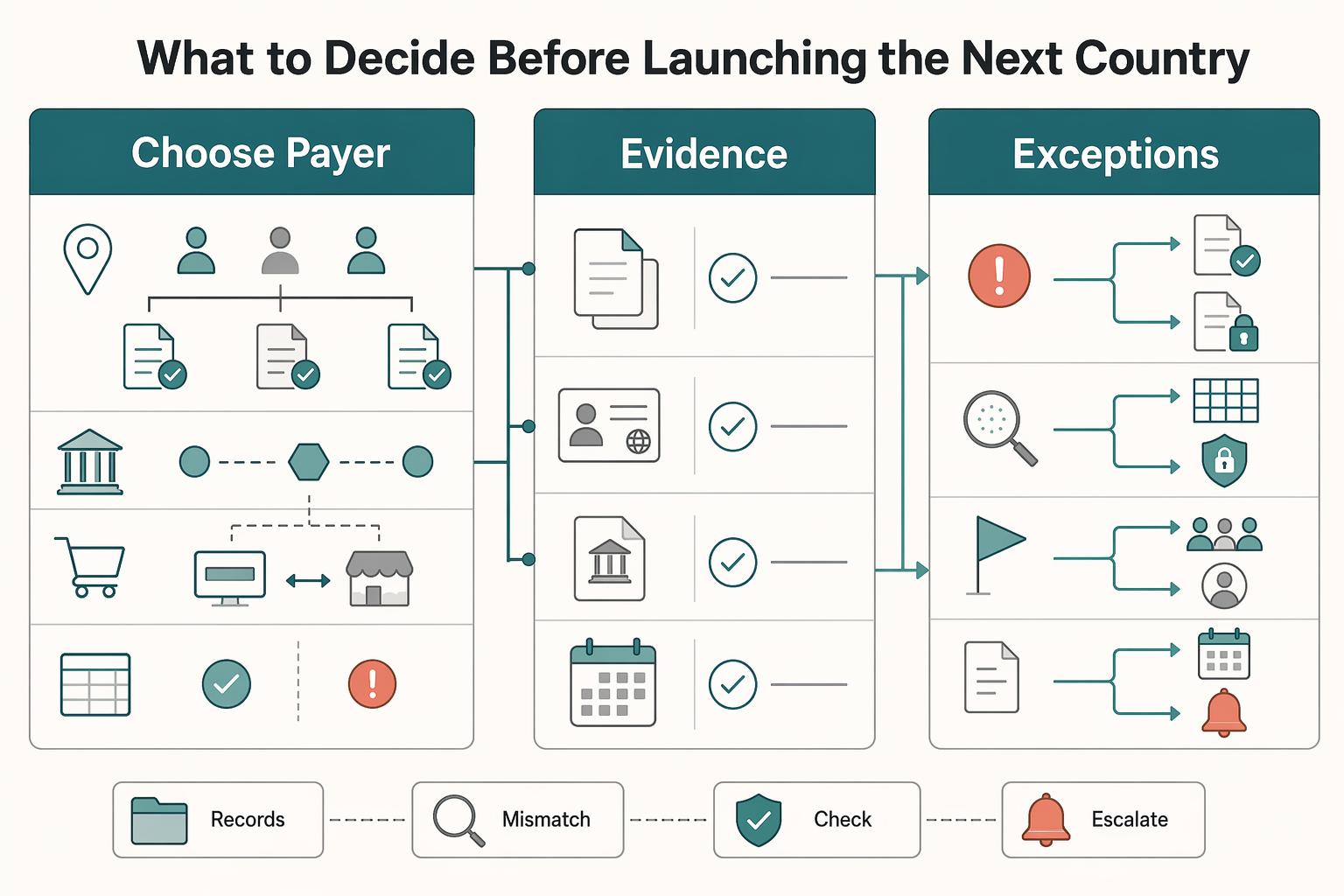
Creator Platform Tax Reporting for 1099 and W-8 Expansion Decisions
Tax form routing is an operating decision, not a creator support task. When it goes wrong, you see payout delays, avoidable withholding, and reporting risk. For creator platforms, the core job is to classify payees before the first payout and keep that logic defensible as volume grows.