
Quick Answer
Start with one market and one worker segment, and delay launch until a one-page model memo confirms earnings inputs, repayment path, and exception ownership. Readiness means you can trace each payout from source event to ledger posting, show which rule version approved or held it, and complete a dry run that includes a normal payout, a return, and a support escalation. Expand cohorts before countries.
What Your EWA Architecture Needs to Support#
EWA is an operating-model decision before it is a product feature. Earned Wage Access lets workers access pay they have already earned before payday. For a gig platform, it also changes earnings verification, fund movement, repayment handling, exception operations, and launch risk.
Demand alone is not a launch signal. As EWA expanded over the last 10 years, concerns about fees, overuse, and compliance grew with it. So the first question is not whether workers want faster access. It is whether your data quality, repayment path, and operating ownership will hold up under real volume.
This guide is for teams making a specific go or no-go decision: one market, one worker segment, one payout setup. For cross-border operators, that framing matters because early choices can create regulatory uncertainty, repayment gaps, or partner dependencies that are hard to unwind later.
Treat this as a high-stakes money decision. You are deciding how workers access funds, where recovery risk sits, and how compliance decisions are carried into production. Some offerings may be limited by area, and some depend on licensed third-party entities whose licensing status can affect your ability to operate. If a partner dependency exists, document it before you scope the build.
If your primary question is retention impact, read Gruv's guide on using EWA as a contractor retention tool. If your question is system trade-offs and operating readiness, start here.
Run a preflight before you design anything#
Bring a short evidence pack into the rest of this process. If your team cannot produce these three items in one working session, pause the architecture work.
| Preflight item | Required details |
|---|---|
| Verify earnings at the source | Name your source of truth for earned amounts, refresh frequency, and correction ownership. |
| Own the repayment path | Define how disbursed funds return, who owns failed recovery risk, and what happens if platform activity stops before settlement. |
| Assign escalation accountability | Put named owners on payout exceptions, compliance decisions, and partner or licensing incidents, with clear evidence requirements for approve, hold, reverse, or deny outcomes. |
- Verify earnings at the source. Name your source of truth for earned amounts, refresh frequency, and correction ownership. A useful checkpoint is whether your data can support an automated flow similar to implementations automated through SuccessFactors integration.
- Own the repayment path. Document how disbursed funds return, who owns failed recovery risk, and what happens if platform activity stops before settlement.
- Assign escalation accountability. Name the owner for payout exceptions, compliance decisions, and partner or licensing incidents, and define the evidence needed for approve, hold, reverse, or deny outcomes.
By the end of preflight, you should be able to explain on one page how earnings are verified, how access is granted, how repayment works, and who handles edge cases. If you need a template for that working draft, start with the Gruv tools library and adapt it to your operating model. Once that preflight is done, lock the market and segment first, because those choices set the constraints your architecture has to survive.
Related reading: How to Build a Spend Control Policy for Virtual Cards on Your Platform.
Choose your first market and segment before you design architecture#
Choose your first jurisdiction and worker segment before you design flows. Those constraints decide whether your payout and compliance logic will work in practice.
| Stage | Focus | Rule |
|---|---|---|
| Market screen | Legal treatment by jurisdiction; operating-model fit with local legal framework; dependency on licensed third parties | Delay markets where legal treatment is unclear or licensing dependency risk is unresolved |
| First segment selection | Payout frequency; immediacy of worker cash-flow needs; payroll or workflow fit | If segments look similar, start where payroll or payout workflows are already recurring and operationally embedded |
| Day-one entry criteria | Available payout rails; API and HR-system integration readiness; regulatory and fraud-control capacity | Launch where controls are clear and enforceable; postpone jurisdictions that still depend on assumptions |
Start with the market screen#
Start with a market screen that covers legal treatment by jurisdiction, operating-model fit, and dependency risk. The goal is to eliminate markets where your core assumptions are still unclear. For each state or country, require a one-page answer to these questions:
- Is legal treatment clear enough to plan without major caveats?
- Does your operating model fit the local legal framework?
- Do you depend on licensed third parties whose licensing status could affect service capability?
Regulatory uncertainty can limit availability by jurisdiction, so treat legal ambiguity as a launch blocker. If legal treatment is uncertain or licensing dependencies are unresolved, delay that market until you can enforce the controls in practice.
Pick the first segment from operating reality#
Pick your first segment from operating reality, not headline demand. Score each candidate on payout frequency, immediacy of worker cash-flow needs, and workflow fit.
Real-time payments support immediate payouts, and EWA is built around access to already earned wages. Gig-worker segments often have strong immediacy needs, so faster access should factor into prioritization. Payroll-linked segments can also be strategically attractive because payroll runs regularly and is deeply embedded in employer workflows.
Set day-one entry criteria you can enforce#
Set day-one entry criteria your team can enforce: available payout rails, API and HR-system integration readiness, regulatory readiness, and fraud controls. Require these readiness checks:
- The disbursement rail is selected and documented.
- Required API and HR-system integrations are scoped and testable.
- Regulatory readiness and fraud controls are defined before launch.
For this build decision, use one rule: launch where controls are clear and enforceable, and postpone jurisdictions that still depend on assumptions.
Related: How to Build a Subscription Billing Engine for Your B2B Platform: Architecture and Trade-Offs.
Decide employer-integrated or direct-to-consumer based on repayment certainty#
Do not choose the model by brand preference or launch speed alone. Use a clear decision framework and evaluate providers against the operational requirements in your environment. If key assumptions about earnings inputs, repayment, or reconciliation are still unclear, keep the decision open.
Teams often pursue EWA to solve a financial-access problem that shows up operationally in lost shifts, turnover, overtime premiums, and customer service impacts. It can also be part of a retention or recruitment strategy. If retention is part of your goal, pair this with How Gig Platforms Can Use Earned Wage Access (EWA) as a Contractor Retention Tool.
Confirm which model suits your jurisdiction with a qualified legal adviser before launch.
| Decision signal | Employer integrated fits better when | Direct to consumer fits better when | Red flag |
|---|---|---|---|
| Earnings verification | You can clearly explain how earned amounts are calculated in this model | You can clearly explain how earned amounts are calculated in this model | Two teams calculate different available amounts from the same work record |
| Repayment and reconciliation | Repayment and reconciliation assumptions are documented and testable in this model | Repayment and reconciliation assumptions are documented and testable in this model | Recovery or reconciliation depends on untested assumptions |
| Exception handling | Roles and handoffs are documented for this model | Roles and handoffs are documented for this model | No clear owner or process for exceptions |
| Provider evaluation | Selection criteria are explicit and tied to operations | Selection criteria are explicit and tied to operations | Model choice is based only on brand preference or launch speed |
Validate earnings-data reliability first#
Your finance, product, and support teams should be able to review the same work record and explain the same payable amount for the same worker and period.
Do not accept a general "good enough" claim. Use a small sample of real records and trace each one from source event to available-balance calculation to payout record. If the same job, shift, or task produces conflicting balances across teams, fix that before choosing a model.
Validate repayment and reconciliation before speed#
Validate repayment and reconciliation next, and weigh them more heavily than launch speed.
For either model, confirm the end-to-end recovery and ledger process is documented, testable, and operationally owned. Test failure modes relevant to your environment, such as payment returns, account changes, payout reversals, and reconciliation breaks between disbursed funds and outstanding balances.
Check operations and support capacity before the final choice#
Assess operations and support capacity before the final model choice. Ownership clarity for exceptions is a core go-or-no-go checkpoint.
Name an owner and first queue for each exception type you expect. If ownership is unclear, treat that as no-go until handoffs and response expectations are documented.
Write a one-page model memo before architecture work#
Write a one-page model memo before architecture work gets too far ahead. It should be specific enough for legal, product, finance, and operations to approve or block. Use this checklist:
- Fee design: who pays, when fees trigger, how fees are shown, and refund or failed-payout treatment. Confirm fee treatment with legal, source records, and your processor.
- Collections posture: repayment method, retry sequence, user messaging, recovery limits, and exception-approval owner. Confirm the permitted recovery approach with legal, written policy, and source records.
- Classification risk posture: how the structure interacts with your worker model. Confirm the classification interpretation with legal and a qualified adviser.
- Exception ownership: named owner for repayment exceptions, account changes, reconciliation breaks, and worker complaints.
- Evidence pack: sample earnings trace, sample repayment trace, support macros, and daily reconciliation template.
Choose the model only when these checks pass with tested behavior and clear owners. If they do not, delay the decision instead of coding around uncertainty.
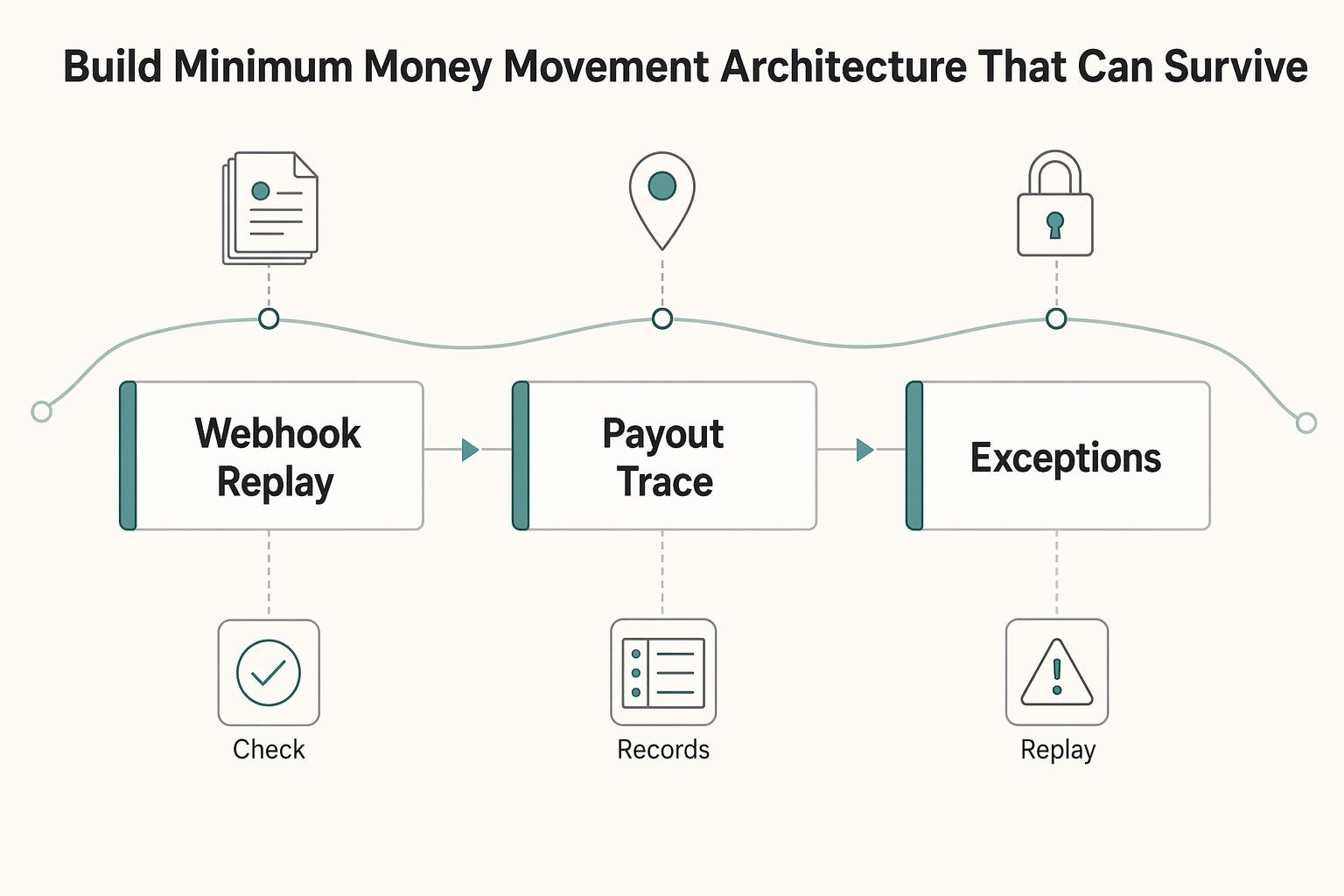
Build the minimum money movement architecture that can survive production#
Build only the money movement architecture that can explain each payout decision, support fast access, and keep working when exceptions show up. Demand is moving toward immediate earnings access, which puts pressure on legacy payout methods. A published Visa case example shows how quickly expectations can move: in that case, payout wait times moved from 3 to 5 days to 30 minutes with a direct-to-card payout solution.
Step 1: Sequence core services by decision flow, not UI flow. Run the path in order: earnings calculator, eligibility engine, payout orchestration, ledger posting, then customer-visible status. That keeps each status tied to a traceable prior decision and helps reduce avoidable support disputes.
Step 2: Set one authoritative internal money record before adding projections. Pick one internal source of truth for money movement. Then derive balances, wallet views, and reporting from it consistently. The operating check is simple: product, finance, and support should all be able to explain the same payout outcome from the same underlying record.
Step 3: Define webhook and event handling for real network behavior. Assume payout updates arrive asynchronously and retries happen more than once. Define event contracts and replay behavior so status updates stay coherent under retries.
Step 4: Map modules to clear control points, market by market. Where supported in Gruv, use Virtual Accounts for inbound flow visibility and Payouts for disbursement routing. Use compliance-gated release controls where approvals are required before funds move. Keep this market-specific. Regulatory treatment can vary by jurisdiction and program, which can limit availability. For cross-border rollout, treat compliance and fraud prevention as first-pass architecture concerns, not post-launch patches.
For adjacent context, read How Gig Platforms Can Use Earned Wage Access (EWA) as a Contractor Retention Tool and How to Build a Gig Platform Referral Commission Model That Protects Margin.
Set eligibility and repayment controls before scaling user access#
Do not widen access until you have explicit eligibility and repayment controls for each market. Regulatory treatment remains uneven across jurisdictions, and changes in licensed third-party status can affect service availability.
Step 1: Write a jurisdiction-aware control policy. Document who can be approved, reviewed, or blocked, and who owns each decision. Keep rules versioned so each approval or denial can be traced to a specific policy state.
Step 2: Define repayment paths with dependency visibility. For each market, record the intended repayment path, the exception owner, and what triggers manual review. For example, employer-integrated flows may use payroll deduction, while direct-to-consumer flows may use direct debit. For direct-debit paths, include insufficient-funds handling because failed debits can trigger worker overdraft fees. Also define how optional fees, such as instant transfer fees, subscriptions, or tips, are controlled.
Step 3: Gate expansion with control reviews, not growth pressure. Run a recurring control review to confirm your policy still matches current regulatory and partner conditions in each jurisdiction. If conditions drift or dependencies become uncertain, pause broader access until controls are updated.
For a fuller breakdown, read Build a Get-Paid Financial Architecture for Offshore Companies. This also pairs well with How to Build a Payment Compliance Training Program for Your Platform Operations Team.
Build compliance gates into product flow, not legal docs#
Compliance should be executable in product, not just written in policy. For each payout request, record four things at every gate: the rule version, the decision owner, the evidence captured, and the release outcome.
| Product checkpoint | Gate rule artifact | Decision owner | Evidence record | Release outcome |
|---|---|---|---|---|
| Request intake check | Versioned intake rule for market, user segment, and payout path | Product or risk owner named in policy | Request timestamp, rule version, disclosure version shown, decision record ID | Continue, hold, or block |
| Pre-disbursement decision | Versioned release rule tied to repayment path and current provider status | Named approver or automated rule owner | Approval result, supporting event logs, repayment-path proof, exception reason (if any) | Release or route to review |
| Exception routing | Written criteria for manual review and escalation | Operations lead or compliance contact | Case notes, escalation owner, handoff time, linked policy version | Return to queue, approve, or deny |
| Final release or hold state | Explicit terminal state definitions in product and ledger | Payments operations owner | Final status, disbursement reference (if released), hold code (if stopped) | Paid, held, blocked, or cancelled |
Map each gate to one operational artifact#
Map each row to one operational artifact. If a gate does not define the rule, owner, required evidence, and allowed next state, it is guidance, not control.
Run one test payout end to end as a check. You should be able to reconstruct the intake result, policy version, disclosure shown, any exception handling, and the final state from records alone.
Enforce one control sequence in product state transitions#
Use one clear control sequence and enforce it in product state transitions: request intake check, pre-disbursement decision, exception routing, then final release or hold.
Keep status wording unambiguous across product, operations, and support. For example, a review state should clearly indicate whether funds are blocked from release.
Keep jurisdiction review as a standing control#
Keep jurisdiction review as a standing internal control, and define explicit internal triggers. Possible triggers include changes to fee logic, repayment path, or provider dependencies, but those triggers are internal review prompts, not legal conclusions on their own.
For every trigger, mark legal treatment as pending verification for the relevant market before release. Treat index or summary materials as inputs to review, not final legal conclusions.
Keep one evidence pack per market#
Maintain one evidence pack per market with a short, operator-usable checklist:
- policy version and effective date
- live disclosure text or production screenshot
- proof of active repayment path as implemented
- current provider dependency list
- named escalation owner for holds, manual reviews, and partner issues
- decision record format with a unique traceability ID
Unique IDs matter because traceability depends on record-level linkage. If support cannot tie a hold to one record ID, one rule version, and one owner, resolution can stall across teams.
If your product uses a wallet or stored-balance layer, tighten wallet-specific controls and user messaging in parallel. See How to Build a Contractor Rewards Program Using Your Platform Wallet.
For a step-by-step walkthrough, see How to Embed Payments Into Your Gig Platform Without Rebuilding Your Stack.
Implement integrations and ops controls your team can actually run#
If your team cannot explain how earned wages are calculated, how funds are disbursed, and how repayment happens, do not widen access yet. Make the operating model explicit before launch pressure builds.
Sequence integrations before you chase coverage#
Set the integration order first. Confirm your EWA model, then define required data inputs and system dependencies. Employer-integrated EWA connects to payroll and depends on time-and-attendance data to calculate earned wages. Payroll systems often connect to adjacent tools like time tracking and benefits workflows.
If you are using a direct-to-consumer model, plan for earnings-estimation inputs such as bank credentials or pay-stub uploads, and set clear internal ownership for that flow.
Write the ops artifacts before volume arrives#
Document repayment mechanics and exception handling before launch in plain language your operations team can run. In employer-integrated EWA, repayment is typically automated through payroll deduction. In direct-to-consumer EWA, repayment is typically collected by direct debit. Include a specific playbook for insufficient-funds debit failures, since those can lead to overdraft fees for workers.
Set fee and payroll-control rules#
Define which fees apply in your program and when they apply. Common EWA fee patterns include expedited transfer fees, monthly subscriptions, and voluntary tips. Add payroll controls for deadlines and deduction accuracy, because missed deadlines or miscalculated deductions can create operational and legal risk.
Related reading: Choosing Creator Platform Monetization Models for Real-World Operations and Accounting and Bookkeeping Platform Payments: How to Pay CPAs and Bookkeepers at Scale.
Roll out in phases with explicit expansion and stop rules#
Do not launch broadly at once. Roll out in phases and expand only when live behavior stays stable. If this rollout is for EWA, treat these as technical gates only. EWA-specific legal or licensing thresholds are out of scope here.
| Phase | Scope | Gate |
|---|---|---|
| Phase 1 | One workload segment in one environment; restricted part of the system first | Require baseline and daily review of average latency, worst inter-node latency, critical-path length, jitter, and response time; stop if latency variance increases communication time or response time |
| Cohort expansion | Broaden workload cohorts before countries | Track latency heterogeneity between instances, jitter from shared network resources, and whether scheduling plus replication still absorb spikes without response-time drift |
| Country expansion | Treat new markets as a deployment-topology decision | Stop when unresolved latency heterogeneity or jitter keeps increasing communication time or response time; expand only when placement continues to optimize either worst inter-node latency or longest critical path |
Start with one segment in one environment#
Keep Phase 1 intentionally narrow: one workload segment in one environment. Run the pilot in a restricted part of the system first, then expand only after controls hold under real conditions.
Before expanding, require a review pack with baseline and trend data for average latency, worst inter-node latency, critical-path length, jitter, and response time. If latency variance does not stay within your agreed bounds, stop expansion.
Broaden workload cohorts only when operations stay boring#
Expand workload cohorts before you expand countries. That helps isolate workload growth from geography-driven placement risk. Track the controls that can fail first at scale:
- latency heterogeneity when instances are placed non-contiguously
- latency jitter from virtualization and shared network resources
- whether scheduling and replication still absorb latency spikes transparently
Use weekly end-to-end trace checks on sampled requests across the critical path. If worst-link latency or critical-path length drifts up, pause and fix placement before adding more load.
Expand countries only after controls pass cleanly#
Treat country expansion as a deployment-topology decision, not just a growth milestone. New geographies can coincide with instance placements farther apart, which can increase latency variance.
Write stop and expansion rules before rollout. Stop when latency heterogeneity or jitter rises enough to worsen communication time or response time. Expand only when placement still meets one of the two explicit checkpoints: controlled worst inter-node latency or controlled longest critical path. If a stop condition appears, pause and close the control gap before adding geography.
Related: Building a Creator-Economy Platform with 1-to-Many Payment Architecture. Before expanding to new cohorts, map your webhook retries, payout statuses, and reconciliation ownership in the Gruv docs.
Conclusion#
If you are making the go or no-go call, use one standard: launch only when you can explain each decision, show the record behind it, and keep operations stable as demand rises. Treat this checklist as a decision test, not a feature list. Each step should end with one visible proof point.
Copy this launch checklist#
Step 1. Lock the first market and worker segment. Choose one jurisdiction and one worker group before expanding scope. Verify: a dated decision memo exists with one owner, core assumptions, key dependencies, and the specific approval or condition that would block launch.
Step 2. Commit to one operating model for v1. Avoid mixing models in the first release. Pick the path your team can run end to end with clear ownership. Verify: one documented decision flow exists from input to outcome, with no handoffs that rely on informal judgment.
Step 3. Ship the smallest path you can audit. Prioritize traceability over breadth in the first release. Verify: you can reconstruct one sample transaction from records only, including any hold, override, or return.
Step 4. Put governance in product behavior. Rules in docs are not enough. Controls must be enforced in the actual user and operator flow. Verify: a versioned evidence pack exists with active rules, required disclosures, dependencies, escalation contacts, and the case record that explains why an action was allowed or stopped.
Step 5. Expand only when operations stay controlled. Add scope only after exceptions, reconciliation work, dependency management, and support load remain manageable. Verify: a weekly review with named owners tracks open exceptions, unresolved dependencies, and operational readiness, with a clear pause rule when trendlines worsen.
That is the real launch decision: not whether you can switch it on, but whether you can defend decisions and keep the system reliable under load. If retention is your next objective, read this guide on EWA and contractor retention. If you are planning adjacent wallet-based incentives, read How to Build a Contractor Rewards Program Using Your Platform Wallet.
Keep one final principle in view: planning is not readiness. In many operating environments, planned opportunities can be revised or canceled, and eligibility may still depend on specific registration or approval gates. Treat your launch plan the same way. Until dependencies are confirmed, controls are active, and records are auditable, the program is still a draft.
Before broader release, run one dry run across both normal and exception paths. Test one complete scenario, then test a hold, a return, and a support escalation. Use the results to mark each remaining gap as a product gap, partner gap, or governance gap. If you want an external review before launch, talk to Gruv.
For rollout testing, read How to Build a Sandbox Test Environment for Your Payment Platform. If you need to validate market coverage and control design before launch, talk to Gruv.
Frequently Asked Questions
What is EWA for a gig platform, and how is it different from payday loans?
Earned Wage Access lets workers access wages already earned before payday, with repayment taken from a later paycheck. For model decisions, focus on product structure, not just naming. If your fee design, repayment path, or user flow starts functioning like credit, route it back through your compliance gate before launch.
Which is safer to launch first for most platforms, employer integrated EWA or direct to consumer EWA?
For many teams, employer-integrated can be safer when payroll and time data are reliable, because earned amounts are verified from those systems and repayment runs through payroll deduction. Direct-to-consumer may be the only workable option when employer integration is unavailable, but repayment risk can be higher. It depends on model and market, so use the model-choice logic before you optimize for speed. If retention is part of your case, see How Gig Platforms Can Use Earned Wage Access (EWA) as a Contractor Retention Tool.
How do gig platforms calculate earned wages in real time when shifts and tasks are variable?
Approve access only against completed work already captured in trusted payroll or time-and-attendance records. In employer-integrated models, those inputs are used to calculate earnings before approval. In direct-to-consumer models, estimates may rely on worker-shared bank credentials or uploaded pay stubs, which is workable but less certain. If earnings are not validated, do not make them withdrawable.
Is EWA considered credit under CFPB, TILA, or Regulation Z rules?
Do not assume one universal answer across products and markets. The market is still patchwork, and treatment depends on structure, repayment, and what the worker pays. In the source framing, covered EWA is tied to employer channel, no employee cost, earned-wage-only advances, and payroll-deduction repayment. If you introduce instant-transfer fees, subscriptions, or tips, reassess through your compliance gates.
What compliance controls are required before enabling the first withdrawal?
There is no single universal checklist, but core controls should be settled before first withdrawal: product structure, repayment method, fee triggers, and auditable payout-decision records. Your evidence pack should let you reconstruct each decision from earnings input, eligibility result, payout event, and any hold or override. If you cannot explain a withdrawal decision from records, you are not ready for production.
What usually breaks first at scale: liquidity, repayment, or webhook driven reconciliation?
It depends on model and market. In direct-to-consumer setups, a documented failure mode is repayment friction when direct debit hits insufficient funds, which can trigger overdraft fees for workers. In employer-integrated setups, focus on payroll and time-data accuracy and reconciliation controls so payout decisions stay auditable. That is why explicit stop rules should govern expansion.
Try a related tool
Researched and edited by the Gruv editorial team. Gruv builds cross-border billing, payouts, and finance-operations software for global businesses.
Sources
- broadbandusa.ntia.gov/sites/default/files/2025-07/Chapter_04_Hawai...trusted
- citydocs.longbeach.gov/CityContracts/DocView.aspxtrusted
- cs.cornell.edu/~taozou/dissertation_taozou.pdftrusted
- documents.fresno.gov/WebLink/DocView.aspxtrusted
- energy.gov/sites/default/files/2024-12/fy-2024-doe-agen...trusted
- europarl.europa.eu/doceo/document/CRE-10-2026-01-20_NL.xmltrusted
- europarl.europa.eu/doceo/document/CRE-10-2026-01-20_FI.xmltrusted
- files.hawaii.gov/dbedt/erp/Doc_Library/2026-03-23-MA-DEA-Sing...trusted
Educational content only. Not legal, tax, or financial advice.
Related Posts
How Gig Platforms Can Use Earned Wage Access (EWA) as a Contractor Retention Tool
**Step 1. Diagnose payout experience before blaming price or demand.** The real retention question is usually not "Do workers want faster money?" It is "Is payout timing and trust one of the reasons they stop taking jobs on our platform?" For many platforms, that is the right place to look first. If contractors are getting enough work but still disengage after a delayed payout, a failed transfer, or confusing settlement timing, you likely have a payout experience problem before you have a marketplace pricing problem.
How to Build a Subscription Billing Engine for Your B2B Platform
If you are designing a B2B subscription billing engine, get the close and reconciliation model right before you chase product flexibility. A durable sequence is to define recurring billing scope (plans, billing periods, usage, and trials), then map settlement and payout reconciliation to transaction-level settlement outputs, and finally tie that discipline into month-end close controls. The real test is simple: finance should be able to trace invoices, payments, and payouts from source events through settlement records into reconciled close outputs without ad hoc spreadsheet rescue.

How to Build a Contractor Rewards Wallet
A contractor rewards wallet needs to prove what was earned, what remains redeemable and whether a redemption actually paid. A points counter alone cannot do that. A duplicate job event can create a second reward; two simultaneous redemptions can spend the same balance; a timed-out payout can leave money in transit while the screen offers it again.