
Quick Answer
Define the commission base and payout eligibility trigger first, then test both against contribution margin before launch. For noisy first-order value, use milestone-gated fixed bounty; for steadier economics, test direct commission; cap override commission tiers so stacked payouts do not outrun recovery. Put lock period, cookie tracking window, and clawback or refund handling terms in writing, and do not scale until finance can reconcile one full close from trigger record to payout outcome.
Build a referral program that scales volume without breaking margin#
Your referral program commission plan for a gig platform should pass a margin test before it chases volume. The core decision is not how generous the offer looks on a landing page. It is whether each payout trigger and each commission base still produce acceptable CAC payback and contribution margin after refunds, abuse, and variable costs.
Step 1 Anchor the payout to economics first#
Start by mapping one proposed payout to one concrete post-referral event. A payout eligibility trigger is the event that must happen before you owe anything, such as a first successfully delivered order. Then define the commission base in plain language so finance, product, and partners are using the same number when they say "5%" or "$100."
This is where teams get fooled by top-line referral growth. More referred signups can look healthy while contribution margin shrinks, especially if you pay too early or pay on the wrong base. Contribution margin is sales revenue less variable costs, so your model has to reflect the real economics of the referred activity, not just booked volume.
If you have recurring revenue, CAC payback can be modeled directly from CAC, MRR per customer, and gross margin. If you are transaction-led, use the same discipline and forecast margin, commissions, and payback before launch.
A practical checkpoint is simple: if you cannot show, on one sheet, the trigger, commission base, expected payout, expected variable costs, and time to recover the spend, the offer is not ready.
Step 2 Use public examples as prompts, not proof#
Public program pages can show how offers are framed, but they do not prove the economics work for your business. Public examples include MyGig and AnyShift. MyGig's public narrative references one-time and recurring commissions. AnyShift publicly advertises a $100 gig worker referral reward. Those are offer shapes, not unit-economics answers.
That gap is exactly why payout design needs more discipline than launch copy. Founders want growth, product wants a clean user flow, and finance needs a payout design it can defend month after month. You need a structure that can scale without turning every payout into a manual exception or a margin surprise.
One clear red flag is a headline reward with no matching release rule, no stated quality gate, and no evidence trail. That setup can lead teams to pay for low-quality referrals they cannot verify later.
Step 3 Set the cross-functional output before you launch#
Before you recruit referrers, decide what the operating output needs to look like. You are not just choosing an incentive. You are designing, launching, and governing a referral motion with controls and traceability. That means choosing a commission model, setting a payout policy, defining tracking requirements, and creating a launch checklist that finance can reconcile.
Your minimum evidence pack for every future payout should be clear now: referral identifier, trigger event, trigger timestamp, applied commission base, approval status, and any hold or reversal reason. You should also decide how you will prevent, detect, and respond to referral abuse before the first payout goes out. If you cannot explain that control set in plain English, keep the offer in draft.
If you want a deeper dive, read How to Launch a Referral Program for Your Gig Platform with Built-In Commission Tracking.
Define the payout model before you recruit referrers#
Define payout logic before recruitment so your referrers, product team, and finance team are working from the same rules.
Step 1 Lock the three payout definitions#
Use these terms consistently from day one:
| Payout type | How it works | What you are paying on |
|---|---|---|
| Direct commission | Payout tied to the referrer's own sales performance | Percentage of sale value |
| Override commission | Payout to someone not directly involved with the consumer sale | Direct plus downstream sales |
| Fixed bounty | Flat payout for a specific qualifying event, not a percentage | One qualifying event or milestone |
A fixed bounty is event-based by design. Amazon Associates, for example, shows a $3.00 bounty for a Prime Free Trial signup; the key takeaway is the trigger logic, not the amount.
Step 2 Define the commission base in one sentence#
Write the commission base in plain language that cannot be interpreted two ways. For example, a percentage of gross sales and a percentage of final cost after expenses are different bases and produce different payouts.
Quick check: give product, finance, and ops one sample referral and have each person calculate payout from the draft terms. If results differ, your base definition is still too loose.
Step 3 Choose the program motion, then pressure-test Terms and Conditions#
Choose the program motion before you set incentives: referral-led usually means customers referring customers, while partner-led programs can include referral partners who send qualified leads without owning the sales cycle.
Before launch, your draft Terms and Conditions should clearly state eligibility, referral process, reward criteria, and payout formula. Clear terms are an operating control against misunderstandings and abuse. Related: What Is AML? Anti-Money Laundering Compliance for Platform Operators.
Choose commission structure by margin profile#
Choose the structure your contribution margin can sustain under conservative referral quality, not the one that looks most generous. If payback risk is high or LTV is uncertain, start with milestone-gated fixed bounty. If margin and order value are stable, test direct commission. Use override commission only with explicit caps tied to contribution margin.
Step 1 Match the payout type to your unit economics#
Start with recoverability: contribution margin (sales revenue minus variable costs) funds the payout, and CAC payback tells you how long recovery takes.
| Structure | Best fit by margin profile | What you are paying on | Main upside | Main risk | Verification checkpoint |
|---|---|---|---|---|---|
| Fixed bounty | Uncertain LTV, volatile order value, early referral quality | One qualifying event or milestone | Predictable max payout per referral | Overpaying low-quality referrals if the trigger is too shallow | Pay only after a meaningful milestone |
| Direct commission | Stable contribution margin and consistent transaction value | Percentage of sale value | Scales with revenue | Margin compression from discounts, refunds, or low-value orders | Re-run with conservative order assumptions |
| Override commission | Partner networks where referrers recruit referrers | Direct plus downstream sales | Faster channel expansion | Stacked payouts can outrun margin | Set tier limits and total payout caps before launch |
If your finance team cannot show downside behavior when referral quality drops, the structure is not ready.
Step 2 Compare milestone behavior against first-order-value behavior#
When first-order economics are noisy, milestone-gated fixed bounty is usually the safer default. AnyShift shows this pattern: a one-off $100 reward only after the referred Shifter completes 10 shifts, and referrals are not capped. The mechanism that matters is delayed qualification, so signups without real activity do not trigger payout.
First-order-value payout models are the opposite tradeoff: payout can track early transaction value, but volatility rises with low baskets, promotions, cancellations, and uneven first-order behavior. Treat that as a direct-commission-style choice, including when you review public examples such as GigShip without verified current terms.
Practical rule: start with milestone gating when first-order value is noisy, and move to direct commission only after referred first orders stay inside a predictable margin band.
Step 3 Cap multi-tier payouts and reject weak payback math#
Override commission can work, but stacking is the core risk. Public implementations show up to 5 levels or up to 7 tiers, and one multi-tier example shows $40 total affiliate payout on a single conversion across levels. Without caps, downstream layers can consume contribution margin quickly.
Set an explicit total payout ceiling tied to contribution margin, not only per-tier percentages. Then apply a hard gate: reject any structure that cannot project a realistic CAC payback period under conservative assumptions. A common SaaS benchmark is fewer than 12 months; even if your target differs, the discipline is the same.
This pairs well with our guide on How to Set Up an Affiliate Program for Your SaaS Product.
Set payout eligibility triggers that protect quality#
Set one payout eligibility trigger and one quality gate, and release payout only after both are met. Paying on the first detectable event alone usually increases noise, reversals, and abuse risk.
Step 1 Choose one trigger and one gate#
Use a simple trigger: signup, first paid event, or a completion milestone. Then add a gate that proves the referral is both real and commercially useful.
The pattern to copy is simple: one clear trigger plus one clear gate. At 7shifts, a trial start does not qualify by itself; the referral must convert to a paid plan and stay active for sixty (60) consecutive days. Kwikly uses a milestone gate: the referred professional must complete hiring and work two shifts, equaling 16 hours or more, within 180 days. If worker quality matters more than registration volume, milestone gating is usually the safer choice.
Operational checkpoint: your event log should prove trigger timestamp and gate status for every approved payout.
Step 2 Pair the trigger with a release policy#
After you pick a trigger, define the release policy that protects margin. For first-order value triggers, set a clear lock period and refund handling rule so cancelled or reversed orders do not become immediate commission expense.
For milestone triggers, use delayed payout release and a written clawback rule. 7shifts shows this structure: reward issuance happens within ninety (90) days after a referral signs up for a paid plan and qualifies. If referral quality is volatile, delayed release is usually more reliable than instant payout promises.
Step 3 Add anti-abuse checks and write exceptions into Terms and Conditions#
If you allow unlimited referrals, approve payouts only after fraud and validation checks. Minimum controls:
- self-referral blocking using overlapping email address, IP address, and session cookies
- duplicate detection across email addresses, external IDs, and phone numbers
- event validation before payout approval, including rejecting unverifiable submissions
7shifts explicitly states that verbal referrals cannot be verified and are not accepted. Its terms also define exception handling, including discretion when a referral has not been contacted for at least six (6) months. Define those exceptions up front in your Terms and Conditions for self-referrals, duplicates, unverifiable referrals, late milestone completion, refunds, and clawbacks.
Related reading: Build a Commission-Only Sales Structure Your Startup Can Run.
Write terms that prevent payout disputes#
Payout disputes drop when your Terms and Conditions make commission math, attribution, disqualification, and policy timing unambiguous.
Step 1 Define payout math so it is auditable#
State the commission base explicitly. Do not stop at "X% commission"; specify what the percentage applies to (for example, gross sales) and any exclusions.
Define the cookie tracking window as a clear referral period. Your terms and tracking setup should match, so each approved payout can be tied to click timing, conversion timing, and the configured window.
If your program spans product lines, write category-specific commission treatment instead of one umbrella rule. Keep category payout and exclusion language explicit, and validate any category-specific legal restrictions with counsel.
Step 2 Publish attribution precedence and evidence rules#
If multiple links, channels, or partners touch one conversion, say which touch gets credit and what evidence controls the decision.
Require referral identifiers captured at conversion time, and keep those identifiers with the conversion record. Also define how attribution changes are handled when customer attribution is updated later, including whether pending actions can still change before lock.
Step 3 Tie reversals, disqualifications, and investigations to lock timing#
Write the clawback rule and refund handling rule against the action locking period: the interval between tracking and lock, when actions can still be modified or reversed.
List disqualification events in plain terms. If paid or boosted ad traffic is excluded, state that directly, and make clear whether a case is delayed, denied, or under fraud review.
Step 4 Version every policy update#
Give each terms update a version and effective date (for example, "effective April 10, 2026"), and state when updated terms become binding.
Store the applied terms version on each payout record so finance and ops can reconcile actions, lock status, and reversals to the correct policy period. We covered this in detail in Build a Freelance Referral Program Without Payout Disputes.
Build payout operations finance can reconcile monthly#
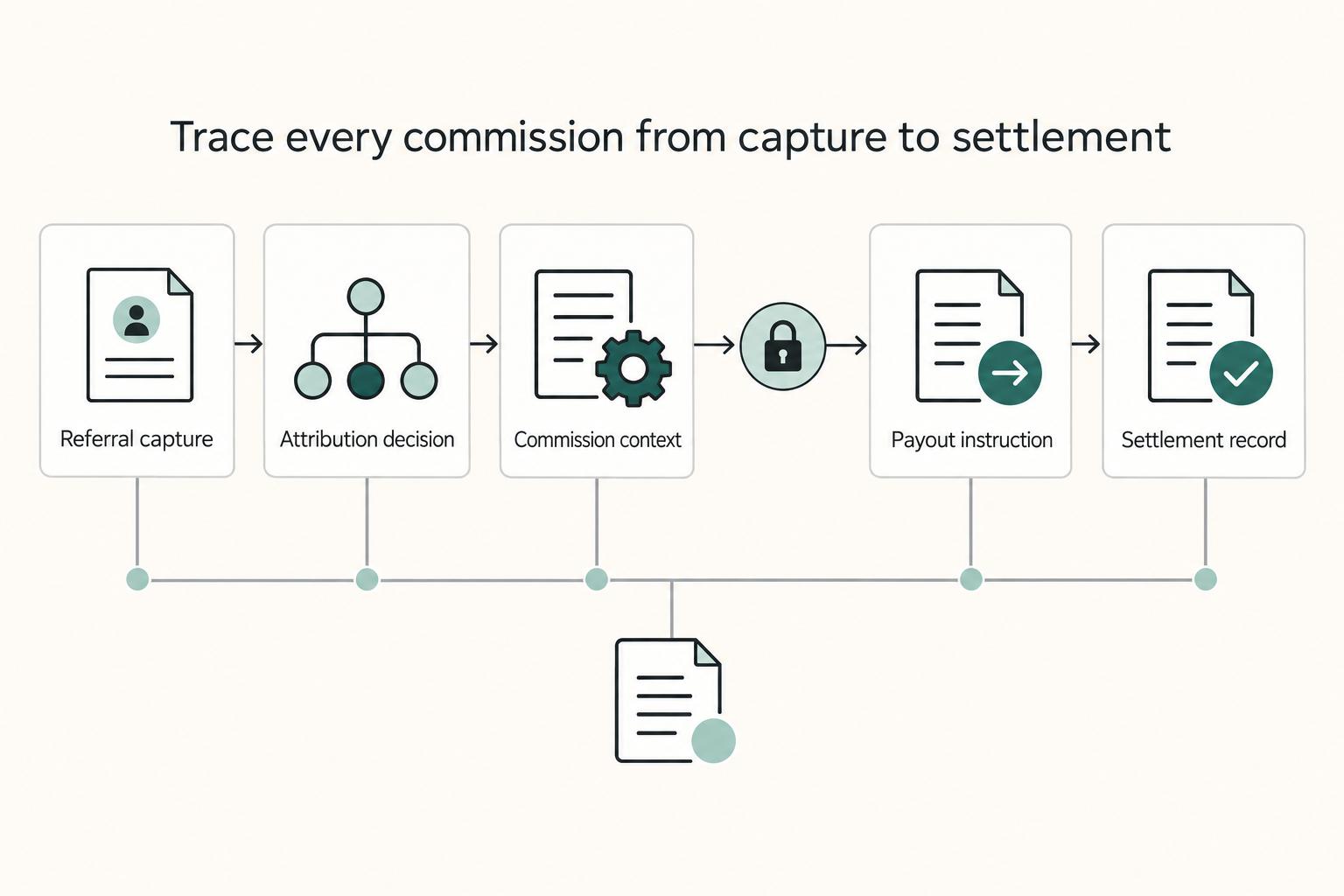
For a referral program on a gig platform, finance should be able to trace each payout from trigger to release in one record set. If a payout cannot be explained from that record set, treat it as an operations gap before you scale.
Step 1 Validate before approval. Use a fixed order of operations: eligibility validation, approval queue, payout release, then post-payout audit. Payouts are not a single event; they move through staged checks before withdrawal. In the approval queue, each record should show the trigger event, commission base, current commission status, and the date the action becomes available after the lock period.
Step 2 Reconcile from one source of truth. Choose one payout ledger as your monthly authority. At minimum, it should export fields equivalent to Date Created, Commission Status, and an availability date, then join back to the internal referral event and the exact commission base used. If obligations roll into an SOI (Statement of Invoices), reconcile both SOI obligations and platform invoices in the same close.
Step 3 Package evidence at the commissionable-action level. Attach payout evidence to each action record, not side channels. Include trigger timestamp, applied lock period, attribution IDs such as AID, PID, and SID when available, the approval decision, and any clawback rule action taken before lock. A practical monthly check is sampling records to confirm finance can recreate why each action was approved, held, or denied using only the stored evidence.
Step 4 Control disputes and retroactive changes monthly. Track disputes and refunds in an exception log instead of manual edits. Review on a monthly cadence using payout-history filters by date range, status, or payout type, then map each exception to the refund handling rule outcome. Once the action locking period has passed, treat changes as explicit next-cycle adjustments rather than edits to a closed cycle. If you also use a payment scheduling period, document that timing so finance knows whether a locked action is payable now or later.
Step 5 Gate go-live with a full close test. Before launch, run one end-to-end test cycle with real sample referrals and have finance close it like month-end. Set a clear variance tolerance between approved actions, scheduled payouts, and the ledger or SOI, and resolve any unexplained gaps before adding more partners.
You might also find this useful: How to Build a Payment Platform Partner Program: Resellers Referrals and Technology Partners.
Instrument tracking and evidence from click to cash#
If one referral cannot be traced from click to payout outcome, the program is not ready to scale. Build one auditable chain that ops can validate and finance can reconcile without manual reconstruction.
Step 1 Capture entry attribution with usable evidence. Start at the click. Store affiliate identity and click-time metadata on the referral record (for example, affiliate ID, timestamp, and tracking code), and keep the configured cookie tracking window on that same record. This lets you verify later that credited outcomes were still within the attribution window.
Use attribution match rate as an operating check: for qualified referrals, confirm how many still map to a valid click record with complete metadata.
Step 2 Record eligibility timing and status progression. For each referral that becomes payable, log the exact payout eligibility trigger timestamp that made it eligible. Do not rely on a generic conversion timestamp when payout depends on a specific qualifying trigger.
Then persist lifecycle states in sequence so referral and payout history stay connected: click, qualification, payout approval, payout completion, reversal. If your system uses statuses such as Pending, Due, Upcoming, Paid, or Cancelled, store those status changes on the same referral key. Refund or cancellation outcomes should appear as explicit status outcomes, not disappear.
Step 3 Join referral events and payout records with one durable key. Tie referral events to payout records so teams can trace in both directions: event to payout, and payout back to event. For each payout decision, keep an evidence pack attached to that chain: click record, qualifying trigger timestamp, approval decision, payout status history, and reversal reason when applicable.
Track payout exception rate monthly: approved referrals that do not reach completed payout, with structured reasons.
Step 4 Define integration boundaries before volume grows. Document ownership across tracking and payout integrations, including where handoffs occur and which system becomes the record after handoff. If referral flow enters a broader Business Solutions funnel, define who writes status updates back to the referral ledger. API connectivity can support tracking and payout orchestration, but downstream coverage still depends on documented interface boundaries.
Review unresolved dispute aging regularly, and confirm each open dispute still has a complete click-to-cash evidence chain.
For more detail, read Indian Gig Economy in 2026: Treat Platform Income as Variable Until Settlements Prove Stability.
Common failure modes and recovery actions#
When referral volume is up but economics are getting worse, treat it as a payout-control issue before you treat it as a growth win.
| Failure mode | Recovery | Key control |
|---|---|---|
| High referral volume, weak margin | Tighten the commission base to the exact paid, qualifying event you can defend in your ledger | Move away from instant release toward a gated fixed bounty model when you need tighter downside control |
| Payout disputes keep increasing | Make attribution and evidence rules explicit in Terms and Conditions | Require a chronological evidence pack: click, qualifying event, approval, payout status |
| Refunds erase expected commission economics | Enforce a lock period before payout release and apply a clear refund handling rule | A 30-day waiting period is one common control |
Failure mode: high referral volume, weak margin. Recovery: tighten the commission base to the exact paid, qualifying event you can defend in your ledger, and move away from instant release toward a gated fixed bounty model when you need tighter downside control. Validate on a real cohort using the full event chain before scaling.
Failure mode: payout disputes keep increasing. Recovery: make attribution and evidence rules explicit in Terms and Conditions, including attribution order and the cookie tracking window. A dispute can immediately reverse a payment, and a full dispute lifecycle can run 2-3 months, so require a chronological evidence pack (click, qualifying event, approval, payout status) for every challenged payout. If you define a terms-level window (for example, a 90-day cookie window), enforce it consistently.
Failure mode: refunds erase expected commission economics. Recovery: enforce a lock period before payout release and apply a clear refund handling rule. A 30-day waiting period is one common control; your rule should also define whether partial refunds reduce commission proportionally, full refunds cancel it, and when negative adjustments are applied after payout. If refunded or cancelled orders can remain in Paid status with no reversal path, fix that before adding volume.
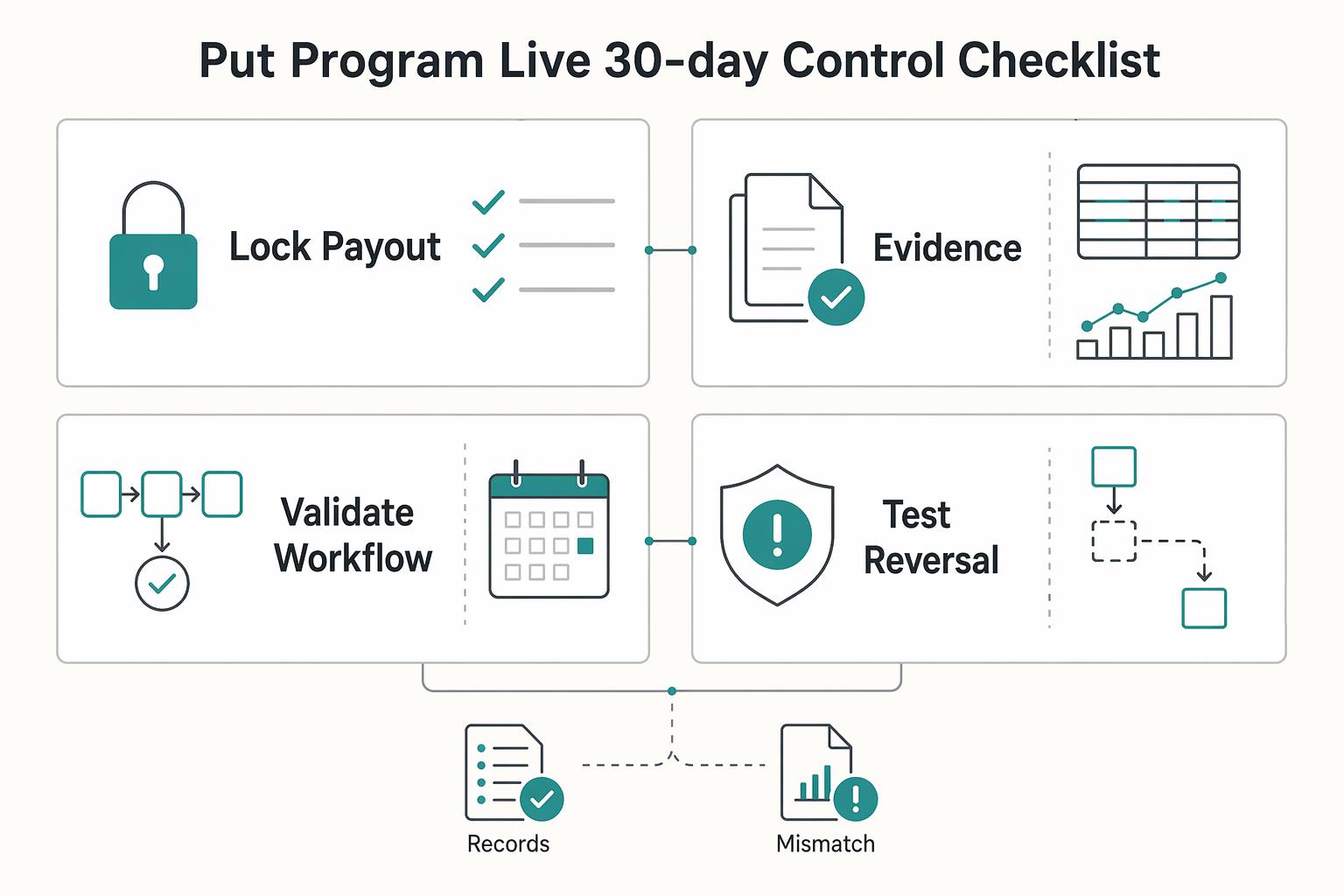
Put your program live with a 30-day control checklist#
A 30-day checklist only works if your controls hold under real traffic. Keep launch volume small until payout logic, policy, tracking, and reconciliation are all working end to end.
- Lock payout structure to your economics first.
Pick one primary model: direct commission, override commission, or fixed bounty. Define the commission base as a plain formula, then run a sample cohort so finance and ops produce the same payout result from the same inputs.
- Approve policy documents before launch messaging.
Set reward and payout design before promotion work. Finalize your Terms and Conditions, payout policy, dispute policy, and exception escalation path, including commission base, payout trigger, validation or lock period, clawback rule, attribution order, and breach consequences (such as reversal or suspension).
- Validate the workflow from trigger to payout state.
Each conversion should move from pending to approved or declined through a clear review step. Approval makes commission payable and declined items are canceled; approved items then move into the next payment cycle. If you use an auto-validation window, common examples are 30, 45, or 60 days, but your window should match your refund and cancellation risk.
- Test reversal handling before lock dates.
Your logs should capture click time, qualifying event time, decision, payout date, and reversals. If a refund or cancellation happens while an action is still pending, your team should be able to modify or reverse it before the lock date.
- Reconcile and retain control evidence before scaling.
Match transaction, payout, and accounting records so payouts are accurate and consistent. Keep evidence for each decision: trigger event, commission base applied, review or approval record, lock status, and any clawback or exception note.
Run this launch order: define commission base -> set payout trigger -> apply lock period and clawback rule -> publish terms -> verify reconciliation -> scale.
For a step-by-step walkthrough, see How to Create a Referral Program for Your SaaS Product.
Frequently Asked Questions
What is the difference between referral commission, affiliate payout, override commission, and fixed bounty on a gig platform?
Referral and affiliate motions are not the same channel. Referrals usually come from your customers, while affiliate programs pay outside partners to send traffic. An affiliate payout can be a flat fee or a percent of a qualifying conversion, while a fixed bounty is a set amount per approved event. Override commission is a second layer paid on team or downstream sales output, so use it carefully because it stacks cost.
When should we pay on signup versus first paid transaction versus milestone completion?
Pay on signup only if signup is the qualifying value event in your program terms. If cancellation, return, or payment-failure risk is high, pay on first paid transaction or milestone completion instead. A simple rule is that the less certain your downstream revenue is, the later your payout trigger should be.
How should we define commission base so partners and finance interpret it the same way?
Write the commission base as a plain-language formula, not a label. “Net sales after returns and cancellations” is far clearer than “revenue,” and it gives finance a defensible base to reconcile. Include the qualifying event, exclusions, event timestamp, and reversal rule, then test one sample cohort and confirm ops and finance calculate the same payout from the same evidence pack.
What minimum terms must be in place before launching unlimited referrals?
At minimum, your Terms and Conditions should state the commission structure and rates, attribution rules, cookie tracking window, validation or lock period, and disqualification events. You also need explicit consequences for policy breaches, such as commission reversal or suspension. If those points are still fuzzy in draft, do not open unlimited referrals yet.
How do payout structures change CAC payback and contribution margin over time?
CAC payback period is the time it takes to recover acquisition spend, and contribution margin is revenue less variable costs. A fixed bounty gives you a known acquisition cost on day one, which makes payback easier to model. Percentage payouts rise with order value, which can work when margin is stable but can also compress contribution margin quickly if refunds, discounts, or low-quality cohorts show up later.
What should we do if refunds or chargebacks happen after a referral payout?
Do not rush everything into payable status. Use a validation window to check cancellations, returns, and payment success before release, and note that some networks use 30, 45, or 60 days as auto-validation periods. If a transaction is still pending, it can usually be modified or reversed. After the contract lock date, changes are blocked, so your policy must say whether you claw back or net against future payouts.
How long should a cookie tracking window be for a gig platform referral program?
There is no single right window for every gig-platform referral program. Choose a window that matches your real buying cycle and channel overlap. A 24 hour window is one real affiliate example, but whatever you choose, put the exact duration in the terms and log both click time and qualifying event time so attribution can be checked later.
Try a related tool
Researched and edited by the Gruv editorial team. Gruv builds cross-border billing, payouts, and finance-operations software for global businesses.
Sources
Includes 7 external sources outside the trusted-domain allowlist.
- comptroller.war.gov/Portals/45/documents/fmr/current/01/01_09.pdftrusted
- 7shifts.com/refer-a-friend-termsexternal
- affiliate-program.amazon.com/help/node/topic/GRXPHT8U84RAYDXZexternal
- anyshift.com/business-referral-shifterexternal
- corporatefinanceinstitute.com/resources/valuation/cac-payback-periodexternal
- corporatefinanceinstitute.com/resources/accounting/contribution-margin-ove...external
- developers.cj.com/docs/data-imports/action-dataexternal
- dictionary.cambridge.org/us/dictionary/english/overriding-commissionexternal
Educational content only. Not legal, tax, or financial advice.
Related Posts
How to Launch a Referral Program for Your Gig Platform with Built-In Commission Tracking
**Referral program commission tracking on a gig platform starts with reconciliation.** Many referral pages focus on growth, visibility, or real-time insights. None of that helps if your team cannot trace a referral from first capture to final payout and get the same answer from product, ops, and finance.
What Is AML? Anti-Money Laundering Compliance for Platform Operators
Here, **AML** means **Anti-Money Laundering**: the controls used to keep criminal profits from being concealed in the financial system.
How to Build a Payment Platform Partner Program: Referrals, Resellers, and Technology Partners
Build your partner motion to widen distribution only when you can keep control of ownership, onboarding, and incentives. In payments, transactions depend on partner networks, not just product, licenses, or processing setup, so the upside is real. So is the risk. Channel volume can strain execution and economics if you scale before the model is clear.