
Quick Answer
Choose referral, reseller, or technology tracks around the work your team and partners can perform. Assign sales, onboarding, implementation, and support owners; approve attribution, pricing, commission terms, and integration tests; then pilot a small cohort before expanding.
What a Partner Program Needs to Do#
Build your partner motion to widen distribution only when you can keep control of ownership, onboarding, and incentives. In payments, transactions depend on partner networks, not just product, licenses, or processing setup, so the upside is real. So is the risk. Channel volume can strain execution and economics if you scale before the model is clear.
The goal is not to launch a partner page and count logos. It is to create a program that brings qualified demand, expands reach into markets you cannot cover directly, and still leaves you with economics you can defend. For each track, define who sells, who implements, who supports, and who gets paid before you recruit.
A Referral Program, Reseller Partnership, and Technology Partner track are not interchangeable.
| Partner track | What the partner does | What your team still owns |
|---|---|---|
| Referral partner | Sends qualified leads for an incentive | The sales cycle after the introduction |
| Reseller | Acts as an extension of your sales team in defined markets | Ownership boundaries for pricing, enablement, and support handoffs |
| ERP Integrator | Scales ERP integration services for client accounts on systems like SAP, Oracle, Microsoft Dynamics, and Epicor | Integration readiness, delivery governance, and post-launch support ownership |
| Independent Software Vendor (ISV) | Can white-label a platform or embed tools into its own stack | Product boundaries, partner enablement, and accountability for customer outcomes |
This guide focuses on the tension between channel growth and control, speed and execution, and partner incentives and unit economics. The sections that follow cover decision rules, economic logic, contract controls, onboarding criteria, and launch checkpoints so you can scale what you can actually operate.
Before accepting partner-sourced demand, document intake, approval, lead registration, and payout ownership. Give each partner a written commission basis and term; do not assume another vendor’s software commission schedule fits payment-processing economics.
For channel planning and partner positioning, see How to Build a Payment Platform Go-to-Market Strategy: Channels Partners and Positioning.
What to prepare before you design partner tracks#
Do not choose partner tracks until your economics, technical limits, and review boundaries are documented in one place. If those inputs are unclear, recruitment turns into inconsistent pricing, support, and approvals.
Audit your baseline economics#
Start with current performance, not partner projections. Break results down by segment and channel: lead quality, customer acquisition cost, payout exposure, and retention.
The checkpoint is simple. Finance and ops should be able to show where margin is strongest, where costs are heaviest, and which segments can absorb partner incentives. If you only have a total-company view, pause before launch.
Map your actual integration starting point#
Be explicit about what your product can support now. List current integration and implementation paths, then mark features that are available only in certain markets, plans, or custom builds as "where supported."
If you are planning a technology partnership with an independent software vendor (ISV), confirm that you can support the go-to-market and delivery motion around the integration, not just the integration itself.
Confirm compliance boundaries before outreach#
Align operations and legal early on about compliance responsibilities in your model and which partner activities require additional review. Do this before outreach, not after recruiting begins.
The output can stay short. It can include owners, escalation points, and clear notes on what needs review before a partner can pitch, implement, or handle customer data.
Create one working source of truth#
Before recruitment, put assumptions, owners, open questions, and review checkpoints into one shared document. Include compensation logic, tracking method, onboarding path, and who approves exceptions. If you cannot point partners to a clear intake path and lead-tracking method, you are not ready to launch.
Choose the right partner model for your stage and GTM#
Once your baseline economics and review boundaries are documented, choose the lightest partner motion your team can run cleanly. Start where ownership is clear, then add heavier tracks only after handoffs, pricing controls, and support paths are stable.
Compare tracks before you recruit#
Compare the work each track requires after a lead appears. The following allocations are illustrative; replace them with named owners in your agreement.
| Track | What the partner does | Sales owner | Onboarding owner | Implementation owner | Support owner | Good early if | Not now if |
|---|---|---|---|---|---|---|---|
| Referral | Qualified introductions | Platform sales | Platform onboarding | Platform delivery | Platform support | Your team can serve referred accounts | Internal onboarding capacity is missing |
| Reseller | Sells under agreed commercial terms | Reseller within approved authority | Named reseller lead; platform verifies eligibility | Named delivery team in agreement | Reseller first line; platform escalation | Pricing and handoffs are documented | Ownership or discounts remain disputed |
| Technology partner | Builds or embeds supported integration | Named joint-sales owner | Platform eligibility; partner setup | Partner build; platform API support | Partner integration support; platform service escalation | Sandbox and maintenance plan are ready | Custom work or production access is unowned |
If you cannot name the owner for sales, onboarding, implementation, and support in writing, that track is not ready.
Start with the lowest operational load you can support#
Referral can suit a small team when partners only introduce qualified buyers and your team already handles sales, onboarding, and support. It adds less implementation responsibility for the partner, but your team must still have capacity for the resulting accounts.
Test whether partners can supply qualified introductions repeatedly. Assign an owner to enablement and feedback rather than assuming referral demand will sustain itself.
Move toward reseller only when you can answer three questions clearly:
- Who controls pricing and exceptions?
- How will you prevent partner and direct teams from colliding on the same deal?
- Who owns onboarding, implementation, and support after signature?
If those answers are still unclear, hold the reseller launch.
Pressure-test fit instead of assuming it#
Partner labels help with routing, but they are not an operating design. On the first serious call, confirm four points:
- Who owns the customer conversation?
- Who owns onboarding and implementation?
- Who handles day-to-day support?
- How fast do they expect quote, approval, and escalation decisions?
If answers shift between calls or unowned work appears, put the partner in a not-now bucket until ownership is clear.
Put conflict controls in place before heavier tracks#
Before you scale beyond referrals, put two controls in place: a formal deal registration program and a CRM-integrated single source of truth. Channel conflict is concrete. Partners can compete with each other, or with your direct team, for the same deal.
Require a partner agreement that clearly defines compensation. If finance, sales, and partner ops cannot open one CRM record and confirm deal ownership, compensation logic, and next-step owner, the track design is still incomplete.
Related: How to Attract and Retain Partners in the Creator Economy: The Role of Fast Reliable Payments.
Build the partner economics model before partner recruiting#
Build the economics model before you recruit. If a Referral Program or Reseller Partnership does not clear your payback threshold under conservative assumptions, narrow scope first.
Partner revenue arrives only after recruitment, sales, activation, and billable usage. Model that ramp from your own sales-cycle data and cash runway instead of assuming it will fund the first year.
Model contribution margin by motion, not by label#
Model by motion first, because one partner can play multiple roles across your program. Keep direct-sourced and partner-sourced cases separate so you can see true incremental margin.
| Motion | Revenue view | Cost lines to model | Verify before launch |
|---|---|---|---|
| Direct baseline | Current direct-sourced revenue and retention | Current onboarding and support load | Recent cohort actuals |
| Referral Program | Partner-sourced pipeline with conservative close and retention assumptions | Referral incentive plus your onboarding and support costs | Clear attribution and payout visibility |
| Reseller Partnership | Partner-sourced revenue with defined commercial ownership | Margin or discount structure, enablement, support, dispute handling | Agreement defines pricing, onboarding, and support ownership |
Treat any stronger partner-sourced performance assumptions as upside sensitivity, not the base case.
Set payout guardrails before recruiting#
Set payout rules before the first partner is onboarded, including clear deal attribution and payout visibility.
Illustrative monthly referral economics: $10,000 of collected platform fees less $4,000 of processing and service costs gives a $6,000 commission basis. At an agreed 10% of that basis, commission is $600. Subtract a further $1,000 of onboarding and support cost to leave $4,400 before overhead and taxes. Customer payment volume is not platform revenue. Define whether refunds and credits reduce the basis, how later adjustments affect commission, the earning period, and when earned amounts are paid. These assumptions are a worked example, not market rates.
Run separate scenarios when delivery effort differs#
Do not blend all cohorts into one model if delivery effort differs in your own operating data. Keep scenarios separate so onboarding and support load, along with activation risk, stay visible in margin decisions.
Use simple, auditable assumptions for each scenario and map the path from signed deal to first realized revenue. If one path needs more human touchpoints, commissions and support plans should reflect that reality.
Apply one decision rule and narrow scope fast#
Use one rule across the program: if expected payback exceeds your internal threshold under conservative assumptions, narrow scope before launch. That can mean starting with a referral motion when word-of-mouth is already strong, limiting segments, or delaying heavier motions until operations are stable.
Avoid passive management. "Set it and forget it" is a common failure mode, so include ownership, ramp realism, and attribution and payout operations in the model before you scale.
Before you lock partner payouts, sanity-check your baseline rail assumptions with the payment fee comparison tool so your margin model starts from realistic cost bands.
Set pricing and incentive rules partners can actually sell#
Set quoting and incentive rules as operating controls, not as a gesture toward sales flexibility. If your Reseller Partner Program leaves price floors, discount authority, or exception routing unclear, it can create conflict and revenue-management issues.
Define quoting authority by partner track#
Decide upfront who can quote, who can discuss pricing, and who can only introduce opportunities. Channel partner management includes pricing mechanisms, conflict management, and revenue management, so quoting authority should be explicit.
| Track | Partner pricing role | Exception handling |
|---|---|---|
| Referral Program | Partners position the offer and source demand | Your team owns final pricing |
| Reseller Partnership | Partners quote inside a published range | Written approval for exceptions |
| Integrated Partnership | Partners may influence packaging through implementation design | Commercial exceptions route to your pricing owner |
Keep the split simple. Referral partners position the offer and source demand, but your team owns final pricing. In a Reseller Partnership, partners quote inside a published range with written approval for exceptions. In an Integrated Partnership, partners may influence packaging through implementation design, but commercial exceptions still route to your pricing owner.
Before giving quote access, require a lightweight enrollment checkpoint: account creation plus basic company and business-goal details. That helps confirm fit and readiness before you expand pricing permissions.
Separate sourcing incentives from integration incentives#
Do not use one payout logic for every partner motion. Referral incentives should reward sourced deals that close. Integrated Partnership incentives can also account for activation quality when the partner influences implementation.
A simple rule works well here: pay sourcing for commercial outcomes, and pay integration for commercial plus activation outcomes. If a partner mainly introduces buyers, tie rewards to closed-won business. If a partner affects setup quality, hold part of the reward until activation checks are complete.
Publish the commission basis, rate or fixed fee, earning period, any cap, payment date, and adjustment rules in partner-facing terms. A ceiling alone does not explain what a partner will actually earn.
Publish a calculator that shows bands, not promises#
Give partners a calculator with plain inputs they can gather early, then show likely economics bands rather than guaranteed outcomes. That keeps it usable for selling while reducing overpromising risk.
The balance matters. If the tool is too abstract, partners may ignore it. If it looks like a quote engine, they may treat outputs as commitments. Add clear caveats on each output: assumptions vary by product, market, and approved partner track. Assign one owner, show a last-updated date, and require finance approval for assumption updates before external use.
Add coverage caveats everywhere partners sell#
State supported coverage clearly in your partner guide, calculator, and quoting materials. If onboarding responsibilities, rollout status, or supported offers differ by market or program, say so directly and use "where supported" language.
This matters most when you run referral, reseller, and integrated tracks in parallel. Different partner types need different permissions and materials. One generic deck can increase overpromising risk.
If market or product readiness is uncertain, remove it from partner-facing materials until terms and ownership are finalized. That reduces downstream disputes about what partners were allowed to sell.
Lock contract terms before scale creates risk#
After you set quote authority and incentives, lock the contract terms that control them. If partner terms change deal by deal, payout disputes and liability gaps can appear early.
Agreements should make approvals and review repeatable. If your platform works with a regulated bank, confirm which bank and sponsor requirements apply to the partner activity; bank supervisory guidance is not a universal rule for every software referral program.
Standardize the commercial spine across referral and reseller deals#
Use one core term-sheet structure for both your Referral Partner Program and Reseller Partnership, with only limited, preapproved differences by track. Keep these items defined the same way every time: term length, termination rights, exclusivity language, clawback conditions, and dispute handling.
Treat exclusivity as an exception, not a default. If you allow it, define the scope clearly, for example by segment, geography, or product, and require written approval before it is included.
Apply the same discipline to clawbacks. You can use different economics by track, but keep one definition set for triggers, decision ownership, acceptable evidence, and escalation. If referral and reseller contracts describe the same outcome differently, finance ends up reconciling wording instead of revenue.
Define liability boundaries for implementation and data handling#
If an Independent Software Vendor (ISV) or ERP Integrator touches onboarding, configuration, or payment data, define handoffs explicitly. Name who owns implementation decisions, who validates production readiness, who can access or transmit customer data, who must notify whom when issues occur, and who handles remediation for partner-caused errors.
Map responsibilities to the actual product and data flow. A partner implementing a gateway, supporting an ACH workflow, or embedding a hosted payment form may have different access and obligations. Have the relevant product, security, and legal owners approve those boundaries.
Specify evidence and audit rights before the first payout dispute#
Define evidence rules before disputes happen. Your payout terms should state which records establish entitlement, including the partner, billing, and transaction records needed to verify decisions.
Make audit rights usable in practice. Specify retention expectations, dispute review windows, request format, and who may inspect records. Internal-audit style controls work only when records and owners are named.
A common failure mode is straightforward: systems show conflicting records for the same payout decision. If the contract does not define controlling records and cross-system evidence checks, the dispute becomes negotiation instead of verification.
Related reading: How to Expand Your Subscription Platform to Europe for Payment and VAT Readiness.
Design integration and operational controls for technology partners#
Delivery mismatch is a common risk at this stage, so define integration controls before partners go live. In practice, that means a clear scope, a named onboarding path, and test evidence your team can review.
Define integration scope and ownership up front#
Set expectations for what your technology partner motion actually includes. If your model is ISV-led embedding, say that directly and define where your API- or SDK-enabled support ends and custom work begins.
Just as important, make ownership explicit: who owns implementation work, and who carries ongoing build and maintenance effort. Partnership can reduce in-house build and maintenance cost, and clear prelaunch boundaries help you realize that benefit.
Use a named preproduction path, not ad hoc readiness calls#
Use a repeatable checkpoint sequence before production access:
| Preproduction step | Control focus |
|---|---|
| Provision sandbox access | Named partner identity; least necessary permissions |
| Test the supported integration | Success, rejection, duplicate request, timeout, and recovery cases |
| Verify operational handoffs | Logs, alert owner, customer support and incident escalation |
| Approve production access | Stored test evidence, credential owner, launch and rollback approval |
Use your provider’s actual identifiers, credentials, and approval process. Keep production credentials separate from sandbox access and record who can issue or revoke them.
Require operational visibility and reviewable launch evidence#
Do not approve production based on a happy-path demo alone. Require evidence from the preproduction path showing that the integration identity was validated and testing was completed, with enough operational visibility for teams to diagnose issues.
Keep the evidence pack lightweight but auditable. The point is not paperwork. It is preventing post-launch disputes about what was actually implemented.
Align promised integration depth with what you support#
State integration depth in plain language so sales, partner teams, and delivery are aligned on the same implementation model. If some paths are lighter and others are deeper, define that before launch and map each path to support responsibility. That is what keeps the motion scalable: clear depth, clear ownership, and clear go-live gates.
For a step-by-step walkthrough, see How to Build a Finance Tech Stack for a Payment Platform: Accounts Payable, Billing, Treasury, and Reporting.
Use a qualification checklist before approving any partner#
Use a named qualification checklist and approve partners only when they are a fit and ready to execute. Pipeline promises alone are not enough.
Match the checklist to the partner track#
Do not run every applicant through one generic form. Partner tracks differ, so your qualification criteria should differ too.
| Track | Qualification focus |
|---|---|
| Referral Program / Referral Partner Program | Prioritize channel access and lead quality |
| Technology Program / integration track | Test integration capability and readiness to contribute to certified integrations or joint solutions |
| Reseller Program / broader reseller track | Test whether they can actually own the customer relationship, not just pass introductions |
For a Referral Program or Referral Partner Program, prioritize channel access and lead quality, since this model does not require the partner to own implementation or support.
For a Technology Program or integration track, test integration capability and readiness to contribute to certified integrations or joint solutions. For a Reseller Program or broader reseller track, test whether they can actually own the customer relationship, not just pass introductions.
Score commercial quality with realism, not optimism#
Commercial quality should focus on target-segment fit, ability to pay, and expected-volume realism. If a partner mostly serves accounts outside your target profile, fail fast.
Pressure-test forecasts against comparable deals in your own CRM: deal stage, approval dependencies, expected activation date, and evidence of buyer intent. A projected lead is not collected revenue.
Score execution quality before approval#
Execution readiness should be explicit before approval, with a clear operating plan for onboarding, support, and escalation ownership.
Also confirm that the partner can operate inside your process controls. A practical gate is whether they can support CRM-based attribution and follow a deal registration workflow before sending live opportunities.
Approve only when both screens pass#
Approve only when both screens pass: commercial fit and operational readiness. If either side is weak, hold approval and re-review after the missing evidence is provided.
Execute a 90-day rollout with verification gates#
If you are running a 90-day rollout, use that window to test readiness before scale: run a limited pilot, expand only with evidence, and pause any track that fails core checks. Passing qualification is not the same as launch readiness, especially when a track is still labeled Early Adoption or Coming Soon.
Start with a limited pilot#
Start with a small partner cohort, not a broad launch. Treat this phase as a live test of deal flow, onboarding execution, and payout operations by track.
Keep limited-release features in pilot scope until product and support owners approve broader availability. Do not let a partner catalog listing imply that every market or integration is ready.
Require a short compatibility note and rollout plan before pilot entry. For integration tracks, include supported systems, test cases, and rollback ownership. For reseller tracks, include quoting permissions and customer handoff.
Verification gate: each pilot partner has a named owner, a documented onboarding path, and a stored readiness note explaining why it is still in pilot.
Track the same five checkpoints every week#
Track one consistent weekly scorecard across tracks, then interpret results by partner model.
| Checkpoint | What to verify weekly | Common failure sign |
|---|---|---|
| Sourced pipeline quality | Partner-sourced opportunities match your target segment and enter CRM with usable attribution | High volume, weak fit, missing source data |
| Activation rate | Closed deals reach live usage by partner type | Deals close but stall before activation |
| Payout accuracy | Finance calculations match agreed partner logic for the period | Manual corrections, disputes, unclear source records |
| Onboarding cycle time | Time from approval or close to usable production state | Partners stuck in progress with no clear blocker |
| Support ticket burden | Support load per activated partner or account | Ticket spikes concentrated in one track or partner |
Keep the evidence auditable each week: attribution export, activation report, payout reconciliation, onboarding timestamps, and support tickets tagged by partner type.
Hold a keep-expand-pause review#
Run a recurring operating review with product, finance, and ops, and make one explicit decision per track: keep in pilot, expand in a controlled way, or pause.
Avoid letting sourced volume decide the meeting on its own. Product should cover compatibility and delivery friction, finance should cover payout accuracy and margin pressure, and ops should cover onboarding throughput and support burden.
This staged approach can feel slower, but it makes keep-expand-pause decisions explicit before broader rollout.
Fix the failures that usually break partner economics#
If a periodic review shows friction, fix the operating mechanism before adding partner volume. A practical pattern to check is whether payout timing, delivery scope, pricing authority, and contract evidence are drifting out of sync.
Tie payouts to activation and a real usage checkpoint#
If a Referral Program or Reseller Partnership pays mostly at signature, money can go out before the account reaches a usable state. Use staged triggers only where you can verify each stage in-system: signature, activation, and, if your model needs it, an early usage or billable checkpoint.
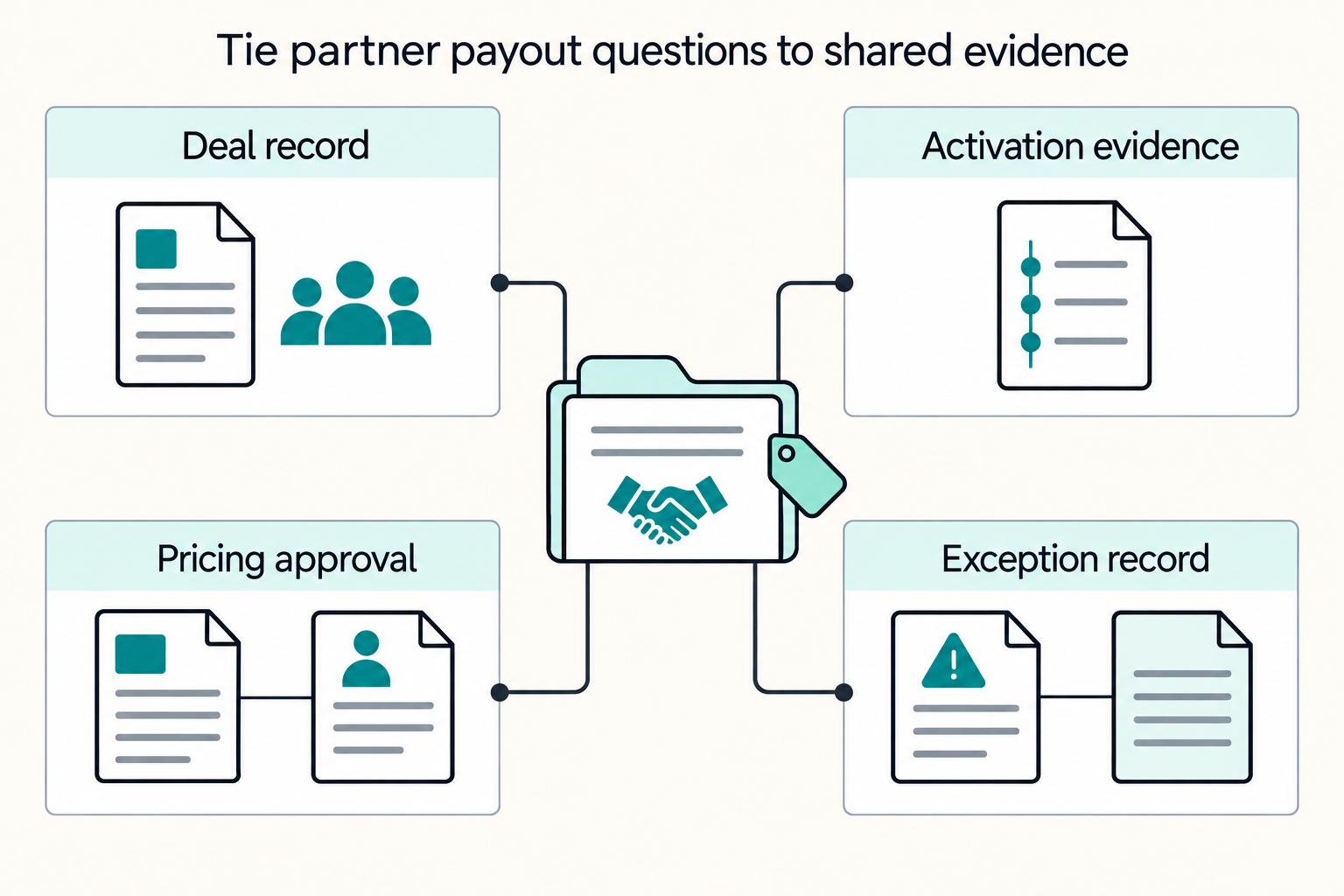
Use the payout triggers agreed in the contract rather than changing earned commissions after the deal closes. Where activation or usage is a condition, define the event and match partner ID, signed commercial record, activation evidence, and billing record before calculating the payout.
Narrow Integrated Partnership scope before delivery debt piles up#
For an Integrated Partnership with an ISV or ERP Integrator, keep launch scope to what the team can support now, not what is planned later. Require a named technical owner, a systems-fit note, a test plan, and a written boundary between supported and custom work before broad rollout.
If the promised scope exceeds current capacity, narrow the supported integration or keep it in pilot. Name the owner and cost of custom work so ongoing maintenance does not disappear into an unpriced support obligation.
Enforce pricing authority in every Reseller Partnership#
In a Reseller Partnership, define pricing authority in writing so exceptions are explicit and attributable. At minimum, document standard terms, discount approval bands, and which cases require finance or executive sign-off.
Log pricing exceptions with the approver, permitted discount, affected customer, and expiration. Compare realized margin with the approved model during the operating review.
Tighten contract definitions and evidence requirements before scale#
Before partner count grows, standardize definitions for terms that drive payout decisions, such as "qualified," "activated," "partner sourced," and "implementation complete." Then consider a minimum evidence pack for disputes: CRM attribution record, signed order form, activation proof, billing record, discount approval, and any exception approval.
The goal is not perfect legal drafting. It is operational clarity so legal, finance, ops, and partners can resolve payout questions from the same record.
Conclusion#
Choose the partner track your team can support, validate economics before recruiting, and lock operating controls before scale. If you cannot explain ownership boundaries clearly, pause expansion and fix the design first.
Define your track mix before outreach. Use a Referral Partner Program when partners send qualified leads and your team owns deal execution. Treat a Reseller Partner Program as a different model, because the reseller can own more of the sales cycle. If you run additional partner tracks, assign technical, onboarding, and support ownership explicitly.
Approve economics and payout guardrails before partner recruitment. Keep the model auditable by track: partner-sourced revenue, onboarding effort, support load, and retention assumptions. For each payout trigger, define the record that proves it happened and the margin line it affects.
Finalize agreements so contract language matches operating reality. Keep the referral versus reseller distinction explicit: referral introduces opportunities; reseller can run more of the cycle. If attribution and responsibility are vague, credit, support, and payment disputes can become more likely.
Pass readiness checks by track, not with one generic onboarding process. For referral, use concrete lead-capture and handoff artifacts such as forms, unique links, or referral codes tied to your CRM flow. For reseller and any additional tracks, make handoff and support paths unambiguous before launch.
Run a pilot, review operating signals, and scale only when quality holds. Keep the first cohort small enough to inspect handoffs, payout exceptions, and onboarding friction directly. In payments, delivery often depends on partner networks, so unclear roles should be fixed before expansion.
Copy/paste launch checklist:
- Define track mix and sales-cycle ownership (referral vs reseller).
- Approve economics model and payout guardrails.
- Finalize contract terms and responsibility boundaries.
- Pass technical and onboarding readiness checks by track.
- Run pilot, review signals regularly, and expand only when quality holds.
When your rollout plan is approved and you need to confirm market/program coverage and compliance gating, talk to Gruv.
Frequently Asked Questions
What is the practical difference between a Referral Program, Reseller Partnership, and Integration Partner Program?
A referral partner introduces qualified buyers while your team runs sales. A reseller sells or distributes the offering under agreed pricing, branding, and support terms; economics may use wholesale markup or revenue sharing. A technology partner builds or embeds an integration. Define sales, implementation, support, and payment ownership separately for each track.
When should a payment platform launch referral first instead of reseller or technology partners?
Launch referral first when you want warm introductions and need your internal team to keep control of the sales cycle. That model keeps ownership clear: the partner introduces, and your team runs the deal. If reseller economics or branding ownership are still unclear, referral can be a lower-ambiguity starting point.
What are the minimum components of a credible partner program in payments?
Prepare written track responsibilities, intake and deal registration, quote authority, incentive terms, dispute handling, and an onboarding path. Technology partners also need supported integration scope, test evidence, production-access approval, and ongoing maintenance ownership.
How do you structure recurring commissions without losing margin?
Choose a commission basis that your finance team can reconcile, then model the rate, earning period, refunds, onboarding, and support against collected revenue. The worked example above uses a $6,000 basis and 10% commission, leaving $4,400 after the stated delivery costs. Test downside scenarios before approving terms; no rate guarantees margin.
Which KPIs should founders and finance teams track by partner type in the first 90 days?
Track sourced pipeline quality, activation, payout accuracy, onboarding time, and support burden by partner track. Define each denominator and start/end event, retain the supporting records, and compare pilot results with your own baseline rather than universal targets.
What contract terms matter most in payment partner agreements?
Define attribution, commission basis and earning triggers, payment timing, adjustments, termination, exclusivity, pricing permissions, customer ownership, support, data access, and dispute evidence. Adapt implementation and maintenance obligations to the technology track.
What details are usually missing from vendor partner pages that buyers should ask before signing?
Prioritize operational questions over headline marketing language. Ask how earnings flow from transactions and value-added services, and ask who owns branding or white-label rights. For referral programs, also confirm incentive type and that the partner is introducing leads while your team owns the sales cycle.
Researched and edited by the Gruv editorial team. Gruv builds cross-border billing, payouts, and finance-operations software for global businesses.
Sources
Includes 1 external source outside the trusted-domain allowlist.
Educational content only. Not legal, tax, or financial advice.
Related Posts

The Freelance Payment Penalty: A Modeled Audit of Platform Fees, FX Spreads, and Payout Delays
The money rarely disappears through a single, easy-to-spot fee. The real loss is stacked. A marketplace takes its commission, a processor adds a charge for international cards, a bank or payment company converts the currency at a spread, a platform holds the funds before release, and a wire sheds a little to intermediaries on the way in. Each layer looks defensible on its own, but the worker feels the combined result as a smaller deposit and a later payday.

How to Respond to a Subpoena for Business Records
Move fast, but do not produce records on instinct. If you need to **respond to a subpoena for business records**, your immediate job is to control deadlines, preserve records, and make any later production defensible.
A US Expat's Guide to Investing in UCITS ETFs to Avoid PFIC Issues
The real problem is a two-system conflict. U.S. tax treatment can punish the wrong fund choice, while local product-access constraints can block the funds you want to buy in the first place. For **us expat ucits etfs**, the practical question is not "Which product is best?" It is "What can I access, report, and keep doing every year without guessing?" Use this four-part filter before any trade: