
Quick Answer
Build the finance tech stack for a payment platform by defining ownership and system boundaries before selecting tools. Use the GL or ERP as accounting truth, keep AP responsible for supplier obligations, treasury responsible for cash timing and liquidity, and carry a traceable record from invoice or payout event through provider reference, journal posting, reconciliation, and reporting. Choose modular tools or a suite based on handoff and reconciliation burden.
Start with ownership and system boundaries#
A reliable finance stack for a payment platform usually starts with ownership and reconciliation, not more tools. The core decisions are what Accounts Payable (AP) owns, what treasury owns, how billing hands off to accounting, and whether each money movement can be traced to the General Ledger (GL) without spreadsheet repair.
A finance technology stack is the connected set of tools you use to run finance and accounting operations. In a payment platform, that often includes billing, payables, cash visibility, payment execution, reconciliation, and reporting. Complexity rises when data is split across products. Even basic payments can turn into manual, multi-step work.
Define system ownership before vendor selection#
Start by defining system ownership. AP covers short-term obligations owed to suppliers for goods or services bought on credit. Treasury management covers cash, liquidity, assets, liabilities, and risk. The GL is the accounting record of company transactions by account. If those definitions are fuzzy, ownership will be too.
Use this rule throughout the guide: capture operational events once, post accounting truth to the GL, and derive downstream balances and reports from that record rather than rebuilding them ad hoc. If you cannot name the authoritative record for an invoice, payout, failed return, and posted journal, resolve that before procurement.
Separate responsibilities early#
Separate responsibilities early, because control quality depends on it. Segregation of duties means authority, custody, and accounting should not collapse into one unchecked role. In practice, the role or tool that authorizes cash movement should not also be the only place that declares the final accounting outcome.
That is why this guide is organized around boundaries, not brand lists. A common operating model is finance owning policy, close quality, and reconciliation standards; engineering owning event integrity, retries, and duplicate-processing controls; and treasury owning cash positioning and payout readiness. A clear warning sign is payment status living in two places with no single audit trail.
Prove reconciliation paths before go-live#
Before go-live, prove the reconciliation path. Reconciliation is comparing records across sources to confirm consistency and accuracy. You should be able to trace a settled invoice, payout batch, or bank movement through approval evidence, provider reference, GL impact, and reporting output.
Treasury tooling adoption can be high, but adoption alone does not prove fit. KPMG's 2025 Global Treasury Survey reports that 76% of respondents use a treasury management system, while integration gaps across treasury tools remain a known issue. Treat any shortlist as a hypothesis to validate against your flow design, bank setup, reporting needs, and jurisdiction.
As you read, keep one test in mind: do not judge the stack by feature count. Judge it by whether you can explain, verify, and recover each accounting and cash event end to end.
Decide your operating model before you buy tools#
Buy tools last. First define your transaction flow, your system-of-record order, and decision ownership so vendor demos map to real operations rather than assumptions.
Name your transaction shape before you shortlist#
Name your transaction shape in plain language before you shortlist anything. Different marketplace models and payout-recipient profiles can require different onboarding and payout flows, and billing-led flows can change how approvals, exception handling, and reporting are designed. If billing is part of your flow, map where your Order-to-Cash (O2C) process ends and where payout execution begins.
Stress-test this with one real transaction on a single page: request, approval, payment-provider reference, journal impact, and final report output. If that path is unclear, tool selection is premature.
Set the record order now#
Set the record order now and keep one source of truth per domain. For accounting, post transactions to the General Ledger (GL) as journals and run reporting from posted ledger balances. This reduces duplicate data paths and reconciliation issues across disconnected tools.
Use this as a red-flag check: if one system shows "paid" but your Enterprise Resource Planning (ERP) or GL record does not show the posted outcome, your operating model likely is not settled.
Assign ownership before procurement#
Assign ownership by function before procurement. Define who owns posting policy, approval evidence, close outputs, event creation, retries, and idempotent request handling. Make those owners explicit so authority, execution, and accounting outcomes do not blur across teams.
Validate retry behavior early with a replay test. With the same idempotency key, you should get the same result, not a duplicate side effect. For Stripe, keys are up to 255 characters and can be removed after they are at least 24 hours old.
Prepare implementation inputs before you compare vendors#
Before you compare vendors, gather:
| Input | What to gather |
|---|---|
| Process maps | Current-state and future-state process maps covering activities, roles, functions, data, and systems |
| Close outputs and ERP constraints | Required close outputs and known ERP posting and reporting constraints |
| Exception log | If available, an exception log (even a lightweight one) to show where failures occur today |
Skipping this often means each function optimizes a different problem.
For a step-by-step walkthrough, see How to Integrate Your Subscription Billing Platform with Your CRM and Support Tools.
Assign system boundaries so AP and treasury stop overlapping#
Set one boundary rule up front: use GL/ERP as accounting truth, and assign treasury to cash timing and liquidity movement. If the same decision can be made in two systems, the boundary is still unclear.
Turn that rule into a practical map so AP, AR, treasury, and GL/ERP do not maintain competing versions of status, approvals, or posting outcomes.
Build a simple boundary table#
Start with a simple boundary table. Aim for one primary owner per decision and one verification checkpoint per row.
| Boundary area | What it should own | Owner decision to force | Verification checkpoint (example evidence) |
|---|---|---|---|
| Accounts Payable (AP) | Supplier obligations for goods or services received before payment | Who can approve a payable for payment processing | Input payable record, approval artifact, resulting journal or posting reference, reconciliation support |
| Accounts Receivable (AR) | Amounts customers owe the business for credit-provided goods or services | When a customer obligation is created and considered collectible | Invoice or receivable record, approval or issuance evidence, journal output, tie-out to receipt or open balance |
| Treasury | Cash management, payment execution timing, liquidity movement, and related financial risk handling | When cash moves, from which account, and with what funding readiness | Payment instruction, authorization evidence, bank or provider outcome, cash reconciliation pack |
| GL/ERP | Core accounting record and financial statement basis | What the accounting truth is after an event occurs | Source event reference, posting logic approval, journal entry, close reconciliation evidence |
One overlap to watch: AP may treat an item as paid at approval, while treasury treats it as paid at execution. Both statuses can exist, but only one should drive GL truth.
Keep accounting truth separate from cash timing#
Use one decision rule consistently: posted accounting truth belongs in GL/ERP; payment timing and liquidity decisions belong in treasury. That separation keeps the financial-statement record apart from cash execution operations and supports segregation of duties.
As a control check, do not let one person or one application path both authorize payment, move cash, and define final accounting outcome without a separate review point.
Mark where O2C ends and AP begins#
Define the handoff between Order-to-Cash (O2C) and AP. O2C runs from order through payment receipt, so if that endpoint is vague, AR and AP can end up processing related downstream events.
Keep the split explicit: invoicing, collection, and receipt application sit with O2C and AR. Supplier obligations and outbound expense approvals sit with AP. Treasury starts when cash execution and liquidity decisions start.
Test each boundary with evidence#
Attach a lightweight evidence pack to each boundary, then test one live transaction through it:
- input record that started the action
- approval artifact showing who authorized it
- output journal or posting reference
- reconciliation evidence tying to cash, open balance, or close support
Run the check on one supplier payment, one customer invoice, and one cash movement. If you cannot trace origin, approval, journal, and reconciliation without manual rescue, fix the boundary before adding reporting logic.
Need the full breakdown? Read How to Handle Currency Gain and Loss Reporting for a Multi-Currency Platform.
Pick modular stack or suite stack with explicit tradeoffs#
Once AP, treasury, and GL boundaries are set, choose the stack shape that reduces avoidable handoffs for your main constraint. Use fewer core systems when speed is the bottleneck. Use a modular design when ownership control and replaceability matter more.
Decide based on the bottleneck#
Define the bottleneck before you compare tools. The real decision is usually not the "best stack." It is whether you need faster go-live or cleaner long-term control.
J.P. Morgan highlights the core risk in multi-vendor treasury environments: components can be incompatible, and weak system communication makes reconciliation labor-intensive and error-prone. Treat that reconciliation burden as a primary cost, not a side issue.
Use this rule:
- If your pain is implementation drag, duplicate exports, and too many consoles, bias toward a suite-centered design around an accounting anchor such as Oracle NetSuite or Sage Intacct.
- If your pain is blurred ownership between approvals, cash execution, and accounting outcomes, bias toward modular ownership across AP, treasury, and accounting layers.
- If you cannot clearly name system ownership for payment status, journal posting, and bank visibility, delay purchase and fix the design first.
Quick checkpoint: map one supplier payment from invoice approval to bank outcome to ERP journal. If the path crosses several systems, confirm each handoff is a control benefit rather than overlap.
Compare operating models, not brand popularity#
| Decision area | Modular stack example | Suite-heavy stack example | What to watch |
|---|---|---|---|
| Core shape | Tipalti + BILL + treasury layer, anchored to ERP | Oracle NetSuite or Sage Intacct centered, with fewer surrounding tools | Modular works only when each tool has distinct ownership. |
| Integration speed | Can be slower to define and test because handoffs need mapping | Can be faster across core flows with fewer handoffs | Useful when timeline pressure is high. |
| Boundary clarity | Strong when AP, treasury, and accounting are intentionally separated | Can blur if suite workflows absorb treasury timing decisions | Lock ownership rules before build. |
| Replacement flexibility | Higher; one layer can be swapped | Lower; central suite assumptions spread outward | Matters when your payment model is still changing. |
| Reconciliation burden | Higher risk if bank, status, and journal records are not tightly linked | Can be lower in core records when side tools do not recreate the same records | Test exception handling, not only happy-path posting. |
A suite-heavy design can reduce moving parts, which helps when integration speed is the main constraint. A modular design is often stronger when invoice handling, payment execution, and cash visibility need different owners. A common failure pattern is overlap, not tool count by itself.
One finance leader described fragmented systems as closing the books with "one hand tied behind our back." Use that as a filter. Every extra boundary needs a clear purpose and a tested reconciliation path.
Group vendors by job to be done#
Group vendors by job to be done, then pick one primary owner per job.
- AP execution: Ramp, BILL, Coupa, AvidXchange
- Treasury visibility: Nilus, Trovata, Rho
- Accounting anchor: Oracle NetSuite, Sage Intacct
This prevents apples-to-oranges evaluation. For example, Coupa frames around total spend management, AvidXchange is AP-focused, and Trovata and Nilus emphasize treasury visibility and workflow automation.
Verification should be transactional: require each finalist to show how one transaction keeps a native reference ID through ERP journal and cash or payment outcome records. If that link depends on manual copy-paste or spreadsheet bridges, expect close friction later. If two shortlisted tools both want to be the master AP status record, remove one before implementation.
Design the billing to payout lifecycle as one auditable chain#
Treat invoicing, cash confirmation, payout creation, and General Ledger (GL) posting as one auditable chain, not separate timelines. When those timelines drift, Accounts Receivable (AR) can look settled while payout liability, provider status, and journal evidence no longer match.
Create one canonical invoice-to-payout chain#
For each Order-to-Cash item, carry the same references end to end: internal request ID, approval artifact, provider reference, journal impact, and export artifact. Keep billing, treasury, and ERP ownership boundaries if needed, but make sure one shared key survives across all three.
Keep business meaning separate from transport detail: invoice record for the AR event, payout record for the liability event, provider record for external execution state, and GL record for accounting impact. The connection between them should be written at transaction time, not reconstructed in a month-end spreadsheet.
If you use Oracle Receivables, keep posting states explicit. Posting is staged: General Ledger Transfer first, then Journal Import creates unposted journals in the GL. Keep both references so the audit trail stays intact.
Make retries safe on every write path#
Use an idempotency key on payout creation and similar writes so retries are treated as the same operation instead of a second money movement. Stripe supports this pattern, and keys can be removed after they are at least 24 hours old.
At the webhook layer, design for duplicate deliveries. Persist processed event IDs and ignore repeats. Because webhooks carry asynchronous state updates, store provider event ID, internal object ID, action taken, processed timestamp, and resulting status so replays stay safe.
One common break point is when the first attempt succeeds at the provider, but your worker fails before local persistence. On retry, check the idempotency key and existing provider reference before sending another write. If a matching provider reference exists, update status and journal linkage only.
Verify with transaction evidence, not dashboard confidence#
For one settled invoice and one payout batch, prove the full trail without manual stitching: invoice ID, payment confirmation event, provider reference, export artifact, journal ID, and status history. If someone must merge CSVs manually, the chain is not ready.
For exception-heavy items, keep a compact evidence pack: approval record, provider event ID, exported artifact name, journal batch reference, and manual intervention notes. In Sage Intacct, create, edit, and delete actions are automatically logged with user ID, which supports audit history.
Keep payout finality separate from instruction acceptance. A payout can remain pending for up to 10 days after arrival_date in some cases, so your status trail should show that gap clearly.
This pairs well with our guide on How to Build a Subscription Billing Engine for Your B2B Platform.
Implement treasury controls for cash visibility and payout reliability#
Treasury controls should decide payout readiness based on actual cash position, not AP workflow status alone. Once your invoice-to-payout chain is traceable, treasury should answer three release questions: is the cash available, is it in the right account, and is the payout still safe to send?
Keep treasury release decisions separate from AP execution#
Separate treasury release decisions from AP execution. AP can approve the business payment, but treasury should own cash position, funding timing, and payout readiness, with GL and ERP as the accounting anchor.
That boundary matters most when balances move across multiple banks, processors, or entities. Treasury's core responsibility is knowing where cash is held and how much is available. Without integration, teams end up moving data manually between systems, which increases delays, errors, and reporting gaps.
For one payout batch, show the cash view used at release time and the funding decision. Then show the bank or provider account selected and the journal or export artifact that recorded the outcome.
Centralize cash visibility and reconcile outcomes into accounting#
Centralize bank and processor visibility in treasury tooling, then reconcile outcomes into accounting. Nilus and Trovata both position around bank connectivity and real-time cash visibility, while Nilus also states reconciliation across payment processors, banks, and ERP.
The core design choice is system boundaries: treasury tooling for operational cash visibility, ERP for posted accounting truth. If you use a treasury or banking layer such as Rho, avoid overlapping accounting integration methods, because that can create duplicate transactions, duplicate journal entries, and reconciliation challenges.
Checkpoint: compare yesterday's ending bank position, today's settlement activity, and today's posted cash movement in ERP. If a number exists only in a dashboard and not in reconcilable records, visibility is incomplete.
Strengthen failure telemetry when failures rise or rails expand#
When payout failures rise and reason codes are unclear, prioritize status and exception telemetry as you evaluate whether new rails are needed. Webhooks capture payment events outside the synchronous flow, and providers such as Stripe and Adyen return machine-readable decline or refusal data you can classify.
Capture at minimum:
- provider event ID
- decline or refusal reason
- affected payout or transfer ID
- retry decision taken
- final internal status and posting impact
This helps teams distinguish rail issues from internal data-quality, funding, or retry-handling problems.
Add control gates for FX, deposits, and return events#
Add control gates for stale FX quotes, unmatched deposits, and asynchronous return events so treasury operations and close stay aligned. If you use quoted FX rates, enforce quote validity windows explicitly; Stripe documents example lock windows of 5 minute, 1 hour, and 24 hour quotes.
For reconciliation, treat unmatched deposits and returns as items to classify before close is complete. NetSuite frames reconciliation as matching bank statement activity to internal records, and Sage Intacct documentation explicitly includes resolving unmatched transactions.
Go-live check: trace one returned or reversed payout from provider event or webhook to treasury exception handling, to bank reconciliation item, to final ERP treatment without spreadsheet patching. For a related procurement view, see Procurement Technology Stack for Platform Operators at Each Growth Stage.
Build the reporting layer finance and engineering can both trust#
If a report cannot reconcile to the General Ledger (GL), it is not decision-grade. Build this layer to translate AP, payouts, cash, and exceptions into outputs that tie back to Oracle NetSuite or Sage Intacct, with evidence finance can close on and engineering can trace.
Start with a minimum reporting pack#
Start with a minimum reporting pack and keep the scope tight.
| Report | What it should answer | Primary source | Evidence to attach |
|---|---|---|---|
| AP aging | Which unpaid bills are open and how past due they are | AP tool plus ERP | bill ID, vendor, due date, aging bucket, approval record |
| Payout outcomes | Which payouts are pending, paid, failed, or canceled (for providers that expose those statuses), and why | payment provider events | payout ID, provider status, failure or return reason, retry decision |
| Cash position | What cash is available now across bank balances and near-term payables/receivables | treasury or ERP cash view | account/entity, balance timestamp, funding decision reference |
| Close exceptions | What is blocking close right now | reconciliation and close review | exception owner, opened date, current status, resolution note |
| Reconciliation breaks | Which operational totals do not match posted accounting totals | ERP and subledgers | source total, GL total, variance, journal or export reference |
Keep definitions strict. NetSuite AP aging is built around unpaid bills and days past due, and Cash 360 groups receivables, payables, bank balance, and cash forecasts. Use that level of detail as the baseline, not a rolled-up dashboard.
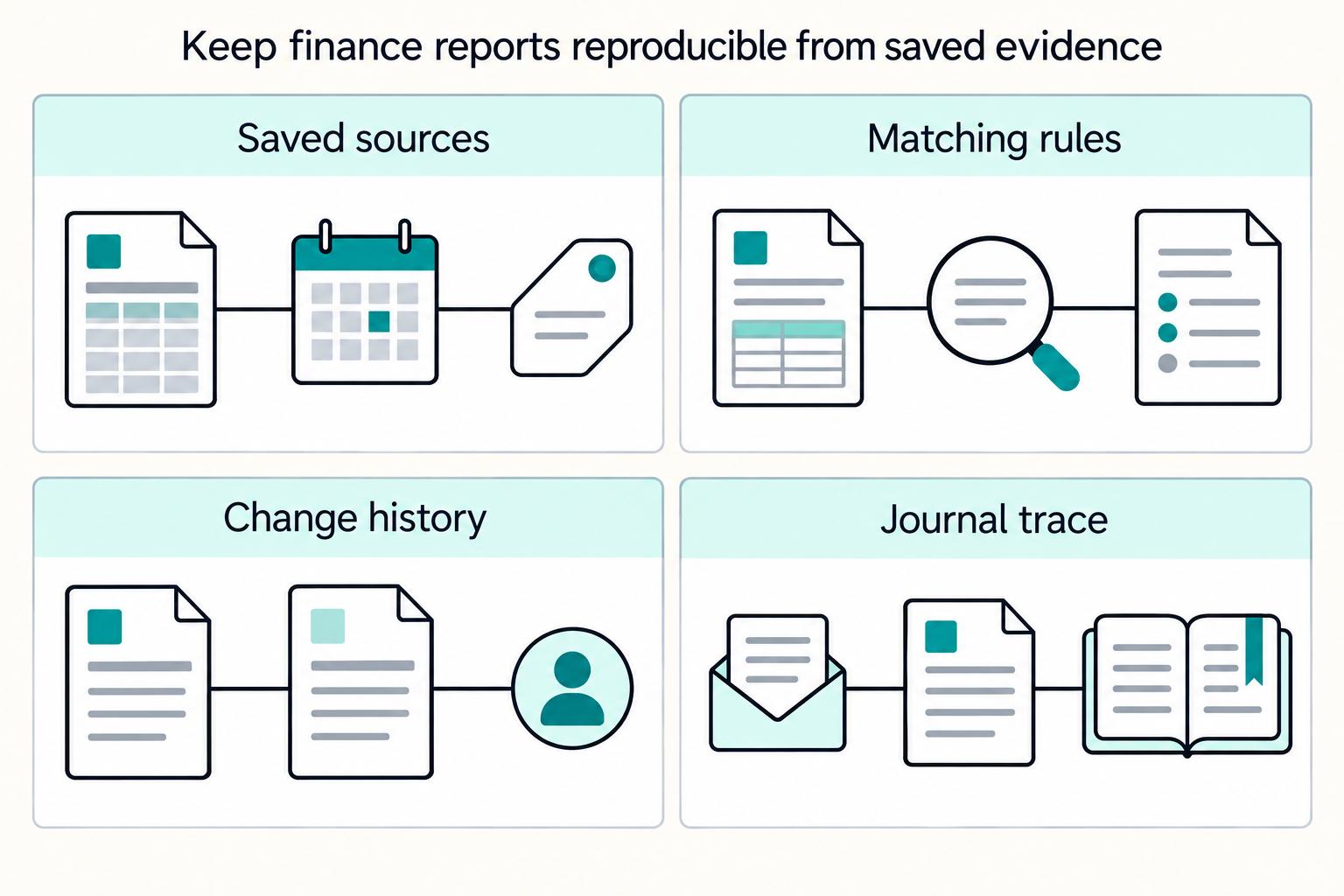
Verification point: pick a reporting date and confirm each report is reproducible from saved source data, not only from a live screen.
Tie operational metrics to accounting outputs#
Tie operational metrics to accounting outputs before broad distribution. If Ramp or BILL shows AP activity, you should be able to point to where that activity landed in the GL.
Treat sync as an input, not proof of reconciliation. Ramp documents repayment sync to NetSuite as journal entries, and BILL documents bi-directional NetSuite sync plus transaction sync to Sage Intacct. You still need matching rules by period, entity, and transaction class, and you should not clear variances until you can identify the specific open export, rejected sync, or unposted journal.
Watch for reporting limits that hide gaps. BILL Insights tables can display a maximum of 25,000 rows, so filter by date or entity and compare counts to source totals before trusting completeness.
Attach audit-ready artifacts to every report#
Attach audit-ready artifacts to every report, not only month-end files. Preserve who approved, what changed, when it was posted, and which upstream event triggered the journal.
BILL approval reporting includes explicit approval fields, and Sage Intacct audit trail records user, timestamp, and before and after value changes. Pair those records with payment-side event references, such as Stripe payout status or Adyen return reason codes, so each exception can be traced from provider event to accounting impact.
Checkpoint: for one failed payout and one paid AP item, produce a full trace from approval record to source event ID to posting timestamp to final journal impact, without spreadsheet patching.
We covered this in detail in How to Build a Deterministic Ledger for a Payment Platform.
Execute a 30 60 90 day rollout with hard checkpoints#
After you can trace reports to the GL, roll out in controlled waves instead of switching everything at once. Phased execution lowers risk, gives you usable feedback from each batch, and keeps rollback practical if early cutovers expose gaps.
| Phase | Focus | Checkpoint |
|---|---|---|
| Days 0 to 30 | Lock scope and inventory before moving money | Confirm discovery is complete, live AP/AR/treasury/ERP records match scope, define minimum data contracts, and test idempotent request handling |
| Days 31 to 60 | Migrate one dependency-contained flow | Run legacy and new paths in parallel and confirm approvals, provider references, and posted entries reconcile for a pilot close window without spreadsheet patching |
| Days 61 to 90 | Expand only after controls hold | Enforce approvals, verifications, reconciliations, and segregation of duties, and keep rollback ready throughout |
Days 0 to 30, lock scope and inventory#
In days 0 to 30, lock scope and inventory before moving money. Confirm discovery is complete and that live AP, AR, treasury, and ERP records match what your team thinks is in scope, because bad inventory makes every later checkpoint unreliable.
Define minimum data contracts from operational events to accounting outputs, with fields and mappings your teams can reconcile consistently. In parallel, test idempotent request handling by sending the same request twice with the same key and confirming you get the original result, not a duplicate payout. If your provider can prune idempotency keys after 24 hours, make sure retry and replay logic does not assume indefinite protection.
Days 31 to 60, migrate one dependency-contained flow#
In days 31 to 60, migrate one dependency-contained flow, such as contractor payouts. Grouping dependent workloads reduces partial-outage risk during phased execution.
Run legacy and new paths in parallel long enough to compare totals, statuses, and journal outcomes for the same period. The checkpoint is not just successful payments. A useful checkpoint is whether approvals, provider references, and posted entries reconcile for a pilot close window without spreadsheet patching. If counts diverge, stop and isolate the break: missing event, rejected export, or posting-rule mismatch.
Days 61 to 90, expand only after controls hold#
In days 61 to 90, expand volume only after enforcing the control activities already defined by finance: approvals, verifications, reconciliations, and segregation of duties. This is where rollout risk rises if teams add traffic before removing duplicate decision paths.
Retire legacy steps only when exception criteria are pre-defined, measured consistently by flow and period, and reviewed by owners. Keep rollback ready throughout with source backups, prior export paths, and a named cutback decision owner. If you cannot restore the prior path inside the same close window, you are not ready for full cutover.
Use the same go or no-go checks at every phase#
Use a consistent set of go or no-go checks at every phase:
- Data completeness: source counts and totals tie out.
- Approval traceability: every moved item has a retrievable approval record.
- Reconciliation pass rate: operational totals match posted accounting results at your defined threshold.
- Rollback readiness: the reversal path has been tested, not just documented.
Before you move from pilot to full volume, align your data-contract and rollback criteria with the implementation patterns in Gruv Docs.
Add compliance and risk controls before scale exposes gaps#
Do not scale payouts or billing until you can prove controls ran for each decision. If a KYC, KYB, AML, or payout-eligibility check cannot produce retrievable evidence on demand, treat it as missing, even if the UI shows it as enabled.
Place policy gates before money movement or account access changes#
Place policy gates where money movement or account access changes, not later in AP, AR, or the GL. In practice, that means identity and business verification, AML screening where applicable, payout-eligibility checks, and required document collection where applicable before approval or release.
Apply a risk-based approach, but keep checks explicit. Match verification depth to customer profile, entity type, transaction pattern, and product risk. Where beneficial-owner requirements apply to legal-entity customers, written procedures should identify and verify the beneficial owner, the natural person who in the end owns or controls the customer. For onboarding identity verification, rely on reliable, independent documents, data, or information, not only self-entered form data.
Checkpoint: test one approved payout, one rejected payout, and one pending onboarding case, then retrieve the full evidence pack for each. You should be able to show collected documents, decision output, exception approver, if any, and the event that allowed or blocked release.
Split RegTech ownership from finance operations#
Define a clear ownership split between RegTech and finance operations. RegTech helps address regulatory challenges, but it is not the full compliance function.
Keep screening, identity checks, and document capture in the compliance layer when supported. Keep payment approvals, posting, reconciliation, and close ownership in finance operations and your ERP or accounting system. Then create one indexed evidence path per transaction or counterparty: source event, verification result, approval record, override record, if any, payout decision, and accounting reference.
Validation test: ask someone outside the project team to reconstruct a case end to end. If they need Slack threads, screenshots, or tribal knowledge, your evidence design is still fragmented.
Design for masking and auditability from day one#
Design for masking and auditability from day one. For payment card account data, displayed PAN should be limited to no more than the first six and last four digits.
Also log every override and manual intervention with durable detail: who changed it, when, what changed, why it changed, and what record was reviewed first. Do not stop at storing logs; make sure they are monitored and retrievable.
Verification test: force a controlled exception. Have an authorized reviewer override one eligibility block in a test case, then confirm the audit trail captures prior status, approver, reason, and linked accounting record.
Set retention and evidence rules before volume rises#
Set retention and evidence rules before volume rises. If you are a U.S. money services business, maintain an AML program, make it available to Treasury on request, and retain required Chapter X records for five years. SAR copies and supporting documentation also carry a five-year retention period, and the MSB SAR trigger includes transactions that involve or aggregate at least $2,000.
| Requirement | Rule |
|---|---|
| AML program | If you are a U.S. money services business, maintain an AML program and make it available to Treasury on request |
| Chapter X records | Retain required Chapter X records for five years |
| SAR copies and supporting documentation | Five-year retention period |
| MSB SAR trigger | Transactions that involve or aggregate at least $2,000 |
If your obligations differ by jurisdiction, keep the same design standard: records must be demonstrable, discoverable, and tied to transaction history. This aligns with GDPR accountability, which requires compliance with data-processing principles to be demonstrable. If a tool can run checks but your team cannot prove them later, treat that control as failed and fix the evidence path before scaling.
Related: What Is RegTech? How Compliance Technology Helps Payment Platforms Automate Regulatory Reporting.
Recover quickly from the failures that break month end#
When month end breaks, stabilize three things first: one status authority, replay-safe retries, and one drill path from source event to GL in your ERP.
Set a single payment-status authority#
Set a single payment-status authority when AP and treasury disagree. Recovery starts by naming one record that downstream systems read, rather than letting each tool store its own final state. In card-style flows, that can be a single payment object; Stripe recommends one PaymentIntent per order or customer session, and that object can be inspected for payment status.
Checkpoint: pick one payment that shows different states across AP, treasury, and reporting, trace which record produced each state, and rebuild mappings so all downstream statuses are derived from the authority record. If ERP and treasury are still connected through manual updates, expect delayed reporting and cash-visibility gaps until the mapping is corrected.
Enforce strict idempotency and replay-safe processing#
Prevent duplicate payouts by enforcing strict idempotency and replay-safe processing from source events. A retry should return the same result, not execute a second disbursement. Use one idempotency key per create or update request and keep that key stable across retries.
Keep implementation limits explicit: idempotency keys can be up to 255 characters, and Stripe notes keys may be removed after at least 24 hours, so your retry window must align with key retention. Verification test: replay the same payout request with the same key and confirm the same result is returned, including failure outcomes, with no second payout.
Treat unreconciled finance reporting as provisional#
Treat finance reporting that does not reconcile to the GL as provisional during recovery. The priority is lineage: trace balance to journal to the underlying subledger transaction, then fix the break point. That keeps correction work tied to evidence instead of dashboard differences.
A practical pattern is a reconciliation flow with drilldown from account balances to journals and underlying subledger activity, plus explicit exception identification during out-of-balance investigation. Patch transformation logic only after you can show the same transaction across event ID, journal reference, and report row.
Consolidate vendors only when evidence supports it#
Treat vendor consolidation as an evidence-based recovery move, not a category cleanup exercise. If multiple tools appear to cover similar finance workflows, assess them with objective criteria: decision ownership, accounting export quality, exception handling, reconciliation burden, contract constraints, and termination effort.
Use a risk-based review across the full third-party lifecycle, including planning, selection, ongoing monitoring, and termination, with scrutiny calibrated to risk, complexity, size, and relationship type. A practical rule: if a tool adds handoffs but not unique control evidence or cleaner ERP linkage, flag it for consolidation review.
Final takeaway and copy paste checklist#
Choose the stack that keeps ownership explicit, cash movement traceable, and reconciliation repeatable. Favor clear control boundaries over a longer vendor list.
If you keep one rule, use this: do not add another tool until you can trace one real transaction from source event to cash outcome to posted accounting result.
- Assign owners in writing.
Assign AP, AR, treasury, and GL/ERP responsibilities in a written role plan. Keep segregation of duties intact so one person is not executing consecutive accounting steps.
- Map payment events to accounting evidence.
Treat ERP as the accounting anchor for GL and reporting outputs, and treasury or TMS as the cash-positioning and payment-execution layer. For each accounting-relevant state change, define whether and how it maps to journals (direct, batch, or handoff), and retain audit-ready records: event type, time, source, outcome, identity, and the posted journal or export artifact.
- Prove retry safety and go-live controls before scale.
Use idempotency keys so retried payment requests are recognized as the same request, and defend webhook processing against duplicate delivery retries. If you run phased checkpoints, set explicit go or no-go criteria and a rollback path with authoritative records named.
Before go-live, copy and paste this into your implementation doc:
- Ownership across AP, AR, treasury, and GL/ERP is explicitly assigned
- Every payment state change that affects accounting has a documented journal mapping and audit artifact
- Idempotent retries are tested for payment requests and webhooks
- Reporting pack reconciles operational metrics to GL totals
- Compliance gates and override logs are evidence-ready
- Phase checkpoints have go or no-go criteria and rollback steps
If you want a practical review of your AP/treasury boundaries and reconciliation controls before go-live, talk with the Gruv team.
Frequently Asked Questions
What is the minimum viable finance stack for a payment platform?
The minimum viable stack is one that gives clear ownership for invoice state, cash movement, and accounting records, with the GL as the accounting anchor. It is viable only if you can trace a settled transaction from its source event to the posted journal without conflicting system states. If that trace breaks, the stack is not operationally complete.
What should AP own vs what treasury should own?
AP should own supplier obligations and approval of what is owed for goods or services. Treasury should own cash position, liquidity, funding timing, and payout readiness. If the decision is about when cash moves and whether funds are available, it belongs in treasury.
Which system should be source of truth for invoices, cash, and journals?
Set one source of truth per domain and document it clearly. Keep journals in the GL, and define where invoice status and cash movement status are finalized. Do not let two tools claim final ownership of the same field.
When should we choose modular tools instead of an all-in-one suite?
Choose modular tools when clear separation across AP, treasury, and accounting matters more than speed and when replaceability is important. Choose a suite-centered design when faster implementation and fewer handoffs are the main constraint. Make the decision based on handoff and reconciliation burden, not vendor preference alone.
What reporting layer is required for audit-ready finance operations?
Your reporting layer should reconcile back to the GL and retain evidence that is sufficient and appropriate for review. Attach approval records, source events, posting details, and journal references so reports are reproducible from saved source data. Tooling helps, but audit readiness depends on effective controls and evidence quality.
How do we prevent reconciliation breaks during implementation?
Test incomplete, invalid, and duplicate data before go-live, and verify idempotency so retries do not create duplicate money movement. Run a payout reconciliation checkpoint that matches bank payouts to the underlying settlement batches. Use phased checkpoints and stop when counts, statuses, or journal outcomes diverge.
What should we verify before each go-live phase?
Verify data quality, control evidence, and replay safety before each phase. Confirm representative transactions can be traced end to end across source records, cash movement, and posted accounting output. Also confirm source counts and totals tie out, approval records are retrievable, and rollback is tested.
Where Gruv fits
Plan and approve payout batches
See how payee status, approval rules, route review, and exception handling sit in one payout workflow.
See reconciliation and mismatch review
Compare ledger entries, provider payment records, and statement rows to see what matches and what finance needs to review.
Researched and edited by the Gruv editorial team. Gruv builds cross-border billing, payouts, and finance-operations software for global businesses.
Sources
- csrc.nist.gov/pubs/sp/800/34/r1/upd1/finaltrusted
- ecfr.gov/current/title-2/subtitle-A/chapter-II/part-2...trusted
- ecfr.gov/current/title-31/subtitle-B/chapter-X/part-1...trusted
- fdic.gov/news/financial-institution-letters/2023/fil2...trusted
- federalregister.gov/documents/2023/06/09/2023-12340/interagency-...trusted
- gao.gov/pdf/product/665712trusted
- gao.gov/greenbooktrusted
- guides.gaoinnovations.gov/greenbook/2025/principle-10-design-control-a...trusted
Educational content only. Not legal, tax, or financial advice.
Related Posts

The Freelance Payment Penalty: A Modeled Audit of Platform Fees, FX Spreads, and Payout Delays
The money rarely disappears through a single, easy-to-spot fee. The real loss is stacked. A marketplace takes its commission, a processor adds a charge for international cards, a bank or payment company converts the currency at a spread, a platform holds the funds before release, and a wire sheds a little to intermediaries on the way in. Each layer looks defensible on its own, but the worker feels the combined result as a smaller deposit and a later payday.

How to Respond to a Subpoena for Business Records
Move fast, but do not produce records on instinct. If you need to **respond to a subpoena for business records**, your immediate job is to control deadlines, preserve records, and make any later production defensible.
A US Expat's Guide to Investing in UCITS ETFs to Avoid PFIC Issues
The real problem is a two-system conflict. U.S. tax treatment can punish the wrong fund choice, while local product-access constraints can block the funds you want to buy in the first place. For **us expat ucits etfs**, the practical question is not "Which product is best?" It is "What can I access, report, and keep doing every year without guessing?" Use this four-part filter before any trade: