
Quick Answer
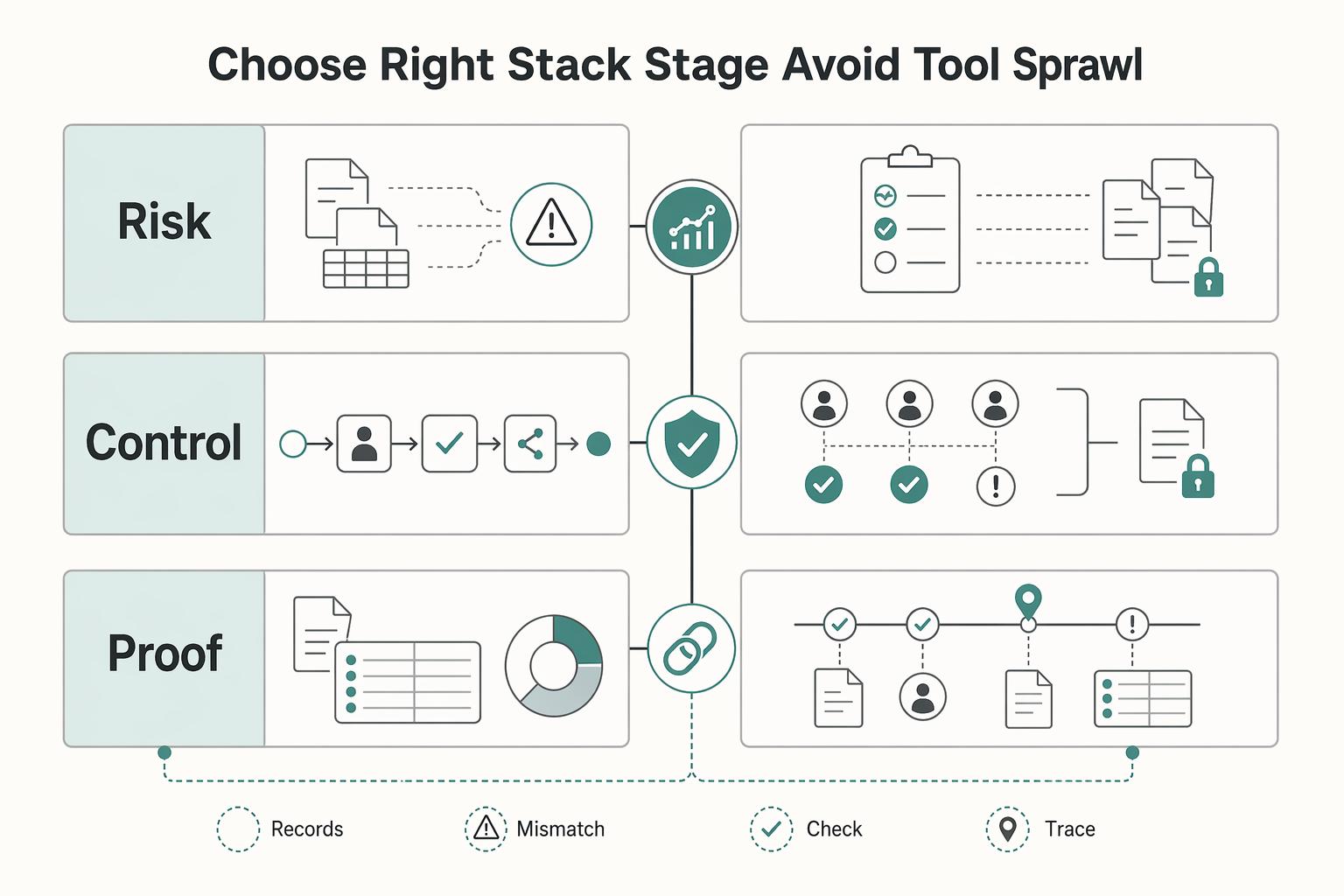
Start with the approvals, invoice controls and payment evidence your existing systems can provide. Add AP automation for invoice exceptions, procurement analytics for sourcing or spend analysis, and payout orchestration for execution gaps. Verify the outcome and integration cost before expanding.
Procurement stack choices get expensive fast once payouts and compliance scale#
Use funding stages as rough operating examples, not purchasing requirements. A small team can need strong payment controls, while a larger team may already have the required workflow in its ERP. Buy for the demonstrated gap.
- Start with stage, not vendor shortlists
Early teams may prioritize tighter approvals, clearer payout visibility, and exportable records before they need a broad procurement suite. Growth teams may need faster exception handling and clearer ownership across finance, product, ops, and engineering. This is a stage-based decision guide for platform operators, not a generic software roundup.
- Deploy the minimum stack that proves control
Early on, that can mean a lightweight purchasing and approval layer, disciplined accounts payable checks, and a payout setup you can verify lane by lane. If feature demos are driving the decision instead of traceability, you may be overbuying. The first checkpoint is not "does it integrate?" but "can you tie a request, approval, payment instruction, provider status, and reconciliation artifact together without asking three teams for screenshots?" Deploy what gives you operational proof, not the widest feature map.
- Defer expansion layers until the trigger is real
Separate procurement analytics from AP automation and payout execution. Sourcing, spend and supplier analysis do not by themselves fix failed invoice processing. When exceptions rise, identify the failing step and first test the capability you already own.
- Validate market and rail constraints before you commit
Confirm your provider’s country, entity, currency and payment-method support for the exact program. A marketplace connected-account restriction can matter for that provider model, but is not a universal rule for every procurement stack.
Related: Finance Automation and Accounts Payable Growth: How Platforms Scale AP Without Scaling Headcount.
How to choose the right stack for your stage and avoid tool sprawl#
Choose the smallest stage-fit stack that gives you clear request-to-payment control, then add tools only when they close a specific gap. There is no one-size-fits-all architecture, so prioritize end-to-end operation over feature count.
Add the next layer only when it fixes a real visibility or approval gap. If requests still get stuck in email threads and spreadsheets, fix intake, approval, and routing first. Make missing approvals, unclear ownership, and off-book spend harder to hide.
Sprawl usually breaks at integration points, not in product demos. Map how data moves across AP, engineering, and payments ops before you buy, and avoid tools that add new manual bridges. Favor software that reduces handoffs now, not after a future integration phase.
More software does not automatically reduce work. If AP still re-keys details, asks engineering for payout status, or resolves exceptions in chat, you have shifted workload, not reduced it. Choose the option that removes manual touches on common exception paths.
If you cannot explain request-to-payment traceability in one flow, pause optimization buying and fix the audit trail. The flow should be clear across requisition, sourcing, purchase orders, receiving, invoicing, and payment, with exportable records. Evidence quality beats feature breadth while control is still maturing.
Evaluate ROI after control and integration checks. Stage-fit ROI is whether the tool reduces operator time, reconciliation friction, and visibility gaps enough to justify integration burden. Buy the next constraint, not the full suite.
This is not only a suite-selection problem. If no one owns the request-to-payment chain across AP, engineering, and payments ops, fix accountability before adding more tools.
Best stack at seed stage when Excel still runs most procurement#
At seed stage, establish approvals, invoice control and payment visibility. These can be capabilities in the accounting or ERP system you already use, rather than three new products.
| Layer | What to implement now | What to check before you buy |
|---|---|---|
| Existing purchasing/approval capability, or a targeted tool if needed | A configurable requisition approval workflow so requests leave sheets, inboxes, and chat | You can export who requested, who approved, and when |
| Existing AP approval and invoice controls | A clear invoice intake -> review -> approval flow | Invoice approval is visible in-system, not re-approved informally in email |
| Payout controls for first global lanes | A provider that can send third-party payouts in local currency | You can verify required corridors, track payout status, and export transaction history |
The tradeoff is straightforward: this stack is fast to deploy and makes ownership clearer, but manual exception handling remains. Failed transfers, invoice mismatches, and out-of-band approvals still need operator intervention.
For a creator platform, first link the existing purchase approval, invoice and payout records. Add a new approval tool only if the current system cannot preserve the required evidence or handle the workflow. Trace one month-end payment before expanding the stack.
Best stack at growth stage when approval speed and exception handling break#
When approvals slow down and exceptions leave the system, keep your e-procurement platform as the control surface and add targeted layers for exception handling and payout orchestration.
| Layer | When it fits | What to verify |
|---|---|---|
| E-procurement platform as front door | Keep it as the control surface as volume grows | One approval path with a clear record; policy-driven routing, SLAs, and approvals run end to end |
| AP invoice automation | Repeated capture, matching or workflow exceptions | Test existing ERP/AP capability before adding a product |
| Payout orchestration | Add it before more payout point tools when approval latency and payment failures rise together | Durable local identity, documented provider-key scope and unknown-outcome resolution before retry or fallback |
- Fix AP Exception Handling Before Adding Analytics
Test invoice intake, matching and exception routing in the existing ERP/AP system. Microsoft Dynamics 365, for example, lets AP review failed automated invoices and resubmit them to workflow. Procurement intelligence instead helps analyze spend, sourcing and supplier decisions; evaluate it for those needs rather than labeling invoice repair as intelligence.
- Add orchestration before adding more payout point tools
Keep a durable internal payment identity and reserve initiation atomically. Use the provider’s idempotency key only for unchanged parameters in its documented account and operation scope and retention window. After a timeout, query and reconcile the original outcome before resubmitting or choosing another provider. Deduplicate incoming event deliveries and apply local effects atomically, preserving legitimate later returns and authoritative event ordering.
For an illustrative pilot, suppose 200 invoices include 40 exceptions taking 15 minutes each: 10 operator hours. If an existing AP feature reduces these to 20 exceptions at 10 minutes each, recurring work falls to 3 hours 20 minutes, saving 6 hours 40 minutes. Compare that measured saving with configuration and review time. Add another product only if it improves the actual gap enough to cover integration and ongoing support costs.
For the metrics behind stage-by-stage planning, read KPIs for Each Stage of Platform Growth: From Seed to Series C to IPO.
Best stack from Series C to IPO when auditability matters more than feature count#
From Series C through IPO prep, the right stack is the one you can defend: every payment should be traceable from request through reconciliation without jumping across inboxes or side files.
| Control layer | What it must support | Verification |
|---|---|---|
| E-procurement policy record | Request, approver identity, policy decision, and entity context for each spend decision | Sample five payouts across two entities and confirm each has a linked request, approval record, policy rule, and owner |
| Reconciliation and payment-evidence layer | Payment instruction, processor or bank reference, status transitions, and the reconciliation artifact | Pull a month-end sample and confirm you can move from approved spend to settled payment to reconciled ledger support without re-keying data |
| Tax and reporting controls | Payee status, income source/type and applicable reporting treatment | Retain the classification and confirm current filing rules for the actual entity and return population |
Link payment instruction, provider reference and authoritative outcome to reconciliation evidence. Request acceptance or a local sent label does not prove settlement. Preserve pending and unknown outcomes, rejected instructions and later returns separately; reconcile them to the approved obligation and ledger.
Determine tax handling from payee status and payment type/source, rather than postal address. Personal-service income is generally sourced where the work is performed; offshore services are normally foreign-source, so a U.S. payer does not alone create Form 1042-S reporting. Some covered U.S.-source payments remain reportable even with no withholding. Use the applicable IRS instructions to identify reporting exceptions and electronic-filing requirements, including any aggregate return count and special financial-institution rules.
Compare stack options by stage before you commit budget#
Choose the stack for your next control gap, not your next demo. A stage-based view keeps budget tied to what you need to run safely now, while deferring modules that add integration work, admin overhead, or switching friction before they are necessary.
Overbuying early is common, and the later pain is usually weak evidence paths, uneven entity coverage, or market/program gaps, not missing feature checkboxes. Use each stage to define three things: what must be controlled now, what can wait, and what event forces an upgrade.
| Stage | Best-for profile | Must-have systems | Minimum compliance baseline | Defer list | Upgrade trigger | Practical caveat |
|---|---|---|---|---|---|---|
| seed stage | Lower spend, few approvers, first cross-border payouts, finance still close to spreadsheets | Lightweight e-procurement layer, centralized approval records, basic AP controls, payout status visibility | Apply provider/program payee checks and record-specific retention rules; do not use one universal tax retention period | Procurement intelligence, advanced orchestration, multi-provider routing, heavy customization | Approvals move into chat/email, AP re-keys payment data, first country/entity expansion creates recurring exceptions | Country and program support varies by provider and region, and some features are available only when specific programs are enabled |
| growth | More vendors, more exceptions, marketplace or embedded-payments complexity, month-end pressure | E-procurement as control surface, AP automation, stronger reconciliation layer, payout-status events synced back to finance | Map required checks to the covered entity/program; define tax-document ownership and record-specific retention | Broad suite expansion too early, duplicate point tools for the same approval step, nonessential sourcing modules | Approval latency and payment failures rise together, duplicate review work grows, exceptions cannot be cleared from one record | FATF standards are global, but implementation is local, so do not assume one KYB flow, one document set, or one threshold across jurisdictions |
| Series C | Multi-entity operations, controller oversight, tighter board scrutiny, audit sampling pressure | Entity-aware e-procurement, linked payment instruction and provider reference, reconciliation evidence, structured tax-reporting support where in scope | KYC/KYB ownership is clear by entity and product line; tax handling is tied to payee records and reporting outputs where applicable; retention expectations are written by record type | Niche tools that do not improve traceability, manual side files by subsidiary | You cannot pull a sample and show request, approval, payment result, and ledger support from one evidence path | Some features are technically available but not contractually or regionally enabled, so confirm what is live per entity before standardizing |
| IPO | Public-company-style control expectations, formal testing, repeatable cross-entity evidence | Auditable end-to-end chain, access controls, exception logging, tax/reporting support, retention schedule with owner and retrieval process | Maintain a retention schedule by record purpose and applicable rule, including tax records, contracts and litigation holds; some tax-credit support requires longer retention | New connectors without control owners, "temporary" spreadsheet approvals, corridor expansion without evidence design | Control testing finds gaps, consistent operation cannot be evidenced, or payment support must be rebuilt manually for reviews | Market coverage still varies; a country listed as supported does not guarantee every payout method, entity structure, or program type |
Single-vendor or best-of-breed#
| Option | Integration load | Failure isolation | Control depth | Operating cost pattern |
|---|---|---|---|---|
| Single-vendor consolidation | Usually lower early because there are fewer connectors and handoffs | Can reduce connector-related breakpoints, but one vendor incident can affect more of the chain | Often sufficient at seed/early growth when the goal is unified visibility | Often lower early; switching friction can rise later |
| Best-of-breed | Usually higher because you manage more seams across tools | Can isolate issues by domain when interfaces and monitoring are strong | Often stronger in specific layers like reconciliation, tax handling, or complex payout ops | Can avoid paying for broad unused modules; support and change-control overhead usually increases |
Before committing budget, trace one recent payment per entity. If you cannot show the approval record, KYC/KYB or payee setup step, tax document state, provider outcome, and retained support in one clear chain, fix that evidence path before adding more tools.
Execute in the first 90 days without breaking payouts or controls#
After you choose stage-fit tools, execution order is what protects payouts and controls. In the first 90 days, run changes in sequence: clean data, assign owners, define policy, configure systems, test integrations, then roll out with a documented rollback path.
| Step | Focus | Key detail |
|---|---|---|
| Data cleanup and owner map | Normalize vendor and payee records, remove duplicate counterparties, and assign clear ownership for each payment path | Keep approval evidence and change history in a tracked system so changes and approvals are retrievable |
| Policy before configuration | Document implementation steps, validation steps, and a rollback plan before launch | Do not enable a new approval route or payout lane until rollback triggers, approvers, and in-flight handling are defined |
| Evidence pack per payment path | Keep a standard pack with approval log, policy decision, provider status, reconciliation export, and exception-resolution notes | Resolve original timeouts before retry/fallback, retain pending/unknown and later returns, and reconcile authoritative provider outcomes |
| Tax-reporting readiness | Collect and retain the records needed for later reporting | Classify payee status and income type/source, then retain documents and reporting support for covered payments |
Retain approval, payee, provider-attempt and reconciliation evidence, including unresolved outcomes and later returns. A cancellation or failure is final only when the provider evidence supports it. For ACH payout credits, track rejected or returned credits by reason and bank-program rules; debit-origination return thresholds are a different population.
At onboarding, collect the tax status and service-location evidence needed for your actual payments. Assign a reviewer for reporting classifications and retain the calculation and supporting documents. Payment reach and reporting readiness are separate launch checks.
Spot the red flags that mean your current stack is now a risk#
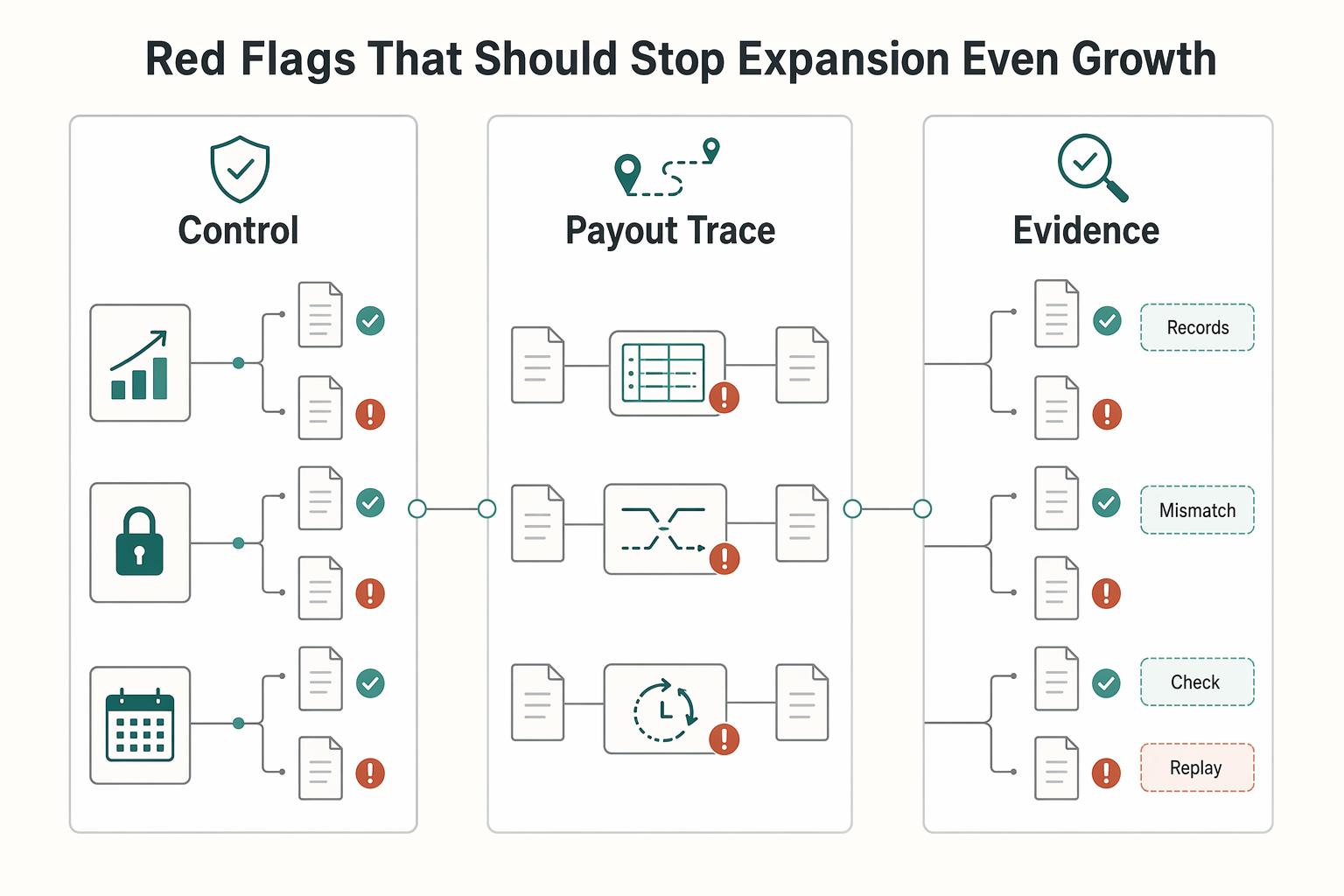
If you cannot explain and evidence each payment path quickly, your current stack is now a scaling risk.
- Re-keying between approval and payout
Manual re-entry between your e-procurement platform and payout system is a control gap, not just an efficiency issue. As volume grows, manual P2P work gets more complex and increases error and documentation risk. Test one live payment end to end: approval record, payee record, amount, and provider reference should flow without copy-paste steps.
- AP cannot trace approval to final outcome
If AP cannot move from approval to paid, failed, or canceled status quickly, traceability is weak. Approval evidence and later changes should be captured in systems that preserve the audit trail. If you cannot get from approval ID to provider status and reconciliation export in one path, treat that as a blocker before expanding to new geographies.
- Exceptions live in chat and spreadsheets
Give each exception a named owner and durable record with provider evidence and next action. Do not resolve a payout timeout by starting another payment in a chat thread; preserve the unknown outcome until authoritative confirmation.
- Tax handling for foreign contractor payments is ad hoc
Ad hoc cross-border tax workflows are a sign your stack is under-scoped. Not every foreign contractor payment is reportable, but U.S.-source amounts paid to foreign persons can trigger Form 1042-S duties for a withholding agent. Before adding optimization layers, require structured capture of payee tax status, payment source characterization, and retrievable records.
Frequently Asked Questions
What tools should a platform operator use at seed, growth, and late scale?
At seed, use existing approvals and AP capabilities where they meet the control need, with searchable payout outcomes. At growth, fix the measured invoice or payment exception path; add procurement analytics only for sourcing, spend or supplier-analysis needs. At later scale, keep an entity-aware chain from request to authoritative outcome and reconciliation.
When does a procurement stack become too fragmented to manage safely?
Fragmentation becomes a problem when evidence or ownership breaks between systems. Trace one payment from approval through provider confirmation and reconciliation, including any unknown, failed or returned state. A low tool count does not excuse a broken handoff, and manual re-entry alone does not establish that a new suite will solve it.
What are the minimum controls before scaling global vendor or contractor payouts?
Separate approval and execution responsibilities, verify payee details and retain the authoritative payment outcome and reconciliation. Apply KYC or other gates where the actual entity/program requires them. For Form 1042-S, establish foreign-person status and the payment’s income type/source and reporting rule; foreign address alone is insufficient, and no withholding does not always mean no reporting.
Should we choose one suite or combine best-of-breed procurement and payout systems?
Choose a suite when integrated consistency, a common data model, and a single interface matter more than functional depth. Choose best-of-breed when your payout, tax, or exception needs are materially more complex than your procurement needs, but go in knowing the tradeoff is higher integration and maintenance burden. Neither model wins by default. The right answer is the one you can control and evidence with the fewest brittle handoffs.
How do we decide when to add procurement intelligence instead of hiring more AP staff?
Measure invoice throughput, exception reasons, rework and operator time. Test whether existing AP functionality can remove the recurring problem before buying. Procurement intelligence addresses spend, sourcing or supplier analysis; invoice capture and matching are AP capabilities, while payment status and retries belong to execution and reconciliation.
What are the top mistakes when replacing Microsoft Excel in procurement operations?
The biggest mistake is moving forms into software without moving controls with them. Weak spreadsheet governance increases error frequency, and teams often recreate the same problem by keeping approvals in the new tool while exceptions, bank changes, and payout notes stay in spreadsheets or chat. Another common miss is skipping field cleanup before migration, which can leave duplicate vendors, inconsistent payment terms, and missing tax status in the new stack from day one.
Try a related tool
Researched and edited by the Gruv editorial team. Gruv builds cross-border billing, payouts, and finance-operations software for global businesses.
Sources
- csrc.nist.gov/Projects/risk-management/about-rmftrusted
- docs.stripe.com/api/idempotent_requeststrusted
- ecfr.gov/current/title-17/chapter-II/part-229/subpart...trusted
- ecfr.gov/current/title-31/subtitle-B/chapter-X/part-1...trusted
- gao.gov/assets/890/882014.pdftrusted
- guides.gaoinnovations.gov/greenbook/2025/principle-10-design-control-a...trusted
- guides.gaoinnovations.gov/greenbook/2025/principle-13-use-quality-info...trusted
- irs.gov/individuals/international-taxpayers/electron...trusted
Educational content only. Not legal, tax, or financial advice.
Related Posts
KPIs for Platform Growth from Seed to Series C and IPO
The useful way to read growth metrics is by stage, not as a fixed scorecard. **Key Performance Indicators (KPIs)** change with a company's lifecycle, and the decisions you make from them should change too.

How Platform Teams Scale AP Volume Without Adding Headcount
Use this as a decision list for operators scaling Accounts Payable, not a generic AP automation explainer. In these case-study examples, invoice volume can grow faster than AP headcount when the platform fit is right, but vendor claims still need hard validation.
IRS Form 1042-S for Platform Operators: How to Report and Withhold on Foreign Contractor Payments
If you own compliance, legal, finance, or risk for a platform paying foreign contractors, sellers, or creators, you may need to make **Form 1042-S** operational. That means clear decisions, reliable checks, and escalation points your team can apply and defend.