
Quick Answer
Build a growth mindset for freelancers by converting stress points into repeatable systems you review on a schedule. Use a Residency Dashboard for compliance checks, Proposal Loss Analysis for rejected deals, a Value Delivery Report for pricing conversations, and a 90-day forecast for cash decisions. The shift is practical: stop relying on mood and memory, and run each pressure point with a clear trigger, log, and review habit.
Turn Recurring Stress into Repeatable Action#
If your pipeline swings month to month, clients push on price, and your confidence drops every time you stretch into a bigger project, you may not have only a motivation problem. Often, it is an operating problem. A useful growth mindset for freelancers is not positive self-talk. It is the habit of turning recurring stress into repeatable action.
That matters because a solo business runs on more than talent. You still need a strong idea, a workable business plan, and a real client base. You also need to stay current with your niche and local market, then turn what you learn into daily decisions. A simple checkpoint helps: if you cannot name one thing you will do today to move a goal forward, the goal may still be too vague.
| Generic mindset advice | Operational growth mindset for freelancers |
|---|---|
| "Believe in yourself" | Define a manageable goal you can actually stick to |
| "Embrace challenges" | Break one stress point into a repeatable process |
| "Raise your rates" | Check whether price, offer, and sales process still convert, because prices can go up while sales can go down |
| "Think bigger" | Review your niche, local market, and client mix before changing direction |
This article is a roadmap, not a pep talk. Each section takes a common pressure point and turns it into an operating habit you can repeat: clearer goals, steadier execution, and more predictable finances.
Before you apply any of it, adapt the ideas to your jurisdiction, your service model, and the kinds of clients you serve, then verify before acting. A common failure mode is procrastination through over-planning. Another is wishful thinking without any real process. The goal here is something more grounded than either.
For a step-by-step walkthrough, see The 'Dunning-Kruger Effect' and imposter syndrome for freelancers.
System 1: Manage Compliance from One Source of Truth#
You reduce compliance anxiety by running a system, not by relying on memory. The shift is simple: treat rules as variables you track and verify, especially before travel, contract, or invoicing changes.
When this breaks down, it usually looks the same: you postpone checks, make decisions from scattered notes, and then scramble later. In practice, you do the opposite. You create one source of truth, review it before key moves, and verify anything that could change tax, visa, or invoice treatment.
Build your Residency Dashboard#
Your Residency Dashboard should be easy to update and quick to review. Use one source of truth, whether that is a spreadsheet, database, or notes system, and keep it practical:
| Dashboard item | What to include |
|---|---|
| Time by jurisdiction | Where you are spending time and your running day count by jurisdiction |
| Rule being managed | What rule you are managing, plus the source you will use to verify it |
| Verification log | What you verified and when, with a link or note to the source you relied on |
| Client invoicing details | Client details that affect invoicing, including tax-related details provided by the client and whether treatment still needs validation |
| Supporting records | Your supporting records location, so travel and billing evidence is easy to retrieve |
Review this dashboard before you book travel and before you accept contract changes that could affect where or how you work. It helps you manage compliance deliberately, but it does not replace local tax or legal guidance.
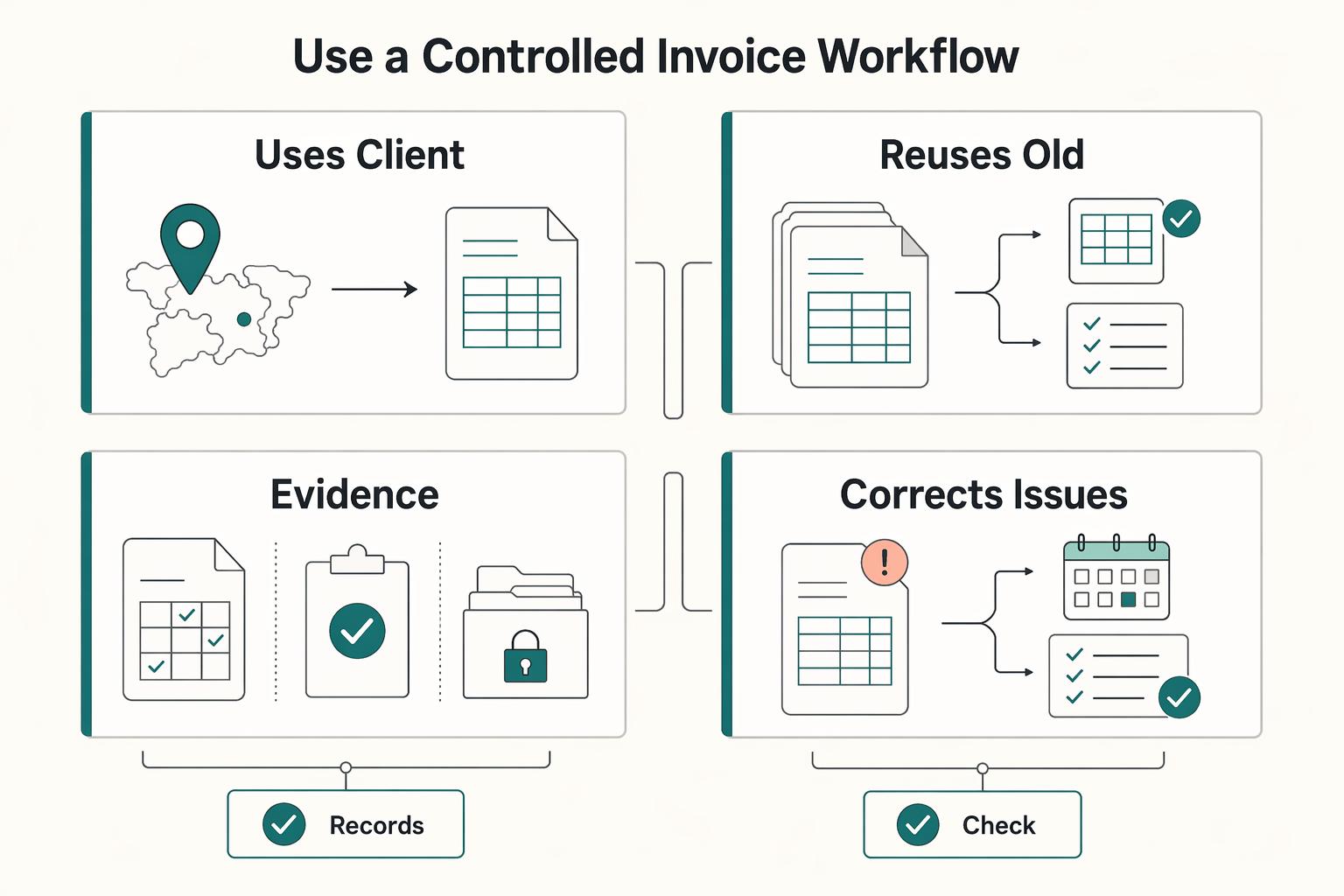
Use a controlled invoice workflow#
After the dashboard is in place, apply the same control to invoices. Keep VAT and reverse-charge concepts in your workflow, and validate jurisdiction-specific treatment with current local guidance before issuing invoices.
| Reactive compliance behavior | Controlled compliance workflow |
|---|---|
| Uses client tax details as-is from emails or chats | Confirms and records client tax details before invoicing |
| Reuses old invoice wording without checking context | Uses a template with invoice treatment wording confirmed against current guidance |
| Stores documents across scattered tools | Keeps invoices and related records together in a retained folder |
| Corrects issues only after someone flags them | Runs a short pre-send check on details, wording, and record links |
Start small if needed: build the single dashboard file first. That one habit turns compliance from background stress into a process you can manage.
If you want a deeper dive, read GDPR for Freelancers: A Step-by-Step Compliance Checklist for EU Clients.
System 2: Build a Client Acquisition Machine That Turns Rejection into Revenue#
If you want rejection to improve revenue instead of draining you, treat each lost deal as usable signal, not a verdict on your ability. In practice, that means converting setbacks into better decisions.
Run Proposal Loss Analysis as a repeatable loop#
Use Proposal Loss Analysis after every stalled or lost proposal so your process improves on evidence, not memory. Many teams track win rates without clearly understanding why they win or lose, and that risk is higher when you run everything solo.
| Step | What to record or do | Examples or labels from the article |
|---|---|---|
| Capture the loss reason | Record client name, proposal date, offer version, quoted scope, price format, and objection | Label each reason as confirmed, inferred, or unknown |
| Tag the pattern type | Use stable tags for at least one outreach cycle | price; unclear outcome; weak urgency; wrong buyer; procurement friction; timing; no trust proof; scope mismatch |
| Choose one proposal change | Test one change at a time | leading with the business problem; tightening scope; adding a clearer success measure |
| Test in the next outreach cycle | Compare results against benchmarks verified from current CRM or proposal records | Use the conversion benchmark and proposal review cadence only after verifying them from current proposal records |
Keep your evidence pack tight: discovery notes, proposal version, pricing option shown, and objection summary. Avoid vague labels like "not a fit" because they do not support better decisions.
Sell outcomes when the client needs progress, not just labor#
Start discovery by clarifying pain points and goals before you draft the proposal. Jobs to Be Done is useful here: clients hire services to make progress, not just to buy activity.
You can also borrow the performance work statement mindset from FAR 37.602: write scope around required results and measurable standards, not only methods or hours. This is a drafting discipline, not a claim that government contracting rules automatically govern your freelance agreement.
| Decision area | Task-based selling | Outcome-based selling |
|---|---|---|
| Discovery questions | "What tasks do you want completed?" | "What problem needs to change, and what result defines success?" |
| Proposal structure | Task list, hours, and deliverables | Current problem, target result, scope tied to result, measurable success indicators |
| Pricing logic | Prices time and activity | Prices the defined result, risk reduced, and progress created |
| Client risk framing | Client carries risk if completed tasks do not solve the core issue | Risk is reduced by explicit assumptions, exclusions, acceptance criteria, and result definition |
Task-based selling can still fit standardized work. When the buyer is deciding based on business progress, outcome language usually makes the decision criteria clearer.
Control scope changes before they eat your margin#
Scope change control should be explicit and written before execution. Use this short workflow every time a request changes the original deal:
- Acknowledge the request so the client knows it is logged.
- Restate the desired outcome to confirm what they actually want.
- Issue revised scope with updated deliverables, timeline, dependencies, and price.
- Secure written approval before execution by email, amendment, or signed change document.
Use one rule consistently: if scope, timeline, dependencies, or acceptance criteria change, pause and get written approval first. Formal project and contracting guidance supports reviewing and approving changes before work proceeds.
Better acquisition messaging should feed the next system with stronger delivery proof: case evidence, outcomes language, and clearer success framing for higher-quality future wins. We covered this in detail in A guide to 'Bullet Journaling' for freelancers.
System 3: Engineer a Value Delivery Engine to Justify Premium Rates#
Premium rates are defensible when you show verified outcomes in the client's language, not just completed tasks. Use a Value Delivery Report as a required closeout document so your pricing is tied to evidence the client can review later.
Build the Value Delivery Report around proof, not polish#
Keep it short, but include these five sections every time:
- Client goal
State the business problem or target result defined at the start.
- Actions taken
Summarize what you did without turning this into a task log.
- Measurable outcomes
Include only verified results, such as Add verified performance change and Add verified cost impact.
- Business impact narrative
Explain why those outcomes mattered operationally, financially, or from a risk/compliance perspective.
- Next-step recommendation
Recommend the next action, review cycle, or scope expansion based on the evidence.
Before sending, validate where every metric came from, for example analytics exports, finance records, support logs, or client-provided data. If a result is only directional and not validated, label it clearly or remove it. Avoid vague claims you cannot prove.
Higher-paying engagements often involve measurable ROI, meaningful responsibility, or risk/compliance exposure. If your work affects controls, security, continuity, or decisions, you are being paid for outcomes and risk reduction, not just effort.
| Task language | Outcome language | What to verify before claiming it |
|---|---|---|
| "Updated the website" | "Reduced friction in a priority journey, contributing to Add verified performance change" | Baseline vs. after data, date range, affected pages |
| "Built a dashboard" | "Improved decision visibility, supporting Add verified cost impact or cycle-time change" | Usage evidence, decision context, source-data quality |
| "Documented the process" | "Lowered handoff risk and improved repeatability for the client team" | Who used it, what changed, whether delays/errors declined |
| "Performed ongoing reviews" | "Identified issues earlier and supported continuity through regular checks and response coverage" | Review cadence, issue log, response records, resolved items |
Use a simple operating cadence#
Run three checkpoints on every project:
| Checkpoint | What the article says to do |
|---|---|
| Pre-brief success criteria | So both sides agree what success looks like |
| Midpoint alignment check | So delivery stays tied to the agreed result |
| Closeout evidence review | Before final invoice and testimonial request |
Then complete a short debrief: what you learned, how it changes your next delivery, and how it supports future pricing conversations. This is the practical growth loop: stronger evidence, better judgment, and rates you can defend.
This pairs well with our guide on A Guide to 'Deep Work' for Freelancers.
System 4: Create an Anti-Fragile Financial System for Predictability#
You get more financial predictability by managing timing risk, not by assuming higher revenue will fix everything.
Forecast cash before the pressure hits#
Treat cash management as a recurring operating ritual. Use a consistent review slot and update a 90-day cash flow forecast with four lines: opening cash, committed revenue, expected revenue, and obligations due. Focus on cash actually available in your accounts and when it will arrive, not just what has been invoiced.
Keep committed and expected revenue separate. Committed revenue is tied to signed work, invoices, and known payment terms; expected revenue is likely pipeline that is not secured yet. In each review, check invoice timing, late payers, recurring software costs, contractor payments, and tax set-asides, then flag periods where obligations exceed available cash or runway falls below a target verified from current business records and operating policy.
Do not treat paper revenue as spendable cash. If you invoice $10,000 on 90-day terms, that timing gap can still leave you short when bills are due first.
Allocate every payment with intent#
Once your forecast is visible, assign each payment a job. Keep the Profit First approach as a configurable allocation model, not a fixed split: route incoming money into separate accounts for profit, tax, and expenses based on your current stage, obligations, and cash position. Use allocation ranges only after verifying them against current business records, obligations, and operating policy.
| Account purpose | Manual money handling | Automated allocation workflow | Trigger event | Owner action |
|---|---|---|---|---|
| Profit | You review cleared funds and transfer a chosen share manually | A bank rule or scheduled sweep moves the chosen share automatically | Client payment clears | Leave it untouched except for planned owner decisions |
| Tax | You estimate reserves and transfer when remembered | Each incoming payment triggers an automatic tax transfer | Client payment clears or scheduled sweep date arrives | Reconcile with filing calendar and bookkeeping records |
| Expenses | You keep the remainder in the operating account and monitor bills | The operating account keeps the post-allocation remainder by rule | After allocations complete | Check against the next 90 days of obligations |
Tax handling, account structure, and bookkeeping rules vary by jurisdiction, so finalize your setup with current local guidance.
Review rates when the numbers support it#
Review pricing when evidence shows strain or stronger value, not on a vague schedule. Use three signals: stronger delivery outcomes in your Value Delivery Reports, tighter margin health after delivery and admin time, and workload pressure that threatens quality. When those signals stack up, adjust rates, scope, or payment terms before defaulting to working faster.
Use a simple project comparison: quoted fee, outcome proof, payment speed, revision load, and cash left after expenses and tax reserves. That is the financial side of this mindset: staying stable when volatility and growth pressure hit at the same time. Related: The 'Daily Stoic' for Freelancers: Applying Ancient Wisdom to Modern Work.
Conclusion: You Are the Architect of Your Enterprise#
Treat a growth mindset as an operating choice, not a mood. You become less reactive when you build one repeatable response for the problem that keeps knocking you off balance.
A practical way to apply that is to turn each pressure point into one repeatable check:
- Compliance moves from vague stress to a checklist and organized records
- Rejection moves from personal sting to usable sales notes
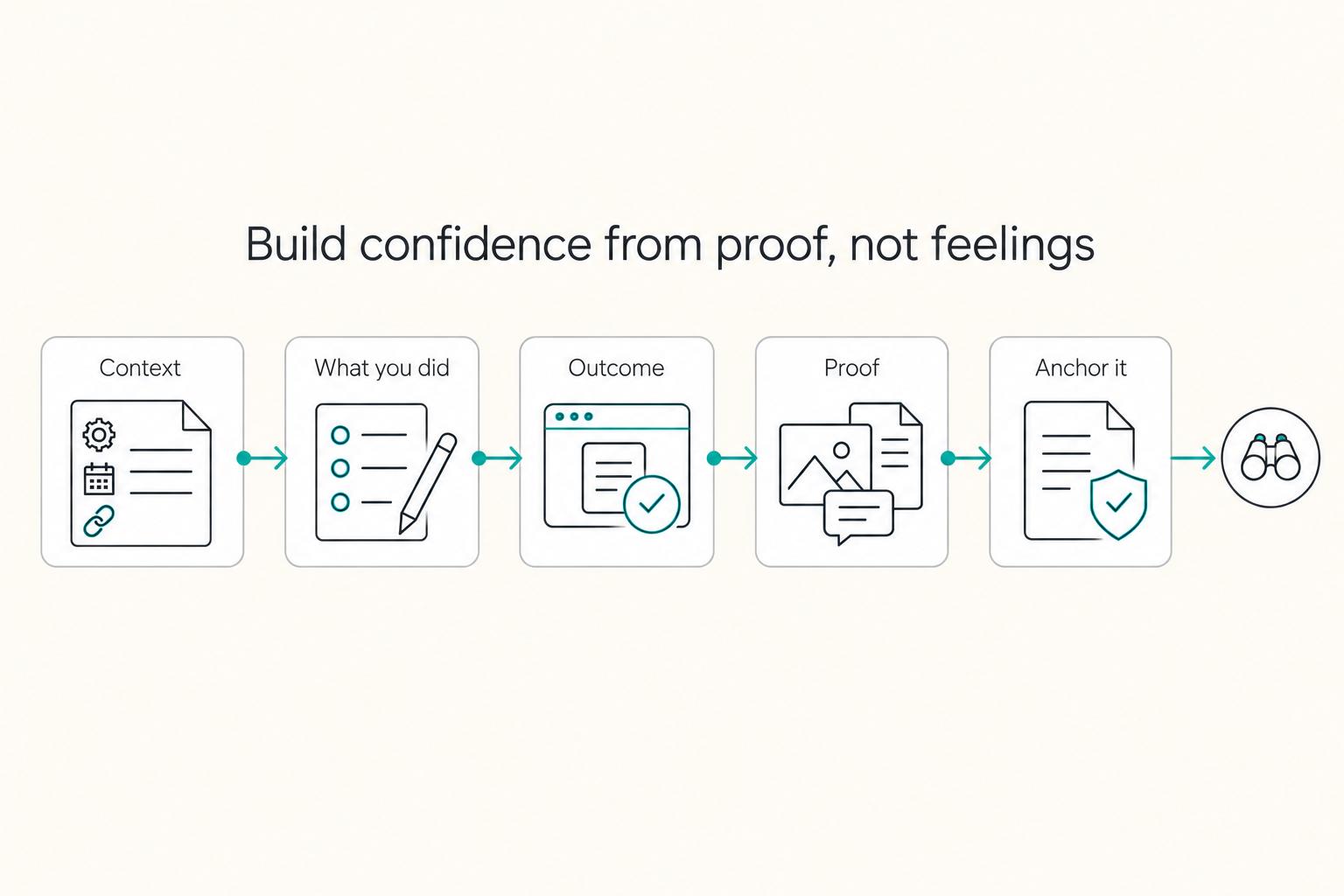
- Self-doubt moves from foggy self-talk to proof you can review
- Cash flow moves from guesswork to a scheduled forecast review
The goal is not to avoid hard weeks. It is to make hard weeks less destructive by defining what to check next. If a major client leaves, you still feel it, but your next move does not have to be panic: open the forecast, review the pipeline, pause nonessential spending, and act from records instead of fear.
Keep the close simple. Pick the one weak area you still avoid. Define the trigger that should start action, such as a proposal rejection, a pricing objection, a missing contract, or a late payment. Then set one review habit you will actually keep: 20 minutes every Friday to update the log, file the document, or compare forecast against reality. If you cannot point to the trigger and the review slot on your calendar, the habit is still too vague.
If self-doubt is the main drag, read How to Deal with Imposter Syndrome as a Freelancer. If compliance is the weak spot, start with the GDPR checklist guide next and turn that anxiety into a list you can complete.
You might also find this useful: A Guide to the Lifetime Learning Credit for Freelancers.
Frequently Asked Questions
How should you deal with rejection without getting stuck in it?
Treat rejection as input, not identity. Record every no or no-response, then review for patterns. Good looks like being able to point to likely fit, timing, or clarity issues instead of turning silence into a personal verdict.
What should you do when a client says your price is too high?
Do not cut the number first. Ask which part is not working: budget, scope, timing, or confidence in outcomes. Good looks like clarifying the real objection and adjusting deliberately, rather than lowering price because the objection made you uncomfortable.
How do you handle imposter syndrome in a way that is actually useful?
Use growth-mindset self-talk plus evidence of progress. Replace “I’m not good at this” with “I’m not good at this yet,” then note one skill you improved and one piece of feedback you can apply next. Good looks like treating setbacks as learning opportunities, not proof that you do not belong. If this is a recurring issue, read How to Deal with Imposter Syndrome as a Freelancer.
Does this mindset just mean working harder?
No. If you are only struggling harder and fixating on end results, burnout risk goes up. A better test is whether you set direction, keep habits, and avoid over-controlling the exact path. Good looks like consistency when results are slow, not heroic bursts followed by silence.
What do you do after a major setback, like losing a big client?
Give yourself a short window to absorb it, then switch to practical steps. Re-list your immediate priorities, restart consistent outreach, and define the next few actions you can complete this week. Good looks like moving from the emotional hit into clear next steps instead of staying stuck.
How can you tell whether this approach is helping?
Look for better recovery, not constant confidence. A more useful sign than feeling motivated all the time is taking a hit, recovering, and continuing work without spiraling for days. Good looks like faster resets, cleaner records, and stronger feedback loops in how you sell and deliver work.
Try a related tool
Researched and edited by the Gruv editorial team. Gruv builds cross-border billing, payouts, and finance-operations software for global businesses.
Sources
Includes 3 external sources outside the trusted-domain allowlist.
- acquisition.gov/far/37.602trusted
- acquisition.gov/far/43.102trusted
- pmc.ncbi.nlm.nih.gov/articles/PMC10670786trusted
- teachingcommons.stanford.edu/teaching-guides/foundations-course-design/le...trusted
- christenseninstitute.org/theory/jobs-to-be-doneexternal
- gruv.ai/blog/a-guide-to-growth-mindset-for-freelancersexternal
- pmi.org/-/media/pmi/documents/public/pdf/pmbok-stand...external
Educational content only. Not legal, tax, or financial advice.
Related Posts

GDPR Compliance Checklist for Freelancers Working With EU Clients
Start by separating the decisions you are actually making. For a workable **GDPR setup**, run three distinct tracks and record each one in writing before the first invoice goes out: VAT treatment, GDPR scope and role, and daily privacy operations.
How to Deal with Imposter Syndrome as a Freelancer
**Freelance impostor feelings can flare when your work lacks clear, documented boundaries-even when you *do* have talent.** You're the CEO of a business-of-one, and your job is to turn shaky moments into repeatable operations.

The Freelance Payment Penalty: A Modeled Audit of Platform Fees, FX Spreads, and Payout Delays
The money rarely disappears through a single, easy-to-spot fee. The real loss is stacked. A marketplace takes its commission, a processor adds a charge for international cards, a bank or payment company converts the currency at a spread, a platform holds the funds before release, and a wire sheds a little to intermediaries on the way in. Each layer looks defensible on its own, but the worker feels the combined result as a smaller deposit and a later payday.