
Quick Answer
Fast payouts help attract and retain creator partners when they are reliable, transparent, and backed by clear finance controls. The article argues that maximum speed matters less than predictable delivery, real-time status visibility, fewer failed payouts, and a rollout that matches segment needs, funding rules, eligibility gates, and reconciliation capacity as volume grows.
Why fast payouts win creator partners and where teams still get burned#
Fast payouts can help you win and keep creator partners, but speed is not the whole offer. Retention signals are strongest when faster access to funds comes with reliable delivery, clear status visibility, and finance controls that still work when volume grows.
Treat speed as a trust feature#
Treat payout speed as a trust feature, not a headline. Tipalti links quick, efficient payouts and smooth onboarding to higher retention, while Mastercard points to a recurring creator pain point: slow or late payments with little transaction visibility. In practice, a payout does not feel fast if creators cannot tell what is happening.
A better rule is to lead with predictability and visibility, then accelerate where your operations can support it. Billion Dollar Boy's March 31, 2026 launch with Lumanu followed that pattern by combining speed with integrated onboarding, tax compliance, payment distribution, and real-time transaction status visibility.
Your first checkpoint is simple: can you show a creator where a payment sits right now and what is blocking it? If that still takes manual checks across spreadsheets, inboxes, and bank files, your fast-payout promise is not ready.
Balance the promise with cost and controls#
Do not widen the promise until you have balanced partner growth against payout cost, controls, and reconciliation load. Founders often see speed as a growth lever, while finance teams focus on tracking, compliance, and close discipline. Both are right.
Lumanu describes that tension plainly: marketing moves fast, but finance and procurement still need every dollar tracked and every vendor compliant. "Early Pay" can improve the creator experience by offering payment outside standard invoice cycles, but eligibility, funding, and ledger impact still need clear rules.
The common failure mode is over-promising. Teams announce faster payouts, then run into payment failures, document gaps, or method constraints, and support takes the hit. A delayed payout with no status update can feel like non-payment. Before launch, build a thin evidence pack:
- Current time-to-paid by creator segment and payout method
- Failure and return rates, with top exception reasons
- Reconciliation effort, measured by manual touches per payout batch or close cycle
- Onboarding, tax, and compliance document completeness
If you cannot produce those numbers, you are still guessing about both retention upside and finance impact.
Read launch messaging like an operator#
Read vendor and launch messaging like an operator, not a buyer of headlines. Tipalti and the Billion Dollar Boy/Lumanu launch stories emphasize speed, onboarding, and operational streamlining, and Lumanu/Visa messaging cites severe creator pain, including reported waits of 60 to 180 days. Those are useful signals, not a decision rule.
Public messaging can leave out the part that matters most in execution: who gets faster payouts first, which methods are dependable enough to support the promise, what control guardrails apply, and how held payouts are handled. That is where teams get burned.
Use market claims as directional input, not proof. Visa research saying 30% of creators would benefit from faster access to funds supports testing. It does not mean every partner values maximum speed over reliability and transparency. The stronger offer is narrower: fast where dependable, explicit where not, and disciplined enough for finance to scale.
For a step-by-step walkthrough, see Payments Infrastructure for Creator Platforms: A Complete Build vs. Buy Guide.
What to prepare before you redesign payouts#
Before you redesign payouts, lock four basics in shared data: who you pay, how payouts perform today, which finance number is authoritative, and what the rollout actually covers. That is the minimum needed to keep a speed promise from turning into a support burden.
Segment the payee base first#
Start with segmentation, because payout policy should follow partner economics and operating reality. Creators and partners across affiliate networks, influencer programs, and online marketplaces should not sit in one payout population.
Use segmentation to set practical policy differences, not rigid permanent buckets. You are deciding where timing, method choice, and compliance friction should vary. Verification point: every active payee maps to one segment in your data. Red flag: one default cadence and one exception policy still apply to everyone.
Build a baseline pack#
Build a baseline pack before you touch payout rules. At minimum, capture current payout latency, payout failure rate, and top support-ticket reasons by segment.
If you use Stripe, expected arrival dates and dashboard failure reasons are a good starting baseline. Review bank-detail quality directly, because failed payouts are often tied to incorrect bank details. Verification point: you can show the top failure reasons and whether they cluster by segment, country, or payment method.
Assign system-of-record ownership#
Write down system-of-record ownership before launch. If finance owns the payout ledger in NetSuite or Sage Intacct, product telemetry should explain payout events, not replace the finance record.
Assign clear owners: one for the finance number, one for telemetry, and one reconciliation checkpoint between them. That helps prevent silent drift where product says paid while finance still shows pending.
Define rollout scope in one page#
Write a one-page rollout scope before anything goes live. Include countries in scope, payment methods in scope, and an operational definition of "fast."
Be explicit about geography and method coverage, then define "fast" by payout lifecycle stage and status visibility, not by marketing language. If your provider emits status updates through API responses or webhooks, use those exact states in the scope so product, finance, and support are all working from the same flow.
Related: Mass Payouts for Affiliate Networks: How to Pay Publishers Partners and Creators at Scale.
Pick the right payout model for each partner segment#
Choose the model by segment, not by headline appeal. The real decision usually comes down to three things: cash-flow need, who funds acceleration, and how much support load you can operate. For many teams, Mass Payouts can be the scale baseline. Early Pay can be a targeted retention experiment when unit economics can carry it. Instant Creator Payments can support a stronger speed promise only where coverage and failure handling are reliable.
Compare the models before you promise speed#
| Model | Who benefits most | Who funds acceleration | Where margin or ops pressure appears |
|---|---|---|---|
| Mass Payouts | Large recipient groups that can work on a standard cycle and want predictable batch processing | No special acceleration funding; standard payable flow | Support and reconciliation pressure when payout timing varies by country, industry, or account setup |
| Early Pay | Cash-flow-sensitive partners who value earlier access before normal due date | Buyer/platform in dynamic discounting, or a finance provider in payables finance | Discounts, fees, or subsidy cost; plus eligibility and policy complexity |
| Instant Creator Payments | Partners that strongly value faster access to available funds | Platform and/or recipient (for example, via an instant payout fee) | Coverage and method eligibility gaps, plus returned-payout handling and support volume |
Use segment test rules, not one policy for all#
Use segment test rules, not a universal payout rule. If your data shows retention risk and healthy contribution margin in a segment, Early Pay can be one controlled acceleration test option.
If margin is thin, you may keep the standard cycle and improve predictability first with clear payout dates, accurate status visibility, and fewer failed payouts. Treat each segment as a hypothesis to validate, not a blanket policy. Verification point: for each segment, define the funding owner, timing promise, fee or discount logic, and fallback when acceleration is unavailable.
Pressure-test rails and support constraints#
Pressure-test rail and support constraints before you choose a model. Payout availability is method- and market-dependent, and initial payouts can take 7-14 days after first successful payment receipt. If your messaging implies immediate access, that gap can break launch expectations quickly.
For Europe, handle SEPA scope and timing carefully. The SEPA region includes 41 countries (status: 22 May 2025) and is broader than EU or euro-area scope, and some EU legislative protections do not apply outside the EU or EEA. SEPA instant payments are designed for availability within 10 seconds, 24/365, but that does not mean every SEPA payout you send will settle that way. A Guide to SEPA Transfers for European Freelancers is a useful operating reference when Europe is in scope.
Also plan failure handling early. Incorrect destination information is a major cause of returned payouts, and some account or method choices can carry higher failure rates.
Treat competitor narratives as hypotheses#
Use competitor narratives as hypotheses, not proof. Mastercard and Tipalti both frame payout speed and experience as retention levers, but those are still market claims until your own cohort data confirms them.
Benchmark against those narratives only after checking your own segment outcomes: repeat participation, churn, support contacts per payout, and post-fee margin. Red flag: rolling out an "instant for everyone" promise before your data shows the segment value outweighs the cost and support burden.
If you're managing payouts for creators working across borders, The European Content Creator Blueprint for Cross-Border Client Work covers the operational details.
Match payout speed promises to creator cash-flow reality#
Your payout promise should be segment-specific and operational, not a blanket "fastest for everyone" claim. Once you choose a payout model, define what each partner group can actually expect in timing, visibility, and eligibility.
Use payout behavior to build working personas#
Use working personas based on payout behavior data, not follower count alone. Income volatility and campaign cadence can be useful grouping signals, because creators can share payout pain points while still having distinct needs.
| Persona | Cash-flow pattern | What they usually value most | Default offer direction |
|---|---|---|---|
| Volatile starters | Irregular earnings, one-off campaigns, long gaps between payouts | Faster access when cash is available, clear visibility | Optional acceleration where eligible |
| Campaign-burst operators | Earnings spike around launches or seasonal brand work | Predictable payout timing plus occasional faster access | Standard cycle with targeted acceleration |
| Always-on scaled partners | Frequent payouts, recurring programs, higher volume | Reliability, fee transparency, easy reconciliation | Stable scheduled payouts first |
Sanity-check each assignment with evidence you already have: payout frequency, campaign concentration, timing-related support tickets, and early-access requests.
Set a default rule for each persona#
Set a default payout rule for each persona, then test it. Mastercard reports that inconsistent and unpredictable income is a top barrier for nearly a third of creators, so high-variance cohorts can be a practical place to test optional acceleration.
Do not assume speed is the only value driver. Visa frames strong payout experiences as fast, smooth, transparent, and convenient. Some high-volume partners may care more about predictable dates, clear fees, and status visibility than paying for maximum speed every time.
Visa also reports that over 70% of surveyed digital entrepreneurs would consider switching platforms for better payout options, and more than 80% would pay a small fee for instant payouts. Use that as demand evidence for better options, not proof that one instant offer fits every segment.
Anchor the promise to reliability and visibility#
Anchor your promise to retention risk, not just headline speed. Mastercard links payout quality (speed, choice, and security) to whether creators stay, and it also highlights slow or late payments and low transaction visibility as recurring creator friction.
If instant or early access depends on method, country, or account state, keep that path optional and eligibility-based. Avoid broad language like "fast, global payouts" unless support can honor it without a long list of exceptions.
For each segment, keep a one-page policy spec covering eligibility, who pays acceleration fees, supported methods, expected timing range, and fallback cycle.
Write offer language that survives edge cases#
Write offer language that survives edge cases. Meta's March 18, 2026 Creator Fast Track announcement used explicit terms. It offered three months of guaranteed pay for eligible reels, with thresholds like $1,000/month at 100,000 followers and $3,000/month at 1,000,000+ followers.
Apply that same precision to your Digital Economy Partners:
- Volatile starters: "Eligible creators can choose faster access to available earnings on supported payout methods. Any fee is shown before confirmation."
- Campaign-burst operators: "Standard payout cycle for all campaigns, with accelerated payout available on eligible jobs."
- Always-on scaled partners: "Scheduled payouts on a fixed cycle with status tracking and transparent fees."
If your promise does not clearly answer who is eligible, how fast, and under which conditions, it is still marketing copy, not operator-ready policy.
For a more operational view of payout infrastructure at scale, see How to Scale a Gig Platform From 100 to 10000 Contractors: The Payments Infrastructure Checklist.
Price and fund faster payouts without breaking unit economics#
Pricing and funding determine whether faster payouts support retention goals or just add margin pressure. Before rollout, decide who pays for acceleration and how those flows will be recorded in finance.
Choose who funds acceleration#
Choose the funding model first, because the same speed feature behaves very differently depending on who carries the cost.
| Funding option | Who pays the acceleration cost | When it usually fits | Main tradeoff |
|---|---|---|---|
| Platform-funded acceleration | Your platform absorbs the fee | Segments where payout speed is part of acquisition or retention | Better creator experience, direct margin pressure |
| Creator-paid acceleration fee | Creator opts in and pays the fee | Segments that value optional speed | Better margin protection, possible fee sensitivity |
| Brand-funded terms | Brand or campaign budget covers earlier disbursement economics | Premium or managed programs where payout timing is part of the package | Preserves creator experience, adds sales and invoicing complexity |
| Blended Supply Chain Finance | A finance company pays early and buyer pays later at invoice maturity | Larger programs with predictable approved payables | Reduces pressure on your cash, adds third-party and accounting complexity |
If you use Supply Chain Finance, define it precisely. It involves a supplier receiving early payment from a finance company. In reverse factoring arrangements, a financial institution pays supplier amounts owed by an entity, then the entity repays the institution later or on the same day. This is not just a product setting. It changes the payment chain and the reconciliation path.
Model contribution margin by segment#
Model contribution margin by segment and payout model before launch. Do not average cohorts together.
For each segment, track:
- Baseline contribution margin under the standard payout cycle
- Direct acceleration cost, fixed or percentage-based
- Operational overhead, including support, exceptions, and finance review
- Failed-payment rework, including retries, corrections, and delayed close work
Use the standard payout path as a control where possible. Stripe states its standard payout schedule is free on a 2-business-day timeline, while Instant Payouts are paid acceleration that can move funds within 30 minutes to eligible debit cards or bank accounts. Stripe also states 1% fees in most countries and 1.5% in the US, Australia, and New Zealand, with the US increase effective June 1, 2024.
Set stop or go rules before the pilot#
Set stop or go rules before the pilot starts. If retention improves but margin drops beyond your accepted limit, narrow eligibility instead of scaling.
Keep the offer only where the economics work, and tighten by payout method, country, account history, or campaign type when needed. Track rework explicitly, not just visible fees. Campaign-cited data reports up to 87% of creators have been paid late or experienced payment issues, which indicates payment reliability issues are common and should be modeled in exceptions and retries.
Map posting and reconciliation early#
Document posting and reconciliation logic early in QuickBooks, Xero, or Microsoft Dynamics 365 Business Central. A fast pilot can still fail operationally if fees, timing, and bank matching are not mapped before scale.
In QuickBooks, confirm whether instant deposit economics change by setup. QuickBooks indicates instant deposits can be fee-free when QuickBooks Checking is the default debit card. In Xero, document whether processing costs are passed through and whether that is allowed in-region. Xero states surcharging can be configured where allowed and says online payment options can speed collection. In Business Central, validate the exact reconciliation path for accelerated payouts and related fees. Microsoft documentation states bank reconciliation aligns books to bank statements and supports automatic reconciliation in payment reconciliation workflows.
If those posting and reconciliation checks fail in test transactions, pause scale, fix the accounting path, and rerun the close simulation. Before you scale acceleration, run your own scenario math with this payment fee comparison tool.
Set eligibility and compliance gates before launch#
Accelerated payouts should only be available to accounts that are operationally ready and policy-approved. Set those gates before launch and make them visible to product, risk, finance, and support.
Write eligibility as policy#
Write eligibility as policy, not support discretion. Use signals like unresolved verification status, account health, and fraud or risk flags, without forcing one cutoff across all creator segments or countries.
Apply the policy consistently. If an account shows unresolved verification issues or similar risk markers, keep it on the standard cycle until cleared. When acceleration is enabled, log an auditable approval record so you can explain later why that account qualified. Verification point: sample three recent accounts per segment and confirm an operator can explain eligibility from the record alone.
Make payment-operations gates explicit#
Make payment-operations gates explicit before you enable faster payouts. Your policy should clearly state KYC status requirements, when beneficial ownership verification is required for legal-entity users, whether AML review applies in your setup, and what events trigger a payout hold.
This is a launch control, not housekeeping. Some payout infrastructures require verification before payments or payouts can proceed, and unresolved verification can remove payout capability. In covered financial institution and money services business contexts, beneficial-owner procedures must be written into AML programs, and those AML programs must be risk-based and commensurate with business profile.
Use a clear operator rule: no verified payout capability, no accelerated payout. If your provider allows payout pauses, document the operational effect. Stripe says pausing payouts blocks both automatic and manual payout creation, and in-flight payouts can stay pending for up to 10 days. Support needs a consistent response path for that scenario.
Verification point: test one account with missing verification and confirm the payout is blocked, the hold reason is visible internally, and user messaging does not promise unavailable speed.
Separate payout controls from tax reporting#
Separate payment-operations compliance from tax-reporting workflows so issues route to the right team. KYC, KYB, AML, and payout holds can determine whether funds can move. FATCA, FBAR, FinCEN, and Form 8938 are separate U.S.-linked reporting topics that may apply to some users.
Keep the distinctions explicit:
- FBAR is FinCEN Form 114 and is filed with FinCEN, not the IRS.
- Filing Form 8938 does not replace FBAR filing.
- FBAR uses a $10,000 aggregate foreign account threshold during the calendar year, is due April 15, and has an automatic extension to October 15.
- IRS examples for Form 8938 include thresholds such as $50,000 or $75,000 for certain specified individuals living in the U.S. Higher thresholds can apply for joint filers and some individuals living outside the U.S.
This is routing guidance, not tax advice. If the blocker is tax documentation, escalate to tax or legal instead of leaving support to improvise.
Publish an escalation path for blocked payouts#
Publish a simple internal escalation path for blocked or delayed payouts before the first live cohort. You do not need a complex approval matrix, but you do need clear ownership across risk, finance, and support.
A practical flow can be simple. Support identifies the block reason. Risk confirms whether verification, AML review, or another risk control is outstanding. Finance confirms payout status. The account returns to standard or accelerated timing only after the hold is cleared. That prevents split-brain handling where one team says "paid," another says "pending," and the creator gets no clear resolution.
For a broader look at automation and faster settlement, read The Future of Contractor Payments: AI Automation and Instant Settlement.
Design the money movement architecture for reliability at scale#
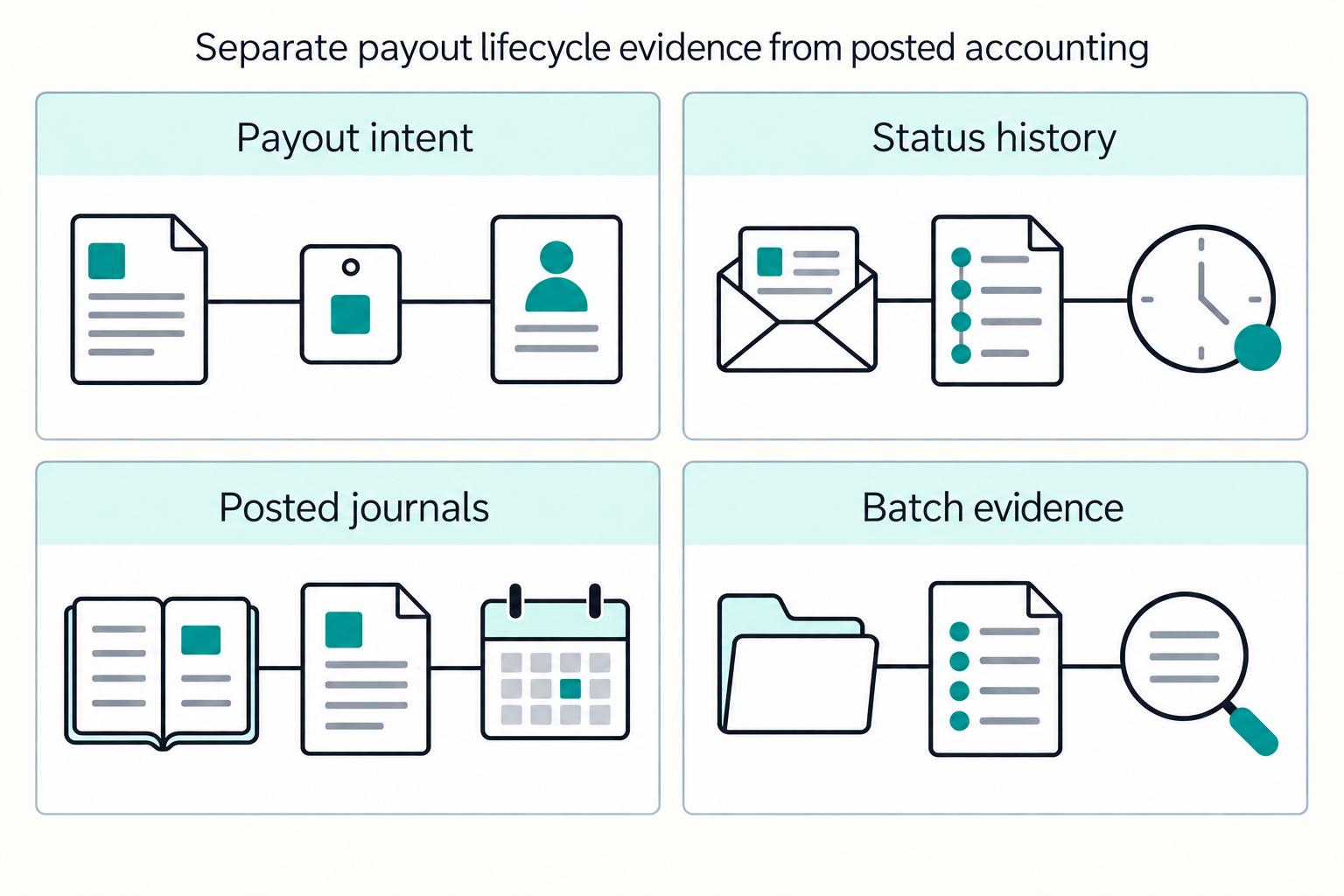
Faster payouts stay reliable only when the event chain is explicit. The core design choice is simple: keep one operational source for payout intent and status, while your ERP records the accounting result.
Map the full payout event chain#
Map the full flow before you optimize any single step. Define clear checkpoints across the flow, for example:
- Fund collection
- Operational ledger posting
- Balance or wallet update (if applicable)
- Payout initiation
- Payout status updates
- Reconciliation export
You do not need one rigid sequence for every product, but you do need clear ownership at each checkpoint. In practice, payout intent and status changes belong in the operational layer, while finance owns journal-entry posting and close-ready reporting. That boundary matters when support asks whether funds were paid and finance asks whether they were posted.
Verification point: trace one recent payout from originating transaction to payout batch to reconciliation export. If no one can clearly point to "requested," "sent," and "booked," the map is still too loose.
Design retries so they cannot duplicate payouts#
Assume retries will happen, and design so they cannot create duplicate payout effects. In Mass Payouts flows, that means idempotent write paths plus replay-safe webhook handling.
Use idempotent requests for payout creation and any call that mutates payout state. On inbound events, add persistent deduplication so replayed webhooks do not reapply state changes. This matters because undelivered webhook events can be retried automatically for up to three days, and manual processing does not stop those retries while events remain undelivered.
A practical control is to persist idempotency keys for outbound writes and processed-event records for inbound webhooks. Your state machine should accept valid transitions like pending, paid, failed, and canceled, but reject duplicate replays that would create a second payout object or double-apply status.
Verification point: replay the same webhook event twice in test and confirm one payout object, one ledger effect, and one user-facing status history.
Choose rails by settlement behavior and coverage#
Choose rails by settlement behavior and coverage, not by headline speed. SEPA Transfers can be a strong euro rail, but only when your partner footprint and bank coverage match.
For SEPA Instant Credit Transfer, the ECB defines funds availability as within ten seconds of payment order. Do not generalize that to all SEPA activity by default. Coverage language also needs precision: EPC states SEPA covers 41 countries and territories, while map-style materials can enumerate up to 50 when territories and dependencies are counted differently. If your promise is geography-based, anchor it to the exact scheme list you support.
If most of a segment sits inside your supported SEPA footprint, standardize there first and make exceptions explicit. If your footprint is mixed, split promises by rail and geography instead of forcing one SLA across all partners. For more context on the rail, see A Guide to SEPA Transfers for European Freelancers.
Set a clear source-of-truth boundary#
Set a hard source-of-truth boundary between the operational platform and your ERP. The operational platform should own payout lifecycle events. The ERP should own posted accounting entries.
That matches how reconciliation actually works: operational balances and GL balances serve different purposes, and SAP Business One GL records are journal entries posted to the company database, not live payout state. If finance treats ERP exports as real-time payout tracking, or product treats accounting exports as event history, exception handling will drift quickly.
Use payout reconciliation reports to connect settlement batches back to underlying transactions. If support, finance, and product each need different exports to answer one payout-status question, your boundaries are still unclear.
Roll out in phases with hard checkpoints#
Roll out accelerated payouts in phases, and expand only when each phase clears predefined checks. Treat the launch like a canary: limited scope, time-bound evaluation, then a go or no-go decision.
In the creator economy, payout speed alone may not protect retention if reliability and trust break down. That makes the rollout model as important as the payout feature itself.
Start with a narrow pilot cohort#
Start with a pilot cohort you can observe closely. A tightly scoped cohort, for example one segment, one region, or one payout method, keeps the failure surface easier to diagnose.
Before launch, set success criteria, issue-reporting paths, and shared status definitions. Use consistent operational states such as processing, posted, failed, returned, and canceled, and align teams on one critical nuance: posted does not guarantee recipient receipt.
Verification point: confirm support and operations can resolve the same sample payout case using the same status labels and fallback action.
Test failure handling before launch#
Test failure handling before pilot launch, not just happy paths. Include incorrect bank details, canceled payouts, returns, and other common failure scenarios.
Because incorrect bank details are a major source of failed payouts, validate that those failures are detected early and routed with usable reason context. In parallel, validate auditability: request and event logs should let you reconstruct payout requests and how status changed through reconciliation.
Verification point: confirm failed, returned, and successful outcomes each produce a traceable status history and reconciliation record.
Run the pilot on a fixed review cadence#
Run the pilot as a time-limited evaluation with explicit issue intake and a fixed review cadence. Set checkpoints before launch, then review by day or payout cycle.
| Checkpoint | What to verify | Why it matters |
|---|---|---|
| Payout success rate | Share of payouts that avoid failed, returned, or canceled outcomes | Core reliability signal |
| Average time-to-paid | Time from approved intent to paid or posted state | Confirms speed promise in practice |
| Support volume | "Where is my money?" contacts and related ticket load | Early trust signal |
| Reconciliation variance | Differences between payment totals and payout totals | Detects control drift |
| Churn trend (context) | Early partner drop-off or reduced repeat activity | Supplemental retention signal |
If access expands inside the pilot, do it in phases and verify each phase before moving forward.
Define rollback criteria before launch day#
Define rollback criteria and fallback execution before launch day. If those rules are not set in advance, incident response turns into debate.
Use documented tolerances for reliability, reconciliation variance, and support backlog, then map each breach to a specific action. Returned payouts may appear after an initially healthy state. Typical return timing can be 2-3 business days, so include a lag window before declaring the pilot healthy.
Verification point: run a rollback tabletop to prove cohort freeze, support-message updates, and fallback-cycle routing can execute without ad hoc decisions.
Keep a launch log and review it#
Keep a launch log throughout the pilot, then run a structured post-pilot review before any scale decision. That gives you an auditable decision trail instead of a memory-based one.
Log policy changes, cohort scope, incidents, status-definition changes, temporary overrides, and named approvers. Finance sign-off can be part of governance, especially for scope changes and reconciliation readouts. After the pilot, decide to expand, hold, narrow, or roll back based on the original success criteria. For the broader release, schedule a fuller post-implementation review in the one-to-three-month window to confirm early results still hold under ongoing operations.
Related reading: The Gig Economy in 2026: Payment Volume Trends Contractor Growth and Platform Consolidation.
Common mistakes when teams move too fast and how to recover#
Fast payout rollouts can fail on promise scope, finance controls, and evidence standards, even when product UI is strong.
1) Promising "instant" before coverage is clear#
"Instant" should be narrow and explicit because availability depends on rail and institution participation. FedNow is participation-based and its published participant list is updated irregularly, and SEPA Instant Credit Transfer can deliver funds in less than ten seconds where participants support it, but reach is still adherence-based.
Recovery: Rewrite partner-facing promise language to match actual region and method eligibility, and publish those limits in product and help flows. Verification point: Test real recipients across pilot geographies and confirm the promise shown in-product matches the route they can actually receive.
2) Shipping speed without daily reconciliation discipline#
If payout speed changes before finance operations are aligned, exceptions can pile up and deposit visibility can degrade. NetSuite and Sage Intacct both document daily exception and reconciliation handling, which is a control requirement, not optional cleanup.
Recovery: Stand up daily exception review and reconciliation workflows in NetSuite or Sage Intacct before expanding volume. Verification point: Finance and product can trace the same payout through approval, posting, settlement, reconciliation, and exception handling with consistent IDs and statuses.
3) Treating one market-size figure as settled fact#
Industry sources cite conflicting creator-economy valuations (for example, $100 billion and over $250 billion), so a single external number should not be treated as settled fact for payout rollout decisions.
Recovery: Use internal demand, unit economics, and pilot performance to set rollout assumptions, and treat external market-size figures as directional context. Verification point: Planning docs show range-based assumptions and sensitivity checks, not one fixed market-size input.
4) Treating competitor coverage as proof#
Competitor launch coverage is market signal, not KPI validation. Hello Partner positions itself as news, and Campaign/CampaignLive is business media; partnership-framed launch stories, including "more than 55%" context claims, are not independent proof of payout performance or retention impact.
Recovery: Require internal KPI validation before scaling: payout success, time-to-paid, exception aging, support load, and cohort retention or repeat behavior. Verification point: If your pilot metrics do not improve, hold or narrow rollout even if media narratives are positive.
Measure whether faster payouts are actually retaining partners#
Do not call faster payouts a win unless cohort retention improves and payout operations stay healthy. Keep or expand an option only when repeat participation, churn or reactivation, and margin move in the right direction together.
Split retention by payout model#
Measure retention by cohort, not as one blended trend. Compare repeat participation, churn, and reactivation for partners on your standard cycle versus each accelerated option.
Use retained, churned, resurrected, and dormant views where available. Keep cohort assignment clean so the same partner is not counted in multiple payout cohorts for the same period, and watch reactivation separately from long-term retention.
Pair growth metrics with payout health#
Retention lift by itself is not enough. Track payout status outcomes, failed or returned payouts, exception aging, and support contacts per payout.
Use lifecycle statuses from your payout providers so you are not judging from initiation alone. Check whether returned payouts resolve inside your expected window, with the understanding that some returns are typically visible in 2 to 3 business days while webhook retries can continue for up to 30 days.
Review retention and margin together#
Review on a regular decision cadence that matches your launch volume. For each payout option, decide to keep, expand, narrow, or retire based on cohort retention outcomes and margin impact together.
If repeat participation rises but support contacts per payout also rise, narrow eligibility, fix the operational issue, and reassess in the next review cycle.
Publish a one-page scorecard before expansion#
Before you widen rollout, use a one-page scorecard shared by product, finance, and ops. Include cohort size, repeat participation, churn, reactivation, payout status mix, return counts, exception aging, support contacts per payout, and a short margin note.
Tie the scorecard to one source of truth for cohort assignment and one for payout outcomes. If those disagree, pause expansion until they reconcile.
The execution checklist that keeps speed and control in balance#
Do not launch accelerated payouts until your segment, payout model, and control ownership are written and testable. Speed exposes unclear rules and weak finance controls faster than it creates growth.
Write the decision memo first#
Write a short decision memo before product or ops changes configuration. Define the first segment, Affiliate Network, Influencer Network, or Online Marketplace, lock the payout model, Mass Payouts, Early Pay, or Instant Creator Payments (where supported), and name who funds acceleration.
Define "faster" in operational terms, not marketing terms. If you use Early Pay, state whether it is invoice acceleration with a discount (dynamic discounting). Checkpoint: finance, product, and support should give the same answers on eligibility, payable timing, and cost owner.
Validate money movement and accounting mappings#
Validate money movement and accounting mappings before you enable faster payouts. For NetSuite, QuickBooks, or Xero, confirm payout status, fees, reversals, and exceptions map correctly and tie back to the original earning event.
Design for duplicate prevention and replay safety. Stripe supports idempotent requests and can resend undelivered webhook events for up to 3 days, so anti-duplication logic is required. PayPal can reject a reused sender_batch_id within 30 days, but you still need your own dedupe and reconciliation controls. Checkpoint: retry payout creation and replay a status event in test; the result should be one payout, one ledger impact, and a clear audit trail.
Enforce policy gates before showing the option#
Enforce policy gates and exception handling before showing any faster-payout option. Set account verification, payout eligibility, hold reasons, and named escalation owners across risk, finance, and support.
Keep tax and payments compliance as separate workflows. IRS guidance states Form 8938 does not replace FinCEN Form 114 (FBAR). For some U.S. taxpayers, FBAR can be triggered when aggregate foreign accounts exceed $10,000 at any time during the year. Form 8938 has a general $50,000 threshold in some cases and may be higher depending on filing context. Do not treat these figures as universal eligibility rules.
Pilot before you scale#
Pilot before you scale. Run one segment, one region, and one payout method so you can separate real retention movement from noise.
Review retention and margin together with one scorecard: payout success rate, time-to-paid, reversal or failure rate, support contacts per payout, reconciliation variance, and early churn signals. Checkpoint: if errors or unresolved exceptions increase, pause expansion even if adoption is strong.
Scale only when the promise holds#
Scale only when the promise holds under load: reliable delivery, transparent fees, and clean finance controls. If you cannot explain qualification decisions, payout lifecycle status, or accounting mapping, roll back to the standard cycle and fix controls first.
Use this copy/paste checklist:
- Define segments (Affiliate Network, Influencer Network, Online Marketplace)
- Choose model (Mass Payouts / Early Pay / Instant Creator Payments where supported)
- Validate economics and accounting-system mappings (NetSuite, QuickBooks, Xero)
- Enforce policy gates and exception handling
- Launch pilot, review scorecard, then scale or rollback
When you are ready to operationalize rollout controls, review Gruv Payouts for compliance-gated disbursements, batch status visibility where enabled, and audit-ready tracking.
Frequently Asked Questions
How do fast payouts actually improve creator partner retention?
Fast payouts can improve retention by reducing income unpredictability and making access to funds more dependable. But speed alone is not enough. Retention is stronger when faster payouts also come with reliable delivery, clear status visibility, and fewer failures or delays.
What is the practical difference between Early Pay and Instant Creator Payments?
Early Pay changes commercial terms by paying approved invoices earlier, often with discounting or another funding decision behind it. Instant Creator Payments give faster access to available balances, with timing depending on the rail and provider. They should be treated as different products in both operations and messaging.
Which payout model should a platform test first in an Online Marketplace?
There is no universal first test for every Online Marketplace. Start with the model that matches how earnings become payable in your ledger, because that drives operational complexity. If your flow centers on approved invoices and discounting, Early Pay can be a practical first test. If creators need faster access to cleared balances and your method supports it, instant payouts may fit better.
Who should fund payout acceleration: the platform, the creator, or the brand?
Any of the three can fund acceleration, but the cost owner should be defined before launch. Platform-funded acceleration can support acquisition or retention, creator-paid acceleration can protect margin when speed is optional, and brand-funded terms can fit premium or managed programs. The right choice depends on segment economics and how much complexity your team can operate.
What are the minimum compliance and risk controls before launching faster payouts?
Use identity collection, verification, and recordkeeping as the baseline before enabling faster payouts. Make payout eligibility, hold reasons, and escalation ownership explicit, and keep accounts with unresolved verification or risk issues on the standard cycle. Keep payout controls separate from tax-reporting workflows so blockers route to the right team.
How do we scale from a small pilot to Mass Payouts without breaking reconciliation?
Keep transaction-to-payout traceability intact as volume grows. Make payout creation idempotent, preserve clean links between each transaction and its payout batch, and ensure retries or replayed status events do not create duplicate disbursements. Treat any traceability gap as a reconciliation defect to fix before expanding.
Researched and edited by the Gruv editorial team. Gruv builds cross-border billing, payouts, and finance-operations software for global businesses.
Sources
- ecfr.gov/current/title-31/subtitle-B/chapter-X/part-1...trusted
- ecfr.gov/current/title-31/subtitle-B/chapter-X/part-1...trusted
- federalreserve.gov/paymentsystems/fednow_faq.htmtrusted
- ftc.gov/business-guidance/resources/disclosures-101-...trusted
- irs.gov/businesses/comparison-of-form-8938-and-fbar-...trusted
- irs.gov/businesses/small-businesses-self-employed/re...trusted
- nccih.nih.gov/grants/pilot-studies-common-uses-and-misusestrusted
- oecd.org/en/publications/the-role-of-online-marketpla...trusted
Educational content only. Not legal, tax, or financial advice.
Related Posts

The Freelance Payment Penalty: A Modeled Audit of Platform Fees, FX Spreads, and Payout Delays
The money rarely disappears through a single, easy-to-spot fee. The real loss is stacked. A marketplace takes its commission, a processor adds a charge for international cards, a bank or payment company converts the currency at a spread, a platform holds the funds before release, and a wire sheds a little to intermediaries on the way in. Each layer looks defensible on its own, but the worker feels the combined result as a smaller deposit and a later payday.

How to Respond to a Subpoena for Business Records
Move fast, but do not produce records on instinct. If you need to **respond to a subpoena for business records**, your immediate job is to control deadlines, preserve records, and make any later production defensible.
A US Expat's Guide to Investing in UCITS ETFs to Avoid PFIC Issues
The real problem is a two-system conflict. U.S. tax treatment can punish the wrong fund choice, while local product-access constraints can block the funds you want to buy in the first place. For **us expat ucits etfs**, the practical question is not "Which product is best?" It is "What can I access, report, and keep doing every year without guessing?" Use this four-part filter before any trade: