
Quick Answer
Automate intake and exception work before promising faster money movement. Confirm the exact rail, bank pair and provider limits; preserve approval, submission, settlement and recipient-credit timestamps. AI suggestions must pass source and policy checks. Resolve unknown execution before retrying, then reconcile each confirmed movement to the contractor obligation.
How AI Automation and Instant Settlement Change Contractor Payments#
Treat instant settlement as a market-by-market operating outcome, not a feature badge. This explainer is for founders and operators deciding where contractor payment automation can deliver immediate, final funds availability, and where it still means only faster initiation, approval, or messaging.
That distinction matters because mistakes create drag quickly. If you expand before you have payment compliance, payment visibility, and clear controls, you can increase failed or delayed payouts and investigation workload across finance, ops, and support.
Vendor language often compresses very different outcomes into one promise. Some rails define true finality with final and irrevocable settlement, and FedNow guidance requires participating institutions to make recipient funds available immediately on a 24x7x365 basis. That is not the same as a product that only speeds up internal processing. If you do not separate those clocks, you risk building product and GTM plans around a claim that does not hold once contractors expect cash to be available.
Cross-border conditions make this harder. The Financial Stability Board highlights persistent frictions in cross-border payments: high costs, low speed, limited access, and insufficient transparency. So the real question is not whether you can automate payments, but where your rails, compliance setup, and status visibility support a credible instant or near-instant promise.
This article keeps the terms precise: instant settlement, payment visibility, and payment compliance. It compares domestic and cross-border rollout options in practical terms and gives you launch checkpoints, including:
Keep forward-looking payment claims grounded in the Federal Reserve's FedNow overview and FedNow FAQ, and apply the FTC's advertising substantiation policy before you promise automation or settlement outcomes.
- whether rail-level finality terms are published
- whether you receive usable status events instead of generic in-progress states
- who owns exception handling when payouts stall or fail
For a U.S. money services business covered by 31 CFR 1022.210, an effective AML program is required. Determine the platform’s own regulated role and applicable exceptions separately from its provider’s role; the rule does not automatically classify every contractor-payment software business as an MSB.
The goal is practical. You should be able to choose first markets and an operating model that hold up under real payout conditions, so your launch promise matches what contractors actually experience. For a fuller breakdown, read Freelance Crypto Payments That Protect Cashflow and Reduce Disputes.
Start with precise definitions that teams often blur#
Use three distinct terms: payment initiation, recipient funds availability and rail settlement finality. Instant-payment systems can combine near-real-time availability and interbank settlement, but an API response or an available wallet balance alone does not establish final settlement.
Keep three clocks separate:
- Operations clock: request, invoice validation, required checks and approval.
- Execution clock: submission, rail acceptance and settlement finality.
- Recipient clock: when the payee can use the credited funds.
Ask which rail is used, when its settlement becomes final and what confirms recipient availability. FedNow and RTP are instant-payment services; ACH uses scheduled business-day settlement rather than continuous real-time settlement. A provider advancing funds before its own interbank settlement needs a different explanation from rail finality.
If your use case is cross-border and contractor trust is fragile, consider prioritizing transparent status alongside speed. Real-time tracking tied to a UETR or transaction ID gives teams and contractors a concrete in-flight view, while vague “processing” states can still drive support demand.
Be explicit about uncertainty. Vendor speed claims are often high-level and may not include rail-level SLAs for true finality. If a provider says “instant to same-day,” require corridor-level detail, rail mapping, funds-availability definitions, and exception-state evidence. Otherwise, treat the claim as faster initiation, not instant settlement.
Compare markets before you commit product and GTM resources#
Choose launch markets based on operational reliability, not headline speed claims. Start where rail access is clear, compliance ownership is clear, and exception handling is predictable. Those conditions are usually easier to verify for domestic payouts. For cross-border contractor payments, they are usually harder because multiple jurisdictions, providers, and supervision models are involved.
Compare programs on rollout risk, not market hype#
Use this table to plan validation by rail. Expected failure rates must come from your pilot population, not a country ranking inferred from the rail’s name.
| Rail/path | Current starting point | Validate before launch |
|---|---|---|
| U.S. FedNow | 24x7x365 domestic instant service via participating institutions; $10m network customer-credit-transfer limit since November 12, 2025 | Both bank accounts reachable, institution/product limits may be lower, funding and approval constraints |
| UK Faster Payments | Scheme supports individual payments up to £1m; providers may impose lower or daily limits | Account/method limits, recipient credit behavior and the provider’s exception process |
| SEPA Instant | Instant euro credit-transfer scheme; current 2025 rulebook v1.2 published September 30, 2026 uses a 10-second execution timeline | Actual scheme reachability, provider limits, institution/location-specific IPR deadlines and recipient evidence |
| Cross-border funding plus local payout | Multiple legs may include FX and a domestic instant last mile | Time and finality for every leg; local instant payout does not make funding or FX instant |
In practice, sequencing can be straightforward: a domestic rail with broad support is often easier to operate than a cross-border corridor with hidden review steps, uneven receiving coverage, or unclear compliance ownership.
Domestic vs cross-border operations#
Cross-border payments are more complex than domestic payments. In practice, that can mean more reconciliation work, more status ambiguity, and more manual intervention.
| Payment model | Operational complexity | Reconciliation load | Dependency on manual approvals |
|---|---|---|---|
| Domestic contractor payouts | Lower; rail behavior and compliance expectations are usually narrower and easier to document | Lower to medium; fewer entities and timing gaps can make reconciliation simpler | Lower in many setups, especially when onboarding and payout controls are completed before payout creation |
| Cross-border contractor payments | Higher; coordination across jurisdictions, institutions, and local payout methods | Higher; more timing breaks, status mismatches, fees, and corridor-specific exceptions can appear | Higher in many setups, because compliance reviews, beneficiary checks, and routing exceptions may need human intervention |
If you need one rule, use this one: launch where your exception path is boring. Fast happy-path payouts are not enough. Unsupported banks, compliance holds, or missing beneficiary data must also be easy to detect and resolve.
Verify these artifacts before you pick a market#
Before you commit a market, get the evidence that tells you how the flow actually behaves.
- Rail mapping by market and payout type. Get the specific rail used, not a broad “real-time” or “same-day” claim.
- Funds-availability definition and exception states. Confirm what completion means and which states exist between initiation and final credit.
- Compliance ownership by business model. In the U.S., transferring funds as a business can be MSB activity, so ownership between you and partners must be explicit.
Check actual account reachability and provider restrictions even when a market has an instant-payment mandate. A published policy target or future rollout date does not establish that your bank pair, amount, currency and beneficiary are supported today.
Recommendation: launch first where compliance requirements are clear and exception handling is mature, then expand into harder cross-border corridors after your status handling, reconciliation, and manual-approval flows prove reliable in production. This pairs well with our guide on The Pros and Cons of Accepting Cryptocurrency Payments.
Choose your operating model before choosing tools#
Choose the operating model first, because it determines who owns compliance checks, exceptions, and payment visibility when payouts stall. The core decision is who controls routing and who owns exception handling.
Three models and what changes operationally#
| Model | What it gives you | What you control | Payment visibility and risk |
|---|---|---|---|
| API-led orchestration | One layer across multiple providers, with routing by attributes like country, currency, or amount | High control over provider selection, retries, and how statuses are normalized | Visibility can be strong, but you own more exception handling when routes fail or constraints change |
| Provider-led managed flows | Provider-managed operations, with some programs absorbing parts of tax, fraud, disputes, and support | Less direct control and lower day-to-day operational ownership | Visibility is bounded by the provider’s events, reporting model, and program scope |
| Hybrid modular rollout | Start narrow, then add modules or control where pain appears | Medium control with a narrower initial scope | Visibility can fragment if modules expose different states, approval rules, or reconciliation outputs |
API-led orchestration can expose routing controls, but alternate-provider retry needs its own safety gate. Resolve a timed-out or unknown first attempt before submitting another; provider-scoped idempotency does not deduplicate a second provider’s payout. Managed flows can reduce build burden only for the operations included in the contract.
Map available modules to the actual payment task#
Start with the first operational gap: inbound attribution, disbursement control or seller-of-record requirements. For a Gruv evaluation, verify the currently enabled module, provider and market scope before planning the rollout.
- Virtual receiving details: evaluate when attributing inbound bank transfers is the bottleneck; confirm the enabled account entity, currency and details.
- Payouts: evaluate when approval, beneficiary validation and disbursement are the main task; inspect actual events and controls.
- Merchant of Record: evaluate only where a seller-of-record arrangement fits the commercial and tax role; it is separate from contractor payout routing.
What to verify before you sign anything#
Before you sign, ask for operator-level artifacts rather than high-level product claims.
- Status taxonomy and event payloads: confirm all states between initiation and completion, and whether they are exposed consistently.
- Verification and hold evidence: confirm what you receive when payouts are held, rejected, or sent to review.
- Route constraints by bank or corridor: confirm transfer-priority and amount-limit constraints, since “supported” does not mean every payout size or urgency is feasible.
For a narrow pilot, select the modules needed by that flow rather than assuming inbound attribution must always precede payouts. Keep funding, approval, provider execution and reconciliation linked, with change paths for provider or corridor constraints.
Put AI where it removes bottlenecks, not where it adds risk#
Once ownership of exceptions and release control is clear, put AI on payment-operations bottlenecks, not on final compliance judgments. The practical gain is less manual triage, cleaner inputs, faster correction paths, and clearer status visibility when payouts fail.
Where AI earns its place#
Candidate AI tasks include classifying exceptions, extracting remittance fields and proposing matches. Test them on your own records with known answers; acceptance rate and correction effort determine whether they reduce work.
That is different from deciding whether a payout should pass a compliance gate. Keep AI scoped to bounded tasks with observable outcomes, such as routing failed payout cases, capturing required fields during intake, flagging exceptions for review, and triggering correction steps after failed payments.
Good uses versus risky uses#
Use a simple rule: automate only steps with guardrails, visible outcomes, and a clear human handoff.
Good candidates:
- document intake with validation checks and configurable matching logic
- exception flagging that creates review tasks instead of auto-approving payouts
- reconciliation prep, including matching remittance details to payment records
- delayed or failed payout response orchestration, including prompt correction flows
Risky candidates:
- black-box approval or rejection of compliance-gated payouts
- release-logic changes operators cannot review
- autonomous handling where operators cannot explain why a case was routed, held, or cleared
Keep consequential decisions observable and reviewable. An extraction or classification can look confident while being wrong; compare it against the source record and deterministic payment controls before it affects a release.
Use oversight as a design test#
For higher-risk decisions, design for effective human supervision during use. Operators should be able to understand what happened and intervene when needed.
Before rollout, verify:
- the policy boundaries the model can act within
- the operator view of case classification outcomes
- rollback behavior for misroutes and false flags
- logs for handoff, review, override, and final resolution
- the action permissions and external payment APIs the model cannot call
- separate software rollback from recovery of already-submitted or settled payments
If automation bias appears, narrow the scope quickly. Let the model suggest, sort, and draft, but keep human confirmation for holds, releases, and compliance-sensitive exceptions.
Do not confuse vertical AI with payment infrastructure#
A scheduling or customer-intake assistant can improve support work, but does not establish bank reachability or settlement speed. Measure those gains as operations improvements and verify the money-movement path separately.
Be more cautious in cross-border payouts, where cost, speed, access, and transparency frictions still persist. Treat domestic service-workflow wins as evidence for intake and support efficiency, not proof that global payout operations will perform the same way.
Build compliance gates into the timeline from day one#
If you want faster contractor payouts, design for compliance before payout creation. KYC, KYB-style business verification, AML and sanctions controls, tax-profile collection, and jurisdiction-specific payout constraints can determine when a contractor is payout-ready.
Separate statutory duties from provider and internal policies. Verification, beneficial-owner information, screening or tax documentation may be needed for the applicable account and payout model; record the actual requirement and owner rather than treating every check as universally mandatory.
Where compliance changes the timeline#
Treat every payout as three stages: readiness gate, execution, and post-event confirmation. Delays often show up when those stages are blurred.
| Gate | What changes cycle time | Operator check before release |
|---|---|---|
| Identity and business verification | KYC checks and, for entities, beneficial-owner identification can be required before payout capability is enabled | Confirm required identity fields are collected and verification status is complete before creating the payout |
| AML and sanctions controls | Reviews can interrupt transaction flow, and blocked transfers can trigger reporting obligations | Confirm screening outcome, hold reason, and escalation owner are recorded |
| Tax profile readiness | Missing or invalid tax data can delay setup and create withholding obligations | Determine applicable documentation by payee and payment: W-9 for U.S. persons, appropriate W-8 form for foreign persons, including W-8BEN-E for covered entity documentation |
For covered reportable payments, missing or incorrect U.S. payee TIN information can trigger 24% backup withholding, subject to the applicable payment and payee exceptions. Route that determination to the tax owner; an absent form is not a universal reason to reject every contractor payment.
A baseline artifact set to maintain#
Use this as an operational baseline and adapt it by jurisdiction, provider, and program requirements:
- required data fields: legal name, address, date of birth or entity details as applicable, TIN or foreign-status form, payout method details, country, and settlement currency
- evidence records: submitted documents, verification outcomes, screening result, tax-form receipt date, and any hold or restriction reason
- approval logs: who reviewed an exception, who overrode it, when, and under which policy
- escalation ownership: named owners in compliance, finance ops, support, and engineering for verification failures, sanctions hits, tax issues, and payout rejects
The failure mode to avoid is simple: creating the payout first and discovering later that the contractor was never payout-ready.
Sequence the steps in the right order#
Record the approved payable and execution attempt before money movement, and use the provider’s supported idempotency mechanism within its retention window. If submission times out, query the existing attempt before retrying or rerouting. Reconcile confirmed provider movements once, while deduplicating event delivery separately.
That sequencing preserves a clean decision trail: readiness before money movement, retry-safe execution, and matched post-event confirmation instead of blind trust in event streams alone.
Confirm corridor eligibility before launch#
Do not describe faster payout behavior as universal. Payout availability varies by country, industry, and provider configuration, and settlement currency support is country- or region-specific.
Document the approved countries, currencies, banks, amounts, methods and beneficiary types, including onboarding requirements and restrictions. Use that scope in contractor-facing estimates rather than appending “where supported” to an otherwise broad speed promise.
Before rollout, pressure-test policy gates, idempotent retries, and exception ownership for your first corridor in the Gruv docs.
Design for failures you will definitely hit at scale#
Approved payouts can still fail in predictable ways, so the operational win is not avoiding exceptions. It is making each one visible, owned, and recoverable before it turns into repeat tickets and duplicate work. At scale, unresolved reconciliation gaps, stale quotes, payout rejects, duplicate retries, delayed webhooks, and stuck manual approvals can all look like “processing” unless you define them explicitly.
The failure table you actually need#
| Failure mode | Primary owner | Detection signal from real-time tracking | Customer-facing message | Recovery target |
|---|---|---|---|---|
| Unmatched deposits | Finance ops / reconciliation | Inbound funds posted but no automatic match to invoice or customer balance reference | “We received funds and are matching them to the correct payment record.” | Manually reconcile the transfer and attach it to the correct payout record before release |
| Stale quotes | Treasury / payments ops | FX quote validity window reached before execution, or quote no longer valid at submission time | “Your payout is pending a refreshed exchange rate before release.” | Refresh the quote, reprice if needed, and reapprove before sending |
| Payout reject or return | Payments Ops with Finance/support | Provider reason code and financial movement evidence distinguish reject, return and pending investigation | Explain the documented reason and correction needed; do not assume every failure is wrong bank details | Confirm whether funds moved or returned and whether fees changed; correct the specific cause and authorize one new attempt only when safe |
| Duplicate retries | Engineering / payments platform | Repeated client or server retry against the same payout action after a network failure without an idempotency key or duplicate-object check | “We’re confirming your payout was created only once before any retry.” | Resolve the first attempt’s execution state; prevent another payment for the same obligation and reconcile any duplicate movement |
| Delayed webhooks | Engineering / platform reliability | Expected event absent, delivery failure, or provider-specific retry/backfill status | “Your payout is still being tracked. Final confirmation is delayed, but we are checking directly.” | Backfill missed events, rebuild the status timeline, and reconcile against source-of-truth records |
Unresolved manual approvals | Finance ops / compliance approver | Approval request open beyond policy window, no decision owner, or queue growth without status progression | “Your payout is awaiting review. We’ll notify you as soon as approval is complete or more information is needed.” | Assign an approver, decide approve or reject, or request missing evidence with a dated status update |
Make status states concrete, not comforting#
Generic status labels create confusion. A contractor waiting on bank-detail correction needs a different next step than one waiting on approval, event confirmation, or a refreshed quote.
Use states that map to real decisions and evidence: received, under review, awaiting bank correction, sent, confirmation delayed, completed, rejected. This gives support and contractors a shared reference point and helps answer the common “where is my payment?” question with specifics instead of reassurance.
Show a payout as created when the provider creates its resource, submitted or sent only when the applicable execution milestone is confirmed, and completed only when the defined recipient outcome is evidenced. Creating a payout object does not by itself prove dispatch or final settlement.
Operator details that prevent repeat incidents#
Validate destination data before release. After a timeout, query the existing attempt and resolve unknown execution before retrying. Persist the internal obligation and attempt identity; a new API key or an alternate provider cannot guarantee that the first payment did not execute.
Authenticate and durably record webhook events, acknowledge promptly, then process heavier work asynchronously. Expect duplicates and out-of-order updates; query current state when needed and backfill missing movements. Delivery retry schedules are provider-specific: Stripe documents retries for up to three days in live mode, which is not a universal payout-provider guarantee.
Apply the same rigor to manual approval queues. If an item needs approval, track approver, request time, requested evidence, and escalation owner. Without those fields, work is waiting, not managed.
The deeper failure mode is fragmented records. Automation helps only when status history, approval trail, payout object, and reconciliation record are visible together.
A practical rule for rollout#
If real-time tracking shows execution is healthy but tickets keep rising, fix your state model before expanding corridors or making faster-payout promises.
Sequence the first 90 days of rollout#
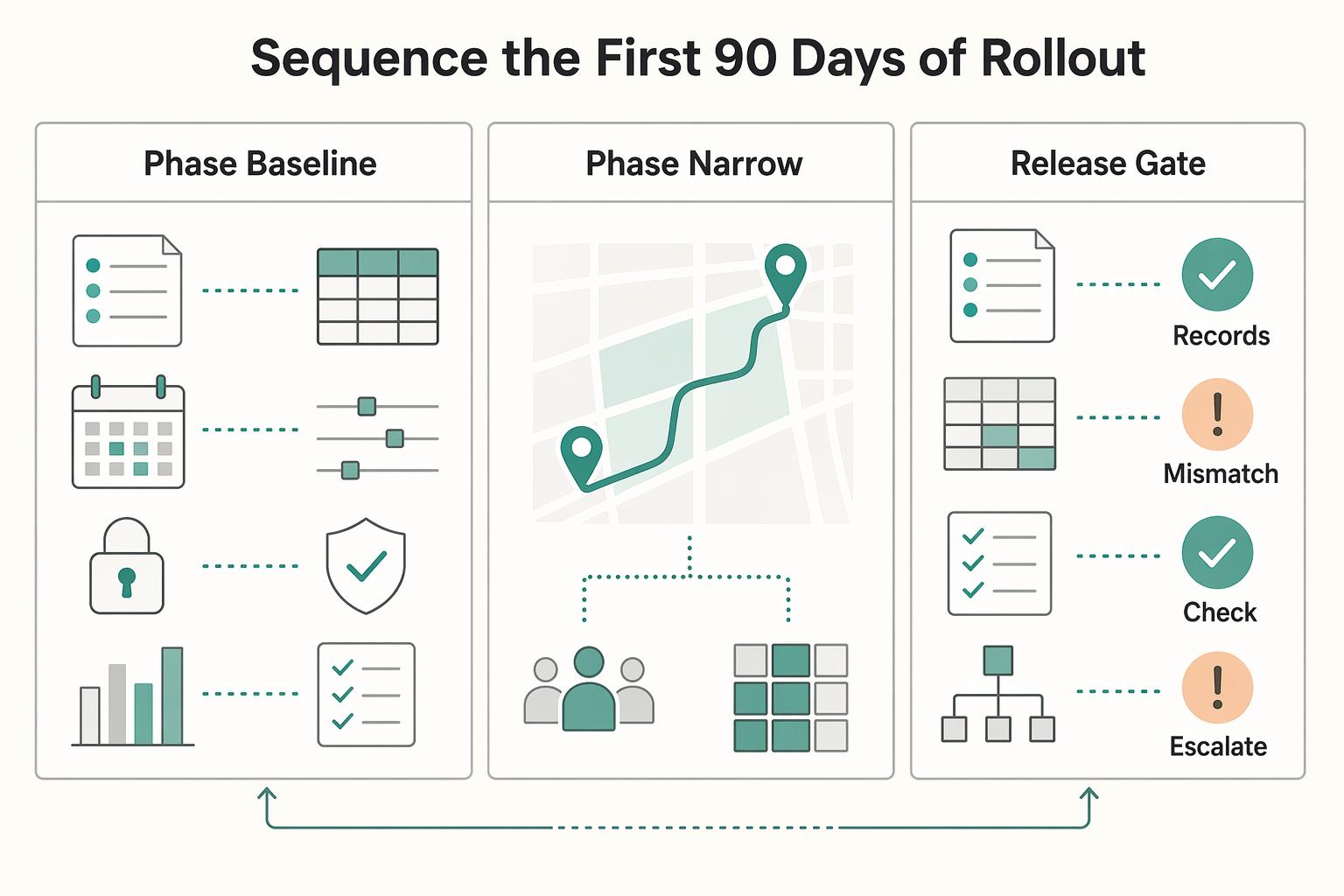
Treat the first 90 days as a gated rollout plan, not a broad launch: baseline first, pilot one corridor and one cohort second, then expand only if your controls hold.
Assign a cross-functional owner for readiness, approval, execution and reconciliation before go-live. Instant-payment finality makes prevention especially valuable; a later request for return is not an automatic undo of the original transfer.
| Phase | What you are proving | What to measure | Minimum evidence before moving on |
|---|---|---|---|
| Phase 1 baseline | You understand current operations before automation changes them | invoice processing time, approval latency, exception categories, support contacts, reconciliation lag | Baseline report, owner list, exception taxonomy, current-state status map |
| Phase 2 narrow pilot | Automation works in one controlled payout path | Status-event coverage, payout completion consistency, reconciliation checkpoints, manual intervention rate | Event logs, query or report outputs, reconciled pilot transactions, approval records |
| Phase 3 gated expansion | Reliability holds as volume and market complexity increase | Stable completion rates, no material support-volume spike, complete audit trail across payouts and exceptions | Release review, sample audit pack, support trend review, unresolved-issue register |
Phase 1 baseline the current state before you switch anything on#
Start with operating reality, not corridor count. If you cannot measure invoice processing time, approval wait time, and top exception categories, you cannot tell whether automation improved outcomes or just moved delays.
Keep the baseline operator-focused. For each payout, capture request time, approval start and end, payout creation time, status changes, completion confirmation, and exception tags. The goal is a before-and-after record that finance ops, support, compliance, and engineering all trust.
Use this phase to lock ownership. FedNow readiness guidance calls for a cross-functional internal team with defined roles before launch. If approval policy, reconciliation, support messaging, or payout execution has no clear owner, pause and fix that first.
Phase 2 automate one corridor and one cohort, then instrument everything#
Pilot narrowly as a scoping choice, not a universal rule. Choose one corridor and one contractor cohort where requirements are already understood and exception handling is manageable.
Instrument status progression end to end: request received, approval decision, payout created, sent, delayed confirmation when relevant, completed. If your provider supports report pulls and queries, use them from day one instead of relying only on dashboard summaries.
Add a reconciliation checkpoint tied to recipient-credit evidence and the applicable accounting cutoff. Track late or missing provider reports explicitly. Global policy targets can inform planning, but do not replace your provider’s evidence and service commitments.
Guard against false confidence from fast initiation. For any near-instant-settlement claim, require sample reviews where the payout object, confirmation evidence, and reconciliation record align.
Phase 3 expand only when the gates pass#
Expand only when completion, support and evidence targets hold for comparable cohorts. Track support contacts per payout as well as absolute contacts, so volume growth is not mistaken for deteriorating service. Define a sampling window and minimum exposure before interpreting a small pilot’s result.
Your release review evidence pack should include:
- status-event history for a representative transaction sample
- reconciliation outputs showing credited payments matched on time
- approval logs with timestamps and decision owner
- exception list with root-cause category and resolution outcome
If the pilot misses targets, stop adding surface area#
If early cohorts miss targets, pause expansion and diagnose before adding corridors. Start by checking policy gates and data quality, plus mismatched status definitions across systems.
Do not assume volume will resolve execution risk. The FSB’s 2025 progress report says global improvements are unlikely to meet the 2027 roadmap timetable. EU instant-payment deadlines also differ by institution type and location, so verify the specific provider’s obligations and reachability.
If stable, expand one variable at a time. If unstable, fix evidence trails, policy logic, or source data before adding countries.
Related: The Future of Contractor Payments: Embedded Finance Real-Time Rails and Programmable Money.
Measure outcomes with operator-grade checkpoints#
Measure each expansion release as an operations change: continue only when process, execution, and contractor-trust signals hold; hold or roll back when they weaken, even if vendor benchmarks look strong.
Track the three layers that show operating reality#
One completion metric is not enough. Use separate layers for internal friction, funds movement, and contractor confidence.
| Layer | What to track | What it tells you |
|---|---|---|
| Process health | manual approvals backlog, approval aging, exceptions waiting on missing data or documents | Whether automation reduced internal delay or shifted work into queues |
| Execution health | Status progression from request to approval to payout created to sent to completed, plus non-final or action-required states | Whether payments are reaching a final outcome reliably |
| Trust health | Contractor inquiry rate, top ticket reasons, repeat contacts on the same payout | Whether your status model and payout handling are credible to recipients |
For a hypothetical 1,000-attempt pilot, suppose 900 reached the defined recipient-completion event, 50 failed and 50 remain pending at the measurement cutoff. Cohort completion is 90%; completion among resolved attempts is 900/950, about 94.7%. Report both with the 50 pending cases and their ages. Dropping pending attempts from every chart can hide an accumulating delay problem.
Watch for faster initiation paired with a growing approvals backlog, and avoid treating sent as success. A payment status shows what is happening at that point in the lifecycle, and action-required states still need intervention until a final outcome.
For an always-on rail, monitor execution throughout the day and compare timestamps to the rail and provider’s actual service definitions. Separate approval-to-submission time, rail processing and recipient availability. A sample flow’s elapsed time is not a universal SLA for your contractor payout.
Make every release carry its own evidence pack#
Do not approve from dashboard summaries alone. Require a release pack that lets finance ops, support, and engineering reconstruct outcomes without screenshot hunting.
At minimum, include:
- event logs showing resource state changes
- reconciliation outputs matching documentation to actual funds movement
- exception-resolution times by category
- payout status distributions, not only aggregate completion rate
For each sampled payout, align the obligation, execution attempt, provider movements and recipient confirmation on IDs, amounts, currencies and timestamps. Keep event notifications as evidence alongside the provider’s current state and financial reports; no single event feed proves all movement.
A clean top-line completion rate with a growing tail of non-final statuses or slower exception resolution is a red flag.
Use continue, hold, and rollback rules from your own data#
Translate these measures into explicit SLO-based release decisions. An SLO is a defined reliability target for operating decisions.
Continue when the recent cohort meets the defined targets and records are complete. Hold expansion when reliability deteriorates. Roll back software or routing configuration for new traffic when a release causes defects, but keep tracking in-flight attempts. Settled transfers and posted ledger entries need authorized recovery or compensating records, not deletion or replay.
Use vendor benchmarks to frame questions about scope and measurement, then compare them with your own cohort. General AP productivity results do not establish contractor payout settlement performance.
Tie each external speed claim to an internal definition#
Define the proving event for every speed claim. Recipient availability, bank settlement finality and a provider’s API response are separate milestones. Final instant payments may have a request-for-return process, but the request does not guarantee recovery or make the original transfer revocable.
Map claims to the right layer:
Faster processing: process health, for example lower approval latencyInstant settlement: execution health, meaning rail-specific final confirmation plus reconciliation evidenceBetter payment experience: trust health, tracked through inquiry rates and repeat contacts
This translation keeps rollout decisions grounded in operator evidence instead of headline claims. Related reading: Freelance Finance Automation With Zapier and Stripe Controls.
Validate vendor claims before they shape strategy#
Treat each vendor claim as a question about measured outcome, population and conditions. Evaluate productivity, approval controls and payment speed separately rather than judging all three with one yardstick.
| Claim category | Evidence to request | How to use it |
|---|---|---|
| Invoice/AP productivity | Task definition, baseline, sample population and correction effort | Measure operations time; do not infer settlement speed |
| Approval automation | Plan/product availability, authority limits and override audit trail | Verify it applies to the actual release workflow |
| Same-day or instant payments | Country, currency, method, bank reachability, cutoff and completion event | Use a corridor-specific recipient estimate |
| AI exception resolution | Reviewed labels, wrong-match rate and permitted actions | Trial bounded proposals before granting action permissions |
Decision rule: do not treat faster processing as final settlement. If a claim does not define what event counts as settled, classify it as process speed, not funds finality.
Use a claim-to-proof check for each major promise:
- what exactly was measured
- where it was measured
- which population or corridor mix was included
- which conditions or cutoff windows applied
- which evidence your team can inspect
Keep the answers in a shared assumptions register for product, finance ops, sales, and GTM. One row per claim is enough: vendor, exact wording, proof source, scope limits, open questions, and your approved internal interpretation.
Make the build versus partner call with explicit decision rules#
Use this rule first: build the control plane when your edge is orchestration, and partner for rail access when time-to-market is the constraint. In practice, this is an ownership-versus-speed decision, not a build-versus-buy ideology test.
A partner can reduce technical and administrative burden for an initial launch, but it does not transfer your compliance or operational accountability. Treat partner adoption as a connection strategy, not a risk-transfer strategy.
Build where your differentiation lives#
Build first if you expect to win on provider and corridor decisioning. That usually means routing logic, payout-state modeling, approval controls, reconciliation outputs, and operator visibility into what happened, what is pending, and what needs action.
Use this checkpoint: if the asset you are protecting is your payout method rules, approval model, reconciliation logic, and contractor-facing status states, build the control plane. If most upcoming work is bank connectivity, scheme access, and provider onboarding, you are probably building commodity rail access too early.
Partner when launch speed matters more than rail ownership#
Choose partner-first when you need one region live quickly or local rail access is the gating factor. FedNow went live on July 20, 2023, is designed for 24x7x365 processing, and allows institutions to participate through third parties. That can be a practical model for fast domestic rollout.
For cross-border paths, account for funding, FX and the final local payout separately. G20 targets are policy goals, not a provider SLA; the actual estimate needs evidence for the chosen corridor and its first and last mile.
Score the choice before you commit#
Score each path from 1 to 5, where 5 is better for your business now, using evidence rather than deck language.
- Integration effort: Can you launch the first market without months of rail-specific build?
- Compliance ownership: Which obligations remain yours even when a partner executes part of the flow?
- Exception burden: How much reject, delay, and status-gap handling will require manual intervention?
- Market coverage: Does support exist for the exact country, currency, and payout path you need?
- Migration risk: If you add or replace partners later, how much ledger, status, and policy logic must change?
Always verify corridor support at country-and-currency level, not just headline footprint. Coverage varies by market and settlement currency, and local payout routes are often faster than cross-border paths.
| Founder situation | Best call now | Keep in house from day one | Why |
|---|---|---|---|
| One domestic region, speed matters most | Partner for rail access | Payment visibility, approval policy, reconciliation, contractor status messaging | Faster launch and lower connection burden while keeping rail portability in scope |
| One cross-border corridor, demand still uncertain | Hybrid | Corridor rules, compliance checks, real-time tracking, exception-handling logic | Cross-border variability makes portability and control logic more valuable |
| Multi-region expansion likely | Build control plane first, then add partners market by market | Routing logic, payout state model, audit trail, provider abstraction | Coverage is uneven and changes over time, so lock-in risk can rise across regions |
If you are launching one region now, partner-first can be the lower-execution-risk path when speed is the priority. If multi-region expansion is already part of your plan, build the layer that lets you change partners without rewriting core operating logic.
Compare the first corridor’s implementation cost, operational burden and recovery requirements before adding partners.
Conclusion#
Near-instant contractor payouts are a market-by-market operational outcome, not a universal product feature. Treat automation and instant-settlement claims as corridor-specific assertions you need to validate, not language you can reuse across every launch.
Verify the specific institution and rail rather than only the country. ECB guidance distinguishes euro-area and non-euro-area deadlines and later dates for payment and e-money institutions. In the U.S., platforms access instant rails through eligible participating institutions and service providers; platform software does not acquire direct central-bank access merely by integrating an API.
Cross-border rollout can include multiple domestic rails, currencies and provider responsibilities. Keep country-specific AML and sanctions obligations with their owners, and preserve evidence for every funding, conversion and payout leg. One country’s enabled instant rail is not a worldwide settlement commitment.
Scale with measurable checkpoints. Confirm you can track payout status from initiation to funds availability, assign ownership for exceptions, and reconcile events without ambiguity. A corridor is not production-ready because the happy path is fast. It is ready when exception handling is visible, owned, and recoverable.
Define settlement terms precisely across product, operations, and support. Document when funds are final, how rejects or timeouts behave, and how delays tied to compliance review are communicated so external promises match what your rail and providers can actually support.
Before broader expansion, create three artifacts:
- build a first market comparison table with country, currency, rail access, compliance burden, and near-instant feasibility
- define written settlement terms covering finality, funds-availability wording, reject windows, and required evidence
- validate one corridor end to end with timestamped status events, reconciliation output, and exception reporting
When your comparison table is ready, use it to validate market coverage and operating constraints with Gruv.
Frequently Asked Questions
What does `instant settlement` actually mean in contractor payments?
It means the settlement on the selected rail becomes final promptly, with recipient funds availability defined separately. Instant-payment systems such as FedNow and RTP combine fast settlement with availability, but quick initiation or a provider’s “sent” status does not prove either. A request for return is a separate recovery process, not a guaranteed undo.
How does `contractor payment automation` reduce delays from `manual approvals` and disconnected systems?
Automation can reduce invoice and approval handoffs, validate required fields and route exceptions. Measure approval wait, submission delay and recipient availability separately. A faster approval does not change the bank rail’s settlement schedule.
What usually breaks first when scaling `cross-border contractor payments`?
Test missing or inconsistent beneficiary data, FX or funding gaps, holds, unknown execution and reconciliation breaks. Preserve first-mile and last-mile references so you can identify the delayed leg. Do not infer the most frequent failure without your own cohort data.
How should founders compare domestic and cross-border rollout constraints before market entry?
Compare the exact country, currency, bank pair, method, amount and provider restrictions. Confirm recipient availability and rail finality separately. Domestic instant capability does not establish end-to-end cross-border timing; retain the funding, FX and local-payout evidence for each corridor.
Which `service-level agreements (SLAs)` matter most when evaluating payout partners?
Prioritize SLAs that define finality, funds availability, timeout behavior, and exception handling, not uptime alone. A useful minimum set is the exact point funds become irrevocable, the timeout or reject window, and how rejects, returns, and investigations are communicated. If an SLA cannot state when a payment must settle or be rejected within a specified period, contractor-facing expectations will be hard to manage.
How do `AI agents` improve operations without creating compliance risk?
Use AI to propose classifications, matches and drafted responses within a defined permission boundary. Validate fields against source documents and leave release authority with the approved policy and authorized decision makers. Monitor incorrect matches and operator overrides; a model’s confidence does not establish compliance or payment readiness.
What proof should operators request when vendors claim faster or “real-time” payment performance?
Ask for corridor-level evidence that separates initiation speed from funds availability and settlement finality. The proof pack should include country and currency scope, rail used, timestamped status events, timeout or reject definitions, exception rates, and reconciliation outputs for the same corridor mix you plan to launch. Treat objective speed claims as claims that should already have a reasonable basis and prior substantiation, especially when large automation gains are also being advertised.
Where Gruv fits
Plan and approve payout batches
See how payee status, approval rules, route review, and exception handling sit in one payout workflow.
See reconciliation and mismatch review
Compare ledger entries, provider payment records, and statement rows to see what matches and what finance needs to review.
Researched and edited by the Gruv editorial team. Gruv builds cross-border billing, payouts, and finance-operations software for global businesses.
Sources
Includes 1 external source outside the trusted-domain allowlist.
- docs.stripe.com/webhookstrusted
- docs.stripe.com/api/idempotent_requeststrusted
- ecb.europa.eu/paym/retail/instant_payments/html/instant_pa...trusted
- ecfr.gov/current/title-31/subtitle-B/chapter-X/part-1...trusted
- federalreserve.gov/paymentsystems/fednow_about.htmtrusted
- ftc.gov/legal-library/browse/ftc-policy-statement-re...trusted
- irs.gov/businesses/small-businesses-self-employed/ba...trusted
- europeanpaymentscouncil.eu/what-we-do/epc-payment-schemes/sepa-instant-...external
Educational content only. Not legal, tax, or financial advice.
Related Posts

The Freelance Payment Penalty: A Modeled Audit of Platform Fees, FX Spreads, and Payout Delays
The money rarely disappears through a single, easy-to-spot fee. The real loss is stacked. A marketplace takes its commission, a processor adds a charge for international cards, a bank or payment company converts the currency at a spread, a platform holds the funds before release, and a wire sheds a little to intermediaries on the way in. Each layer looks defensible on its own, but the worker feels the combined result as a smaller deposit and a later payday.

How to Respond to a Subpoena for Business Records
Move fast, but do not produce records on instinct. If you need to **respond to a subpoena for business records**, your immediate job is to control deadlines, preserve records, and make any later production defensible.

A US Expat's Guide to Investing in UCITS ETFs to Avoid PFIC Issues
The real problem is a two-system conflict. U.S. tax treatment can punish the wrong fund choice, while local product-access constraints can block the funds you want to buy in the first place. For **us expat ucits etfs**, the practical question is not "Which product is best?" It is "What can I access, report, and keep doing every year without guessing?" Use this four-part filter before any trade: