
Quick Answer
In 2026, the short-term rental market favors operators who can prove compliance, run resilient systems, and serve a clear guest niche. Regulation is the biggest risk, so deals should be underwritten from verified local rules, not headlines. Success depends more on stable operations, channel diversification, and clean documentation than on broad demand alone.
The 'Compliance Moat': How to Mitigate Your #1 Risk - Regulation#
Regulation can be one of the fastest ways a short-term rental thesis breaks. In this market, the edge is not just revenue upside. It is whether you can prove the use is allowed, spot rule changes early, and show a clean paper trail when a regulator, insurer, lender, or buyer asks questions.
Underwrite the rule path before the revenue story#
Before you model occupancy, answer three questions for the exact address and jurisdiction.
| Check | Where to look | Checkpoint |
|---|---|---|
| Legal status check | City or county code portal; planning or zoning page; business licensing or tax office page mentioning lodging or rentals | Use is addressed in the current municipal code or official local guidance, and the office that owns the answer is identified |
| Enforcement climate check | City council agendas, meeting minutes, planning commission packets, city-published studies | Recurring attention to transient lodging, housing pressure, neighborhood complaints, or tourism controls |
| Policy-change risk check | Pending ordinances or bills and official legislative trackers | Live text, version changes, and timeline labels such as Introduced, Amended Assembly, Enrolled, and Chaptered |
- Legal status check
First, verify that the use is addressed in the current municipal code or official local guidance, and identify which office owns the answer. Start with the city or county code portal, then the planning or zoning page, and then any business licensing or tax office page that mentions lodging or rentals. Your checkpoint is the primary text, not a blog recap or a host forum screenshot.
- Enforcement climate check
A market can be technically legal and still politically unstable. Search official city council agendas, meeting minutes, planning commission packets, and any city-published studies for recurring attention on transient lodging, housing pressure, neighborhood complaints, or tourism controls. For example, New Orleans publicly lists a document titled "Transient Lodging Study - City of New Orleans". Even without assuming its conclusions, the existence of that study is a signal to review before buying.
- Policy-change risk check
Then look for pending ordinances or bills, where they sit in the process, and whether the text is drifting in a way that could change your operating model. Official legislative trackers matter most here. California's Legislative Information page is a useful model because it exposes "Text >>", "Votes >>", "History >>", and "Compare Versions" on one page. The habit is simple: read the live text, compare versions, and note timeline labels such as 02/21/08 - Introduced, 06/09/08 - Amended Assembly, 07/07/08 - Enrolled, and 07/22/08 - Chaptered. Do not underwrite from a headline alone.
A practical red flag is this: if you cannot reach the primary legal source and are forced onto summaries, treat that as unresolved risk, not "probably fine." One candidate legal source in this research path returned "Access Denied - WAF Rule Reached." Missing evidence is still a finding.
Build a setup that survives scrutiny#
Clean structure is not paperwork for its own sake. It can make the same property easier to insure, easier to defend, and easier to sell.
| Area | Hobbyist setup | Professional setup |
|---|---|---|
| Entity structure | Property operated informally in personal name, little separation between owner and business activity | Entity choice documented after legal and tax advice; local registration details captured in writing where applicable |
| Insurance posture | Assumes existing home coverage applies, no written confirmation tied to guest use | Coverage reviewed for short-term rental activity, insurer confirmation saved, renewal dates tracked |
| Tax handling | Income and lodging-related records mixed with personal accounts | Separate bookkeeping, jurisdiction-specific tax handling noted, remittance evidence filed |
| Audit readiness | Documents scattered across inboxes and platform dashboards | Single binder with current approvals, policy docs, tax records, and dated verification notes |
The tradeoff is cost and setup time. The payoff is fewer surprises when a claim happens or a buyer starts diligence.
Monitor lightly, then escalate fast#
You do not need a full-time research habit. You do need a simple routine. One workable cadence: during an active acquisition, review official agenda and bill pages weekly; for a stabilized property, run a brief monthly check by searching the city site, reviewing pending agenda items, and re-checking official text if the topic resurfaces.
Escalate when any of these happen: a new ordinance is introduced, a hearing gets scheduled, bill text changes in a way you do not fully understand, or an insurer or platform asks for updated compliance information. When that happens, pause new dates. Review the primary text, confirm the impact with the relevant office or counsel, and only then decide whether to resume bookings, tighten minimum stays, change channels, or pivot the property to a different rental strategy.
That response only works if your documentation is current, so one practical binder template can cover at least this:
| Document | Owner | Refresh cadence | Verification status |
|---|---|---|---|
| Current operating authorization or written jurisdiction note if no formal permit path is published | Owner or manager | At purchase and after any rule change | Current / pending / missing |
| Insurance declarations and any written confirmation for guest-use coverage | Owner | Each renewal | Current / pending / missing |
| Tax registration records and remittance evidence where applicable | Bookkeeper or owner | Each filing cycle used in your market | Current / pending / missing |
| Property control documents such as deed, lease, HOA approval, or manager authority | Owner | At purchase and on renewal or amendment | Current / pending / missing |
| Dated screenshots or PDFs of official code, bill history, and version comparisons | Owner or ops lead | Monthly while active in market | Current / pending / missing |
That binder can help with regulator inquiries, buyer diligence, and exit readiness. More importantly, it forces you to operate from verified text instead of optimistic assumptions.
If you want a deeper dive, read GDPR for Freelancers: A Step-by-Step Compliance Checklist for EU Clients.
Designing the Autonomous Operation: From Admin Burden to Semi-Passive Asset#
After your compliance setup, your next priority is to remove repeat admin without creating brittle operations. Automation is useful when it handles predictable tasks and leaves clear human ownership for exceptions. If a tool saves time in normal conditions but fails hard during outages, handoff gaps, or vendor no-shows, you have shifted the burden rather than reduced it.
Use a simple decision frame: compare control, time burden, failure risk, and margin impact.
| Operating model | Control | Time burden | Failure risk | Margin impact |
|---|---|---|---|---|
| Manual host-led | Highest day-to-day control | Highest owner involvement | Lower software dependency, higher owner bottleneck risk | Fewer software or manager fees, but your time cost is real |
| Automation-first | High control with fewer repetitive tasks | Medium after setup | Integration gaps, bad rules, and missed exceptions can compound | Software spend rises; owner time burden may fall |
| Fully managed | Lowest direct control | Lowest owner involvement | Manager concentration risk and slower visibility into issues | Management fees compress margin |
Pick tools by function, not by brand story#
Choose your setup by function: pricing, access and safety, guest communication, and channel management.
| Function | Core requirement | Exception or fallback |
|---|---|---|
| Pricing | Rules and override control; floors, ceilings, and blackout logic | Who can reverse a rule quickly |
| Access and safety | Keep convenience and recovery together | Backup entry path, battery process, and outage fallback |
| Guest communication | Automate routine messages for confirmation, check-in, and check-out | Human escalation path with named ownership for disputes, refunds, and safety events |
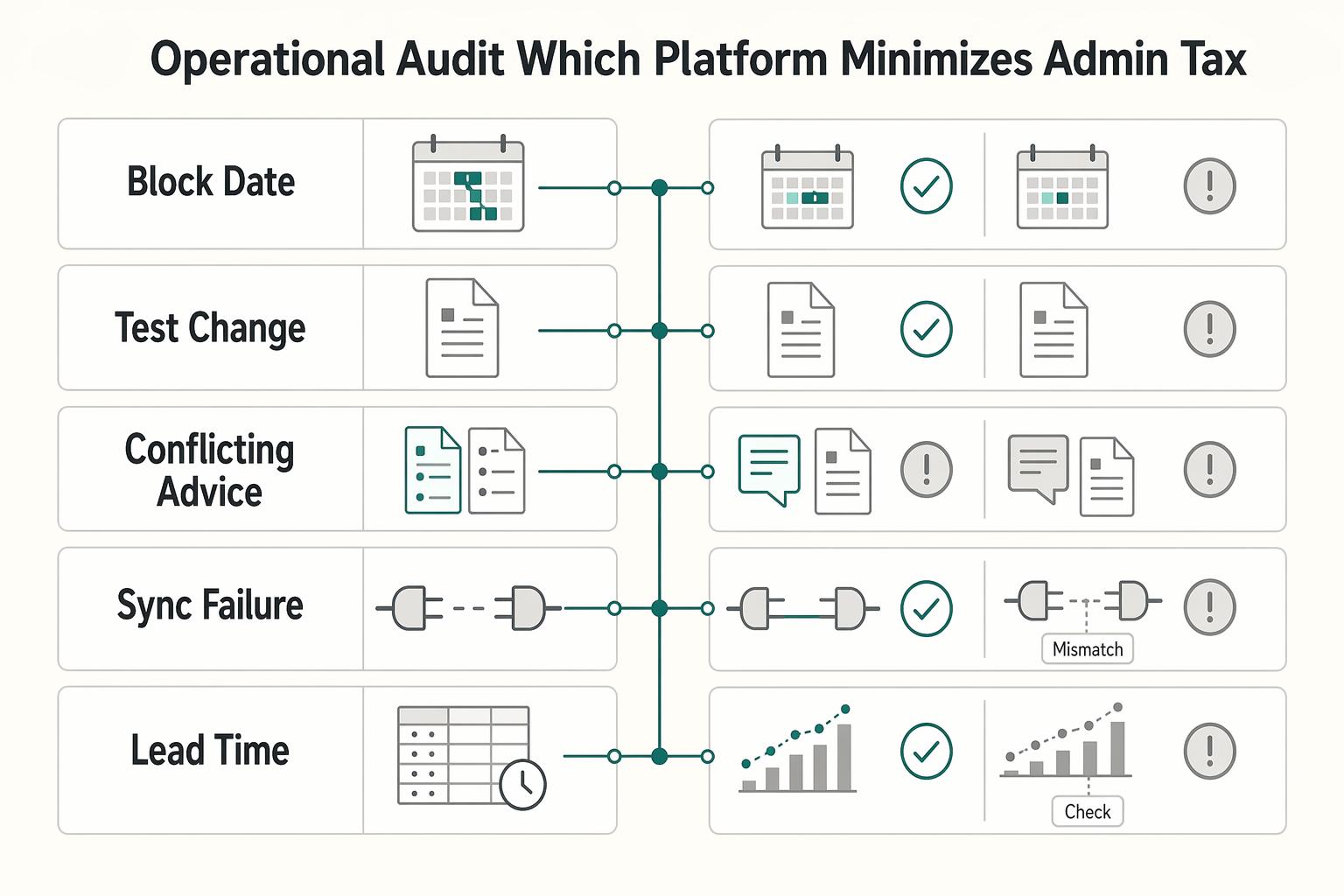
| Channel management | Verify what syncs: calendar, rates, and stay rules; check sync speed | Detect failures before they become double bookings or broken promises |
Pricing: Require rules and override control. Define floors, ceilings, blackout logic, and who can reverse a rule quickly.
Access and safety: Keep convenience and recovery together. If you use smart access, document a backup entry path, battery process, and outage fallback.
Guest communication: Automate routine messages (confirmation, check-in, check-out), but keep disputes, refunds, and safety events on a human escalation path with named ownership.
Channel management: Verify what syncs (calendar, rates, stay rules), how fast sync happens, and how you detect failures before they become double bookings or broken promises.
For stack design, decide explicitly where trade-offs are acceptable:
All-in-one PMS:simpler governance, fewer integration handoffs.Best-of-breed stack:deeper per-function control, but more integration testing and clearer failure ownership.
Make turnover resilient#
Turnover is where fragile systems break first. Build redundancy and clear handoffs so one person or one tool is not a single point of failure.
| Control | Details |
|---|---|
| Vendor coverage | Keep primary and backup vendors for cleaning and maintenance |
| Turnover SOP | Maintain one written turnover SOP with photo standards and a named owner |
| Escalation paths | Define paths for late cleans, damage, and lockouts |
| Check-in quality control | Require a quality-control handoff before check-in, such as timestamped proof and final check ownership |
| Weekly review | Open issues, sync failures, recurring guest complaints |
| Monthly review | Software spend, contractor spend, refund leakage, maintenance backlog age, turnover error rate, and owner time consumed |
Run a fixed review cadence:
Weekly:open issues, sync failures, recurring guest complaints.Monthly:review software spend, contractor spend, refund leakage, maintenance backlog age, turnover error rate, and owner time consumed.
Keep benchmark ranges pending until current market/source data has been verified.
Related: Vrbo vs. Airbnb: A Comparison for Property Owners.
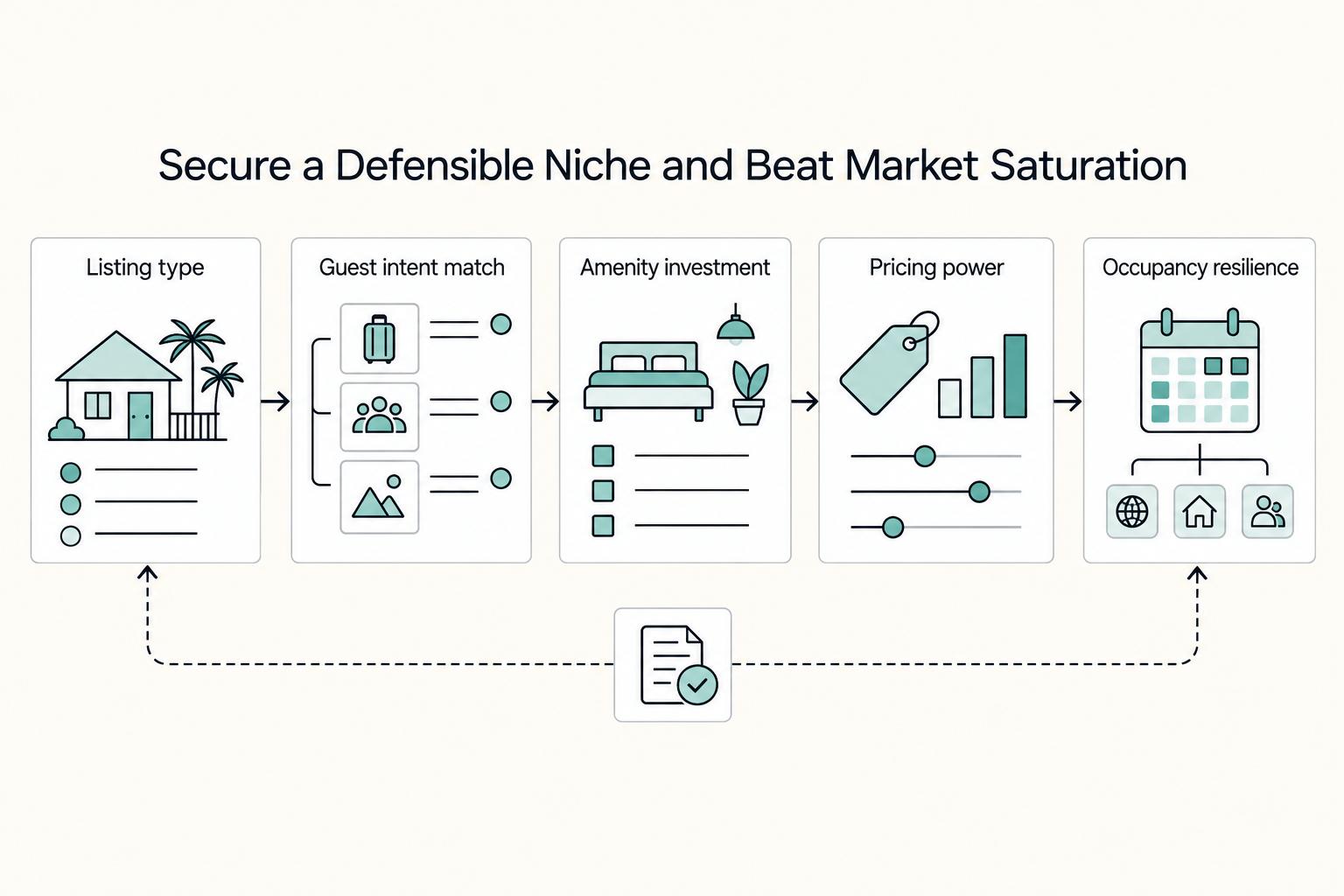
Beyond 'Good Photos': Secure a Defensible Niche and Beat Market Saturation#
In a saturated market, your edge is guest-fit, not broad appeal. You get better resilience when your listing is built for a specific trip purpose and your demand does not depend on a single platform.
| Listing type | Guest intent match | Amenity investment | Pricing power | Occupancy resilience | Operational complexity |
|---|---|---|---|---|---|
| Generic listing | Broad but vague | Often scattered | Usually weaker when comps look similar | More exposed to last-minute discounting | Lower at first, but guest mismatch can create friction |
| Niche listing | Clear use-case fit | More targeted | Better when the offer solves a real trip need | Stronger when demand comes from more than one channel | Higher upfront because standards must stay consistent |
Use a simple selection process before you invest further:
- Map property strengths. Start with what the home can reliably support: location, layout, parking, quiet hours, workspace, pet setup, accessibility, or longer-stay comfort.
- Validate demand signals. Confirm the same guest use case appears in more than one channel, such as OTA inquiries, repeat guests, SEO, email, or direct traffic.
- Test guest-fit. Check whether inquiries and bookings match your intended stay type without heavy discounting or constant exceptions.
- Reject fragile niches. If demand relies on one platform's visibility, you are exposed to ranking volatility and sudden visibility loss.
Underwrite for your ideal guest before buying extras. Class each expense as must-have (directly required for the trip purpose), nice-to-have (helps conversion but is not essential), or avoid (costly, hard to maintain, or off-promise). Use cost benchmarks only after current market/source data has been verified. Reject any niche that requires constant last-minute discounting, intensive manual hand-holding, or amenities your turnover team cannot reset consistently.
Keep message-market fit consistent across platforms:
- Title states the guest use case, not just bed count.
- Lead photo shows the main reason to book.
- Opening paragraph and amenity order reinforce the same promise.
- House rules do not conflict with the guest type you want.
If you use pricing software, favor explainable rules over opaque logic. A Jul 10, 2024 industry report on FBI antitrust focus around rental price-setting software is a practical reminder to keep pricing decisions understandable and defensible.
You might also find this useful: Do You Need Separate Short-Term Rental Insurance?.
Conclusion: The Future Isn't a Threat, It's an Opportunity#
The practical read on this market is simple: outcomes will be driven less by headline demand and more by whether your location, compliance posture, and operating model still work when conditions tighten. If you cannot validate those three, pause. If you can, commit with a structure that protects the downside first.
A useful decision order is this: pick the guest and market you want to serve, verify compliance durability in that specific city or county, then test whether your operating setup can deliver reliably. That second step matters most. Before you underwrite growth, attend town council meetings and keep your compliance documentation organized. A common failure mode is assuming current rules will hold while organized opposition pushes stricter enforcement.
| Path | Main tradeoff | Risk exposure | Execution burden |
|---|---|---|---|
| Compete on price | Easier to explain to guests, harder to protect margins | Higher exposure to fee pressure, seasonality, and broader competitive pressure | Medium |
| Compete on efficiency | Better response speed and lower admin if your tools are set up well | Medium exposure to tool coordination issues across multiple platforms and weak automation setup | High upfront, lower ongoing |
| Compete on niche | Better chance of differentiated demand and stronger fit | Medium exposure to narrower audience size or weak niche research | High |
Your next moves should be concrete:
- Compliance review: confirm current rules for [market], monitor town council direction, and pressure-test your plan against stricter enforcement scenarios.
- Stack decision: choose what you will automate now, such as messaging and dynamic pricing, and what still needs human review.
- Niche validation: test whether [property type] actually fits [guest segment] before you spend on amenities or branding.
AirDNA notes U.S. supply growth is slowing in 2025, which may help pricing power for existing hosts, but that is not a reason to skip diligence. The better bet is disciplined iteration: protect the downside, monitor local signals, and expand only after the property proves it can operate cleanly and legally.
For a step-by-step walkthrough, see The Best Software for Managing Short-Term Rentals.
Frequently Asked Questions
How do regulations affect short-term rental profitability?
Regulation affects profitability by adding both costs and revenue limits. Some costs are controllable, like self-management versus paying a manager 20% to 40% of gross revenue, while local registration requirements and operating limits are not. Verify market selection and current regulatory status before you underwrite a deal.
What are the biggest risks in the short-term rental industry?
The biggest risks are regulatory changes, dependence on one OTA, and operational breakdowns. Warning signs include proposed rule updates, new platform data-sharing requirements, ranking drops, missed cleans, maintenance backlog, and slow guest replies. First mitigations are active rule monitoring, an audit-ready digital binder, channel diversification, vendor redundancy, and tighter turnover checks.
Is the short-term rental market still a good investment?
It can still be a good investment, but only after you score market stability, operational complexity, platform dependence, and then upside. A legally shaky market, a property that needs 2 to 4 months before it can earn, or a thesis built on one platform ranking are all weak signals. Verify the rules, avoid underwriting to top host performance you cannot match, and treat it as a red flag if the realtor is also trying to be your property manager.
How is technology changing the short-term rental industry?
Technology helps when it removes repeat admin without removing human ownership of exceptions. Messaging workflows, calendar sync, smart access, and routine task handling can reduce repetitive work, but bad rules can scale bad outcomes fast. Compliance tooling is also useful for document tracking and reminders only if someone keeps the permit, tax, and policy data current.
What are the key short-term rental trends for the next 5 years?
The next five years look more disciplined than expansionary, with slower post-pandemic growth conditions, stronger hotel competition, and tighter economics. Operators are likely to benefit more from diversified channels, consistent standards, and defensible niches than from broad, generic listings. Test every amenity against reset time, maintenance burden, and fit for your niche before treating it as a growth lever.
Try a related tool
Researched and edited by the Gruv editorial team. Gruv builds cross-border billing, payouts, and finance-operations software for global businesses.
Sources
- congress.gov/bill/119th-congress/senate-bill/1071/text/eahtrusted
- data.consilium.europa.eu/doc/document/ST-5600-2026-ADD-3/en/pdftrusted
- dgs.ca.gov/-/media/Divisions/PD/PTCS/PAU/FISCAL-Financi...trusted
- documents.coastal.ca.gov/reports/2026/3/Th13b/Th13b-3-2026-corresp.pdftrusted
- documents1.worldbank.org/curated/en/761811468761126588/pdf/multi-page...trusted
- eur-lex.europa.eu/legal-content/EN/TXT/HTMLtrusted
- fairfaxcounty.gov/boardofsupervisors/sites/boardofsupervisors/...trusted
- huduser.gov/publications/pdf/scattered_site_housing.pdftrusted
Educational content only. Not legal, tax, or financial advice.
Related Posts

GDPR Compliance Checklist for Freelancers Working With EU Clients
Start by separating the decisions you are actually making. For a workable **GDPR setup**, run three distinct tracks and record each one in writing before the first invoice goes out: VAT treatment, GDPR scope and role, and daily privacy operations.
Vrbo vs. Airbnb: A Comparison for Property Owners
For a professional short-term rental operator, choosing between Airbnb and Vrbo is not about brand preference. It is a portfolio decision that affects revenue, operating load, and risk. If you treat your property like a real business, the comparison has to go well beyond surface fee checks.

The Freelance Payment Penalty: A Modeled Audit of Platform Fees, FX Spreads, and Payout Delays
The money rarely disappears through a single, easy-to-spot fee. The real loss is stacked. A marketplace takes its commission, a processor adds a charge for international cards, a bank or payment company converts the currency at a spread, a platform holds the funds before release, and a wire sheds a little to intermediaries on the way in. Each layer looks defensible on its own, but the worker feels the combined result as a smaller deposit and a later payday.