
Quick Answer
Measure the whole delivery cost before changing an agency's pricing: production, review, rework, tools and coordination. Compare hourly, fixed-fee, retainer and hybrid options against client value and scope risk. Use AI where the inputs and error consequences fit, with proportionate review and permissions. A three-line offer or a 90-day pilot is an option, not a universal requirement; existing obligations and lawful payment duties still apply.
How the agency model is changing#
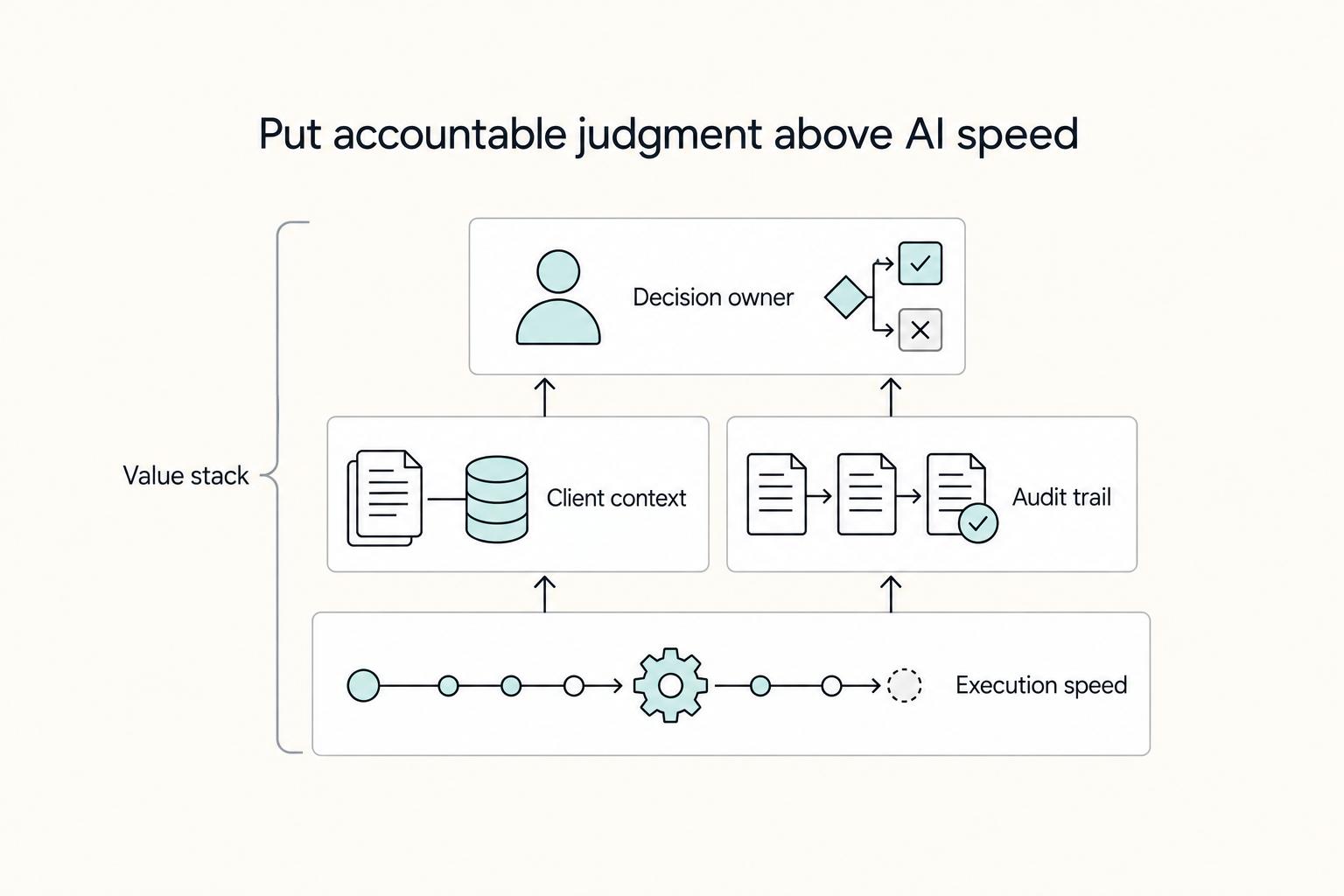
AI can increase agency speed, not agency responsibility. The future of agencies with AI is less about producing more output and more about deciding who owns judgment as execution gets faster. When automation is treated as a shortcut, weak briefs, unclear approval rights, and late client communication surface sooner.
Follow decisions in the order risk appears in real work:
- define what clients are paying for
- set pricing that protects strategic value
- tighten delivery and approval control
- place compliance and tax checks where contracts and money move
Business structure still affects tax and legal responsibilities when delivery tools change. AI does not select the correct structure for you or create a separate operating entity. Keep that ordinary business decision distinct from whether a drafting task should be automated.
For example, a UK sole trader generally needs Self Assessment where gross self-employment income exceeds £1,000, subject to the rules. For the 2025–26 tax year, someone newly required to file must generally notify HMRC by October 5, 2026; the online filing and payment deadline is January 31, 2027. These are jurisdiction-specific duties, not evidence that an AI agency model is commercially sound.
Assign responsibility for material decisions, but make review proportionate to consequence and existing client terms. An internal approver cannot waive law, change a client's contract or substitute for professional advice where required.
Define the new agency model before you buy more tools#
Define your agency value stack before buying more AI tools. Execution speed is often easier to buy; accountable judgment is not. Your model should make final decision ownership explicit.
AI can assist with drafts, variants and summarization. The important cost is the completed, usable deliverable: include fact checks, editing, client-specific adaptation and correction. A quick first draft is not a measured improvement in the full workflow.
| Layer | Main value | Who owns it | Fragility signal |
|---|---|---|---|
| Automatable production | Draft creation, repetitive research prep, variant generation | Production lead | Output volume rises while revisions rise too |
| Human decision layer | Offer positioning, channel tradeoffs, final recommendation | Senior strategist or founder | Draft quality improves, but business outcomes stay weak |
| Client-trust layer | Scope clarity, approval record, expectation setting | Account owner | Rework increases because rationale is unclear |
Map current revenue to production, strategic direction, orchestration and delivery responsibilities. Those are lenses for an offer review, not mandatory invoice categories. Identify where the client sees value and where you actually incur cost; a useful new tool can still be worth adopting before a broader offer redesign.
Use familiar personalization examples to explain the mechanics, then separate that from your advisory role. Personalization is not business judgment. Your role is to decide what stays consistent, what can be tailored, and when speed should be constrained because risk is high.
The likely pressure differs by service. A buyer may expect routine variants more cheaply while paying for a specialist's judgment, or may simply buy a fixed outcome regardless of production method. Treat those as hypotheses to test with your clients, not a forecast that every incumbent or agency segment will decline.
Decide what to automate and what to keep human#
Automate repetitive, low-risk execution, and keep a human approver for decisions that can change brand risk, legal exposure, or pricing. The common mistake is automating by tool capability instead of decision consequence.
| Work type | Condition | Control |
|---|---|---|
| First-pass production | Inputs are stable and the task repeats often | Automate first-pass production |
| Claims, pricing terms, or sensitive positioning | Output can alter claims, pricing terms, or sensitive positioning | Require a named human sign-off before publish |
| Strategy and executive recommendations | Strategy, offer positioning, and executive recommendations | Keep human-led |
Select automation using actual task performance and consequence. A preference survey, vendor forecast or broad occupational estimate cannot establish whether your client's specific workflow is safe, profitable or acceptable.
Use three provisional categories: bounded tasks suitable for automation, tasks that need review and tasks you retain as human decisions. Revisit the classification when inputs, tool behavior or consequences change. A category label is an operating choice, not proof of reliability.
Apply this test before automating any client-facing step:
- If inputs are stable and the task repeats often, automate first-pass production, for example draft setup or initial copy variants in mature campaign workflows.
- If output can alter claims, pricing terms, or sensitive positioning, require a named human sign-off before publish.
- Keep strategy, offer positioning, and executive recommendations human-led, even when execution is automated.
- Mark each task as green-light, red-light, or review-needed, then record the owner and approval point.
Track cycle time, correction work and quality together. Faster work with the same revision count may still contain less visible errors or lower client value. Use representative samples and relevant checks before drawing a conclusion; investigate material failures before adding the affected automation.
Keep one compact evidence file per major deliverable with task classification, approver, what was automated, and why the final version was accepted. That record helps when clients ask who made the call or when teams disagree on whether a step should stay automated.
Reprice your services before clients force the conversation#
Assess pricing before renewal or a new offer, rather than assuming every AI improvement requires immediate repricing. Hourly billing exposes time savings directly; fixed fees can preserve revenue but leave you bearing scope and rework risk. Any change to existing signed terms needs the applicable agreement.
Clients pay for a service they value, but that value is not independent of alternatives and budgets. Test whether a faster turnaround, more useful variants or stronger specialist judgment changes willingness to pay. Do not use a broad shopping forecast to justify a particular agency retainer.
Consider hourly pricing for uncertain work, fixed pricing for bounded deliverables, retainers for a defined recurring service, and hybrids for a base scope with explicit extras. Each shifts risk differently. Outcome-based pricing also needs a measurable result, reliable attribution and agreement on factors the agency cannot control.
| Pricing line | What is included | Possible pricing shape | Contract guardrail |
|---|---|---|---|
| Automated execution | Recurring, predictable production work | Flat monthly fee or volume tier | Define output limits, turnaround window, and revision cap |
| Strategic oversight | Positioning decisions, tradeoffs, and final recommendations | Retainer or hybrid base plus scoped projects | Name the final approver and define escalation triggers |
| Governance and reporting | Decision log, rationale summary, and performance narrative | Fixed monthly fee | Require a monthly evidence pack and sign-off record |
Use market signals to shape your terms, then make the terms explicit in the agreement: what is automated, what stays human-led, what is out of scope, and who owns final approval when pricing or brand risk is affected.
Run one monthly repricing checkpoint before renewal:
- margin by pricing line, not only by client total
- revision rounds versus cycle time
- discount requests versus added strategic asks
- approval and escalation time that was not in scope
If speed improves but rework and discount pressure rise, investigate the cause. A three-line offer is one option; a simpler package, clearer scope or unchanged pricing may work better. Do not unilaterally migrate an existing account or hide an unsupported governance charge.
Build clean operations before adding agentic complexity#
Clean operations should come first: standardize intake, assign one decision owner, then automate selected steps. Layering AI onto a messy process usually just makes the mess move faster.
An agent can perform sequences of actions using tools, which changes the consequence of a mistake. Define allowed actions, data and permissions, plus review and recovery points. Start with the workflow you actually need; rebuilding it from a blank page is optional and can discard useful controls.
- Standardize briefs.
Use a brief suited to the service. Identify essential missing inputs before the affected work; distinguish them from optional fields so a template does not unnecessarily stall delivery.
- Assign one owner per deliverable.
Make one person accountable for final approval and escalation.
- Automate after the first two are stable.
Start with repetitive, lower-risk steps, and keep high-value decisions and exceptions with humans.
Use one approval map and one escalation path so work does not stall in review loops. Keep one evidence artifact per job with the request, decision owner, final output, and revision reason.
Review a sample of completed work for repeated errors and handoff problems. Keep input and output versions where useful, and include correction time in the cost. A successful sample does not prove every future task is reliable.
Set up money movement and payout visibility for cross-border work#
For cross-border work, connect delivery and cash handling into one traceable chain: invoice, collect, convert if needed, and pay out with clear ownership at each step.
| Payment stage | Operational question |
|---|---|
| Client invoice | Which legal entity invoices, in which currency, and when is payment due? |
| Receipt | Has the provider or bank actually confirmed funds, and what fees or FX affected the net? |
| Contractor payable | What amount is contractually due, on what date, and under what lawful deductions? |
| Provider checks | Which regulated provider controls onboarding, restrictions and any required clearance? |
| Records | Which actual tax or reporting duties apply to this payer, payee and transaction? |
Assign responsibility for reconciliation and payment instructions where useful. Distinguish an internal payment decision from a regulated provider's clearance: an agency manager cannot override a bank's legal restriction, and an internal approval gap does not itself change a contractor's due date.
Use a proportionate cash view for reporting, with fields such as:
- pending invoices by client, amount, currency, and aging
- collection status and expected receipt date
- whether conversion is required, and who approved it
- payout status and unresolved exceptions
- tax registration and filing checkpoints where applicable
A Merchant of Record generally acts as the seller for a specified transaction and can carry associated tax and payment responsibilities. It is not a synonym for an agency, escrow or contractor payout processor. Use that model only if the actual arrangement supports it, and identify the seller and obligations in the agreement.
Keep jurisdiction-specific filing dates in the business calendar. They do not need to appear in every client payment snapshot or become a release condition for unrelated contractor fees.
Keep business structure in the same record because it affects tax treatment and legal responsibilities.
Apply actual compliance duties without inventing payout gates#
Determine which checks actually apply by role, jurisdiction and provider. A legal restriction, required withholding or agreed payment condition can affect a payment; a missing internal form does not automatically authorize holding the entire amount. Follow existing due dates and investigate gaps promptly.
| Gate item | What to record |
|---|---|
| Provider onboarding | Actual provider's identity or business checks, requests and restrictions; do not assume the agency is itself an AML-regulated business |
| VAT or sales tax | Applicable registration, supply treatment and invoice duties; a missing validation note is not a universal payment freeze |
| U.S. payee documents | Use the appropriate W-9 or W-8 form where applicable; determine actual payer reporting or withholding duties |
| Business tax reporting | Keep agency owners' personal filing obligations separate from contractor payment eligibility |
| Client data | Permitted inputs, access and retention, including tool provider terms and applicable privacy duties |
Keep the relevant records with the payee or business case. For a specific payment, check:
- Whether the provider is requesting a legally or contractually required check
- Which amount and due date the contract establishes
- Whether a specific withholding duty applies, rather than a blanket refusal to pay
- Who owns any unresolved factual question and what correction is available
- Whether personal or confidential data is being unnecessarily exposed to an AI tool
For U.S. reportable nonemployee payments, a missing or incorrect taxpayer identification number can trigger backup withholding under the applicable rules. The IRS describes a 24% withholding rate where required; that is a withholding and reporting process, not permission to retain the full fee indefinitely. Foreign payees and other payment types require their own analysis.
Separate payment administration from owners' personal tax planning. An agency owner's foreign earned income exclusion or foreign-account reporting question does not make a contractor eligible or ineligible for payment. Get the right facts to the responsible tax adviser rather than forcing every client job through unrelated personal-tax checks.
Likewise, AI-generated tax or compliance notes need verification before action. Do not let an automated label decide whether money is owed, a payee's classification or a legal withholding requirement.
Choose a stack you can control and audit#
Choose tools you can audit end to end. If you cannot reconstruct who approved an output, what produced it, and which inputs were used, keep that tool off client-critical work until you can. Fast demos can hide handoff risk when you need to explain decisions later.
Tool choice is about fit, not a universal winner. A small e-commerce brand and an enterprise B2B team can need different approval depth, automation scope, and reporting detail, so test real use cases, implementation hurdles, and day-to-day operations before longer commitments.
| Criteria | What to test | Evidence to retain | Lock-in warning |
|---|---|---|---|
| Output consistency | Run the same brief set over a fixed period and review variance | Inputs, outputs, reviewer notes, and final approved version | Quality may depend on a feature you cannot replicate elsewhere |
| Approval controls | Verify named approver, timestamp, and publish or send gates | Approval logs tied to job ID and client owner | You can publish, but may not be able to prove who approved what |
| Data export quality | Export contacts, activity records, approvals, and asset metadata, then validate mapping | Sample exports and mapping notes to your canonical client record | Critical fields may drop or become unusable during export |
| Lock-in risk | List delivery steps that rely on proprietary objects or provider-specific behavior | Dependency register with replacement options and migration notes | You may move raw data but lose decision history or consent context |
Connect CRM and automation using stable client or job identifiers and explicitly defined status fields. Reconcile material conflicts; unrelated missing metadata should not freeze every draft or communication. The system of record records an operating decision, but does not establish legal authority by itself.
When mismatches appear, use explicit override rules:
- Investigate conflicting ownership or permission fields and route the affected action to the appropriate responsible person.
- Treat a valid hold according to its actual scope; preserve unrelated authorized work and necessary notices.
- Record consequential changes and their reason where useful; do not use a local override to bypass law or client restrictions.
- Keep export or recovery records proportionate to the service and its retention duties.
Consider running an annual exit test even when pricing and policy look stable. Attempt a controlled migration on a low-risk path, and treat the drill as failed if you can move records but lose approval history, consent context, or ownership continuity. Set a clear recovery target, and update contracts if that target is not realistic.
Treat cookie-gated snippets or member-only commentary as prompts for questions, not as decision evidence, until your own admin checks confirm the behavior you depend on. For a broader lens on platform dependence, The 'Unbundling' of the Agency: How Platforms are Reshaping IT Services is a useful companion read before your next exit test.
Red flags that your AI agency model is becoming fragile#
Fragility often appears before obvious problems: delivery can look faster while control gets weaker.
- Correction time grows while headline drafting time falls.
- Claims are published without relevant checks.
- Confidential data enters tools without suitable permissions or terms.
- Tool permissions exceed the actions needed for the task.
- Margin appears higher because review or integration costs were omitted.
A weak record can explain a workflow failure, but a complete record does not prove good work. Review the delivered result, the client's actual experience and the total cost alongside the approval trail.
Legal structure also does not eliminate every risk. A limited company is distinct from its owners, but personal guarantees and individual duties can still matter. Compare actual contract exposure and insurance rather than relying on a simplistic limited-liability label.
Keep records suited to the engagement, with required tax records at business level. Improve material control gaps before extending affected automation; do not make a complete document pack for every job a universal condition for doing business.
Execute a 90-day buildout with weekly checkpoints#
Use a staged sequence: define the operating model first, automate second, then tighten compliance and reporting.
Phase 1: define commercial and ownership boundaries Focus on scope control before volume.
- Define the service, included revisions, correction duties and genuine extras.
- Identify decision authority appropriate to the deliverable and existing contract.
- Assess new offers against capacity and pricing rather than automatically freezing every ad hoc request.
- Clarify ambiguous requests: they may be included work or owed corrections, not automatically new scope.
Phase 2: automate only low-risk production Expand only where errors are reversible.
- start with repeatable tasks where errors are reversible
- add QA gates, exception handling, and human review before client release
- keep a release record per job: version, reviewer, revision reason, and final owner
Phase 3: formalize compliance and evidence outputs Lock auditability before broader rollout.
- roll out compliance and tax validation checkpoints where applicable
- finalize client-ready evidence exports so approval and delivery history is easy to retrieve
- Identify material gaps in the records and pause only the affected new automation or unsupported action while resolving them; continue authorized unaffected work and existing duties.
Use a concise scorecard with consistent definitions for margin trend, revision rate, exception backlog, and client escalations.
If checkpoints repeatedly flag quality issues, pause new automation and remediate process quality first.
Assess upside using your own representative work and assumptions. A large market value-potential range cannot establish your agency's profit or a buyer's willingness to pay.
Build a client-facing evidence pack that reduces disputes#
Useful records can help resolve a disagreement, but disputes can also concern defective work, unclear terms or an ordinary commercial disagreement. Keep accurate evidence, including facts that do not support your position.
In AI-era delivery, the summary often becomes the client's decision layer. If that summary sits outside your control, evidential, regulatory, and reputational risk increases. Keep one controlled operating summary per engagement that states what was automated, what stayed human-led, who approved each stage, and what changed before release.
Adapt the pack to the client and service. Possible elements include:
- operating summary with approval chain: request owner, drafter, reviewer, final approver, and release date
- financial and compliance snapshot: invoice and payout status, plus relevant tax-documentation and reporting-tracking notes
- jurisdiction flags showing where terms, checks, or rollout status differ
- exception log with scope-change reason, approver, and client acknowledgment
Check data and IP before promising unrestricted rights. The U.S. Copyright Office's January 2025 statement explains that AI-assisted work can contain protected human authorship, while prompts alone do not establish sufficient authorship of generated output. That does not decide infringement, confidentiality or rights under every country's law. Review the actual inputs, human contributions, tool terms and client rights commitment.
Show value month over month with outcomes, not output volume, and keep the same fields every month:
| Month | Outcome metric | Target | Actual | Owner | Evidence note |
|---|---|---|---|---|---|
| Month 1 | [Outcome metric] | [Agreed target] | [Result] | [Owner] | Approval or attribution trail status |
| Month 2 | [Outcome metric] | [Agreed target] | [Result] | [Owner] | Approval or attribution trail status |
| Month 3 | [Outcome metric] | [Agreed target] | [Result] | [Owner] | Approval or attribution trail status |
If evidence is missing, explain what is known, what remains uncertain and how you will resolve it. Do not fabricate an approval trail or refuse a legitimate invoice discussion because your internal pack is incomplete.
Worked example: faster drafting, different pricing outcomes#
Assume an invented fixed-fee campaign service priced at USD 3,000, with labor valued internally at USD 50 per hour. Before AI, production takes 20 hours and review and coordination take 10: 30 hours × 50 = 1,500 direct labor, leaving 1,500 contribution before overhead and tax. After a pilot, production takes 8 hours, review and coordination 14, and allocated tools cost 100: 22 × 50 + 100 = 1,200 direct cost, leaving 1,800 contribution at the same price.
| Pricing scenario | Revenue | Direct cost | Contribution before overhead/tax |
|---|---|---|---|
| Original fixed fee | USD 3,000 | USD 1,500 | USD 1,500 |
| AI pilot, fixed fee retained | USD 3,000 | USD 1,200 | USD 1,800 |
| AI pilot, client negotiates 20% lower fee | USD 2,400 | USD 1,200 | USD 1,200 |
| Hourly atUSD 100, assuming all 22 hours billable | USD 2,200 | USD 1,200 | USD 1,000 |
If review and coordination rise to 24 hours instead of 14, direct cost becomes (8 + 24) × 50 + 100 = 1,700, leaving 1,300 at the original fixed fee. These are assumptions, not industry averages. Add your actual overhead, fees, acquisition costs and service-quality measures. A task saving does not force a discount, guarantee margin or justify changing signed terms.
For the pilot, record the same deliverable boundaries, total hours by activity, tool allocation and correction outcomes. Compare like work and note changes in client difficulty or scope. Review can confirm no change is warranted; avoid attributing every favorable movement to the tool.
The NIST AI Risk Management Framework is voluntary guidance. It can help organize risk management, while this agency's pilot and commercial decisions remain its own. Following a framework is not certification that the workflow is lawful or profitable.
Conclusion#
The durable AI agency model is faster execution plus tighter control, not automation for its own sake. Speed helps only when accountability stays clear and human judgment remains explicit on client-facing decisions.
The commercial outcome can be mixed even within one agency. Compare services separately and include the time spent on scoping, review, integration and corrections. One efficient task does not establish that the whole retainer became more profitable.
Operate with bounded autonomy: use AI in constrained, low-risk tasks, and treat agent output as a production process that is instrumented, audited, permission-scoped, and continuously evaluated before it reaches clients. This protects margin gains without weakening accountability.
Use the next 90 days as a focused planning window, not a guaranteed formula:
- Lock service boundaries and approval logic so automation and human oversight are clearly defined.
- Expand automation in repetitive, well-defined tasks first.
- Keep an evidence trail for key decisions and approvals so you can explain outcomes under pressure.
Review the pilot using the evidence you actually gathered. Expand a useful workflow, revise a weak one or keep the existing approach when it performs better. Tool adoption is not an objective in itself, and the next 90 days need not end with a new pricing model.
Frequently Asked Questions
Will AI replace agencies or just change what clients pay for?
AI can change production costs and service expectations, but this guide does not establish a forecast that agencies will disappear or survive. Test whether your service still solves a valuable problem, and whether its full economics work.
How is AI changing agency economics for independent operators?
Production time may fall while review, integration and correction costs rise. Measure the complete service and its pricing basis. A fixed-fee workflow may gain contribution while an hourly service loses revenue if billable time falls.
What usually breaks first when a small agency adopts AI?
Control is often an early pressure point. Common failure points are unmanaged autonomy, over-permissioned data access, and weak governance. When ownership is unclear, rework and client friction can rise quickly.
What should I automate first if my operations are still messy?
Start with repetitive, low-risk tasks that already have clear acceptance criteria. Keep sensitive messaging and final sign-off human-led until your review process is stable. Expand automation only after those controls are consistently working.
Which skills stay human-critical even with strong automation tools?
Scoping, prioritization, risk judgment, and difficult client conversations remain human-critical. Final approval authority should stay with a clearly named person. AI agents can reason through more complex requests than scripted chatbots, but they still need supervision and boundaries.
How do compliance requirements change when I work across multiple countries?
Determine applicable privacy, IP, tax and payment duties for the actual parties and locations. Frameworks can organize risk review but are not legal authority or a substitute for local requirements.
How do I explain AI usage to clients without weakening my perceived value?
Use a plain-language summary of what was automated, what stayed human-led, and who approved final decisions. That keeps attention on your judgment and accountability instead of tool novelty. It also helps preserve control over how your work is presented and understood.
Try a related tool
Researched and edited by the Gruv editorial team. Gruv builds cross-border billing, payouts, and finance-operations software for global businesses.
Sources
Includes 2 external sources outside the trusted-domain allowlist.
Educational content only. Not legal, tax, or financial advice.
Related Posts

Unbundling IT Agencies Without Breaking Delivery or Payments
Unbundling is no longer a theoretical strategy choice. For freelancers and small cross-border teams, it is an operating decision about where accountability must stay tight and where specialized execution can be split without creating hidden risk.

Best Accounting and Tax Advisors for U.S. Expats: Pick the Right Support Level
**Pick the support level that matches your compliance surface area, then evaluate providers on written scope and form coverage.** The common failure mode for most U.S. expats is not "forgetting to file." It is hiring the wrong help model, under-scoping what you actually need, and finding the gap when IRS filings and related reporting obligations hit the critical path. You run a business-of-one, and your tax workflow is part of the system.

The Freelance Payment Penalty: A Modeled Audit of Platform Fees, FX Spreads, and Payout Delays
The money rarely disappears through a single, easy-to-spot fee. The real loss is stacked. A marketplace takes its commission, a processor adds a charge for international cards, a bank or payment company converts the currency at a spread, a platform holds the funds before release, and a wire sheds a little to intermediaries on the way in. Each layer looks defensible on its own, but the worker feels the combined result as a smaller deposit and a later payday.