
Approve new corridors only after pilot evidence shows payments can be approved, executed, and reconciled under failure. FedNow and RTP improve movement speed, but release still depends on policy checks, escalation ownership, and traceable status records. Treat tokenized lanes as policy-sensitive, especially with the 03/11/2025 House Financial Services hearing on a federal payment stablecoin framework and a U.S. central bank digital currency. Use go/no-go gates based on operability, not rail availability.
Treat contractor payouts as a market-entry decision, not a speed feature. The real test is whether a country and payout program can run cleanly on day one and still hold up in reconciliation and reporting when exceptions happen.
This guide helps you assess contractor payout options such as embedded finance, real-time rails, and programmable money. The scope is intentionally narrow: contractor disbursements, not general treasury. The right call can vary by country, payee type, and payout program.
Start with a practical rule: rail access is not market readiness. Payment instruments can change faster than clearing and settlement infrastructure, and regulatory approaches are still evolving. That gap is where launches break.
Policy timing matters too. In the U.S., a House Financial Services hearing on 03/11/2025 examined a federal framework for payment stablecoins and the consequences of a U.S. central bank digital currency. You do not need to predict the outcome, but you should treat tokenized payout plans as operating inside a live policy environment.
The same caution applies to programmable designs. Smart contracts are often associated with transparency and automation, but actual transfers, whether on-chain, off-chain, cross-chain, or hybrid, still need careful implementation because platform constraints and semantics are complex. A practical split helps: business teams define the process logic and decision rules, while developers implement the transfer mechanics.
Before you spend launch budget, build four artifacts that multiple teams can use:
If product, ops, finance, and support cannot all read the same launch evidence and reach the same conclusion, the launch case is not mature enough.
Use one operating rule for expansion decisions: approve a new contractor corridor only when a failed payment, a policy hold, and month-end reconciliation can be handled without improvisation. For a companion piece, see The Future of Contractor Payments: AI Automation and Instant Settlement.
Readiness decisions only hold up when product, ops, and finance use the same payment terms. If your vocabulary is loose, you can optimize for initiation speed and miss whether payouts can actually be completed, tracked, and reconciled.
For this guide, programmable money refers to digital currency with conditional logic, often implemented through smart contracts that execute when predefined conditions are met. The key test is not the code itself. It is whether rules execute when conditions are met and whether that execution can still be reviewed, tracked, and reconciled when exceptions happen.
| Term | Meaning here | Why it matters |
|---|---|---|
| Programmable money | Digital currency with conditional logic | The key test is whether rules execute when conditions are met and can still be reviewed, tracked, and reconciled when exceptions happen |
| Smart contracts | Execute when predefined conditions are met | The key test is not the code itself but whether execution can still be reviewed, tracked, and reconciled |
| Real-time payment rails | Networks that move funds quickly | Rail speed does not remove approval, compliance, or back-office steps before a contractor payout is released |
| Payment APIs | Interfaces used to initiate, confirm, and track payments on those rails | They are distinct from the rails themselves |
| Status states | Initiated, approved, sent, completed, returned, or under review | Teams need the same meaning for each state so operations can handle exceptions cleanly |
Real-time payment rails are the networks that move funds quickly. Payment APIs are the interfaces used to initiate, confirm, and track payments on those rails. That distinction matters because rail speed does not remove approval, compliance, or back-office steps before a contractor payout is actually released.
A shared vocabulary also needs status discipline. Teams should mean the same thing when they say initiated, approved, sent, completed, returned, or under review. If those states blur together, launch conversations can sound aligned while operations break on first contact with exceptions.
If you are evaluating stablecoins or instruments labeled bank tokens, treat them as value forms, and treat rails, APIs, approvals, and reconciliation controls as operational infrastructure.
That separation prevents a common mistake: confusing a token or wallet option with operational readiness in a payment environment that still runs across multiple domestic and international rails. A better checkpoint is whether you can initiate, confirm, track, and reconcile a payout, not just send a transfer.
Here, embedded finance means financial services inside the platform where work already happens. In operator terms, that is more useful than a set of disconnected tools that forces teams to reconstruct events across systems.
For contractor payouts, quality means successful completion with a clear payment trail and visible controls, not just a fast click. You might also find this useful: The State of Global Contractor Payments 2026: Fees Speeds Rails and Trends.
Real-time rails can speed up funds movement, but they do not by themselves make contractor payouts ready to release, controlled, or cleanly completed.
The core distinction is movement versus completion. A transfer can move in near real time while payout release still depends on policy checks, approval flow, and reconciliation. In many firms, a human approval step still sits before payment instructions are released, so faster rails do not remove that gate.
Use a practical rule: when your control checks sit outside the transaction flow, higher speed can amplify operational risk. Machine-initiated payments still need clear answers on what is allowed, under which rules, and who is accountable if something goes wrong.
That becomes more important in a 24/7 model. Always-on rails turn latency and downtime into business risk, and programmable settlement adds interoperability and governance requirements alongside speed. The takeaway is straightforward: treat real-time rails as one layer of payout performance, not the full payout system.
It also changes operating assumptions. If payment movement happens continuously but control and exception operations do not, the model can be misaligned before scale starts. The issue is not that the rail is wrong. It is that the control layer and support layer have not been shaped to match the rail.
If you want a deeper dive, read FedNow vs. RTP: What Real-Time Payment Rails Mean for Gig Platforms and Contractor Payouts.
Build the matrix before feature work, because rail availability is not the same thing as launch readiness. Treat each country, contractor segment, and payout method as a separate launch case, then require evidence that operating controls and exception handling can hold up after launch.
For cross-border programs, use four grounded stress tests in every row: cost, speed, access, and transparency. Those pressure points keep teams from over-scoring a market on settlement speed alone.
Use one row per market-program pair, not one row per country. Country X + marketplace + bank payout and Country X + marketplace + tokenized payout are different operating programs and should be scored separately.
Use shared status labels across product, risk, finance, and support:
| Market-program pair | Cost | Speed | Access | Transparency | Technology and legal review | Launchability |
|---|---|---|---|---|---|---|
| Country + vertical + bank-rail program | Confirm end-to-end cost assumptions | Confirm expected settlement and exception timelines | Confirm who can use the path in practice | Confirm status visibility across the flow | Confirm required policy/legal review status | Score by evidence, not intent |
| Country + vertical + tokenized program | Confirm end-to-end cost assumptions | Confirm expected settlement and exception timelines | Confirm who can use the path in practice | Confirm status visibility across the flow | Assess both opportunity and risk; confirm policy/legal review status | Score by evidence, not rail type |
The table is a decision tool, not a forecasting exercise. If evidence is missing, keep the row red.
Attach evidence to each row instead of debating readiness in slides. A row should point to pilot outputs, exception ownership, and any unresolved blocker. That makes launch review concrete and keeps teams from upgrading a market based on confidence alone.
Score bank and tokenized lanes with the same discipline. Stablecoin arrangements may create cross-border opportunities, but they also introduce risk, so you should never treat them as auto-ready.
A common failure mode is front-end progress outpacing back-end maturity. Payment methods can evolve faster than clearing and settlement infrastructure. That can leave operations underprepared even when movement looks fast.
Include policy context directly in each row. For stablecoin-linked programs, track policy and legal review status and do not assume approval from technical availability alone. Legal and technology issues are coupled in cross-border programs, so review them together.
Do not launch off a successful demo. Launch only when operating gates are validated for each market-program pair. Check:
No universal benchmark values are provided here, so set thresholds internally and block launch until evidence meets them.
A practical checkpoint is simple: for completed and failed payouts, can you quickly show payment status and escalation owner? If not, the row stays yellow or red.
Run that checkpoint on more than the happy path. Confirm that your team can explain each scenario without reopening multiple systems just to reconstruct the story.
For a step-by-step walkthrough, see Payment Infrastructure Trends 2026: How Marketplace Operators Should Prioritize Real-Time Rails, Stablecoins, BNPL, and Embedded Checkout.
Turn your market matrix into an implementation checklist by mapping each corridor to payout states, controls, and fallback paths in the Gruv Payouts module.
Match the rail to the payout scenario and operating model, not to whichever lane looks newest. In practice, fit depends on whether your team can support always-on operations and manage latency and downtime risk in that payout flow.
Real-time payments are moving toward an always-on operating model. Cross-border bank flows are being reshaped by ISO 20022 harmonization and interconnection of domestic real-time systems. Tokenized lanes add programmable 24/7 settlement, along with extra interoperability and governance requirements.
| Scenario class | Best first use | Main operating strength | Main operating caution | Verify before launch |
|---|---|---|---|---|
| Domestic instant payouts | Domestic disbursements where always-on availability matters | Aligned to always-on payout operations | Latency and downtime become direct business risk | Operational readiness for always-on monitoring and response |
| Cross-border bank payouts | Cross-border bank-account payouts | Benefits from harmonized messaging and interconnection trends | Operating complexity can increase across connected systems | End-to-end message visibility and operating ownership |
| Tokenized settlement lanes | Programs that need programmable, continuous settlement | Programmable 24/7 settlement and embedded logic | Added interoperability and governance burden | Interoperability and governance controls are defined before launch |
A useful decision lens is to ask where ambiguity lands when a payment fails. If a lane increases uncertainty across your operations or partner network, it needs a higher launch bar than a lane your team can diagnose and recover directly.
The evidence summarized here does not provide contractor-specific benchmarks for recurring versus milestone payouts. Treat control depth, dispute handling, and reversibility as program-specific policy decisions.
Use speed as one factor, then align rail choice to the control model your team can operate reliably.
Market signals around embedded and programmable settlement can show where the network is heading. They do not prove your program is operationally ready. Treat those signals as direction, then validate your own end-to-end payment evidence before launch.
Always-on rails change the failure profile: latency and downtime become business risk. Define fallback behavior for each scenario in advance so failed primary routes degrade safely instead of leaving payouts in unknown states. The selection rule is simple: choose the lane your team can complete, explain, and recover reliably under failure.
Before you launch, define fallback ownership, user-visible status behavior, and finance reconciliation expectations. If those answers are vague, the lane is not ready for scale.
Related reading: LATAM Contractor Payout Rails for Brazil, Mexico, Colombia, and Argentina.
Once you choose a payment rail, pre-execution control becomes the next requirement. For contractor payouts, the practical standard is not just fast settlement. It is whether you can verify key conditions before release and explain each decision later.
Move the control point into the transaction decision, not an after-settlement queue. At minimum, define which checks must pass before execution, and confirm your provider can show what was evaluated for each payout. The core question is no longer only "did it settle?" but "what did we verify before we let it settle?"
This is the shift from reactive review to earlier safeguards: controls are applied at execution time, with transaction-level evidence for counterparties, thresholds, and policy limits. If that evidence is missing for a payout, treat it as launch risk.
Avoid collapsing all controls into a single "verified" outcome. Keep status states clear enough that operations can explain the current decision without manual reconstruction. If your team cannot quickly identify which control checks are still open, exception handling may not scale cleanly.
This is especially important when several teams touch the same payout. A review state that is useful to Risk may be too vague for Support or Finance. Use states that can travel across teams without losing meaning.
Where contracting and settlement responsibilities are split across entities, map that ownership before volume goes live. Ambiguous responsibility at launch can push uncertainty into payout operations and weaken accountability when transactions are challenged.
For every payout, keep transaction-level evidence that links the pre-execution decision to the execution outcome. That evidence supports auditability and control proof at scale.
In practice, you should be able to answer two questions quickly: what was verified before execution, and what happened when execution was attempted. If those answers live in different places with different timing, your proof layer is likely too weak.
For contractor payments, speed is table stakes. The durable advantage is whether each payout is checked, explainable, and provable at the transaction layer.
Need the full breakdown? Read How Embedded Finance is Changing the Competitive Market for Gig Platforms.
A payout program is not launch-ready if the tax and reporting path is unclear. Before go-live, define document ownership by contractor cohort, who reviews records, and how incomplete records are handled.
If your operating model uses W-9, W-8, or downstream Form 1099 handling, set those paths before launch so operations is not deciding case by case. At a minimum, your payout record should make the tax form type, collection date, and current status easy to confirm.
That information also needs to be usable at payout time, not just stored somewhere in onboarding. If a record is incomplete, outdated, or under review, that status should be clear to support and finance before funds movement starts.
For U.S. persons working abroad, you may see FEIE questions in support and finance workflows. IRS guidance says the exclusion applies only to qualifying individuals with foreign earned income, and excluded income is still reported on a U.S. return. Form 2555 is a key filing artifact in that process. The physical presence test uses 330 full days (not necessarily consecutive) during any period of 12 consecutive months, and a full day is 24 consecutive hours.
Plan for FBAR escalations as well. You do not need to provide tax advice, but you do need clear escalation paths and support boundaries so reporting questions are handled consistently.
Avoid silent tax-data failures. Use clear internal tracking for incomplete tax records and reporting setup so teams can explain payout outcomes without ad hoc investigation.
This pairs well with our guide on Real-Time Reporting Metrics Platform Finance Teams Can Actually Control.
Real-time rails only help if your operating sequence is explicit and auditable before launch. Document the flow end to end, then enforce it in your systems and operating docs, from compliance and funding checks through payout execution, reconciliation, and reporting.
If your payout stack spans multiple providers, define where each handoff sits in that flow before disbursement and make state handling unambiguous. This keeps funding clarity separate from payout speed and reduces reconciliation drift when providers use different timelines and formats.
Treat reprocessing and exception handling as control requirements, not implementation details. Faster payouts increase the need for traceability and consistent controls.
Assign one accountable owner to each checkpoint to reduce handoff delays. As a pre-launch gate, simulate major payment changes in this sequence before production so tradeoffs across speed, cost, liquidity, and risk are visible early.
The sequence should also define what must be true before a payout can advance to the next step. If an upstream status is still unclear, the payout should stop in a known state instead of drifting forward and creating cleanup work later.
Before you scale, treat payout failures as a core operating-model requirement, not an edge case. In always-on instant-rail environments, latency and downtime are business risks, and fragmented provider stacks add more breakpoints through different data models, file formats, settlement timelines, and failure modes.
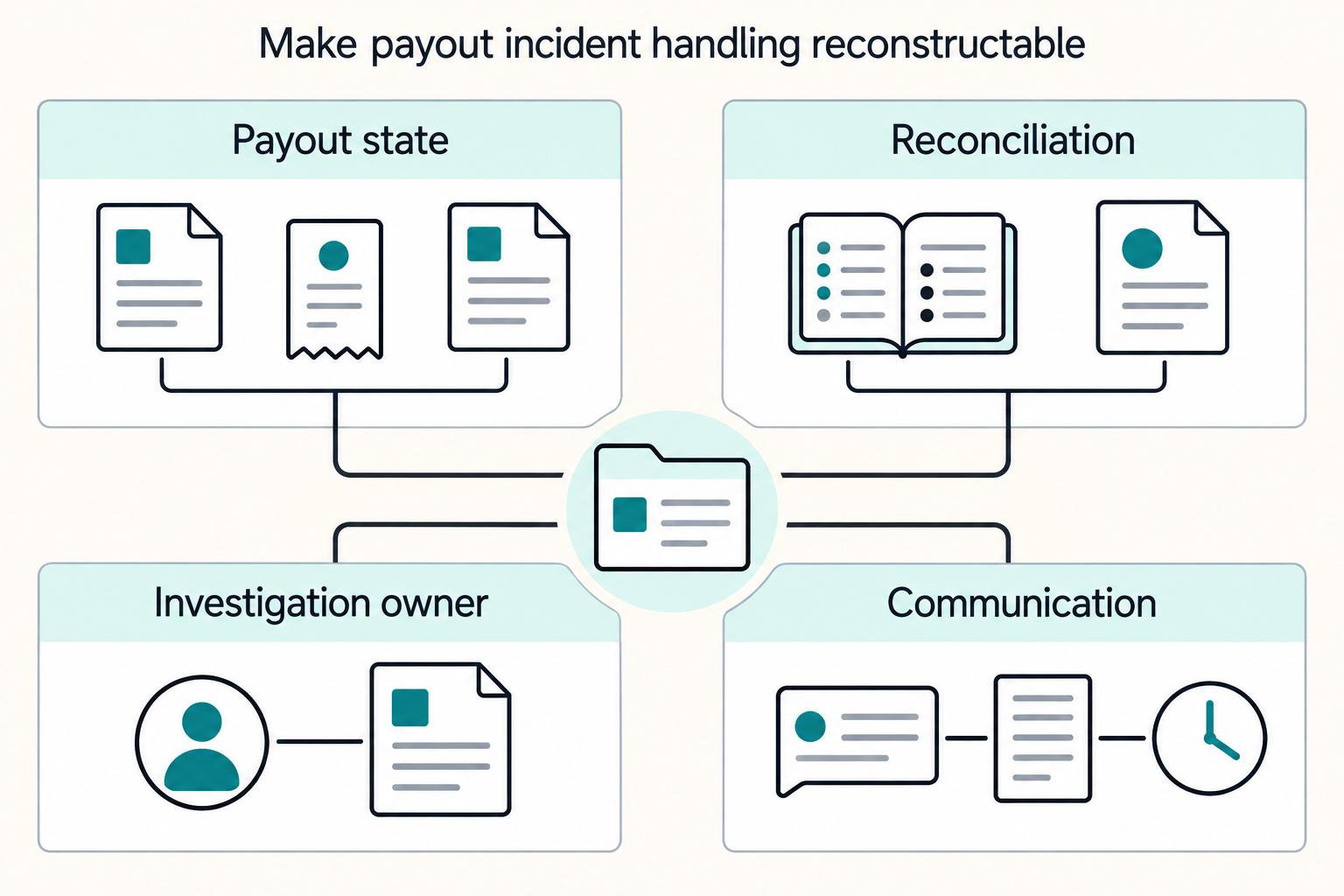
Use one payout orchestration layer to coordinate rails, providers, compliance rules, and status visibility. That gives your team a consistent view of payout state across rails, which matters when observability breaks and reconciliation turns into a multi-system puzzle.
Track operating health with signals you can act on quickly, especially payout status visibility across rails and reconciliation progress. As automation increases payout speed, raise your control standard at the same time by designing for traceability and consistent controls so incidents can be resolved without guesswork.
Write failure handling as an operational runbook, not just a product requirement. Teams should know who owns investigation, how communication and escalation work, and how finance classifies payout state during incidents. Clear runbooks help limit the operational and business impact when outages or provider mismatches occur.
Expand only when control evidence keeps pace with payment speed. Real-time movement is already available for many institutions, but rollout readiness still depends on trust, auditability, and control.
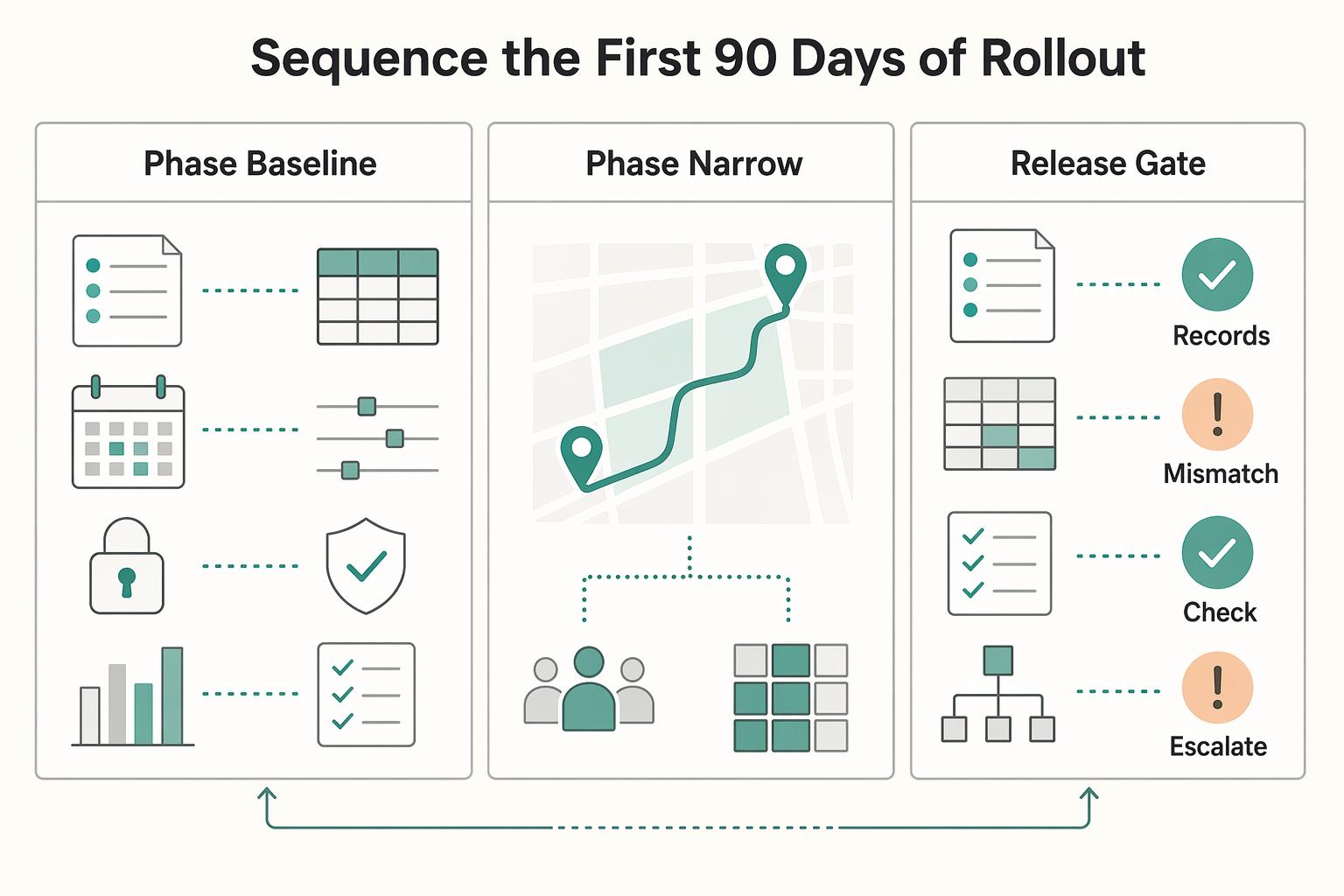
A phased launch should prove your operating model before you widen scope. Expand only when pre-execution checks and reconciliation remain reliable in production.
Use compliance at the transaction layer as your core gate. If payouts cannot verify counterparties, regulatory thresholds, and policy limits before execution, broadening rails or segments can increase speed without improving control confidence.
Look for a usable transaction audit trail on each payment: a clear validation record attached to the transaction. If teams still reconstruct decisions after the fact, treat that as a signal to delay expansion.
Programmable money is most useful when rules run inside the transaction, not only after settlement. If compliance and reconciliation are still largely post-transaction, adding new programmable lanes can increase movement speed without improving control quality.
The practical test is simple: are checks and validation happening before execution, with fewer manual checks and fewer reconciliations? If not, preserve optionality by pausing lane expansion until that shift is real.
Decide ownership of pre-execution controls, exception handling, and reconciliation before you expand depth. If control ownership is unclear, treat that as a readiness gap rather than expanding by default.
Define expansion gates in advance and enforce them:
Optionality is preserved by proving one controlled path, then extending from evidence rather than momentum.
Launch a market only when operational readiness is verifiable for the specific country and program. Rail availability alone is not a launch decision. The practical test is whether your team can run, trace, and explain payout operations end to end before you spend GTM budget.
Recent policy and operator signals point to local variance, not one universal rollout path. On 03/11/2025, a House Financial Services hearing examined a federal framework for payment stablecoins and the consequences of a U.S. central bank digital currency. A later Federal Reserve Payments Innovation Conference also centered on stablecoin use cases and business models, with issuer, bank, and app perspectives. One panel participant explicitly noted that use cases differ country by country.
That is why the bar should be verified readiness in each target market, not feature ambition.
Build a readiness matrix and a rail-scenario table before committing campaign budget, launch targets, or dates.
The readiness matrix should be country- and program-specific: payout lane, owners, evidence that key checks ran, reconciliation path, reporting outputs, and fallback handling. The rail-scenario table should compare real operating scenarios across countries and programs so tradeoffs are explicit before launch.
Those two artifacts work together. The matrix tells you whether a market-program pair is operable; the scenario table tells you whether the chosen rail fits the kind of payout you are trying to run. You need both before GTM pressure starts shaping payment decisions.
Run a limited pilot first, with narrow scope, then scale only after the evidence holds. A Federal Reserve panelist described being live in four markets, Mexico, Argentina, Colombia, and Brazil, which is consistent with phased expansion rather than blanket rollout.
Set go/no-go gates before the pilot starts. If exceptions cannot be traced cleanly, reporting outputs need manual patching, or fallback handling is unclear, pause and fix those gaps before scaling demand. Before GTM spend, align product and compliance on country and program coverage, controls that run in practice, and rollout constraints. For a related visibility framework, see End-to-End Payments Visibility: How CFOs at Platform Companies Track Every Dollar in Real Time.
Before committing GTM budget, validate market/program coverage, compliance gates, and rollout constraints with your operating assumptions in hand via Gruv contact.
Programmable money means payment value moves only when defined conditions are met. In contractor payouts, that means checks on counterparties, regulatory thresholds, and policy limits can run before execution. It also means each transaction can carry its own audit trail, so compliance shifts from after-the-fact review to built-in safeguards.
Not by themselves. Real-time rails improve transfer speed, but reliability still depends on trust, auditability, and control, including pre-execution checks and reconciliation you can trust. If those controls sit outside the transaction flow, speed alone does not make payouts reliable. A fast rail helps most when transaction checks and reconciliation are equally clear.
It changes the product when controls, payment tracking, and reconciliation are built into one flow instead of stitched across separate tools. APIs help by enabling real-time payment tracking tied to reconciliation. That gives operators clearer, faster visibility into what happened on each payout.
They reduce manual work only when rules run before execution and the evidence is easy to review later. If teams still reconstruct decisions across disconnected records, complexity has mostly moved rather than dropped. A practical checkpoint is whether each payment leaves a clear decision and reconciliation record without manual stitching.
Use them as a situational lane, not a universal default. The strongest fit is typically closed-loop, cross-border, or other high-friction contexts where continuous, programmable settlement solves a real operating constraint. Be more cautious when error prevention and dispute paths are critical, because those burdens can shift outward to users, intermediaries, and courts.
Rail availability is only the first check. You still need live proof that trust, auditability, and control hold up in production, especially for pre-execution checks and reconciliation. Until that evidence is real, treat the corridor as unproven and keep rollout scope tight.
A former product manager at a major fintech company, Samuel has deep expertise in the global payments landscape. He analyzes financial tools and strategies to help freelancers maximize their earnings and minimize fees.
With a Ph.D. in Economics and over 15 years of experience in cross-border tax advisory, Alistair specializes in demystifying cross-border tax law for independent professionals. He focuses on risk mitigation and long-term financial planning.
Educational content only. Not legal, tax, or financial advice.

You are not choosing a payments theory memo. You are choosing the institution-backed rail path your bank and provider can actually run for contractor payouts now: FedNow, RTP, or one first and the other after validation.
Treat instant settlement as a market-by-market operating outcome, not a feature badge. This explainer is for founders and operators deciding where contractor payment automation can deliver immediate, final funds availability, and where it still means only faster initiation, approval, or messaging.

This article is about payout rails for an international contractor program, not transport infrastructure. The real decision is which markets to open first after you price total payment friction, not just the headline transfer fee.