
Quick Answer
End-to-end payments visibility means a CFO can trace each payment from initiation through provider acceptance, bank movement, reconciliation, and final posting to the General Ledger. In practice, this requires a defined visibility boundary, stable transaction IDs and references, explicit ownership for each event, deterministic matching rules, and exception queues so accepted, settled, posted, and unresolved states stay distinct in real time.
What End-to-End Payments Visibility Actually Means#
For a Chief Financial Officer, real-time visibility is an operating decision before it is a reporting feature. If teams are not aligned on ownership and proof for each money event, a live dashboard exposes that gap faster. That is broader than a simple payment-status view. Risk can appear at handoffs, especially when a payment event cannot be tied cleanly to bank data and back to ledger records.
What real time actually means#
"Real time" should be defined by stage, not by label. On payment rails, the Federal Reserve defines instant payments as sent and received within seconds, any time of day, any day of year, with immediate receiver funds availability. In the U.S., FedNow went live on July 20, 2023, is available to depository institutions, and is designed for uninterrupted 24x7x365 processing with payment-integrity and data-security controls. RTP is also positioned as always on, including weekends and holidays.
The practical issue is that rail speed and internal visibility are not the same thing. A processor can confirm acceptance quickly while matching, cash application, or journal posting still waits on later files, references, or approvals. When you say "real time," define exactly which stage is current and which is still pending.
Where traceability can break#
Traceability can break in the data layer, not only in fund movement itself. Structured remittance data matters here. ISO 20022 remittance guidance is intended to create a common data definition and implementation approach that improves automation, reduces exceptions and errors, and supports AP and AR integration.
Use a checkpoint that is simple and testable. For any event, you should be able to retrieve the platform transaction ID, amount, currency, timestamp, processor reference, and the matching bank or funds-movement reference used for downstream matching. If identifiers change across retries or disappear during file handoffs, visibility turns into manual evidence gathering.
Perfect immediacy is not required for useful decisions. Clear proof of status is. Accepted, settled, posted, and unresolved are different states, and they should not be treated as interchangeable.
Why scope and controls need an early warning label#
Capabilities and compliance controls vary by market and program. Cross-border supervision is still handled differently across jurisdictions. BIS notes there is no fully complete global standard set governing supervision and oversight across all non-bank payment service provision.
Treat rollout verification as design work, not a late legal step. Before you make production decisions, confirm supported rails, required data fields, operating assumptions, and control requirements for each market and partner setup. If current provider documentation, bank specifications, and approval paths are missing, treat that gap as a design risk.
For a step-by-step walkthrough, see Real-Time Reporting Metrics Platform Finance Teams Can Actually Control.
Define the visibility boundary before you automate#
If you want finance and ops to trust the view, define the boundary in writing before you automate, or "real time" will be read as the fastest upstream status instead of end-to-end proof.
For many platform teams, a documented chain runs from bank statement intake through cash application and matching to posting in the General Ledger. Be precise about each state. "Acceptance for settlement" means a payment has passed required checks and can be settled, while cash application is matching incoming payments to outstanding invoices.
A payment can be complete in one system and unresolved in another. FedNow includes interbank clearing and settlement, but internal visibility still depends on linking bank confirmation, cash application outcome, match result, and ledger posting to the same transaction record. A useful check is whether each item has a request ID, provider reference, bank or movement reference, status, and journal-entry or posting link.
Write the out-of-scope list#
State what your platform does not control so operators and executives do not overread "real time."
| Area | What is outside control | Example |
|---|---|---|
| Rails or participants | You cannot access them directly | FedNow access is limited to U.S. depository institutions |
| Country and currency combinations | Your provider does not settle them for your program | Presentment breadth and settlement capability can differ by country and currency |
| External actions | You can observe them but cannot force them | Downstream bank posting behavior |
Choose the accounting truth rule#
Set this finance rule early: decide whether to close and report from the General Ledger as the accounting record. ERP documentation describes the ledger as the debit and credit register and a complete business-transaction record, so operational balances may diverge from final records until posting is complete.
If systems disagree, do not smooth over the mismatch in a dashboard. Route it as a reconciliation exception with evidence. A common pattern is an upstream success status paired with an unreconciled bank item, which can create false confidence unless it is routed fast. We recommend treating that mismatch as a control event, not a cosmetic dashboard problem.
Map the money event chain and ownership#
Once the boundary and ledger truth rule are set, make every money event accountable. If initiation, provider acceptance, bank movement, posting, and final Journal Entries do not have explicit ownership, your live view can turn into status noise.
Start with an event inventory, not a swimlane diagram. Provider lifecycle states are often a better control baseline than internal labels added later. Stripe's PaymentIntent tracks a payment from creation through checkout, and provider reporting treats settlement as its own event, so accepted, settled, and posted should stay separate.
Build the inventory from observable events#
Build the chain from events you can actually prove: initiation in your product, provider acceptance, bank or funds movement, internal posting, and final Journal Entries in the General Ledger. Keep each row tied to the system that observed that event first, and do not collapse states into "paid."
Store one row per event with stable trace keys. Keep the provider transaction ID, such as a PaymentIntent ID, and keep the event source + id pair for uniqueness and traceability. For connected-account flows, keep the connected-account identifier too, since Stripe includes a top-level account property on connected-account events.
| Event | System of Record | Owner | Evidence | Verification checkpoint | Escalation trigger |
|---|---|---|---|---|---|
| Initiation created | Internal Applications | Product Owners | Internal request ID, user action log, timestamp | Success: request stored with unique ID. Pending: awaiting provider submission. Investigate: duplicate or missing request ID. | Duplicate requests or no downstream provider record |
| Provider acceptance | Payment Systems | Platform Operations | Provider transaction ID, provider status event, webhook receipt | Success: provider accepted or final status event received. Pending: asynchronous method awaiting final outcome. Investigate: expected status transition does not arrive. | App shows accepted but provider stream is absent or conflicting |
| Settlement or bank movement | Payment Systems and Bank Data | Platform Operations | Provider movement reference, provider report, bank movement record | Success: bank or provider movement is observable. Pending: accepted but not yet settled. Investigate: amount mismatch or abnormal delay. | Accepted but unsettled, or settled amount mismatch |
| Posting to receivables or clearing | Internal Applications | Platform Finance | Posting batch ID, matching reference, account mapping | Success: posting completed with source references. Pending: queued for posting. Investigate: posting failure or missing reference key. | Unposted accepted funds, or posting without source reference |
| Final Journal Entries | General Ledger | Platform Finance | Journal ID, journal-line reconciliation reference, posting timestamp | Success: journal posted and linked to source event. Pending: batch created but not posted. Investigate: amount or reference mismatch. | Close-impacting mismatch, missing journal link, or unreconciled clearing line |
This is a working control table, not an industry-mandated schema.
Assign a person, not just a team name#
Ownership should be explicit across Platform Finance, Platform Operations, and Product Owners, with a named primary and backup for each event. Team labels alone are too broad when exceptions hit month-end.
A practical rule is this: the owner is the person who can produce event evidence without another team's help. Product typically owns initiation semantics and required fields. Operations typically owns provider and bank event monitoring. Finance owns posting logic, clearing accounts, matching controls, and final ledger acceptance.
Define one checkpoint per event#
Each event row should answer three questions: what confirms success, what is pending, and what opens investigation. Keep those checks concrete and testable.
For provider-state changes, webhook events are usually the right checkpoint because they notify your system when status changes, including asynchronous final outcomes. But webhook receipt confirms status movement, not end-to-end completion.
Link each journal to the transaction and the source event that authorized it. Set an alert for every long-lived pending state using the provider’s actual expiry or expected completion time. For an authorization awaiting capture, store the applicable capture deadline rather than assuming one default period across payment methods.
Visibility breaks down fast when your ledger updates on one cadence and settlement confirms on another. Real-Time Ledger vs Batch Settlement for Platform Volume Decisions explains how to choose the right model for your volume and control needs.
Connect systems with explicit data contracts#
Set the data contracts before integration work gets too far, or your "real-time" view can drift into duplicate events and manual cleanup. Between Internal Applications, processors, and your Cloud ERP, treat IDs, timestamps, status fields, and source references as required fields, not optional metadata.
Oracle's import and matching flow depends on required columns and stable transaction attributes such as transaction number, bank account, amount, and currency. When matching criteria are not met, items can remain unmatched and move to manual reconciliation before transfer to the General Ledger.
| Contract boundary | Minimum fields | Why it matters | Block condition |
|---|---|---|---|
| Internal Applications to processor | Internal payment request ID, amount, currency, request timestamp, idempotency key | Reduces duplicate creates on retry and preserves the originating business event | No unique request ID or retry key |
| Processor webhook to internal store | Provider transaction ID or PSP reference, event type, success or outcome flag, event timestamp, raw payload | Supports state tracking, replay handling, and an audit trail tied to provider evidence | No stable provider reference or no timestamp |
| Internal store to Cloud ERP | Source transaction ID, reconciliation reference, amount, currency, and required journal import data | Enables downstream matching and journal traceability | Missing source reference or required import data |
Carry one canonical transaction ID end to end and store provider-specific references alongside it. For idempotent retries, define which calls require a key, where that key lives, and how duplicate detection works before any posting step. This matters because retry behavior is provider-specific, not universal.
Use controlled status values and retain traceable event fields such as event type, outcome, timestamp, and source reference. Keep raw provider payloads so teams can verify what was received, not just what transformed logs show.
If a source lacks a stable identifier, hold automatic allocation to an invoice or counterparty until Finance verifies it. Keep the observed bank movement visible. Finance can record confirmed cash in a clearing or suspense account under its accounting policy while the final allocation remains unresolved.
Set reconciliation rules that teams can execute#
Run matching in two lanes: deterministic matches and exception handling. If both sit inside one generic process, teams can lose clarity on what can post safely, what needs evidence, and what is simply aging into risk.
Keep three states visible at all times: automatically matched items, open exceptions, and addressed exceptions. Open exceptions need action, not passive reporting, so avoid one undifferentiated queue.
Separate what can match from what must be investigated#
We recommend using the deterministic lane only for evidence-complete matches. When stable references, amount, currency, and expected timing align within your approved tolerance, auto-match and retain a traceable evidence link.
Everything else should go to an exception queue with a clear owner, action SLA, and required evidence pack. That keeps analysts focused on real breaks instead of repeatedly checking clean items.
Use this quick test for rule quality:
- Can you show exactly why an item auto-matched?
- Can you open any unmatched item and see next action, owner, and required evidence?
If either answer is no, your rules are too implicit. You should rewrite the match rule before you widen automation.
Draw a hard line between auto-reconcile and human review#
AI-powered reconciliation should help with classification and match suggestions, not erase control boundaries. Auto-match only when criteria are deterministic and evidence-complete. Use human review for ambiguity, missing data, or posting risk.
| Criterion | Auto-match | If missing |
|---|---|---|
| Stable internal and provider references | Required | Route to review |
| Amount and currency alignment, or a documented approved tolerance | Required | Route to review |
| Expected timing relationship for that payment flow | Required | Route to review |
| No duplicate event signal | Required | Route to review |
| No failed Cash Application condition | Required | Route to review |
| Traceable support for the payment record and proposed ledger impact | Required | Route to review |
If any condition fails, route to review. Cash-application issues are often caused by inaccurate payment details, so avoid auto-posting items that cannot be cleanly tied to the correct invoice or receivable.
Use a decision table that assigns action, owner, and evidence#
This mismatch taxonomy is a practical operating model, not a universal standard.
| Mismatch type | What it usually means | Default owner | Action SLA | Required evidence |
|---|---|---|---|---|
| Timing gap | Provider event, bank movement, and ledger timing are out of sync but may still resolve normally | Platform Operations first, Platform Finance if aging grows | Same business day triage; escalate if still open by next close checkpoint | Provider logs, bank timestamp, expected movement timing, pending ledger entries |
| Amount variance | Amount in bank, provider, or ledger does not align | Platform Finance | Investigate the variance before final allocation; record confirmed cash using Finance’s clearing policy | Bank record, provider transaction detail, ledger entry or draft posting, fee or adjustment detail |
| Missing reference | No stable provider reference or internal transaction ID to support matching | Platform Operations | Immediate hold from auto-reconcile until reference is recovered | Raw provider payload or immutable extract, internal request record, bank descriptor or remittance detail |
| Duplicate event | Same event may have been retried or replayed, risking duplicate side effects | Platform Operations with Finance review before ledger impact | Immediate review before any ledger post | Idempotency key record, provider event IDs, retry logs, existing ledger entries |
| Failed Cash Application | Payment received but not matched to the correct invoice or receivable | Platform Finance / AR operations | Resolve quickly to reduce errors and operating cost | Remittance details, invoice record, customer account detail, bank record, application notes |
Set explicit internal SLAs, such as same-business-day triage or review before allocation. For covered U.S. consumer EFT errors, Regulation E has separate notice, investigation, and provisional-credit rules, including conditions for an extended investigation. Route those cases through the applicable error-resolution process; an internal queue SLA does not replace it.
An unresolved match should not become a final invoice allocation merely because it is old. Aging increases escalation. Keep confirmed cash recorded under Finance’s clearing or suspense policy while the allocation is investigated.
If you are defining event schemas, status transitions, and retry handling, map your implementation approach against Gruv integration guidance: Read the docs.
Build an exception queue that does not become a black hole#
Treat exceptions as an impact-based worklist, not a storage bin. Aging should raise urgency, never lower the evidence bar. Design the queue with explicit owners, timers, and handoff points so items cannot sit between Platform Operations and Platform Finance unnoticed.
Sort by impact first#
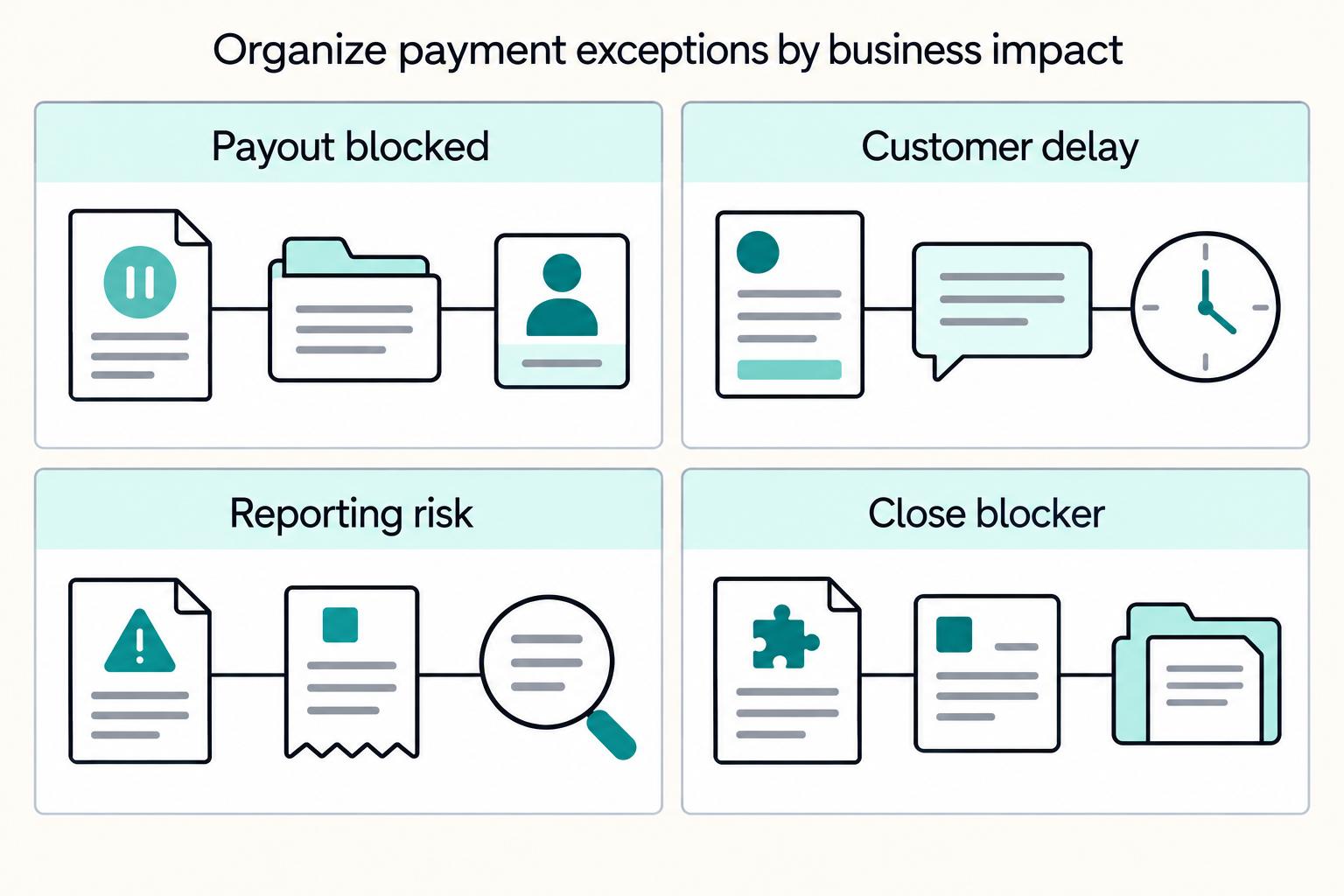
Triage by business impact before source system or error code. One practical schema is payout blocked, reporting risk, close blocker, and customer-visible delay in Payout Execution. These labels are not universal, but they force the right first question: what breaks if this stays open for another hour or day?
| Impact group | What puts an item here | Initial owner | Escalation trigger | Minimum evidence to attach |
|---|---|---|---|---|
| Payout blocked | Funds cannot be released, or payout is stuck before a terminal outcome | Platform Operations | No clear unblock path or manual review freeze | Provider event history, payout ID, current status, retry or manual review notes |
| Customer-visible delay in Payout Execution | User expects payout movement but item remains pending beyond expected timing | Platform Operations | Delay exceeds published or internal expectation, or support volume rises | Payout request record, provider timestamps, bank or processor reference, customer-facing status |
| Reporting risk | Operational records and expected ledger treatment disagree | Platform Finance | Possible misstatement or unsupported posting risk | Bank Data, provider detail, draft or posted Journal Entries, matching notes |
| Close blocker | Item can affect Month-End Close or external reporting timelines | Platform Finance with finance-lead-visible lane | Not resolved by close checkpoint | Full exception pack plus owner, next action, and estimated resolution timing |
Status detail matters. In payout flows, "accepted" is not the same as final completion, and outcomes can later move to paid, failed, or canceled. Some manual review failures can freeze funds instead of paying out. If all non-paid payouts are treated as one generic delay, normal funding timing and blocked outbound payments get mixed together.
Make the Platform Operations to Platform Finance handoff explicit#
Many backlog problems are handoff problems. Route exceptions to a named worklist, not a shared inbox, and define exactly when Platform Operations hands off to Platform Finance.
Use hard criteria such as:
- No stable provider or internal reference can be recovered.
- Bank movement conflicts with expected ledger treatment.
- Any proposed General Ledger posting would require judgment instead of deterministic support.
- The item can affect close readiness, reporting, or cash application.
Checkpoint: for any exception, you should be able to see current owner, next action, and required evidence immediately. If not, the queue drifts into status-chasing. A common failure mode is Operations holding a reporting-risk item too long because the issue started in a processor. Once ledger risk appears, Finance should own the accounting decision while Operations continues provider follow-up.
Measure response and resolution, not just volume#
Queue volume alone hides risk. Track response and resolution timing on every exception. Response timing shows acknowledgment speed. Resolution timing shows whether work actually clears.
For close-critical items, run a priority lane with visible finance leadership review. Not every exception needs direct CFO routing, but anything that can affect Month-End Close should sit above the normal queue because reporting calendars are fixed. Form 10-Q can be due 40 or 45 days after quarter end, and Form 10-K can be due in 60, 75, or 90 days depending on filer status.
Also review backlog patterns, not just counts. Repeated issues such as missing references, duplicate events, or payout-state confusion usually point to an upstream contract or ownership defect. Feed those patterns back into matching rules and integration fixes, or the queue stays busy while the same break keeps generating new work.
Put control gates where risk actually sits#
If you want a control that can still stop money in time, put control gates at the points where funds can still be stopped, reviewed, or clearly tied to accounting impact. Checks only at onboarding, or only after posting, leave a gap where money can move before compliance, policy, or accounting decisions are complete.
Risk also shifts across the flow. Identity and sanctions controls often matter before release, while posting controls matter when movement becomes a Journal Entry in the General Ledger.
Gate the payout and movement steps, not just onboarding#
For a U.S. bank program, distinguish the bank’s Customer Identification Program from your platform’s release policy. Covered financial institutions also have beneficial-owner due-diligence obligations for legal entity customers. FinCEN’s February 2026 relief permits specified reliance on previously collected ownership information for subsequent accounts; it does not abolish initial identification or ongoing risk-based due diligence. Map the bank’s requirements and your own release controls to the relevant customer and program.
If your program supports it, gate release at the movement step using:
- identity status and customer/business verification completeness
- beneficial owner verification where customer type requires it
- AML or sanctions policy checks
- release approvals before funds are sent
Before a payout leaves pending, you should be able to see the verification result, policy result, approver when required, and the payout or provider reference tied to the release decision. If those records are incomplete, route to review instead of auto-release or auto-post.
Make overrides fully traceable to the accounting result#
Overrides should always be traceable from operational action to accounting outcome. If someone bypasses a hold, releases after review, or forces a posting path, keep an Audit Trail showing who changed what and when. NetSuite system notes are one example of this kind of evidence. We recommend preserving that evidence where your finance team can review it with the accounting result.
Also link each override to resulting Journal Entries so Platform Finance can verify accounting impact without reconstructing events. A practical override evidence pack is:
- payout ID and provider reference
- prior and new status
- user identity and approval record, if applicable
- resulting journal entry IDs
Use a journal-entry approval gate before posting where available. In flows with upstream operational overrides, this can be the last controlled stop before unsupported entries reach the ledger.
Retries should be idempotent, but posting must still dedupe#
Use Idempotent Retries for request-level resilience, but treat duplicate-event handling as a separate posting control. Idempotency protects retries. It does not guarantee downstream events arrive only once.
Store processed event identifiers and enforce a unique business-operation or journal reference. Commit the deduplication record and the journal effect atomically, or use an equivalent transactional design. An event-ID check alone can race between workers, and two different event IDs can refer to the same financial operation. Request idempotency and posting deduplication protect separate boundaries.
Confirm market and program rules before rollout#
Do not assume one global control matrix applies unchanged in every market. FATF explicitly allows country-level implementation adapted to local circumstances, and Treasury's 2022 instant-payment sanctions guidance emphasizes a risk-based approach for new payment technologies.
Define which rules are global versus market-specific or program-specific, then confirm before rollout:
- current policy source
- jurisdiction or program scope
- exact movement step where each gate fires
If this check stays informal, dashboards can look consistent while underlying control logic diverges across markets.
Track KPIs that prove operational truth, not just activity#
Activity counts can look healthy while close readiness is still fragile. Use KPIs that show whether the General Ledger can be trusted now, not just how much payment traffic moved.
Measure readiness before month-end#
Track close readiness before month-end close, not only the final duration. APQC defines monthly close cycle time as the span between the initial trial balance and consolidated financial statements. That is useful as an outcome metric, but limited if it is your only visibility metric. We use it as an outcome check, not as a substitute for event-level proof.
If a balance cannot be tied to source activity and supporting records, treat that as a readiness failure now, not a close surprise later. That gives Platform Finance a current risk view instead of a retrospective one.
Track reconciliation by age and failure type#
In matching work, pair cycle time with backlog shape. APQC treats cycle time as total process time and defines reconciliation cycle time as the hours needed to reconcile a single bank account, which is more decision-useful than queue volume alone.
Do not rely on one aggregate average. Break unresolved items and time-to-resolution out by failure type, such as timing gaps, missing references, duplicate events, amount variances, and rail outcomes like FedNow accept, reject, and accept without posting. When daily or weekly reconciliations are not feasible, monthly reconciliations generally take longer, so rising aging is an early warning.
Add signal-quality KPIs#
Also track signal quality, not just throughput. Two useful checks are the percent of events with sufficient audit documentation and the percent of postings linked to a stable source reference. When available, that reference can be an EndToEndId, intended to remain unchanged across the end-to-end chain, or a provider reference tied to the originating event.
When traceability drops, operational dashboards can still look healthy while audit support weakens. That is a control risk, because PCAOB standards emphasize sufficient evidence and audit documentation as the written basis for conclusions.
Review these KPIs weekly with Finance and Operations. If an exception has an external timer, track the actual obligated party and triggering event. For ACH requests for return, Nacha requires the RDFI to advise the ODFI of its decision or status within ten banking days of receipt. That is a status-response obligation, not a promise that every payment will be returned. Related reading: Shortening Month-End Close.
Choose your operating model deliberately#
Choose the model based on control reliability first, then speed. When exception labels and evidence are still inconsistent, a centralized queue can be safer. When taxonomy and controls are consistently applied, modular queues with shared governance become more practical.
A single shared queue can give Platform Finance a clearer path to consistency. One team can apply the same posting rules, evidence requirements, and escalation criteria across flows, which is useful while you are still stabilizing matching signals. The tradeoff is straightforward: consistency improves, but bottlenecks can grow as adoption scales.
Where centralization helps most#
Centralization can be a better first move when failures still repeat across flows and data quality is uneven. At that stage, consistency in exception handling can matter more than local speed in specialized paths.
Keep the control gate explicit: require a consistent minimum evidence standard, clear ownership, and traceable status handling before posting decisions. If any flow bypasses those basics, the shared queue stops being a real control point.
The risk to watch is drag from handoffs and siloed triage. Central models can gain efficiency through scale, but they can also slow specialist flows when queue owners lack product context.
Where modular queues help most#
Modular domain queues fit better once taxonomy is stable and domain teams can run controls without redefining core terms. Decentralized ownership can reduce delays from cross-team transitions, especially where rail or product context drives decisions.
The tradeoff is control drift. If domains use different status labels or evidence locations, close work gets harder even if local resolution is faster. Modular only works if shared controls remain fixed: a common posting policy, a minimum evidence pack, a shared escalation trigger, and one canonical exception taxonomy.
Compare the options before you split queues#
| Model | Control strength | Implementation effort | Incident containment | Scalability |
|---|---|---|---|---|
| Centralized single shared queue | High for consistency and common governance | Can be lower at first because standards are set once | Lower if one queue design or rule issue affects many flows | Can bottleneck as volume and product variation grow |
| Shared or federated model | High if central rules are enforced consistently | Moderate because governance stays central while execution is distributed | Better than fully centralized if domains are partitioned cleanly | Strong balance when teams need different operating pace |
| Modular domain queues by flow or product line | Variable and depends on shared controls being real | Higher because each domain needs ownership and capability | Stronger local blast-radius containment when issues stay partitioned | High for specialized flows, but only with mature operating discipline |
A shared or federated model is often the steady-state target: centralized policies with decentralized execution. Use central governance for core rules and evidence standards, then let domain teams run their queues where specialized payout context matters.
Use this decision check before splitting queues:
- If exception labels and evidence are not yet consistent across flows, keep operations centralized.
- If every domain queue can produce consistent control records and escalation behavior, split by flow or product line without giving up shared controls.
Execute a 90-day rollout with measurable checkpoints#
Roll out in three 30-day blocks, and sequence the work deliberately: standardize event language first, then stabilize retry and exception behavior, then harden audit evidence and monitoring. Do not start with automation volume or AI tuning before payment, bank, and ERP systems share the same event language.
| Period | Focus | Checkpoint |
|---|---|---|
| Days 1 to 30 | Define the event taxonomy, ownership map, and data contracts | Trace sample transactions from source event to ERP-ready record without manual relabeling |
| Days 31 to 60 | Implement matching logic, exception queues, and Idempotent Retries with a controlled rollout | Verify provider-specific retry behavior and recover the original operation without duplicate journal effects, including concurrent workers and expired provider keys |
| Days 61 to 90 | Harden the Audit Trail and tune AI-Powered Reconciliation on narrow, well-referenced cases | Exit when unresolved close blockers are lower, matching cycles are faster, and ledger-to-source traceability is consistent |
Days 1 to 30#
Start by defining the event taxonomy, ownership map, and data contracts. ISO 20022 is a practical reference because it provides a common language and supports richer end-to-end processing. Use it to discipline naming and status design, rather than assume every rail behaves the same way.
Set a minimum contract with fields such as a stable transaction identifier, provider reference, timestamp, status enum, amount, currency, named owner, and posting intent. Treat payment status as a control checkpoint: accepted and rejected outcomes should be explicit, for example via a status pattern equivalent to pacs.002, so triage stays consistent. Validate this phase by tracing sample transactions from source event to ERP-ready record without manual relabeling. If a source cannot provide stable identifiers, keep it out of auto-posting.
Days 31 to 60#
Next, implement matching logic, exception queues, and Idempotent Retries with a controlled rollout. Keep deterministic matches in one path and true breaks in another so unresolved discrepancies can be isolated and resolved.
Define retry behavior for each provider and endpoint. Stripe saves the first result after endpoint execution begins, including a server error; validation failures and concurrent-execution conflicts do not create that saved result. Its keys can be removed after they are at least 24 hours old. After a key expires, query the original operation before submitting a new request. Keep your own business-operation and journal deduplication records for the recovery period you support.
Days 61 to 90#
Only after that should you harden the Audit Trail and tune AI-Powered Reconciliation on narrow, well-referenced cases. Audit evidence should capture event type, time, location, source, outcome, and identity so investigations and control reviews are workable.
Lock KPI reviews into close governance with Platform Finance and Platform Operations using ongoing monitoring, including reconciliations, trend analysis, and analytics rather than end-period checks alone. Exit when unresolved close blockers are lower, matching cycles are faster, and ledger-to-source traceability is consistent.
Conclusion#
End-to-end payments visibility is an internal-control outcome, not a dashboard outcome. If you cannot trace a payment from the initiating event through settlement, reconciliation, and posting to the General Ledger, you have status visibility, not finance-grade visibility.
Treat this as an operating discipline: clear ownership, explicit evidence, and enforceable controls. The General Ledger is the bookkeeping record that feeds financial statements. Account reconciliation is an internal control over financial reporting. The audit trail is what lets you reconstruct who did what and when.
The practical target is traceable money movement with evidence at each step. Each material event should carry a stable identifier, timestamp, status, source reference, and a path to the resulting journal entry or exception record.
Be explicit about rail behavior. FedNow guidance describes real-time clearing and settlement between financial institutions, and describes settlement as final. Same Day ACH is windowed: Nacha's third window became effective March 19, 2021, with interbank settlement at 6:00 pm ET. If your payout mix spans both models, do not promise identical tracking or matching expectations across rails.
Use this order of operations:
- Map the event chain first. Define events from request through settlement and GL impact, then assign owner and required evidence for each.
- Set reconciliation rules second. Specify what qualifies for deterministic matching and what must route to manual review.
- Automate last. Scale automation only after duplicate handling, missed-event recovery, and exception escalation are stable under control.
The decision standard is straightforward and aligns with ICFR expectations: can management demonstrate responsibility for internal control over financial reporting and maintain evidential documentation to support its assessment? If your team can trace source event to GL entry, explain breaks, and produce audit-trail evidence for overrides and exceptions, your controls are durable. If not, fix control quality before expanding automation. When your team is ready to validate market/program coverage and control gates for rollout, talk with Gruv.
Frequently Asked Questions
What does end-to-end payments visibility include for finance?
It includes the full chain from payment initiation through clearing, settlement, matching, reconciliation, and final posting to the General Ledger. Clearing and settlement alone are not enough. If any step cannot be tied to source evidence, you have status visibility, not full financial visibility.
Which systems must be connected first to support real-time tracking?
There is no single mandatory integration order. A practical control chain connects payment-system or processor event streams, bank data, and the ERP or ledger layer. Real-time events are only financially useful when they can be matched to bank movement and GL posting intent, otherwise they should stay in manual review.
How is Continuous Close different from simply speeding up Month-End Close?
Month-end close finalizes the prior month, while continuous close moves matching, exception handling, and evidence capture earlier during the month. A faster month-end close is still a period-end activity. Continuous close is about getting financially usable insight before issues accumulate.
Which payment events should trigger automatic reconciliation versus manual review?
Use automatic matching only when the configured criteria produce a deterministic, evidence-complete result. Match currency and references, and apply the approved treatment for known fees or tolerances. Route unexplained variances, missing references, and suspected duplicates to review. Matching rules must agree with the accounting policy; a small difference is not permission to discard it.
What KPI set best proves visibility quality for finance leadership?
Use KPIs that show control quality, not just activity. Track aging of open items, unresolved exceptions, time to resolution by failure type, and the percent of postings linked to source references. Add a close-readiness measure, such as the share of cash and payment accounts substantiated before month-end.
What are the most common failure modes in payout tracking and how should teams respond?
Check for duplicate processing, missed events, and unmatched bank or ledger records. Authenticate events, persist them durably, and make journal effects safe under concurrent retries. Recover missed deliveries using the provider’s documented history and replay tools, then reconcile against provider and bank records. Keep unresolved cases visible rather than assuming a recovered webhook completes reconciliation.
Which controls are required for audit-ready real-time operations across markets/programs?
Start with posting deduplication, reconciliation to independent payment or bank evidence, and clear exception ownership. Map identity, beneficial-owner, and sanctions checks to the covered institution, customer, and program. FinCEN’s February 2026 relief allows specified reuse of ownership information for subsequent accounts; initial identification and ongoing risk-based due diligence remain. Avoid applying one global onboarding or payout policy to every jurisdiction.
Researched and edited by the Gruv editorial team. Gruv builds cross-border billing, payouts, and finance-operations software for global businesses.
Sources
- bsaaml.ffiec.gov/manual/OfficeOfForeignAssetsControl/01trusted
- consumerfinance.gov/compliance/supervisory-guidance/interagency-...trusted
- csrc.nist.gov/projects/incident-responsetrusted
- csrc.nist.gov/pubs/cswp/29/the-nist-cybersecurity-framewor...trusted
- docs.stripe.com/api/idempotent_requeststrusted
- docs.stripe.com/webhookstrusted
- ecfr.gov/current/title-12/chapter-X/part-1005/subpart...trusted
- ecfr.gov/current/title-31/subtitle-B/chapter-X/part-1...trusted
Educational content only. Not legal, tax, or financial advice.
Related Posts

The Freelance Payment Penalty: A Modeled Audit of Platform Fees, FX Spreads, and Payout Delays
The money rarely disappears through a single, easy-to-spot fee. The real loss is stacked. A marketplace takes its commission, a processor adds a charge for international cards, a bank or payment company converts the currency at a spread, a platform holds the funds before release, and a wire sheds a little to intermediaries on the way in. Each layer looks defensible on its own, but the worker feels the combined result as a smaller deposit and a later payday.

How to Respond to a Subpoena for Business Records
Move fast, but do not produce records on instinct. If you need to **respond to a subpoena for business records**, your immediate job is to control deadlines, preserve records, and make any later production defensible.
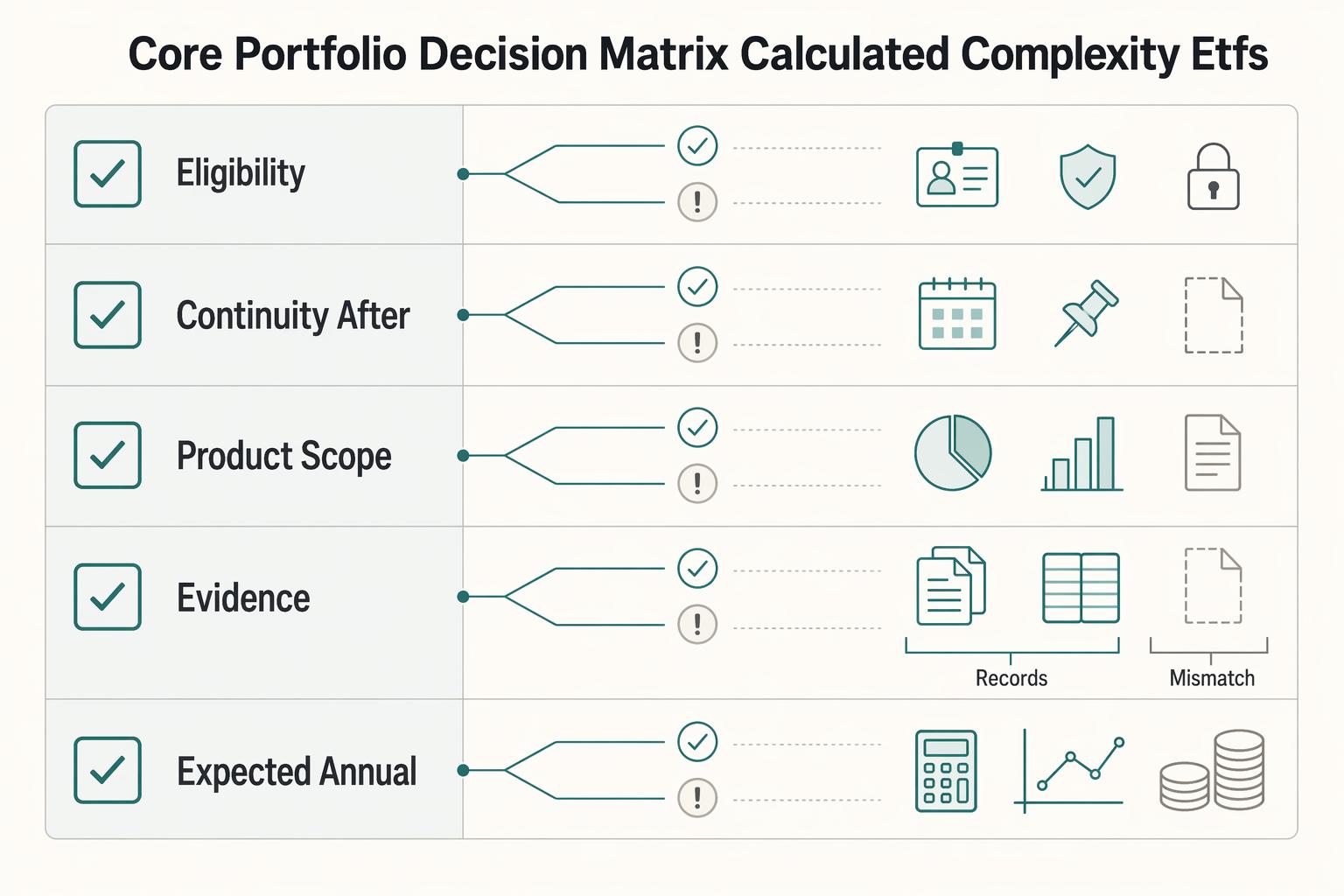
A US Expat's Guide to Investing in UCITS ETFs to Avoid PFIC Issues
The real problem is a two-system conflict. U.S. tax treatment can punish the wrong fund choice, while local product-access constraints can block the funds you want to buy in the first place. For **us expat ucits etfs**, the practical question is not "Which product is best?" It is "What can I access, report, and keep doing every year without guessing?" Use this four-part filter before any trade: