
Quick Answer
Start by treating the embedded finance gig platform competitive landscape as a sequencing decision: score countries for regulatory friction and payout dependability, then launch one lane in one canary market. Keep payments partner-led until exception handling, reconciliation outputs, and incident ownership are steady, and delay embedded credit until payment and KYC signals are mature. Use written expand, pause, and exit gates so growth follows operating proof instead of market headlines.
Why Embedded Finance Now Shapes Platform Competition#
Treat the embedded finance gig platform competitive market as a market-selection and control problem, not a feature race. Financial products are increasingly distributed inside non-financial platforms, and those platforms are taking more of the customer relationship and profit pool.
For gig and digital labor platforms, that is a core operating decision. Embedded finance means services like payments, lending, insurance, tax, and accounting built into software users already rely on. Money movement and lending are still the biggest lanes, but adjacent ones can matter just as much depending on your model and market.
Start from where competition actually happens. Competition increasingly happens inside the product experience, not only between apps. Users often prefer financial services built into the software they use every day, so the financial layer can shape trust, retention, and monetization. That matters across rideshare, delivery, and online labor platforms. When the in-product flow breaks, users may experience it as a platform failure, not a partner issue.
Choose the first lane with operator evidence, not category hype. There is no universal launch order across payments, lending, insurance, tax, and accounting. The right first lane is the one where you can verify the user problem clearly and improve it in your target market. The expensive mistake is treating lanes, countries, and partners as interchangeable. They are not.
Lock down the decisions you can actually control. You cannot control every market outcome, regulatory shift, or partner incident. You can control market selection, Banking-as-a-Service (BaaS) dependency, partner structure, and rollout sequencing.
BaaS means non-banks offer financial services through partnerships with banks and fintech firms. This partnership model also raises third-party risk. US interagency guidance effective June 6, 2023, expects lifecycle governance across planning, due diligence, contract negotiation, ongoing monitoring, and termination for third-party relationships.
So fast integration is not enough. Embedded-finance value chains can add complexity and reduce transparency. That makes ownership boundaries, escalation paths, reporting, and exit terms worth defining at the start.
This guide focuses on those controllable choices so expansion decisions rest on operating evidence, not headlines. For a step-by-step walkthrough, see Indian Gig Economy in 2026: Treat Platform Income as Variable Until Settlements Prove Stability.
What to prepare before choosing a market and product lane#
Do not compare countries or product lanes until you have a compact evidence pack that makes hard constraints visible. These decisions are stronger when they start from policy, payout, and partner constraints, not market-size narratives.
Build the minimum input pack#
Start with four inputs: your target country list, current payout pain points, top user segments, and current provider constraints across money movement and Banking-as-a-Service (BaaS). Segment detail matters because domestic payouts, cross-border freelancer payouts, and business seller settlements can carry different operational and compliance implications.
Use the World Bank Global Payment Systems Survey dimensions to structure each country pack beyond demand signals: infrastructure, legal and regulatory environment, remittances, and oversight. For each country, confirm the current payout rail, the main failure mode, and which regulated entity or partner would sit behind the proposed flow.
Define early success measures#
Set an early scorecard before partner conversations expand. Keep it focused on outcomes that are measurable across lanes: speed, transparency, access, and cost. Then define how each metric is measured, who owns it, and what counts as an exception.
If you cannot trace those measures from day one, lane comparisons will likely mislead you. Margin potential alone is a weak signal when operational burden and compliance work are still unclear.
Collect hard constraints in the US market and MENA region first#
In the US, treat licensing as more harmonized than before but still non-uniform. As of February 26, 2026, 31 states had enacted the Money Transmission Modernization Act in full or in part. That covered 99% of reported money transmission activity, so state-by-state checks still matter, including whether a flow could fall under remittance transfer scope.
| Market | Grounded constraint | Validation point |
|---|---|---|
| United States | As of February 26, 2026, 31 states had enacted the Money Transmission Modernization Act in full or in part, covering 99% of reported money transmission activity | State-by-state checks still matter, including whether a flow could fall under remittance transfer scope |
| UAE | The framework includes licensed Domestic and Cross-border Fund Transfer Services | Validate lane feasibility in the rulebooks, not just through partner interest |
| Saudi Arabia | Payment Service Providers License process runs in two stages beginning with In-Principle Approval under implementing-regulation requirements | Validate lane feasibility in the rulebooks, not just through partner interest |
In MENA, validate lane feasibility in the rulebooks, not just through partner interest. The UAE framework includes licensed Domestic and Cross-border Fund Transfer Services, and Saudi Arabia's Payment Service Providers License process runs in two stages beginning with In-Principle Approval under implementing-regulation requirements. Cross-border operations can also run into practical friction from differing data formats, operating rules, and compliance checks.
Assign decision owners and a fast go/no-go path#
Assign clear owners across product, compliance, and operations, and make them review the same evidence pack. When functions work from different assumptions, decisions slow down and partner discussions drift.
Use a single checkpoint. No country or lane moves forward until owners align on policy scope, partner viability, metric instrumentation, and termination assumptions for network partnerships. That lifecycle discipline matters because US guidance frames third-party risk management across planning, due diligence and selection, contract negotiation, ongoing monitoring, and termination, not onboarding alone.
Map your competitive set by archetype not brand logos#
Start with operating model, not logos. The decision-grade comparison is which player controls the user moment, which party carries regulated responsibilities, and how that structure affects speed, control, and margin.
Group competitors by archetype first#
Use four buckets before naming companies: non-financial platforms, financial institutions, fintech enablers, and superapps. That keeps the map focused on repeatable behavior instead of brand noise.
A grounded baseline includes e-commerce stacks such as Shopify and demand platforms such as Uber and DoorDash. They create different kinds of pressure. Merchant-stack players can bundle seller tools with financing products, while demand platforms can sit close to fulfillment and payout moments.
Keep financial institutions separate from fintech enablers. Incumbents remain central to the value chain, while enablers help platforms deliver embedded products. Keep superapps separate too, because they combine multiple vertical services in one customer journey.
Separate direct substitutes from adjacent pressure#
Direct substitutes are the players that can own the same user action you want to own. For marketplace and gig models, that is often onboarding, transaction flow, and payout.
Adjacent pressure can change your economics without always taking the end user directly. B2B embedded-finance providers, BaaS firms, and bank-fintech partnership models can shift delivery economics and risk allocation even when they are not user-facing brands. Use a simple test for each competitor: mark direct substitute or adjacent pressure, then name the user moment it controls.
Compare partner structures, not just product surfaces#
This is where tradeoffs become visible. Use the table to compare structure, not to rank providers.
| Operating model | Integration depth | Compliance burden | Partner lock-in | Operational overhead |
|---|---|---|---|---|
| Network partnership with a marketplace provider | Can be deep when split payouts, cost deductions, held funds, and reconciliation reporting are supported | Still material; requirements can vary by business model, transaction type, and country | Can increase switching effort when payout logic, reporting outputs, and account structures are provider-specific | Requires planning, due diligence, contract negotiation, ongoing monitoring, and termination planning |
| Bank-fintech or BaaS arrangement | Often deep because a fintech can provide end customers access to a bank's products and services, including payments, deposits, and lending | Material; third-party use can increase risk, and outsourcing does not remove compliance responsibility from the bank | Can create dependency when flows, data access, and roadmap control are split across bank and fintech | Runs across the full life cycle: planning, due diligence, contract negotiation, ongoing monitoring, and termination |
| Direct financial institution relationship | Variable; verify marketplace-specific support for split logic, payout controls, and reconciliation needs | Material; confirm obligations for the specific program, transaction type, and market | Can vary by contract terms, data portability, and change-control constraints | Can be significant when product changes require custom implementation or heavier bilateral coordination |
Verify with public evidence, not marketing pages alone#
Before you treat any archetype as decision-ready, validate it with public evidence. SEC filings can confirm whether a merchant stack includes financing products, product documentation can confirm payout and reconciliation capabilities, and regulatory guidance can clarify what responsibilities remain in partner-led models.
In practice, partner structure can matter as much as feature count. Adyen's Jose Sepulveda put it this way: "Historically, partnership agreements are somewhat transactional," and "We've created a full-on partnership model that gives partners a defined journey for how they can grow with us."
Do not confuse commercial reach with launch readiness. A provider may advertise payouts to 118+ countries while compliance requirements still vary by business model, transaction type, and country.
Related: Gruv Platform Payments: The Complete B2B Guide to Global Payouts Compliance and Embedded Finance.
Score each country on launch friction before revenue upside#
Treat launch friction as a go/no-go gate, not something to optimize later. Delay any country where compliance or payout reliability is red, even if top-line demand signals look strong.
Build a weighted scorecard around blockers#
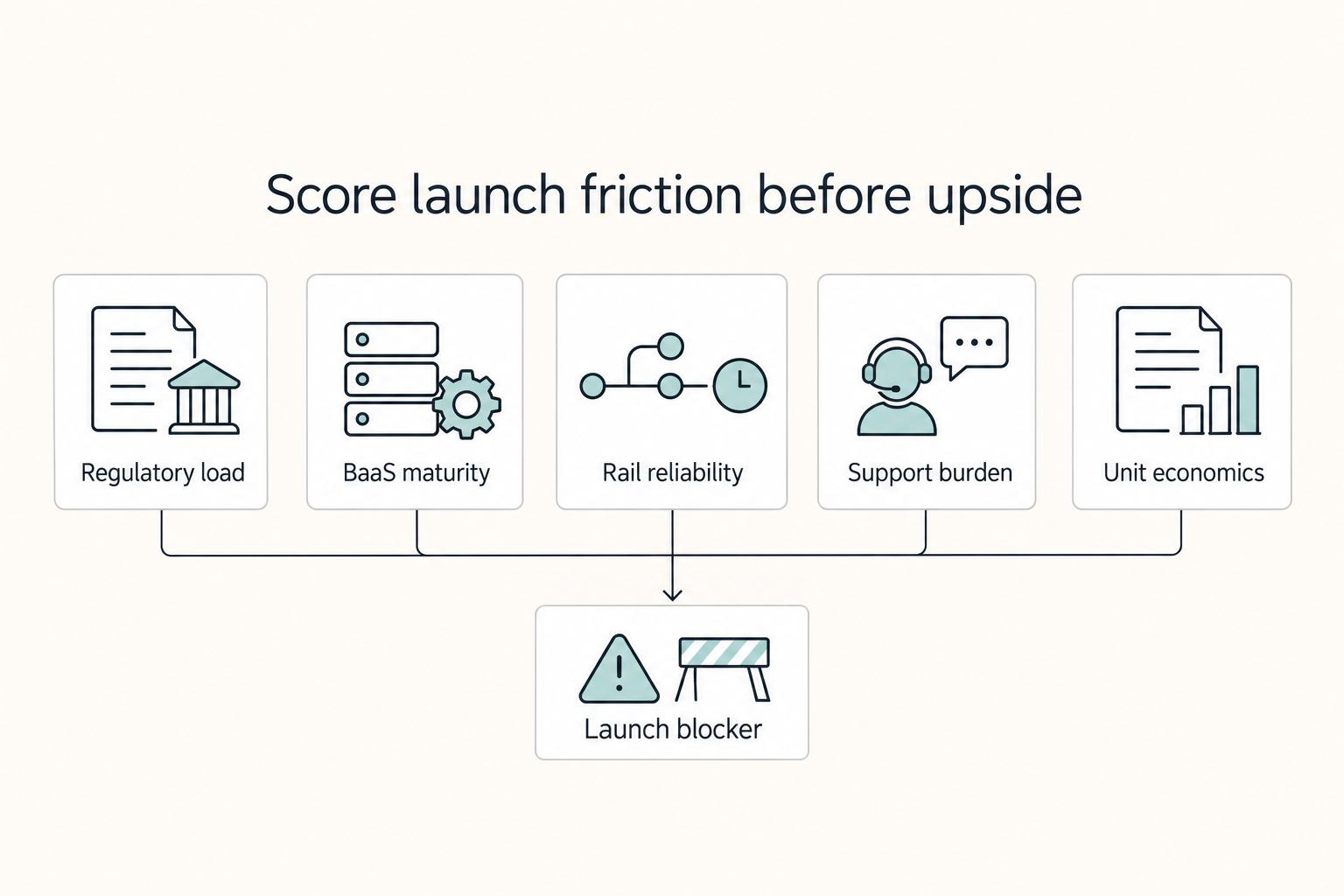
Score each country on five factors: regulatory complexity, BaaS maturity, payout rail reliability, support burden, and unit economics. Weight the score toward what can actually block launch.
Use verifiable inputs for each score:
- Payout and rail maturity: use the World Bank GPSS baseline, with cross-country data sourced from central banks and monetary authorities, including outreach to over 100 authorities.
- US money-movement reality: MTMA improves harmonization, but implementation is still state-based, with 31 states enacted in full or part, and MSB operations still carry BSA recordkeeping and reporting obligations.
- BaaS and open-finance readiness: score country by country. UAE onboarding is phased, and Saudi open banking was staged by capability, starting with AIS.
Verification checkpoint: if a score is based on sales claims or market chatter, mark it unverified until you can support it with regulator, partner, or product documentation.
Apply a hard stop before upside modeling#
Do not let market-size headlines drive the launch decision. Commercial 2024 embedded-finance estimates conflict sharply at $92bn, US$115.8bn, and US$591.1bn, so TAM claims should never override execution risk.
Use a strict rule:
- If compliance is red: hold.
- If payout reliability is red: hold.
- Default to no strategic exception until both are out of red.
This matters most in moving or fragmented regimes:
- In the US, money transmission and insurance remain jurisdiction-heavy because both are state-based.
- Reporting workflows also move. The IRS update reverting the Form 1099-K dollar limit to $20,000 is a reminder that these operations need active maintenance.
Compare lane feasibility before adding credit#
Sequence by country: payments, insurance, and tax first. Add lending and embedded credit only after the core lanes are workable. Leave credit for later because entry often depends on registration or licensing choices, and regulatory treatment varies by jurisdiction.
Treat the table below as provisional until validated in the shared evidence pack.
| Country | Speed to launch | Operational risk | Core lane | Coverage | Reporting | What drives the call |
|---|---|---|---|---|---|---|
| United States | Medium | High | Amber | Amber to red | Amber | MTMA progress helps, but operations remain state-dependent; MSB BSA duties apply; insurance is state-based; tax workflows can change |
| UAE | Medium | Medium to high | Amber | Validate separately | Validate separately | Open Finance onboarding is phased; confirm partner and data-access readiness before build |
| Saudi Arabia | Medium | Medium to high | Amber | Validate separately | Validate separately | Open banking rollout was staged by capability, with AIS first; verify lane-specific maturity |
| EU member state | Medium | Medium | Amber | Validate separately | Amber | DAC7 places reporting obligations on platform operators, but member-state implementation still needs validation |
Require one shared evidence pack before build#
No country should move to build until legal, ops, and finance sign off on the same dated, versioned evidence pack.
Include at minimum:
- Regulatory memo for money movement, coverage, reporting, and whether credit entry depends on registration or licensing
- Payout rail evidence, including GPSS inputs, partner capability docs, fallback settlement paths, and exception handling
- Unit-economics sheet with corridor-cost sensitivity, not just blended revenue assumptions
- Support model for manual reviews, payout failures, reporting volume, and coverage constraints
- Country decision note with lane-level green, amber, and red status and owners
This checkpoint forces an explicit speed-versus-risk choice based on shared evidence, not optimism.
Decide partner first or build first for each lane#
Once a country clears your red-line screen, decide lane by lane. A partner-first model can help when policy variation is high and team capacity is limited. Then phase toward build where deeper control is the real advantage.
Choose the starting model with an if-then rule#
Treat integration model choice as strategy, not procurement. Outcomes depend on choosing where to play and being honest about risk and brand tradeoffs across integration models.
If a lane has high regulatory variance, blurred ownership boundaries, or recurring reporting duties, start with network partnerships through fintech or BaaS. If your advantage depends on controlling core logic, user experience, and operating data, define a phased build path early, even if you do not build immediately.
Verification checkpoint: before signing, confirm who owns the user-facing flow, who performs the regulated activity, and what data you can extract without manual work. In bank-partner models, third parties often control distribution and access while regulated compliance accountability remains with the regulated institution.
Default to payments with a partner, then reassess build timing#
This is often a practical partner-first starting point because adoption is already established in SaaS workflows. SMEs are used to integrated payments, and SaaS providers with integrated payments accounted for 36% of SME acquiring revenues, with an expectation of 45% by 2028.
Reassess internalization when operations are consistently under control: exceptions are predictable, reconciliation is routine, and incident handling is measurable. If incident handling is still noisy, internalizing early can increase execution risk.
Treat insurance and tax as compliance-heavy lanes#
Coverage and reporting can stay partner-led unless product differentiation truly depends on underwriting logic or filing experience. Reporting is the clearest example. Platform operators can face recurring multi-jurisdiction reporting obligations, including annual DAC7 reporting for EU-resident sellers, and OECD model rules exist because fragmented local requirements create burden.
Use partner due diligence as an execution test. Ask for sample output files, correction workflows, seller-notice templates, and evidence of how jurisdiction changes are handled. Gig income reporting is mandatory, so this is a compliance function, not an optional feature.
Define exit criteria before integration starts#
Set exit criteria at contract start, not after lock-in pain shows up. Third-party risk management guidance covers the full life cycle, including termination.
| Exit trigger | What to check | Failure signal |
|---|---|---|
| Data access quality | Complete transaction, consent, reporting, and exception data in structured exportable form | Data is not available in structured exportable form |
| Margin compression | Unit economics at scale | Unit economics deteriorate at scale with no credible improvement path |
| Roadmap control | Critical product changes | Critical product changes are consistently blocked by partner priorities |
| Incident response performance | Escalation windows, severity levels, and owners | Requirements are not meeting required windows, levels, or ownership expectations |
Use four explicit exit triggers:
- Data access quality: complete transaction, consent, reporting, and exception data in structured exportable form
- Margin compression: unit economics deteriorate at scale with no credible improvement path
- Roadmap control: critical product changes are consistently blocked by partner priorities
- Incident response performance: escalation windows, severity levels, and owners are not meeting requirements
Where operational-resilience reporting applies, include a materiality test for partner arrangements and incident reporting readiness. The standard is simple: know which partner failures are material, and have a workable exit path before those failures occur.
Pick the first embedded products by gig model#
Lane order matters more than feature count. Start with the financial workflow users already judge every day, then add only the next lane your data and operations can support.
Match the first lane to the platform's earning pattern#
For rideshare and food delivery, start with contextual money movement and payout reliability. Workers often expect fast access to earnings. Uber highlights Instant Pay with cashout up to 6 times per day, and DoorDash offers daily cashout for $1.99.
That makes payout trust the first problem to solve. If payout status is unclear, or banking and processing delays can still push deposits by up to 2 business days, launching coverage first usually will not fix the core issue.
For professional and B2B marketplaces, the foundation is broader: money movement plus onboarding, verification, payout orchestration, and reporting and reconciliation outputs finance can actually use. Marketplace providers frame this as one operating flow: onboard users, process payments, and pay out funds.
Separate table stakes from later differentiation#
Use this split to keep first-release scope honest.
| Business model | First lanes to ship | Table stakes | Differentiate later |
|---|---|---|---|
| Rideshare apps | Contextual payout flows, instant/fast payout, payout-status visibility | Reliable earnings flow and supportable cashout | Coverage add-ons, if relevant, after payout exceptions are controlled |
| Food delivery services | Order-linked funds flow, daily cashout, clear delay messaging | Predictable courier payout and manageable exceptions | Coverage or other add-ons, if relevant, after deposit timing is stable |
| Professional/B2B marketplaces | Money movement, onboarding/verification, reporting and reconciliation outputs | Pay in, pay out, and produce usable finance/compliance records | Embedded credit after payment and KYC data quality is strong |
For US marketplace flows, resolve tax-form ownership early. Determine whether your setup creates Form 1099-K responsibility for a payment settlement entity or Form 1099-NEC reporting needs for contractor payments.
Gate credit and limit release scope#
Do not test embedded credit until payment and KYC data can support real eligibility decisions. Providers tie financing eligibility to account and payment signals, including processing volume, so incomplete account history or inconsistent KYC should delay launch.
Use one internal scope rule: keep each market release focused on a small number of new financial lanes. That keeps attribution clear when support volume, reconciliation quality, or compliance execution changes after release.
Verification checkpoint: before launch, confirm you have all three artifacts for the chosen model: a payout-exception report, a finance-ready reconciliation export, and, for US marketplace flows, a documented 1099-K or 1099-NEC ownership decision. If any are missing, reduce scope before adding the next lane.
If you want a deeper dive, read The Rise of Embedded Finance: What It Means for Freelance Platforms.
Design the operating evidence pack before go to market#
Do not launch until you can prove what happened in each critical money-movement and reporting flow from system records alone. If finance or ops cannot trace a payout, exception, or compliance event without manual reconstruction, the launch is early.
Write the minimum proof set for each live flow#
Define one minimum proof set for every live flow: policy logic, payout-state visibility, reconciliation output, and incident procedure. Support, finance, and compliance should be able to answer the same questions from the same record set.
Treat payout-status monitoring as a core control. Your team should be able to view payout status, receive status-change events, and confirm reversals or completion.
For reconciliation, use provider reporting that preserves the transaction-to-payout association when available. If you create manual payouts, assign internal reconciliation ownership before launch, because that mapping responsibility sits with your team.
Require traceable audit artifacts, not screenshots#
Ask for audit artifacts that stand on their own for every critical flow. A reviewer should be able to validate a case from timestamps, IDs, event history, and exported reports, not from chat threads or ad hoc spreadsheets.
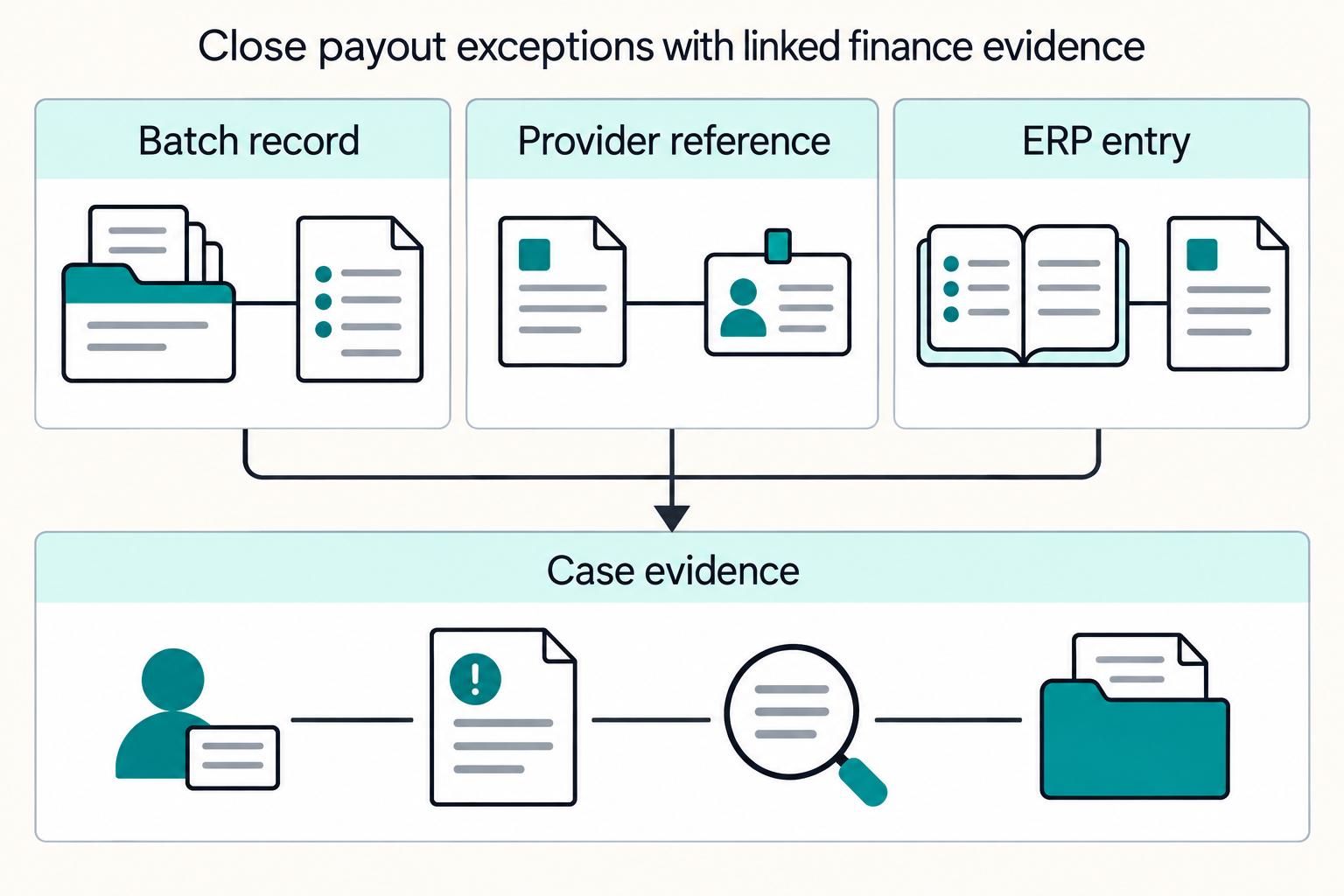
Use a consistent case trace: transaction or payout ID, status-change history, linked reconciliation output, and a named next-action owner. Apply the same standard to reporting and compliance exceptions. For incidents, rely on documented procedures so technical and operating steps are repeatable during failures.
Where US employment-tax recordkeeping obligations apply, use the IRS baseline of keeping records for at least four years after filing the fourth quarter for that year.
Lock partner evidence standards into contracts#
If launch depends on fintech or financial institution partners, put evidence and response requirements into contracts, not assumptions. SLA and contract terms should cover service availability, responsibilities, escalation procedures, cancellation terms, business continuity, and incident response detail.
This is worth doing because contract gaps in continuity and incident-response responsibilities are a known control risk. Outsourcing does not remove accountability when those controls are weak.
For network partnerships, define named escalation paths, failure-handling steps, evidence-delivery expectations, and incident-notification responsibilities. In covered US banking contexts, timing can be strict and role-specific, including 36-hour notification duties after determining a qualifying incident and service-provider disruption triggers tied to disruptions lasting 4 or more hours in FDIC context.
Add a hard launch gate and test it#
Before rollout, make sure compliance-event reporting and exception-queue reporting are live, accessible, and tested by the teams that will run them.
Required controls before rollout:
- Payout-status feed or dashboard with state changes
- Reconciliation output tying payouts to underlying transactions (or documented internal mapping for manual payouts)
- Incident procedure with owners, escalation contacts, and evidence expectations
- Live compliance-event report and exception queue for unresolved cases
Use one red flag: if payout disputes or compliance exceptions still require reconstruction from emails, CSVs, and partner tickets, delay launch. That is an operating control gap, not a minor tooling issue.
Sequence rollout in three releases to control risk#
Use your evidence pack to pace expansion, not to speed it up. A common risk is adding countries, lanes, and partner dependencies faster than support, finance, and compliance can absorb.
| Stage | Focus | Guardrail |
|---|---|---|
| Release 0 | Payout-status visibility, reconciliation output tied to underlying transactions, a working exception queue, and named incident owners | Begin only after these controls are live; if these are still manual, phased rollout can hide gaps briefly and then amplify them |
| Release 1 | Core money-movement flow and payout reliability for a narrow production slice | Treat it as a canary and keep the cohort small enough for one operations team to review serious exceptions end to end |
| Release 2 | One adjacent lane, such as coverage or reporting, plus stronger exception handling | Do not combine multiple new lanes, and do not pair a new lane with a new country in the same release |
| Release 3 | Expand countries or deepen monetization, for example through embedded credit | Do not do both at once |
Before you start
Begin only after Release 0 controls are live: payout-status visibility, reconciliation output tied to underlying transactions, a working exception queue, and named incident owners. If these are still manual, phased rollout can hide gaps briefly and then amplify them.
Start with payments in a canary release#
Release 1 should focus on the core money-movement flow and payout reliability for a narrow production slice, often in a single country or similarly constrained scope. Treat it as a canary: a partial, time-limited release to a smaller subset so you can learn from live traffic without exposing the full platform.
Keep the cohort small enough for one operations team to review serious exceptions end to end. A useful boundary is one jurisdiction, one partner chain, and one support motion you can inspect.
Checkpoint for Release 1: can support and finance prove what happened in payout cases from system records alone? For successful, failed, reversed, and delayed payouts, they should be able to match IDs, status history, reconciliation output, and current owner without relying on emails or CSVs.
Add one adjacent lane and harden support operations#
Release 2 should add one adjacent lane, such as coverage or reporting, plus stronger exception handling. Do not combine multiple new lanes, and do not pair a new lane with a new country in the same release.
This sequencing fits market reality. Payments and lending remain the largest embedded-finance categories, while insurance, tax, and accounting are adjacent growth lanes. Expansion beyond the first lane can be harder than it looks, so this release should prove your team can operate a broader financial workflow, not just ship another feature.
Operationally, add structured reason codes, clear case routing, and evidence fields for the new lane. Run exceptions through a detect-respond-recover incident flow so ownership and remediation stay explicit.
Expand geography or monetization only after baseline stability is proven#
Release 3 should make one move: expand countries or deepen monetization, for example through embedded credit. Do not do both at once.
Country expansion adds policy variation, payout-rail differences, and support coordination load. Monetization expansion introduces a different risk profile. Treat them as separate stressors and sequence them accordingly.
Use one decision rule: can the baseline service still run within your defined impact tolerance after the added change? The operating habit is to map, test, and stay within tolerance before moving on.
Enforce a stop rule before every next release#
Define a hard pause rule before Release 1 starts. If tracked reliability indicators exceed planned tolerance after a release, pause the next release and remediate first.
This follows established release-governance logic: halt change when reliability performance is outside budget. Your thresholds can be platform-specific, but the rule must be explicit, owned, and reviewed on a fixed window.
When the stop rule triggers, check three things before resuming: where the failure started, whether the evidence trail is complete, and whether fixes were re-tested on a limited cohort.
Watch for failure modes competitors ignore#
Once you have a stop rule, the next priority is avoiding the predictable mistakes that trigger it. Common misses are over-trusting macro reports, benchmarking only fintech peers, and treating partner terms as a launch-only detail instead of a scale risk.
Normalize macro reports before go/no-go decisions#
Use market reports for context, not as feasibility proof. The World Economic Forum supports a qualitative shift, but not a single sizing model.
Reported sizing paths vary materially. Yahoo Finance carried a U.S. estimate of US$115.66 billion by 2025 with 6.9% annual growth. Another Yahoo item marked as GlobeNewswire content framed 9.3% growth. Global estimates also diverge from USD 83.32 billion (2023) to USD 588.49 billion (2030) and USD 148.38 billion (2025) to USD 1,732.53 billion (2034).
Use one rule: do not approve a country or lane from one headline number. Normalize source, geography, time window, and product scope first, then compare that with your own feasibility checks.
Map competition by user surface, not license category#
If you benchmark only fintech peers, you can misread the real pressure. The IMF notes that large digital platforms already offer payments and credit, and WEF examples show communications platforms such as Botim expanding into fintech and service ecosystems.
Build your comparison set around where users already spend time and transact, not only around who looks like a fintech vendor. A practical baseline is one fintech peer, one superapp-type platform, and one large non-financial platform archetype.
Negotiate partner terms for stress, not just launch speed#
Partner-first can work, but contracts need to hold under scale pressure. Federal Reserve material highlights compliance, operational, liquidity, and third-party risk in bank-fintech arrangements, and FDIC guidance explicitly spans planning, due diligence, contract negotiation, ongoing monitoring, and termination.
Treat pricing, data access, escalation, and termination support as core launch controls, not legal cleanup. Do not assume dependency will create portability or roadmap constraints, but test whether the terms allow those constraints to appear later.
The practical standard is service dependability under pressure. Reuters-reported coverage said Careem would suspend Pakistan ride-hailing service on July 18, 2025, citing economic challenges, competition, and capital constraints. One operator statement said conditions "made it hard to justify the investment levels required to deliver a safe and dependable service in the country."
Related reading: The Best Personal Finance Apps for Freelancers.
Use proof checkpoints to decide expand pause or exit#
Treat expansion as a proof decision, not a momentum decision. If the core payout lane and coverage are not stable across repeated internal review cycles, delay adding a country, lane, or larger user segment.
Confirm operating stability before you expand#
Use the same checks in each cycle so results stay comparable. For the core lane, review payment success rate and network authorization rate, then confirm where failures happen and why. For support, track ticket counts, wait times, and agent capacity in real time, not just total volume.
Expand only when payout reliability is steady, compliance handling is controlled, and support capacity is not being stretched across repeated reviews.
Pause when operational strain outruns adoption#
Pause noncritical rollout work when operational load grows faster than adoption. Use an error-budget style rule: if reliability drops below SLO, halt changes and releases except urgent fixes until service returns to target.
If one incident consumes more than 20% of the error budget over four weeks, run a postmortem before reopening expansion.
Exit a lane when third-party risk overwhelms margin#
Exit when third-party risk, incident pressure, or unresolved auditability gaps outweigh the lane's benefits, even if margin still looks better on paper. Partner-led delivery does not remove accountability, and third-party risk management should hold from planning and due diligence through monitoring and termination.
If you cannot map the people, process, technology, and information dependencies required to run the lane, treat that as an exit red flag.
Re-run your checkpoints before every major move#
Before any major expansion decision, re-run your internal checkpoints using current operating evidence. A market can still look attractive while a specific lane is no longer fit to scale.
Before you expand to the next market, pressure-test your payout reliability and exception workflow against a concrete operating baseline in Gruv Payouts.
Conclusion#
Make expansion a written go/no-go decision backed by evidence, not a revenue story.
- I have a country scorecard with explicit red-line constraints, not just revenue upside assumptions. It covers legal and regulatory conditions, payment-system readiness, partner availability, and support burden, with legal, ops, and finance signing the same evidence before build starts.
- I have chosen partner-first or build-first per lane with written exit criteria. Partner lanes are governed across planning, due diligence, contract negotiation, ongoing monitoring, and termination, with clear escalation windows, data access and reporting terms, and portability expectations.
- I have prioritized lanes by business model and limited first release scope. Payments (including payouts) and lending are often prioritized first, while adjacent lanes such as insurance, tax, or accounting expand when support and exception handling are stable.
- I have a launch evidence pack with auditability, exception handling, and verification checkpoints. It includes policy logic, payout visibility, reconciliation outputs, SLA terms, exception queues, and incident-response procedures; for certain cross-border transfers above USD/EUR 1,000, payment messages should include required originator and beneficiary details to support traceability.
- I have clear expand, pause, and exit triggers before scaling the next market. Thresholds are explicit for payout reliability, compliance exceptions, support load, incidents, and partner performance, and reviewed on a recurring cadence, not only after failures.
When your expansion checklist is locked, translate it into implementation-ready events, controls, and reconciliation patterns in the Gruv Docs.
Frequently Asked Questions
What does an embedded finance competitive market mean in day-to-day decisions for gig platforms?
It means you are deciding which adjacent financial service your platform can integrate with real economic ownership, not just which feature to ship next. In practice, this often shows up in payout reliability, compliance exceptions, and partner escalation quality. If a lane creates more manual review and reconciliation work than your team can run cleanly, it is not a real advantage yet.
When should a platform partner with financial institutions or fintech providers instead of building in-house?
Start partner-first when policy variation is high, team capacity is limited, or the lane still needs proof before deeper investment. That pattern is common in platform finance, and large technology platforms also use financial-institution partnerships to deliver many services. Treat partner decisions as full-lifecycle risk management, including planning, due diligence, contracting, ongoing monitoring, and termination.
Which should come first for most platforms: Payments, Insurance, Tax, or Embedded credit?
There is no universal order for every platform. Payments and lending are currently the largest embedded-finance product families, while insurance, tax, and accounting are common adjacent lanes. Sequence by operational proof, support load, and exception-handling readiness, not by category labels alone.
How should operators compare the US market and MENA region without relying on headline market-size claims?
Compare execution conditions, not just market narratives. In the US, instant-payment rail capability and data-portability obligations are explicit at the federal level, including FedNow going live on July 20, 2023, and a personal financial data rights rule effective January 17, 2025. In MENA, opportunity and execution risk coexist: adoption is improving, but fintech adoption still lags and regulatory approaches differ by country.
What country-level constraints should be validated before committing product and go-to-market resources?
Validate AML/CFT exposure, payout-rail reliability, partner coverage, reconciliation and reporting requirements, and country-specific policy obligations before launch. If a target involves a FATF high-risk jurisdiction context, treat enhanced controls as an upfront design requirement. Keep checks country-specific: in the UAE, open-finance participation is mandatory for in-scope licensees, and in Saudi Arabia policy has been actively moving, including open-banking fintech licensing announced on 3/26/2026.
How do superapps and non-financial platforms change the risk of entering a new market?
They can raise competitive pressure quickly because distribution scale and data can transfer into financial services through a data-network-activity feedback loop. The risk is not only faster growth by others. It also includes potential dominance and privacy concerns that can reshape the market. Enter with the narrowest lane you can operate reliably rather than a broad bundle you cannot support.
Try a related tool
Researched and edited by the Gruv editorial team. Gruv builds cross-border billing, payouts, and finance-operations software for global businesses.
Sources
- consumerfinance.gov/rules-policy/regulations/1005trusted
- csrc.nist.gov/projects/incident-responsetrusted
- fdic.gov/news/financial-institution-letters/2023/fil2...trusted
- fdic.gov/news/financial-institution-letters/2024/agen...trusted
- federalregister.gov/documents/2024/07/31/2024-16838/request-for-...trusted
- federalregister.gov/documents/2023/06/09/2023-12340/interagency-...trusted
- files.consumerfinance.gov/f/documents/cfpb_adult-fin-ed_remittance-tra...trusted
- files.consumerfinance.gov/f/documents/cfpb_personal-financial-data-rig...trusted
Educational content only. Not legal, tax, or financial advice.
Related Posts

Choosing Embedded Finance for Freelance Platforms With an Operations-First Scorecard
Trend headlines are not a selection method. If you are evaluating embedded finance for freelancers, start with an operations-first scorecard that tests day-to-day execution before you reward product polish.
Gruv Platform Payments for Global B2B Payouts and Compliance
If you are building global B2B payouts, the first win is a coherent operating model, not every money feature on day one. This guide helps you plan platform payments architecture and controls without overbuilding early. It is intentionally written for a cross-functional audience because each team owns a different failure mode:
How Platform Teams Scale AP Volume Without Adding Headcount
Use this as a decision list for operators scaling Accounts Payable, not a generic AP automation explainer. In these case-study examples, invoice volume can grow faster than AP headcount when the platform fit is right, but vendor claims still need hard validation.