
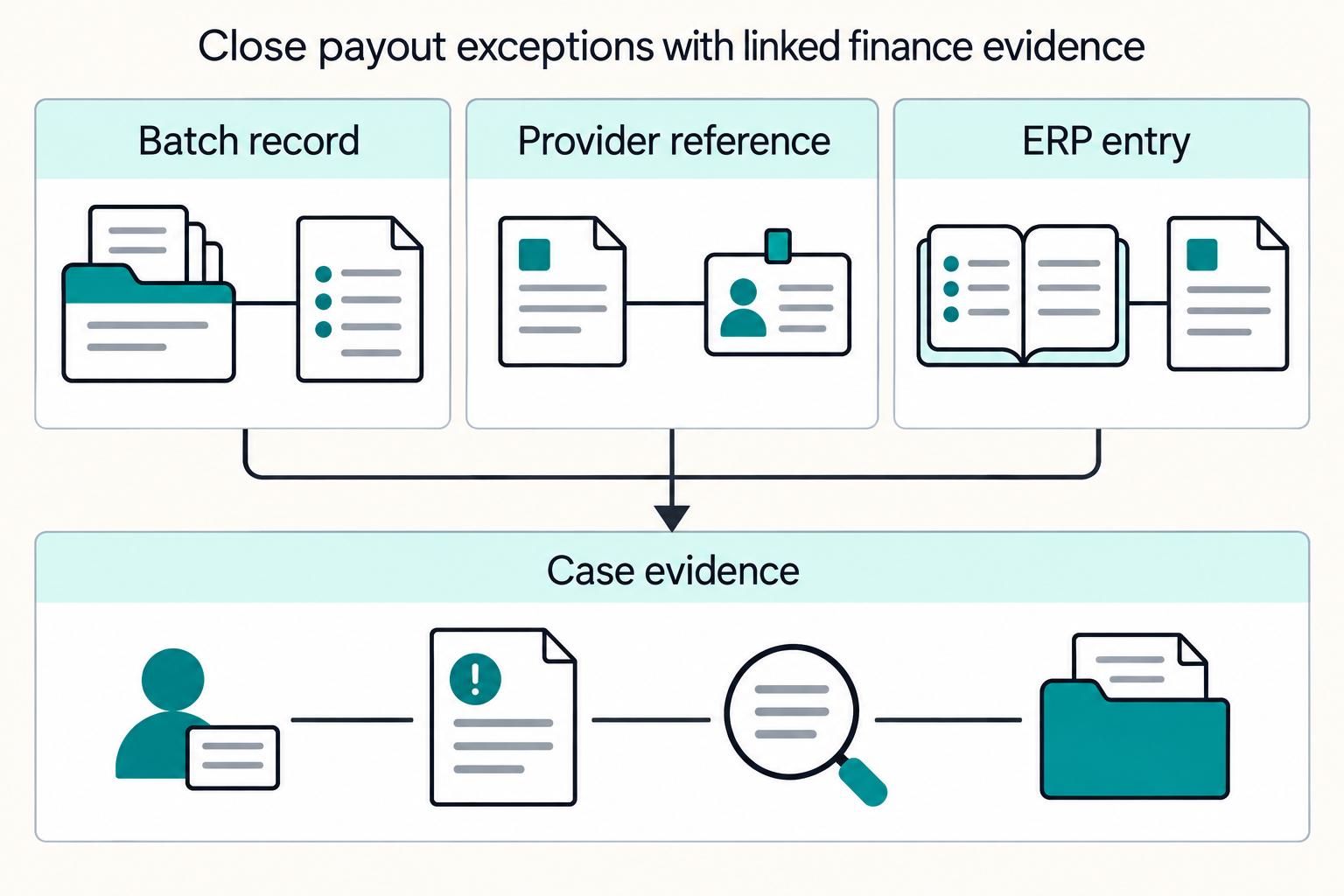
Quick Answer
Build global B2B payouts by defining the operating model first, then validating one full lifecycle end to end before adding more features. This guide recommends a modular platform payments approach: map the money lifecycle to a single source of truth, place compliance gates on money-moving decisions, define clear payout states, and make reconciliation and audit evidence part of the design from day one.
What global B2B teams need from platform payments#
If you are building global B2B payouts, the first win is a coherent operating model, not every money feature on day one. This guide helps you plan platform payments architecture and controls without overbuilding early. It is intentionally written for a cross-functional audience because each team owns a different failure mode:
| Team | Primary concern |
|---|---|
| Founders | launch risk and coverage decisions |
| Product | state design, user experience, and failure handling |
| Engineering | API contracts, webhooks, retries, and posting integrity |
| Finance ops | reconciliation, exceptions, and release, hold, and reversal evidence |
When those groups work from different assumptions, you end up with siloed channels and a disconnected operation. So this guide treats architecture as the practical starting point. Use a clear blueprint, but do not assume every platform needs the same stack. For this scope, align early on what the API should create, which webhook events you will treat as authoritative for state changes, and what the record system needs to capture as the system of record.
The scope is narrow on purpose. This is about platform payments infrastructure from collection through payout, with controls for release, reconciliation, and exceptions. It is not a guide to consumer checkout conversion tactics or generic embedded-finance definitions.
Assume variation up front. Coverage, payout rails, and compliance steps may differ by market and program, so confirm them before launch. Do not infer readiness from a generic demo or another company's setup.
Before you scale, validate one full lifecycle end to end. Here, that means request created, funds state updated, payout submitted, exception handled if needed, and final outcome traceable in records your finance team can use. That is the standard this guide is built to support.
This pairs well with our guide on Building a Virtual Assistant Platform Around Payments Compliance and Payout Design.
Define the stack before you buy tools#
Start with a blueprint, not a vendor shortlist. Define your end-to-end operating scope first, then select tools that fit it. This gives teams a practical starting point and helps avoid siloed decisions.
Align terms internally before procurement. If your teams use labels like Platform Payments, Embedded Finance, and Payment Orchestration, document what each one means in your program. Then have product, engineering, and finance evaluate against the same memo.
This helps prevent a common failure mode: siloed channels that create disconnected outcomes. If a sales narrative blends multiple layers into one pitch, pause and map scope line by line before you buy.
Put MoR in scope before procurement#
Include Merchant of Record (MoR) in your initial scope review, but treat ownership details as contract-specific, not assumed. Confirm responsibilities directly in provider documents and legal review.
Use one practical checkpoint with every vendor. Ask for an architecture diagram plus a report or export sample that shows boundaries, handoffs, and what data lands in your records for downstream analytics and forecasting. If they can demo front-end flows but cannot show clear ownership and records, your stack is still undefined.
For sequencing, prioritize the architecture that addresses your immediate operating risk first. Add adjacent scope only after the core flow and ownership model are clear.
If you want a deeper dive, read The Complete Guide to Platform Payments: Everything a Marketplace Operator Needs to Know.
Pick a modular rollout sequence that matches risk#
A modular rollout only helps when each phase reduces operational drag. If admin work rises and forecasts become uncertain, hold the line and fix the current phase before you add more.
Turning on every layer at once can look fast, but it can create hidden complexity. Keep each module as a gated step, and require one clear reason it exists before you add it.
No universal rollout order is established here. Treat your sequence as an internal hypothesis, then validate it phase by phase with current artifacts, not slideware.
Use pressure signals to decide when to simplify or expand#
If your teams can run the flow without heavy admin overhead, keep it simple. If they are spending most of their time on administrative tasks, deals are stalling, or forecasts are becoming uncertain, treat that as a signal that the current setup needs redesign.
Define phase exits before build starts#
Do not use "MVP" to mean "enabled." Set exit criteria before implementation so product, engineering, and finance ops can assess readiness the same way.
| Phase gate | Owner | Pass condition | Evidence |
|---|---|---|---|
| Scope clarity | Product | The phase goal and handoffs are explicit | Current architecture diagram and operating notes |
| Build readiness | Engineering | The implementation path is operationally manageable | Tested workflow records and failure-handling notes |
| Operational readiness | Finance ops | The phase can be run and reviewed without ad hoc work | Current report or export samples and close-process check |
Require current artifacts at every gate. If the only proof is old implementation material, for example a notebook last updated on Jun 2, 2020, treat it as historical context, not readiness evidence.
Map the full money lifecycle to a single source of truth#
Once you know the rollout order, make one harder decision early: which record wins when product, ops, and finance disagree. In practice, define your own source of truth for money movement, document the lifecycle in order, and make sure each stage traces back to that record.
The sources supporting this guide help with corridor readiness, tax-readiness artifacts, and record design, but they do not hand you a universal payout architecture. Define your lifecycle explicitly, then test whether every handoff leaves evidence your finance and ops teams can actually use.
Walk the lifecycle in order#
If your flow has multiple handoffs, map them in order. At each stage, make the record answer three questions: what changed, who can prove it, and where that proof is stored.
It is not established that any specific component, for example a ledger or wallet view, must be authoritative in your system. Define that ownership explicitly in your design.
| Stage | What to record | Verification checkpoint | Red flag |
|---|---|---|---|
| Initial transaction step | Core identifiers, amounts/currencies, current state | The record links to the originating agreement or payable item | Key fields change without traceable history |
| Mid-lifecycle handoff | Input received and resulting state transition | One documented action explains the state change | Repeated inputs create conflicting state outcomes |
| Finalization and close | Final status, settlement/outcome reference, exceptions | One report ties operational outcome to record impact | Teams report different outcomes for the same transaction |
Separate source context from control design#
Webhook-driven progression, posting logic, and duplicate-handling rules for payouts are not specified here. Treat those as explicit implementation decisions in your own system, not assumptions.
Build the audit trail while the product is still small#
Do not wait for audit pressure to add traceability. At each stage, store a minimum evidence pack at action time: identifiers, actor or approval source, timestamp, and resulting state.
If you cannot trace a single transaction across your documented stages without jumping across tools and teams, your source of truth is not singular yet.
Related: Online Marketplace Payments: The Complete Guide to How Two-Sided Platforms Process Money.
Put compliance gates where failures actually happen#
Put gates at the decision points that can move money, and state exactly what action they block. If a gate cannot be explained in one sentence with an owner and attached evidence, it is not production-ready.
Use this section as an operating design pattern, not authoritative legal guidance for KYC, KYB, AML, tax forms, or regional payout law. Program-level gate requirements still need provider documentation, current policy review, and counsel where required.
Gate decisions, not side workflows#
A gate only works if it can stop the exact state change that creates risk. Keep gate status on the same operational record your product, ops, and finance teams use to make payout decisions.
| Gate type | Trigger event | Blocked action | Required evidence | Override path |
|---|---|---|---|---|
| Account state gate | Account creation or profile change requiring review | Account enablement or payout setup | Current status, decision source, timestamp, linked record | Named owner records reason and expiry on the account record |
| Event review gate | Operational event or case trigger | State progression or payout eligibility | Case outcome, timestamp, disposition, evidence pointer | Designated escalation owner with documented approval tied to the record |
| Payout release gate | Payout request, batch submission, or manual release attempt | Payout submission or release | Approval state, funding linkage, open-hold check | Documented exception attached to the payout record before release |
| Document state gate | Required document-status change | Payout enablement or account completion | Current document status, timestamp, required evidence pointer | Finance or ops owner records exception scope and effective period |
Use this table as a control template, not a legal rulebook. Keep the evidence pack simple and queryable. A practical minimum per gate is:
- status
- timestamp
- owner or approval source
- evidence link or document reference
- override reason, if any
The key operational point is simple: approval workflows become hard to keep timely and effective when status and timing are unclear. Avoid vague notes like "compliance cleared" and store structured fields that can be queried and audited.
Treat document states as product states#
If your program includes document checks, represent them as explicit product states, not back-office cleanup. Your system should be able to answer, from the record itself, what is required, what is currently on file, and what is blocked until it is resolved.
If those answers live in inboxes, chat, or memory, exceptions can grow and payout release can drift into manual handling.
Handle program differences before launch, not after#
Do not assume one gate flow carries over unchanged into every corridor or program. Specific regional compliance differences must be validated separately.
Before enabling a new corridor, require a written, owner-approved statement of what changes in gate definitions, blocked actions, and evidence requirements. If that cannot be stated clearly, the corridor is not ready to ship.
Need the full breakdown? Read How to Launch a Legal Compliance Platform for Freelancers and Handle Their Payments.
Choose architecture with explicit tradeoffs#
Choose the architecture you can explain and audit end to end. For this decision, treat every tradeoff as something to validate in your own stack, because this guide does not provide benchmark data for payout-architecture performance.
Three shapes, three risk profiles#
A direct integration is one deep connection to one provider. It may look straightforward in a narrow scope, but you should test how tightly provider states and compliance handling become coupled to your product model.
Payment Orchestration is a routing layer across providers behind one internal contract. Use it as a flexibility strategy only if you verify that normalization does not hide provider-level details your ops and finance teams need during investigations.
A modular stack with Gruv components can combine modules such as Virtual Accounts, Payouts, and Merchant of Record (MoR) workflows where enabled, instead of one all-in pattern. It can preserve control boundaries only if you define a clear source of truth and stable event-to-record mappings.
| Architecture option | Best fit scenario | Failure mode to test early |
|---|---|---|
| Direct integration | Narrow initial scope with limited provider variation | Provider-specific logic may spread into core product states and become hard to unwind |
| Payment Orchestration | You expect multi-provider routing or redundancy needs | Critical provider detail may be abstracted away from reconciliation and exception handling |
| Modular stack with Gruv components | You want modular control over money movement and records | Ownership boundaries may be unclear, so evidence and status fragment across systems |
Score what is expensive to change#
Do not decide on launch speed alone. Score each option against the questions below, especially the parts that are expensive to reverse later:
- How fast can you ship the first corridor without creating manual reconciliation work?
- How hard is provider replacement without rewriting approval and payout states?
- What is your outage blast radius if one provider path fails?
- How many systems must finance join to reconcile one payout batch?
- How clearly can blocked actions be tied to KYC, KYB, AML, tax, or VAT document states where enabled?
Include a cost-of-change pass now. If your roadmap may add Virtual Accounts or Merchant of Record (MoR) workflows where enabled, test whether today's model still works without re-architecting core records.
Verify before committing#
Before you commit, run a tabletop on one payout batch through approval, provider outage, return or reversal, and a compliance-state change. Your architecture is only ready if one record can still show hold status, provider reference, internal posting trail, and release evidence.
Ask for artifacts, not assurances: sample status exports, webhook payload examples, reversal handling, and the exact fields linking document state to payout eligibility.
For a practical implementation example, see IndieHacker Platform Guide: How to Add Revenue Share Payments Without a Finance Team.
Build payout operations for retries, returns, and exceptions#
You are not ready to scale until each payout batch has a clear internal lifecycle and reconciliation checkpoints. Treat statuses as an operational control surface, not just UI labels, and keep the flow explicit: collect, hold or gate, disburse, then reconcile and report.
Define internal states as your contract#
Provider wording can differ, so define your own state meanings and required evidence before a batch moves. That way, product, ops, and finance are working from the same contract.
| State category | Operational meaning | Required checkpoint |
|---|---|---|
| Pre-disbursement gate | Approved internally but not released yet | Approval record exists and policy/compliance gates are met |
| Disbursement in progress | Released and waiting for downstream confirmation | Provider reference is captured and linked to the batch |
| Reconciled completion | Confirmed enough to close in payout ops | Confirmation reconciles to ERP entries and payout batch references |
| Exception path | Not complete and requires follow-up before closure | Next action is documented and reconciliation impact is recorded |
Handle failures in a fixed order#
Handle payout failures in a fixed order so the team does not improvise under pressure. Use the same sequence every time:
- Identify the exception path and decide whether disbursement should be gated.
- Capture provider confirmations and batch references in the operating record.
- Reconcile outcomes to ERP entries and payout batch references before closure.
- Verify ops can tie final payout releases back to finance records so transaction risk remains visible.
Do not scale until provider confirmations reconcile to ERP entries and payout batch references without manual guesswork.
Design for asynchronous timing#
If you start with files and then automate with APIs/webhooks, keep the same traceability requirements. Your records should still let you trace each batch to funding currency, conversion timestamp, and settlement timestamp so investigations and FX-risk checks remain explainable from transaction date to settlement date.
Run an exceptions queue with clear ownership#
Define exception ownership and required evidence in your internal process. A practical record includes internal batch ID, provider reference, related ERP entry, payout batch reference, and the evidence required to close the case.
Use artifacts to close cases: approval records, provider confirmations, and records that tie final payout releases back to operations and finance.
For a step-by-step walkthrough, see How to Write a Payments and Compliance Policy for Your Gig Platform.
Handle FX without introducing hidden operational risk#
Treat FX as a control-design question, not a solved rule in the material here. The available evidence points to operational pain points in 2022, but it does not provide direct FX workflow mechanics.
| Check | What to define |
|---|---|
| FX record attachment | Confirm where the FX record is attached in your flow (funding event, payout instruction, or both) |
| Field validation | Validate currency, amount, quote/reference ID, and timing fields before release |
| Payout-critical value changes | Define which payout-critical value changes require re-approval |
| Investigation trail | Persist an investigation trail in the transaction record: reference IDs, timestamps, approvals, and outcomes |
| Quote expiry and payout execution | If quote expiry and payout execution are separate steps, assess conversion-failure risk explicitly |
Before release, confirm which FX artifact your provider treats as executable and traceable for the payout path.
Whether Virtual Accounts reduce conversions in multi-currency flows depends on implementation. In embedded-finance UX, keep estimate labels explicit and mark values final only when the executable conversion artifact is linked to payout release.
Make finance ops audit-ready from day one#
Audit readiness starts with evidence you can close against. Keep one date-stamped record set for operational activity, and avoid siloed systems that produce inconsistent answers at month-end.
Use a single close package anchored to your transaction record, then link the operational trail that explains how records moved or changed. Treat this as a practical operating baseline, not a universal standard.
| Artifact | What it should answer | Checkpoint | Common failure mode |
|---|---|---|---|
| Period snapshot | What posted in-period and what stayed open | Period and generation timestamp are explicit | Teams use different extracts and totals drift |
| Central reporting view | Whether operational records agree across teams | Operational data lands in one analytics or reporting store | Siloed systems produce inconsistent outputs |
| Open-item tracker | What still needs follow-up and current state | Owner and latest update date are visible | Open items age out of view and return as unexplained variance |
| Formal reporting artifact (for example, a 10-K filing page) | What period the report covers and when it was filed | Coverage window and filing date are clear | Internal records and formal reporting cannot be matched quickly |
Connect operational artifacts to close#
Keep operational status in the same reporting view as posting activity. The goal is simple: explain, from one place, how records moved or were held.
A reliable checkpoint pattern is centralizing operational data into one analytics or reporting store. The failure pattern is the inverse: siloed systems produce inconsistent outputs across teams.
Reconciliation checkpoints that catch drift early#
Name your checkpoints early and keep them period-bounded and timestamped. Reconcile activity and open items from the same close package, and keep unresolved items visible until they are resolved.
Red flags before month-end#
Watch for record-linkage drift before close:
- different teams export different numbers for the same period
- the same operational event appears differently across systems
- open items grow without clear ownership or update dates
- period snapshots are missing clear generation timestamps
If these appear, pause reporting cuts and fix record linkage first. Cleaner closes come from fewer disconnected records, not more spreadsheet work.
You might also find this useful: Upskilling Platform Finance Teams for Payments Compliance and Automation.
Decide what to embed now versus later#
Default to sequencing: stabilize the core money path first, then layer adjacent products. Build around a modular flow (Collect -> Hold/Gate -> Disburse -> Reconcile/Report) before expanding into additional embedded features.
Before you add monetized embedded features, run a live pilot and confirm coverage, onboarding requirements, and reconciliation outputs in production-like conditions. In the same pilot, verify how funds are sourced and what hold and release controls exist so your policy gates behave as intended. If tax form collection is in scope, verify capability scope before you rely on it.
Apply the same test to Merchant of Record (MoR). It can be a strong fit when you need MoR-style B2B invoicing, explicit compliance gates, and reconciliation-ready records in one flow. If contracting and tax-liability ownership are still unclear, resolve that early, since ownership depends on your model and configuration.
The practical target is to validate ownership, controls, and reconciliation outputs before layering adjacent features.
90-day execution checklist by team#
Treat this 90-day window as a controlled pilot, not a broad rollout. Expand corridors only when you can show three things end to end: aligned due-date logic, KYC- or KYB-aligned readiness checks, and traceable invoice-to-ledger evidence.
| Team | Primary focus | Key check |
|---|---|---|
| Product | Define launch corridors and compliance-gated user states before expanding scope | Use one due-date interpretation across invoice records, aging views, funds-received timestamps, and payout-release rules |
| Engineering | Lock the pilot transaction path before expansion and keep it auditable end to end | Keep traceability from invoice record to funds-received timestamp to payout-batch action to ledger posting |
| Finance and ops | Set reconciliation cadence, exception ownership, and audit artifact retention before volume grows | Keep invoice data, due date, funds-received timestamp, KYC or KYB status, payout-batch status, exception notes, and the matching ledger trail |
| Leadership | Use each checkpoint for a clear go, hold, or scope-cut decision based on reliability and readiness | Day 30: due-date alignment and compliance-gated state logic; Day 60: payout-batch controls and invoice-to-ledger traceability; Day 90: expand, narrow scope, or stay in pilot |
Product#
Product should define launch corridors and compliance-gated user states before expanding scope. Name exactly which payer and payee paths are in scope, what counts as "funds received," and which states stay blocked until required checks clear.
Use one due-date interpretation across invoice records, aging views, funds-received timestamps, and payout-release rules. If those records diverge, teams can misclassify agreed contractual timing as delay and make corridor performance look better or worse than it is.
Engineering#
Engineering should lock the pilot transaction path before expansion and keep it auditable end to end.
For each pilot transaction, keep traceability from invoice record to funds-received timestamp to payout-batch action to ledger posting. Make state changes and exception handling explicit so teams can explain outcomes without reconstructing events manually.
Finance and ops#
Finance and ops should set reconciliation cadence, exception ownership, and audit artifact retention before volume grows. Keep the records needed to explain timing and release decisions without manual reconstruction. That includes invoice data, due date, funds-received timestamp, KYC or KYB status, payout-batch status, exception notes, and the matching ledger trail.
Separate "paid on agreed terms" from true late payment. A late payment is made after the contractual or statutory period, and evidence is mixed on whether longer terms alone drive actual payment timing, so measure before assuming.
Leadership at day 30, 60, and 90#
Use each checkpoint for a clear go, hold, or scope-cut decision based on reliability and readiness, not dashboard polish.
- Day 30: confirm due-date alignment and compliance-gated state logic
- Day 60: confirm payout-batch controls and invoice-to-ledger traceability under pilot conditions
- Day 90: decide whether to expand, narrow scope, or stay in pilot
Hold if the team cannot clearly explain where delay starts, what blocked payout release, or how a payment moved through the transaction record. For deeper context on delay measurement, see Late Payments Epidemic: How Platform Operators Can Fix the Global B2B Payment Delay Crisis.
Related reading: Scaling a Global Payout Platform from 100 to 10000 Monthly Payments.
Turn this checklist into implementation tickets and webhook/ledger test cases in the Gruv docs, so each team is testing the same release conditions and records.
Conclusion#
Win by sequencing the money path correctly, not by launching every feature at once. Teams usually move faster when they make one corridor work end to end, then add complexity only after the core path is stable.
These programs can fail at the handoffs when teams work in silos. Product promises one experience, operations runs another, and finance works from separate reporting. That disconnected execution is what can turn a promising launch into costly rework.
Your operating standard should stay practical: clear checkpoints and records your team can actually review when exceptions show up. If your team cannot explain what happened at each stage from records it can pull, you are not ready to scale. The goal is not theoretical completeness. It is direct observation from live execution.
Treat this architecture as a practical starting point, not something to copy blindly. Use it to speed decisions, then validate it against your actual constraints and operating capacity.
A practical next step is simple. Take the first corridor through three checks:
- Confirm scope before roadmap promises. Verify the corridor you want to launch, who owns each handoff, and which reporting outputs stakeholders will use.
- Pick rollout order by operational risk, not feature appeal. If execution accuracy is your main exposure, stabilize the core flow and handoffs before layering additional capabilities.
- Validate the first corridor under normal and broken conditions. Test a clean path and exception paths, then confirm outcomes match what product, ops, and finance expect.
Once the first corridor is boring, explainable, and auditable, scaling gets much easier. If you want corridor-by-corridor validation before launch, talk to Gruv.
Frequently Asked Questions
What is the practical difference between platform payments, embedded finance, and payment orchestration?
Platform payments is the operating layer for collect, hold or gate, disburse, then reconcile and report. Embedded finance is how those capabilities appear inside your product. Payment orchestration scope varies by vendor, so confirm what it includes in your model before adding another layer.
What are the minimum compliance gates before enabling cross-border payouts?
There is no universal minimum checklist for every market. KYC and KYB workflows vary by account type and region, and contracting or tax liability can change with your model and configuration. Before enabling a corridor, define explicit onboarding and payout-release gates, then validate coverage, onboarding requirements, controls, and reconciliation outputs in a live pilot.
Should we implement collections, walleting, FX, or payouts first for a B2B platform?
There is no single correct rollout order for every B2B platform. Keep collect, gate, disburse, and reconcile working as one modular flow. If reliable disbursement is the core need, prioritize payout operations with batching, validation, controls, and an audit-friendly status model.
How should we handle payout failures, returns, and stale FX quotes operationally?
Treat failures and returns as controlled exceptions with clear validation, controls, and auditable statuses. Keep state changes explicit so finance and ops can trace outcomes through reconciliation. Define retry, return, and FX quote rules for your own model and configuration during implementation.
What controls does a finance team need for audit-ready global payouts?
Finance needs predictable states, finance-friendly reporting, and an audit-friendly payout status model. Keep records that explain release and exception decisions, including status history tied to compliance gates and reconciliation. A practical check is whether someone outside implementation can trace one payout from funds handling to release and reconciliation without reconstruction.
When should we use a single-vendor stack versus a multi-provider model?
Start with a single-vendor stack when one provider can meet coverage, onboarding, controls, and reconciliation needs in a live pilot. Move to multi-provider when pilot results show coverage gaps, onboarding differences, or workflow requirements one provider cannot meet. Before splitting providers, confirm coverage, onboarding requirements, and reconciliation outputs in a live pilot.
Researched and edited by the Gruv editorial team. Gruv builds cross-border billing, payouts, and finance-operations software for global businesses.
Sources
Includes 1 external source outside the trusted-domain allowlist.
Educational content only. Not legal, tax, or financial advice.
Related Posts

The Freelance Payment Penalty: A Modeled Audit of Platform Fees, FX Spreads, and Payout Delays
The money rarely disappears through a single, easy-to-spot fee. The real loss is stacked. A marketplace takes its commission, a processor adds a charge for international cards, a bank or payment company converts the currency at a spread, a platform holds the funds before release, and a wire sheds a little to intermediaries on the way in. Each layer looks defensible on its own, but the worker feels the combined result as a smaller deposit and a later payday.

How to Respond to a Subpoena for Business Records
Move fast, but do not produce records on instinct. If you need to **respond to a subpoena for business records**, your immediate job is to control deadlines, preserve records, and make any later production defensible.
A US Expat's Guide to Investing in UCITS ETFs to Avoid PFIC Issues
The real problem is a two-system conflict. U.S. tax treatment can punish the wrong fund choice, while local product-access constraints can block the funds you want to buy in the first place. For **us expat ucits etfs**, the practical question is not "Which product is best?" It is "What can I access, report, and keep doing every year without guessing?" Use this four-part filter before any trade: