
Quick Answer
Choose the ownership model first: Merchant of Record for simpler early rollout, or split flows for tighter control of settlement, disputes, and tax records. Then validate the path with evidence, not demos, by saving the exact Stripe and PayPal fee pages, domestic vs international definitions, and payout assumptions. Before scaling, confirm idempotency keys, webhook replay handling, and a stop rule for unexplained ledger drift.
Marketplace Payments Architecture: MoR vs Split Flows, Real Margins, and Launch Controls
What a durable platform payments architecture needs to support#
Platform payments are an operating design problem before they are a checkout feature. What looks simple to a buyer usually means you need to control money movement, split logic, fund holds or releases, and payouts.
That is built into the marketplace model. In a marketplace, third-party sellers offer goods or services and the operator processes the transaction. In practice, that usually means dividing funds between seller proceeds and platform commission, and often delaying payouts or holding funds to reduce fraud and non-delivery risk.
This article is for the people who have to make those choices in production: founders, finance and ops leads, and engineering owners. The real question is not just, "Can we take payments?" It is, "Can we control the money flow well enough to launch cleanly and keep it manageable as volume grows?" Growth can raise users and value while costs surge. Scaling means adding revenue without costs rising at the same rate.
A good starting point is to make provider selection the output of requirements, not the other way around. Before you compare providers, write down the payment features your business actually needs:
- country support for the markets you plan to launch in
- currency support for how buyers pay and sellers get paid
- fee categories you expect to absorb or pass through
- integration complexity, especially where split payments, held funds, or compliance requirements matter
If your comparison sheet does not cover those four items, the decision is still too early. A side-by-side comparison artifact exposes tradeoffs that look minor in a demo and can turn expensive after launch.
Do not leave core mechanics vague. If your model depends on automatic fund splitting or on holding funds until delivery or completion, treat those as first-class requirements now. They shape your economics, your product promises, and your operating load as you grow.
This article gives you a decision path for provider choices and a launch checklist for payment operations. Where requirements vary by market or program, each section points to what you should confirm before go-live.
Use one rule throughout. Do not approve a payments architecture until you can explain who gets paid, why funds may be held, how commission logic works, and whether provider support matches your real countries and currencies.
Related: The Platform Payments Glossary: 200 Terms Every Marketplace Operator Should Know.
Start with the right mental model of platform payments#
Define terms and evidence before you choose tools. If your team uses the same word to mean different things, reporting can drift quickly and teams may not explain the same transaction the same way.
Terms like settlement, payout, reversal, chargebacks, ledger, and webhooks often get treated as obvious. In practice, finance, ops, engineering, and support can attach different meanings to the same word unless you make those meanings explicit.
This is not just a wording problem. It is an operating problem. In broader platform-work research, weak understanding is linked to unclear definitions and limited data. The OECD, ILO, and European Commission launched a Joint Expert Group on Measuring Platform Work in 2019, and the OECD handbook frames measurement through formal guidelines. The WEF also maps platform categories and highlights both opportunities and challenges for workers. The useful takeaway here is simple: create your own measurement artifact early.
A lightweight version is enough:
- a short definitions sheet for core terms
- a simple map of when key states can change
- a record list of what counts as evidence
Then pressure-test it on one real transaction. If finance and ops cannot explain the same amount consistently using the same records, your model is not ready for production.
If you want a deeper dive, read Online Marketplace Payments: The Complete Guide to How Two-Sided Platforms Process Money.
Choose your architecture before you choose providers#
Choose the money-ownership model first, then pick providers. Changing providers can be painful. Changing who collects funds, settles them, handles disputes, and owns payout or tax records can create migration work across contracts, data, support, and finance.
A common framing is Merchant of Record (MoR) versus a pure marketplace split model:
- MoR-style path: can reduce early implementation complexity, depending on provider and contract terms.
- Pure marketplace split path: can provide more direct control over split and payout behavior, with more operating design work up front.
Once that ownership choice is clear, compare providers against the architecture you actually want to run.
Start with ownership, not API shape#
Decide ownership boundaries before you get pulled into implementation details. If ownership is fuzzy, reversals, exceptions, and tax reporting can expose the gap quickly.
Use these questions as your architecture gate:
- Who is closest to customer charge collection?
- Who is treated as owning settlement flow?
- Who responds to and evidences disputes?
- Who owns payout and tax-reporting records?
Do not infer legal liability from pricing pages or product marketing. Confirm legal allocation through contracts, counsel, and provider documentation for each launch market.
Compare rails using verifiable artifacts, not headline rates#
Model your expected payment mix and verify it against provider fee artifacts. Headline domestic-card pricing alone can hide real cost.
| Option | What you can verify now | Cost drift to watch | Approval checkpoint |
|---|---|---|---|
| Stripe | Pay-as-you-go pricing with no setup, monthly, or hidden fees; published pricing includes 2.9% + 30¢ per successful domestic card transaction, plus 0.5% for manually entered cards, 1.5% for international cards, and 1% if currency conversion is required. Stripe also notes custom pricing for large volume or unique models. | Models that only use domestic-card pricing understate cost when international cards or FX are in the mix. | Save the pricing page used for approval, document mix assumptions, and confirm whether custom pricing applies. |
| PayPal | Market-specific fee pages and downloadable PDFs are available; business fee materials cover payouts, chargebacks, disputes, and currency conversion. PayPal defines Domestic as same market and International as different markets. | Rates apply to the listed relevant market/region, and assumptions can age because fee or rate changes may be posted via the Policy Updates Page. PayPal's Iceland consumer page also notes some EEA EUR/SEK international flows are treated as domestic for fee application. | Save the exact country page or PDF and last-updated stamp used for signoff. Example stamps shown on PayPal pages include February 9, 2026 (US business), February 19, 2026 (US consumer), and 21, April 2025 (Iceland consumer). |
| Bank-transfer rails via VBAs | The cited Stripe and PayPal fee excerpts do not establish public VBA pricing or rules. Treat this as a separate diligence track. | Cost modeling can vary with settlement timing, returns or rejections, FX, and rail-specific schedules. | Get fee schedule, settlement timing, return or rejection behavior, and supported geographies in writing before modeling VBA rails. |
Decide what you are willing to migrate later#
Some decisions are painful to unwind once volume shows up, so lock them early:
| Decision area | What to lock early |
|---|---|
| Account structure | Provider-side identity and role mapping for platform and payees |
| Settlement ownership | Who is treated as receiving settled funds first |
| Dispute ownership | Who responds, funds, and evidences disputes |
| Tax document ownership | Who collects and stores required tax records |
If these are still unresolved at launch planning, the architecture is not ready to lock.
Practical decision rule#
Choose the path that fits your priorities between operational simplicity and control, and document the tradeoff explicitly before signoff.
For signoff, keep a tight record. Save the exact fee pages, last-updated dates, domestic and international definitions, your payment-method and currency-mix assumptions, and written ownership decisions for settlement, disputes, and tax documents.
Map the full money lifecycle your teams must operate#
Treat payouts as one explicit operating flow: onboard payees, create payouts, route rails, then track status until each payment is cleared, failed, or requires action.
| Stage | What your team should define |
|---|---|
| Payee onboarding | Capture tax forms, bank details, and run compliance checks up front (including W-9 for U.S. and W-8 for international payees). |
| Payout creation | Standardize how payouts are initiated: one API call for batch generation or a CSV upload with payee IDs and amounts. |
| Rail routing | Route each payout based on payee preference (for example ACH, wire, push-to-card, or PayPal). |
| Status tracking | Treat webhook updates as operational triggers and monitor each state: cleared, failed, or requires action. |
Keep payout visibility tight for both internal teams and payees. When payees cannot see payout status, support load rises and trust drops.
Put compliance gates in the flow, not in policy docs#
Compliance is strongest when it changes what can happen in the money flow. Identity, legitimacy, and compliance checks should block or unlock higher-risk actions like account activation and first payout, instead of living in a policy doc disconnected from operations.
Onboarding is a control point, not just intake. It is the first line of defense against fraud, regulatory penalties, and reputational damage. Your flow should show exactly where identity and legitimacy are verified, where documents are collected and reviewed, and where background checks are completed before payout eligibility is granted.
Gate the actions that create risk#
Put checks at the moments that change risk:
| Risk point | Control |
|---|---|
| Onboarding | Complete identity and legitimacy verification, document review, and background checks before full account operation |
| Payout unlock | Confirm required documents and internal requirements before the first payout |
| Risk changes | Trigger additional review when account risk materially increases |
If your team cannot trace the exact step where an account moved from pending review to payout-eligible, the control is too loose.
Define hold and release before you need it#
Set hold-and-release logic before alerts start firing. For risk alerts, define what is paused, who reviews, and how the decision is recorded.
Use a case record for manual releases with the trigger, documents reviewed, reviewer, rationale, and final payout decision. That prevents ad hoc overrides without creating the opposite failure mode, where every minor flag becomes a permanent freeze. The tradeoff is real. Weak controls increase losses, while excessive strictness can reduce merchant conversion.
Use control artifacts your teams can actually operate#
A policy is not enough. The real test is whether your teams can run the control day to day. In payment systems, that usually means operational artifacts tied to policies and procedures, internal controls, risk assessment, and management reporting.
Traditional acquirers are often cited as taking 3-7 days to onboard a merchant. You do not need to copy that timeline. But if you compress review time, be explicit about which checks remain mandatory and which actions stay blocked until review is complete.
Add jurisdiction and program branches early#
Do not force every market through one global path. Build jurisdiction and program branches into the flow early where requirements differ.
When handling is unclear for a market or program, keep the account restricted until legal, tax, and operations owners confirm the path. Control design should reflect the specific risk context of each institution and program.
Model real margins before launch, not headline take rate#
Headline commission is a weak pricing input. Look at the margin left after the full money lifecycle has done its work.
Build the cost stack you will actually pay#
Model the cost stack against the actual payment path and final settlement outcome, not one blended rate.
| Cost line | What to model | Verification checkpoint |
|---|---|---|
| Collection fee | Card, wallet, ACH, and channel-specific rate by provider | Stripe lists 2.9% + 30¢ for domestic cards, plus +0.5% for manually entered cards, +1.5% for international cards, and +1% if currency conversion is required; Stripe also states no setup, monthly, or hidden fees. |
| PayPal collection variants | Separate rates by product and checkout path | PayPal US business pricing shows multiple rates, including 2.89% + $0.29, 2.99% + $0.49, 3.49% + $0.49, and 4.99% + $0.49. |
| Payout cost | Fee assumptions by payout route and destination, plus retry-handling assumptions | PayPal fee docs include a distinct PayPal Payouts section. |
| FX cost | Provider conversion fee plus external bank or card exchange-fee exposure | Stripe lists +1% when currency conversion is required; PayPal fee docs include Currency Conversions and note bank or card exchange fees may still apply. |
| Disputes and chargebacks | Case-fee and loss exposure, plus handling effort | PayPal merchant fee docs include separate Dispute Fees and Chargeback Fees sections. |
| Reserves | Liquidity impact and delayed access to funds | Model reserves explicitly as an assumption; do not assume zero because a public page omits your reserve terms. |
| Operational overhead | Manual review, support, reconciliation, retry handling, payout exceptions | Track unit cost or time per exception so operating cost is visible in margin decisions. |
Do not flatten provider logic into one line item. On PayPal, "Domestic" and "International" are different transaction contexts, and published rates are scoped by market or region.
Keep fee artifacts in the model as checkpoints. PayPal provides a downloadable PDF and shows a page timestamp, for example Last Updated: February 9, 2026 on the US merchant fees page. That helps control drift.
Gross commission breaks at settlement#
Gross commission is a booking number. Net margin is what remains after modeled fee lines and lifecycle events after checkout.
Use a simple test. Trace sample orders through posted states and confirm the model handles successful collections, collections with disputes or chargebacks, successful payouts, failed payouts, and retries.
Basket shape changes the economics#
Basket mix changes which costs hurt most. In low-ticket, high-frequency flows, fixed per-transaction components like 30¢, $0.29, or $0.49 can eat margin quickly. In high-ticket, lower-frequency flows, percentage costs, international surcharges, FX, dispute exposure, and reserve assumptions usually matter more per event.
If you run both profiles, segment the model by basket type, payment method, and domestic versus international flow.
Delay pricing changes until adverse cases are in the model#
Do not change launch pricing until effective margin has been stress-tested for disputes, chargebacks, currency conversion, and payout retries. At minimum, test domestic card, international card, currency-conversion, disputed or chargeback, and failed-payout-retry scenarios against provider fee schedules and settlement records.
If your model uses one PayPal rate for all traffic, ignores Stripe surcharges, or sets reserves and operations cost to zero, you do not have a decision-ready margin model. You have a headline take-rate sheet.
Related reading: IndieHacker Platform Guide: How to Add Revenue Share Payments Without a Finance Team.
Design payouts for reliability and exception recovery#
Payout reliability is really exception recovery. If you cannot see state clearly, assign ownership clearly, and recover from failure consistently, payout volume will expose that weakness fast.
Organize payout operations for visibility#
Do not run payouts as one undifferentiated stream. Build operations views that show what was submitted, what is still pending, what completed, and what moved into exception handling.
That matters because payout recipients are waiting for funds after fulfillment, and marketplace admins usually end up owning back-office work such as disputes, fraud prevention, and compliance activity. If payout state is visible only in engineering logs or provider tools, operations will struggle to answer payee questions or resolve failures quickly.
Use stable references so recovery stays controlled#
Give each payout case a stable internal reference so your team can trace status changes and tell follow-up work from a new send. The goal is simple: one payout intent, one traceable lifecycle, and less ambiguity during recovery.
Apply the same reference across status updates from external systems so repeated updates are easier to triage and do not blur active and resolved exception cases.
Build explicit exception queues and case evidence#
Name exception queues up front so failed payouts and review-required cases do not get mixed together. Different exception types need different next actions, and mixed queues slow recovery.
Attach core evidence to each case: payout reference, recipient record, and the underlying order or service record. Where fulfillment proof is part of operations, keep it in the same case record so exceptions do not stall on missing context.
Define ownership and response expectations#
Exceptions move faster when they always have a named owner and a clear next step. Document who responds first, who can resolve directly, and when to escalate to specialist support.
If an exception sits without ownership or action, treat it as an operational risk, not a normal delay.
Implement API and webhook controls that prevent duplicate money movement#
Start with one rule. Every money-moving request must be safe to retry, and repeated inbound events must not create repeated state changes in your records. That is how you stop timeout ambiguity from becoming duplicate payments or long manual investigations.
Make retries safe before you add scale#
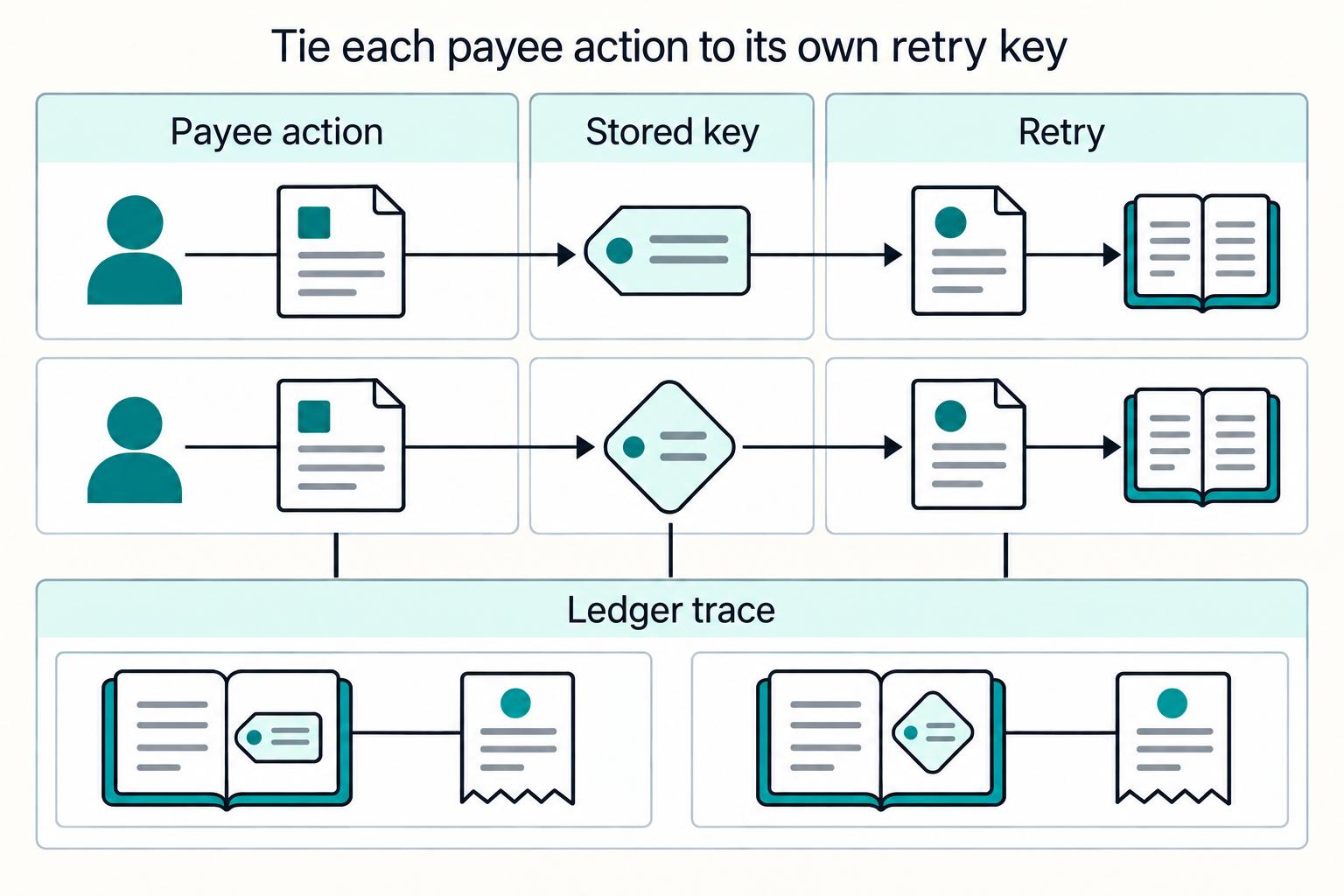
Require Idempotency Keys on endpoints that create or move funds. Idempotency means the same request input returns the same result, which is what makes retries after network timeouts safe.
Implementation order matters. Generate a unique key, store it server-side before calling the provider API, and reuse that key on retries. For batch payouts, map keys to individual payee actions instead of using one key for the whole batch.
This is not edge-case hardening. One documented failure mode is the ambiguous timeout where teams must either risk paying twice or manually verify what succeeded. A vendor source also claims duplicate payments can cost about 0.8-2% of annual disbursements, with a $5M/month example showing $40K-$100K/year before recovery costs. The risk direction is clear even if your own rate differs.
Set an explicit retention window for idempotency-key lookups. A universal duration is not established, so define yours based on your retry horizon, provider behavior, and support investigation window.
Treat webhooks as a contract, not just a notification#
Webhooks can replace repeated status polling by pushing payment updates to your endpoint. Treat that feed as a strict event contract. Define which payload fields you accept and which fields you persist for processing.
Use API keys and domain whitelisting to verify event origin. On the operating side, test duplicate delivery behavior directly. Resend the same webhook payload multiple times in a test environment and confirm your system applies one state transition, not multiple money movements or duplicate ledger effects.
Keep traceability from request to ledger state#
For each movement of funds, link your internal request record, payment identifiers from webhook payloads, and resulting Ledger state so exceptions can be investigated quickly.
Store the core evidence on the transaction record itself: idempotency key, internal request ID, payment ID from the webhook payload, normalized event status, raw webhook payload, and related ledger entry IDs.
Plan for cross-border timing risk and FX behavior#
Cross-border timing risk can come from gaps between collection, settlement, conversion, and payout, not only from a single transfer event. These flows are often slower and less transparent than domestic payments, and they can pass through multiple systems where interoperability is limited.
Separate indicative FX rates from firm executable quotes in your product and records when both are used. Use indicative rates for display, and record firm quotes as decision artifacts with their own quote reference, timestamp, source amount, target amount, currency pair, and (if applicable) expiry. If a quote is no longer valid at payout time, follow your internal requote-or-delay policy instead of reusing stale data.
Keep FX evidence on the same transaction or ledger trail you use for money movement, including:
- collection currency and amount
- settlement currency and settlement timestamp
- rate type, either indicative or firm
- quote reference, quote timestamp, and expiry
- conversion timestamp and payout currency amount
Map timing at the corridor level so treasury and ops can plan around observed delays, not assumed ones. Cross-border journeys may span stages like card funding, domestic transfer, and later refund or payout handling, so collection in one currency may not immediately support payout in another.
Define internal rules for when to hold funds, convert, or release payout based on your risk posture and payout-window commitments. Where quote-validity windows and payout latency overlap, consider moving conversion closer to payout or adjusting the payout window.
Set up tax and documentation operations early#
Set up tax-document operations before payouts go live. You can automate document handling, but tax judgment should stay with the user and their advisor.
Decide where each artifact is collected, where its status is stored, and where ops reviews it. The key control is one status record ops can trust across systems: missing, received, under review, accepted, expired, or needs refresh.
| Artifact or topic | What your platform can automate | What should stay outside platform judgment |
|---|---|---|
| FEIE-related submissions | Store questionnaire or documents, tag claimed tax year and date window, status, and reminders | Whether the user is a qualifying individual or may exclude income |
If your operating model uses documentation gates, make the gate read from machine-usable status fields, not support notes. Keep scope explicit in product and support copy: the platform handles collection and status tracking, while users confirm filing and eligibility decisions with advisors.
Limit visibility by default. Most ops users only need status and next action, not full tax identifiers or raw files. Keep an audit trail of status changes, who made them, and when.
FEIE is where boundaries often blur. The IRS states FEIE applies only to a qualifying individual with foreign earned income, and the person still files a U.S. return reporting that income. Under the physical presence test, the checkpoint is 330 full days in 12 consecutive months. A full day is 24 consecutive hours from midnight to midnight, and days count only while the tax home is in a foreign country.
Use support language that explains the rule, but do not confirm personal eligibility. Failing the 330-day requirement does not turn into a pass because of common disruptions. If a user cites war or civil unrest, route to advisor review and note that the IRS publishes annual Revenue Procedure guidance on waivers. Keep timing clear in ops notes too. Exclusion calculations apply to the year income was earned, which can differ from when it was paid.
For context, the FEIE maximum is $132,900 per person for tax year 2026. Treat that as user-education context, not a platform-side determination.
Use a recurring controls checklist:
- artifact owner
- last validation date
- evidence link
- next refresh date
- FEIE macro guardrail: explain IRS concepts, do not confirm eligibility
For a step-by-step walkthrough, see How to Handle VAT on Platform Fees Across the EU: A Marketplace Operator's Guide.
Launch with a 90-day control checklist#
Use this checklist as an internal control cadence, not a universal standard. Prove control first, then optimize speed and margin.
Marketplace payments are more than card acceptance. Your live flow needs split functionality, delayed or escrow-like payout capability, and compliance features that hold up under real volume.
Start by validating core payment-flow requirements#
List required payment features and compare providers before selecting one. Confirm your flow can automatically split buyer payments between seller proceeds and platform commission, and support delayed or escrow-like payouts where your model requires it.
| Requirement | What to confirm |
|---|---|
| Country support | Support for the markets you plan to launch in |
| Currency support | How buyers pay and sellers get paid |
| Fee categories | What you expect to absorb or pass through |
| Integration complexity | Especially where split payments, held funds, or compliance requirements matter |
| Automatic split of buyer payments | Split buyer payments between seller proceeds and platform commission |
| Delayed or escrow-like payouts | Support delayed or escrow-like payouts where your model requires it |
Run an end-to-end sample check on real transactions. For each transaction, confirm you can trace the payment event, split outcome, and payout decision without relying on support notes.
Reconfirm provider fit against your actual launch footprint. Compare required features against provider support for countries, currencies, fees, and integration complexity.
Monitor operational risk protections#
Once the basics are in place, keep operational visibility on exceptions and disputes so issues are surfaced and resolved quickly.
If your model holds funds until delivery, monitor that control closely: it can reduce fraud and non-delivery risk, but it can also affect payout timing for sellers.
Re-check provider fit as you scale#
As you expand corridors or seller coverage, rerun provider-fit checks for geography and currency support.
Before scaling volume, map your own checklist to concrete event flows and failure states, then use the Gruv docs to validate webhook, idempotency, and reconciliation design choices.
Define escalation criteria before you need them#
Write stop-or-escalate criteria in advance so finance, ops, and engineering use the same standard when risk signals increase.
For each criterion, define what evidence is required to clear it, who signs off, and what confirms the issue is contained.
Conclusion#
Strong marketplace operators make the architecture decision early, model real margin before launch, and treat compliance and operational controls as core product work. Marketplace payments are multi-party by design, so success depends on managing the full settlement flow across capture, split, payout, and possible reversal, not just checkout.
If you are still choosing a provider, start with explicit requirements and compare options directly on country coverage, currency support, fees, integration complexity, split handling, delayed payout behavior, and compliance support. If any of those are unclear for your launch markets or program, treat that as a launch blocker.
Margin needs the same discipline. A visible commission like 5%, 10%, or 15% is not the same as realized margin, and payment costs can stack across the full flow. Effective payment-related costs can run roughly 2-5% of GMV once payout and gateway costs are included. Treat that as a warning signal, not a universal rule.
For execution, start narrower than you think: launch with limited countries and payout patterns, enforce clear controls and exception handling, and expand only after operations are stable. Before go-live, align product, finance, and engineering on one implementation checklist, then validate market and program coverage with hard-case flows, not only happy paths.
If you want a practical review of your MoR vs marketplace path, payout operations, and market-specific compliance constraints, talk to Gruv.
Frequently Asked Questions
How are marketplace payments different from standard ecommerce payments?
Marketplace payments are built for multi-party money movement, not a single buyer-to-merchant payment. In standard ecommerce, one seller usually receives the payment. In a marketplace, one transaction may route across multiple vendors and the platform. That is why marketplace flows commonly include split processing, commission deductions, and multi-party payouts.
Which fees most often reduce marketplace take rate in real operations?
Your posted commission is not always your realized margin. In practice, you need to account for fee effects across the full flow, and provider choices are a tradeoff across fees, currencies, geography, and integration complexity. A useful check is to compare gross commission with what remains after end-to-end money movement for that order.
What should operators track daily to stay compliant and audit-ready?
Track balances consistently and treat that as a core operating control. Also monitor compliance status, including KYC and KYB considerations. To stay audit-ready, keep records that connect each transaction, commission deduction, and payout in one traceable flow.
How do split payments and payouts work when failures happen mid-flow?
Split payments divide one incoming transaction into multiple allocations for different recipients or funding sources. In marketplace operations, collection and payout are distinct parts of the money flow. A common risk control is holding payments until service delivery to help protect buyers and sellers from fraud or non-delivery.
What breaks first when payout volume scales quickly?
Balance tracking and provider fit across country support, currencies, fees, and integration complexity become increasingly important as payout operations scale.
Which integration controls prevent duplicate charges or duplicate payouts?
A sound control posture relies on reliable balance tracking, clear transaction-to-payout traceability, and provider-aware integration design.
Try a related tool
Researched and edited by the Gruv editorial team. Gruv builds cross-border billing, payouts, and finance-operations software for global businesses.
Sources
- bis.org/publ/bppdf/bispap167.pdftrusted
- fedramp.gov/resources/documents/rev4/REV_4_CSP_Authoriza...trusted
- imf.org/-/media/files/publications/ftn063/2023/engli...trusted
- irs.gov/individuals/international-taxpayers/foreign-...trusted
- irs.gov/individuals/international-taxpayers/figuring...trusted
- occ.gov/publications-and-resources/publications/comp...trusted
- oecd.org/content/dam/oecd/en/publications/reports/202...trusted
- paypal.com/us/business/paypal-business-feestrusted
Educational content only. Not legal, tax, or financial advice.
Related Posts

The Freelance Payment Penalty: A Modeled Audit of Platform Fees, FX Spreads, and Payout Delays
The money rarely disappears through a single, easy-to-spot fee. The real loss is stacked. A marketplace takes its commission, a processor adds a charge for international cards, a bank or payment company converts the currency at a spread, a platform holds the funds before release, and a wire sheds a little to intermediaries on the way in. Each layer looks defensible on its own, but the worker feels the combined result as a smaller deposit and a later payday.

How to Respond to a Subpoena for Business Records
Move fast, but do not produce records on instinct. If you need to **respond to a subpoena for business records**, your immediate job is to control deadlines, preserve records, and make any later production defensible.
A US Expat's Guide to Investing in UCITS ETFs to Avoid PFIC Issues
The real problem is a two-system conflict. U.S. tax treatment can punish the wrong fund choice, while local product-access constraints can block the funds you want to buy in the first place. For **us expat ucits etfs**, the practical question is not "Which product is best?" It is "What can I access, report, and keep doing every year without guessing?" Use this four-part filter before any trade: