
Quick Answer
Handle VAT on EU platform fees by analyzing each fee line as its own supply, not by assuming the underlying goods sale, OSS treatment, or deemed-supplier rules determine it. Map each money flow, identify supplier and customer on every line, classify fees separately from sale amounts, then route each line to OSS, IOSS, or local returns with matching records and invoice wording.
Why Platform Fees Need Their Own EU VAT Analysis#
EU VAT gives marketplace operators a workable rule set for many online sales, but platform fees and commissions still need their own VAT analysis. The rules are clearest in specific facilitated-goods scenarios, while fee lines such as seller access, intermediation, listing, promotion, or retained commission often need separate analysis.
That distinction matters. From 1 July 2021, EU VAT rules changed for cross-border B2C e-commerce, and marketplaces can, in certain cases, be treated as having received and supplied goods themselves for VAT purposes. That deemed-supplier logic matters, but it is not universal, and it does not automatically determine the VAT treatment of every fee your platform earns. Even where a platform is not treated as a deemed supplier, record-keeping duties can still apply.
Risk rises when teams apply familiar sale-side OSS or deemed-supplier logic to fee revenue without testing the fee as its own service. For B2B services, the general EU rule is that the place of supply is where the taxable customer is established, so fee treatment often has to be tested separately from the underlying goods transaction.
This guide is an operating playbook, not a legal memo. It splits the work into two buckets: what finance, ops, and legal can classify and control internally, and what should go to tax counsel before billing logic is hard-coded or returns are filed. If contracts, settlement logic, and invoices tell different stories, escalate before you take a VAT position.
As of 2026, the scope here is operational control for multi-market EU activity, not country-by-country legal conclusions. The European Commission treats platform VAT as an area with ongoing challenges. The VAT in the Digital Age package was adopted on 11 March 2025, with phased rollout after that.
Before you go deeper, align the team on three basics.
- whether the issue is sales-side VAT, fee-side VAT, or both
- who supplies what to whom, in which Member State, and on which invoice line
- which filing routes you use, noting that OSS returns are additional and do not replace domestic VAT returns in a Member State
Treat this guide as a control and escalation path. Its job is to prevent one failure mode: treating all marketplace cash as one tax question when sale amounts and platform revenue can need separate VAT decisions.
What changed in EU VAT and what it does not answer about platform fees#
Use the 1 July 2021 reform for what it clearly covers: cross-border B2C e-commerce goods flows, including specific deemed-supplier cases. Do not treat it as the automatic VAT answer for every fee, commission, or seller charge your platform books.
Identify what the reforms clearly changed#
The clearest change is in goods facilitation. EU materials frame deemed-supplier treatment around platforms facilitating supplies of goods in certain circumstances. These include imported goods with an intrinsic value not exceeding EUR 150 and cases where non-EU businesses sell goods from EU fulfilment centres. In those scenarios, the platform can be treated as having received and supplied the goods itself for VAT purposes.
Start with a simple check: is the line item the consumer goods sale, or a separate platform charge such as access, intermediation, listing, promotion, or retained commission? If it is a separate platform charge, do not assume the goods rule settles it.
Separate goods concepts from fee concepts#
Keep the concepts in the right bucket. The concepts below place the underlying sale, but they do not automatically classify your own fee revenue.
| Term | What it helps with | What it does not do |
|---|---|---|
| Intra-Community distance sales of goods | Classifies certain cross-border goods movements between Member States | Does not classify platform fee revenue by itself |
| Place of consumption / Member State of consumption | Helps determine where VAT is due for covered supplies and how OSS splits reporting by Member State of consumption | Does not by itself decide VAT treatment of each fee line |
Keep reporting obligations in scope, but in the right bucket#
Reporting changed too, but you still need line-by-line analysis. OSS returns are additional and do not replace domestic VAT returns, and OSS records must be kept for 10 years from the end of the transaction year. The ViDA package adopted on 11 March 2025 also sets a path to fully digital cross-border B2B VAT reporting obligations by 2030.
Before you automate anything, make sure your contracts, invoice lines, and payout statements all describe the same supply story. If they do not, stop there and fix that mismatch first.
What to prepare before you classify a single fee#
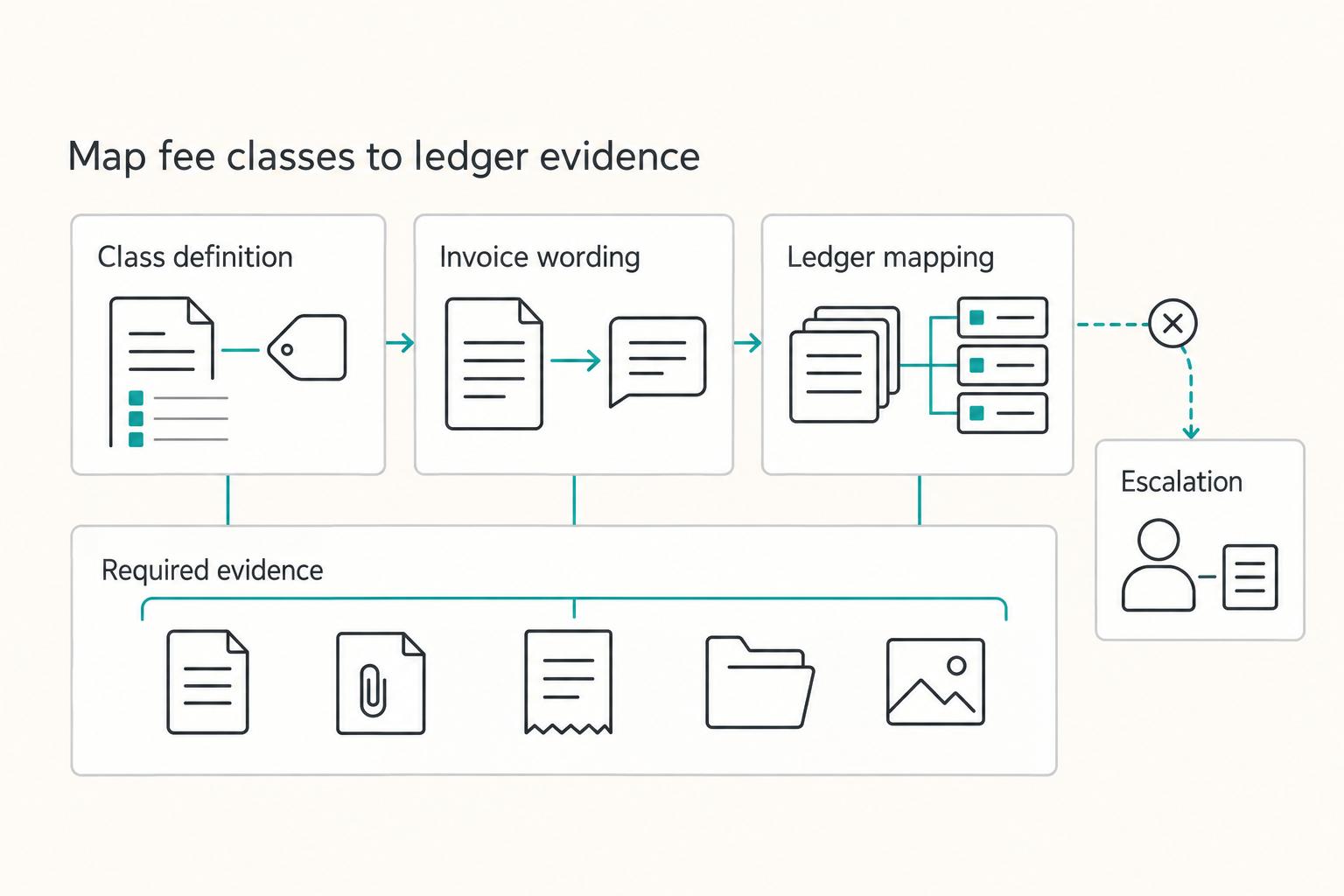
Prepare the evidence chain first. Before you classify any fee, your contracts, invoice outputs, system tax fields, filing route, and escalation owner should all describe the same supply story.
Gather the documents that define the charge#
Collect your seller terms, billing terms, invoice templates, and payout statement formats. Check that the charge described in the contract matches the invoice line description. If labels conflict, for example "commission" versus "service fee," reconcile that first.
For most B2B supplies, invoicing is generally required under EU VAT rules, so the wording in these documents is a core control point before classification.
Pull the minimum audit fields from your systems#
At minimum, extract counterparty country, service date, VAT identification number status, and invoice line taxonomy. For OSS records, capture the Member State of consumption, type of supply, date of supply, and VAT payable. Also capture the information used to determine where the customer is established, has a permanent address, or usually resides.
| Field | Where the article uses it |
|---|---|
| Counterparty country | At minimum, extract from your systems |
| Service date | At minimum, extract from your systems |
| VAT identification number status | At minimum, extract from your systems; if missing or unclear, do not assume reverse charge applies |
| Invoice line taxonomy | At minimum, extract from your systems |
| Member State of consumption | Capture for OSS records |
| Type of supply | Capture for OSS records |
| Date of supply | Capture for OSS records |
| VAT payable | Capture for OSS records |
| Information used to determine where the customer is established, has a permanent address, or usually resides | Also capture this information |
Run one trace test from source record to issued invoice. If VAT ID status is missing or unclear, do not assume reverse charge applies.
Confirm which filing routes you already use#
Map each flow to the route you already use: VAT One Stop Shop (OSS), Import One Stop Shop (IOSS), or local VAT registration outside those schemes. OSS is optional, and if you opt in, registration is in one single Member State of identification.
Keep IOSS scope narrow: distance sales of imported goods in consignments not exceeding EUR 150, excluding excise goods. Confirm return cadence up front as well. Union and non-Union OSS are quarterly, while the import scheme is monthly.
Assign a named decision owner for edge cases#
Give unresolved calls on customer tax status, supply type, or invoicing treatment a named owner in your team. Liability can sit with the supplier or the customer, so ambiguous cases need a defined escalation path before classification proceeds. If a flow is in OSS scope, retain supporting records for 10 years from the end of the transaction year.
Step 1 map every money flow and legal actor before tax logic#
Map the transaction first, then apply VAT logic. If buyer payment, seller settlement, and retained platform fees are blended together, you cannot reliably classify each line.
Separate the cash lanes#
Build your map from actual cash movement, not product labels. On a digital platform, that usually means separate rows for buyer payment, seller settlement, and retained platform amount. Add a separate row for any direct buyer-facing charge.
A net payout is not a tax conclusion. Settlement may be funds movement, while the retained amount may be a separate platform service, so each row needs its own treatment context.
Use one row per flow with a stable source reference, for example payout statement ID, invoice template, contract clause, or transaction date. Before moving on, confirm the tie-out: buyer cash should reconcile to seller settlement plus retained amounts plus any separate buyer charge.
Name the legal actor on each line#
For each row, identify the legal supplier, the customer, and the invoicing party separately. Do not treat payment handling as proof that the platform is the supplier.
Add a deemed-supplier flag where relevant. Under EU rules, an electronic interface can be deemed to receive and supply goods in certain cases, including facilitated distance sales of imported goods in consignments with intrinsic value not exceeding EUR 150.
Keep that flag in view, but do not let it answer every line automatically. Even when goods may fall into a deemed-supplier scenario, keep platform-retained fees on separate rows.
Split goods from TBE services#
Do not mix goods and telecommunications, broadcasting, and electronic (TBE) services in the same lane. They use different place-of-supply logic, and blending them creates downstream classification errors.
For distance sales of imported goods, destination logic points to where dispatch or transport to the customer ends. For TBE services to a non-taxable person, place of supply follows where that customer is established, has a permanent address, or usually resides.
Add the territorial evidence checkpoint#
End each row with evidence for territorial treatment, not just a country label. For distance sales of imported goods, capture destination Member State and evidence of where transport ended. For TBE B2C rows, capture the customer-location evidence you actually hold.
If a row is sensitive, do not rely on a single weak datapoint. Customer-location presumptions can be rebutted using three non-contradictory evidence items, so show what exists and what is missing so tax can approve or escalate quickly.
Treat this as a control artifact you keep, not a workshop note you forget. Record-keeping requirements apply to facilitating platforms, including cases where the platform is not deemed supplier. EU text also points to retention of at least 10 years for supplies facilitated by an electronic interface.
| Flow row | What it represents | Legal supplier | Customer | Invoicing party | Territorial test | Approve or escalate |
|---|---|---|---|---|---|---|
| Buyer payment for goods | Underlying sale amount | Seller, or platform if a deemed-supplier case applies | Buyer | Seller or platform | For distance sales of imported goods, destination where transport ends | Escalate if deemed-supplier flag is triggered or destination evidence is weak |
| Seller settlement | Funds remitted after deductions | Case-specific based on the underlying legal arrangement | Seller receiving funds | Case-specific | Reconciliation/control row linked to sale and fee rows | Escalate if settlement logic conflicts with contract language |
| Retained seller-facing fee | Platform service or commission candidate | Platform (if the fee is a platform service) | Seller | Platform | Service territorial analysis in next step | Escalate if legal customer or VAT ID status is unclear |
| Buyer payment for TBE service | Electronic service sold to non-taxable person | Seller or platform depending on facts | Buyer | Seller or platform | Customer establishment, permanent address, or usual residence | Escalate if location evidence is incomplete or contradictory |
The output of this step should be a one-page flow table your tax reviewer can approve quickly or mark for escalation.
Related reading: How to Handle Currency Gain and Loss Reporting for a Multi-Currency Platform.
Step 2 classify each charge line as sale amount platform fee or marketplace commission#
Classify every retained or billed amount before you do VAT analysis, and treat platform service charges as separate from the underlying sale line. If a charge pays for facilitation, access, listing, or marketplace participation, classify it first as a separate platform service-line candidate, even when it is retained from the same buyer payment.
Deemed-supplier treatment applies to supplies of goods only in certain circumstances. It does not, by itself, settle VAT treatment for seller-facing platform fees or marketplace commissions. The goal in this step is a stable tax-class dictionary that billing, ERP, and reconciliation teams can apply consistently.
Build a line-item matrix before tax logic#
Create one class per economically distinct line, not per UI label. If a label like "commission" hides more than one thing, split it into its underlying components before assigning tax treatment.
| Tax class | What it represents | Initial posture | Standardized internal wording | Example ledger family | Escalate when |
|---|---|---|---|---|---|
| Gross sale amount | Underlying sale to buyer | Analyze as sale-side line | Underlying sale description | Revenue clearing or pass-through sales | Deemed-supplier flag is triggered or line mixes multiple supply types |
| Seller-facing platform fee | Charge for platform access/facilitation/tools | Separate service-line candidate | "Platform fee" / "seller service fee" | Platform service revenue | Contract does not clearly identify service recipient |
| Marketplace commission | Retained amount for arranging/facilitating sale | Separate service-line candidate | "Commission" with clear basis | Commission revenue | Contract language conflicts with statement label |
| Buyer-facing charge | Separate charge shown to buyer | Keep separate until reviewed | Distinct buyer charge label | Buyer fee revenue | Charge is inconsistently bundled or presented |
| Unknown or mixed line | One amount contains unresolved elements | Hold for review | "Unclassified pending tax review" | Suspense/exception account | Source documents conflict or legal characterization is unclear |
If "platform fee" and "marketplace commission" are priced or documented differently, keep them as separate classes.
Apply one decision rule consistently#
Use one operating rule: classify by what the charge pays for, not by how cash is settled. A netted deduction can still be a separate service line supplied by the platform.
Before you approve a class, check that seller terms, invoice or statement wording, and ledger posting all describe the same thing. If they do not align, keep the line out of automated tax treatment.
Keep an explicit unknown bucket#
Do not force ambiguous lines into sale amount or commission just to close a period. Unknown is a valid control state when documentation or legal characterization is inconclusive.
For complex cross-border uncertainty, escalate to tax or legal. Where appropriate, consider a VAT Cross Border Rulings request in a participating EU country where you are VAT-registered.
Tie each class to controlled wording and ledger mapping#
Use controlled wording and fixed ledger mapping for each class. The aim here is internal consistency, not jurisdiction-wide legal wording rules. Each dictionary entry should include:
- class name and plain-language definition
- assumed legal supplier and customer
- sale-side versus fee-side designation
- expected invoice or statement label
- ledger code or ledger family
- required evidence fields, for example contract reference, product type, counterparty country, and VAT ID status
- escalation trigger and owner
Use this dictionary as the control artifact for reporting and record-keeping design, including OSS or IOSS mapping where relevant. EU e-commerce VAT changes include record-keeping requirements for marketplaces, including where a marketplace is not a deemed supplier. OSS schemes are optional, and if used, all supplies within that scheme must be declared through OSS. OSS returns also do not replace domestic VAT returns. The output of this step should be a versioned tax-class dictionary approved by tax and used by billing, ERP, and reconciliation teams.
For a step-by-step walkthrough, see How to Calculate LTV in a Two-Sided Marketplace for Buyer, Seller, and Platform Decisions.
Step 3 assign VAT owner and treatment with escalation triggers#
Assign VAT owner per line before you worry about rates, returns, or filing channels. For seller-facing platform services to business customers, test VAT reverse charge first. For marketplace-facilitated goods where the platform may be a deemed supplier, send the sale line down the sales-side path and keep it separate from fee-side logic.
Test business-customer platform services under Article 44 and Article 196#
Start with the seller-facing fee or commission line, not the buyer sale line. If the line is your platform's own service to a taxable person, Article 44 places the service where that customer is established. Article 196 can then make the customer liable for VAT in qualifying cases.
Use customer status as the operating check. If the customer provides an EU VAT ID, validate it and retain the confirmation record. In practice, that can include the VAT ID, validation result, check timestamp, and the matched legal entity or country in your account master. If those fields do not align, do not auto-apply reverse charge.
Do not let payout mechanics drive the tax decision. A fee deducted from payout can still be a separate service line, and VAT ownership still depends on service recipient and the Article 44 and 196 conditions.
Route deemed-supplier goods to sales-side VAT logic#
Keep goods logic and fee logic separate. In the EU, marketplaces facilitating goods can be treated, in certain circumstances, as the deemed supplier for VAT purposes. When that applies, the underlying goods sale belongs on the sales-side path.
The buyer sale amount should follow your goods-sales VAT path, while the platform fee or commission still needs its own service-line analysis. Even on one settlement statement, those lines can have different VAT owners and may require different reporting routes, potentially including VAT One Stop Shop (OSS) or local returns, depending on the scenario.
Set a control check here: if a deemed-supplier flag is present, store separate tax decisions for the gross goods sale line and the seller-facing fee line. If your engine stores one outcome for the full payout event, treat that as a control defect.
Escalate role and evidence conflicts early#
Use a release gate for new fee types: no full automation until contract language, billing labels, and ledger mapping identify the same supplier, customer, and service description. Escalate for review when any of the following applies:
| Escalation trigger | What the article says |
|---|---|
| The charge bundles platform access, listing, payment handling, or other elements into one mixed supply | Escalate for review |
| Contracts suggest you act in your own name, but billing or ledger setup treats you as acting on behalf of the seller | Article 28 role conflict; escalate for review |
| The VAT ID is missing, invalid, or tied to a different entity than the contracting customer | Escalate for review |
| Seller terms, invoice wording, and billing configuration describe different supplier or customer roles | Escalate for review |
Do not guess through these cases. Mixed supplies and unclear supplier roles do not have one predetermined treatment across all scenarios, so keep them in exception handling until resolved.
Correct the contract first when form and cash diverge#
When legal form and cash flow diverge, fix contract and invoice wording first where possible, then align the tax calculation. This is a practical sequencing rule, not an absolute one. You may still need an interim treatment to keep invoicing moving, but avoid hard-coding long-term VAT logic to documents you already know are wrong.
Before month-end, run edge-case fee lines through a repeatable reverse-charge triage so legal reviews stay focused on true ambiguities: Use the VAT reverse charge checker.
Step 4 set reporting path and evidence pack for OSS IOSS and local returns#
Route each VAT-classified line to a filing path, and keep deemed-supplier sales, imported low-value goods, and separately billed platform fees on distinct tracks unless you have a documented reason not to.
Map each classified flow to one filing channel#
Assign each tax line to VAT One Stop Shop (OSS), Import One Stop Shop (IOSS), or a local VAT return outside the special schemes. Line-level mapping is usually safer than settlement-level mapping when one payout includes items that can fall under different reporting paths.
| Filing channel | Use it for | Return rhythm | What to watch |
|---|---|---|---|
| VAT One Stop Shop (OSS) | Supplies reported through the EU special scheme | Quarterly in Union and non-Union schemes | OSS returns are additional and do not replace domestic VAT returns |
| Import One Stop Shop (IOSS) | Certain imported distance sales of low-value goods | Monthly in the import scheme | Scope is limited to consignments not exceeding EUR 150 |
| Local return | Transactions outside special schemes or still reportable domestically | Varies by jurisdiction | Do not assume OSS or IOSS captures all reporting obligations |
For OSS, structure reporting by Member State of consumption, and make sure the filing entity is aligned to the correct Member State of identification portal.
Separate deemed-supplier sales from your own fee income#
Do not let a deemed-supplier conclusion on the goods sale swallow the fee analysis. Keep the sales line and fee line as separate tax decisions.
If you are treated as deemed supplier for the underlying goods sale, report that amount on the appropriate sales path. If you also charge a separate seller-facing service fee, assess that fee as its own supply and route it based on its own treatment.
Build an evidence pack for each filing period#
Your filing file should let a reviewer reconstruct why each amount went to OSS, IOSS, or a local return. Organize it by filing period and classification, with references back to source records. Depending on the transaction and rule set in scope, this can include:
| Evidence item | Article detail |
|---|---|
| Invoices or equivalent billing records | Including supplier VAT ID where an invoice is required |
| Customer location evidence | Including two non-contradictory items where that place-of-supply rule applies |
| VIES VAT-number check results | Where cross-border business-customer status was used |
| Adjustment journals, credit notes, and reclassification entries | Linked to original invoice or settlement references |
Treat this as an audit-ready record set, not a one-time filing attachment. Record-keeping obligations can apply even when the platform is not the deemed supplier. OSS-related records may also need long retention, for example ten years in OSS record guidance, and electronic delivery without delay when requested.
Verify totals before submission#
As an internal control before submission, run a classification-level tie-out. Each reporting bucket should reconcile to the general ledger and payout settlement reporting for the same period, with a documented bridge for timing differences, reversals, and manual journals.
Focus on bucket-level accuracy, not just grand-total cash agreement. If OSS sales reconcile only after netting out service fees, stop and correct the mapping before filing.
Step 5 build controls in systems and ledgers so audits are defensible#
Once you set the filing path, lock it into production so VAT outcomes are reproducible and auditable. You do not need a full rebuild first. You need controls that keep classification, billing, ledger posting, and return outputs aligned.
Lock billing to approved tax classes#
Make invoice tax treatment flow from the classification outputs set in earlier steps, not from ad hoc edits after launch. For each high-risk class, confirm the invoice line, tax code, ledger account, and filing bucket all map to the same class definition.
For marketplace models, including cases where the platform is not treated as the deemed supplier, prioritize the classes most likely to misstate a return if miscoded, including lines routed to OSS. Repeated manual tax edits in production are a control failure signal, not a normal operating state.
Preserve a full trail from invoice event to return export#
Build traceability so any filed amount can be reconstructed from source to submission. For OSS, required record content is set out in Council Regulation 282/2011, Article 63c, including fields such as Member State of consumption, type of supply, date of supply, and VAT payable.
Keep these records for 10 years from the end of the year of the transaction. Make sure they can be provided electronically without delay when requested by the Member State of identification or a Member State of consumption. As a practical test, take one filed amount and trace it back to the underlying invoice line, VAT attributes, adjustments, and settlement reference.
Route missing or stale VAT attributes into exceptions#
Do not let incomplete VAT attributes flow silently into invoicing or return files. Route missing or stale items into an exception queue and assign clear ownership so issues are resolved before filing. Start with the highest-consequence exceptions:
- missing Member State of consumption or contradictory location evidence
- missing customer tax-status inputs used in classification
- invoice lines posted without a tax class or with a class that conflicts with source attributes
Avoid end-period bulk fixes that break traceability. Under OSS, persistent failure to comply with scheme rules, including not providing requested records within a month after a reminder, can lead to exclusion from the scheme.
Common failure modes and how to recover without replatforming#
If your transaction split is wrong, start with a classification rebuild before considering a new stack. Recover by restating cash flows, separating fee analysis from sales analysis, and reconciling filing outputs before the next submission.
Split the historical tax base before you change any VAT logic#
A common failure mode is treating all marketplace cash as one VAT base because settlement lands as one net amount. Start by restating historical flows into separate buckets, such as sale amount, platform fees, and marketplace commissions.
Use contract terms, invoice wording, payout reports, and ledger lines to remap each retained amount to a charge type. Your checkpoint is simple: for a sample period, gross buyer cash minus seller settlement fully explains retained amounts, and each retained line maps to one tax class. If retained cash cannot be tied to a documented fee type, treat that as a billing and filing control gap.
Review fee treatment separately from deemed supplier sales logic#
Do not assume that deemed-supplier status for some goods flows answers every fee question. That treatment applies only in certain circumstances, so fee treatment still needs its own review even when the sale side looks settled.
For each fee type, log four fields: who the customer is, what service the fee pays for, how it is invoiced, and what remains unknown. If a fee scenario is complex, cross-border, and still unresolved, use the VAT Cross Border Rulings process in the participating EU country where you are VAT-registered.
Build a filing bridge between VAT One Stop Shop and domestic returns#
A filing failure is treating OSS as the full filing perimeter. If you opt to use OSS, remember OSS returns are additional and do not replace domestic VAT returns, so you need a bridge showing what goes through OSS and what stays local.
Build that bridge by filing channel, legal entity, and period. Name the Member State of identification, route supplies covered by your chosen OSS scheme into OSS, and route the rest into domestic returns. Verify two things each cycle: all supplies that fall under that OSS scheme are declared through OSS, and OSS plus domestic totals tie back to the ledger after adjustments. Keep cadence aligned: Union and non-Union OSS returns are quarterly, and import-scheme returns are monthly.
Tighten place of consumption evidence before the next cycle#
Weak place-of-consumption evidence can create downstream risk when you need to support why a Member State was used. Recovery is mainly an evidence-control problem, not a system-replacement problem.
Identify where location evidence is missing, contradictory, or outside your archive. Then enforce required fields in billing or checkout and retain support records with invoice and settlement trails. Prioritize this before the next cycle, including flows where the platform is not deemed supplier, because record-keeping duties can still apply. Related: Platform Take Rate Optimization: How to Set Marketplace Fees Without Losing Liquidity.
Copy paste monthly control checklist for compliance owners#
Run this as a signed month-end control, not just a reminder list. The goal is to catch classification drift before it creates filing errors across VAT, OSS schemes (including the import scheme), and domestic returns.
Check for new charge types#
Start with one question: did any team introduce a new retained amount this month? Include renamed platform fees, new add-ons, recovery charges, and wording changes for marketplace commissions on invoices or payout statements.
Use evidence, not verbal confirmation. Compare this month's invoice line taxonomy, contract wording, and payout labels against last month's approved classification matrix. If a new fee appears without documented review, freeze the treatment change and log an exception until legal, finance, and ops align on who the customer is and what the charge is for.
Reconcile billed amounts to books and settlements#
Reconcile invoiced platform fees and marketplace commissions to both the ledger and payout reports using the same period cut and entity perimeter.
Look for unmatched deltas, netting errors, and retained amounts without invoice support. A practical pass condition is that buyer cash, seller settlement, and retained charges fully reconcile for the population you review. If a delta cannot be mapped to a documented charge type, treat it as a control failure.
Confirm filing readiness and evidence completeness#
Confirm which supplies are declared through OSS in your Member State of identification and which remain in domestic VAT returns. OSS returns are additional and do not replace standard VAT returns, and if you use an OSS scheme, all supplies under that scheme must be declared through that scheme's OSS return.
Before submission, confirm cadence and records: Union and non-Union OSS returns are quarterly, and the import scheme is monthly. Make sure period records are archived, including records, invoices, and adjustment or bad-debt-relief references where applicable.
Close the loop on escalations#
Review all VAT escalations and legal decisions from the month, especially complex cross-border issues that may require a VAT Cross-border Rulings request in a participating EU country where you are VAT-registered.
If the same issue appears again, move it from casework into a permanent control: a billing rule, contract clause, or required data field.
What to do next if your fee model spans multiple EU markets#
Start with classification and evidence controls, not new tooling. If you handle VAT on platform fees across multiple EU markets, early risk reduction usually comes from consistent treatment and retrievable records, not a larger tax stack.
Lock a common classification baseline first#
Set one shared rule set before localizing by country. In billing and ledger outputs, separate at least:
- customer sale amount
- seller-facing fee or commission
- buyer-facing charge
For each fee type, finance should be able to point to the contract term, invoice wording, counterparty, and reporting lane. If that is unclear, pause and fix it first with a short classification register and evidence pack, including invoice templates, tax ID status where relevant, country fields, and settlement-to-ledger support. Where electronic-interface recordkeeping rules apply, keep records electronically available for at least 10 years.
Escalate gray areas early and document decisions#
Escalate early when supplier role, contract language, invoicing, or fee characterization is unclear. Do not carry those issues through close cycles. Use Commission and VAT Committee guidance as inputs, not final legal answers. They are practical or advisory, and each Member State transposes and applies VAT rules through its own national framework. Ambiguous cases need local-jurisdiction input before you standardize treatment.
Record each decision in one place with:
- fact pattern
- jurisdictions affected
- chosen treatment
- legal or tax approval owner
Then translate that into concrete invoicing, coding, and filing instructions for ops and finance.
Localize only where risk or volume justifies it#
Run one EU baseline, then localize where exposure is material. That is often the most defensible operating model.
Refine by market when you see material volume, repeated exceptions, or a local interpretation that changes treatment. Keep reporting lanes scoped correctly.
- OSS: baseline portal for eligible cross-border B2C e-commerce VAT reporting (from 1 July 2021)
- IOSS: VAT handling for certain goods supplied from outside the EU to EU customers
- imported consignments up to EUR 150: keep this goods lane distinct for deemed-supplier analysis so unrelated platform-fee treatment is not pulled into it
Operational sequence: standardize first, escalate ambiguity second, localize third.
If your team needs a coverage and controls sanity check across collection, ledger traceability, and payout operations, map your current flow with Gruv before changing tooling: Talk to Gruv.
Frequently Asked Questions
Does the EU marketplace VAT reform automatically determine VAT on platform fees?
No. The 1 July 2021 changes mainly shape cross-border B2C e-commerce goods treatment and certain deemed-supplier cases. A platform fee or commission still needs its own VAT analysis to determine whether it is part of a facilitated goods supply or a separate service.
Are online marketplaces always treated as a deemed supplier for VAT purposes?
No. Deemed-supplier treatment applies only in certain circumstances for facilitated supplies of goods. It does not automatically apply to every platform activity or every fee the platform earns.
Which transactions should go through VAT One Stop Shop (OSS) versus Import One Stop Shop (IOSS)?
Use OSS for supplies reported through the EU special scheme, including eligible distance sales of goods and cross-border supplies of services to EU customers through one Member State. Use IOSS for distance sales of imported low-value goods in consignments not exceeding EUR 150. Transactions outside those schemes still go through local VAT returns.
What records must a digital platform keep when it is not the deemed supplier?
Record-keeping duties can still apply even when the platform is not the deemed supplier. For OSS-scoped records, keep fields such as Member State of consumption, type of supply, date of supply, VAT payable, and the data used to determine customer location where relevant. Retain records for 10 years from the end of the transaction year and keep them electronically available on request.
How should we handle platform commissions when the seller and buyer are in different EU countries?
Do not classify the commission based only on the seller's country and the buyer's country. First decide whether the amount belongs to a deemed-supplier goods scenario or is a separate seller-facing service fee. If the service characterization is unclear, resolve that classification before filing.
When should we apply VAT reverse charge on marketplace-related service fees?
Apply reverse charge only when the Article 196 conditions are met. For seller-facing platform services to business customers, test the service line first and confirm the customer is a taxable person with supported VAT status. If customer establishment, VAT ID status, or service characterization is unclear, do not auto-apply reverse charge.
Researched and edited by the Gruv editorial team. Gruv builds cross-border billing, payouts, and finance-operations software for global businesses.
Sources
- consilium.europa.eu/en/press/press-releases/2025/03/11/taxation-...trusted
- ec.europa.eu/commission/presscorner/api/files/document/pr...trusted
- eur-lex.europa.eu/eli/dir/2006/112/2021-07-01/engtrusted
- eur-lex.europa.eu/eli/dir/2006/112/2025-04-14/engtrusted
- europa.eu/youreurope/business/taxation/vat/check-vat-n...trusted
- europa.eu/youreurope/business/taxation/vat/one-stop-sh...trusted
- legislation.gov.uk/eudr/2006/112/article/28trusted
- legislation.gov.uk/eudr/2006/112/article/44/2010-01-01trusted
Educational content only. Not legal, tax, or financial advice.
Related Posts

The Freelance Payment Penalty: A Modeled Audit of Platform Fees, FX Spreads, and Payout Delays
The money rarely disappears through a single, easy-to-spot fee. The real loss is stacked. A marketplace takes its commission, a processor adds a charge for international cards, a bank or payment company converts the currency at a spread, a platform holds the funds before release, and a wire sheds a little to intermediaries on the way in. Each layer looks defensible on its own, but the worker feels the combined result as a smaller deposit and a later payday.

How to Respond to a Subpoena for Business Records
Move fast, but do not produce records on instinct. If you need to **respond to a subpoena for business records**, your immediate job is to control deadlines, preserve records, and make any later production defensible.
A US Expat's Guide to Investing in UCITS ETFs to Avoid PFIC Issues
The real problem is a two-system conflict. U.S. tax treatment can punish the wrong fund choice, while local product-access constraints can block the funds you want to buy in the first place. For **us expat ucits etfs**, the practical question is not "Which product is best?" It is "What can I access, report, and keep doing every year without guessing?" Use this four-part filter before any trade: