
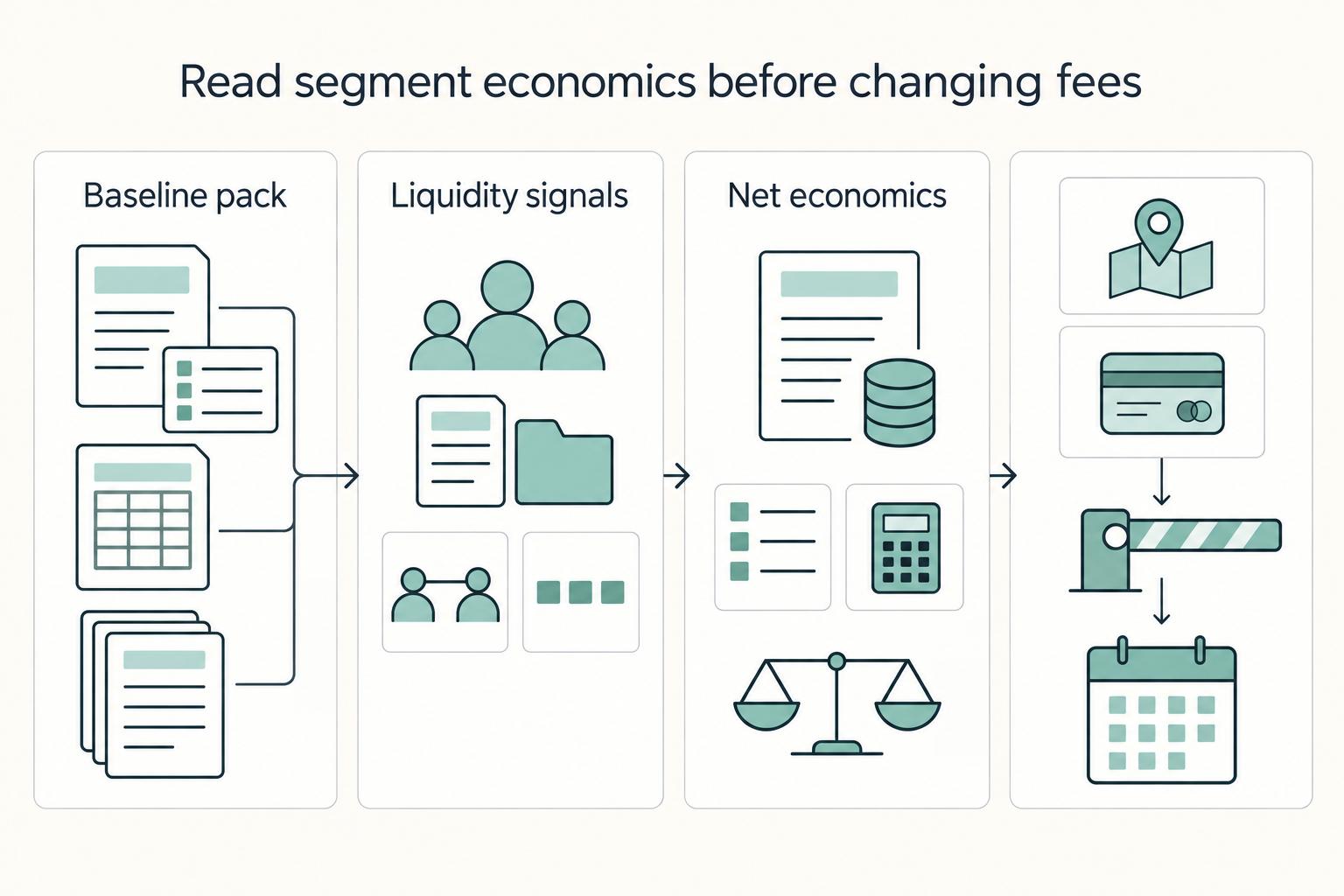
Quick Answer
Use a segment-by-segment fee test with hard stop rules before any broad change. Build a baseline sheet with take rate, platform revenue, total transaction value, and revenue split, then run treated and holdout cohorts to isolate impact. Adjust who pays based on constrained-side behavior, including maker-taker options where needed. Scale only after reconciliation confirms gross amount, fee assessed, and net payout align, and interaction quality does not decline.
Start With Liquidity, Then Set Fees#
Fee changes in a two-sided marketplace are network decisions, not just pricing decisions. They can change participation on both sides and determine whether your economics improve or quietly get worse.
A two-sided platform serves two distinct customer groups that need each other, so pricing on one side cannot be judged in isolation. A fee that looks accretive in a spreadsheet can thin the wrong side, weaken interaction quality, and pull down the revenue line it was meant to lift.
Treat take rate work as a network decision, not a finance-only exercise. The force that matters most is the indirect network effect between sides. If supply gets thinner, demand can become less active. If demand becomes less reliable, suppliers may stop engaging. In that setting, a fee change can ripple through fragile parts of the market.
This guide will not hand you a magic benchmark for a "good" rate. The validated sources behind this guide do not support clean benchmark ranges by marketplace type, so there is no universal number to copy. The useful questions are operational: who should pay, how much that side can absorb, what signal tells you the market is tolerating the change, and when it makes sense to expand beyond transaction fees.
Before you start#
This guide is for founders, revenue leaders, product teams, and finance operators who need an execution sequence they can actually use. Before you touch fees, make sure your team can answer two basic questions without hand-waving: which side of the market is constrained right now, and what metric would show damage first if pricing changed? If you cannot answer those, do not start with a fee increase. Start by getting a baseline on participation, transaction volume, platform revenue, revenue split, and at least one liquidity health signal you already trust.
One more point matters because it changes how you think about who pays. In two-sided markets, profit-maximizing pricing can mean charging one side less and, in theory, even below cost if that side is what makes the other side participate. The failure mode is obvious once you see it: teams raise visible marketplace fees evenly, assume the impact will be linear, and then find that activity weakens first in the thinnest cohorts.
The rest of the guide is built to prevent that mistake. You will establish the baseline, define no-regret constraints, map where liquidity breaks first, choose structure by segment, and roll out changes with checkpoints instead of guesswork.
For a broader look at creator platform monetization models, see Choosing Creator Platform Monetization Models for Real-World Operations.
What to prepare before you touch marketplace fees#
Before you change pricing, build one evidence pack per segment so you can read economics and liquidity together instead of relying on blended averages.
| Step | Focus | Key check |
|---|---|---|
| Step 1 | Baseline pack per segment: one time window, consistent definitions, take rate, platform revenue, total transaction value, current revenue split | Reconcile to finance reporting and payout ledger data before any fee test |
| Step 2 | Liquidity health inputs: interaction quality, user counts, match or fill signals, cohort-level patterns | Use them to catch early deterioration that topline transaction value can miss |
| Step 3 | Market-type and net-economics checks: B2B, C2C, C2B, plus payments, tax, and compliance constraints | Use processor and payout cost ranges as directional checks; confirm GST/HST treatment if Canada applies |
Step 1 Assemble a baseline pack for each segment#
Assemble a baseline pack for each segment using one time window and consistent definitions. Include take rate, platform revenue, total transaction value, and the current revenue split between the platform and participants. Keep this at the segment level, then reconcile it to finance reporting and payout ledger data before you run any fee test.
Step 2 Add liquidity health inputs to the same pack#
Add liquidity health inputs to the same pack. In a two-sided marketplace, track interaction quality alongside user counts, plus your match or fill signals and cohort-level patterns that may show activity weakening. This helps you catch early deterioration that topline transaction value can miss.
Step 3 Split models by market type before analysis#
Split models by market type before analysis: B2B, C2C, and C2B should not share one default fee model. Then confirm payments, tax, and compliance constraints that affect net economics, because payment infrastructure includes banks, gateways, compliance checks, and operations rather than commission alone. Processor and payout costs are often described in rough ranges, for example 2-3.5% per transaction plus a fixed fee, and about 2-5% of GMV once payout and gateway costs are included, so use them as directional checks, not benchmarks.
If Canada applies, confirm GST/HST treatment before you model a net gain from fee changes, and keep the supporting internal note or Canada GST/HST guidance with the pack.
If you want a deeper operational lens, read Two-Sided Marketplace Dynamics: How Platform Supply and Demand Affect Payout Strategy.
Establish your baseline economics and your no-regret constraints#
Set one baseline sheet per segment and define hard stop conditions before any fee test. Otherwise, you can show short-term margin lift while liquidity quality deteriorates underneath.
Step 1 Lock the one-sheet baseline#
Build one sheet per segment that product, finance, and operations can all read the same way. Include take rate, platform revenue, total transaction value, transaction fees, payout strategy, and contribution to unit economics after direct transaction costs.
Keep B2B, C2C, and C2B rows separate if your models differ. A blended fee view can hide different buying behavior, payout patterns, and servicing cost.
Use a compact row-level layout with:
- current fee and who pays it
- payment and payout cost stack
- net platform revenue after direct transaction costs
- interaction quality signal
- liquidity health signal
- contribution to unit economics
Do not move to testing until this sheet still reconciles to the baseline pack and finance reporting.
Step 2 Set the no-regret constraints#
Define non-negotiables as stop conditions, not goals. The core tradeoff is simple: fees must stay low enough to attract volume and high enough to earn revenue and limit losses.
| Guardrail | Signal | Treatment |
|---|---|---|
| Minimum liquidity by segment | Liquidity by segment | Non-negotiable stop condition |
| Minimum interaction quality on both sides | Interaction quality on both sides | Pause the test if one side weakens first, even when blended revenue improves |
| No unexplained deterioration in repeat activity or fill/match outcomes | Repeat activity; fill or match outcomes | Non-negotiable stop condition |
| No gain that disappears after payment, payout, tax, and support costs | Payment, payout, tax, and support costs | Do not treat it as a gain |
For most marketplaces, set guardrails for:
- minimum liquidity by segment
- minimum interaction quality on both sides
- no unexplained deterioration in repeat activity or fill/match outcomes
- no "gain" that disappears after payment, payout, tax, and support costs
If one side weakens first, pause the test even when blended revenue improves.
Step 3 Log what you do not know#
Create an evidence log next to the sheet and treat unknowns as inputs to the decision. There is no validated benchmark range for a "good" B2B marketplace take rate, so do not invent one or import C2C assumptions.
For each assumption, record:
- what you currently believe
- what evidence supports it now
- what result would disprove it
Keep this log active, especially before automation. Algorithmic pricing can push prices higher even in competitive markets, so make your guardrails explicit before broader rollout.
If you are weighing subscriptions against transaction fees, see Choosing Between Subscription and Transaction Fees for Your Revenue Model.
Map where liquidity breaks first when fees move#
Map liquidity risk by zone first, then by side, before you move fees. In a two-sided platform, changes on one side can spill into the other side, so blended revenue alone is not a safe read.
Step 1 Split the market into liquidity-sensitive zones#
Do not assess fee risk only at the marketplace-wide level. Break it into zones where cross-side effects can surface early:
- New supply onboarding: first-time suppliers, newly activated sellers, or fresh inventory cohorts
- Repeat demand: returning buyers, repeat bookers, or users with a known reorder pattern
- Thin categories: segments with fragile supply-demand balance, low depth, or uneven fill or match outcomes
For each zone, keep one liquidity signal and one interaction-quality signal in your operating sheet. If a zone has no observable signal, hold the fee test there until you can measure it.
Step 2 Assign the likely first reaction by fee incidence#
Document who pays the fee and where you expect the first reaction to appear. In two-sided markets, pricing strategy is shaped by indirect network effects, so treat side-pricing as a hypothesis to test, not a universal rule.
Write the hypothesis before launch in your evidence log so product, finance, and operations review the same assumption. Example: "If we increase the demand-side fee in repeat-demand cohorts, we expect revenue per transaction to rise, and we will watch for early behavior shifts before broader liquidity changes."
Step 3 Add failure checkpoints and pre-write the rollback decision#
For each zone, name the first failure mode you expect to see and the rollback condition tied to your no-regret constraints. Keep the table compact and explicit before launch:
| Zone | Fee move | Expected gain in platform revenue | Expected risk to network liquidity | Rollback trigger |
|---|---|---|---|---|
| New supply onboarding | Increase supplier fee | Higher revenue per activated supplier | Lower early participation can reduce cross-side activity | Revert if no-regret constraints are breached |
| Repeat demand | Increase market-taker fee | Higher revenue on repeat transactions | Demand-side behavior shifts can weaken cross-side outcomes | Revert if no-regret constraints are breached |
| Thin categories | Apply or widen maker-taker fee difference | Better side-specific monetization | Fragile balance can break faster in low-depth cohorts | Revert if no-regret constraints are breached |
If you cannot state likely breakpoints and rollback conditions in one row per zone, pause the test design and tighten it first.
Choose fee structure by segment, not one global take rate#
Choose fee structure by segment based on liquidity role, not marketplace-wide averages. Start with who supplies liquidity, who consumes it, and which side is easier to lose. Efficient markets need a balance between liquidity suppliers and demanders, and participants can respond differently to fee changes.
Step 1 Match the structure to the segment's real constraint#
Use a flat take rate where liquidity is already stable and segment behavior is predictable. Use tiered or value-based pricing when segments receive measurably different value, especially in B2B contexts where one blanket increase can misprice both high-value and price-sensitive cohorts.
Use dynamic pricing only if the rule is clear, explainable, and reproducible in your logs. If you cannot explain why a fee changed for a specific user, do not scale it.
Include maker-taker logic when one side is constrained, because fee splits can shape behavior differently across sides. Use electronic-market evidence to inform test design, not as a universal benchmark for marketplace take rates.
| Fee structure | Where it tends to fit | Main tradeoff | Likely liquidity effect |
|---|---|---|---|
| Flat take rate | Stable, thick segments | Simple to run, less precise by cohort | Often neutral until one side tightens |
| Tiered pricing | Segments with clear value or volume differences | Better fit, more operational overhead | Can reduce pressure on sensitive cohorts |
| Value-based pricing | Accounts with measurable service value differences | Strong alignment if value proof is clear | Can support balance if value signals are credible |
| Dynamic pricing | Fast-changing conditions with clear rules | Flexible but trust-sensitive | Can help or hurt depending on rule clarity |
| Maker-taker fees | Segments with side-specific constraints | Requires careful side-level monitoring | Useful for rebalancing constrained participation |
Step 2 Apply the decision rules before launch#
If liquidity is thin, bias lower fees on the constrained side first. If demand is deep but conversion is weak, test market-taker pricing first with tight guardrails. If value is highly differentiated in a B2B segment, use tiers tied to measurable service value rather than blanket increases.
Keep the decision anchored in all-in economics: participants react to total cost of ownership, not just the headline fee.
Step 3 Define what each option must prove in test#
Before scaling, each fee structure should prove three outcomes in the same segment: improved platform revenue, no material drop in interaction quality, and no deterioration in supply-demand balance.
Track one participation metric by side, one interaction-quality metric, and one balance metric such as fill or match outcomes. Keep the customer-facing rule text, fee-calculation logic, and cohort assignment in the test record so decisions remain auditable. Related reading: How to Calculate a Freelance Rate You Can Actually Get Paid On.
Roll out fee changes in controlled steps with verification gates#
Treat a fee change as a controlled release, not a config tweak. Expand only when finance and operations can reconcile the new logic, reproduce postings, and roll back quickly.
Step 1 Select one cohort and keep a real control group#
Start with one cohort that matches your segment logic and has clean baseline data. Keep a treated cohort and a holdout so you can isolate fee effects from normal seasonality and mix shifts, instead of relying on a loose before-and-after read.
Set owners before launch:
- Product owns cohort rules, fee-rule deployment, and customer-facing fee text.
- Finance owns reconciliation, platform revenue reporting, and rollback approval.
- Operations owns payout exceptions, support handling, and issue escalation.
Step 2 Set operational gates before money moves#
Gate launch on end-to-end operability, not just fee calculation. Confirm the payout path can handle settlement, refunds, and reporting under the new logic.
If you are also moving to faster rails, treat liquidity and irrevocability as first-order risks: obligations can settle in seconds rather than days. Your bar should be immediate transfers with automated reconciliation, or a clear, controlled path from batch operations to that model. If finance cannot trace gross amount, fee assessed, and net payout without manual patchwork, hold launch.
Step 3 Add duplicate-posting protection and a usable audit trace#
Use idempotent change controls and event logging so retries do not duplicate fee postings or skew revenue reporting. For every test transaction, keep an evidence trail: fee-rule version, cohort assignment, transaction ID, posting timestamp, payout status, and reconciliation result.
If a retry or backfill can post twice while the user sees one completed order or match, stop and fix it before expansion. If event replay does not reproduce the same totals, the rollout is not ready.
Step 4 Review against guardrails, then expand one dimension at a time#
At each checkpoint, compare the test cohort with your control against pre-set guardrails for liquidity and interaction quality. Expand only when participation is stable, interaction quality holds, and fill or match outcomes do not worsen.
If revenue rises but supplier participation weakens, buyer response quality drops, or reconciliation exceptions increase, roll back and diagnose first. When expanding, change one variable at a time: cohort size, segment, or payout condition.
Common fee optimization mistakes and how to recover fast#
Most fee failures are not math errors. They happen when monetization is separated from liquidity, buyer and supplier behavior, and operational proof. If revenue goes up but interaction quality drops or reconciliation noise rises, treat the change as a failed test.
| Mistake | Recovery | Focus |
|---|---|---|
| Treating take rate as a finance-only lever | Re-anchor to marketplace health | Review participation, interaction quality, and fill or match outcomes alongside revenue |
| Applying C2C assumptions to B2B pricing | Re-segment around B2B frictions | Rebuild segments by procurement friction, integration burden, and risk profile |
| Raising transaction fees without fee-incidence logic | Test explicit side-level hypotheses | Treat it as a warning if fee text, ledger postings, and internal hypotheses point to different payers |
| Weak evidence discipline | Log unknowns and rerun before scale | Pause expansion and test again if you cannot isolate fee change, segment mix, or posting defects |
Treating take rate as a finance-only lever: re-anchor to marketplace health.
Do not judge fee changes on margin alone. Pricing logic is increasingly automated across markets, and research shows algorithmic pricing can raise prices even without collusion. Keep or expand changes only after you review participation, interaction quality, and fill or match outcomes alongside revenue.
Applying C2C assumptions to B2B pricing: re-segment around B2B frictions.
If you run B2B, do not assume a consumer-style fee change will behave the same way. B2B transaction-cost work distinguishes coordination costs from motivation costs and shows firm-to-firm behavior shifts when transactions move online. Rebuild segments by procurement friction, integration burden, and risk profile, then test how the fee change affects those frictions.
Raising transaction fees without fee-incidence logic: test explicit side-level hypotheses.
Changing fees before you define who is likely to absorb or react to the change is guessing. Set a side-level hypothesis first, then test maker-taker structures or tiered pricing where they fit that hypothesis. Treat it as a warning if fee text, ledger postings, and internal hypotheses point to different payers.
Weak evidence discipline: log unknowns and rerun before scale.
When results are mixed, do not explain them away. Mark unproven assumptions, log unknowns, and rerun with the same evidence pack used in rollout: cohort assignment, fee-rule version, transaction ID, posting timestamp, payout status, and reconciliation result. If you cannot isolate whether the outcome came from the fee change, segment mix, or posting defects, pause expansion and test again. Related: Building Subscription Revenue on a Marketplace Without Billing Gaps.
Expand margins beyond transaction fees at the right time#
Expand beyond transaction fees only after your core fee model is stable enough to trust. Proceed when market liquidity is steady, interaction quality remains acceptable, and unit economics are predictable after the latest fee tuning. If any of those are still moving, a second revenue layer can hide whether your core pricing is actually working.
Step 1 Confirm the core marketplace is stable before adding monetization complexity#
Confirm the core marketplace is stable before adding monetization complexity. Check how smoothly transactions occur, not just user growth, because liquidity is about transaction flow. Use side-by-side cohort checks so transaction volume or GMV, interaction quality, and platform revenue all stay within guardrails after the fee change, not just during launch week.
If the same segment still swings when you adjust transaction fees, wait. The tradeoff is straightforward: fees must stay low enough to attract volume and high enough to support revenue. Adding subscriptions or promotions too early can mask whether the base fee is still off.
Step 2 Add one adjacent monetization layer at a time#
Add one adjacent monetization layer at a time, and match it to existing behavior. Beyond transaction commissions, the grounded options here are subscriptions and promotions.
If recurring access or tools already drive repeat value, test a subscription in a narrow cohort. If sellers already compete for visibility, test promoted placement or a similar promotion product. Keep the core transaction fee unchanged during the test so you can isolate whether the added layer improves platform revenue without damaging transaction volume, GMV, or interaction quality.
The common failure is model mismatch. Promotions in low-intent demand can become noise, and subscriptions before repeat usage is proven can feel like a tax. If you cannot clearly state who pays, why they pay, and what behavior should stay unchanged, the test is not ready.
Step 3 Separate transaction-fee, subscription, and promotion revenue lines#
Keep reporting structure as disciplined as pricing structure. Separate transaction-fee revenue, subscription revenue, and promotion revenue in finance and operations so revenue split and take rate reporting remain reliable. Since take rate is the share of GMV the platform keeps as revenue, define exactly what is included and what is tracked separately.
Model payments as a full cost stack, not only a processor rate. Payment infrastructure includes banks, gateways, compliance checks, and operational processes, and cost behavior can shift with basket structure, payouts, and risk, not just GMV. In practice, you should be able to trace a sample transaction from gross payment to platform share and seller payout, with transaction ID, posting timestamp, and payout status. If you cannot, pause expansion until you can.
For a step-by-step walkthrough, see How Interchange Fees Change the Price You Need to Charge.
Conclusion#
The practical question is not how far you can push take rate. It is which fee structure lifts platform revenue without moving your market into a lower-liquidity phase on either side.
Step 1. Confirm your baseline before you change anything. Build one current-state sheet for each segment with take rate, platform revenue, total transaction value, and revenue split. Keep the reporting window and cohort logic consistent across all four fields so you are not comparing platform revenue from one slice of activity to transaction value from another. If finance cannot reconcile the baseline cleanly, stop there. A fee test on a broken baseline will give you false confidence.
Step 2. Set side-specific guardrails and write the rollback triggers in advance. You need separate guardrails for buyer-side and seller-side liquidity. That matters because liquidity can move in cycles, and early stress can appear unevenly across segments. A useful checkpoint is simple: if platform revenue rises but your core conversion or match metrics worsen beyond your preset limit, you roll back.
Step 3. Choose structure by segment, not by headline commission. If one side is clearly constrained, test lower fees on that side first or use maker-taker fees. Electronic-market modeling is directionally useful here: how you allocate fees across sides can change trading activity, and in that model maximal trading rate is achieved with asymmetric fees. Treat that as a testable hypothesis in your market, not a universal rule.
Step 4. Launch in cohorts and keep an evidence pack. Do not roll fee logic across the whole network at once. Start with a limited cohort, record the fee schedule version, affected segment, start date, owner, and pre and post metrics, then review at fixed checkpoints before expanding. The failure mode to watch is not only lower volume. It is higher reported platform revenue paired with weaker liquidity or a revenue split that becomes more fragile because one side disengages.
Step 5. Expand beyond transaction fees only after the core economics hold up. Once liquidity remains healthy and unit economics stay predictable after fee tuning, then test adjacent monetization. Keep the same discipline you used for fees: prove the margin lift without damaging transaction likelihood. If you need a fast modeling aid, use a simple calculator such as Platform Revenue Split Calculator: Model Marketplace Take Rates before you socialize the next pricing move.
If payment model structure is part of the fee decision, see MoR vs. PayFac vs. Marketplace Model for Platform Teams.
Frequently Asked Questions
What is take rate, and how do you calculate it in a marketplace model?
In this guide, take rate is treated as a core marketplace metric that should be interpreted alongside liquidity and match rate, not GMV alone. A validated universal formula is not established, so avoid treating one take-rate number as a complete health signal by itself.
How do marketplace fees affect liquidity in a two-sided marketplace?
Liquidity is the likelihood that a transaction will happen on your marketplace. On the supply side, seller liquidity is the probability that a listing leads to a transaction within a defined period. On the demand side, buyer liquidity is the probability that a visit leads to a transaction. A fee change can help one side while hurting the other, so track both sides together instead of relying on MAU or churn.
When should you use maker-taker fees instead of a single commission?
This guide does not validate a specific rule for when maker-taker fees are better than a single commission. What it does support is testing fee changes carefully and reviewing buyer liquidity and seller liquidity separately so you can see side-specific tradeoffs.
What is a good take rate for a B2B marketplace?
There is no validated universal benchmark for a "good" B2B marketplace take rate. Treat take rate as context-specific, and evaluate it with liquidity and match rate rather than GMV alone.
Can a marketplace scale on transaction fees alone?
This guide does not establish a general rule that transaction fees alone can or cannot support scale. It does support monitoring fee changes for two-sided tradeoffs and avoiding one-metric conclusions.
What are the first signs that a fee increase is damaging network liquidity?
Watch for a lower probability that visits turn into transactions (buyer liquidity) and a lower probability that listings transact within your target period (seller liquidity). Review those signals alongside match rate, and do not rely on MAU or churn alone to judge the fee move.
How should fee strategy differ across B2B marketplace, C2B marketplace, and C2C marketplace models?
This guide does not provide approved take-rate ranges or fee templates by B2B, C2B, and C2C model. Use consistent take-rate tracking, then compare buyer liquidity, seller liquidity, and match rate by model instead of forcing one global rule.
Try a related tool
Researched and edited by the Gruv editorial team. Gruv builds cross-border billing, payouts, and finance-operations software for global businesses.
Sources
- digitalcommons.pepperdine.edu/cgi/viewcontent.cgitrusted
- dspace.mit.edu/bitstream/handle/1721.1/47915/51875764-MIT.pdftrusted
- faculty.haas.berkeley.edu/hender/Algo.pdftrusted
- faculty.wcas.northwestern.edu/apa522/Two-Sided-Market-and-Network-Effects.pdftrusted
- gai.gmu.edu/wp-content/uploads/sites/27/2021/05/Session-...trusted
- govinfo.gov/content/pkg/CHRG-108shrg26057/html/CHRG-108s...trusted
- hbs.edu/ris/Publication%20Files/22-050_ec28aaca-2b94...trusted
- law.berkeley.edu/wp-content/uploads/2015/04/Evans-Schmalensee...trusted
Educational content only. Not legal, tax, or financial advice.
Related Posts
Platform Revenue Split Calculator for Modeling Marketplace Take Rates
A useful **marketplace take rate calculator** is not just a pricing widget. For operators, it is a way to model how take rate, fixed fees, and average transaction value affect projected platform revenue and margins.
How Supply and Demand Dynamics Should Set Your Marketplace Payout Strategy
In a two-sided marketplace, payout strategy is not back-office plumbing. It can shape whether sellers stay active, whether transactions complete reliably, and whether buyers can find supply that is ready to transact.

Canada GST/HST for Platform Fees: How Marketplaces Decide What to Charge, Track, and Report
You can make defensible calls on **canada gst hst platform fees** without building a large tax operations function, but only if your controls are explicit and documented. The core questions are straightforward: who is making the supply, what is being charged, which rate applies, and what evidence supports that treatment.