
Quick Answer
Choose marketplace payout timing by seller earnings needs, loss exposure, provider eligibility and operational capacity. Test faster access in a narrow cohort against the existing schedule, measuring acceptance and retention alongside cost, losses and exceptions. Document proportionate reserve and release rules, guard each payout obligation against duplicates, and resolve uncertain attempts before using another route.
Set Payouts to Market Conditions#
In a two-sided marketplace, payout strategy is not back-office plumbing. It can shape whether sellers stay active, whether transactions complete reliably, and whether buyers can find supply that is ready to transact.
A marketplace depends on buyers and sellers being able to transact in the same category, location and time window. Unclear or unreliable payouts may discourage sellers from accepting work. Faster payouts may help when access to earnings is the constraint; they will not fix weak demand or poor matching.
So payout choices deserve the same scrutiny you would give search, onboarding, or pricing. The practical questions are not just "How fast can we pay?" but "Who should get paid when, through which route, and after which checks?" Those decisions cut across product, engineering, and finance and ops. Product cares about user trust and completion behavior. Engineering has to make routing, state changes, and payout events reliable. Finance and ops need timing rules they can reconcile and explain when exceptions happen.
This guide is built to help platform teams make those choices with clear eyes. We will focus on three decisions that usually matter most early: payout timing, payout routing, and policy gates. Timing means whether funds move on a schedule, faster where supported, or only after certain milestones. Routing means which payout path or provider gets used for a given user, country, or account setup. Policy gates are the checks that decide whether a payout can proceed now, needs review, or must wait for more information.
The limits matter just as much as the strategy. Payout schedules are not universal. They can vary by industry, country or region of operation, and payout account type. Some programs also shift payout timing based on customer payment terms, including non-standard terms such as Net 45 or Net 60. Faster options may be available, including instant payout methods, but only to supported destination accounts. If you ignore those constraints and promise speed first, you risk designing an experience your rails or program rules cannot actually support.
Before you roll anything out, verify four basics: country coverage, payout rail availability, supported destination account types, and whether program-specific terms can delay disbursement beyond the default schedule. That checkpoint sounds administrative, but many payout plans fail there. The rest of this article assumes you want a payout design that improves marketplace balance without creating timing promises, routing complexity, or compliance exposure you cannot operationally support.
Build the operating model before changing payout speed#
Do not launch faster payouts until ownership is clear and your liquidity definitions are specific to your marketplace.
Measure supply availability and qualified demand separately from payout readiness. Available sellers may still have unresolved payout requirements. Use payout readiness as an additional operational filter, not as the definition of marketplace liquidity.
Then map the full transaction path end to end: onboarding and verification -> payments and payouts -> reconciliation. Onboarding requirements can vary by business model, transaction type, and country, so avoid treating it as a single generic step. Include bank-account ownership verification in onboarding to reduce payout fraud exposure before disbursements speed up.
Assign clear owners to failure-prone parts of the flow. One practical split is product for interaction quality and user-facing rules, ops for support and exception handling, and engineering for idempotency and webhook reliability. This ownership model is not universal, but each responsibility needs a clear home.
Use a hard decision rule: if ownership is fuzzy, do not launch faster payouts yet. Fix accountability first, because faster money movement amplifies unclear retry handling, support ambiguity, and reconciliation gaps instead of solving them.
Define liquidity quality and the metrics that actually matter#
Liquidity quality is whether good matches happen, complete, and repeat, not whether GMV or signups are growing.
Track match rate, acceptance, completion and repeat activity by cohort. Define each denominator, including which requests and sellers qualify, so changes in traffic or seller mix do not masquerade as improved interaction quality.
Pair marketplace health with payout reliability#
Review marketplace and payout metrics together each week. A seller may still accept work while a payout is unresolved, but repeated failures, returns or delays can put future participation at risk. Track that payout reliability separately from current supply availability.
| Area | What to track weekly | Why it matters |
|---|---|---|
| Search and discovery | Qualified search volume, match rate, acceptance rate, completion rate | Shows whether demand is finding supply that can actually transact |
| Supply quality | Available sellers, payout-ready share, repeat seller activity and repeat buyer behavior | Separates usable supply from raw signups |
| Payout reliability | Payout counts by processing, posted, failed, returned, canceled; success rate; exception rate | Shows whether disbursements are completing cleanly, not just initiated |
| Operations | Time-to-resolution for payout exceptions, support backlog, aged unresolved cases | Shows whether ops can contain issues before they affect retention |
Count unique payout obligations as well as attempts. Report the share completed within the promised window and keep pending obligations visible; retries are operational workload, not additional sellers or successful payouts.
Build the scorecard around reviewable evidence#
Review the scorecard with ops, product, engineering and finance. Compare the same seller segment and corridor over time, and investigate changes in payout performance alongside changes in match quality.
On payouts, require evidence that is easy to verify: lifecycle-state counts, webhook event coverage, top unique failure reasons, median time-to-resolution, and oldest unresolved exceptions. If discovery metrics look healthy while failed or returned payouts rise, treat that as an operations signal before increasing payout speed.
The tradeoff is straightforward: this scorecard takes discipline, but it helps prevent growth that hides declining completion reliability and rising payout exceptions. If you need a deeper supply lens, see payout quality and contractor retention. Related: How to Build a Two-Sided Marketplace: Balancing Client and Contractor Acquisition.
Choose payout timing and reserve policies by market condition#
Start conservative, then speed up only when your evidence is clean. Payout timing should track loss exposure, support capacity, and supply-retention risk, not seller pressure alone.
Separate settlement availability from payout schedule and bank arrival. Stripe Connect, for example, lets eligible platforms configure schedules; its delay_days setting concerns when applicable charge funds become available, rather than how quickly a bank receives a payout. Confirm the actual account, country and product settings in the schedule documentation. Faster options also depend on eligible balances and destinations and may add fees.
If you also use product-layer release gates, treat them as a separate policy choice and define ownership and evidence rules before scaling them.
Match the timing to the risk pattern#
If refund or dispute exposure rises, review the risk assessment and available protections before accelerating payouts. A reserve must have a contractual and legal basis, a proportionate amount, an owner and documented release conditions. Do not automatically increase every seller's hold because an aggregate rate changed.
If sellers say slow earnings access is causing them to decline work, test faster disbursement in a narrow eligible cohort. Compare against a similar cohort on the existing schedule. Measure seller acceptance, completion and retention alongside payout cost, losses and support load; faster payment is useful only if the benefit outweighs those costs.
A useful operating check is simple: finance and ops should be able to explain every hold with one named policy gate, for example payout readiness, reserve due to dispute or refund exposure, or required review. If support cannot do that quickly, sellers will experience holds as arbitrary.
Reserves need clear limits and clear explanations#
Specify reserve amount, basis, review date, release events and appeal or support route. Stripe's platform-created connected-account reserves have a180-day maximum; that limit belongs to this product, not every hold or jurisdiction. Confirm applicable terms and law for your program, and release funds when the stated conditions are met.
Document refund-funding and failure handling for the actual provider product. Keep reserve use, negative balances and failed refund cases visible, and confirm whether a failed refund is retried automatically before authorizing a manual resubmission.
Check country, currency, destination and account eligibility for each faster payout option. Stripe Connect's Instant Payouts guidance specifies country-dependent eligibility and local-currency requirements. These conditions do not establish coverage for another product or a cross-border corridor.
| Trigger | Action | Owner | Evidence required | Rollback condition |
|---|---|---|---|---|
| Disputes or refunds trend up and negative balances appear | Review proportionate, authorized reserve controls; assess payout cadence | Finance with risk and ops | Negative-balance cases, dispute or refund reason mix, reserve sufficiency review | Release or revise holds under their stated terms; monitor exposure after the change |
| Supply churn rises but payout success is stable | Test faster domestic payouts for low-risk sellers | Product with finance and ops | Churn by cohort, payout success rate, exception rate, support ticket volume | Support load rises or payout exceptions worsen |
| New seller cohort or first payout cycle | Use scheduled payouts instead of broad instant access | Finance and ops | Onboarding completion, payout readiness, initial payout timing review, compliance status | Cohort shows clean completion and low exception rates over time |
| Cross-border expansion request | Keep scheduled release and validate local-currency and country rules first | Finance with compliance and ops | Country coverage, local-currency support, corridor requirements, support readiness | Failed payouts, unexplained holds, or unresolved reconciliation issues increase |
For most platforms, the default is scheduled first, reserve policy defined early, and instant access only for narrow cohorts with clean signals. Scaled programs can widen faster options only after hold logic, domestic controls, and cross-border constraints are operationally clear.
In volatile markets, payout timing should sit alongside a clear reserve policy, as outlined in How to Build a Currency Reserve Strategy for Marketplace Platforms Operating in Volatile Markets.
Design payout routing and rails for cross-border reliability#
Cross-border payout reliability comes from corridor-specific routing and tested fallback logic, not from choosing one provider. Design each route so you can verify coverage, monitor status changes, and reconcile outcomes without guesswork.
Verify the exact sender country, beneficiary country, currency, account type and transaction purpose with the provider. If support is unclear, obtain confirmation before offering the route.
Pick routes by what breaks, not just by what ships#
Compare routes on four points: corridor support, failure handling, status transparency, and reconciliation burden. Rails with webhook status notifications usually give you better operational visibility because product can update user-facing states as payouts move.
Use authenticated provider events as one status source, backed by API retrieval and reconciliation when events are missing or contradictory. Inbound virtual-account collection is a separate leg: receiving customer funds does not prove an outbound seller payout completed.
| Route | Eligibility check | Required onboarding and verification artifacts | Common failure modes | User-visible status states |
|---|---|---|---|---|
| Primary cross-border payout rail | Confirm corridor and channel coverage before offering it | Jurisdiction, business type, and requested capabilities for the connected account | Unsupported corridor, failed beneficiary details, webhook delivery gaps | Processing, paid, failed, action needed |
| Secondary cross-border payout rail | Contract and verify corridor eligibility; execute only after resolving the original attempt | Same core account verification data, plus any route-specific beneficiary fields | Route mismatch, duplicate retry attempts, manual exception queue growth | Processing, rerouted, paid, failed |
| Inbound collection via virtual account | Use where local inbound bank transfer collection is supported for the payer context | Customer or account mapping needed to reconcile inbound funds to the right balance | Unmatched transfer, delayed posting to customer balance, reconciliation breaks | Awaiting transfer, funds received, reconciling, ready for payout |
Write fallback logic before launch#
Define a primary route and an approved alternative, but make replacement conditional. A timeout, late webhook or missing bank line leaves the first attempt uncertain. Investigate its provider reference, and use the alternative only after confirming that the original cannot still complete and that the obligation has not already been paid. Guard the obligation across providers so concurrent attempts cannot both execute.
Verify signatures before accepting events, persist them durably, then acknowledge promptly. Deduplicate events and protect each business transition against repeated or out-of-order delivery. Keep failed processing in a reviewable queue and retrieve provider state when necessary. Provider delivery retries are not payout retries; confirm the actual product's delivery window rather than assume one universal limit.
Keep FX and MoR choices auditable#
Store the actual FX quote, expiry, amount and fee treatment. Revalidate it before payout creation. If the quote is no longer valid, obtain approval for a new quote rather than silently changing what the seller will receive.
Document the transaction parties and responsibility for refunds, disputes and applicable taxes. A Connect charge configuration identifying a merchant of record is a different arrangement from buying a managed MoR service. Confirm the contracted product and eligible business model before assuming responsibilities transfer; neither arrangement alone establishes payout coverage.
For a step-by-step walkthrough, see Accounts Payable vs. Accounts Receivable for Platforms and the Two-Sided Ledger.
Put compliance gates where they reduce losses without choking growth#
Identify mandatory checks before enabling each capability, then add proportionate risk controls where permitted. Growth targets must not override a required legal, sanctions or provider-program restriction.
Use a risk-based model as your default. Apply controls in proportion to ML/TF exposure, and avoid broad hard blocks across low-risk activity. Where risk is higher, tighten controls there with enhanced due diligence instead of adding blanket friction across your full seller base.
Separate onboarding from withdrawal#
Use separate capability states when the program permits: onboarding may be complete while payout-specific information is still missing. Continue other activity only if legal and program requirements allow it; a payout block is not permission to accept new charges.
Give support and the seller the permitted reason, actionable missing information and next review step. Restrict sensitive investigation details; do not expose suspicious-activity reporting or other information whose disclosure is prohibited.
A practical sequence is:
- collect baseline onboarding data before enabling charges and payouts
- hold or review payouts when payout-specific evidence is missing or risk signals rise
- route higher-risk cases to enhanced due diligence rather than widening hard blocks for everyone
Treat tax data as payout readiness#
Identify the tax data and reporting duties that apply to the seller and transaction. VIES can support a required EU VAT-number check, but it is not a universal seller-payout eligibility test. Record the check and handle a failed validation according to the applicable tax treatment and program policy.
| Context | Requirement | Timing |
|---|---|---|
| Applicable EU VAT treatment | Verify VAT registration where required; retain check evidence | Before the affected tax or invoice decision |
| Applicable U.S. payer reporting | Appropriate documentation for the seller: W-9 for U.S. persons; foreign-person forms where applicable | Under the applicable reporting/withholding and program requirements |
| In-scope DAC7 activity | Collect and verify required seller information | Under the applicable due-diligence timetable |
For applicable U.S. reporting, FormW-9 is for U.S. persons; foreign sellers may need an appropriate FormW-8 or other documentation depending on their circumstances. For in-scope DAC7 activity, confirm seller-information and verification duties. Neither tax paperwork nor VAT validation substitutes for identity or payout eligibility checks.
Tune false positives before adding more blocks#
If false positives are rising, tune sequence and rule logic before adding new hard blocks. Use observable rule-level false-positive signals to find where clean users are being overblocked, narrow those controls, and then decide whether any additional hard gate is justified.
Instrument the full payout lifecycle for audit and recovery#
Your ledger records internal balances and obligations; provider and bank evidence establish external execution facts. Reconcile them and investigate conflicts. A ledger entry alone cannot turn an uncertain transfer into a completed payout, and an eventual-consistency delay must not allow a second withdrawal against the same available balance.
Keep balances explainable when events arrive asynchronously#
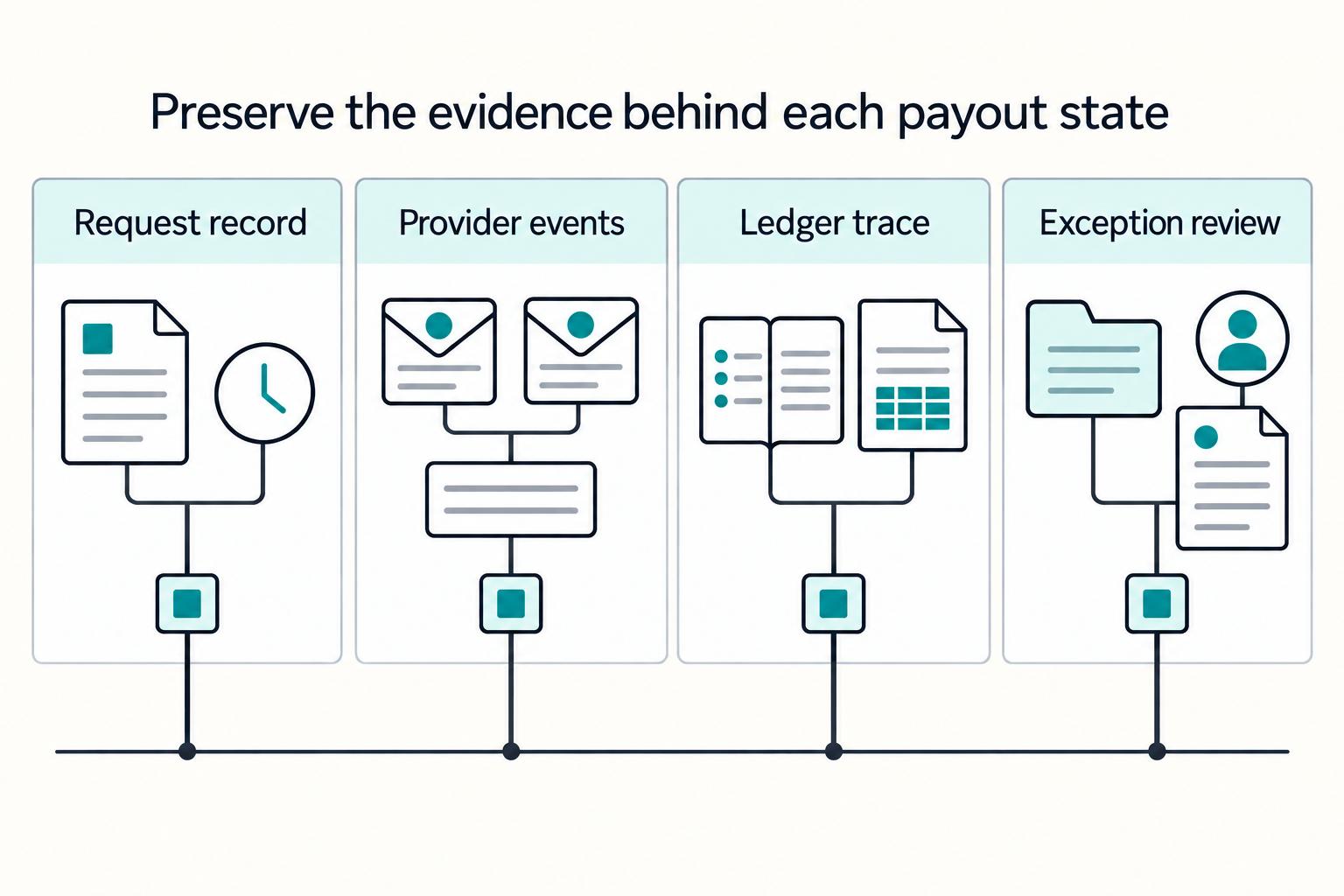
Design payout flows so you can always answer: what happened, and why. A payout usually spans request creation, provider acceptance or rejection, later webhook events, and final reconciliation, so your records need to stay traceable across asynchronous steps.
Post money movement to the ledger in a way that remains auditable even when a webhook arrives after the API response. A practical check is to sample recent payouts and confirm each one can be traced from user action to ledger entry to provider reference to final status. If the provider dashboard is the only place with full history, your own balances become hard to defend during disputes or close.
Make retries safe with idempotency keys#
Use the same idempotency key and unchanged request for retries of one intended provider operation, within that provider's documented protection window. Maintain a durable internal obligation record and an atomic execution claim as well; a new client key must not bypass duplicate-payment protection.
After a timeout, retrieve the existing attempt before treating it as failed. Stripe permits keys to be pruned after at least24hours, so an old key is not permanent duplicate protection. If the protection window is uncertain or expired, investigate and reconcile before any replacement attempt. Keep replacement approval, the original attempt and the new attempt linked to the same obligation.
Define the minimum audit pack and close checks#
For each payout, maintain a minimum audit pack finance, ops, and engineering can all use:
| Type | Item | Detail |
|---|---|---|
| Audit pack | Original request payload | Original request payload and timestamp |
| Audit pack | Provider reference | Provider reference or payout identifier |
| Audit pack | Webhook events | Webhook events received for that payout |
| Audit pack | Ledger entries | Ledger entries tied to the movement |
| Audit pack | Exception notes | Exception notes for failed or manually reviewed payouts |
| Audit pack | Reconciliation export | Reconciliation export, ideally at payout or settlement-batch level where supported |
| Close check | Reconciliation | Reconciliation as part of your operating close, including payout-level settlement batches where available |
| Close check | Failed payout aging review | Failed payout aging review so unresolved failures do not stall indefinitely |
| Close check | Unresolved exception queue | Unresolved exception queue with owner and investigation notes |
If your team cannot produce this evidence pack quickly for a payout, instrumentation is still too thin.
When payout timing starts affecting working capital, pair this with a float plan, as outlined in How to Build a Float Management Strategy for Marketplace Platforms.
Prevent liquidity fragmentation and disintermediation as you scale#
The practical rule is simple: concentrate activity in priority cohorts before adding payout routes, geographies, or seller segments. Expansion often splits liquidity into thinner pools where supply and demand no longer meet in the same location, category, or time window.
In practice, fragmentation appears when growth is uneven across those pools. One cohort sees empty shelves, while another has idling supply, frustration, and churn. Track balance at the cohort level, not just in aggregate totals, and sequence expansion deliberately as each pool proves stable.
Disintermediation risk also increases as you scale if users can match on-platform but complete transactions off-platform to avoid fees. Keep the platform's communication and support experience strong enough to remain the easiest path to complete the transaction on-platform, especially in newly expanded cohorts.
Do not default to blanket subsidies when liquidity is thin. The stronger pattern is targeted incentives tied to interaction quality in defined cohorts, then expanding payout complexity after that cohort shows reliable repeat demand and clean execution. If quality is weak, fix matching and support first. For an earlier-stage liquidity playbook, see Bootstrapping Marketplace Liquidity Without Breaking Unit Economics.
Turn this into a 30-day implementation plan#
If you want to change payout speed in the next 30 days, start with observability and control, not broader acceleration.
| Period | Focus | Key actions |
|---|---|---|
| Week 1 | Baseline | Review liquidity, interaction quality, payout failure modes, and current compliance gates by seller segment and corridor |
| Week 2 | Policy decisions by segment | Set timing and authorized reserve/release rules per segment; verify routes and resolve original attempts before fallback |
| Week 3 | Instrumentation | Enforce idempotency; build webhook consumers for duplicate and out-of-order delivery; make payout state traceable across request, provider reference, webhook events, internal records, exception notes, and reconciliation outputs |
| Week 4 | Controlled canary rollout | Treat canarying as a partial, time-limited production deployment; define rollback triggers before launch; do not rely on manual graph inspection alone as the primary release gate |
| Before you scale | Readiness checks | Validate market and program coverage; align product, engineering, ops, and compliance owners; confirm support can see payout status, exception reason, and next action |
Week 1 and Week 2#
Week 1 is for a baseline: liquidity, interaction quality, payout failure modes, and current compliance gates. Review this by seller segment and corridor so you can see where payout friction is operationally material, then document which onboarding, verification, and withdrawal gates are intentional versus inherited.
Week2 is for segment policies: timing, reserve basis and release rules, supported routes and exception ownership. Make fallback conditional on resolving the original attempt, not simply on its age. Confirm required artifacts and known failure states before approving a timing change.
Week 3 and Week 4#
Week3 is instrumentation. Use durable obligation guards, atomic execution claims and provider-scoped idempotency. Authenticate and persist webhook events, deduplicate processing and handle out-of-order states. Trace outbound obligations to provider execution, relevant bank or settlement evidence and internal ledger treatment; use merchant settlement-batch reports only for the incoming flows they describe.
Week 4 is a controlled canary rollout with explicit go or no-go criteria. Treat canarying as a partial, time-limited production deployment, and define rollback triggers before launch. Do not rely on manual graph inspection alone as the primary release gate.
Before you scale#
Close the month by documenting policy changes and support playbooks, then run final readiness checks:
- Validate market and program coverage.
- Align product, engineering, ops, and compliance owners.
- Confirm support can see payout status, exception reason, and next action.
If those checks are incomplete, keep rollout scope narrow until they are resolved.
Related reading: How to Build a Global Accounts Payable Strategy for a Multi-Country Platform.
Frequently Asked Questions
How does payout strategy change supply and demand balance in a two-sided marketplace?
Payouts influence whether sellers stay available when buyers are ready to transact. Faster or clearer payouts can help supply-side participation, but repeat transactions still depend on both sides showing up together consistently. If payout friction rises, seller availability can drop, which weakens match quality and demand-side conversion.
When should we speed payouts, and when should we tighten controls first?
Test faster payouts only when sellers' earnings access is a demonstrated constraint and loss, exception and support measures remain within your approved thresholds. Tighten applicable controls first if those measures deteriorate. For ACH funding, use the relevant debit-return rules and denominators; a credit payout does not share the same unauthorized-debit threshold.
Which metrics matter more than GMV and user count for payout decisions?
Match rate is critical because it shows whether buyers and sellers are actually finding each other. Pair that with operational reliability metrics such as payout success rate, exception rate, failed payout aging, and time to resolution. GMV and user count can rise while interaction quality gets worse, so they should not be your only payout-governance signals.
Why does liquidity fragmentation happen as marketplaces grow?
It can happen when supply and demand become uneven across geographies, seller segments, or payout setups. The result is thinner pools where buyers cannot find the right sellers, or sellers wait without enough qualified demand. Low match quality is the warning sign, and when match rate stays low, users have more reason to go elsewhere.
How can payout design reduce disintermediation risk?
Users bypass platform payments when the platform fee feels higher than the value it adds. Clear payout timing, visible payout status, predictable holds, and responsive support can strengthen perceived platform value. If off-platform attempts are rising, and payout complaints are rising in the same cohort, treat that as a potential leakage signal and investigate quickly.
What minimum controls should exist before launching cross-border payouts?
Confirm the exact corridor, account type, currency and program support. Complete applicable onboarding and verification, reserve or release rules, and traceable request, provider, bank and ledger records. Test uncertain outcomes, duplicate attempts and support escalation before launch.
Which rules vary by country or program, and how should we confirm them safely?
Payout availability is not one-size-fits-all. It varies by country, industry, and program, and self-serve cross-border payouts may be limited to listed regions rather than global coverage. Confirm the exact country pair, account type, and program terms before launch, and if you use a Merchant of Record, verify which transaction responsibilities shift and which still stay with your platform.
Try a related tool
Where Gruv fits
Researched and edited by the Gruv editorial team. Gruv builds cross-border billing, payouts, and finance-operations software for global businesses.
Sources
- docs.stripe.com/connect/manage-payout-scheduletrusted
- docs.stripe.com/connect/connected-account-reservestrusted
- europa.eu/youreurope/business/taxation/vat/check-vat-n...trusted
- irs.gov/forms-pubs/about-form-w-9trusted
- irs.gov/forms-pubs/about-form-w-8trusted
- taxation-customs.ec.europa.eu/taxation/tax-transparency-cooperation/admini...trusted
Educational content only. Not legal, tax, or financial advice.
Related Posts
Bad Payouts Are Costing Your Supply in Two-Sided Platforms
Payout issues are not just an accounts payable cleanup task if you run a two-sided marketplace. They shape supply-side trust, repeat participation, and fill reliability. They can also blur the revenue and margin signals teams rely on.
How to Calculate LTV in a Two-Sided Marketplace for Buyer, Seller, and Platform Decisions
In a two-sided marketplace, many teams look at buyer-side and seller-side value separately, then compare each view to the relevant Customer Acquisition Cost instead of forcing everything into one blended ratio. Treat Lifetime Value as an operating number, not a spreadsheet guess.
How to Build a Two-Sided Marketplace by Balancing Client and Contractor Acquisition
Balance is an operating discipline, not a traffic goal. In a two-sided marketplace, growth breaks when one side shows up faster than the other side can respond in a useful way. More client demand is not progress if qualified contractors cannot be found or trusted. More contractor signups are not progress if clients cannot find the right fit and close real work.