
Quick Answer
Make payout timing predictable, show clear status milestones and give exceptions one owner. Reconcile provider evidence, ledger records and contractor-visible states. Keep pricing stable while testing these changes in comparable cohorts so improvements are easier to interpret.
How payout failures erode supply#
Payout issues are not just an accounts payable cleanup task if you run a two-sided marketplace. They shape supply-side trust, repeat participation, and fill reliability. They can also blur the revenue and margin signals teams rely on.
That framing matters because a platform is not a one-sided billing engine. In a two-sided market, participation on one side affects participation on the other, and the value each group gets rises or falls with the other side's presence. If contractors do not trust when they will be paid or cannot see why a payout is delayed, the problem often does not stay inside finance. It can show up as slower supply response, more support contacts, more manual exceptions, and weaker marketplace reliability.
Pricing changes are harder to interpret when supply-side trust is already unstable. Keep pricing constant while testing a payout improvement in comparable cohorts, and account for demand, seasonality and other product changes. A before-and-after improvement alone does not establish causation.
The people who usually have to make that call do not get perfect signals. This list is for founders, product leaders, revenue teams, and finance operators looking at contractor churn, fill-rate softness, or rising payout complaints. They need to decide what to fix first. The first checkpoint is simple: verify that your payout experience is predictable enough to support a fair pricing test. In practice, that means timing windows are consistent, statuses are visible to contractors, and exceptions are handled the same way every time instead of through inbox heroics.
One red flag matters more than it may seem. If the business treats payout friction as a back-office defect while the supply team sees attendance, acceptance, or repeat participation slip, you are likely looking at a marketplace problem, not just a finance-only problem. U.S. survey evidence points in a similar direction. Among people doing short-term tasks, many said they wished pay was more consistent, and 9% of people in 2024 reported making money from short-term tasks. For this workforce, consistency is not cosmetic.
The promise of this article is practical and narrow. Stabilize payout quality and transparency before drawing hard conclusions from pricing and monetization changes. That sequence will not solve every supply problem, but it gives you a cleaner way to tell what is actually hurting contractor retention on a two-sided platform and what is not.
For a step-by-step walkthrough, see How Gig Platforms Can Use Earned Wage Access (EWA) as a Contractor Retention Tool.
Who this list is for and how to choose the right payout model#
Use this list if payout quality is affecting supply behavior on a two-sided platform, not just finance workload. If contractors cannot predict payout timing or understand hold reasons, do not lead with take-rate changes. Stabilize payout reliability and communication first, then test pricing once the signal is cleaner.
This decision is usually cross-functional: founders, marketplace GMs, AP leads, and revenue or supply operators. Compare payout models using the same four filters each time:
- Contractor retention
Prioritize predictability for the supply side: clear payout windows, visible statuses, plain-language hold reasons, and a consistent dispute path.
- Accounts payable load
Watch for manual approvals, exception handling, and reconciliation drag. If release cycles still depend on inbox chasing, the model is operationally fragile.
- Compliance risk
Check whether the contract and applicable law allow a holdback, how much may be withheld and when it must be released. Construction retainage rules are sector-specific; they are not a default policy for marketplace contractors.
- Unit economics
Faster access can improve trust, but it can also increase cost or risk exposure. If disputes are concentrated in one segment, tighten controls there instead of slowing the whole marketplace.
One red flag to treat seriously: if payout incidents are rising while monetization is changing, you can misread a supply-trust issue as a pricing issue.
Related: Two-Sided Marketplace Dynamics: How Platform Supply and Demand Affect Payout Strategy.
Best payout operating models for contractor retention#
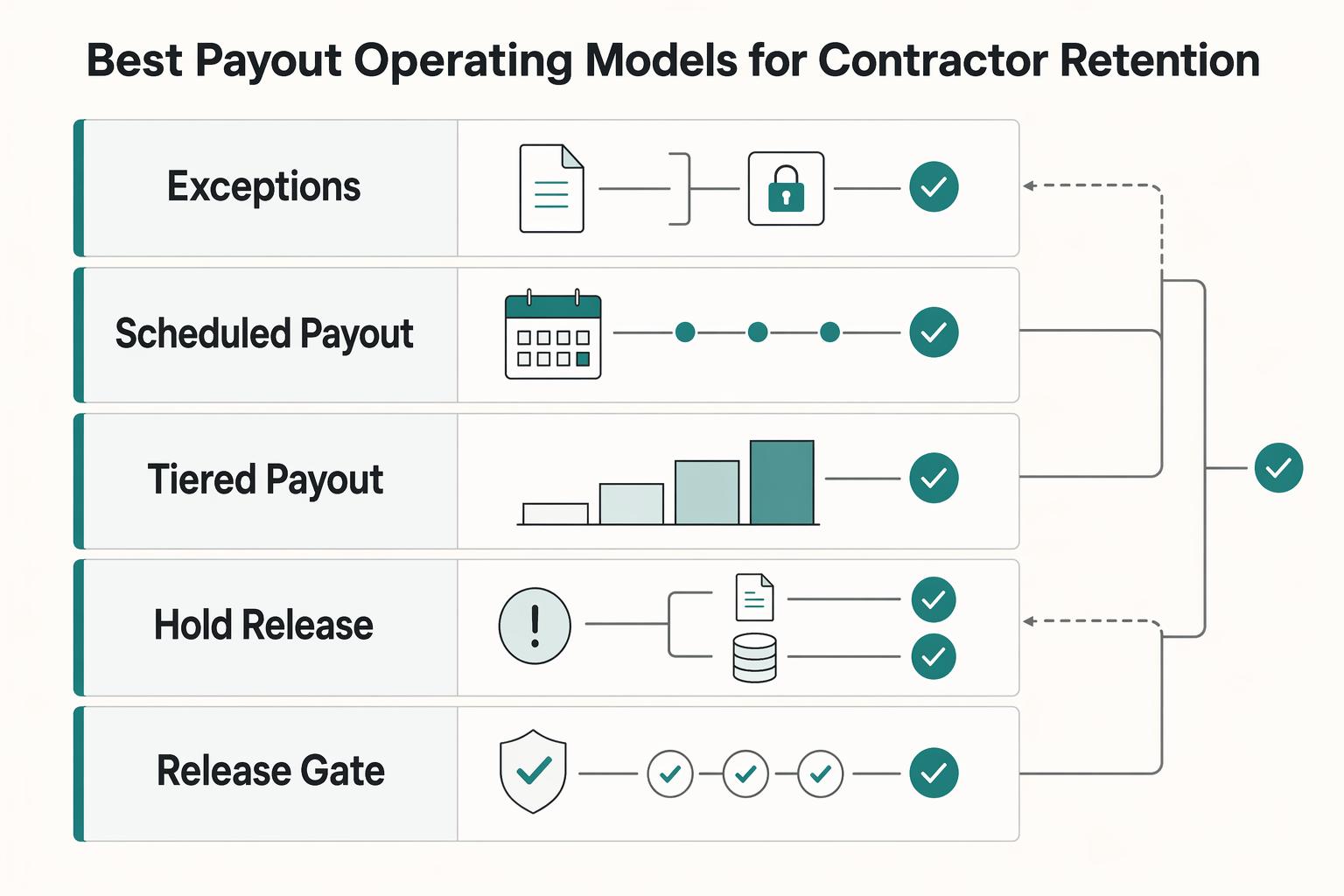
For most platforms, start with fast standard payout plus a strict exception workflow. It sends a clear trust signal to contractors without forcing instant access across your full supply base.
| Model | Best for | Key detail | Note |
|---|---|---|---|
| Fast standard payout with strict exception workflow | Scaled marketplace teams that already release funds on a predictable cadence | Keep standard payouts fast for most accounts and route unusual cases into one controlled exception path | Publish the payout cadence, show hold reasons, and assign one owner for exceptions |
| Scheduled payout with visible status milestones | Finance-heavy organizations where reconciliation and predictability matter more than headline speed | Use a fixed payout cadence with explicit review and release windows | Illustrative weekly schedule: work period, client review window and a published release date. Distinguish available balance from bank arrival. |
| Tiered payout by contractor segment | Mixed-risk supply pools where not every contractor should follow the same release path | Give faster access to lower-risk segments and tighter release controls to higher-risk segments | If segmentation rules are unclear, contractors can read timing differences as arbitrary treatment |
| Hold-and-release model for disputed work | Milestone-based categories where disputes are common and work resembles main contractor/subcontractor dynamics | Use a defined holdback tied to milestone completion, inspection, or acceptance | Use a lawful, contractually agreed amount and release condition; do not import construction percentages into unrelated work. |
| Compliance-gated accelerated payout | Platforms that want faster access only after required verification is complete | Tie acceleration to policy gates; users must pass KYC checks before payout | Moving to a higher verification tier can make payouts temporarily disallowed; an instant payout reference says funds typically settle within 30 minutes |
- Model 1: Fast standard payout with strict exception workflow
Best for scaled marketplace teams that already release funds on a predictable cadence. Keep standard contractor payouts fast for most accounts, and route unusual cases through one controlled exception path so you do not slow everyone down. In practice: publish the payout cadence, show hold reasons to contractors, and assign one owner for exceptions.
Speed and control can coexist. Before release, verify the approved instruction, beneficiary, available balance and any earlier attempt. After submission, match provider outcomes to financial records and contractor-facing status, using recipient-credit evidence where available.
- Model 2: Scheduled payout with visible status milestones
Use a fixed payout cadence with explicit review and release windows. Publish when work is reviewed, when earnings become available and when a withdrawal is expected to reach the bank. Those are separate milestones; a platform release date is not a bank-credit guarantee.
This model works when statuses are specific, not generic. Show milestones such as submitted, under review, approved, scheduled, and released. The tradeoff is perceived slowness, so consistency against the stated release date is critical.
- Model 3: Tiered payout by contractor segment
Best for mixed-risk supply pools where not every contractor should follow the same release path. Give faster access to lower-risk segments and keep tighter release controls for higher-risk segments. This keeps speed targeted instead of exposing the entire marketplace to one risk profile.
The main risk is opacity. If segmentation rules are unclear, contractors can read differences in timing as arbitrary treatment.
- Model 4: Hold-and-release model for disputed work
For milestone-based work, define any lawful holdback in the contract with a precise acceptance or dispute condition and a release deadline. A holdback does not automatically authorize keeping undisputed earnings or bypassing local payment rules.
This model contains conflict by isolating the disputed amount rather than freezing everything. It only works when milestones and approval evidence are explicit and documented in the payout decision trail.
- Model 5: Compliance-gated accelerated payout
Best for platforms that want faster access only after required verification is complete. This keeps acceleration tied to policy gates instead of preference. Adyen's guidance is explicit: users must pass KYC checks before payout, and moving to a higher verification tier can make payouts temporarily disallowed.
The benefit is auditable speed for verified users, including near-immediate options where supported. Stripe's instant payout reference provides a benchmark: funds typically settle within 30 minutes. Keep the fallback path clear when verification is incomplete so contractors know what is blocked and what happens next.
If you want a deeper dive, read Subscription Billing Meets Contractor Payouts: How Two-Sided Platforms Handle Both on One System.
Minimum viable payout standard every serious platform should meet#
If your payout operation misses these four basics, fix them before pricing changes: a clear policy, one controlled exception path, auditable reconciliation, and a trust-protection operating rule when incidents rise.
- Plain-language payout policy
Publish one policy that covers normal flow and exception flow. At minimum, define payout timing windows, visible payout states, hold triggers, and dispute handling. Contractor-facing detail should include transaction detail, the scheduled send date, and how payout amounts were calculated.
Keep it usable under stress. If a payout fails or is returned, show a concrete status and return reason instead of a generic "pending." Practical status labels include processing, posted, failed, returned, and canceled.
- One exception workflow with an owner
Route all payout exceptions through one path with a named owner, an internal SLA, and contractor-facing updates at each step. Avoid ad hoc handling across support tickets, finance inboxes, and chat threads.
Document delay reasons, expected delivery windows and escalation thresholds for the actual provider and payout method. Keep initiation, balance availability and recipient-bank credit separate; use provider evidence when tracing a missing transfer.
- Auditable reconciliation before every release cycle
Before release, reconcile the approved amount, beneficiary, available balance and any previous attempt. After submission, match provider outcomes and bank evidence to financial entries and contractor-visible status. If an earlier attempt is uncertain, investigate it before issuing a replacement.
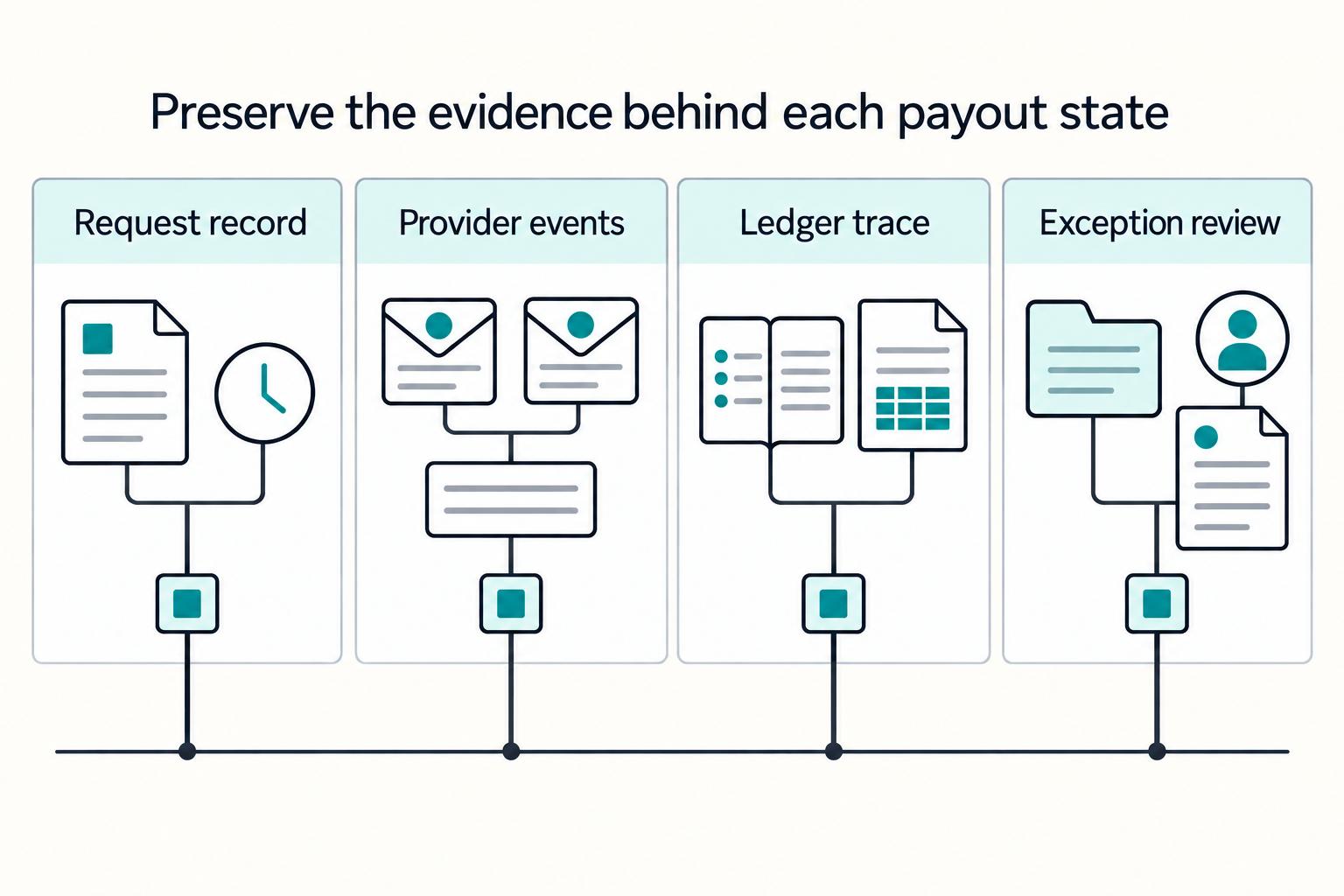
Your evidence should tie bank payouts to underlying settlement batches and support transaction-level checks for settled and paid-out amounts. For incident review, keep the payout report extract, ledger line, and status history together.
- Retention protection before take-rate pressure
If payout incidents rise, pause take-rate-increasing changes until payout reliability and communication stabilize. Treat this as an operating rule, not a universal external threshold.
Sequence matters: when contractors are already unsure about payout timing, added fee pressure compounds trust loss. Restore payout clarity first, then revisit monetization changes.
The first 30 days to fix payout quality without changing pricing#
Use the first month as a reliability sprint, not a pricing project: fix visibility and resolution quality first, and keep unit economics unchanged until payout behavior is stable across a full four-week window.
| Week | Focus | Actions | Concrete detail |
|---|---|---|---|
| Week 1 | Map failure modes end to end | Map the real payout path across product, accounts payable, support, and ops, then classify recent incidents by payout state and handoff point | Use payout states such as processing, posted, failed, returned, and canceled |
| Week 2 | Fix communication before economics | Improve ETA language, add a visible incident/status page, and use one named exception owner; hold pricing, payout fees, and take-rate experiments constant | Choose an incident update cadence the team can meet; 30 minutes is an illustrative internal target. |
| Week 3 | Enforce one escalation path and measure quality | Use one escalation path for delayed contractor payouts and track reopened tickets plus full resolution time | Return discovery and recovery vary by rail and country; measure each separately. |
| Week 4 | Run a controlled cohort test before touching pricing | Use a small, time-limited cohort and canary-style rollout before broad rollout | Revisit pricing only if trust signals improve; otherwise pause monetization experiments if payout behavior is still unpredictable by the end of Week 4 |
- Week 1: map failure modes end to end
Map the actual payout path across product, accounts payable, support, and ops, then classify recent incidents by payout state and handoff point: processing, posted, failed, returned, or canceled. Use state transitions and return reasons to separate bank-side issues, platform-side issues, and pure visibility gaps.
Label each issue for retention risk and margin impact. Separate the time a return becomes visible from the time funds are recovered and a corrected payout arrives. Keep a payout timeline, financial entries, ticket history and user-facing status history for each incident.
- Week 2: fix communication before economics
Improve ETA language, publish an incident/status page and give exceptions one owner. Choose an update cadence the team can reliably meet; every 30 minutes is an illustrative internal target rather than a network standard.
Hold pricing, payout fees, and take-rate experiments constant in this week. If you change economics while repairing communication, you will not know what actually improved trust.
- Week 3: enforce one escalation path and measure quality
Use one escalation path with an owner and explicit thresholds. Set return-investigation and recovery expectations by provider and rail rather than promising a universal two-to-three-day resolution.
Track reopened tickets and full resolution time as core quality signals. If reopened tickets stay high, cases are being marked solved before contractors see real resolution.
- Week 4: run a controlled cohort test before touching pricing
Test changes with a small, time-limited cohort before broad rollout. A canary-style rollout lets you evaluate outcomes on a subset instead of assuming full-launch success.
Revisit pricing or take rate only if trust signals improve in that cohort. If payout behavior is still unpredictable by the end of Week 4, pause monetization experiments and fix root-cause reliability first.
We covered this in detail in Accounts Payable vs. Accounts Receivable for Platforms and the Two-Sided Ledger.
How to choose payout speed versus risk and margin tradeoffs#
Choose payout speed based on where the bigger loss sits: if contractor churn is rising, protect retention first and recover margin later through better routing and fewer exceptions.
| Payout speed | Compliance risk | Operational burden | Margin impact |
|---|---|---|---|
| Accelerated payout lane (for example, Stripe Instant Payouts with funds typically settling within 30 minutes) | Higher if unready accounts are pushed through. Verification requirements vary by business type, country, and payments capabilities, so readiness checks must be tighter | Medium to high. Faster release increases pressure on support, finance, and risk when data is missing or misclassified | Higher direct cost because there is a fee on each Instant Payout |
| Scheduled standard payout (for example, a two-day payout delay configuration) | Lower day-to-day risk when timing and policy are clear, but still dependent on verification and communication quality | Lower. Fixed release timing usually simplifies reconciliation and limits exceptions | Usually lighter than accelerated lanes because you are not paying for speed on every payout |
| Segmented controls (holds/pauses for flagged accounts only) | Useful when dispute or verification issues are concentrated in one segment. Pausing can block payout creation, so controls need tight governance | Higher for flagged accounts, lower for everyone else. Teams must actively review and clear exceptions | Often protects margin better than slowing the full base, though manual review and delays still carry cost |
A broad slowdown often applies your highest-risk policy to your lowest-risk contractors. In a two-sided platform, that can amplify supply-side frustration and churn risk.
- If churn is the main issue, pay for speed selectively
Use faster access for low-risk cohorts when trust and repeat participation are weakening. Faster payout options can carry a premium, but sequence matters: stabilize participation first, then recover cost through cleaner verification, better routing, and fewer exceptions.
- If disputes are concentrated, apply controls where they cluster
Use targeted controls where the risk is concentrated. For Stripe’s supported Accounts v1 pause workflow, an in-flight payout remains pending for up to 10 days from creation; if it is not unpaused in that period, Stripe cancels it and returns funds to the connected-account balance. This rule is specific to that workflow, not a universal payout deadline.
- Before rollout, require three checkpoints
Confirm policy readiness, reconciliation pass rate, and exception closure performance before expanding any faster lane.
Policy readiness: timing windows, hold triggers, and dispute paths are explicit and user-facing.Reconciliation pass rate: payout event, ledger record, and contractor-visible status align in recent samples.Exception closure performance: delayed/held cases close cleanly instead of reopening through support.
Use this operating rule: speed up low-risk cohorts when churn risk is rising, and isolate controls to high-risk cohorts when dispute risk is concentrated.
Red flags that signal payout quality is driving supply-side loss#
When these signals cluster, payout quality is likely a supply-side growth issue, not just a finance workflow issue. If demand is steady but your reliable suppliers participate less, audit payout visibility, dispute handling, and exception operations before you blame acquisition.
- On-time releases, high "where is my payout" volume
Repeated status tickets after on-time release usually signal weak visibility more than pure delay. WISMO-style inquiries are a known high-volume support category, so match ticket timestamps to release events and contractor-visible status to confirm whether the gap is status clarity.
- Experienced suppliers pull back after payout disputes
If tenured suppliers decline work after payout disputes, treat it as a trust warning. Do not claim direct causality without cohort controls, but payment-practice pressure is associated with supplier retaliation and operational disruption, so this pattern should be escalated quickly.
- Stable demand, weaker supply-side fill
In two-sided markets, supply-side contraction can reduce demand-side value. If demand holds while fill weakens in the same cohort reporting payout friction, prioritize payout quality in your diagnosis before treating it as a top-of-funnel issue.
- Manual overrides become normal in the exception workflow
Frequent one-off fixes and support-led payout corrections are a risk signal, not a sustainable operating mode. Manual payables handling reduces visibility and increases error exposure, so repeated override paths can compound trust loss and retention drag. If helpful, track this with the same discipline used in Which Contractor Payment Experience NPS Metrics Actually Predict Retention.
The evidence pack that proves payout improvements are working#
Payout improvements are only credible when you can show consistent, trend-aware evidence that links payout quality to contractor behavior. Use one monthly operating pack so leadership can separate real movement from noise and make pricing decisions on cleaner signals.
- Run one monthly pack with the same four cuts
Keep the cadence monthly and the structure fixed: payout timeliness, exception closure, contractor complaint themes, and retention movement by cohort. Define cohorts as comparable groups with one shared characteristic, for example acquisition date, tenure, or payout-incident exposure. If those definitions drift, the pack stops being reliable evidence.
- Anchor pre/post to one payout policy change
Tie each before/after read to a single payout policy change and its go-live date. Use regular-interval pre/post views so you can read movement with the underlying trend in view, not a single noisy window. Treat this as directional unless you also have a proper comparison design for causality.
- Require reconciliation sign-off before claiming supply-side recovery
Gate claims on shared sign-off from finance, product, and ops that reconciliation checks passed. At minimum, the payout event, ledger record, and contractor-visible status should be consistent for the reported period. If manual overrides cannot be traced across those records, do not treat retention movement as settled.
- Track unknowns explicitly
Do not rely on external benchmark levels for payout timeliness, exception closure, or payout-linked retention. Make internal measurement quality explicit, and document limits such as seasonality, parallel product changes, and cohort contamination.
- Use the same pack to time pricing work
Use this document for both trust recovery and monetization readiness. If complaints are still shifting, exception closure is unstable, or reconciliation is failing, pricing and take-rate optimization are still confounded. When those signals stabilize in the same cohorts, you have a safer base to restart optimization.
This pairs well with our guide on How to Build a SaaS Marketplace That Manages Subscriptions and Contractor Payouts.
Conclusion#
If you remember one thing, make it this: in a two-sided marketplace, payout reliability is part of growth, not just finance hygiene. These businesses work when both sides keep showing up for reliable, repeatable transactions, and public marketplace research indicates that supply-side contraction can reduce demand-side value too.
-
Treat payout quality as a market-health input. Late or confusing payouts do more than create tickets. They can change supplier behavior, and in a marketplace that can spill into fill reliability, buyer experience, and churn on the other side. Payout trust can affect participation, not just satisfaction, so it belongs in growth and monetization decisions alongside margin and conversion.
-
Fix core control points before you push hard on pricing experiments. Nothing here proves one universal sequence, but the least glamorous operational work is often foundational: one exception workflow, clear contractor-visible status milestones, and auditable reconciliation across the payout event, ledger record, and what the contractor actually sees. The tradeoff is straightforward: you may accept more ops effort now, but you reduce the risk of making take-rate changes while your supply side is already uncertain.
-
Use a short execution cycle to choose, test, and verify one model. Pick one payout model from the list, run it through a focused, time-boxed cycle, and review the same evidence pack every week: on-time payout rate, exception resolution time, reopen rate, complaint themes, and retention movement by cohort. The discipline matters. Do not change the payout policy, status rules, and pricing at the same time or you will not know what moved the result.
A May 2024 Federal Reserve Financial Services survey release reported businesses using faster or instant payments for cost reduction (48%), flexibility (39%) and 24/7 availability (35%). The publisher also markets these services. These findings support testing an operational hypothesis, not claiming marketplace-specific retention causality.
So the practical recommendation is simple. If your payout operation is still generating avoidable uncertainty, consider pausing aggressive monetization experiments while you stabilize trust signals. As reconciliation consistency and exception handling improve in your own data, you are in a better position to test unit-economics changes with lower supply-side risk.
Frequently Asked Questions
What are bad payouts in a two-sided platform?
In a two-sided platform, bad payouts are not just late payments. They can also include unclear status updates, inconsistent exception handling, and disputes that leave contractors unsure when they will be paid. That matters because participation on one side affects the other, so trust problems on the supply side can spill into fill reliability and buyer experience.
How do payout issues affect contractor retention?
Payout friction can increase uncertainty, and uncertainty can change behavior quickly. Contractors who do not trust timing or status may reduce repeat participation, keep one foot on another platform, or leave after a dispute. Public faster-pay research is directionally consistent here: Federal Reserve Financial Services survey commentary says employers see better satisfaction and retention from same-day pay, which is useful evidence even if it is not marketplace-specific causal proof.
Which payout KPIs should we track first?
There is no universal KPI starter set. Start with a small set that measures payout timeliness and issue resolution in your own workflow, then expand only if definitions stay stable month to month. Your verification checkpoint should still be reconciliation across the payout event, ledger record, and contractor-visible status before you treat any KPI move as real.
What is the fastest fix if we cannot change pricing yet?
There is no single fastest fix when pricing cannot change. A low-risk first move is operational: make payout status clearer, use one exception path, and tighten reconciliation. You can ship those changes without introducing new take-rate noise into the read.
Should we prioritize payout speed or compliance controls?
Required legal and provider checks set the boundary; speed options operate within it. Offer accelerated access only to eligible recipients and use clear review and release criteria. A reviewer cannot override a legal prohibition just to meet a speed promise.
How do we know this is not just a demand problem?
You usually cannot prove that from one metric. If demand looks steady but repeat supplier participation, fill reliability, or post-incident cohorts worsen, payout quality is a credible supply-side hypothesis worth testing, not a causal conclusion. That is when the monthly evidence pack matters: compare before and after one payout policy change, and do not claim causation unless the comparison design really supports it.
Try a related tool
Researched and edited by the Gruv editorial team. Gruv builds cross-border billing, payouts, and finance-operations software for global businesses.
Sources
- docs.stripe.com/global-payouts/manage-payoutstrusted
- docs.stripe.com/payouts/instant-payoutstrusted
- federalreserve.gov/publications/2025-economic-well-being-of-us-...trusted
- ftc.gov/system/files/attachments/us-submissions-oecd...trusted
- justice.gov/sites/default/files/atr/legacy/2011/05/12/27...trusted
- neeley.tcu.edu/News/Insights/Rodriguez-Swink-Researchtrusted
- one.oecd.org/document/DAF/COMP/WD%282017%2927/FINAL/En/pdftrusted
- stripe.com/resources/more/two-sided-marketplace-strategytrusted
Educational content only. Not legal, tax, or financial advice.
Related Posts

Subscription Billing and Contractor Payouts on One Two-Sided System
Treat recurring billing and contractor disbursements as one money flow, or reconciliation is usually where the breakage shows up first. When teams separate customer collection from payout release, they can end up with two versions of the truth: one for revenue, one for payables, and neither is easy to reconcile at month-end.
How Supply and Demand Dynamics Should Set Your Marketplace Payout Strategy
In a two-sided marketplace, payout strategy is not back-office plumbing. It can shape whether sellers stay active, whether transactions complete reliably, and whether buyers can find supply that is ready to transact.
How to Build a Two-Sided Marketplace by Balancing Client and Contractor Acquisition
Balance is an operating discipline, not a traffic goal. In a two-sided marketplace, growth breaks when one side shows up faster than the other side can respond in a useful way. More client demand is not progress if qualified contractors cannot be found or trusted. More contractor signups are not progress if clients cannot find the right fit and close real work.