
Quick Answer
Use contractor payment experience nps retention as a directional read, not a launch trigger. Treat `% Promoters - % Detractors` and the `-100 to +100` range as sentiment input, then confirm with repeat payout completion or fixed-cohort retention before changing fees. When scores rise but behavior does not, pause the change and review payout reliability, survey timing consistency, and exception-handling patterns first.
Platform NPS Is a Directional Signal, Not a Pricing or Retention Trigger#
Platform NPS is useful as a directional loyalty signal, but on its own it is not enough to justify pricing, payout-policy, or retention changes. Teams make better decisions when they treat score movement as a prompt to investigate, not as proof that retention outcomes improved or declined.
NPS is a common customer-experience metric based on likelihood to recommend. It groups responses into Promoters, Passives, and Detractors, then calculates the score as % Promoters - % Detractors, producing a range from -100 to +100. That simplicity makes it easy to read and easy to overinterpret.
The main risk is simple. Teams react to subtle score shifts before confirming what actually changed. NPS is often framed as a predictive business indicator, but movement alone can still mislead, especially when survey timing changes.
This article takes a narrower view: do not treat Platform NPS as contractor-specific causal proof of retention outcomes, but do not ignore it either. Treat it as one input in a broader retention dashboard, then validate whether behavior and outcomes move in the same direction before acting.
Before escalating an NPS change, run a quick operator check:
- Confirm survey timing stayed consistent.
- Check whether any real operational or product change happened in that window.
- Compare sentiment movement with retention-relevant behavior, not sentiment alone.
The goal is not a prettier scorecard. It is a tighter chain from signal to action. Measure sentiment, verify what changed, confirm with behavior, and then decide whether to adjust product, operations, or monetization.
Start with the model that matters#
Treat NPS as a sentiment signal, not retention proof. It helps you monitor sentiment direction, but it does not validate retention outcomes on its own.
Keep the mechanics explicit so interpretation stays disciplined:
- NPS asks a
0to10recommendation question. - Promoters are
9s and 10s, Passives are7s and 8s, and Detractors are everyone else. - The reported score ranges from
-100to+100.
For payout decisions, define the moment being measured before you read the score. If the question captures broad relationship sentiment, do not report it as payment-specific truth. If you need payment-specific signal, anchor the survey to a payout journey moment in your own product and label that trigger in reporting.
One practical risk is category blur. A low score can reflect friction outside the payout touchpoint. Pair NPS with CSAT and VoC so you can separate touchpoint issues from broader sentiment. CSAT tests a specific interaction, while VoC helps connect direct, indirect, and inferred feedback into a usable evidence trail.
Before changing price, fees, or payout policy, require a small evidence pack:
- NPS by survey trigger with respondent count
- CSAT for the exact payout touchpoint
- VoC themes or verbatims that show what changed
That keeps one-number movement in context and treats the link between payment experience, NPS, and retention as a hypothesis to test, not a proven chain.
Related reading: What Are the Tax Implications of an Honorarium Payment?.
Separate what is known from what is unknown#
Treat Platform NPS as retention-relevant, not retention-proving. It can track loyalty and CX direction, but it does not prove a contractor payment experience -> Platform NPS -> contractor retention chain.
| Status | Point |
|---|---|
| Known | Insight Global frames NPS as a leading indicator of customer experience and loyalty, and Meegle ties NPS to retention strategy. |
| Known | CustomerGauge links NPS programs to retention and revenue outcomes and reports visibility gaps: over 62% cannot calculate CX ROI, 70% do not know bottom-line impact, and 60% do not know driver-level cost impact. |
| Known | Qualtrics recommends tracking multiple CX metrics because one score cannot capture full experience dynamics. |
| Unknown | Whether payment-specific sentiment changes caused later retention changes in your contractor base. |
| Unknown | Any contractor-payment-specific threshold that makes a pricing, fee, or payout-policy change automatically safe. |
For pricing or payout-policy decisions, require a second confirmation signal before shipping. Use cohort retention, a shared start group followed over time, or event-based retention, where one payment event is completed and then another is observed later. If NPS rises while repeat payment behavior stays flat, treat that as sentiment lift without retention proof.
Before you turn an NPS move into a monetization decision, confirm directional agreement from a behavior or cohort retention metric. If signals conflict, hold the decision and treat NPS as directional only.
This pairs well with our guide on What to Do If You've Been Misclassified as an Independent Contractor.
Build a minimum viable metric stack before changing monetization#
Before you change fees, pricing, or payout policy, align one shared stack across sentiment, behavior, and outcomes so teams are not arguing about metric definitions mid-quarter.
| Layer | Metric | What it answers | Primary owner | Refresh cadence | Evidence quality |
|---|---|---|---|---|---|
| Sentiment | Net Promoter Score (NPS) | Is overall loyalty sentiment moving up or down? | Product or CX | Monthly, with consistent survey triggers | Directional |
| Sentiment | Customer Satisfaction Score (CSAT) | Did a specific payout interaction feel satisfactory? | Product or support ops | Weekly or after key transactions | Diagnostic |
| Sentiment | Voice of the Customer (VoC) themes | What are users praising or complaining about? | Product with support input | Weekly theme review, monthly rollup | Diagnostic |
| Behavior | Repeat payout usage | After a first payout event, do users return for another? | Finance ops or analytics | Weekly | Strong directional |
| Outcome | Contractor retention | Are existing contractors staying active over the selected period? | Revenue ops or analytics | Monthly cohort review | Decision-grade |
| Outcome | Customer retention | Are existing customers staying on the platform over the selected period? | Revenue ops or finance | Monthly or quarterly | Decision-grade |
This split matters because each metric has a different job. CSAT reflects transaction-level satisfaction, NPS reflects broader loyalty sentiment, and VoC captures feedback themes rather than a single score. NPS alone is not enough for monetization decisions.
Lock definitions before the quarter starts. NPS is % Promoters - % Detractors, with the 0-6 group in the negative bucket, and retention should use one agreed formula and one fixed time window across teams. If your metric source changes month to month, your trend is not decision-grade.
Use this checkpoint before action: if Promoters rise but retention is flat, investigate possible pricing friction and payout reliability before funding new feature work. Use operational evidence, not sentiment alone. Include payout event logs or webhooks, such as completion and failure states plus available timing signals, alongside repeat payout usage and cohort retention for the same period.
Keep the rule simple: ship monetization changes only when sentiment movement agrees with at least one behavior or outcome signal. Related reading: Build a Freelancer Payment Portfolio That Protects Cashflow.
Map payout journey moments to sentiment drivers#
Once the stack is in place, tie surveys to real payout moments. Use NPS as an event-linked signal, not a floating brand score, then verify movement against operational logs before drawing conclusions.
Trigger surveys from payout events, not generic pulses#
Transactional NPS works best after a specific experience, so trigger surveys off payout lifecycle moments:
| Payout moment | What to check |
|---|---|
| Payout initiation | Whether setup and submission felt clear |
| Status visibility | Whether in-progress states felt understandable and trackable |
| Exception handling | Failed or delayed paths that required support |
| Completion confirmation | The full experience right after paid or credited confirmation |
Keep timing aligned with operations. Stripe documents payout.created, payout.updated, payout.paid, and payout.failed, and notes notifications can span several days. Stripe also notes instant payouts typically send payout.paid within 30 minutes. That supports a different survey window than slower payout rails.
Tag Detractors to payout failure patterns before executive interpretation#
Treat 0-6 responses as a segment to diagnose with operational context and open-text themes, not as automatic proof of broad brand decline.
Tag payout-related patterns explicitly, such as unclear status states, repeated delay signals, and unresolved exception flows. For status visibility checks, documented states like PayPal pending and unclaimed are useful reminders that wording and resolution clarity can affect perception. That includes unclaimed flows that may auto-cancel after 30 days.
Segment by operating unit to test operational variance#
After event-level triggering is in place, compare results by segment or operating unit instead of relying on one blended platform score.
Use Business Partners vs in-house servicing as a test lens, not proof of causality. If variance clusters around exception handling or status visibility in one operating context, review process maturity, coverage, response handling, and state transparency before changing messaging.
Add an operational verification checkpoint for major score moves#
Before reporting a major NPS shift to leadership, run a matching event-log review for the same period.
This keeps interpretation tied to process reality and aligns with guidance to connect NPS with interaction and journey data. In practice, compare survey-trigger windows with payout lifecycle evidence, for example Stripe webhook activity and timing or Adyen tracking-object outcomes like credited or failed. If sentiment moved without a clear operational shift, treat the result as provisional.
Related: Mobile-First Payout Experience: How to Design Contractor Payment Flows for Mobile.
Compare leading indicators that predict retention risk earlier#
Do not wait for retention to tell you something is wrong. Use a mixed indicator stack. NPS can give early directional risk, then operational payout signals help you find root causes and decide what to fix.
| Indicator | What it surfaces first | Lead time | Actionability | Best use |
|---|---|---|---|---|
| Net Promoter Score (NPS) | Overall relationship sentiment after a payout experience (0-10 scale) | Fast when surveys are triggered from payout events | Medium | Early warning that retention risk may be rising |
| Customer Satisfaction Score (CSAT) | Satisfaction with a specific interaction (commonly 1-5) | Fast and closer to the transaction | High | Isolate friction in a step or support touchpoint |
| Voice of the Customer (VoC) | What users say, think, and expect in comments/themes | Continuous, slower to structure | Medium to high (after tagging) | Explain why sentiment changed |
| Failed payout rate | Reliability issues in payout outcomes | Immediate once status events are tracked | High | Detect operational breakage quickly |
| Exception resolution time | How long failed, returned, or manual-review cases remain open | Near real time with clean timestamps | High | Prioritize support and ops fixes |
| Repeat payout completion | Whether users return and complete another payout in your own data | Slowest (needs a later completed event) | Medium to high | Behavioral check after sentiment shifts |
Use broad signals for warning and narrow signals for action#
NPS is broad and fast to collect, but it is not root-cause evidence by itself and should not be the only signal for pricing or payout-rail changes. CSAT is more transactional, so it is better suited to diagnosing specific payout moments. VoC adds the language behind score movement. Operational indicators then confirm what actually happened in payout flow outcomes.
Stripe payout outcomes such as processing, posted, failed, returned, and canceled, plus Adyen transfer status changes via balancePlatform.transfer.updated, are the verifiable trail for action decisions.
Read combinations, not single metrics#
If Passives (7-8) rise while payout failures stay stable, test communication clarity first: status wording, expected timing, and completion messaging, before changing price or payout rails.
If the 0-6 bucket rises and exception volume or resolution time rises with it, prioritize ops reliability first. Reduce failed or returned payouts and shorten exception handling time before debating packaging or fee changes.
If Promoters (9-10) improve but repeat payout completion does not, treat the sentiment improvement as provisional until behavior confirms it.
Verify timing logic before treating trends as decision-grade#
Anchor timing to payout state changes, not only ticket timestamps or webhook receipt time. Adyen notes webhook retries can continue for up to 30 days. That can distort exception timing if clocks start late.
For major score movement, pair three items: survey trigger window, matched payout status history, and case timeline for failed or returned payouts.
Avoid false cross-region comparisons#
Normalize before comparing programs or markets. Stripe states payout schedules vary by country and industry, and returned payouts are typically seen in 2-3 business days but can take longer by recipient country.
Also account for support coverage differences, for example staffed exception handling vs self-serve. Otherwise raw CSAT, VoC themes, and exception resolution time may not be directly comparable across regions.
Need the full breakdown? Read Are You an Employee or a Contractor? A Self-Assessment Checklist.
Link NPS movement to real retention cohorts#
Use Platform NPS as a retention signal only after you tie it to a fixed retention cohort and compare later behavior by NPS segment. Freeze one cohort entry event, segment into Promoters, Passives, and Detractors (0-6), then test repeat payout behavior before making pricing, servicing, or payout-policy decisions.
Start with a fixed cohort entry date#
Retention analysis needs one starting event date per cohort. If the entry event shifts across users or periods, your retention curve can reflect measurement changes instead of behavior changes.
Choose one clear starting event and keep it unchanged for the cohort window. For some teams, first successful payout can be that anchor, but the method does not require a universal anchor event.
After the freeze, keep the cohort definition fixed for that read. Avoid adding late entrants to that cohort and avoid redefining the entry event mid-read.
Segment after cohort freeze, then compare behavior#
Assign NPS classes after cohort freeze using the standard bands: Promoters (9-10), Passives (7-8), Detractors (0-6). Then compare repeat payout return behavior with the same return-event definition across segments.
| Step | What to do | What must stay stable |
|---|---|---|
| 1 | Freeze cohort on one start event date | Entry event definition |
| 2 | Assign NPS segment later | Survey timing, wording, and method |
| 3 | Compare repeat payout behavior | Return event definition across segments |
| 4 | Review contractor retention, then customer retention | Treat customer-side movement as follow-on, not causal proof |
This order keeps the behavior link intact. Jumping from headline NPS movement to outcome claims skips the validation step that makes the read decision-grade.
Require confidence checks before action#
Act only when three checks pass:
- Sample sufficiency: avoid decisions on undersized response cuts that can be random noise.
- Survey comparability: timing and methodology must be consistent across periods.
- Instrumentation stability: no unresolved changes to wording, trigger logic, event joins, or respondent eligibility.
Use this red flag in practice: if cohort retention drops while NPS is flat, treat it as a possible coverage gap and audit nonresponse bias plus VoC capture. That pattern is not proof of coverage failure, but it is strong enough to pause high-impact decisions until validated.
Distinguish payment friction from broader service-quality noise#
To get decision-grade signal from Platform NPS, separate payment friction from non-payment issues before you interpret score movement. NPS is a single 0-10 recommendation question, so it can absorb frustration from many parts of the experience unless you tag themes explicitly.
Treat open-text feedback and support metadata as classification input, not anecdote. Use Voice of the Customer (VoC) tagging with a simple top-level split, payment-specific vs non-payment. Then apply sub-tags such as payout delay, unclear status, failed payout, returned payout, exception handling, support responsiveness, and product usability.
Join feedback to payout events, not just survey scores#
A low score is payment-rooted only when both signals agree: the feedback theme and the payout record in the same user and time window. Pair VoC tags (X-data) with payout operations data (O-data), using webhook or event-log streams where available.
If you use Stripe Global Payouts, statuses such as processing, posted, failed, returned, and canceled give concrete join points. This helps you distinguish a money-movement issue from a service or product issue that happened around the same time.
Use contrast rules before changing the money side#
Before making pricing or payout-policy changes, look for contrast:
- If payment-rooted complaints rise and the same cohort also shows more failed, returned, or exception-heavy payouts, prioritize payout-flow fixes first.
- If non-payment themes dominate, avoid forcing payment-pricing changes based only on headline NPS movement.
Watch for taxonomy drift. If complaint mix changes right after survey wording, support macros, or routing changes, treat the shift as potentially measurement-driven until validated.
Build a monthly evidence pack leadership can trust#
Keep one monthly pack with the same cuts each cycle so trend reads stay comparable.
| Evidence pack item | What to include | Check before sharing |
|---|---|---|
| Top complaint tags | Ranked payment vs non-payment themes | Taxonomy unchanged; tag definitions documented |
| Affected cohort size | Respondent count and linked payout-user count by cohort | Survey eligibility and trigger timing stable |
| Estimated impact exposure | Cohorts with tagged complaints and weaker repeat payout activity | Same activity definition used month to month |
Add a short exceptions note every month, for example survey trigger changes, missing webhook windows, or support-tag migrations. That prevents false precision when estimating payment-rooted low-score share.
If you want a deeper dive, read Customer Success Metrics for Payment Platforms: NPS CSAT and Retention.
Set monetization decision rules leadership can actually use#
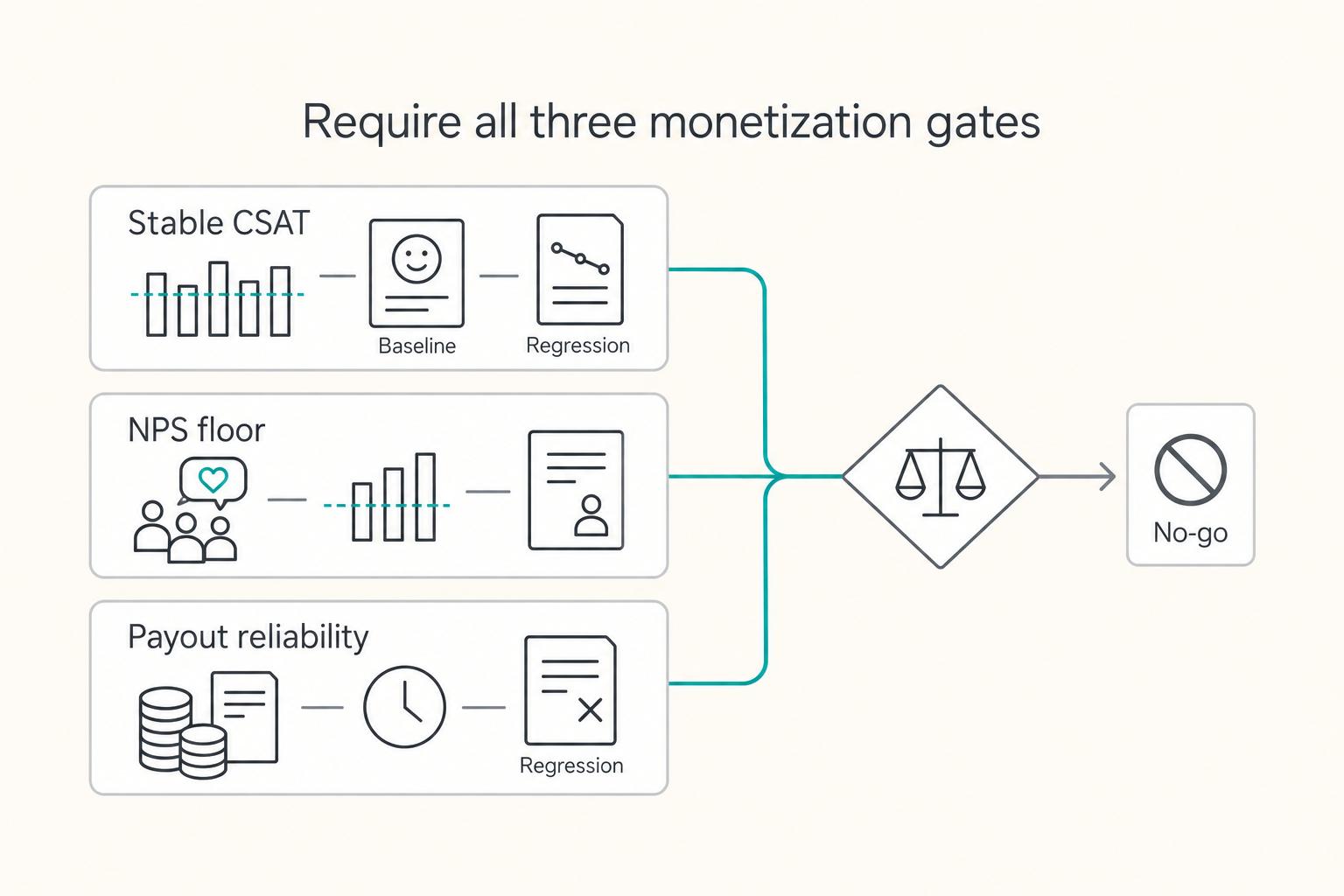
Use a fee or pricing go or no-go rule that requires all three gates to pass together: stable CSAT, non-worsening NPS, and no unresolved payout reliability regression.
Each gate covers a different risk. CSAT reflects customer satisfaction, NPS reflects broader loyalty, and payout reliability is the operational stop because payment failures and service disruptions can drive churn, including involuntary churn. Since evidence on NPS prediction strength is mixed, do not treat NPS as a standalone approval signal.
| Gate | What should be true before launch | What to verify |
|---|---|---|
| CSAT stability | No decline outside your pre-set tolerance in the exposed segment vs baseline or control | Survey timing unchanged, respondent mix comparable, no routing or support process change distorting responses |
| NPS non-worsening | No material worsening in NPS and no hidden rise in low-score responses | Check bucket mix, not only topline: Promoters (9-10), Passives (7-8), Detractors (0-6) |
| Payout reliability clear | No unresolved rise in failed or disrupted payouts | Event or status data complete before signoff |
Start with one segment, not the whole platform#
Roll out monetization changes in one contractor segment first, then expand gradually only if retention and operational metrics stay within your existing operating bands. This canary approach reduces risk and aligns with staged payment testing practices.
If you use Stripe platform pricing tools, simulate pricing impact on historical charges before launch, up to 50 charges per test setup. Choose a segment for clean measurement, not flattering results. Consistent program setup and survey timing help keep comparisons meaningful.
Make rollback mechanical, not political#
Predefine rollback using both sentiment and behavior, not headline NPS alone. For example, you can pre-agree a pause or reversal trigger if the exposed segment shows more 0-6 responses and weakening repeat payout behavior versus control, even when topline NPS looks flat.
This avoids false comfort from aggregate scores, where offsets in other cohorts can hide risk in the segment you changed.
Put the rule in a one-page approval pack#
Require a one-page approval memo tied to the monthly evidence pack. Include the exposed segment, control definition, retention target bands, latest complaint-tag mix, payout status trend, and the exact rollback trigger.
If payout reliability issues are still unresolved, treat monetization changes as blocked until operations are stable. You might also find this useful: Contractor Payment Satisfaction Survey: How to Measure and Improve Payout Experience.
Before expanding pricing tests, align your rollback triggers with payout reliability and status visibility in Payouts workflows.
Implement instrumentation and governance in Gruv#
If NPS will influence pricing or payout decisions, make money movement traceable first. In Gruv, that means a verifiable path from collection to ledger posting to payout status so sentiment shifts can be checked against real payment events, not timing noise.
Trace the money path, not just the survey#
Instrument distributed tracing across the services involved in the contractor payment flow. For any surveyed contractor, you should be able to follow the request path from initiating action through ledger entry creation to final payout status.
Before leadership review, sample recent low-score responses and confirm three linked records exist: collection event, ledger-posted event, and payout result. If a low-score or Passive response cannot be tied to a verified event path, treat it as directional rather than decision-grade.
Keep governance evidence ready for review#
Decision rules only hold if policy actions leave an audit trail. Keep audit logs for who changed payout rules, who approved exceptions, and when a segment launch or rollback was triggered, with searchable records and immutable event history for review.
For survey joins, use masked data views for nonprivileged users and pseudonymised join keys when person-level linking is required. Dynamic data masking can reduce exposure in query results without changing stored data, but masking alone is not a complete privacy control.
Make retries and reconciliation boring#
Retention analysis can break when duplicate or stale status updates leak into the dataset. Use idempotency tokens or keys for mutating payment operations so safe retries do not create duplicate side effects, and account for Stripe's documented repeated-key reuse window of 24 hours.
Reconcile payouts back to underlying transactions, including exception paths. Stripe frames payout reconciliation around settlement batches, and instant payouts still require your team to reconcile against transaction history. If reconciliation is incomplete, pause retention readouts for that cohort until duplicate and stale-event checks pass.
Common mistakes that create false confidence#
Once your events are traceable, the next failure mode is overreading the survey. Net Promoter Score is recommendation intent on a 0-10 scale, not proof that payout experience changes caused retention changes. If responses are not tied to a fixed cohort and a known payout moment, treat movement as directional, not decision-grade.
| Mistake | What the section says |
|---|---|
| Mistaking survey movement for causality | Do not claim a payout change improved retention just because NPS rose after launch; first confirm survey trigger, timing, and sample stayed stable, then compare to a retention cohort. |
| Promoter growth can hide risk in Passives | A headline score can improve while more contractors in a key segment shift from 9s and 10s into 7s and 8s. |
| Mixed markets and variants create fake trends | NPS needs segmented interpretation by cohort, business line, location, and channel before action, especially when payout coverage, support handling, or program variant differs. |
| Borrowed narratives are not contractor evidence | LinkedIn, Insight Global, and Meegle can help with general framing, but they are not contractor-payment proof unless the same population, payment moment, and operating context match. |
Mistaking survey movement for causality#
Qualtrics-style NPS classifies Promoters as 9-10, Passives as 7-8, and Detractors as 0-6. That helps you read sentiment, but it does not establish cause. Bain positions NPS as predictive of growth and lifetime value, while peer-reviewed marketing research reports methodological skepticism and replications finding no NPS effect on sales growth. A separate multi-industry retention study found top-2-box satisfaction performed better for retention prediction, and that the best metric changes by context.
Use a strict rule in payout decisions. Do not claim a payout change improved retention just because NPS rose after launch. First confirm survey trigger, timing, and sample stayed stable, then compare to a retention cohort anchored to a real payment event, for example first successful payout date. If scores move but repeat payout behavior or cohort retention does not, you have a hypothesis, not an operational result.
Promoter growth can hide risk in Passives#
Promoter growth alone can overstate progress. Passives are included in total respondents but do not directly raise NPS, and Qualtrics characterizes them as a middle group that is vulnerable to competitive offerings.
That risk is easy to miss in important payout segments. Your headline score can improve while more contractors in a key segment shift from 9s and 10s into 7s and 8s. They may still transact now, but Passives are vulnerable to competitive alternatives. If Promoters rise overall while Passives rise in a key segment, investigate that segment before calling loyalty improved.
A practical exec-deck check is a table with counts and shares of Promoters, Passives, and the 0-6 segment by payout-value tier. Without it, confidence can be overstated.
Mixed markets and variants create fake trends#
NPS needs segmented interpretation by cohort, business line, location, and channel before action. In payment contexts, this is especially important. If markets differ in payout coverage, support handling, or program variant, a blended score may look cleaner while hiding risk.
Cross-country comparisons are especially easy to misread. SurveyMonkey's analysis across 9 markets says cultural context makes direct comparisons challenging, and the same analysis reports 71% 9-10 responses in Brazil in that sample. So a higher score in one country may reflect response norms, payout coverage, or both. Keep country, variant, and payout-option coverage separate in your evidence.
Borrowed narratives are not contractor evidence#
LinkedIn, Insight Global, and Meegle can help with general framing, but they are not contractor-payment proof. The retrieved LinkedIn case is about Sales Navigator. Insight Global's cited context is a December 2024 survey of 905 US workers across industries. Meegle presents broad NPS-retention framing without contractor-payment specificity.
Before using those narratives for pricing or payout-policy decisions, require evidence on three matches: same population, same payment moment, and same operating context. If any one is missing, treat the narrative as background and validate with your own segmented cohort data.
For a step-by-step walkthrough, see Indian Freelancer Payment Analysis That Protects Net INR.
Conclusion#
Do not let Platform NPS substitute for retention strategy. Use it as a directional signal, then confirm payout operations, repeat payout behavior, and retention cohorts move with it before changing pricing, fees, or payout policy.
That guardrail matters because even strong NPS sources do not claim a high score guarantees success. Public evidence links relative NPS to growth in many industries, including a widely cited 20% to 60% explained variation in organic growth, but that is correlation, not proof for contractor payout programs. A score on the standard -100 to +100 range can show recommendation intent changed. It cannot, by itself, show why it changed or whether retention will hold.
Operate by separating knowns from unknowns. Known signals: Platform NPS, another loyalty signal in your VoC program, repeat payout behavior, and cohort retention. Unknowns: whether movement came from payment-status clarity, banking issues, support quality, or unrelated product noise. If those unknowns remain, pause the pricing decision.
Before executive review, require one evidence pack instead of one dashboard tile. At minimum, include sentiment, payment reliability exceptions or banking-failure patterns, repeat payout completion, and cohort retention for the same survey window. Then add a checkpoint: match material NPS movement against payout event logs and any instrumentation or survey-trigger changes.
Roll out in stages, not all at once. Use canary logic: test one defined contractor segment first, measure operational and retention signals, and expand only if results hold.
- Build the metric table and label each line as directional or decision-grade.
- Lock decision gates before launch, including the low-score, repeat payout, or reliability changes that trigger stop or rollback.
- Run one controlled segment test, review the evidence pack, then decide on broader rollout.
This approach keeps pricing decisions tied to evidence instead of a single score. It connects sentiment to operational signals that may influence contractor and customer retention.
To turn the metric stack into an executable operating model, review integration patterns and controls in the Gruv docs.
Frequently Asked Questions
Does Net Promoter Score (NPS) actually predict contractor retention, or only suggest direction?
Treat NPS as directional unless you can connect it to retention outcomes in your own cohorts. A 2015 retention study across 93 firms in 18 industries found top-2-box CSAT performed best overall as a single predictor, and prediction improved when feedback metrics were combined. A separate 2023 working paper found NPS was not a reliable predictor of revenue growth. For contractor payment decisions, NPS is a useful signal, not standalone proof.
Which parts of the contractor payment experience influence Detractors the most?
There is no universal rank order you can apply with confidence. Start with payment-journey friction you can verify in your own data, especially payment-status uncertainty and failed-payment categories. Check pending-state patterns and split failures into operational categories such as declines versus blocked payments before assigning a broad explanation to a low-score shift.
Can improving contractor retention improve customer-side NPS, VoC, or CSAT?
It might, but you should not assume it will. You still need evidence that the same customer populations were affected and that service outcomes changed in ways customers noticed. If retention improves while customer feedback stays flat, the retention gain can still matter commercially without proving a customer-experience lift.
What can leaders conclude from Platform NPS alone, and what remains unknown?
Platform NPS can show whether recommendation intent is moving and whether the mix of Promoters, Passives, and Detractors is changing. By definition, NPS subtracts the percentage of Detractors from the percentage of Promoters, with Promoters scored 9-10, Passives 7-8, and Detractors 0-6. On its own, it does not tell you whether payment experience drove the change or whether the movement will hold in retention outcomes.
Which metric stack is the minimum needed before changing payout pricing or fees?
There is no single-metric minimum, but NPS alone is not enough for pricing or fee changes. In practice, pair NPS with CSAT or VoC, add qualitative follow-up, and check behavior and cohort retention. If sentiment rises but behavior and retention do not, pause the pricing decision and investigate operational friction first.
How should teams benchmark when public contractor-specific NPS benchmarks are weak?
Benchmark internally first, then use public data only as context. Public benchmark sets cover broad cross-industry samples, not contractor-payment-specific populations. Where possible, keep country, program variant, payout option, and survey trigger consistent over time so comparisons stay interpretable.
How often should product and finance ops review retention cohorts against Promoters, Passives, and Detractors?
There is no single evidence-backed cadence for every program. Set review timing based on payout volume and decision windows, and run checkpoints after material payout-flow, fee, or support-policy changes. Only compare periods when survey timing and instrumentation are stable enough to make the result interpretable.
Try a related tool
Researched and edited by the Gruv editorial team. Gruv builds cross-border billing, payouts, and finance-operations software for global businesses.
Sources
Includes 5 external sources outside the trusted-domain allowlist.
- consumerfinance.gov/data-research/consumer-complaintstrusted
- eur-lex.europa.eu/eli/reg/2016/679/2016-05-04/engtrusted
- paypal.com/us/cshelp/article/what-does-the-status-of-my...trusted
- aapor.org/standards-and-ethics/standard-definitionsexternal
- amplitude.com/docs/analytics/charts/retention-analysis/ret...external
- aws.amazon.com/blogs/opensource/performing-canary-deploymen...external
- bain.com/consulting-services/customer-strategy-and-ma...external
- blog.hubspot.com/service/customer-retention-metricsexternal
Educational content only. Not legal, tax, or financial advice.
Related Posts
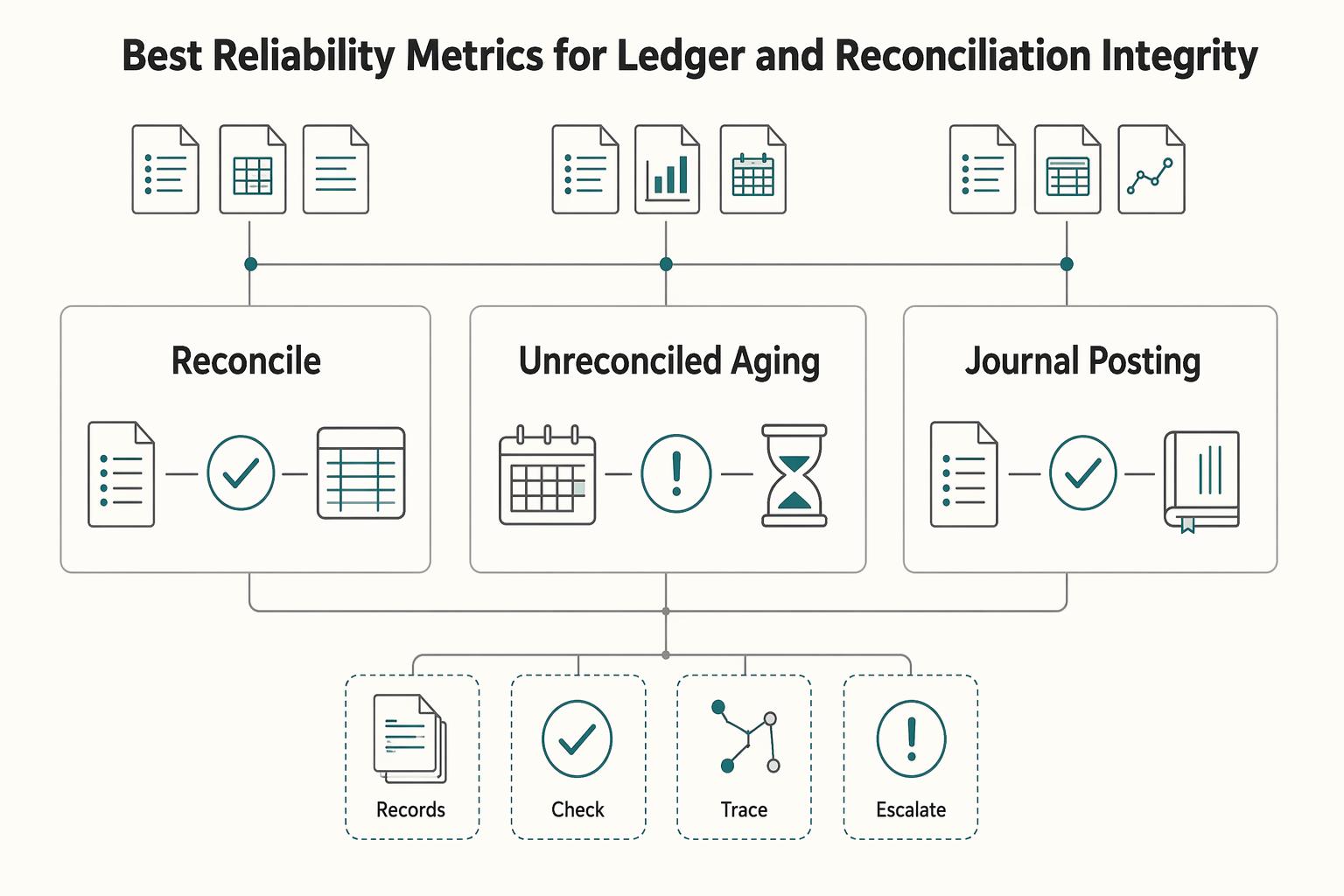
Customer Success Metrics That Catch Payment Ops Failures Early
Use NPS, CSAT, and retention as customer signals, then verify each against transaction records, matching controls, funds-movement evidence, and payout data before you act. In payment operations, these metrics help when they surface money-movement risk early, not when they are treated as proof that operations are healthy on their own.
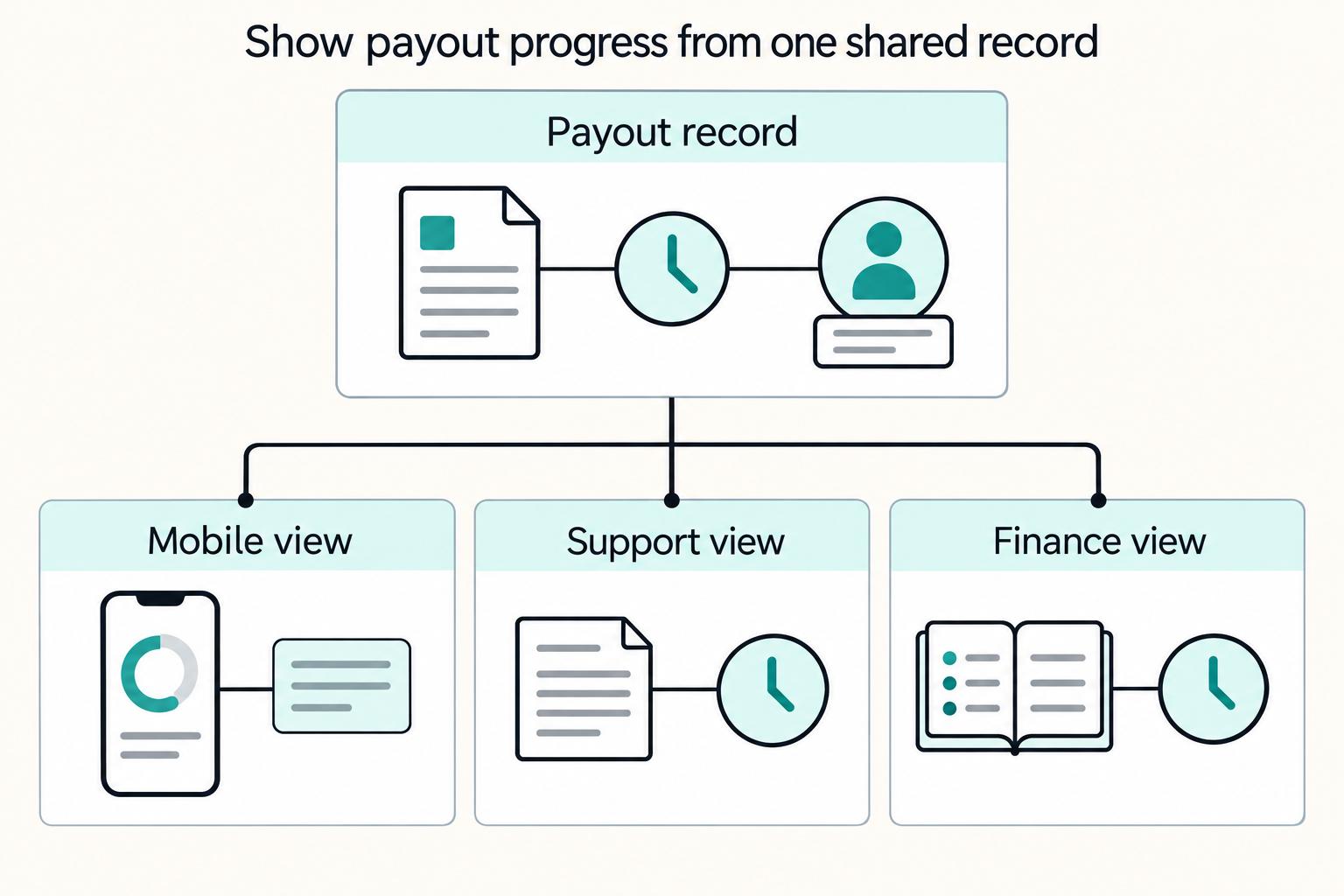
Mobile Contractor Payout UX: Design Rules and Launch Checks
Mobile payout design now affects contractor trust and ops cost because speed without **traceability** fails in practice. If your flow feels instant but cannot clearly show where money is, why it is held, and what posted to the `Ledger journal`, the experience is incomplete. This guide focuses on one practical outcome: a contractor payout flow that feels immediate from first tap while staying auditable through final posting.
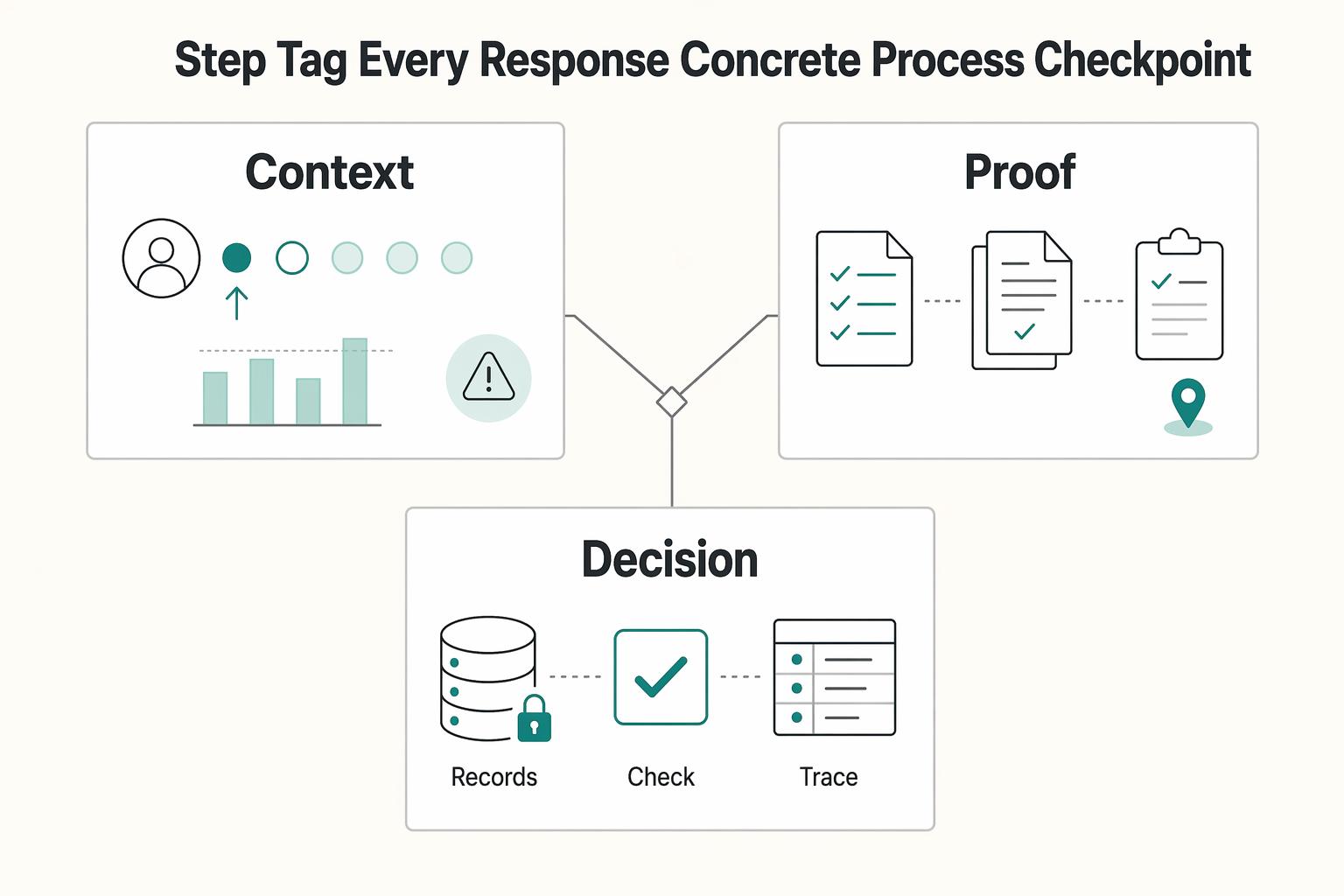
Improve Contractor Payout Experience With a Satisfaction Survey
Contractor payout experience is an operating signal, not just a sentiment metric. When an `Independent Contractor` sees delays, unclear status, or repeated exceptions, trust can erode, retention risk can rise, and finance teams end up absorbing the mess through manual follow-up and reconciliation pressure.